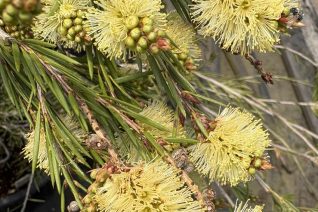
Callistemon pallidus 'Eleanor'

Callistemon (Melaleuca) pallidus ‘Eleanor’

More than 25 years ago I raised some Callistemon from seed. This seedling with vivid magenta purple flowers has survived temperatures below 10ºF for all that time but requires a protected spot inland to thrive. Amazing performance at the Oregon Coast where the bright brushes may appear several times a year. To 6′ x 6′ and arching this willowy evergreen accepts light summer water and requires as much sun as possible. Best against a south facing wall in Portland. It may freeze back below about 12ºF, but recovery from the base is rapid. Virtually any soil. Moderate deer resistance. This seedling was planted at our then neighbor Eleanor’s house so it received that name. Photo credit: Evan Bean.

Xera Plants Introduction

My Favorites

Plant type:  |  Sun exposure:
Biome: , , ,  |  USDA Hardiness zone: Zn8a 15º to 10ºF
Foliage color:  |  Foliage season:


Callistemon (Melaleuca) pityoides ‘Harry’

This is a great dwarf form of Alpine bottlebrush and its most useful for its size and shape than for expansive floral displays. However, when in bloom its beyond adorable. Slow growing rounded shrub to 1.5′ x 1.5′ after 7 years. The small needle-like leaves are medium green with a distinct ochre cast. Very tough evergreen for the most challenging sites. Accepts intense reflected heat, summer drought and arctic cold. This is a true alpine plant. No pruning necessary as it naturally assumes a dense rounded habit with no intervention. Good deer resistance. Excellent as in informal unpruned hedge. Accepts almost all soil types from saturated clay to sand. The diminutive flowers are actually small circular balls of light yellow stamens- adorable. Blooms May- June and possibly again in autumn. Native to the very highest elevations of Australia. Flowers are attractive to hummingbirds and butterflies. Combines well with wild flowers or perennials. Nice looking shrub all the time.  This is an introduction from  Desert Northwest Nursery. And its an excellent plant. Full sun- not tolerant of shade.

My Favorites

Plant type:  |  Sun exposure:
Biome: , , ,  |  USDA Hardiness zone: Zn7a 5º to 0ºF
Foliage color:  |  Foliage season:


Callistemon (Melaleuca) pityoides ‘Mt. Kosckuisko’

Dwarf alpine Bottlebrush that we like most as a clipped hedge. Dense rounded shrub composed of fine olive green needles. To 3′ x 3′ in time. Full sun and very little water when established. It can also tolerate regular summer irrigation. Sporadically, in late spring starry cream colored bottlebrush flowers appear. Extremely hardy to cold and very deer resistant evergreen. Alpine Australia. This durable shrub with a fine texture makes a fantastic clipped hedge. It can be trained as one solid shrub or separated into spheres. Pruning is done just once a year in early summer. This can sacrifice blooms but the effect is striking for a small cold hardy, drought tolerant, low prune hedge. In time it blooms more heavily. Give it a few years. The starry white stamens are tipped in yellow for a light yellow overall color. Highly deer resistant shrub. Great year round appearance.


My Favorites

Plant type: ,  |  Sun exposure:
Biome: , , ,  |  USDA Hardiness zone: Zn7a 5º to 0ºF
Foliage color:  |  Foliage season:


Callistemon (Melaleuca) pityoides ‘Wetland’s Challenged Mutant’

A great introduction from the Sequim, WA nursery Desert Northwest. Incredibly showy in bloom this easy to grow shrub produces 4″ long 1″ thick  soft yellow colored sweetly scented brushes in late spring and early summer. Moderately fast growing shrub to 7′ tall and 3′ wide in 6 years. The pretty, fine foliage is handsome ochre green and contrasts beautifully with the light taupe colored bark.This is an exceptional shrub out of bloom as well and has a very upright, tidy habit for this genus. From a distance a mature shrub appears like a Podocarpus. Full sun and average to rich soil with light but consistent summer water. Drought adapted. Considering the size of the brushes this is an exceptionally hardy Callistemon taking 5ºF when established. If there is any confusion about which species this appears to be- the foliage is unlike C. pityoides but the large brushes are dense and fragrant just like that species. A hybrid is likely. This very upright shrub would make a fantastic informal hedge/screen with minimal pruning. Great shrub. Pollinated at night by moths who will literally glue themselves to the brushes for hours. Fascinating shrub.

My Favorites

Plant type: ,  |  Sun exposure:
Biome: , , ,  |  USDA Hardiness zone: Zn7b 10º to 5ºF
Foliage color:  |  Foliage season:


Callistemon (Melaleuca) pityoides ‘Corvallis’

I found this Callistemon in a garden in Corvallis, OR over 20 years ago. For the previous 30 years it had thrived through the coldest (0ºF or  -18ºc) winters. Upright growing fine textured evergreen shrub to 6′ tall and 3′ wide in 7 years. 2″ pale yellow fluffy brushes appear in late spring/summer and again in early autumn. Full sun, average soil – especially good in clay soils and regular summer water- though it can live on no supplemental water in summer irrigation improves fall bloom. Completely deer resistant. Perfectly hardy in all of Western Oregon. Long lived shrub that tolerates heavy snow and ice. Easy shrub. Moderately fast growing. Excellent performance on the Oregon coast. Prune if needed after bloom has ended.  Excellent companion shrubs are Ceanothus x ‘Topaz’ and  Myrtus communis ‘Andy’s Hardy’ which bloom simultaneously,

Xera Plants Introduction.

My Favorites

Plant type: ,  |  Sun exposure:
Biome: , , ,  |  USDA Hardiness zone: Zn7a 5º to 0ºF
Foliage color:  |  Foliage season:


Callistemon subulatus 'Dark Red'

Callistemon (Melaleuca) subulatus ‘Dark Red’

There are several hardy red flowered bottlebrushes on the market but if you really like red this is the one. Small gray thin leaves densely clothe the arching stems of this clumping multi branched low shrub. In spring and then sporadically all summer deep red 2″ long and wide bottlebrush flowers appear. Happiness and hummingbirds ensue. To 3′ x 3′ in 5 years and strongly arching. Full sun and a protected location- against a south or west facing wall is ideal. Light summer water. Excellent performance in containers- hardy Callistemon often are shy to bloom in containers but this girl is not shy at all. Brilliant, Brilliant red. Freezes to the ground below about 10ºF- returns vigorously from the base in spring. Excellent performance at the Oregon Coast. Moderately deer resistant.

My Favorites

Plant type:  |  Sun exposure:
Biome: , , ,  |  USDA Hardiness zone: Zn8a 15º to 10ºF
Foliage color:  |  Foliage season:


Callistemon (Melaleuca) viridiflorus ‘Shamrock’

Our selection of a very compact, dense and tidy growing Mountain Bottlebrush. Moderately slow growing shrub to 5′ x 3′ in 7 years. In May-July 3″ acid green bottlebrush flowers decorate all the branch tips. A thrill for hummingbirds. In winter the small pointed deep green leaves take on dramatic maroon tints- great contrast with the white, cork-like bark.New growth is tinted red and is furry and with a silver sheen. Very tidy compared to the species which can be somewhat wild and unkempt. If you don’t want that try ‘Shamrock’. It fits in small sites well and is adaptable to all types of soil, including heavy clay. Great cold hardiness- suffering no injury at 5ºF. Excellent landscape shrub or foundation plant. Tidy and dense. Moderate deer resistance.  Light water requirements. Very good as a hedge or screen with a  uniform dense habit. Blooms when young.

Xera Plants Introduction.

My Favorites

Plant type: ,  |  Sun exposure:
Biome: , ,  |  USDA Hardiness zone: Zn7b 10º to 5ºF
Foliage color: ,  |  Foliage season:


Camellia sasanqua ‘Dwarf Shi Shi’

Most of us associate Camellias with large shrubs to small trees but this is a true dwarf and it fits in very small sites.  Dwarf (slow growing) shrub with glossy green foliage and in autumn to mid-winter a constant supply of semi double rosy red flowers. To 4′ x 4′ in 10 years. Nice looking shrub that is an exceptionally heavy bloomer. This sport of  ‘Shi Shi Gashira’ which is a dark pink and very popular fall blooming Camellia. ‘Dwarf Shi shi’s ‘ flowers are closer to red than its sport parent. Full sun to very light shade. Occasional deep soaks in summer aids flower bud set.  Takes dry conditions when very established. Water regularly to establish and mulch. Sasanqua Camellias are hardier and bloom more heavily in full hot sun. Good performance at the Oregon coast where most Sasanqua Camellias languish. Not often bothered by deer. The entire floral tube detaches and falls never clinging and turning brown. Limited quantities.

My Favorites

Plant type: ,  |  Sun exposure: ,
Biome: , ,  |  USDA Hardiness zone: Zn7a 5º to 0ºF
Foliage color:  |  Foliage season:


Camellia sasanqua ‘Scented Snow’

A remarkable  Sasanqua Camellia with flowers that are sweetly scented , semi anemone form white to cream and are huge. Every time this plant blooms i have to refresh my memory that this is not a C. japonica or x williamsii but a pure sasanqua. The fresh looking flowers are attached to glossy neat foliage that is good looking year round . Sasanqua  Camellias do their best in full hot sun, They will bloom the heaviest and earliest in full sun. Rich soil with regular water for the first 4 years.  Then occasional deep soaks in summer.. Makes a wonderful hedge and is opulent in bloom in November to January. Excellent espalier subject, the enormous flowers really shine. Flowers are hardy to the upper 20’s and a thaw encourage more to open.  The perfume of this cultivar is very nice, Camellia forest introduction 2008. To 4′ x 7′ wide. Excellent landscape plant and one of the best sasanquas.

My Favorites

Plant type:  |  Sun exposure: ,
Biome: , ,  |  USDA Hardiness zone: Zn7a 5º to 0ºF
Foliage color:  |  Foliage season:


Camellia x ‘Wirlinga Bride’

Fantastically  graceful Camellia of complex parentage. Large spreading and arching Camellia with small glossy leaves and from 1″ distinctly pointed flower buds open masses of 2″ wide yawning flowers. The interior of the pure white flower is decorated with the yellow stamens. Most of the flowers point downward in a dainty pose that adds to this Camellias grace. To 8′ tall x 8′ wide and branching in large divided boughs that give the impression of wings. The intensity of the white flower color is amplified in the darkness of winter. Blooms late January through March. Immensely graceful and floriferous this has none of the strict formal look of most other species. (C. tsaii x C. cuspidata) x C. fraterna )  Luckily this Camellia includes the ultra hardy C. cuspidata and is not tender in the slightest. Flowers are hardy into the upper 20’s and masses of incipient buds means that the show starts again post freeze. The small fluted flowers fall cleanly from the shrub and collect in a pure white carpet. Rich soil with regular irrigation. Takes less water as it gains establishment. Part shade to full sun. A protected location helps the flowers deal with the vagaries of winter weather. Wonderful Camellia that we love at Xera.

My Favorites

Plant type:  |  Sun exposure: ,
Biome: , , ,  |  USDA Hardiness zone: Zn7b 10º to 5ºF
Foliage color:  |  Foliage season: