

Compact and very flowery this form of the dependable Abelia fits into smaller areas and perfumes the late summer to autumn gardens with masses of small white flowers. To just 4′ x 4′ in 7 years for full sun to light shade and most soils. Drought adapted when established, it will also accept regular summer irrigation. Slow growing and cold hardy evergreen. Following the massive bloom, the calyx of each flower remains and turns madder red. A second season of showiness that persists as a red glow through winter. This dense shrub retains its good looks for year without needing much pruning. Pruning should be done in early spring. Blooms on wood from the current season.
Biome: Hot Aspects

Its surprising in our climate that heat is as big of an issue as it is. But there are scores of sunburned and toasted plants littering our city by the end of summer. We average just 2.o” of rain during June-August and you have to take into account reflected heat. That could be heat emanating from an asphalt street such as occurs in a hellstrip or the accumulated heat of a hot wall. Both can conspire to fry plants. Luckily, we grow a LOT of plants adapted to excess heat. These plants won’t fry on the first day above 95ºF. Some plants revel in reflected heat, they come from hotter climates and need warmth to both bloom and to ripen wood for winter. That means it receives enough heating calories to ensure winter hardiness. Currently, Portland averages 14 days above 90ºF per year. By the next decade that number will have more than doubled. Part of gardening with climate change is to anticipate those effects and adapt to them. Increasingly, we will be considered a hot summer climate. We should garden accordingly.

Climate Adapted Plants for Gardeners in the PNW
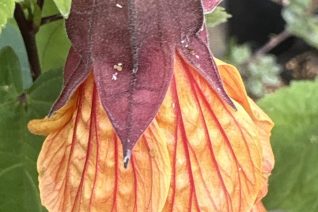
Abutilon (Callianthe) ‘Nectarine’
One of our very finest Flowering Maple selections. Relatively large pendulous flowers are soft citrus yellow/orange with darker red veining. As this variety blooms out the flowers expand and the petals reflex upward, a very charming look. Vigorous and surprisingly cold hardy Abutilon. To 4′ x 4′ in a season. Rich soil that drains with REGULAR H20. During the growing season Flowering maples very much appreciate at least one application of all purpose organic fertilizer to enhance vigor and blooming. Easy to grow in containers where it will likely perform as a tender annual. In the ground it is different. By the end of winter the plant will look absolutely horrible sticks and maybe a few pieces of tattered dead leaves. The secret to the spring resurrection is to water heavily and consistently until you see new growth. Then you can let the soil dry between irrigation. Loved by Hummingbirds and birds in general. Grows very fast in the correct conditions. Blooms June to October.
Xera Plants Introduction
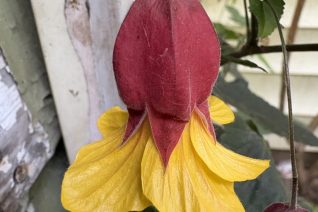
Abutilon (Callianthe) megapotamicum (a) ‘Marianne’
Improved selection of the Chinese Lantern Plant- which is actually from South America, and this form has larger more flared yellow petals. They extend and recurve from the bold red calyx. This arching multi-stemmed shrub blooms almost non-stop from June to frost and often longer. Vigorous to 6′ tall and 4′ wide forming a large patch in time. The arching thin stems and skinny pointed leaves display the rows of flowers perfectly. A hummingbird delight. One of the hardiest to cold this behaves as a sub-shrub in the coldest winters- freezing back but returning boldly from the ground when the soil warms. Most winters, damage is restricted to burned tips and the majority of leaves which will drop. Plant with the base in a protected location- for instance between low shrubs to protect the crown, or near the base of a wall. Mulch if arctic (below 20ºF) weather threatens. Following a freeze the plant will look absolutely awful. Refrain from cutting it back until you see new growth emerge- either from the base or vertical stems. In any case water it consistently and heavily until you see vigorous new growth- the transformation with regular water is remarkable. So, don’t by any means give it up for dead. Full sun to quite a bit of shade. A bit tall and lanky for containers- just plan for this. Rich, WELL DRAINED soil improves both cold hardiness and speeds recovery. Excellent performance at the Oregon Coast. Very bardy suffering no LEAF damage i the ground for the past 6 winters. uh, huh.

Abutilon (Callianthe) megapotamicum (a) ‘Red’
Everything about this form of hardy flowering maple is identical to the species except the molten red flowers with deeper veins shot through. The 2″ pendant flowers appear from May to October on a large growing sub-shrub. To 6′ in a single season It makes rapid growth as temperature rise above 70ºF. Full sun, in a protected location in rich soil with regular summer irrigation. Abutilons look absolutely horrific in spring even after a normal winter. Expect this. The solution is to water, water, water especially as the temperatures rise. It blooms on new wood and flowers are continuous as the shrub grows. Mostly deciduous but it can be evergreen at the coast or in protected places in mild winters. Loved by hummingbirds who are lured by the lurid red flowers filled with nectar. Cut back by 1/2 after all danger of frost has passed. Supply a handful of all organic fertilizer and water faithfully. Excellent performance at the Oregon coast. Inland it is best with the protection of a shrub covering its roots so that the soil does not freeze. In this situations it can live even thrive for many many years. Mulch with compost. Native to the mountains of Brazil. Root hardy to about 10ºF. Long lithe stems can be woven through a fence or a lattice.

Acacia covenyi
An exciting shrub/small tree with paddle shaped blue evergreen phyllodes for foliage and in late winter to early spring a massive display of luminous yellow flowers. I’ve always loved Australian wattles so it was with great excitement that we decided to grow this striking plant. Moderately fast growing to 16′ tall and 8′ wide forming either multiple or a single trunk. The bark is chocolate brown and smooth. Very few Australian Acacias will thrive in Portland, its just about 5 degrees too cold in our coldest years. This one is different, (a few species will live for 4-6 years before they finally succumb to Jack Frost. Acacia pravissima etc.) This, however, is the cold hardiest that we have grown. It is hardy to just below 10ºF for brief stints- good enough for long term survival. This is a rare limited endemic to the high mountains of New South Wales but is popular as a garden subject the world over. The small, fluffy, balls of electric yellow flowers foam among the blue leaves – incredibly pretty. Full sun and a protected location – against a south facing wall is ideal for a very pretty fun to grow tree. Once fully open the flowering stems may be cut for long lasting bouquets. Blooms on wood from the previous season, prune if needed after flowering has ended. Light consistent water to establish . Not fussy about soils and happiest in full, all day sun. Protect from subfreezing east wind. Bloom time is concurrent with several earlier Ceanothus (‘Blue Jeans’, ‘Dark Star’, ‘Concha’) and creates a vivid early spring yellow and blue display not soon to be forgotten. Drought adapted when established. Not bothered by deer/elk- not entirely sure about rabbits- if they are profuse in your neighborhood it wouldn’t hurt to protect the plant with chicken wire when young. Beautiful year round and spectacular in bloom. AKA Blue Bush.

Acanthus syriacus
Outrageous Bear’s Breeches for hot and sunny aspects. Forms large rosettes of spiked intricate leaves that almost lay flat on the ground. In summer, enormous chalice-like soft purple blooms rise to 2′ tall. Each flower opens to reveal yellow petals. A beautiful combination. Full sun and rich, well drained soil with light summer water. Give this plant room and air circulation. It does not like to be crowded. Fully cold hardy and completely winter deciduous. Established plants can get by on less water. Moderate deer resistance. To 2′ wide in several seasons. Spectacular cut flower.

Achillea millefolium
This is the green foliage form of our wild yarrow. A rambunctious, easy to grow evergreen perennial for rough sites in well drained soil in full sun. Continuously from spring to autumn ‘umbels’ of pure white flowers rise 18″ above low spreading aromatic, finely divided ferny foliage. Most often it is green with variants that have gray foliage from time to time. Low water perennial that can even be used as a lawn substitute. A single plant spreads to several feet wide. Moderate deer resistance. Butterflies oh the butterflies.This is a pioneer perennial and will often out compete less robust native perennials. Its best use is as a contained weed. It is great for pollinators Individual plants rarely persist more than 3 years. Oregon native plant.

Achillea millefolium ‘Pretty Woman’
Of all the selections of our native yarrow this stands out for many reasons. The ‘umbels’ of flowers are a rich red which holds the color for an extended period. It fades only slightly to a rust red with time. Its vigorous and easy to grow. And it re-blooms reliably if spent flowers are removed. All the way until frost and sometimes longer. A very, very good long-lasting cut flower. To 18″ tall forming spreading colonies. Semi-evergreen. Low water when established in well-drained soils. Excellent to moderate deer resistance. Appreciates an annual application of compost. Oregon native plant.

Achillea millefolium ‘Willamette Gray’
Greg got seed of this distinctive form of Yarrow near Oregon City. Unlike most garden varieties that are derived from European stock which very much appreciates rich soil and regular water to perform and those forms are also not pungent. We wanted our locally native yarrow that is incredibly durable, has gray foliage that is pleasantly aromatic with broad white flowers. This is a much more climate adapted perennial. Its found throughout all of the state, and can be found anywhere from meadows to surprisingly deep woods. This is a very thrifty plant and once established it really doesn’t need supplemental summer water. Spreads to form finely divided low gray foliage. The flat umbels of pure white flowers are very large and this is a landing pad for all pollinators as well as butterflies. To 20″ tall in bloom. Excellent meadow component with clumping grasses, annuals, and bulbs. A great plant for hell strips and hot aspects too. Very easy and forgiving perennial. Blooms May-August. Mostly evergreen save for the very harshest winters. Not bothered by deer. Oregon native plant.
Xera Plants Introduction

Achillea sibirica
A wonderful relatively new Achillea (Yarrow) from Siberia. It brings not only larger chalk pink flowers in bold umbels it is cold hardy to USDA Zone 2. This plant will never freeze out. Forms expanding clumps with upright stems clothed in glossy long green leaves with small teeth. On 22″ stems umbels of flowers appear from May to August. After the first flush of flowers shear away and water and another round will commence. The long stems make great long lasting cut flowers too. Loved by a bazillion pollinators, hover flies, bees of all kinds swarm the flat landing pad. Full sun to very light shade in rich, soil that drains. Incorporate some oxygen in by double digging. Good companion plants are Agastaches and Penstemons as well as ornamental grasses. Completely deciduous in winter. Light consistent summer H20 to establish. Long lived perennial. Moderate deer resistance. Elegant perennial. Siberian Yarrow.

Aethionema grandiflorum
Sweet little evergreen shrublet with fine blue foliage. Atop a rounded form in spring, masses of light pink flowers are incredibly showy for such a diminutive plant. To about 8″ x 1′ forming a bun. This member of the brassica tribe is excellent in rock gardens or even on hot dry sunny slopes. Full sun and average, well drained soil. Light to little summer water. Blooms for 3-4 weeks in mid to late spring. Cut back hard after blooming- new blue foliage will flush out almost immediately. Troughs, rock gardens. Low care rock garden classic.

Agapanthus ‘Bee Bop’
I selected this seedling about 8 years ago and its been growing in my garden for all that time. A completely deciduous variety that does not show leaves until all chance of frost has passed. Forms a large clump with strappy arching green leaves – to 2′ across in 5 years. As the clump increases so do the amount of flower stalks. The orbs of flowers are neon to cobalt blue. An arresting, glowing blue. Slightly smaller in diameter than other varieties (about the size of a baseball) this plant packs a LOT of flowers onto a stalk- at least 50 and they reverberate above the clump for weeks in July to August. To 26″ in bloom. The stalks that support the vivid flowers are incredibly strong and they barely bend in a breeze. This is a wonderful perennial for full sun and rich, amended soil. Add a handful of lime at planting time to ensure neutral pH. Disappears cleanly in winter. Regular water though its bloom cycle. Pair with chartreuse foliage for a dynamic contrast. Loved by hummingbirds and bees. Best in the center of an ascending border from low plants to tall. Long lived, cold hardy selection that we love.
Xera Plants Introduction

Agapanthus ‘Blue Velvet’
This is a very handsome and dependable hardy Agapanthus bred in Ireland. It forms a spreading clump and in mid summer 3′ tall stems support multiple pendant midnight blue flowers.. Full sun and rich soil. Add a handful of lime to the planting hole. Our soils are acidic and this perennial likes neutral (7) Alkaline (sweet) soils to perform at its best. You can also plant it next to a concrete sidewalk which will also give it the alkalinity that is craves. The clump of scrappy mid green leaves is shorter than most varieties and maintains a tidy plant both before and AFTER bloom so it makes an exemplary garden and landscape perennial. Regular water is crucial through the bloom period, July /August when flowering ends and you cut away the dead stalks it remains good looking until it totally disappears in mid autumn. Irish and UK Agapanthus appear to have much greater cold tolerance than American selections, they wait to emerge until all threat of a freeze has passed. Very cold hardy easy to grow wonderful pendant tower of cobalt blue. The truss of flowers is very large and showy. Good cut flower, loved by pollinators too. Limited quantities. One of the finest lily of the niles for our gardens.

Agapanthus ‘Tall Blue Xera’
This is a strain of Agapanthus from the very cold hardiest varieties that we grow. Not only are these perfectly hardy to cold they are naturally completely deciduous. Even better they wait to emerge until all danger of frost has past. Many ‘hardy’ CA varieties leaf out in the false spring of late winter and then get nipped hard by possible late freezes. Not at all fussy about soil but best in enriched soil with light consistent summer irrigation. Large globes of rich sky blue flowers are bigger than a grapefruit and wave at the top of 3′-4′ stems. Quite a bit taller than other hardy varieties. Full sun to very light shade and not fussy. They will live in containers for eons and bloom like crazy. Flowers appear from late June to early August and are very showy. This is a very pretty tall strain that is reliable and kind of hard to F up. If you’ve lost Agapanthus in a cold garden or unfortunate freeze this is the one to try. As with all Agapanthus they thrive and bloom in neutral to alkaline soil. Incorporate a handful of lime in the hole at planting time. Strappy clumps of mid-green leaves are handsome following bloom. As the plant multiplies it increases its blooms stem count markedly.
Xera Plants Introduction

Agapanthus ‘White Profusion’
Born and bred in the PNW this excellent compact and extremely floriferous white flowered Lily-of-the-Nile is a first rate selection. To 20″ tall and forming an expanding but compact clump. Flowers appear for 4-6 weeks in mid-summer. Clear, pristine white with abundant flower spikes- a small amount of leaves supports copious flower spikes- a great attribute of the best Agapanthus. Lots of flowers/few leaves. Full sun to very light shade in rich, well drained soil with regular summer water. Completely winter deciduous. Handsome pale green matte foliage. Long lived perennial. Mix with Blue Agapanthus for contrast. Bloom stems increase markedly with the size of the clump. Our favorite hardy white Lily of the Nile. Agapanthus do best in neutral to alkaline soil. Incorporate a handful of lime in the planting hole.

Agapanthus ‘Xera’s Cobalt’
Our own seed strain taken from the very darkest blue flowers in the Agapanthus kingdom. Prolific blooming, long lived, cold hardy perennials that require rich, well drained soil with regular summer water. Full sun to very light shade. Blooms of the deepest cobalt to black rise on average to 30″ tall for 4-6 weeks in mid-summer. Completely deciduous in winter. Wonderful in the middle/back of a border and a natural with ornamental grasses and Kniphofias. Add a handful of lime to the hole at planting time and put the Agapanthus right on top of it. The parents of this strain are all naturally very hardy and do not emerge until all threat of frost has past. Hummingbird plant.
Xera Plants Introduction.

Agapanthus inapertus
Drooping Agapanthus isn’t exactly a romantic moniker but it aptly describes the dramatic blossoms on this large perennial. Strappy leaves form clumps and rise to 30″ tall. In August bold spikes emerge to 4′ tall with sky blue drooping clusters of flowers. Very pretty. Clumps spread to 3′ wide so give this plant room for the future. As the plant increases so does the flower stem count. The tall strong flowers work wonderfully in arrangements. They are also coveted by hummingbirds. Full sun and rich soil with regular summer water- at least until blooms fade. As with all Agapanthus it blooms better in neutral to alkaline soil. Incorporate a handful of lime in the planting hole. Mulch in very cold gardens. Excellent for the middle or back of a border. Lives in large containers for many years. Native to high elevation grasslands in South Africa. Winter deciduous.

Agapanthus x ‘Exmoor’
Fantastic cold hardy lily of the nile cultivar that is easy to grow and spectacular in bloom. This selection made in Scotland forms large clumps of strappy leaves and deep navy blue buds open to lighter sky blue flowers. Tall growing Agapanthus to 3′-4′ in bloom and flowers appear from late June to early August. Loved by hummingbirds and bees this is naturally deciduous variety. The leaves disappear to nothing in winter- a good trick because this UK variety shares a common trait among those from there, it holds off on sprouting in spring until all threat of a frost has passed. Its very cold hardy too, solidly zone 7. Excellent long blooming dramatic perennial for hell strips, borders. The contrast between the dark buds and lighter open flowers is a joy. Flower heads are about the size of a soft ball or larger. Regular water in rich soil. Apply a handful of horticultural lime in the planting hole. Agapanthus prefer and bloom better in neutral soil (ours are acidic to strongly acidic). A four year old clump will be 2′ across with 10 or more large flower stalks. They increase yearly from there.

Agapanthus x ‘Stripes’
An excellent cold hardy Lily-of-the-Nile that was bred in the PNW. To 3′ tall in bloom from a low basal presence of strappy green leaves. Each flower in the truss is light blue with darker blue stripes. They are pretty up close- from a distance it reads as glowing baby blue. And you can use this luminosity to your advantage. Easy to grow perennial for full sun to very light shade in rich, well drained soil with regular summer water. This cultivar performs even without regular water but the blooms last longer and are larger with it. Completely deciduous in winter. Agapanthus perform best in neutral to alkaline soil, incorporate a handful of lime in the planting hole.

Agapanthus x ‘Summer Nights’
A northwest raised cold hardy selection with deciduous leaves and the most intense deep blue flower spikes to 28″ tall in June and July. Full sun, well drained soil and regular water. Deciduous Agapanthus (REALLY) appreciate good soil. Combine with other perennials for love, joy. Best with regular summer irrigation and annual applications of organic fertilizer. Has been a long lived, long term performer in landscapes from Vancouver, BC to Medford , Oregon. Selected for intense deep blue flower color combined with excellent hardiness to cold.

Agastache ‘Lilac Moon’
Cool bicolored Hummingbird Mint that has masses of flowers that appear from orange buds which quickly change to luminous light lavender when open. To 20″ tall and forming a clump this very, very, long blooming perennial is delightful for hummingbirds, bees and butterflies. A soft pastel coloration that pairs wonderfully with light yellow flowers and even blue. Great in seasonal containers. Blooms non-stop from June to October. Do not remove flower spikes as new flowers will appear continuously from the same spike. Rich, WELL DRAINED soil with light, consistent summer water. Its best to water Agastaches consistently during their first year in the ground- to establish a large root system. Ideal on slopes- to assist in drainage in winter. Double dig soil to incorporate lots of oxygen in the soil. One of our favorite introductions. An amazing combination of flower colors on a single plant. Do not cut back until new growth has flushed out in spring and all threat of a hard freeze has passed.
Xera Plants Introduction

Agastache ‘Berry Princess’
We believe this to be a cross inheriting some of the coloration of A. auranticus as well as A. cana. To 28″ tall this clump forming, everblooming perennial brings bright red buds that open to purple flowers. The colorful combination lasts all summer into autumn. New flowers are born on the same spikes so do not remove. Moderate consistent water through the first summer to establish. Double dig soil to incorporate oxygen into the soil and aid in irrigation to the roots. Established plants get by with a little less. Loved by hummers and pretty decent cutfower as well. Full all day sun for best performance, will not be quite as floriferous in part shade. Sweetly scented foliage is an extra benefit. To 18″ wide and slowly increasing. Excellent on berms as well as slopes. Mulch in fall. Small rosette of winter foliage is protected by the previous years defunct stems. Prune these away after all threat of a hard freeze has passed.
Xera Plants Introduction

Agastache ‘Electric Punch’
One of our all-time best introductions ‘Electric Punch’ is a floral powerhouse of a hummingbird mint with exceptional adaptation to our cold and wet winters. Rising to 34″ tall in bloom, a clump can become enormous in rich, WELL DRAINED soil with light, consistent summer water. Also, accepts no water but with interruptions in bloom. Incorporate plenty of oxygen into the soil and slopes are ideal. Do not remove flower spikes during the season- new orange aging to pink flowers appear from the same inflorescence. Best to wait until spring to cut back the previous seasons defunct stems. Moderate deer resistance. Agastache are best watered well for their first season, in subsequent years they will use much less.
Xera Plants Introduction.

Agastache ‘Mandarin Dream’
This is our selection of an improved form of the species Agastache auranticus. It has deeper orange flowers on taller stems and exhibits excellent winter/cold/wet hardiness. To 30″ tall, the vivid blooms erupt from June to October. Tightly clump forming perennial whose tall wand-like stems require more horizontal room as well. Hummingbird Mint excels in very well-drained soils with consistent, light summer water. Full sun- you can fudge in light shade and still get results. Remove the previous seasons spent stems in March. Agastache are plants that like oxygen in the soil and they often seed themselves happily between large stones. They appreciate soil that is rich but permeable at all times. We advise to wait until March to remove the previous year’s stem. The hollow stems that remain over winter actually provide oxygen to the roots. If you cut them back too early (Fall, winter) you also leave the new growth at the base unprotected from the elements. So, the stems should remain to both give the plant oxygen and protect the next seasons clump of foliage. Double dig the soil heartily and add a little compost and even pumice if your soil is stingy. Water regularly for the first season to establish a large root system which will require less H20 in subsequent years. This is a vibrant orange that mixes well with deep purples and blues.
Xera Plants Introduction.

Agastache ‘Rainbow Sorbet’
One of our larger growing introductions this is a flowering machine with large individual flowers that open pale orange and senesce to pale pink. Overall this is a pastel flower palette. To 36″ tall and as wide in full sun and well drained soil with light, consistent summer water. Agastaches are excellent as container subjects- they will accept the most cramped roots and still perform. Wait until March to remove the previous years spent stems. Give this guy room. Hummingbird nirvana. Good winter hardiness.
Xera Plants Introduction.

Agastache ‘Xera Flame’
Our selection of a compact and free flowering cold hardy Hummingbird mint with intense dark orange flowers. Blooms June to October and they rise on spikes to 18″ tall. Does not flop- great for smaller spaces. Regular summer water in well drained, enriched soil. Excellent on slopes which improves winter drainage which increases cold hardiness. Full sun to very light shade. Irresistible to pollinators. Blooms appear from the same spikes all season- do not remove. Wait to cut it back until spring. Then remove dead top growth to make way for the new growth that is pushing from below.
Xera Plants Introduction.

Agastache pallida ssp. neomexicana
Cute flowering hyssop that makes a clump of strongly vertical stems clad at the tips with soft mauve/purple flowers. A boon to pollinators as well as hummingbirds. Blooms June to October continuously from the same spikes. To 18″ tall and barely half as wide. Agastaches like light soil. Double dig the soil well to incorporate oxygen and apply a handful of all organic fertilizer at planting. This will establish the plant much faster. Excellent performance on slopes where it achieves the drainage that it likes. Middle of the border or massed in a meadow- this easy to grow perennial performs for a long time. Do not cut back until after Valentine’s Day. Consistent water for the first summer then light water in subsequent years. Excellent performance in mixed container plantings. Moderate deer resistance. Foliage is sweetly pungent.

Agave americana ‘Medio Picta Alba’
Tender <sigh> but perhaps the most spectacular variegated Agave. It makes a great container plant for LARGE containers. To 5′ x 5′, it grows a little slower in containers. Make sure it’s sturdy and well built too because this puppy has been known to grow so vigorously as to shatter its own home. Use well drained cactus mix and add a handful of all organic fertilizer. Move to a freeze free environment such as an unheated garage if temperatures threaten to drop below 20ºF. Otherwise move it to a dry place for winter- under a south facing eave is ideal. Move it back out in the open when rain dwindles. Light summer water will speed growth. Leaves on this form are blue on the edges with a dramatic pure white stripe down the center. Wow.

Agave bracteosa
Far and away the easiest Agave to cultivate in our climate and the handsome contorted sage green leaves are free of a deadly spike at the tip. Don’t be fooled, though. The leaves are lined in fine serrations that can cause a cut if you rub your person against them. To 3′ tall and as wide for very well-drained soils in full sun to very light shade. Amend the soil with pumice to sharpen drainage if needed. Ideally adapted to slopes. Good dimensions as a large focal point in a rock garden or clustered into clumps in the gravel bed. Accepts the highest reflected heat. Light summer water speeds growth. Often produces offspring from the base. These can be detached and replanted when its truly warm. Bold mature clumps are breathtaking. Wonderful life in hellstrips. Obviously deer resistant, but the tips can be brittle so handle them with care when planting. Excellent year round appearance and texture.

Agave harvardiana
Spikes! A very upright and pokey Agave with steel blue/gray foliage that forms large rosettes. To 3′ across eventually this cold hardy Agave demands excellent drainage but is worth the effort. VERY well drained soil- amend with liberal amounts of pumice and gravel. Excellent on a slope. Plant with the rosette tilted to shed winter water. Makes new pups happily and they will often come up quite a distance from the parent plant. To 3′ tall when up and established. Great in containers that you protect from winter wet. Move to a covered place in fall- a south facing eave is sufficient. Cold hardy below 0ºF- when established. Best to plant in March or April so that it has the longest possible season to develop a root system going into its first winter. Light summer water to none. High deer resistance.

Agave ovatifolia ‘Frosty Blue’
A real winner in our climate this is perhaps among the easiest bold Agaves to cultivate. Large rosettes of flared deadly leaves are a luminous light blue. The whole rosette can achieve 3′ wide and nearly as tall but smaller is more common. Excellent tolerance of the combination of cold and wet that Agaves mostly despise. This plant also is less prone to injury from necrosis of damage- slugs, snails etc. Full sun to a surprising amount of shade, though you’ll want to avoid the overhead detritus of trees into the rosette. In full sun such as a bare parking strip it revels in heat, exposure and fast drainage. Amend the soil to at least 1/2 pumice and 1/2 virgin native soil. Water to establish then only what falls from the sky. Obviously site away from paths- stab wounds suck, literally. In Mexico they planted large agaves in front of the bedroom windows of their female children. The idea I guess was to deter suitors with bad intentions. But its a neat story and you could see how it would work. Obvious awesome deer resistance. Sometimes called Whale Tongue Agave.

Agave parryi ‘Flagstaff’
From the very far north end of this variable species range in Northern Arizona near—‘Flagstaff’. High elevation form that is found above 7000′ in the wild. Very cold hardy moderately large Agave. Full sun and very well drained soil. You must amend the soil with pumice and gravel to avoid wet accumulating around the crown in winter. This is made all the more easy by placing on a slope. The rosettes should be tilted to shed winter wet. Very stiff and sharply tipped steel blue leaves form a rosette that is at first upright then spreads out a little. Remove leaves from deciduous plants that collect in the rosette in autumn- they blow in from god knows where and leaving them can encourage rot. Excellent in containers. Move containerized plants under an eave or overhang to keep it dry in winter. No water required after initial establishment. Beautiful form of this cold hardy species. High deer resistance.

Agave parryi ssp. couesii
A really pretty pale blue Agave with sharp angular leaves in a remarkably symmetrical rosette with age. Cold hardy and it requires very well drained soil in a hot position. A south facing slope is ideal in soil that has been amended with liberal amounts of pumice and gravel. And you should tilt the rosette so that water does not collect in winter. This variety is a little slower than others. Aside from perfect drainage it requires a little bit of heat and patience. To 20″ tall by 30″ wide in time. Great container subject- make sure the container is sturdy and large enough to accommodate both a spreading primary rosette and prolific pups which crowd the base. In time it can form bold colonies. Move containerized plants to a dry location in winter. Remove deciduous tree leaves that collect in the rosette in autumn to stave off rot. SW U.S. High deer resistance.

Agave parryi ssp. neomexicana
New Mexico Agave is a spike wonder. Much more upright-growing than the species with sharp-tipped leaves that terminate in a blood red thorn. OW. Forms a very symmetrical plant with many leaves of steel blue. Full sun and VERY WELL-DRAINED soil. Excellent on hot slopes where it will tilt the rosette to avoid winter wet. Pups, heh, freely and you will soon have many rosettes. Amend the soil with pumice and gravel. Make sure there is plenty of air in the soil and no place where water could collect. Fantastic specimen plant for a dry garden/gravel garden. Water through the first summer to establish then none in subsequent years. Clean out the rosette when deciduous leaves collect in there- a shop vac works great. The leaves will cause rot when they decompose….so they must go. Great in containers- large, sturdy containers. Cold hardy. High deer resistance.

Agave parryi ssp. truncata
Consistently one of the most successful Agaves for gardens in our region. Soft gray rosettes have leaves with a distinct upright habit. At the tips of the wide leaves is a single (deadly) black thorn. Very nice. Full sun and very well drained soil with little to no summer water when established. This Agave requires soil that is never soggy- amend heavily with pumice and gravel to create air pockets. Plant this (and all) hardy Agaves in our climate on a tilt. The tilted rosette sheds rainwater and it keeps it much drier in winter. Ideally, this Agave should be sited on a hot, south facing slope. In autumn deciduous leaves from (everywhere) seem to blow into the rosette and collect. You must remove these immediately so that they do not rot the center of the plant. A shop vac works wonders…so do bar-B-Q tongs. Excellent in containers. Its best to plant hardy Agaves in early spring to early summer. They require a long season to develop a root system which ensures that they are cold hardy. No root system and not so hardy. Hardy below 0ºF when dry. Highly deer resistant.

Albizia julibrissin ‘Summer Chocolate’
Amazing form of Mimosa that seems to thrive in the Willamette Valley. Finely divided foliage is a remarkable maroon/black. The pale pink powderpuff flowers that appear just after the leaves and continue for two months are excellently contrasted by the leaves. A very wide spreading tree to 25′ tall and as wide in 10 years. Full, unobstructed sun and virtually any soil that drains well. It’s vitally important that you water this tree heavily upon planting and into its first autumn. It must be well established to sail through its first winter. I have 4 in my garden and I watered them very heavily for the first summer season and they have never looked back. Creates exotic, beautiful specimens in time.
NOT AVAILABLE 2022/23

Allium acuminatum
This delightful onion has a wide range in our state. Primarily you see it in dry, exposed sites a little way up from the bottom of the Willamette Valley. Mid green slightly fragrant grassy leaves give way to an 8″ stems in May-June with a chalice of multiple pink/lavender pink upward facing flowers. Full sun to part shade and adaptable to many soils as long as there is a dry rest in summer. This onion quickly goes summer dormant directly after seed set and disappears entirely by mid summer. Great pollinator bulb for Willamette Valley meadows. Its nearly always on a slope where it is found. Replicate this and give it only the rain that falls from the sky in subsequent years. In time the bulb multiplies and it can also self sow. Leave a disturbed area around the plant and keep it free of weeds and they can mature and bloom in several years. Light deer resistance. aka Slender leaved onion. Very attractive food source for butterflies. Oregon native plant.

Allium amplectens
Slim leaved onion is very easy to identify in Western Oregon though it occupies more than one biome. Where I grew up it was always found in the same meadow. The meadow was primarily Festuca californica and Festuca roemeri. This onion was found between those grasses and usually intertwined at the base with native mountain strawberriy (Fragaria virginiana var. platyphylla) and rosy plectritis. Its ease of identification comes with a pinch of the leaf or flower- resinous onion odor. This 10″ tall allium supports clear white flowers (occasionally they range to pale pink in these seed grown plants). This is a petite but very ornamental native onion. Its bloom time coincides with onset of summer drought. June into July. It forms enlarging bulbs and as soon as the starry flowers are spent the seed ripens and bursts casting it all around. Full sun and average to enriched soils. Water to establish potted plants then in subsequent years natural rainfall will suffice. This local native is sold in Europe as a cultivar called ‘Graceful Beauty’- its just the species A. amplectens but graceful is a great description of this wildflower. Excellent planted among Rosa nutkana and a perfect and natural accompaniment with native hardy annuals. Each bulb produces multiple flowers which increase over time. Attractive to a vast group of pollinators- local bees and hover flies make repeated visits. Adaptable to all soils that drain. Avoid standing water. Adaptable to clay soils. Oregon native plant

Allium caeruleum ‘Heacock Form’
Probably one of our very favorite bulbs and a gift from a friend w/ VERY good taste and I’m happy to say we are going to have a steady supply in the future. For the moment quantities are limited. Why so special? This is the enormously huge version of that precious blue allium caeruleum. Flower size on the species which is very available are comparable to a nickel to a quarter size. This form cranks it up w/ flowerheads the size of golf balls and larger. Spectacular. This very rare form is so superior and still charming that I’ve put it all over my garden. It needs full sun and rich soil that drains. Not difficult by any stretch- though full sun is required. and I suspect more water than I give mine. I put one in then 3, then like 9 and I had to stop myself. Sky blue orbs. This plant needs to build up some bulk to bloom, which means you need a certain amount of leaves and bulb heft for them to bloom. I say this because its possible to sell them out of bloom because they are that freaking cool. <pant, pant> Semi evergreen leaves are low, thin and pungent. Possibly deer resistant- I don’t know yet. And bunnies. Well, Bunnies suck.

Allium schoenoprasm
Chives! Everyone needs these easy to grow, long-blooming, edible perennials in their garden. Late spring brings stems clad in rich lavender/purple flowers that are spicy and wonderful in salads. Cut back at any time and a new crop of tasty leaves will appear. To 18″ tall and forming clumps. Full sun and virtually any soil with consistent summer water. Moderate deer resistance. Often seeds around. These are easy to identify and dispatch or share with friends. A first-rate flowering border perennial as well. Winter deciduous.

Allium sikkimense
Blue is an elusive color in Alliums but there are several that achieve that hue. This small bunch forming onion is a delight with clusters of nodding blue flower in mid-late summer. To 10″ tall a multiplying clump will spread to 1′ wide over time. Rich, well drained soil with regular summer water. Excellent in rock gardens, the front of borders and even hellstrips. Very easy to grow herbaceous perennial that blooms for 4-6 weeks. Cute little cutflower and loved by pollinators. Winter decidiuous for full sun- no fudging here. Long lived and hardy in containers. Moderate deer resistance.

Aloiampelos (Aloe) striatula
We’ve grown a lot of Aloes with purported cold and wet hardiness and this is the one that has been the most successful. A large succulent shrubby plant with rosettes of deep green succulent foliage. In late summer to autumn a showy display of large yellow flower spikes can occur. Very pretty and loved by all nectar seeking folks. Give this South African perennial VERY GOOD DRAINAGE in full sun and a warm position. A slope is always helpful. Amend the soil with plenty of gravel and sand as well as compost- these guys do need to eat- so a little handful of organic fertilizer is recommended. Capable of freezing to the ground (below 15ºF) and resprouting from the base when truly warm weather arrives. Plant on a south or west facing slope preferably against a warm wall or boulder for added reflected heat. Easy, if large, container plant that you should protect from temperatures in the teens. To 3′ x 3′ on average in our climate. Mostly evergreen here. Combine with Agave, Cactus which will also increase their growth rate if you provide light, consistent water during hot weather.

Amsonia hubrichtii
Threadleaf Bluestar is a fantastic native North American perennial with many seasons of interest. To 4′ tall this strongly clump-forming perennial has thread-like green leaves that line the sturdy, very vertical stems. Upon rising in late spring they host clusters of star shaped, fragrant (yep) blue flowers. Very pretty. The green, fine-textured foliage holds space as a blowsy presence in borders, gravel gardens, hellstrips. In autumn the entire plant turns shocking yellow and stays that way for weeks. Fall color at ground level and it rocks. Light but consistent summer water to aid in establishment. Very drought tolerant then. Full sun in any soil type but for permanently boggy. Good deer resistance. They will try it once but not again- for what it’s worth. Completely deciduous in winter. Emerges mid-spring. Very long lived, no-fuss perennial. Mix with ornamental grasses, cacti, just about anything.


Pearly everlasting is a widespread North American perennial that is common in our area at slightly higher elevations but it is found in every biome. A vigorous spreading perennial in the daisy (Aster) family with thin olive green leaves with a silver underside. On average to 2′ tall. In richer conditions and following disturbance it can become prolific and overwhelm clear cuts and fire scars until it is out competed and shaded out. The bright white phyllaries appear as pure straw petal -like flowers that gives its common name. Once the golden center of the flowers goes over it emits an incredible amount of fluffy seed. So prolific it can coat nearby trees and shrubs with downy seeds. It makes a very useful native perennial that can be used to out compete invasive non native weeds. Very easy to grow. Water regularly after planting let the soil dry between summer irrigation. Water until established, then tolerant of summer drought in subsequent years. Full sun to very light shade. A great perennial for bioswales. and rain garden. It can have a brief lifespan- 3 -5 years, but copious seed constantly regenerates this plant. Loved by native bees and bumbles. Combine with other vigorous natives such as Douglas aster (Symphyotrichum subspicatum) and our native Golden rod (Solidago c. elongata) to keep everyone in check and provide a summer long display of pollinator flowers. Blooms, depending on elevation from May in the lowlands to mid summer in alpine areas. Cut back hard in winter to emerging leaves. 1′ to 5′ wide per plant. Do not enrich or amend the soil, water, water to establish in virtually any soil that is not boggy. Drought adapted when established. Deer and rabbit resistant. Dislikes nursery pot culture, often looks poor in containers. Easy in the ground where its roots can spread. Oregon native plant.

Anchusa azurea ‘Dropmore’
Alkanet, Italian Bugloss- neither name is very appealing but I’m here to testify that if you are a connoisseur of the color blue this big showy perennial is for you. To 4′ tall multiple spikes bear rich, deep, true blue flowers in one bodacious cloud. This form is not only a superior blue, but its a more reliable perennial. Most live 2-3 years but this often persists for longer. This borage forms a basal rosette of rough leaves- this is important to identify the inevitable seedlings- they are dark, dark green and spiny. Blooms first year from seed. A Spectacular plant for a young garden, a dry garden, wild border or in its most classic home the cottage garden. Full sun and average to enriched soil that drains quickly. Light consistent water to establish then drought adapted. Long, long blooming plant that often has bumble bees fast asleep in the cup shaped flowers. Very cool. Obvious pollinator gem. Very climate adapted plant.

Anigozanthos flavidus
A customer of ours from the N. Oregon Coast (Gearhart) brought us divisions of the large, green-flowered Kangaroo Paw species. It had thrived in her garden there for 20 years and formed a huge patch. She had divisions aplenty. We’ve since found that it isn’t quite hardy inland but it’s still a durable, cool, long-blooming plant. Easy container plant that you can protect if the temperature threatens to drop below 20ºF. In summer they send up 4′ spikes with their green, curiously fuzzy paw-shaped flowers. They remain in bloom for weeks. Full sun and fertile well-drained soil with regular water. Easy to divide. Multiples quickly.

Antirrhinum sempervirens
Cute little perennial Snapdragon species native to the mountains adjacent to the Mediterranean. Gray-green, almost succulent foliage is lush and is great with the profuse white snapdragon flowers which appear from late spring to mid summer. Full sun and rich to average, well-drained soil. Light summer water. Gets by with none but doesn’t look as good. Dies completely to the ground in winter and quickly resprouts from the base in spring. Rock gardens, gravel gardens, borders, hellstrips. Seeds around, and finds places that it likes. That could be the cracks in a wall or even pavement.

Apocynum androsaemifolium
Spreading Dogbane is a pretty semi-shrubby native perennial that is found in every biome in our area. David Douglas mentioned this billowing perennial with clouds of light pink/white bells. Mostly he hated tripping over it in the Willamette Valley. This very permanent plant spreads to form big drifts in the wild. Streambanks, prairies, alpine meadows it can appear. The rounded downward pointing leaves emerge on semi-woody stems. In June-August clouds of flowers appear for weeks. Loved by pollinators and birds specifically attractive to native hummingbirds and butterflies. To 2′ tall and spreading by stolons to a wide area. Water to establish then none in subsequent years. Mulch after planting. Virtually any somewhat rich soil type including amended sand. Full sun to part shade. Wonderful plant and floral texture for meadows. I have great childhood memories of this plant in July in full bloom perched with our huge native black bumble bees. Very convenient bloom time- it begins to bloom just as most other natives are finished. Dogbane is toxic when consumed by humans or animals- hence the common name. When stems are broken a milky sap is exuded. Moderate deer resistance. Distantly related to milkweed. Once very common in the Willamette Valley its territory has shrunk. Great performance in hellstrips and verges that are lightly or completely non-irrigated. Give this plant room to spread and plan ahead. Limited availability. Oregon native plant

Arbutus andrachne
The true strawberry tree of the Mediterranean this close relative of our Pacific Madrone is a small rounded multi-trunked tree. Evergreen long glossy foliage creates dark shade. In the spring whitish/green urn shaped flowers transform into small, edible, red berries. These are loved by birds and people too, the dried fruit is reportedly extremely heavy in antioxidants. The bark exfoliates beautifully just like our own and it peels in summer to reveal a green glossy trunk that slowly changes to rusty brown and continues to be glossy. Seed of these trees was collected outside of Jerusalem. This small tree of of the Mediterranean region circles that whole sea and even results in hybrids with Arbutus unedo. Moderately fast growing tree to 30′ in great age. Beautiful tree that is extraordinarily drought adapted. Ideal for hot sunny slopes and perfect accompaniment to Manzanitas and our own Madrone. Avoid subfreezing wind and err on the side of protected location, a west or south aspect is ideal. Water to establish the first season then none in subsequent years. Beautiful evergreen, lovely fruit, and bark. Gains cold hardiness with age. AKA Greek Strawberry tree.

Arbutus menziesii
Pacific Madrone, iconic tree of the Pacific Northwest. Famous for its glossy, russet orange sinuous trunks, exfoliating bark, and round, evergreen foliage. In spring, clusters of white flowers are showy and turn into vivid red berries by autumn. These are loved by birds- especially western tanagers who will quickly strip a tree as flocks move from one to the next. Must be grown from seed and it must be transplanted when small. Just the way it is. Plant it in average, well drained soil. Water lightly through the first summer in subsequent years leave it strictly alone. Full sun is best- tends to wander towards the sun in shade. Underplant with low water natives such as Arctostaphylos, Ceanothus, Vancouveria. Slow at first it picks up speed after about 4 years- then it can grow 2′-4′ a year. Somewhat messy tree- loses older leaves in summer and the bark exfoliates all over the place too. Know this and live with it. Ours are raised from seed of trees native to our wholesale nursery site- so its a local strain. Pacific madrone is native from the highest mountains of southern California to southern British Columbia. It is the northern-most broadleaved evergreen tree (native) in North America. Oregon native plant.
*Cultural note: Pacific Madrone is best established with a little attention. Remember that the first year is the most important. Madrones are adaptable to a host of soil types, thats why you see them in such varied places but err on the side of good drainage, a slope etc. If the soil is dry when you plant do this, dig a wide area and loosen the soil. This will add oxygen and allow the water to percolate and get to the roots. (If the soil is already moist plant as per your regular routine.) Water after planting to settle the soil. Let the plant go dry and depending on aridity and heat- you may have to water more in hot weather, less in cool weather. This is only relevant in the first summer after planting. To water give the Madrone seedling about 1/2 gallon of water. This will be just enough to wet the root ball and keep the seedling from wilting. It should grow a little bit too. if the plant shows signs of wilting this amount of water will also revive it. Stop watering when cooler weather arrives (September) and winter rains resume. In subsequent years you should not water your Madrone at all. Do not amend the soil at all, native unimproved soils are what they are adapted to. Remember they are native right here and are perfectly adapted, trust this adaptation. Also, do not crowd your madrone immediately, mulch it lightly with fine bark and give it good air circulation for its first several years.

Arbutus unedo
This is the standard small tree form of Strawberry Tree that is so important in PNW horticulture. A good looking evergreen tree that eventually forms a rounded dense crown. To 14′ tall and a third as wide in 12 years. Excellent small patio tree- as long as you account for the prodigious autumn fruit drop. Birds and squirrels consume the fruit which is alluded to in the specific name unedo- which means ‘I eat only one.’ I know people who eat them and claim to like them. So to each their own. No denying the electric neon yellow to bright red fruit is striking September to December. White urn shaped flowers appear simultaneously with the fruits in autumn. In time the bark develops to dark brown and shredding. Native to the Mediterranean with a disjunct population in southern Ireland. Drought tolerant when established.

Arbutus unedo ‘Elfin King’
Compact, everblooming form of Strawberry Tree with a huge attendant crop of vivid fruit in autumn. To 9′ tall and 8′ wide in 10 years in any well drained soil with light summer irrigation- completely drought adapted when established. Good looking, climate adapted evergreen native to the Mediterranean as well as Ireland. Nice specimen or small garden tree. Avoid the coldest, windiest sites. Handsome shredded mid-brown/red bark. Provide good air circulation. Quite a bit slower growing than the species. In time it develops into a rather dense upright shrub- just a tad smaller than the species. Locate away from paths, patios as fruit drop can be messy. A great, easy, dependable broad leaved evergreen for our climate. Related to our native Madrone. Native to Ireland down to Portugal and in to the mediterranean. Prune in early spring if needed.
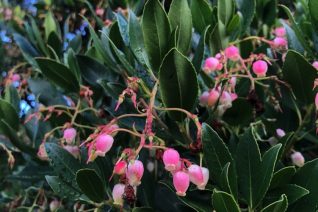
Arbutus unedo ‘Oktoberfest’
This is an exceptional form of Strawberry tree with an upright tree like habit with a dense crown and pink rather than white flowers. To 12′ tall after 8 years. The long deep green foliage is lusterous and glossy. In autumn clusters of pink urn shaped flowers appear. They form yellow, then orange, then red fruits that are showy from August to January. These can be a little messy during fruit drop- many are eaten by large birds. Loved by Anna’s hummingbirds as well as other species that are going south. Moderately fast growing. In areas exposed to gorge wind locate on a west or south facing aspect. Very easy to grow and will accept both annual summer drought as well as light consistent irrigation. Average to enriched soil, water for the first year then monitor it in subsequent years- chances are you won’t see it wilt. Wonderful hedge or hedgerow subject with a long lifespan. Full sun to very light shade. Combine with fall blooming sasanqua Camellias for a flowery fall show. Excellent performance at the Oregon coast.

Arctostaphylos ‘Greensphere’

Very cool and tough Manzanita that is a true dwarf and therefore it is slow to get to market. We anticipate having more of this dense growing, cold hardy, disease-resistant shrub. To 30″ x 30″ with great age forming a perfectly round sphere. New growth is bright red settling to blue green. Leaves are held densely on the stems. Full sun and good air circulation in average, well-drained soil. Excellent cold hardiness to near 0ºF. A natural for hellstrips or anywhere space is a premium. Pink flowers in late winter are showy and profuse. Mahogany glossy bark- in time. Very limited quantities. Probably available in autumn. Very slow growing. Limited availability- Order via email.

Arctostaphylos ‘Monica’

She’s a big girl, but so pretty and adaptable and easy to grow we love her. Soaring to 9′ tall and almost as wide the pretty, large, deep forest green foliage is particularly disease resistant. In late winter to early spring profuse clusters of pink flowers transform into russet berries (bird food). Fast growing shrub with amazing glossy mahogany stems and trunks. Full sun, well drained to average soil with no summer water. One of the most garden tolerant of the gigantic cultivars. Cold hardy to at least 5ºF. Spectacular turned into a small tree.

Arctostaphylos auriculata ‘Diablo’s Blush’
Excellent garden-tolerant smaller Manzanita. New growth is blushed pink as are the winter flowers. Settling to soft gray, this dense rounded plant achieves about 5′ x 7′ in 7 years. The bark becomes reddish and shaggy with age. Full sun and very well drained soil with no supplemental water once established. Gray foliage is organized symmetrically around the thick stems. This is a good scale for smaller gardens and a handsome shrub at all times. Provide good air circulation in an uncrowded environment. Excellent landscape shrub. Best in average soil. Cold hardy, provide good air circulation.

Arctostaphylos auriculata ‘Knobcone Point’

Interesting and very handsome compact Manzanita that retains what appears to be juvenile foliage. Each rounded leaf has small indentations that give the plant a finer mein. Silver/ gray foliage is handsome all the time and the leaves clasp the stems in a symmetrical way. In January to April clusters of pinkish/ white urn shaped flowers appear at the branch tips. Not the heaviest blooming Manzanita. The mature trunks and stems revert to a solid mahogany glossy finish with time. Dense growing to 4′ x 4′ in 6 years- larger in time. Beautiful, architectural shrub for full sun and dry summer conditions. No supplemental water when established. Rounded good looking plant for hillsides, parking strips, dry shrub borders. This species is native to mid to higher elevations of the Bay area and has performed wonderfully in our gardens. A naturally dense growing plant.

Arctostaphylos bakeri ‘Louis Edmonds’

One of the most picturesque Manzanitas, this selection bears lovely gray-green leaves that are nearly circular, held perpendicular to the stems. The bark is one of the best of all species and selections, deep burgundy/purple and smooth. Vivid pink flowers that appear in late winter to spring transform into small russet red apple-shaped fruits. To 6’ tall and 4’ wide in 5 years. Requires well drained soil with little additional irrigation when established. Cold hardy. Good looking year round. Good gray foliage adds contrasts to other Manzanitas and is resistant to black spot. Very upright growing cultivar that can fit in skinnier locales. Either way limit pruning to tip pruning after flowering to control size and remove leafless shaded branches from the base. Adaptable to garden conditions- if you make sure to skip any irrigation during the summer. Brilliant pink flowers are among the most vivid in the genus. aka Arctostaphylos bakeri ssp. bakeri.

Arctostaphylos canescens ‘Gunmetal’
Our selection of native Hoary Manzanita and one of the finest. We’ve driven by this shrub for years on the highway to N. California and for years it captured our attention. A smaller rounded shrub of metallic silver gray with white flowers. we formerly listed this as a hybrid and it may not be the pure species. Either way its a stellar garden Manzanita and thrives in harsh conditions. This native Oregon species bears its clusters of showy white flowers in winter/spring. The bark is a wonderful contrasting smooth deep mahogany- a great foil to the foliage. To 4′ x 6′ in 8 years. Moderaterately slow growing for an Arctostaphylos. In habitat it perches on a nearly vertical cliff of basalt. So, its adaptable. Not prone to black spot and it hails from an area with a naturally high rainfall. Avoid all supplemental water when established. It literally thrives on neglect. Silver foliage shines year round but is especially showy silver in winter. Arctostaphylos canescens is one of the most difficult species to propagate : Limited quantities. A Xera Plants favorite. Oregon native plant.
Xera Plants Introduction

Arctostaphylos canescens var. sonomensis

Our very, very favorite Manzanita and one of the very rare ones in the wild. Occurs on two ridges in northern California- Horse Mountain was one of them and Greg’s dad just happened to have a cabin there. Not an easy Manzanita to cultivate. Low, dense, spreading, very gray shrub to 3′ x 5′ wide in time. The bark is a great glossy mahogany and the winter/spring flowers are white tinted pink. Russet berries are quickly consumed by wild life. Spectacular shrub for full sun, average to poor, well-drained soil and absolutely no summer water. Loathes the combination of water and heat. Neglect is its friend and you will reap great rewards with this beautiful shrub by strictly ignoring it once it is established. Ultra cold hardy- hailing from over 4500′ in elevation and recommended for cold gardens. This species is native to southern Oregon, and though not technically native to Oregon this is our favorite form of this species. Not the easiest to propagate so quantities are often limited. Absolutely NO summer water. Ever. Forms rounded balls of soft silver. Dynamic on slopes. Easily prone to death from soil pathogens if watered in summer. Absolute neglect.

Arctostaphylos columbiana ‘Blue Point’

We’re intent on expanding our offerings of our cold hardy native Hairy Manzanita. This form we found in the Hood River Valley and it was conspicuous to us for several reasons. The plant which has long pointed blue leaves was exceptionally disease resistant. It also was tolerant of quite a bit of shade as well. Hairy Manzanita from this part of the state is exceptionally cold tolerant. It will happily live on both sides of the Cascades. The long blue/gray foliage is perpendicular to large stems. The bark becomes deep mahogany and glossy with age. Best in unimproved native soils. To establish water it regularly once a week until you see good new growth then set it free. Drought adapted. To 7′ x 6′ a large shrub that grows quickly to its ultimate size. Full sun to quite a bit of high overhead shade. Always good air circulation. The very early spring flowers are pure white and large on this cultivar. Russet berries that follow attract wildlife. Wonderful shrub, easier to grow than ‘Wolf Creek’. Cold hardy well below 0ºF. Oregon native plant.
Xera Plants Introduction

Arctostaphylos columbiana ‘Mountain Blue’
This exceptional form of hairy manzanita we discovered on the north side of Mount Hood. The large foliage is distinctively blue and is held perpendicular to the stems. In very late winter to early spring pearl pink/white flowers decorate the branch tips and appeal to both hummingbirds and native bees. A large rounded shrub to 6′ x 8′ forming a wide dome. Its best attribute is its distinctive deep mahogany glossy bark which contrasts with the blue foliage. Russet berries follow the flowers and are consumed by wildlife. Full sun to very high overhead shade in average to poor unimproved soil. Water once a week to establish, when new growth begins taper off then drought adaptation is exceptional. Its also exceptionally hardy to cold to at least -15ºF and is as happy in the Willamette Valley as Central Oregon. Moderately fast growing. Disease resistant, Best to grow Arctostaphylos columbiana as lean as possible. Give it just enough water to establish and then only bark/chip mulch. A very pretty cultivar that is one of our favorite manzanitas. Oregon native plant
Xera Plants Introduction

Arctostaphylos columbiana ‘Pacific Coast’

This is a compact, dense growing form of Hairy Manzanita from the city of Manzanita on the coast. These are Greg’s collections. He chose several forms that had nice foliage, foliage color, habit, and resistance to disease. This form is one of the most compact of the three. Slightly smaller leaves are born densely on a more reserved growing plant. In late winter to spring clusters of white flowers followed by drupes that turn distinctly red. Inland forms of this Manzanita have maroon to russet berries so this is a distinct difference. Beautiful dark, glossy maroon bark as for the species. To 6′ x 6′ in 7 years. Adapted to average to poor soils which will allow it to grow at a more reserved rate. Arctostaphylos columbiana reacts to richer soils, even clay soils with exuberant growth. Best in our native soils that are unimproved. Dig a large hole and provide regular water until you see good new growth then taper off. In subsequent years only what falls from the sky. Arctostaphylos columbiana (Hairy Manzanita) is a proto species one of the first and it is the most widespread Manzanita in Oregon and Washington. Genetically it dominates and most of Calfiornia’s northern species are derived from ancient Hairy Manzanita. Provide full sun and good air circulation. Excellent underplanted with native annuals and Sedums. Good looking siver/ gray foliage year round. Extraordinarily drought adapted. Associated plants with the coastal species are Vaccinium ovatum, Pinus contorta ssp. contorta Garrya elliptica, Baccharis pilularis and Salal (Gaultheria shallon). Often found with Festuca rubra on stabilized sand dunes. Oregon native plant
Xera Plants Introduction

Arctostaphylos columbiana ‘Parkdale East’

This form of our native Hairy Manzanita was found quite far east of the Cascade crest and offers greater hardiness to cold. Unfortunately, it has the same characteristics of the species- it is unpredictable. To 4′ x 7′ with sage gray leaves and white to pink-tinted flowers in spring. Very well-drained soils in an open position with NO summer water when established. Dramatic smooth mahogany bark is an outstanding feature. This is the variety that is best suited to life in the Columbia River Gorge and possibly eastern Oregon in sheltered sites. It should easily tolerate -15ºF. Best with total neglect and full sun. Russet berries follow the flowers into summer and autumn- always consumed by wildlife. Very limited quantities. This form has been successful in cold gardens east of the mountains where all other California varieties failed. Nice looking shrub. Oregon native plant.
Xera Plants Introduction

Arctostaphylos columbiana ‘Wolf Creek’
Our native Hairy Manzanita is one of the most widespread species in the PNW. It is very susceptible to overwatering and overly enriched soils. .This can be avoided by strictly avoiding all irrigation once established and planting in average, unamended soil. Large-growing shrub with gray green leaves, the telltale hairy leaf petioles and white flowers in spring. Russet berries follow. Its best attribute is its smooth exfoliating mahogany bark. And in time you can remove the tired lower branches to reveal it as well as improve air circulation. To 8′ x 8′ very quickly in average, well-drained soil. No summer water and little intervention from the gardener. Wild areas, dry hillsides. This form we selected from the southern Willamette Valley. It occurs in specific sites around the Valley and is common at the coast /coast range as well as the Cascades. Its populations are most stable on steep rocky slopes and sandy substrates at the coast where plants live longer in impoverished situations. During the warm interstadial (8000-4000 yr BP) when our climate was a bit milder but with a much more pronounced summer drought it was much more widespread- once found in the city limits of Portland at two sites those have been usurped by development. Excellent performance in hot dry urban sites. Oregon native plant.
Xera Plants Introduction.

Arctostaphylos densiflora ‘Type Form’

This is the species that is an important parent in some of the most popular hybrid Manzanitas. From a very restricted range in Sonoma County CA this lovely Manzanita sports gray green sharp tipped foliage and wonderful glossy mahogany bark. Moderately fast growing evergreen shrub to 7′ x 7′. In winter white tinted pink urn shaped flowers occur in conspicuous clusters. Very pretty. Orange tinted glossy berries follow but are quickly consumed by wildlife. Easy shrub for full sun to very light shade and everage, un-amended native soil. Avoid anywhere that there is standing water in winter. Excellent on slopes and somewhat formal in appearance as opposed to many species. Very rare in commerce. Excellent shrub that is beautiful year round. No summer water when established. This species is critically endangered in Sonoma County, CA. In fact it is possible due to extensive fires recently that this plant is functionally extinct in the wild. Handsome shrub.

Arctostaphylos edmundsii ‘Big Sur’
This handsome low growing and compact Manzanita has great performance in our climate. Glossy mid-green foliage clothes a dense growing plant to 2′ x 4′. Admirable low ground cover as a massed subject but individual plants have glossy mahogany trunks that develop character with age. Masses of small light pink urn shaped flowers appear in late winter to early spring. Healthy looking at all times and not prone to black spot. Takes reflected heat well and even tolerates a light amount of shade. No water necessary once established, but it will take light water on slopes. Great small scale for small gardens. In time you can lift the plant up by pruning to reveal the small trunks. Long lived. One of the finest smaller varieties. Avoid the coldest gardens. Central CA coast.

Arctostaphylos edmundsii ‘Witches Broom’

A very compact and slow growing form of this species.. Round glossy leaves add to the the overall dome shape. In winter into spring a continual procession of whitish-pink flowers. They come in groups and decorate this small shrub evenly. To about 1′ tall by 3′ wide not very quickly. Dense and smothers weeds effectively. Grows about 3″ per year, faster in more fertile soil. Great in year round containers where its restrained growth and ability to adhere to contours makes it perfect for life on the edge. Not quite as vigorous as kinnnick kinnick and actually a better specimen than ground cover. Great in rock gardens. Little summer water when established. Nice resistance to black spot. Appreciates a warm location. Moderately deer resistant. We have yet to see it produce berries. Or they were snagged by birds before we could notice. Demure little shrub. Looks glossy and fresh year round.
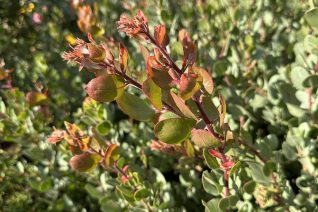

An excellent form of a great Manzanita species. This form of Big Berry Manzanita was a seedling in the Santa Barbara Botanical garden. The species has a wide range in California and I am personally familiar with this shrub, it grew on property that i owned in the Sierra foothills in California. The very tough and uniform rounded blue gray green leaves are handsome but this form has new growth stained in red and then slowly blush before permanent pale blue. The tips often retain the color year round. Cold hardy and extremely drought tolerant, it also takes well to garden cultivation with no supplemental summer water. This form to 3′ tall x 8′ wide in 7 years. It would make an ideal bank cover and low limbs will self layer aiding in soil stabilization. White flowers in winter followed by relatively large pea sized drupes in bold clusters. Full sun to very light shade, the best color will be in full sun and average soil with no supplemental water . The color of the foliage steals the show. In time the stems exfoliate to cinnamon orange. Cold hardy to brief drops to 0ºF. A very pretty, tough Manzanita. ( Photos: Chris Hembree )

Arctostaphylos hookeri ‘James Roof’
Smaller growing Manzanita that assumes the twisted form of a bonsai with age. In fact this 2′ x 4′ wide decumbent shrub makes a wonderful, long lived container plant. In the ground it excels on slopes and other places where standing water never occurs. Full sun to high overhead shade (a high tree canopy). In late winter scattered smaller white urn shaped flowers decorate the branch tips. They morph into highly prized fruit for wildlife. Sage green diamond shaped foliage it lightly twisted and terminates to a sharp tip. Twigs, branches, and trunks all have a glossy mahogany finish. Great shrub for covering low slopes. Effectively blocks weeds. Water to establish and then set it free. Several plants may be massed to produce a small scale, drought adapted ground cover. Exceptionally garden tolerant selection that is exceptionally handsome. This species is native to the central CA coast and has been one of the best for garden culture in our region. Accepts light irrigation in summer. Excellent performance at the Oregon coast. It thrives on sandy soils. Nice smaller growing selection. Naturally summer drought adapted. Orange drupes are showy.

Arctostaphylos hookeri ‘Wayside’

At the North Willamette Experimental Station in Wilsonville where OSU conducted a trial of scores of Arctostaphylos species and cultivars this special ground cover Manzanita has been consistently one of the best performers. Deep green pointed leaves are held perpendicular to the sun on cinnamon red stems. In time it forms glossy red bark that is very showy. Low and dense growing to 2′ tall and 6′ wide. Excellent bank cover or ground cover in any soil that is not amended or boggy. Profuse white flowers in spring. First rate weed suppressing plant for hellstrips, rock gardens, dry borders. Excellent appearance year round. No summer water. Take advantage of its low dense growth to cover and suppress weeds. Wonderful plant for baking hot locations. Very easy to grow.

Arctostaphylos manzanita ‘Dr. Hurd’
An old and venerable cultivar of this species. This small tree achieves 12′-15′ with great age forming a showy and jaw dropping evergreen. Pale sea foam green/ grayish foliage is large and very circular giving this tree a billowing appearance. In winter white tinted pink flowers erupt from all the branch tips. These morph into large russet berries consumed by birds. The mahogany twisting, muscular bark is the most outstanding feature. Fast growing in youth (2′-5′) per year when excited. Give this dry loving shrub EXCELLENT air circulation in an open exposure. It can be afflicted by black spot in wetter than normal springs. ‘Austin Griffiths’ which is 1/2 this cultivar is more resistant to black spot. In time you can remove the lower shaded branches to show the trunk and improve air circulation as well as general good looks. Tall and often half as wide. Locate in a hot sunny place and water to establish then set it free. Very striking tree that is best planted as a smaller plant. Large specimens will NOT live as long and will be more difficult to establish.

Arctostaphylos nortensis ‘Demeter’
Our employee Adinah spotted this distinct form of our native rare Del Norte manzanita in extreme SW Oregon. This form boasts very silver foliage with sharply pointed leaves and the conspicuous glands that identify the species. In mid winter to early spring clusters of pink buds open to pendant urn shaped white flowers. Loved by over wintering Anna’s hummingbirds. A low and spreading Manzanita to 4′ tall by 6′ wide in 7 years. Not as rapid of growth as other varieties. Full sun and average, well drained soil. Do not amend the soil but rely on our own native soils perfect fertility. To further enhance success double dig a wide area around the plants new home. This incorporates oxygen into the soil in a wide area and also allows the percolation of water. Mulch after planting with a coarse bark. Very pretty, very gray dome shaped shrub which eventually reveals contrasting mahogany glossy peeling trunks. A very pretty species that rare and whose native range extends to just two counties . One in California (Del Norte) and one in Oregon (Curry) and it is one of the rarest species in Oregon and in general. Once established, do not water- neglect and perfect climate adaptation will do the rest. It is native just inland beyond the Redwood belt. Oregon native plant.
Xera Plants Introduction

Arctostaphylos nummularia ‘Select Form’
Stunning glossy perfectly round leaves line wiry stems on this dense, mounding, very happy low-growing Manzanita. New growth is tinted red and settles to bright green. To 2′ tall and 4′ wide creating a dense weed-suppressing dome of foliage. White flowers in spring. Very garden tolerant for full sun to very light shade. Moderately fast growing. Excellent candidate for hellstrips, hillsides, etc. Great performance at the Oregon Coast. Little to no summer water once established. Very very good looking plant. It thrives in perfect conditions- neglect and sun and is much more fussy in shade. Cold hardy to 5ºF. Nummularia= coin shaped, referring to the leaves Takes a little bit of shade- especially if there is a very high tree canopy. Adapted to coastal conditions including sandy soils. The glossy leaves and dense nature of this shrub make it hard to capture in photographs.

Arctostaphylos pajaroensis ‘Lester Rowntree’
Virtually the same as ‘Warren Roberts’ it is completely interchangeable with that cultivar. Why do we grow ‘Lester’? Aside from having amazing blue foliage and clusters of deep pink flowers from January to March we LOVE Lester Rowntree. She was an amazing, intrepid self-taught botanist who roamed California in the 1930’s in her simple pickup truck camping and botanizing throughout that state. Her incredible book ‘Hardy Californians’ is a must read for any gardener on the west coast. And its not just about plants- Check it out. This shrub is large in time to about 4′ tall by 8′ wide. The pink flowers born on the blue foliage is a sublime combination. Following bloom new spring growth is a fantastic red/ orange before settling to blue. Bark is a smooth mahogany with time and the trunks are sinuous and winding. This is an excellent shrub in our climate. Once established it requires absolutely no supplemental water- ever. Sailing through temps in the 100’s and bone dry with NO visible signs of stress. Our kind of shrub. It is cold hardy and completely climate adapted. Hell strips, dry borders, informal shrubberies. Mix with Ceanothus, Grevilleas, Halimiums. Very pretty year round.

Arctostaphylos pajaroensis ‘Myrtle Wolf’
Always at the top of the list of Arcto Afficianados this is not often seen in gardens. An excellent winter blooming Manzanita that has been a fantastic performer in the PNW. Upright growing shrub with blue foliage- new growth is briefly tinted red. In January to March copious bright pink clusters of urn shaped flowers appear. Anna’s hummingbirds are not far behind. To 5′ x 5′ in 6 years in full sun and average, well drained soil. No summer water when established. Excellent winter blooming shrub that is always good looking. This is a reliable cultivar for spectacular floral shows. Place close to an exit or entrance where you can stare into the pendulous pink flowers and the winding branch structure. Supply good air circulation. Photos by Chris Hembree

Arctostaphylos pajaroensis ‘Warren Roberts’
Big beautiful Manzanita that has thrived at our very cold wholesale nursery for almost 20 years and has never been harmed by weather. To 4′ tall and up to 8′ wide the new growth emerges a fiery orange red before settling down to a nice gray/blue. In late winter pink tinted urn shaped flowers decorate the whole shrub. The combination of the blue foliage and strongly pink flowers is magical in winter. Well drained average to poor soil in full sun is ideal but it can get by with less than ideal conditions. Water to establish the first summer then none in subsequent years. This is a great landscape shrub that retains its good looks year round. Very adaptable to garden situations where water is curtailed. Long season of bloom in February to April. Blushed small apple shaped fruits are stripped quickly by wildlife. Foundations, hillsides, sterile road cuts. Adaptable and very pretty shrub.

Arctostaphylos pumila ‘Grey Leaf Form’
Surprisingly happy in our climate in its native Monterey Bay area of California its known colloquially as Dune manzanita. Very gray blue leaves are not huge and hug the stems tightly on a compact moderately growing Manzanita. To 5′ tall and wider over time. In mid winter to early spring white flowers tinted pink appear in clusters at the tips of the plant. The trunk becomes deep mahogany brown over time and contrasts greatly with the light colored foliage. All around fantastic shrub for full sun and average, unimproved soils with little irrigation once established. Not as fast growing as other Manzanitas, usually less than 5″ per year.Very pretty plant that mixes wonderfully in droughty shrub borders, and even as a foundation shrub. Makes a nice life in a containers for years. Long lived. Probably harbors some deer resistance. Extraordinarily drought adapted. Native to a restricted range on the central California coast. Great performance on the Oregon coast.

Arctostaphylos pumila ‘Small Leaf Form’
Immensely handsome dense rounded Manzanita that has smaller than average silver foliage and fantastic bark. Moderately fast growing shrub to 4′ tall x 5′ wide in 8 years. In late winter each branch tip is bedecked in clusters of small white flowers- they are born in profusion and expand from pink buds. Russet colored berries often follow and are consumed by wildlife. The black/mahogany glossy bark is beyond striking with the silver foliage. It splits, rolls up into ribbons, and exfoliates in late summer. In time it may be pruned to reveal trunks–for most of its youth they are hidden by dense almost formal looking foliage. Adaptable to many soils including clay soils- especially on slopes. Excellent long term landscape plant that looks great year round. Very good cold hardiness enduring 0ºF with no problem. Dig a hole 3x as big as the rootball in the pot to loosen the soil and allow the new roots to penetrate virgin soil. Water regularly through the first summer- then little to none in subsequent years. Combine with green leaved Arctos for great foliage contrast. Perfect on slopes, areas with intense reflected heat such as parking lot planter islands. Great urban shrub. Appreciates good air circulation.


Highly recommended by a fellow Manzanita enthusiast this hardy variety native from Mt. Tamalpais in the Bay area NoCal south deep into Baja and east over to the Big Bend in Texas. Aka pointleaf manzanita or Mexican manzanita this is a very upright and skinny manzanita to 6′ tall but less than 3′ wide. The blue green foliage is handsome at all times and the large pearl pink clusters of flowers are pendant and very showy in winter. Russet fruits follow beloved by birds. Its finest attribute aside from being tall and thin is that bright, glossy, orange exfoliating trunks contrast in a ghostly way with the blue green leaves. Tolerates some sub freezing wind in east Portland, out of the wind zone it takes temperatures down to 5ºF for brief periods. A wonderful Manzanita with a smaller foot print. The leaves are distinctly long and pointed. This gives this Manzanita an almost willowy feel. Moderately fast growing.

Arctostaphylos rudis
Roughbark Manzanita is a little known species of Arctostaphylos from the central California coast that has turned out to be a great garden plant. Nearly round leaves cling to the winding upward pointing stems. In a short amount of time it forms a rounded, spreading shrub to 3′ tall by 5′ wide (5 years). Late winter bring profuse blush pink urn shaped flowers- followed by clusters of large tight blushed red drupes. Full sun and average, well drained soil with good air circulation. No summer water at all when established. This not only gives it the neglect it adores it increases hardiness to cold in winter. Avoid, exposure to subfreezing winds… not a Manzanita for Gresham or Troutdale but in milder parts a great landscape shrub. Group with other drought adapted shrubs. Handsome smaller scale shrub for hot sunny sites. Develops shredded cinnamon red bark with time. Performs very well in containers. Photo credit below: Lance Wright.

Arctostaphylos viscida ‘Sweet Adinah’
White leaved Manzanita is endemic to southern Oregon into northern California. The leaves are large, round, and very pale blue/gray. This species which also grows on serpentine soil. is incredibly tough and requires special treatment. Adinah found this very pale selection just outside of Ashland, OR.. Extremely drought adapted this species is best in VERY WELL drained soil with light water to establish, Once up and going it will do best with NO SUMMER WATER. This is one of the most striking Manzanitas that we grow.Its also a little bit tough to cultivate, and can up and go away for no real reason, so keep that in the back of your mind- absolute neglect is its best friend. Having said that is easily one of the most striking shrubs native to Oregon. To on average 4′ x 4′ it should be planted in poor to average soil. Avoid all fertilizer, and rich conditions. New growth emerges striking orange/red following clusters of white tinted pink flowers from January to March. Very cold hardy enduring temperatures near 0ºF with no issues. Rock gardens, dry shrub borders, drought adapted screen or specimen. A mature shrub kind of gives me the impression of a big white bubble. Extremely heat and drought adapted native shrub. Limited quantities Some deer resistance. Full sun to very light shade. Oregon native plant.
Xera Plants Introduction

Arctostaphylos x ‘Austin Griffiths’
This is probably one of the very best garden Manzanitas in general. Large growing shrub with sage green foliage, copious, large clusters of pink flowers in winter, and the tell tale famous mahogany peeling bark. To 9′ x 7′ wide in 6 years, fast growing and well adapted to most well drained sites, including heavy clay soils on slopes. Little to no supplemental irrigation. Very resistant to black spot a leaf disease that can afflict Manzanitas. Specimen, or small garden tree. Good looking year round. Flowers appear in late December and are effective through February- not at all affected by cold. Anna’s hummingbirds are immediately in attendance. Provide a wide open exposed site with excellent air circulation. A wonderful garden shrub. We have a large specimen of this shrub in a container at the shop. Though the box it is in is huge it restricts the roots enough to make this Austin smaller than it would be in the ground. It begins blooming in mid-winter. Excellent garden Manzanita all around. Hybrid between A. manzanita ‘Dr. Hurd’ and A. x densiflora ‘Sentinel’. Wonderful plant. Dependable heavy flowering. Center bottom photo credit: Loree Bohl Danger Garden.

Arctostaphylos x ‘John Dourley’
Exceptional low growing Manzanita with new growth emerging electric red and settling to a mature gray/blue. In late fall to early spring copious pale pink flowers appear- very pretty in concert with the vibrant new foliage and older blue leaves. To just 3′ tall by 6′ wide very shortly. Bark is cinnamon colored in time. Full sun and average well drained soil with great air circulation. Little to no summer irrigation. Extremely drought adapted hybrid that many consider to be one of the best. Excellent slope cover. Good appearance at all times. This durable and adaptable Manzanita is excellent for landscapes where little maintenance is required. Its handsome mounding dense habit precludes pruning and it blooms for an extended period, often beginning as early as November and continuing to spring. Great drought adapted, weed smothering evergreen shrub that is constantly attended by Anna’s hummingbirds in bloom. Very easy to grow.

Arctostaphylos x ‘Pacific Mist’
Wonderful low spreading Manzanita that we have grown for more than 20 years. Silver/gray pointed leaves densely clothe the spreading stems of this adaptable shrub. In time the lax, decumbent stems point upward at the tips. In spring white flowers are a bonus. To 2′ tall and 6′ wide in 5 years it may be employed as an informal ground cover. Full sun to light shade and well drained soil of average fertility. Little to no summer water when established. Nice looking plant year round. In time it develops glossy cinnamon colored trunks/stems. Excellent on slopes. Takes more shade than most cultivars. Excellent cold hardiness. Plant on 30″ centers for a large ground cover. Tips may be pruned in spring to encourage density, otherwise it covers the ground densely. A hybrid of obscure parentage that has been around for decades.

Arctostaphylos x ‘Pajaro Hybrid’
Amazingly showy Manzanita that is a delight when new growth emerges stained in raspberry red before settling to a soft gray mauve mature tone. A dense and spreading shrub that always seems to be in growth and therefore never without the colorful foliage. From December to March a non-stop copious display of white tinted pink flowers, in concert with the foliage color its a knockout. To 4′ tall and 8′ wide in 7 years. Best in poor soil or native soil that has NOT been amended. Its an adaptable plant. Let it adapt. No summer water once established. Striking colorful shrub year round. Ground cover, hedges, focal points, blasting hot hellstrips. Anna’s hummers are invariably drawn to this showy winter bloomer. Easy.

Arctostaphylos x ‘Sunset’
One of the very best landscape shrubs for western Oregon. Named for the 50th anniversary of Sunset Magazine way back in 1977- its an excellent, garden tolerant Manzanita. Dense growth emerges orange/red before settling to a mature fashionable army green. The stems and leaf margins are outlined in fine white hairs- an elegant detail. In spring sporadic white flowers appear. Rounded dense shrub for full sun and average to poor soils, including the most compacted. This should be a basic landscape shrub in our climate- To 4′ x 6′ in 5 years, it covers the ground well. A perfect candidate for such places as frying hot circular planters in a sea of asphalt. This remarkable shrub will thrive and not flinch without a drop of supplemental irrigation- and it will still always look good. In fact, soil that is too rich or too much additional summer water leads to an initially massive plant that is then not long lived. A little rough living adds years and slows down what has got to be natural hybrid vigor. May be tip pruned to encourage density if required- and may even be sheared quite severely and still maintain its self respect. The shredding cinnamon/brown bark is handsome with time but the foliage mostly obscures it. Excellent cold hardiness. A truly climate adapted shrub. A Xera favorite shrub that we’ve grown for close to 20 years.

Arctostaphylos x coloradensis ‘Panchito’
Several wonderful attributes makes this a great Manzanita for widespread use. Its extremely cold hardy, a naturally occurring hybrid from southern Colorado- it can handle temperatures lower than -20ºF. Its a great size- slow growing to just 3′ x 3′ in 8+ years. The matte green foliage is dense (almost boxwood-esque) and is a great foil for the clusters of pink buds that relax to lighter pink when open. Full sun and average, unimproved soil. Water to establish then only what falls from the sky. This dainty almost formal looking shrub finds a happy home in smaller gardens, rock gardens, and thrives in Central Oregon. In time the trunks exfoliate to glossy maroon- it take quite a few years for this to be an outstanding feature. Mounded and dense for the first part of its life- expect just several inches of growth per year.. Open exposure with good air circulation. Great performance in Gorge outflow. A perfect substitute for ‘Greensphere’ that is both hardier to cold and a little easier to cultivate. Russet red berries that follow are a treat for the birds that get there first. Accepts the hottest aspects, drought, and brutal cold. Bienvenidos, Panchito!

Arctostaphylos x densiflora ‘Sentinel’

Consistently one of the very best performers in Western Oregon. ‘Sentinel’ accepts many soil types and aspects with superior cold hardiness as well as disease resistance. Fast growing rounded shrub to 7′ x 7′ in 4 years. Attractive sage green leaves are held perpendicular to the red stems to avoid moisture loss. The bark exfoliates to a smooth muscular deep mahogany with time. Excellent specimen or even informal hedge row. In late winter pink urn shaped flowers appear in clusters and turn to russet fruits consumed by birds. Little to no supplemental water ever. Easy to grow. Provide good air circulation. A great Manzanita. ‘Sentinel’ can compete with invasive grasses and still grow and perform. Immensely drought adapted. It may be aggressively tip pruned or sheared carefully to produce a smaller, denser plant. First rate landscape evergreen shrub.

Arctostaphylos x densiflora ‘Harmony’
A handsome, easy, and adaptable Manzanita that is a great plant for beginning gardeners. Sharp tipped bright green rounded leaves clothe stems of smooth mahogany/orange. Fast growing evergreen to 7′ x 7′ in 7 years. Average, unimproved soil that has good drainage. Even adaptable to heavy clay soils if strictly unwatered in summer. Urn shaped pink flowers change to white upon opening and draw hummingbirds. The maroon berries that follow are gobbled by birds and seldom spend much time on the shrub. Full sun to light shade and little to NO summer water. Tip prune after blooming to limit size, encourage density. As with all Manzanita it abhors crowding and should be given excellent air circulation. Dependable, hardy and easy to grow.

Arctostaphylos x densiflora ‘Howard McMinn’
A FANTASTIC Manzanita ‘Howard’ forms an extremely handsome evergreen shrub to 7’ tall and as wide in as many years. Striking mahogany bark is smooth with dark glossy deep green leaves. Profuse clusters of pink urn-shaped flowers appear in late winter and change to white over a period of six weeks. Maroon berries follow in summer. One of the most adaptable to landscapes, tolerates some summer irrigation but absolutely avoid boggy conditions and heat. A fantastic performer in our climate. Excellent as a specimen, basic landscaping shrub, or even informal hedge. Tip prune in summer to limit size and shape if required. Somewhat formal appearance year round. Very nice as an informal hedge and wonderfully adapted to steep slopes. Very good black spot resistance. Verdant and healthy year round. Adaptable to very HIGH overhead shade in woodlands. Avoid rich soils and do not improve. Best in un-amended native soils. Great formal looking shrub for rough conditions. Cold hardy to 5ºF. Exceptionally long lived in our climate.

Arctostaphylos x hookeri ‘White Lanterns’
Stellar small scale Manzanita that is a winner in gardens. Smaller leaves have a finer texture than most shrub types. Forms a symmetrical, dense dome to 3′ x 5′ in 5 years of medium green foliage. Massive bloom as clusters of white flowers (tinted pink in cold weather) occur from every branch tip in January to March. Very showy russet/mahogany bark. One of the best performers in our climate and scaled well for smaller gardens. Wonderful performance in Hell Strips, even large rock gardens. In time you may remove the lower tired branches that have become shaded out and reveal the smooth spectacular peeling trunks. Little to no summer water. Full sun to very light shade in well drained to average soil. Excellent cold hardiness as well as resistance to black spot. As with all give it good air circulation. Adaptable.

Arctostaphylos x media ‘Martha Ewan’
Our former employee Dan found Martha growing in the cemetery of the coastal town of Manzanita. It was bound to happen. This naturally occurring hybrid between Hairy Manzanita (Arctostaphylos columbiana) and the ground cover Kinnick Kinnick (Arctostaphylos uva ursi). Fantastic low growing evergreen shrub that is a superior ground cover. Dense growth clad in deep green leaves covers the ground on a 2′ x 6′ framework. White flowers in spring are followed by large red berries which are then consumed by wild life. Full sun to very light shade in most well drained soils. No summer water when established. Fast growing with little care. Amazing on slopes where it efficiently blocks weeds and the best ground cover Manzanita that we grow.. Better, easier, and faster ground cover than Arctostaphylos uva ursi- Kinnick Kinnick- dense growth is more vigorous and requires less maintenance or even supplemental water. Handsome and immensely easy plant. Though not technically a shade plant this variety can handle quite a bit of shade- avoid low dark shade, high overhead shade is best. Oregon native plant.
Xera Plants Introduction.
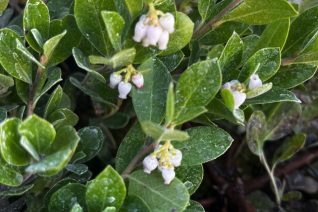
Arctostaphylos x media ‘Xera Pacific’
Our discovery of a naturally occurring hybrid Manzanita on the Oregon Coast. Low and spreading to 2′ tall and 5′ wide in 5 years. Light green paddle shaped leaves. White urn shaped flowers in spring. Bark exfoliates to mahogany and shredding with time. First rate dense weed smothering groudcover. Black spot resisitant. Full sun to part shade in average, well drained soil. No summer water- though it tolerates it better than most. Great Oregon native shrub. Cold hardy. Russet/red berries follow the flowers and are consumed by wildlife. Very similar in habit and use as ‘Martha Ewan’, they are almost interchangeable. The foliage is more rounded and lighter green than the previous. Oregon native plant.
Xera Plants Introduction.

Argyrocytisus battandieri
Moroccan Pineapple Broom is a splendid, hardy NON-INVASIVE tree that we adore for its silver foliage and spicily scented cones of brilliant yellow flowers. Fast growing tree which may also be maintained as a shrub. In our climate with more rain than its native range it usually achieves tree like proportions. To 16′ tall by 10′ wide most often with one to three trunks. Best in poor to average soil with as little irrigation as possible once established. You must treat this plant with a bit of benign neglect. Overly enriched soil and too much supplemental irrigation leads to a rank growing and usually unstable plant that can go over easily in a wet gale. The flower fragrance is definitely pineapple with somewhat salty notes. Blooms appear May-July and are born on wood from the previous year. Prune-if needed AFTER flowering has ended. Full sun is ideal. Wonderful small tree for rough sites- compacted awful droughty soils. Almost always deciduous in our winters and surprisingly hardy taking temperatures just below 0ºF with no ill effects. Moderate deer resistance. Absorbs the blasting heat of south facing walls. Wonderful small tree. Beautiful espalier subject- see pruning above.

Artemesia versicolor ‘Seafoam’
Lovely, soft gray curls make up the foliage of this low spreading perennial. Easy to grow and long lived plant for full sun and well drained soil. Little summer water when established. Takes the hottest aspects with aplomb and remains good looking all season. At the end of summer stems extend to produce small white flowers. Not really showy but it expands the overall texture of the plant. Completely winter deciduous. Cut back hard in early spring. Forms woody stems at the base and is a quite permanent plant. Flows in and around other plants gracefully. Moderate deer resistance. To 1′ x 3′ in a season.

Artemisia douglasiana
Many learn this plant as Douglas Mugwort but its more official common name is Douglas Sagewort. This aromatic vigorous perennial is common throughout western Oregon. It happily inhabits everywhere from ditches to the headlands at the beach. The plant has medicinal qualities that were used by native Americans and they also used the pungent smoke to ward off the spirits of the dead. To 3′ tall and spreading underground by rhizomes. This is a very vigorous plant when established, give it room and the respect it requires. In improved situations it can swamp other plants so best to leave your patch of sagewort to its own devices. Mix with other plants of similar vigor- Spiraea x pyramidata or Rosa nutkana. Give it at least 5′ x 5′ feet to roam. In summer plumes of off-white flowers produce a haven for pollinators. This member of the daisy family brings them from long distances. Very long lived deciduous perennial with long indented leaves that are dark green on top with an underside of pure silver. This makes this almost woody perennial very easy to spot in breezy conditions It appreciates average soil and light water to establish.. If it flags in drought you may give it a deep drink in summer to refresh. Loved by a host of butterflies. Doesn’t need much love to perform. Oregon native plant.

Asarina scandens ‘Sky Blue’
A really interesting and wonderful vine that we grow as an annual but its a perennial in warmer climates and can be here too if you treat it right. Arrow shaped leaves have modified petioles that attach and hoists this climber to 8′ in a single season. A continuous supply of tubular (snapdragon shaped) purple blue flowers with a white throat. Loved by hummers this native of the driest parts of the mediterranean is adapted to being dry in the winter and wet in summer. If wet and saturated the whole vine is only hardy to about 26ºF. However, if the plant is kept dry in the winter it is hardy to MUCH colder. In a former garden I had it planted against the south facing side of my house under the eaves. It was bone dry in winter and to my shock it lived for 7 years with temperatures down to 10ºF. I offer this information as interesting but its a primo delicate vine with beautiful flowers that appear continuously all season which makes a lovely seasonal bower. Great on a tripod, or teutier in containers. Full sun to very light shade in rich, well drained soil. Excellent on spring blooming shrubs that are quiet in summer- its a fine textured plant that will never smother the host. Excellent plant.

Asclepias fascicularis
Narrow leaved milkweed is an Oregonian butterfly weed that has a great wildflower demeanor and is just as attractive to pollinators as well as Lepidoptera (butterflies). Full sun and well drained soil, though it accepts clay soil on slopes that are strictly unwatered in summer , otherwise light consistent irrigation to establish- then natural rainfall alone. To 22″ tall and making a spreading plant. Mix with fine textured ornamental grasses,such as Tufted fairy grass – Deschampsia caespitosa and tall spiky perennials such as simultaneously blooming Kniphofias. Light summer water when companion planted. Flower color is most often creamy white but ranges to light pink. Often seen on road cuts and in ditches in the Willamette Valley. Blends in with grasses and other plants but pollinators find it no matter what. Spreads to form colonies by underground stolons to 2′-3′ wide. Nice cutflower. Important food source for Fendler’s Blue Butterfly which is very endangered and locally indigenous. Winter deciduous. Blooms open in June and persist to August. The large seed heads are pointed and release their downy seeds on the wind in August-September. Oregon native plant.

Asclepias speciosa
This widespread species is native to the floor of the Willamette Valley and is locally common in the Columbia Gorge where it occupies dry rocky hillsides in full sun but tolerates heavy clay soil. In the best conditions (loam) it is huge spreading perennial that requires pre-planning and some real estate. Gray green stalks and leaves rise up to about 4’tall and bear deliciously fragrant pink orbicular flowers. These are irresistible to butterflies, including Monarchs, and if you want one to visit your garden this plant is good insurance. However, all butterflies find it irresistible. Spreads underground vigorously by stolons and can come up quite a way from the initial clump. Full sun and well drained soil. Completely winter deciduous and emerges relatively late in spring. Be patient. see video below. IMG 6323. Oregon native plant.

Asclepias tuberosa
Common butterfly weed native to the central parts of the continent makes a striking long blooming perennial in our gardens. To 2′ tall flat cymes of brilliant orange flowers appear in July and re-bloom until frost. Emerges late – not until May and then rockets out of the ground and almost immediately commences blooming. Fantastic plant for all pollinators. Remarkably showy perennial for very well drained soil- try a slope and deep but infrequent irrigation or add a few handfuls of pumice to the planting hole. Mine thrives in the heat and rigors of my hellstrip. completely deciduous in winter.- its good to remember where you planted it. Butterflies, Oh the god damned butterflies. Excellent combined with blue and purple flowered perennials such as Verbena rigida with the same cultural requirements and bloom time.

Asphodeline lutea
You don’t see this perennial from the middle east very often in our gardens. Its a great, low water long lived plant with dramatic, showy flowers. Spikes to 4′ tall are clouds of large starry yellow fragrant flowers. Blooms appear in May and June and are showy for weeks. Grassy blue green leaves form a clump at the base. Rich, well drained soil with little to no summer water once established. Mass for a very showy effect. Remove spent flowers and you are left with relatively good looking low arching blue green leaves. Must have full sun and a bit of patience to bloom. We try to sell them in bloom to avoid the wait. Moderate deer resistance. Winter deciduous. Long lived.

Azara microphylla (Upright form)
We’ve chosen this distinct form of Azara microphylla which has a much more upright habit and is also hardier to cold. Fast growing light textured evergreen tree. The tiny leaves are deep forest green and glossy and good looking year round. In March on old wood from the previous year and beyond alights with tiny yellow filament flowers. They have the intense and penetrating perfume of hot candy. Well, thats my take, others frequently chime in that it smells like Cocoa or Vanilla. Its an odd sweet fragrance that carries for many feet on mild early spring days. Explosively fast growing tree for any well drained site with regular deep watering. This speeds up early growth to 3′- 4′ a year. The dark, fine foliage provides a great contrast with the light taupe/tan colored bark. In time it exfoliates to reveal bright orange and tan patterns. Excellent urban tree that is incredibly drought tolerant when established. Locate out of the path of the most violent subfreezing east wind. Ultimate height in 10 years is about 22′ tall and less than half as wide. Easy, satisfying tree native to southern Chile. Great performance at the Oregon Coast as well. Casts very light shade.

Baccharis pilularis ssp. consanguinea
This is the Willamette Valley form of coyote brush (bush)- also known as chaparral broom. A relatively short lived evergreen shrub in the aster family. Indeed this form blooms in autumn through winter with small brushes of white plumed flowers on female plants. Smaller yellow flowers on males. Typical of the steepest cliffs abutting the ocean and in the Willamette Valley it populates recent road cuts and fire zones. Often it will be seen all alone in the center of a Willamette Valley field. Native inland from northern Marion county to Douglas county. Very fast growing and drought adapted daisy bush for rough sites and poor soil. Improved soil will yield an enormous shrub so its difficult to pin point an exact size but everything from 4′ tall in poor soil with no summer water to 12′ x 12′ in rich soil with irrigation. I suggest no irrigation after planting. Excellent fodder for insects and birds. It may be pruned heavily in spring and will quickly regenerate. Foliage is deep glossy green but fine textured. Not bothered by deer. Excellent native companion for Manzanita, Grevilleas. VERY EASY to grow. average life span 10 years. Good instant plant for a native garden, but not long term. Native from N. Oregon coast south to Baja California. A prominent component of the California beach chaparral and on the Oregon coast as well. Common associated plants on the coast are Salal (Gaultheria shallon) and Mahonia nervosa. In the Willamette Valley its primary role has been ursurped by Scot’s Broom. Too bad. Oregon native plant.

Baeckea gunniana
Heathmyrtle as it is known is a fine textured shrub that closely mimics Erica (Heath) and is an aromatic member of the Myrtle family- Hence the common name. The fine needle leaves emit a powerfully sweet menthol perfume when bruised. In winter the entire arching dense shrub takes on vivid copper tints. Early summer brings boughs spangled in tiny white flowers like frost. To 3′ tall and 4′ wide in 5 years in rich, well drained soil with light consistent summer water. Pairs perfectly with Heaths and Heathers with identical cultural requirements. Strong deer resistance. Cold hardy to 5ºF or below. Wonderful evergreen shrub. A Xera favorite. High mountains of Tasmania. It would make a fine sheared hedge. Any amount of pruning results in a much denser plant. Plant on three foot centers. Underused wonderful shrub.

Banksia marginata ‘Minimarge’
MINIMARGE! This is a dwarf form of Banksia marginata that has been cold hardy in the Portland area. The key to cold hardiness is to establish the plant well. Unlike other members of the Proteaceae this small shrub likes the soil a bit richer, but that drains well. You can even add a small amount of compost when planting but nothing other than that. Water it until you see good new growth then taper off to once every two weeks. Full sun, in a warm, protected location. A south facing slope with protection from east wind is ideal. To 3′ x 3′ in 7 years. On older wood 4″ tall yellow cones are produced as flowers from spring to autumn. Protect young plants from severe cold. Very good performance on the Oregon coast. In time it will form a small lignotuber. A swollen woody base with dormant buds. It may then be cut back fairly hard and re-growth will commence. Avoid crowding this plant with others. Open and happy is how it likes to be. Great plant for a large rock garden. Hummingbirds adore the spectacular long lasting flowers. Foliage is deep green with an underside of silver and forms winding stems- never tidy. A plant for collectors primarily. This is not a plant for beginners. Heh. Avoid all fertilizers. Protect small first year plants with a cardboard box if it threatens to drop below 20F, remove with a thaw.

Berberis darwinii
Darwin’s Barberry is probably one of the showiest barberries in bloom and has excellent performance in Western Oregon. Deep green, glossy, prickily small leaves clothe the frame of this dense and arching shrub. In March/April the whole plant is alight in chains of vivid orange/yellow pendant small flowers. They come in such abundance as to obscure the foliage. By summer those that found a pollinator transform into blue berries covered in a light powdery bloom. Full sun to very light shade in virtually any soil that does not experience standing water. This Chilean native loves our similar maritime climate and is supremely tolerant of summer drought as well. Typically grows to 4′ x 6′ moderately fast. High deer resistance. Locate out of the path of subfreezing wind (east wind) in Portland as it can burn the foliage in severe arctic events. Recovers quickly. No longer recommended for the Oregon Coast. It has been recorded as escaped in several coastal counties. Inland colder temperatures mitigate invasiveness.

Berberis x lologensis
Very cool, rare evergreen barberry hybrid that is naturally occurring in the far southern Andes of Chile/Argentina. Apparently where B. darwinii and B. linearis grow together you can get this lovely huge evergreen flowering shrub. In early spring the arching stems are lined with pendant flowers that arrive as bright red buds and open to hot orange- both colors are present on the flowers which have the fragrance up close of coconut oil. Large growing arching shrub with kind of a wonky habit. Site it where you can spot the vivid flowers in March and then let this spiny creature fade into the background for the rest of the year. Completely drought adapted but will also take regular water. Virtually any soil apart from standing water. Perfectly hardy to cold. High deer resistance. Very difficult to propagate so we only have this fast growing handsome shrub on occasion. But no one else grows it so we list it. Long lived.

Berlandiera lyrata
The so called Chocolate Daisy of the great plains we love for the sweet chocolate scented yellow daisy flowers in summer. Forms a rosette of humble green leaves and then repeatedly in summer it sends up the wonderfully scented flowers on long stems to 1′ high. Full sun and well drained soil of average to rich fertility. Regular summer water encourages more bloom but it takes dry conditions when established. Rock gardens, gravel gardens, borders, containers. To 18″ wide when happy. Full all day sun. Lifespan: 3-5 years in our experience in Oregon. The yellow petals surround a soft green center- makes a nice scented cut flower.

Bolax (Azorella) gummifera
Incredibly useful and handsome and tough creeping evergreen ground cover. The fine interlaced leaves have a texture very much like plastic or tupperware. It creeps along forming tight rosettes that join. In summer the whole surface of this flush plant is covered in chartreuse yellow flowers. Not showy but conspicuous for a plant that looks uniform and green all year. One of the best ground covers between pavers as it can handle compacted soil better than other small scale ground covers. And this is a small scale ground cover, don’t try to cover acreage. Be reasonable and expect good coverage over a space no larger than 5′ x 5′. Glossy foliage sparkles when wet. Regular summer water speeds growth though it is tolerant of dry periods but not complete drought. Expect each 4″ plant to expand to the size of an apple pie in a season. Completely deer resistant. Top dress with compost every few years- especially if it is between pavers. To 1/4″ tall by 1′ wide. Full sun to the very lightest shade. Carrot family.

Bouteloua gracilis
Mosquito Grass or Gramma Grass is a widespread native of the interior west. Slowly spreading to form substantial clumps of fine light green/gray leaves. To 18″ tall the funny flowers born at the tips of the fine stems feature a horizontal inflorescence- to me it resembles a little blond mustache. Blooms appear in midsummer and are attractive well into fall. Full, hot sun and rich to average well drained sites. Mass for a fine textured effect of a blowsy low meadow. In autumn as it enters dormancy it retains a dried to cere presence deep through winter. It may be cut back hard in spring. Light summer water though extremely drought tolerant when established. Oregon native plant.

Brachyglottis monroi
Fun small shrub that we love for its wavy (undulate) gray foliage and compact habit. Evergreen shrub to 3′ x 3′ moderately fast. In summer it is topped by clusters of electric yellow daisies- nice contrast with the gray foliage. Full sun and well drained soil with light to little summer water once established. Avoid exposure to subfreezing east winds- site on a south or west facing aspect if you are in the wind zone. Excellent performance on hot dry slopes. Moderate deer resistance. Great at the Oregon Coast. Evergreen. New Zealand.

Brodiaea coronaria
Crown Brodiaea is in my opinion the more showy of the two that are common in Western Oregon, the other is Brodiaea elegans Harvest lily. This little naked lily inhabits dry hillsides and meadows from British Columbia to California. Cylindrical leaves emerge in autumn and a clump is green until spring. Then as the leaves go dormant it sends up a chalice of rich blue flowers with distinct white petals on the interior of the flower The 4-6 flowers measure nearly an inch wide each when open. To 8″ tall and spreading primarily by seed, this corm will also multiply to form local colonies. Blooms May to July, just as the accompanying grass is going tan summer dormant. Brodiaea has been placed in the Amaryllis family, then the Asparagus family and now it resides, but probably not permanently, in the Lily family. Loved by pollinators and native bumble bees are especially fond of the pretty flowers. Disappears completely after seed set. Full sun and an open aspect. Average soil and tolerant of xeric clay soils that dry to concrete with summer drought. Adored by butterflies. In the Willamette Valley it is common to find this corm among creeping strawberry Fragaria Virginiana platypetala Roemer’s Fescue Festuca roemeri var. roemeri, Prairie stars Lithophragma sp.as well as Ookow Dichelostemma congestum . Once established no supplemental water is required, in fact its best to give this beautiful little flower a dry rest in summer. No summer water zone. Not well adapted to compete with introduced invasive turf grasses. Oregon native plant.

Brodiaea elegans
Wonderful native bulb that has several common names. Harvest lily is one as well as cluster lily. This gorgeous inhabitant of dry hillsides from British Columbia to southern California erupts in clusters of blue flowers just as summer drought ensues. To 14″ tall but normally shorter a clump of scrappy green leaves comes out in autumn and persists until bloom time. As the leaves go dormant the bulb sends up its bloom. Easy to grow if you accept its requirements. Bulbs that are potted should be watered after planting but established plants should rely only on what falls from the sky. Best to not irrigate in summer. In time it spreads by both increasing bulblets as well as seed. Excellent planted among Festuca roemeri var. roemeri as well as Festuca californica where it occurs naturally. Excellent pollinator bulb in the lily family. Leaves are deer resistant but flowers are not reliably deer proof. Full hot, all day sun in soils that dry completely in summer. Native throughout the Willamette Valley and into the gorge locally. Oregon native plant.

Buddleia loricata
South African Buddleia that we are not concerned about escape, We’ve had this plant on our propagation hill for 15+ years, and there is even a rich stock bed right beside NEVER had a single seedling. Kind of wish I would. Thin tapered gray leaves are pure white underneath and along the stems. This downy appearance reads as light gray from a distance. Forms a rounded shrub to about 6′ tall x 4′ wide in 4 years. Blooms on wood from the previous year (important)- restrict pruning to directly after you are sick of the flowers. Large clusters of off white faintly fragrant flowers appear in late spring and remain in bloom to August, sometimes longer. Moderately fast growing evergreen for excellently drained soils to rich soils in full sun. I would err on the side of poor soil, its a tough shrub with great drought tolerance. Two ideal companions to our stock plant are Bupleurum fruticosum and Grevillea australis. Not only does it look good this 1/2 gravel 1/2 clay substrate is kind of rough and all three thrive. You may cut back very hard to refresh/resize- May skip a year of bloom but its a fantastic evergreen gray foliage plant on those merits. High deer resistance. Drought adapted and cold hardy. We’ve never irrigated ours. Pretty shrub for texture. Nice transitional shrub with Ozothamnus or Grevilleas and even Manzanitas.

Bupleurum fruticosum
A subtle but very sophisticated hardy evergreen shrub that is found in all the best gardens. Shiny sea-green leaves are reminiscent of a Euphorbia and are handsome year round. In summer long stems sport umbels of chartreuse green flowers gives away its familial affinity to Dill. Tough shrub that is adaptable to all but boggy soils. To 6’ tall and as wide in several years. Blooms on new wood, may be hard pruned in early spring nearly to the ground to refresh and resize. Re-growth is rapid. Equally tolerant of drought and regular irrigation. A great plant that instantly makes a planting look sophisticated. Excellent with Lavenders and Russian sage. An irresistible pollinator plant that will be covered in multitudes of insects while in bloom. Very easy to grow. Water weekly until firmly established.

Caesalpinia gilliesii (Erythrostemon gilliesii)
Bird of Paradise shrub is an incredibly showy flowering plant that is surprisingly adaptable to the Willamette Valley. Native to Argentina/ Uruguay the exotic large yellow flowers in whorls each with 3″ strings of blood red stamens protruding. Each flower lasts but a day but a truss carries many individual flowers. Fine divided foliage is light gray green and a great foil for the exotic flowers. Full hot, all day sun in a hot site. Ideally, it should be located against a south facing wall- this heat lover is slow to break dormancy in spring and doesn’t normally begin flowering until mid-summer and continuing until cool weather. To 8′ x 8′ drought adapted but water speeds growth. Deciduous. Spectacular. Non-blooming youngsters may need a year or two in the ground to commence blooming heavily. Patience is all that is required. This shrub loves the hottest spot in the garden. Pick a place that would be unbearable on a hot day and you’ve found the home for this sun lover. Bipinnate leaves close with darkness. Each flower opens for just one day but a procession of buds releases them over a period of many weeks. Blooms on new wood, growth from the current season.

Calamintha nepeta ‘Montrose White’
Wow- one of the best perennials that we grow. Easy to grow, so useful, pretty and even a nice edible that we enjoy in summer iced teas. A dome shaped perennial that is virtually everblooming. Clouds of tiny white flowers are absolutely LOVED by pollinators of every kind. A well grown clump in bloom is a buzzing fountain of activity. Blooms May to September unabated. Full sun, rich to average well drained soil with light but consistent summer irrigation. The fine white clouds of flowers work well as filler in borders or as a low cloud supporting taller flowers. Winter deciduous. Loved by the kitties. To 2′ tall and 2′ wide in a single season. Cold hardy and low water. Exceptional plant. See video below. No other plant we grow is as popular with pollinators as this. Takes a second for the video to load.

Calandrinia (ciliata) menziesii
Red Maids. A lovely native hardy annual for the sunniest spots. Rosettes of semi-succulent paddle shaped leaves are about 5″ wide. Found primarily in poor soils in hot sunny locations. Thats where you find it in habitat, the sides of gravel roads, rocky hillsides and good drainage. Beginning in May a constant procession of 1/3″ hot magenta flower are showy when they open in full sun. Native primarily to western Oregon its found through out the west. Resows reliably especially in gravelly soil. Calandrinia should be watered when they are planted from containers just to get it established. Self sown plant are incredibly drought adapted in our climate. This plant literally grows from desert to the mountains. Loved by a lot of pollinator its especially attractive to butterflies. Great in containers as well. Shocking magenta pink. Oregon native plant.

Callistemon (Melaleuca) viridiflorus ‘Xera’s Hedgehog’
We love this cold hardy species also known as mountain bottlebrush. This is our selection of a dwarf form and it achieves a very dense, compact habit at just 2′ tall by 3′ wide in 7 years. In May/June 1″ acid green bottlebrush flowers illuminate the tips of the branches. Pollinated by birds in nature it is a beacon to our local hummingbirds as well. Following the flowers rows of button shaped seed pods become woody and add to the shrubs interest. Full sun and rich to average soil with light consistent summer water for the first few years. It can tolerate regular irrigation but is summer drought tolerant when established. A great plant for foundations, rock gardens, hell strips. The pointed forest green foliage takes on maroon tints in the coldest weather. Cold hardy to 5ºF. Moderately deer resistant.
Xera Plants Introduction

Callistemon (Melaleuca) (formerly sieberi) pityoides ‘Moonlight’
We’ve grown this plant for almost 20 years. In fact I got my original plant in the 1990’s from a rare plant dealer in Vancouver, BC. This fine textured shrub has needles posing as leaves that densely line the lithe arching stems. In early summer the whole plant is alight in 2″ moonlight yellow colored brushes. A hummingbirds dream. Following hot summers it may repeat bloom in autumn. To 3′ tall by 4′ wide with a somewhat twisted habit. Following the bottlebrush flowers small woody seed capsules line the former blooms and persist sometimes for years- it adds interest to this already interesting shrub. Very deer resistant and accepting of quite dry conditions once established. Foliage takes on bronze tints in very cold weather. Grows moderately fast to its ultimate size. Well sized for smaller gardens. Requires full sun- at least 6 hours per day for best bloom. Prune AFTER blooming if necessary. Blooms on wood from the previous season. Alpine Australia.

Callistemon (Melaleuca) pallidus ‘Blue Leaf Form’
This is a relatively cold hardy and spectacular bottlebrush. Very upright growth on a vertical growing plant with distinctly blue leaves. In late spring soft yellow thick bottle brush flowers appear in a massive display. Hummingbirds and people come running. The glowing flower color set against a blue backdrop is sublime. Full sun (no shade, don’t even try) in a warm, protected location such as a south facing wall or fence. Moderately fast growing in the ground to 12′ tall and 4′ wide in 7 years. It can suffer considerable damage in our coldest winters, but established plants have recovered from temperatures below 10ºF. Blooms on wood from the previous year. Prune if needed after blooming has ended. Rows of button shaped woody seed capsule follow and persist for several years. Spectacular and easy at the coast. Aromatic foliage has some deer resistance. Protect containerized plants from temperatures below 20ºF. Blooms well in a container. Tasmania. Water to establish then occasionally in summer. Avoid strong subfreezing wind.

Callistemon (Melaleuca) pallidus ‘Eleanor’
More than 25 years ago I raised some Callistemon from seed. This seedling with vivid magenta purple flowers has survived temperatures below 10ºF for all that time but requires a protected spot inland to thrive. Amazing performance at the Oregon Coast where the bright brushes may appear several times a year. To 6′ x 6′ and arching this willowy evergreen accepts light summer water and requires as much sun as possible. Best against a south facing wall in Portland. It may freeze back below about 12ºF, but recovery from the base is rapid. Virtually any soil. Moderate deer resistance. This seedling was planted at our then neighbor Eleanor’s house so it received that name. Photo credit: Evan Bean.
Xera Plants Introduction

Callistemon (Melaleuca) pityoides ‘Harry’
This is a great dwarf form of Alpine bottlebrush and its most useful for its size and shape than for expansive floral displays. However, when in bloom its beyond adorable. Slow growing rounded shrub to 1.5′ x 1.5′ after 7 years. The small needle-like leaves are medium green with a distinct ochre cast. Very tough evergreen for the most challenging sites. Accepts intense reflected heat, summer drought and arctic cold. This is a true alpine plant. No pruning necessary as it naturally assumes a dense rounded habit with no intervention. Good deer resistance. Excellent as in informal unpruned hedge. Accepts almost all soil types from saturated clay to sand. The diminutive flowers are actually small circular balls of light yellow stamens- adorable. Blooms May- June and possibly again in autumn. Native to the very highest elevations of Australia. Flowers are attractive to hummingbirds and butterflies. Combines well with wild flowers or perennials. Nice looking shrub all the time. This is an introduction from Desert Northwest Nursery. And its an excellent plant. Full sun- not tolerant of shade.

Callistemon (Melaleuca) pityoides ‘Mt. Kosckuisko’
Dwarf alpine Bottlebrush that we like most as a clipped hedge. Dense rounded shrub composed of fine olive green needles. To 3′ x 3′ in time. Full sun and very little water when established. It can also tolerate regular summer irrigation. Sporadically, in late spring starry cream colored bottlebrush flowers appear. Extremely hardy to cold and very deer resistant evergreen. Alpine Australia. This durable shrub with a fine texture makes a fantastic clipped hedge. It can be trained as one solid shrub or separated into spheres. Pruning is done just once a year in early summer. This can sacrifice blooms but the effect is striking for a small cold hardy, drought tolerant, low prune hedge. In time it blooms more heavily. Give it a few years. The starry white stamens are tipped in yellow for a light yellow overall color. Highly deer resistant shrub. Great year round appearance.

Callistemon (Melaleuca) pityoides ‘Wetland’s Challenged Mutant’
A great introduction from the Sequim, WA nursery Desert Northwest. Incredibly showy in bloom this easy to grow shrub produces 4″ long 1″ thick soft yellow colored sweetly scented brushes in late spring and early summer. Moderately fast growing shrub to 7′ tall and 3′ wide in 6 years. The pretty, fine foliage is handsome ochre green and contrasts beautifully with the light taupe colored bark.This is an exceptional shrub out of bloom as well and has a very upright, tidy habit for this genus. From a distance a mature shrub appears like a Podocarpus. Full sun and average to rich soil with light but consistent summer water. Drought adapted. Considering the size of the brushes this is an exceptionally hardy Callistemon taking 5ºF when established. If there is any confusion about which species this appears to be- the foliage is unlike C. pityoides but the large brushes are dense and fragrant just like that species. A hybrid is likely. This very upright shrub would make a fantastic informal hedge/screen with minimal pruning. Great shrub. Pollinated at night by moths who will literally glue themselves to the brushes for hours. Fascinating shrub.
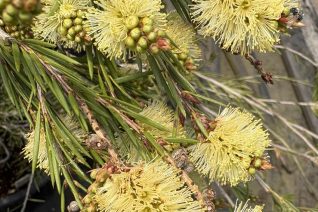
Callistemon (Melaleuca) pityoides ‘Corvallis’
I found this Callistemon in a garden in Corvallis, OR over 20 years ago. For the previous 30 years it had thrived through the coldest (0ºF or -18ºc) winters. Upright growing fine textured evergreen shrub to 6′ tall and 3′ wide in 7 years. 2″ pale yellow fluffy brushes appear in late spring/summer and again in early autumn. Full sun, average soil – especially good in clay soils and regular summer water- though it can live on no supplemental water in summer irrigation improves fall bloom. Completely deer resistant. Perfectly hardy in all of Western Oregon. Long lived shrub that tolerates heavy snow and ice. Easy shrub. Moderately fast growing. Excellent performance on the Oregon coast. Prune if needed after bloom has ended. Excellent companion shrubs are Ceanothus x ‘Topaz’ and Myrtus communis ‘Andy’s Hardy’ which bloom simultaneously,
Xera Plants Introduction.

Callistemon (Melaleuca) subulatus ‘Dark Red’
There are several hardy red flowered bottlebrushes on the market but if you really like red this is the one. Small gray thin leaves densely clothe the arching stems of this clumping multi branched low shrub. In spring and then sporadically all summer deep red 2″ long and wide bottlebrush flowers appear. Happiness and hummingbirds ensue. To 3′ x 3′ in 5 years and strongly arching. Full sun and a protected location- against a south or west facing wall is ideal. Light summer water. Excellent performance in containers- hardy Callistemon often are shy to bloom in containers but this girl is not shy at all. Brilliant, Brilliant red. Freezes to the ground below about 10ºF- returns vigorously from the base in spring. Excellent performance at the Oregon Coast. Moderately deer resistant.
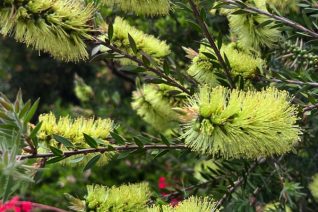
Callistemon (Melaleuca) viridiflorus
Mountain bottlebrush or Green bottlebrush is one of our very favorite shrubs that combines unusual foliage, beautiful bark, and a great flower color. Upright growing with small diamond shaped forest green leaves that line the wand-like stems. In cold weather this unusual shrub takes on maroon and purple tones, a great foil to the very light tan stems and trunk. To 8′ x 6′ in 6 years. In May 4” long by 1” wide chartreuse/yellow bottlebrushes protrude from the tips of the branches shoot out at every angle. In Tasmania where it is native it follows cold air drainages, proving that it requires at least some cold for good flower set. This clone is from a specimen that survived 0ºF in 1989. FULL sun and any soil with occasional summer water. My own receives no irrigation and performs beautifully. Hardier to cold in full sun. Unusual shrub that seems to bridge the aesthetic gap between broad-leaved evergreen and conifer. (Syn. Melaleuca virens)

Callistemon (Melaleuca) viridiflorus ‘Xera Compact’
One of our very best selections of the cold hardy mountain bottlebrush from Tasmania. This unusual variant has smaller leaves held closer together on a compact and dense growing shrub. To 4′ tall and 3′ wide in 7 years. In May-June every branch tip is decked in 3″ chartreuse green bottlebrush flowers. An incredibly heavy bloomer – even when very young. Full sun and virtually any soil with REGULAR summer water. Definitely not as drought tolerant as other hardy Callistemons. Slow growth. Moderate deer resistance. Cold hardy to 5ºF. Combine with other full sun shrubs that require moderate summer water- a good soak once every two weeks. Excels in hell strips. A great texture for borders or even an informal low hedge. Little pruning required. (Syn. Melaleuca virens- they are attempting to lump all Callistemons into Melaleuca- we’re still waiting.) Wildly showy shrub in bloom. Hummingbird delight.
Xera Plants Introduction.

Calocasia antiquorum ‘Black Pearl’
Big, bold, and hardy, this is the cold hardiest Elephant’s ear that we’ve yet grown. Large (14″ long by 9″ wide) leaves with a distinct black dot in the center- the pearl. Large growing perennial to 4′ tall and running underground to spread as wide. Rich, moisture retentive soil with regular summer water. Excellent companion for other bold leaved plants- such as gold leaved Acanthus. Excellent for tropical effects w/ no fear of freezing out. Root hardy below 10ºF when clumps are established Give this large plant room to spread. Easy to grow for the most part. Goes deciduous with the first frost and emerges late in spring when the soil truly warms. Be patient. Not bothered by pests. Mulch for the first autumn. Great for big subtropical effects. Tolerates shallow water, but is not as hardy to cold.

Calochortus tolmiei
Cat’s Ear’s or furry mariposa. This bulb is exclusive to the west side of the Cascades from central Puget Sound south to northern California. In Oregon it occupies a host of biomes. Most commonly its seen in grassy places or steep rocky slopes. On our property near Eugene it was primarily a woodland plant with forays out into the sun. We shamelessly picked this delicate flower for short lived bouquets. Picking it snuffs out the plant. To 8″ tall and sporting multiple flowers on a divided stem. The flowers have a peaked sweet fragrance that gives away the species. A fascinating flower for pollinators. Three rounded petals with a sharp tip are layered in purple to white to blue fur. This is imposed over the base color of the petals which is often white shading to purple. When planting from a container water when you plant it and then nature takes its course. It quickly goes summer dormant after setting seeds in downward shaped capsules. Do not disturb once established. Plants can put up leaves for several years before bloom commences. Patience. No summer water. Protect from deer who will snack on the flowers. Native associates are Sanicula crassicaulis, Dodecatheon hendersonii, Lithophragma parvifora, Nemophila menziesii, Iris tenax, and Carex tumulicola. Emerges quickly in spring- does its thing and then goes back to sleep. Charming.A critical bulb for Willamette Valley meadows, excellent under Oregon white oaks.. Oregon native plant.

Calycanthus occidentalis
Western Spice bush is native throughout semi shady and shady glens primarily in central and northern California with outliers in Oregon found north of Medford. A large deciduous shrub with a lush quality. The late leaves are medium glossy green and large. In summer double petalled madder red /brown flowers appear. The 2″ wide flowers have the distinct fragrance of a wine cask. Its most noticeable up close, but a large shrub in full bloom is a fruitful fragrant cloud. To 7′ x 7′ and adaptable to full sun to quite a bit of shade. Water to establish in its first year and then only occasional. This very tough drought adapted shrub should be used a lot more in our climate. Fall color is bright yellow but does not stop traffic. Tends to hit its ultimate height and then spreads laterally from there. In habitat its associates are Ceanothus, Aristolochia, Aesculus, Smilax. Very easy and long lived Oregon native shrub. Plant with Frangula, Ceanothus, etc in shrub borders or as an informal hedge. The more flowers you have the more dramatic the perfume. Seed heads that follow the flowers are large round semi woody urns and they are showy as well. Loved by hummingbirds and native insects. Moderately deer resistant protect when young. Oregon native plant.

Camellia sasanqua ‘Double Rainbow’
This is an extraordinary fall blooming sasanqua Camellia with very showy flowers and a nice upright habit. Large double cupped flowers emerge from a pink bud and unfurls to a pink edge with a white center. As the bloom ages it turns mostly to white with pink tinted flowers. Bloom appears from late September to late November. Glossy, very dark green leaves are formal in appearance and a great backdrop to the profuse 4″ wide flowers. Full sun to light shade in rich to average soil with regular summer water. This improves fall bloom. Otherwise very established shrubs can get through summer with just a few drinks. As with most sasanquas the flowers have an earthy, light, sweet scent. Long lived, hardy, easy to grow evergreen with a great season of bloom. Prune if needed AFTER flowering has ended. Wonderful as a stiff upright espalier which will protect the flowers from the vagaries of weather. Stunning in bloom. Tolerates hot aspects.. To 7′ x 6′ in 8 years.

Camellia sasanqua ‘Dwarf Shi Shi’
Most of us associate Camellias with large shrubs to small trees but this is a true dwarf and it fits in very small sites. Dwarf (slow growing) shrub with glossy green foliage and in autumn to mid-winter a constant supply of semi double rosy red flowers. To 4′ x 4′ in 10 years. Nice looking shrub that is an exceptionally heavy bloomer. This sport of ‘Shi Shi Gashira’ which is a dark pink and very popular fall blooming Camellia. ‘Dwarf Shi shi’s ‘ flowers are closer to red than its sport parent. Full sun to very light shade. Occasional deep soaks in summer aids flower bud set. Takes dry conditions when very established. Water regularly to establish and mulch. Sasanqua Camellias are hardier and bloom more heavily in full hot sun. Good performance at the Oregon coast where most Sasanqua Camellias languish. Not often bothered by deer. The entire floral tube detaches and falls never clinging and turning brown. Limited quantities.
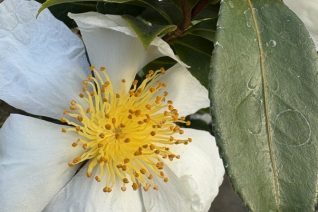
Camellia sasanqua ‘French Vanilla’
A really cool winter blooming Camellia that has several surprises. The pure white single flowers that open from December to February are HUGE- up to 5″ across in full bloom. They have a boss of yellow stamens in the center that emit a light sweet scent. When blooming is over the new growth is the next surprise. Glossy deep black leaves emerge and fade slowly to deep green. Its a great foliage transition and gives the shrub extra depth. Large growing upright sasanqua to 8′ tall and 4′ wide in 7 years. Much wider with time. Great espalier subject with vigorous lithe growth. Sets tons of flower buds and if flowers are ruined by frost more will open in sequence. Full sun to part shade in rich, well drained soil. Light but consistent summer moisture. Very easy to grow shrub with spectacular flowers at a good time of the year. Fast growing to 1′-3′ per year when young. Evergreen.
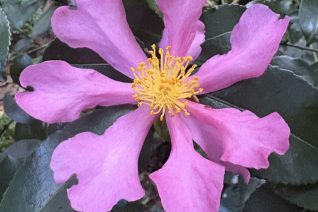
Camellia sasanqua ‘Hugh Evans’
Rare, obscure, insanely heavy blooming fall and winter blooming Camellia sasanqua. Individual flowers are not formal or stiff, instead the the petals are separated, loose and vivid pink. They appear en masse from October to January and decorate the lithe arching stems in pretty cascades of flowers. Blooms are exceptionally cold tolerant for a sasanqua enduring temperatures into the low 20’s and still remaining fresh. No bother though as a parade of buds exists to replace spoiled blooms. Full sun to quite a bit of shade- without the expense of blooming. Fast growing, vigorous open shrub that takes well to pruning in spring to encourage density- build blooming wood. Rich, to average well drained soil with light consistent summer water. A very wild and informal appearing Camellia and we love it. Glossy deep green foliage. To 5′ x 7′ and arching. Light flower fragrance.

Camellia sasanqua ‘Kanjiro’
Not all Sasanqua Camellias are created equally and though they all bloom in autumn to winter some have much studier flowers that are beautiful as well. ‘Kanjiro’ is an ancient Japanese cultivar and to this day it is still one of the finest. The large double dark pink flowers are exceptionally weather tolerant and will even survive freezes into the upper 20’s. Even if flowers are spoiled by frost a seemingly never ending supply of buds replaces the flowers quickly, in fact a this is a natural phenomenon for this shrub. You often get your best displays right after a freeze when the thaw begins. Otherwise its a non stop procession of flowers from October to December. Large growing evergreen shrub with very handsome dark foliage that is good looking year round. To 10′ tall x 10′ wide in 12 years, it may be pruned to a much smaller size or espaliered on a wall which will protect the flowers from the vagaries of weather. Moderately fast growing with regular summer water in full hot sun. Established shrubs are very tolerant of summer drought. Long lived. There is a light earthy fragrance to the flowers. Long long season of bloom. Very nice with Grevillea x ‘Leanne’ for a prolific blooming winter display.

Camellia sasanqua ‘Li’l Rose’
Obscure and stunning DWARF Sasanqua Camellia. Beginning in October and opening blooms through December and sometimes even later. Smaller stature than a standard Sasanqua. The double glistening pink flowers decorate the shrub in a dense way. To 4′ x 4′ in 8 years- but growing larger. Deep, deep green glossy leaves are pretty on this open and lax evergreen shrub. Full sun to light shade in rich to average well drained soil; light consistent summer water increases fall bloom set. Excellent and dainty espalier subject. Very pretty blooms. This is a very showy a successful Sasanqua for out gardens. It fits in small places well. It can also be pruned much smaller. Prune directly after blooming has ended.

Exquisite October to December blooming Sasanqua Camellia with fully double, large flowers for a Sasanqua, 3″ of rich pink. It is a seedling of a more famous cultivar C. s. ‘Showe No Sake’ . To me this seedling is a deeper and richer pink. The substantial flowers have great weather resisitance and the large flowers are prolifiic. A handsome shrub with slightly smaller deep green foliage. Moderately fast growing evergreen shrub for FULL SUN to very light shade. Sasanqua Camellias love full, hot sun. They will grow in shade as well but flowering is much less profuse. This gorgeous shrub is a great candidate for training as an espalier. The large double flowers are quite a display on a single branch. Rich soil with regular summer water to establish, then about once every two weeks to a month after several years. Summer water speeds growth. To 7′ x 7′ in 8 years. Attractive as a large, fall blooming evergreen hedge. Very easy to grow Sasanqua Camellia with exceptional flowers. Excellent hardiness to cold. If blooms are frozen it will also spur this shrub to open flowers like crazy when a thaw arrives. Very long lived.

Camellia sasanqua ‘Scented Snow’
A remarkable Sasanqua Camellia with flowers that are sweetly scented , semi anemone form white to cream and are huge. Every time this plant blooms i have to refresh my memory that this is not a C. japonica or x williamsii but a pure sasanqua. The fresh looking flowers are attached to glossy neat foliage that is good looking year round . Sasanqua Camellias do their best in full hot sun, They will bloom the heaviest and earliest in full sun. Rich soil with regular water for the first 4 years. Then occasional deep soaks in summer.. Makes a wonderful hedge and is opulent in bloom in November to January. Excellent espalier subject, the enormous flowers really shine. Flowers are hardy to the upper 20’s and a thaw encourage more to open. The perfume of this cultivar is very nice, Camellia forest introduction 2008. To 4′ x 7′ wide. Excellent landscape plant and one of the best sasanquas.

Camellia sasanqua ‘Setsugekka’
One of the most successful and spectacular of the autumn/winter blooming Camellias. This classic semi-double white variety begins blooming in early November and finishes in January. The 4″ wide flowers are surprisingly and wonderfully fragrant up close- the fragrance seems to be different for everyone. For me its a sweet note with a background of moist potting soil…see? At any rate its a vigorous evergreen shrub for full sun to light shade. Sasanqua Camellias really do better in full sun- trust me. Light summer water but very drought adapted when established. To 8′ x 6′ in 6 years. Excellent as an espalier which will protect the open flowers from ungodly cold if it occurs. If flowers are frozen existing buds will usually open when it warms above freezing. Good looking tough shrub for year round appeal.

Strange name for this Camellia. The flowers are decidedly fresh pink, and vivid but not burgundy. It could refer to the new growth which arrives with a raspberry tints. Either way it is one of the best Sasanquas I have grown. A dense upright shrub with smaller upturned deep green foliage. To 8′ x 6′ in 7 years . In October to December a continuous display of vivid double pink flowers. They are about 2.5″ wide and profuse. They open over several months and if the open flowers are spoiled by a freeze this will cause a rapid re-bloom with a thaw. Full sun, including hot locations to part shade. Less flowers and lankier growth in more shade. Water regularly for the first several years and then it can get through summer with 2 – 3 deep soaks. Mulch with bark. Not as good a candidate for espalier as this cultivar is dense and somewhat tear drop shaped and wide. Rich soil with mulch for the first several years. Excellent screen or hedge. Takes pruning well, which should be done after flowering has ended and into spring. Very dependable variety with weather resistant flowers – a good performer in our climate. Long lived, cold hardy to near 0ºF.

Canna ‘Wisley Dwarf’
We don’t grow very many Cannas but this one got our attention. Smaller than most it rises to just 3′ tall. In all of summer it produces masses of curly hot orange open flowers. Very pretty and very vivid. The moderately sized leaves are bold but not the tour de force of most. No mind its pretty and easy to grow in RICH, well drained soil with ample summer moisture in a hot, protected position. Emerges late in spring (sometimes not until early May) be patient- Cannas adore heat and it takes a few warm days to warm the soil enough to wake them up. Spreads to form expanding clumps. Full hot sun.

Carex pansa
California meadow sedge is native to stream banks, and vernally wet places at the beach from British Columbia south in to Baja. A deep green winter growing sedge which each plant reaches about 18″ across and 10″ or so inches high. It flops over gracefully and has a very uniform appearance through the year with light irrigation. This is a winter growing plant that resumes growing and greens up with winter rains. In very cold weather (below 20ºF) it can take on russet tints. A FANTASTIC LAWN SUBSTITUTE where it has been used extensively for that application in California. We should use it here too. Plant on 1′ centers for a lawn (faux lawn) cover from one gallons and water regularly through the first season. No water plantings can go summer dormant but in wetter environs this can be avoided and it will remain green and verdant. Water once a week in summer to remain green. Fantastic ground cover, slope cover as it will out compete weeds and form a uniform cover. Tolerates clay soils well, but some amending will reap rewards with a faster growing plant. Tolerates mowing very well. Oregon native plant.

Carex praegracilis ‘Chisai’
Excellent dwarf form of our native meadow sedge. To just 6″ tall it forms dense spreading evergreen patches. In spring to summer both male and female flower spikes rise to just a few inches above the foliage. Nice looking compact plant that retains its verdancy through the winter. An admirable substitute for lawn and mowing is not necessary. This species is most widespread east of the Cascades. Its native throughout the west and this form was identified in California. Plant on 10″ centers for a modern massed ground cover. The mid green to ochre green leaves are dense and smother competition. This creates less of a hummock affect and more of a small dome. Very easy to grow. Excels in containers. Full sun to light shade, also very high overhead shade (a tall tree canopy). Amending the soil with compost and fertilizer will increase vigor and green appearance and quicken establishment. Spreads by slowly expanding rhizomes. Excellent between stones or pavers. Tolerates light foot traffic. Not really large enough to be bothered by deer once established. Hardy below 0ºF. This useful plant has great smaller scale, ease of culture, and consistent good looks. This would be an excellent smaller grassy component of a meadow. Established plants can take quite a bit of summer drought. Carex praegracilis is an Oregon native plant.

Carpenteria californica
Bush Anemone is a locally rare native of the Sierra Nevada foothills in Fresno County in central California. This tough evergreen shrub with thin deep green leaves set against pale exfoliating glossy bark is perfectly hardy to cold and drought. In May/June 3″ wide pure white flowers with a central yellow boss of stamens are sweetly fragrant. Full sun to almost full shade in any soil with adequate drainage. Adaptable to dry clay soils and able to endure extreme drought. Extraordinarily climate adapted- enduring summer drought and winter rain. Appreciates good air circulation. No crowding. To 8′ tall and 5′ wide in 6 years. Often left alone by deer- but they will definitely try newly installed plants. One of our most treasured west coast native shrubs. Very long lived sited correctly and denied summer water. Accepts blasting reflected heat. In time you can limb up the shrub to reveal the white/taupe exfoliating bark which appears glossy with age- this also assists in the air flow that this shrub craves. A monotypic genus. There’s just one species. Limited quantities.
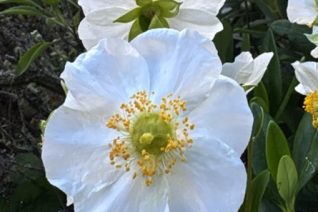
Carpenteria californica ‘Elizabeth’
A wonderful selection of Bush Anemone that was chosen because it produces more flowers (though they are a tad smaller than the species) born in multiple sprays. And this form is slightly more compact as well. An evergreen shrub with lanceolate leaves w/ a rolled margin (revolute). The deep green leaves are attached to tan stems and trunks that with age exfoliate to a glossy metallic sheen. To 6′ tall by 4′ wide in 5 years. Full hot sun to very light open shade in average, well drained soil. For clay soils its best planted on a slope. Water to establish then none after the first summer- in fact this extremely drought adapted shrub prefers to go with out water. Provide good air circulation. Adaptable to the hottest sites, including western and southern exposures. Moderate deer resistance- they will try young plants so protect them. Long lived, climate, adapted shrub. Cold hardy to about 0ºF. The white flowers that occur in May/June are sweetly fragrant. Prune, if needed AFTER flowering.

Caryopteris incana ‘Dark Blue’
We grow this species from seed because it produces such an opulent display of intense blue flowers late in the season. Whorls of flowers are absolutely irresistible to pollinators when it blooms from late July to September. A mostly herbaceous species that dies to the ground. Much more dense and compact plants than other Caryopteris which we find kind of sparse and weedy. To 2′ tall and as wide. Full sun, rich, well drained soil with regular summer water. Takes drier conditions in rich soil. Mulch in fall. Cut back dead tops in spring when you see new growth begin. Aromatic. Bee’s, you plant it for the big ol black wooly bumble bees.

Catananche caerulea
Cupid’s Dart is a simple to grow and wonderful perennial that blooms non-stop all summer long. The papery blue flowers with a deeper blue center attract all kinds of pollinators and are a specialty of Butterflies. Clump forming plant with tall wand like stems that support the flat flowers. Remove spent flowers to encourage more. Full sun and a host of soils that are sharply drained. Regular summer water though it makes due with dry conditions when established. Highly deer resistant. Wonderful companion for roses and perfect with Lavenders for a long blooming light textured wave of flowers. Each flower closes tightly at night. To 20″ x 20″ forming substantial clumps.

Caulanthus inflatus
DESERT CANDLES. This fascinating annual thrills us. Most often seen in the wild in its native California, and is commonly seen in the wildflower mecca of Carrizo Plain. Poppies, gillias, Brodiaea accompany this relative of brassicas. A small rosette of fleshy leaves gives way to an extending inflated hollow spike. Its colored bright yellow/chartreuse and glows from a distance. The MAROON flower not only cluster at the top they symmetrically line the tall stems. All together a glowing sentinel of a plant that is almost never seen for sale. The period of exceptional showiness is brief – 4-6 weeks but it such a bizarre and showy display that we wouldn’t be without it for early/mid spring containers. Might self sow in open disturbed sites. Better to save your own seed. Such a cool west coast native it needs to be appreciated for its unique and luminous beauty. To 30″ tall. Draws native insects including hover flies. Sets seed and dies in early summer completing its life cycle.

Ceanothus ‘Concha’
Big and arching evergreen shrub that becomes an unbelievable sea of ultramarine blue flowers in April. To 8′ x 8′ very quickly in full sun and well drained soil. Amenable to clay if unwatered in summer. Once established NO summer water at all. Grows quickly to its ultimate size give it room. Leaves burn below about 12ºF but recovery is rapid in spring and seldom sacrifices blooms. Rapid growing in our climate it consorts well with native wildflowers and especially bulbs. Completely drought adapted in our climate. One of the most stunning wild lilacs ever released. Pictured below at an elementary school. Planted on the playground, the children use it as a shelter. Kind of cool.

Ceanothus ‘Victoria’
This is one of the most popular shrubs in western Oregon of the last two decades. And rightfully so. This wild lilac sports excellent cold hardiness, prolific flowers, and glossy handsome evergreen foliage year round. A strong growing shrub that can literally explode in growth in rich soil but is much more restrained in poorer mediums. Remember this when planting it. It performs the best in average, un-amended soils in full sun with regular summer water for the first season to establish and then none in subsequent years. Sky blue flowers are profuse covering this dense shrub in a haze of color for 3-4 weeks in May to June. Later blooming that most other Ceanothus. This good looking shrub is so durable its made its way as highway verge mass plantings but it is just as stellar of a garden plant as well. Cold hardy to about 5ºF- it survived -5ºF in the southern Willamette Valley in 2013 by freezing to the snow line and then vigorously re-sprouting. Durable, dependable Ceanothus. Avoid the summer heat + water that it abhors- it leaves it open to root water molds that can do it in and fairly quickly. Excellent shrub for the beginning gardener. Loved by pollinators of all kinds and is virtually rolling in bees during its fabulous bloom. NOT DEER RESISTANT. Most likely a hybrid with C. thyrsiflorus which must be responsible for at least half of its make up. Found in Victoria, Canada- hence the name. Likely it is the old cultivar ‘Skylark’ that was re-named upon its survival there of a hideous winter. The old name was forgotten and the glee of survival and discovery led to the renaming. To be clear ‘Victoria’ and ‘Skylark’ are exactly the same thing. Very fast growing to on average 8′ x 8′. Excellent with all west coast natives. Blooms simultaneously with yellow Halimiums. A fantastic floral and cultural combination.

Ceanothus ‘Blue Jeans’
One of the cold hardiest blue flowered cultivars and one of the earliest to bloom as well. An open spreading shrub with prickily deep green leaves. In March/April the whole shrub is obscured in violet blue clouds of flowers. Upon first viewing in bloom most people are shocked at how showy this evergreen shrub is. To 7′ x 5′ in five years in any well drained soil with little to no summer water. Very adaptable to clay soils, especially on slopes- as with all Ceanothus avoid boggy sites. One of the toughest cultivars that also takes very well to pruning which should be done after blooming to increase density if needed. Blooms on wood from the previous year and the button shaped flower clusters are so profuse that they obscure the foliage. Tolerates blasting reflected heat and is great in hot urban situations. Makes a wonderful informal hedge for wild areas but is just as at home clipped into urban scenes. Full sun. Moderately deer resistant- unusual for a Ceanothus. Cold hardy to 0ºF. The cultivar name might obliquely refer to the flower color but its an apt comparison to this tough , tough, shrub as well. No summer water. See clipped hedge below.

Ceanothus ‘Italian Skies’
A UK selection of our own west coast native wild lilac. And they did a good job. Large mounding evergreen shrub that puts on a spectacular display of deep blue flowers for nearly all of April into May. Fast growing to 5′ x 7′ very quickly in average well drained soil. Little to NO summer water. This cultivar has HUGE trusses of scintillating blue flowers. The largest of any Ceanothus that we grow- the reason why it is such a brilliant plant in bloom. Loved by pollinators of all kinds and especially tempting to large black and yellow bumble bees. Prune after blooming if you need to re-size the plant. Good cold hardiness. Best in a hot aspect. Good job to our friends in the UK.

Ceanothus ‘Midnight Magic’
We’ve been impressed with this extraordinarily deep blue flowered Wild Lilac released by Suncrest Nursery. A fine textured deep green evergreen shrub to 4′ x 8′ and forming a graceful cascading dome. Profuse cobalt blue flowers appear for 2-3 weeks in April. Extremely drought tolerant shrub for full sun and average to poor well drained soil. Little to no summer water required. Locate out of the path of subfreezing gorge winds. One of the most graceful and showiest of the genus. Grows very quickly to its ultimate size. Excellent performance on steep hillsides. Covers the ground like an umbrella with an great, intense, flower color. Excellent underplanted with yellow Pacific Coast Iris.

Ceanothus cuneatus ‘Blue Sierra’
For cold gardens this is an excellent cultivar and its a version of a species native to the Willamette Valley south into California. Small green wedge shaped evergreen leaves on an arching, somewhat angular shrub. In April and May clouds of soft violet blue flowers swarm the whole shrub. Beautiful. To 7′ x 7′ very quickly in poor to average well drained sites. No summer water once established. Handsome at all times. Excellently adapted to rough urban life where compacted soils, reflected heat and little water is present in summer- thrives in all those conditions. Full sun. Easy. Surveys by the California Chaparral Institute report that this is the most common component shrub of that community in both California and Oregon. Fixes nitrogen with its roots and is common following disturbance. Classic west coast shrub. Excellent accompanied by native bulbs and annuals. Beautiful with Pacific Coast Iris. Oregon native plant.

Ceanothus cuneatus ssp. cuneatus ‘Adair Villiage’
This is a Willamette Valley native form of Buckbrush found in the SW part of the Valley. This species is found historically from the Portland/Oregon City area in the Willamette Valley and throughout the southern half of the state well into California.Small isolated populations occur in central Washington- revealing a much larger range at some point. It has lost large areas of its northernmost natural range to development and fire suppression. It is a fire adapted species that requires disturbance to distribute. Thats a pity because this is a fantastic native shrub for hot dry sites. It is now employed by ODOT for freeway plantings and we are happy to see that. A large, angular evergreen shrub with small deep green paddle shaped leaves. In April the whole shrub is swarmed with pure white flowers.This is a beacon to all pollinators and the sweetly fragrant flowers will literally be buzzing in bloom. Fast growing incredibly tough shrub for areas of intense drought and reflected heat. To 8′ x 8′ very quickly in any soil that does not become boggy. Excellent performance in tough urban situations. Irresistible to bees and butterflies. Associated plants in the wild are Rubus ursinus, Dodecatheon hendersonii, Iris tenax and Ranunculus occidentalis. Extremely cold hardy to below 0ºF. No summer water. Moderate deer resistance. Oregon native plant.

Ceanothus cuneatus ssp. cuneatus ‘Mary’s Peak’
This is a different form of our locally native Buckbrush. We found this at approximately 2200′ on Mary’s Peak in the Coast Range in a forest that was comprised primarily of Douglas Fir and Golden Chinquapin. This shorter shrub with smaller deep green leaves is most conspicuous in its slick gray stems. To 3′ tall by 4′ wide in 5 years. Full sun and average to poor soil. Blooms April to May with ivory colored panicles that cover the whole plant on old wood. The sweetly fragrant flowers are always buzzing with pollinators. A true low water shrub that can easily get by on only what falls from the sky, once established. This is a cold hardy and locally native evergreen shrub. Often it grows in an arching and then angular kind of way. This form is less upright. Red seedheads follow the flowers. This is a very well known and stable population in the wild that is regenerating nicely. Extraordinarily tolerant of heat and drought. Traditionally this shrub follows disturbance and was widespread in the Willamette Valley often as a meadow component with Rosa nutkana and Amelanchier, Excellent with native clumping grasses, perennials, and annuals. Oregon native plant.
Xera Plants Introduction

Ceanothus gloriosus ‘Anchor Bay’
A very good looking mounded, evergreen shrub that is best appreciated in milder gardens. In colder gardens provide a warm protected site. The small holly-like leaves are mat green and good looking year round. This moderately fast growing shrub at first spreads out and then with time mounds up. To 30″ tall by 4′ wide in 6 years. Dense growth suppresses weeds. In Apri/May for 3 weeks button shaped flower cluster are pale sky blue and appear on wood from the previous year. Prune, if needed after bloom has ended. This is seldom necessary. Consistent summer water for the first season then none in subsequent years. Excellent adaptation to the Oregon coast. Cold hardy to 8º-10ºF briefly. Very good performance in hot sunny hell strips. Accepts part shade (at the expense of bloom) and poor soils. Somewhat formal in appearance it avoids the brush pile look with dense, closely layered leaves. Not as palatable to deer. Good appearance year round.

Ceanothus gloriosus ‘Emily Brown’
The glory of this large, wild evergreen shrub occurs in April when the branches are awash in deep violet blue flowers.The darkest hue among this species. A fast growing very large shrub to 4′ tall by 12′ wide in time. Excellent for wild uncultivated areas. A handsome spreading deep green evergreen of great drought tolerance. Tolerates most soils that never become boggy. Good cold hardiness to 5ºF. No summer water when established. Loved by bees and butterflies. Takes well to pruning. Blooms on wood from the previous year, prune if needed after blooming. Excellent pollinator shrub for steep hillsides, rough areas. Evergreen foliage is handsome year round. Tolerates part shade. Blooms best in full sun. Photo below by Evan Bean.

Ceanothus gloriosus ‘Pt. Reyes’
The most popular ground cover Ceanothus and an important plant in our climate. Evergreen ground cover shrub that covers the ground densely. In March the entire plant is smothered in light violet blue flowers. Stems root where they touch the ground making it a valuable erosion control. Full sun to light shade in any well drained soil. Excels on steep slopes. To 10″ tall and 3′ wide very quickly. Plant on 3′ centers for a fast dense ground cover. If the shrub grown as a ground cover gets too tall it may be sheared after bloom has ended. Water to establish for the first season, this also speeds growth. Excellent performance in Hellstrips. Little water once established. Moderate deer resistance.Avoid direct exposure to subfreezing east wind. Very well adapted to the Oregon coast.

Ceanothus impressus ‘Dark Star’
Easily one of the showiest wild lilacs commonly grown in our climate. Tiny almost black/green warty foliage is completely covered by masses of foamy deep cobalt blue flowers for several weeks in April into May. One of the showiest cultivars. The depth of blue is amazing. Very few plants can match the intensity of the hue blue. Fast growing evergreen shrub to 6′ x 8′ in three years. Full sun and average, well drained soil. Light consistent water to establish then none. Site out of subfreezing east wind which will not kill it but can burn it badly. Easy, spectacular, fast, west coast native shrub. Note: The size of Ceanothus has everything to do with the fertility of the soil and access to water. Poor to average soil is best for a more moderate rate of growth and not as huge of a shrub.

Ceanothus impressus ‘Vandenburg’
Most Ceanothus are famous for their intense blue and profuse flowers, this interesting shrub has the typical masses of sky blue flowers which obscures the tiny warty foliage. To 5′ x 8′ and spreading wider than tall it becomes a cloud of blue in April and pollinators take notice. Rolling in bees and every other awake pollinator a shrub in full bloom is a buzzing fountain of activity. Fast growing, wiry, dense shrub with extraordinarily dark green tiny leaves. This gives the shrub the distinct appearance of a cloud. Full sun and average to poor soil including heavy clay soils that dry in summer. No summer water once established. Remarkably drought adapted west coast native shrub. Very easy to grow large, showy, shrub for wild areas, blasting hot urban hell scapes. Not totally deer resistant but better than most other species. Excellent performance at the Oregon coast. Endures sandy substrates and even a bit of salt wind. Attracts some of the first butterflies to emerge. Cold hardy to slightly below 10ºF for brief periods. Recovers from cold damage completely by bloom time. NOT FOR SALE 2023

Ceanothus integerrimus
Deerbrush is a widespread species in Oregon favoring areas with extensive summer drought. Its found primarily in the southern 1/3 of southwest Oregon and the north central part of the state into southern Washington. A small population exists on Skinners Butte in Eugene. Wide spreading semi-deciduous to deciduous shrub with young stems that remain green. Locally it is most common from about Dog mountain in the Gorge to the east and is extensive throughout Hood River and Wasco counties. This is an ideal shrub for revegetation areas, it naturally responds to fire, in fact the seeds must be exposed to boiling water to germinate. This species comes in a very wide range of colors. from clear white to deep blue and occasional shades of lilac pink. It may only be raised from seed so flower color is naturally variable. The plumes of flowers are large and airy displaying the color of the flower vividly. The most common flower color in Oregon is light blue. In late May and June a wonderful wildflower drive is up the Hood River Valley. These frothy blue, to pink to white flowers literally foam out from under native oaks and conifers. Its very conspicuous at that time too on the Rowena plateau. A word of warning not only does this shrub encourage deer browse it is also the unfortunate home of many deer ticks. Photograph carefully. Here it is found with such associates as Holodiscus, Toxicodendron, Symphoricarpos and Arctostaphylos. This brushy plant derives its name from the familiar sight of black tail deer breast height chomping away in extensive groves. Not a long lived shrub 10-15 years but it fixes nitrogen efficiently and improves the soil for successors. Full sun to very light shade, best on a dry slope. Water to establish then only what falls from the sky in subsequent years. Very hardy to cold enduring subzero temperatures. Beautiful pollinator heaven in bloom. To 3-7′ tall and as wide in several years. Oregon native plant.
Photo Credit: Dii Mazuz, Bruce Hegna

Ceanothus parryi
This is a fascinating shrub for several reasons. AKA Ladybush or Parry’s Ceanothus was first described in Oregon in the central Oregon Coast Range in 1982. The last shrub to be discovered in our state. What is more fascinating is that the next closest population of this Ceanothus begins in Sonoma County California – 500 miles to the south. This disjunct appearance of what was thought to be a California species only was a bit of a surprise. Located in the Preacher Creek drainage in the Siuslaw National Forest this formerly logged area holds several populations. A very wild looking shrub that is semi-deciduous to deciduous in our winters- the tiny leaves (1/2″ long) attach to stems that are bright light green and in fact in the winter the whole shrub has the look of a rush or a broom. Known for its very large trusses of light blue to dark blue flowers each flower cluster can measure 1′ long. Our native form of C. parryi is light blue and covers itself in pollinator loving bloom in May. To 6′ x 6′ in average soil. Water to establish and then none in subsequent years. There is nothing formal about this plant, very wild and it mixes well with other native shrubs in full sun to very light shade. Very easy to grow- avoid overly enriched soil and too much irrigation or this big wild shrub will soar. Average soil with water for just the first summer leads to the best incremental growth and a plant that doesn’t get out of hand. In habitat in Oregon this shrub is associated with Douglas fir, Vine Maple, and Vaccinium. In bloom this Ceanothus is literally swarmed by pollinators. Easy to grow very pretty native shrub. Blooms on wood from the previous year, prune if needed AFTER flowering has ended. Excellent see through shrub for hell strips. Oregon native plant.

Ceanothus sanguineus
The most widespread native Ceanothus in our region. Its known by two common names, red stem Ceanothus which is fairly self explanartory and Oregon tea. A large growing shrub to small tree with conspicuous sanguine stems clad in large mid green leaves, this completely deciduous shrub is not known for fall color making due with yellow and off green before abandoning it. Fast growing to 12′ tall in May-July depending on elevation frothy white, fragrant flowers loosely decorate this sparse plant. In full sun and with regular irrigation it achieves tree-like status quickly. In the shade it makes rounded twiggy plant that is much less graceful. A wonderful native for pollinators and birds. Pollinators relish the flowers and birds make off with the black and brown seeds. Very graceful when well grown and that means average soil and water to establish then none in subsequent years. Excellent bordering woods and thickets. Naturally occurring with Frangula (Rhamnus) purshiana and Rosa nutkatensis var. nutkatensis. Tolerates more summer water than most Ceanothus but none is necessary. Not deer resistant. Native in the Portland city limits. Oregon native plant.

Ceanothus thyrsiflorus ‘Oregon Blue’
This form of Blueblossom we found on the southern Oregon coast in the far northern part of Curry County. There seems to be two forms of Ceanothus thyrsiflorus in Oregon. The immediate coastal species up to Lane county has broader leaves. Inland you find a much taller form with smaller juvenile leaves. An example of this is our large selection ‘Oregon Mist’. This is the standard broad leaved form you find adjacent to the beach. Glossy rounded leaves are lustrous and deep green year round. In late April to early June an extended period of profuse sky blue flowers. Adored by pollinators and rolling in grateful bees. A large native shrub with a rounded outline. To 8′ tall and possibly a little wider in AVERAGE soil in 5 years. Amended soil leads to prodigious growth and lack of hardiness. Fast growing low water shrub for full sun to very light shade. This plant that we collected in the wild is actually very similar to the cultivar ‘Victoria’- the primary difference is earlier bloom by several weeks. And a slightly lighter blue flower. This is a good standard form of the beach species as found in our state. Its been cold hardy to 5ºF with good pest free foliage. Ceanothus fix nitrogen with their roots and improve the soil. Also, years of detritus from the shrub collects to form wonderful enriched soil as well. Average life span increases the less this plant is watered once established but expect 9-15 years. Durable shrub for urban to rural places. Extraordinarily drought adapted as well as tolerant of dry clay. Pretty and utilitarian. Available, autumn 2020. Oregon native plant.
Xera Plants Introduction
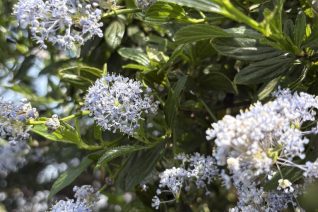
Ceanothus thyrsiflorus ‘Oregon Mist’
Greg and I found this distinctive form of Coast Blue Blossom in the wild. This species ranges from Lane County, Oregon to Santa Barbara County, California. A fast growing seral species that follows fire and disturbance. Very near the location where we discovered this handsome small tree was to the largest Ceanothus thyrsiflorus ever discovered in 1925- it was nearly 30′ tall. This is a large and fast growing evergreen tree with copious amounts of scintillating flowers. It has smaller deep green leaves and huge trusses of soft turquoise flowers in late April to early June. A tall growing tree/shrub that attains heights of 15′ very quickly if allowed. This drought tolerant native takes very well to pruning too- which should be done after blooming. Full sun and average well drained soil- including clay soils. Little to no summer water when established. Excellent for use as an instant screen or informal hedgerow. Pretty in the background of dry borders. Loved by bees and butterflies in bloom. Very easy to grow native evergreen shrub that should be used more. Life span 15-20 years. Oregon native plant.
Xera Plants Introduction.
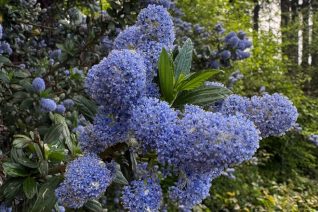
Ceanothus thyrsiflorus ‘Rogue Sky’
A selection of Coast Blue Blossom or Ceanothus thyrsiflorus that we made very far inland from its natural range in SW Oregon. Typically relegated to the coastal strip we found this variety more than 35 miles inland. This improves cold hardiness. A rapidly growing shrub/tree to 16′ tall and 8′ wide in 7 years. Robin’s egg blue flowers smother the whole plant in May. Extremely drought tolerant this fast grower may be either used as a cool, evergreen, native, blue flowered tree or it may be pruned aggressively after blooming to limit the size- increase density create a screen or hedge. Loved by honey bees and all pollinators in general. No summer water once established. Excellent background tree that delights in bloom but fades to a green screen the rest of the year. Plant with other drought tolerant plants- Arctostaphylos, Cistus, etc. Grows 3′-4′ per year when established. The flowers are a soothing blue- which is hard to capture in photographs. The effect in bloom is a blue cloud. Takes partial shade and the worst soils. Oregon native plant.
Xera Plants Introduction

Ceanothus thyrsiflorus ‘Umpqua Sky’
A very large growing, vigorous and pretty tree type Ceanothus native to the extreme SW part of the state. This fast growing evergreen tree (3′-4′ per year) puts on a huge display of soft blue flowers in late April to early June. Full sun to light shade (high overhead shade) and average soil that drains. Adaptable to clay soils, especially on slopes and not watered at all in summer. Completely drought adapted, no water necessary once established. To 18′ tall and half as wide in 7 years. Great screen, blue flowered tree that is beautiful in bloom but fades to a background for the rest of the year. Prodigious pruning can keep it much lower and it makes a great large hedge in no time. Good cold hardiness to 5ºF. We chose this variety in the wild because it was found quite a bit away from the coast which increases cold hardiness and it was immensely heavy in bloom. Prune AFTER flowering if needed. As a hedge or smaller plant it only requires pruning once a year- especially if strictly unwatered. Extraordinarily heavy bloomer and the trusses of flowers are often divided into six or more sub-branches for a very full look in bloom. Pairs well with Madrone and Arctostaphylos. Oregon native plant.
Xera Plants Introduction

Ceanothus thyrsiflorus var. griseus ‘Kurt Zadnick’
What a surprise this very dark, dark, dark blue flowered Ceanothus has turned out to have excellent cold hardiness. In our climate it is a low and spreading evergreen shrub with glossy leaves. To 3′ tall by 6′ wide in 6 years. In April/May a profuse display of the darkest cobalt blue flowers mass over the whole plant. Its so dark that it can seem like shadows over the plant but closer inspection reveals the intensity of the color blue. Full sun to light shade in average soil. Tolerates clay soil as well as withering summer drought. Prune if needed lightly after blooming has ended. This is a great drought tolerant, heat tolerant low shrub for hell strips. No summer water please. Well scaled for hell strips, low massing or a higher ground cover for hillsides. Fast growing to its ultimate size.

Ceanothus var. roweanus ‘Cynthia Postan’
One of our favorite wild lilacs with flowers as deep blue as any and great glossy dark, evergreen foliage. Not as big as Concha it is a large shrub none-the-less. To 5′ x 7′ and spreading. In April to May masses of intense cobalt blue flowers open from showy red buds. Amazing floral display that draws bees and pollinators from 5 counties around. Full sun and average to poor well drained soil. No summer water when established. Hardy to 5ºF and any winter damage that occurs (below 10ºF) recovers quickly and still blooms prolifically in spring. Excellent for no-water wild areas, for large hellstrips, sunny hillsides. The roots fix nitrogen and though its lifespan is but 10 – 12 years on average it enriches the soil in a wonderful way. Great shrub for a new garden. Avoid subfreezing wind.

Ceanothus velutinus var. laevigatus
Mountain balm, snowbrush, tobacco brush and var. laevigatus is the western Oregon form of this widespread aromatic evergreen species. Fast growing and not terribly long lived this shrub has widely dispersed seed that germinates upon disturbance, especially fire. Large glossy aromatic foliage gives away its common names as it emits a sweet balsam some say tobacco fragrance. The heavily veined leaves are large and round and seem to be varnished with this sweet perfume. Rapid growth to 12′ x 12′ in 10 years. The more fertile the soil the larger and shorter lived this pretty shrub will be. Give it average conditions and no supplemental summer water. In May to early June cones of frothy fragrant white flowers protrude from the glossy foliage. Black seeds follow and they are dispersed explosively as well as eaten by birds. These black seeds can remain dormant for generations until they wake. It is found locally in the northern Willamette valley especially around the Tonquin scablands a kolk remnant of the Bretz flood just south of Portland. Expect a lifespan of about 15 years, more with neglect. Blooms on wood from the previous season prune if needed after blooming in June. This is a large shrub and it will reach its ultimate size very quickly, Give it room. Ultra cold hardy to -5ºF on the west side of the Cascades. This fast growing shrub does not appreciate pot culture, plant from the smallest size possible Oregon native plant.

Ceanothus x ‘Julia Phelps’
Wonderful and extremely showy wild lilac that has shown superior performance in our area. Small deep green warty leaves are glossy and are the ideal back drop to the foaming cobalt blue flowers that erupt from red tinted buds in April. Fast growing evergreen that is wider than tall. Typically 6′ tall and 8′ wide in 5 years. This begs for its use on steep unwatered slopes or as a dramatic backdrop to a wildflower garden. Full sun to very light shade in average soil with water to establish then none in subsequent years. Loved by all pollinators and insects will be rolling on the flowers to collect pollen. Avoid direct exposure to subfreezing east wind. Very good in urban situations where it performs in poor soils, little irrigation and reflected heat. In colder gardens place near a south facing wall or at the top of a hill where cold air drains away. Blooms simultaneously with Pacifica Iris and they match each other well in cultural requirements. Remember Ceanothus do best in average unimproved soil. Rich soil can lead to prodigious growth and quite a bit less hardiness to cold. Wonderful cultivar. This and many cultivars will lose flower color with very heavy rain. It literally washes some of the blue color away. Ceanothus blossoms mixed with water will yield blue soap suds ( there are saponins in the flowers).

Ceanothus x ‘Peg’s Pride’
Beautiful ground cover Ceanothus that bears dense sky blue flowers in a vivid carpet in April to May. To 2′ tall and mounding it stretches out to 8′ wide. The dense evergreen growth blocks weeds effectively. Very good on steep slopes. Loved by all pollinators and especially important to native bees. This is one of the cold hardier ground cover hybrids taking 5ºF with no issue. Excellent combined with Cistus and Halimiums. Fast growing to its ultimate size. Best in full sun but will tolerate light shade with sparser bloom. Regular water for the first season to establish then none in subsequent years. Supremely drought adapted. Very good at the Oregon coast and adaptable to sandy substrates.Mid green round leaves are semi gloss and handsome year round. Spectacular in bloom. Plant on 4′ centers for a large evergreen groundcover.

Ceanothus x ‘Xera Azul’
Very fortuitous, we planted 5 species/cvs of Ceanothus in our stock beds and they of course got a little frisky. We ended up with one stellar seedling that has impressed us so much that we showed it to Ceanothus Guru Dave Fross of Native Sons Nursery and he was impressed. In its 3rd year its produced copious blooms that are about the darkest blue that I’ve seen. Only the cultivar ‘Kurt Zadnick’ has deeper tones but this plant displays them differently. Large fluffily black/blue trusses of flowers on a lower and spreading plant. To 4′ tall by 6′ wide very fast. Glossy undulate leaves look nothing like their prospective parents. It has shown great cold hardiness as well as drought adaptation. Um…..we’ve never done anything to it. It hasn’t ever even had supplemental irrigation. So, extraordinarily climate adapted. Also, most Ceanothus seedlings require 3-4 years to commence bloom. This precocious little seedling bloomed its second year. All of this adds up to a great new cultivar. Full sun to very light shade and average soil. Water for the first season to establish then none in subsequent years. Blooms late March to late April and occasionally on new wood through summer. This would make a great bank cover with Cistus and Helianthemum, Eriogonums. So cool we named it Azul. The beginning of a GREAT Ceanothus.
Xera Plants Introduction

Ceanothus x deslilianus ‘Topaz’
Possibly the darkest blue flowering cultivar that blooms in the summer. This hybrid is technically supposed to be deciduous but for us it never has been. Large panicles of cobalt blue flowers erupt from the current seasons growth in June to July. Remove spent flowers and more may follow. To 5′ x 3′ in average to enriched soil with REGULAR summer water. Good drainage. Easy to resize as it blooms on new wood, it may be cut to as low as 18″ in early spring. Black seed capsules follow the flowers and persist until birds relieve them of their contents in autumn. Excellent in borders, as a specimen, or informal hedge-row. Not as drought adapted as most of the genus. This plant is best with consistent moisture through its bloom period- not boggy (ever) but consistent. Remarkable flower color- moody, deep indigo. Click on Ceanothus video in green script.

Centaurea (Psephellus ) simplicicaulis (bella)
This is a really good perennial that combines pretty evergreen foliage and wiry stems that rise to 8″ and open pale pink fluffy Bachelors Button flowers in late spring and early summer. The low mounding foliage is dense and remains good looking through most seasons. It requires full sun and rich, fast draining soils to establish and spread. Line paths, rock gardens, gravel gardens, hellstrips. Light consistent summer water- not at all shade tolerant. Spreads to 2′ wide in time. Perennial containers. Native to Turkey.

Cephalaria gigantea
Big ass huge tall Scabiosa that is difficult to find. We’re remedying that. Large plant to 6′ tall with long wand-like stems support large (2″ wide ) pale yellow Scabiosa flowers. Full sun and rich well drained soil with regular water. Tough perennial for the back of a border or the back in general. Produces a constant cloud of glowing flowers that nod in the wind. Great cut flower. Blooms June to September. Soft yellow flowers match the color intensity of the gray foliage- a sophisticated match. Revels in hot and dry conditions when established. Dies down to nothing in the fall. Roars out of the ground in spring.

Ceratostigma minus
A very unusual plumbago species that we love for its clouds of sky blue flowers on long wand-like stems in autumn. A rounded bushy plant that usually starts from the base each spring. Over summer it develops into a rounded plant. By late summer long thread like wands push up to 14″ long and erupt in clusters of sky blue flowers. The display is light and flowery and it makes a fantastic compatriot with fall asters and and mums. Very easy to grow late blooming perennial from SW China. This does not spread like the much more common Ceratostigma plumbaginoides… instead it forms a distinct shrublike plant unto its own. The luminous flowers have intricately patterned petals which are conspicuous. To 22″ tall and about 1/2 as wide. Rich to average soil that is never boggy. Mulch in November in very cold gardens. Otherwise we’ve not lost it to cold. Great in autumn bouquets. The long stemmed flowers last well in a vase. A welcome color, texture, and height for the autumn garden. Even visited by hummingbirds. Leaves often turn bright red in winter following bloom. Full sun to very light shade. Light summer water- tolerates heat and drought when established. Blooms better in the autumn with deep infrequent soaks if fall rains stall.

Ceratostigma willmottianum ‘Palmgold’
Striking gold leaved perennial that pairs bright blue flowers for a bold effect. Blooms from late July to October on a spreading, sprawling plant. Freezes to the ground in most winters and returns from the base if in rich, well drained soil in full sun. Excellent perennial in containers. To 1′ tall by 2 wide in a season. Regular summer water. Foliage does not burn in sun. Mulch in autumn. Do not cut back until you see new growth in spring. Then remove winter killed stems. Hardier to cold in rich, very well drained soil. Often overwinters in containers. Striking perennial for contrast, brilliance. AKA Chinese Plumbago.

Ceratostigma willmottianum ‘Xera Sky’
A cool sub shrub that covers itself for months in dime sized sky blue flowers. The intensity of the color is hard to capture- it must be experienced. Forms a rounded wiry shrub with diamond shaped wavy small green leaves. To 2′ x 2′ in a season. Full sun, and rich, well drained soil with regular summer water. Freezes to the ground below about 15ºF- re-sprouts form the base in spring. Great in containers. The better the drainage the hardier this extraordinary plant will be. Provide a warm position and mulch in autumn. Once it has been established through a winter it is a fairly permanent plant. Some deer resistance. Do not cut back until you see new growth in spring- then remove all damaged stems. Great in hot sunny borders. Regular summer water.
Xera Plants Introduction

Cercis occidentalis
Western Redbud is a wonderful showy spring blooming tree that gets by on no summer water. Native to California also Utah, Arizona this is primarily a large shrub in the wild. We have found in our climate with a longer rainy season it forms a small tree. In April this entire tree comes to life smothered in tiny but profuse magenta pink pea flowers. They line all the stems and even appear on the trunk. After three weeks of glory the handsome new leaves appear. Round and blue green they have a slight rubbery texture. To 14′-18′ tall and forming a spreading crown. Fall color is orange to yellow but not reliable. Large purple colored seed pods are showy and persist after the leaves have gone. Moderately fast growing (2′-3′) per year when happy. Full sun and well drained soil of average fertility. Water through the first summer to establish then no summer water in subsequent years. Thrives in our climate.
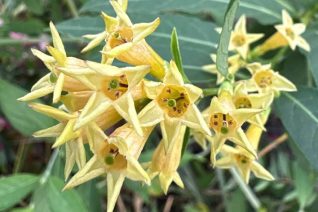
Chilean Jessamine, this is a large growing sub shrub that blooms on new wood and produces clusters of small tubular yellow flowers that pump out a heady perfume at night. Large mid green leaves line sturdy stems. Freezes to the ground in winter in the mid-teens or lower. Roars alive with warm weather and can become a shrub 5′ x 5′ even if cut to the round in one season. The flowers at terminal ends of the shoots close during the day and yawn open at night. Its a good light yellow and is a great companion for other bold plants. such as Aralia californica and cannas. Excllent in very large containers. Rich soil with regular irrigation speeds growth and bloom. Begins growing when temperatures remain in the 70’s for highs, be patient. The fragrance is fruity in a citrus kind of way and doesn’t appear until nightfall. Not bothered by deer or rabbits. Excellent plant for the back of a border. Mulch for the first winter. Chile/Argentina.

Chamaecyparis lawsoniana ‘Barry’s Silver’
Most native Port Orford Cedars that are grown eventually die out of the root pathogen phytophthera so imagine our delight when this small shrub form with gorgeous white foliage has persisted. Not that its totally resistant but it doesn’t just up and die when it gets water on the first 85ºF day. Really at its best as a stunning container subject where one can appreciate the almost white foliage that slowly morphs to aqua green. A nice bicolor effect. Unlike other variegated conifers this one does not get nasty after exposure to an arctic winter and summer sun. Instead it remains fresh. To 5′ tall and 3′ wide in 7 years- in the form of a tear drop. No summer water once established. Regular water is safe in containers. Part shade to full sun and average, well drained soil. Slow growing conifer that always looks good. Oregon native plant.

Chamaecyparis pisifera ‘Iceberg’
We are so pleased with this useful and striking dwarf conifer. New growth is strongly tipped in white before settling to a sea green. Slow growth to 3′ x 3′ in 6 years. Full sun to quite a bit of shade. Soft mein and compact habit make it a great versatile plant. Light summer water though tolerant of regular irrigation. Average soils with reasonable drainage .Good looking year round. Accepts regular irrigation and is wonderful in mixed borders. Easy to grow.

Chamaecyparis pisifera ‘White Pygmy’
Always on the lookout for dwarf conifers that really are dwarf and that are easy to grow with a minimum amount of water. This little gem does just that. Forming a spreading and arching shape- much like an anvil, the new growth on this slow grower is tipped in white. It remains showy throughout the year. To 2′ x 3′ in 10 years. Full sun to light shade in any soil. Light summer water to none when established. Adaptable to dry shade conditions as long as the shade is not too deep. Excellent, easy to grow small evergreen. Fits in the smallest gardens. Great in containers, especially winter containers.

Cheilanthes sinuata
Cliff and rock dwelling elegant evergreen silver fern. Forms a tight clump and the silver gray fronds are slender and rise to about 8″ tall. It is capable of going summer or dry dormant when established. At its best in well drained rock gardens with some protection from blasting sun. In the wild the cliffs they occupy often shade them for half the day. Its a great container fern where it thrives and always looks nice. Best with consistent light moisture. Deer resistant.

Cheilanthes tomentosa
Wooly Lipfern. yeah. This pretty and felty gray fern is widespread over North America. Clump forming gray fern that rises to about 10″ tall. Very elegant plant most often seen in very well drained somewhat dry sites. Full sun to part shade- protection from the most blasting heat. Light, consistent water in summer. Excellent in containers, troughs where it really does its best. Moderately deer resistant.

Chitalpa x tashkentensis ‘White Dawn’
A very pretty intergeneric hybrid tree between Catalpa and Chilopsis (Desert Willow). We really like this small tree that forms an umbrella shaped crown in time. To 20′ tall and continuously producing opulent large white flower clusters- the interior of the flower is marked with purple veining- much like an exotic orchid. The flowers appear on new growth and are continuous from June to September. The long thin tapered light green leaves have a nice texture. They do not color up appreciably in fall- making due with light yellow to off green before abandoning the tree. Excellent garden tree. We prefer the white flowered form as the often planted pink variety …..well, lets just say Portland has a LOT of pink flowering trees. Fast growing in youth-especially if well watered in summer. Otherwise, supremely tolerant of drought as well as rough, hot urban conditions. Casts moderate shade in time. Breaks dormancy late- usually late April. Be patient.

Choisya x ‘Aztec Pearl’
Interesting hybrid between two Mexican Oranges and wow, you get an incredible shrub that adores this climate. Rounded evergreen shrub to 5′ x 5′ after 6 years. In spring (and again in autumn) the whole bush becomes a cloud of fragrant white blossoms. They show up well with the finely divided leaves. Easy to grow shrub that is very forgiving. Drought tolerant when established and it has been hardy to near 0ºF. It takes very well to pruning which will increase both the shrubs density but the amount of flowers as well. The palmate leaves look like thin fingers or even bamboo especially as it becomes dense and layered. Moderate deer resistance. Perfectly adapted to the climate of Western Oregon. Full sun to part shade. Any reasonably well drained soil. Blooms on both old and new wood. Prune after the first flush of spring flowers has ended.

Chondropetalum tectorum ‘Dwarf’
A very nice person from a climate far colder than ours gifted us this cute dwarf Restio. And I have to say it has performed wonderfully in my garden. It froze to the ground at 9ºF- but returned in spring right away. Seems to be one of the hardiest and easiest to grow that we have encountered. Really shines in containers where you can see the sheaths on the blue green segmented stems. Rises to about 20″ tall with many stems. In summer they are topped by clustered brown flower structures. Very nice. Well drained somewhat enriched soil (for a Restio thats odd). Full sun to very light shade. Grows fairly quickly given the conditions stated above. Light summer water. Protect containerized plants from temperatures below about 20ºF. Evergreen most winters including the bummer winter of 16/17. We’ll make as much as we possibly can. South Africa.

Circium occidentale
Western Thistle or Ghost Thistle is native to the mountainous regions of southern Oregon into California. Its frequently seen lining road cuts in recently disturbed very well drained soils. To 3′ tall and all white and cobwebby it produces deep magenta flowers on large candelabra type structures. Flowers appear in June and remain until August. Loved by pollinators as well as birds. Leave the structure to over winter and go to seed and you’ll get even more birds. Forms a rosette the first year and blooms the second. No summer water once established. Loves sharp drainage in average to slightly enriched soils. If you have clay amend the soil with pumice or plant on a steep slope. Avoid competition from other plants. Not a weed. Oregon native plant.

Cistus libanoticum ssp. major
Unique in that the leaves are thin and willow-like they still harbor plenty of waxy perfume. A somewhat gnarled looking shrub over time with plenty of character. In May-July 6″ long stems erupt from the top of the shrub, elongate and produce clusters of large pure white flowers. Blooms for an extended period but each open flower lasts only one day but is replaced by a steady supply. Full sun and average to enriched soil. Water to establish then less to none in subsequent years. In time it develops a shredding, twisted, gray trunk. Moderate deer resistance. Aromatic on warm days. Mixes very well with Arctostaphylos as well as Ceanothus. A really great rock rose. Tp 3′ x 3′ in 5 years.
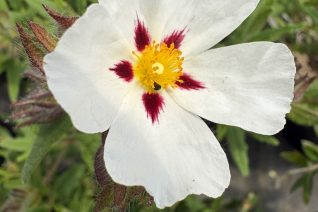
This vigorous and floriferous larger arching Cistus has small flowers just 4cm wide but every white flower has a maroon basal blotch around a yellow center. This is one of the most prolific Rockroses for quantity and length of flowers. Masses of small flowers are intricate and a shrub in full sun is an amazing tapestry of color until about 4pm when all the flower petals drop at once. Excellent hardiness to cold as one of its hybrid parents is the very cold hardy Cistus monspeliensis. Evergreen leaves are long and thin and sweet with the resiny perfume of sweet balsam. This resin (Ladinum) that covers all the foliage imparts a certain amount of fire retardance. To 4′ x 4′ tall and arching in full sun and average soil with regular water to establish. In subsequent years it can take much less. Normal deer resistance and rabbit resistance is good. Dense habit avoids splitting and flailing. Excellent shrub for dry gardens, areas beyond the sprinkler. A great shrub for rural areas- very tough. Very well adapted to our climate. The calyx which remains turns a vivd red and holds in late summer and autumn.
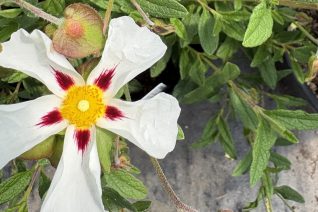
Superior low growing rockrose with masses of flowers for up to two months in late spring to early summer. So profuse are the daily flowers that they obscure the foliage, until about 4 pm and then they drop all of their petals at once. Gordon averages about 32″ tall x 4′ wide in 5 years and continue to gain width after that. The adorable flowers are 2″ across and each white petal is separate form the other giving an airy gap to the flowers. A brilliant maroon nectary guide at the base of each petal surrounding a yellow center. This low and spreading habit naturally accomodates snow and ice and there is less breakage with this cultivar. It has been a cold hardy long term performer in the Willamette Valley. Deep green foliage has a resinous perfume and takes on red tints in winter. Water to establish the first season and then about once every two weeks during summer in subsequent years. Average un-improved soils, including clay soil, and its low spreading habit is ideal for slopes. Extremely floriferous selection. Moderate deer and rabbit resistance. Very drought adapted when established. Very good performance on sandy soils at the Oregon coast and thrives there.
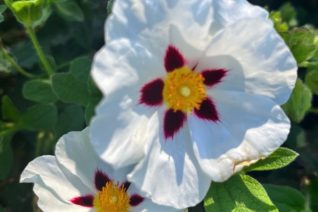
Cistus x ‘Snowfire’
A large growing improved rockrose with huge white flowers with a large red basal blotch on each petal. Deep green foliage takes on maroon tints in cold weather. To 4′ tall and 6′ wide forming a dense outline. Blooms May to July in a daily procession of flowers. Each blossom is 3″ across. Excellent cold hardiness to 5ºF or lower- adaptable to the coldest western Oregon gardens. Grows quickly in average, well drained soil Avoid overly enriched sites which will decrease cold hardiness and lead to rank growth. Lean conditions produce the most dense and cold hardy shrub. Great for rough areas in the back ground. Completely drought adapted- no summer water required. Give it room to spread. I’ve had great success with this shrub on a hillside of rocky clay soil that is strictly unwatered in summer. It and all Cistus present the ability to compete with invasive weeds such as introduced grasses. These invasives quickly out compete many things, but not Cistus. Water deep and infrequently or once established not at all. Rock roses can be prone to breaking in ice/snow. Usually, it is just cosmetic and the plant recovers. Our selections we have observed through many snow events (including a 16″ fall in 2008) and have observed no breakage. One of the very best Cistus selections.

Cistus x bornetianus ‘Jester’
We’ve grown a LOT of pink flowered rockrose. This is our favorite by far. The large flowers are clear pink on the edges fading to near white around the boisterous orange/yellow center. This gives each cupped flower a luminous backlit effect. It blooms profusely and the elegant but subtle flower color virtually marries its gray leaved backdrop. Excellent. To 3′ x 4′ in 5 years ‘Jester’ exhibits great cold tolerance as well as drought adaptation. Full sun and well drained soil with little summer water once established. The large (3″) Pink flowers appear for 4-6 weeks in late spring. Fragrant foliage is waxy and could be unpalatable to deer. Long lived for this genus. Colorful, tough plant. Combine with Ceanothus ‘Victoria’ and Halimium ‘Sarah’. Excellent performance on steep slopes.

Cistus x canescens ‘Albus’
A tough, cold hardy, and spectacular rockrose in bloom. Gray foliage is a great backdrop to the huge (3″) pure white flowers with a central zone of yellow stamens. The flowers appear daily but en masse for weeks in April to early June. Moderate growing evergray shrub to 3′ x 5′ in any well drained soil. Extremely drought adapted and requires NO supplemental irrigation when established. Avoid overly enriched soils which will lead to rank growth and quite a bit less cold hardiness. At our wholesale nursery this wonderful shrub has not suffered cold damage down to 5ºF. Lean conditions increase hardiness. Hellstrips, low water garden sections. Hot dry biomes. A great rockrose.

Cistus x crispatus ‘Warley Rose’
A fantastic low growing Rockrose with superior pink/purple (Pinkle?) flowers for an extended period in May-July. To just 18″ tall it spreads to 3′ wide in average to enriched soil in full sun. The crinkled sage green foliage emits a sweet perfume, especially if you stick your nose right up to it- but mostly it is noticeable on warm days. Its spicy and sweet and adds to the good feelings this very cold hardy selection gives gardeners. One of the last plants to be marauded by deer it makes a great border shrub for rural areas as well. Drought adapted when established, give it one or two good soaks in summer to keep it fresh. Well scaled plant that seldom requires pruning. This selection has survived 0ºF with minor leaf burn and a full recovery by bloom time. Flowers that each last one day come in a weeks long promenade. Rock gardens, hells strips.

Cistus x dansereau ‘Jenkyn Place’
After growing a whole bunch of Cistus this variety has risen to the top. Upright growing deep green evergreen shrub to 5′ tall and 5′ wide. The thin deep green leaves have the sweet fragrance of balsam. Beginning in May a constant procession of 3″ white flowers with a red basal blotch on each petal. Each flower lasts a day but there is a constant supply waiting in the wings. Full sun and average well drained soil. Tolerates clay soils well. If you give it a touch of supplemental summer water it will often extend the bloom season all the way until September. Exceptionally cold hardy. One of the finest rock roses.

Cistus x ladanifer ‘Blanche’
Very large growing deep green aromatic Cistus with enormous clear white flowers for an extended period in May-July. The flowers are so large they are reminiscent of the Matilija Poppy (Romneya coulteri) and they virtually obscure the foliage in bloom. To 8′ tall x 8′ wide very quickly. The winding and shredding trunks that develop are cinnamon brown and have a wild, gnarly appearance with age. Excellent cold hardiness especially if you avoid rich, amended soils. Native unimproved soils that drain are best. Handles clay soils well especially if on a slope. Completely drought adapted, no summer water is required. The resinous deep green foliage emits a sweet balsam aroma on hot days.

Cistus x obtusifolius
Compact white rockrose is a fantastic hybrid that gives this shrub several outstanding attributes. A dense compact habit heavily clothed in small deep green leaves. To just 3′ tall and 4′ wide forming a dome. This dense habit resists splitting in ice and snow. From May to July a massive constant procession of pure white flowers. Often bloom is so heavy that it obscures the foliage. Each flower lasts just a day but is replaced by a seemingly never ending supply. In autumn the spent flower calyxes turn bright orange red and are showy- especially when backlit by the sun. Great landscape shrub for hot sites in any well drained soil that does not become boggy. Avoid overly enriched soils for a more cold hardy and dense growing plant. Easy Cold hardy to near 5ºF. Little to no summer water.

Cistus x pagei
Rockrose are famous for the sweet balsam fragrance emitted from their foliage. The chemical ladanum is responsible and the heart shaped thick leaves of this hybrid are drenched with it. This chemical imparts a certain amount of fire retardant. Hot days bring a wave of perfume from Cistus x pagei long after its profuse display of pale pale pink flowers. Its vaguely pink from a distance. Very heavy bloomer. To 5’x 5′ in 5 years. Exceptionally hardy to cold and very very drought tolerant as well. Tolerates subfreezing wind and temperatures near 0ºF with no harm. Excellent low care shrub for rough areas. Full sun and well drained soil. Light summer water to establish. Moderate deer resistance. Excellent shrub for rural areas. In time it develops gnarled trunks with a shredded exterior. Prune if needed AFTER flowering. Rugged, beautiful, fragrant shrub.

Cistus x platysephalus
Excellent performance- including superior cold hardiness and incredibly floriferous is why we grow this moderately large spreading rockrose. Grass green linear foliage in dense and always fresh on an upright and spreading shrub. Grows in tiers which is pretty and displays the copious single white flowers well. Flowers appear daily from May to July. To 3′ x 5′ and low and spreading initially then lifting itself up gradually. Excellent cold hardiness. We’ve tried many, many Cistus planted out at our Wholesale Nursery site in Wilsonville- at least one zone colder than the city of Portland. This carefree shrub has sailed through 5ºF multiple times with NO DAMAGE and thrives in clay soil on a hillside with absolutely no summer water. As with all Cistus avoid overly enriched soil and too much summer water. Neglect is this tough shrubs friend. Moderate deer resistance. This is confused in the trade and may also show up from time to time as ‘White Gem’- its not.

Cistus x pulverulentus ‘Sunset’
Compact low growing Rockrose with spectacular hot magenta flowers from May to July and sporadically after that. The large flowers (3″) cover the handsome felted light green foliage. To 2′ x 3′ in 6 years- wider with time. Full sun and poor to average well drained soil. Light to little summer water. Hardier to cold and more compact if you avoid rich soil. Tough little evergreen plant. Protected locations like a hot south facing hillside are ideal. Scattered flowers in late summer to early autumn.

Clarkia amoena ‘Dwarf Pink’
Farewell-to-spring is a common wildflower of meadows and glens in Western Oregon. It gets its name because it is often the last wildflower to bloom before the summer drought ends the show. This form differs by its pure pink profuse flowers on a dwarf plant. (The wild form is lavender with a red blotch in the center of each petal.). An amazing display of bloom that appears as if someone dropped a bouquet on the ground. You see no evidence of leaves when its in full fettle. Blooms June to October in a garden setting with regular summer water and rich soil and the gardeners diligence removing spent flowers. Reseeds in open disturbed soil. to 10″ tall and a little wider forming a dome. Nice cut flower. Fun variation on a native. Very attractive to native pollinators. True hardy annual. Oregon native plant.

Clarkia amoena ‘Dwarf White’
Excellent little selection of our locally native wildflower ‘Farewell to Spring’. To just 10″ tall this plant(s) become a solid dome of white flowers from May-August. Cute little cut flower. Full sun in rich, to average well drained soil with just light competition from other plants. Re-seeds reliably in open disturbed sites. A great native derivative for hell strips and even containers. Regular summer water – or it will shut down go dormant and think its time to set seed and then make its melon. Rough areas, cut flower. Oregon native plant.
Clarkia amoena ssp. lindleyi
Farewell to Spring is so called because it is one of the last conspicuous native wildflowers to bloom before the onset of summer drought. And bloom it does all the way to late August. Its seen in mass populations waving above the already sear grass on hillsides that dot the valley. Little water is needed but a little supplemental water and removing spent flowers will extend the show. Otherwise it will die upon setting seed. The 2′ tall stems support multiple luminous pink cup shaped flowers. They appear superficially like a poppy. This is the variety that is locally native in the Portland area. The distinctly lavender pink flowers fade to a lighter interior near the center. But it will also appear with a darker pink/red blotch in the center of each petal on a minority of seedlings. These assist in guiding pollinators and this plant is a prime source for all native bees and butterflies. Excellent cut flower that lasts for quite a while in a vase. This is the source species of all the fancy cultivars that are raised in the cut flower trade. Reseeds happily in open disturbed sites. Excellent plant for wild areas and is often employed on road cuts and freeway embankments in deliberately sown wild flower mixtures. I’ve noticed that this local subspecies re-sows itself annually where other subspecies and especially the showy florist varieties are shy to do so. If you want a robust, climate adapted wildflower then go with this subspecies. It comes back strong. Probably our showiest and longest blooming native annual. Reseeds- leave stems to dry and disperse seed and remember to leave open spaces for next years show. Wonderful with yellow Madia elegans for a months long display of brilliant native annuals. A Xera favorite plant. See video below (IMG) taken at the William Finley Wildlife Refuge just south of Corvallis. Oregon native plant.

Clarkia purpurea ssp. quadrivulnera
AKA Four spot Clarkia or Four spot wine cup, also Godetia. This charming little native hardy annual occupies warm, somewhat dry spots at low elevations west of the Cascades. The flowers are slightly smaller than Clarkia amoena var. lindleyi but it is profuse. Flowers line thin stems and inbetween the very willowy leaves a cup shaped flower with four petals. It ranges from light to dark pink and there is a darker pink swish at the base of each petal. This is known as a nectary guide and its like a landing pad for pollinators. Blooms appear from late May through July. To 14″ tall on average, depending upon the fertility of the soil. Re-seeds happily and the first seedlings which are slightly downy will appear after fall rains begin. Full sun to the very lightest shade. Flowers close on cloudy days. No supplemental water is necessary . Mix with Gilia capitata, Limnanthes alba. and Plectritis congesta with whom it decorates undisturbed meadows. Not a good cut flower, very feral but beautiful and losing its native environment very fast. Excels in a gravel mulch. Excellent for native pollinators and very important to native bees. Oregon native plant

Clarkia rubicundra
This is a wonderful hardy annual from the central California coast ranges and foot hills. Its closely allied to our native Clarkia amoena var lindleyi and though a bit taller the most conspicuous difference is the base of large pink cup shaped flowers are stained in bright red. Thats where it gets its descriptive common name of Claret Cup Farewell to spring. To 32″ tall if forms a candelabra of 2″ flowers that point upwards. The bright red on the base of the petals act as a nectary guide, think of this as landing lights for pollinators. Blooms June to August and it makes a large plant. The flowers spikes make long lasting cut flowers. LOVED by carpenter bees who will cut circles out of the petals to line their nests. So cute. Re seeds in open disturbed sites or even better a gravel mulch. Mix with all other native hardy annuals. Great long blooming container plant. No supplemental irrigation required. Very long blooming. Seeds germinate in early autumn and overwinter as tiny plants.

Clematis ‘Rhapsody’
Possibly one of our favorite large flowered Clematis. This delightful 8′-10′ vine has intense sapphire blue flowers that open light and turn to a darker blue as they age. The petals surround a charming boss of creamy stamens. This very showy vine blooms continuously from July-Sept. Its a smaller scale Clematis that can happily climb large shrubs to small trees without smothering them. The flowers which are 5″ across are dramatic and showy from a distance. Easy to grow in our climate, in rich soil with regular summer irrigation. Full sun to the very lightest shade, but flowers are more vivid with sun. The petioles wrap around supports and hoists this plant up. May be hard pruned in early spring to just several buds. This vine which blooms on new wood will quickly regrow and produce a parade of flowers in just several months. Excellent climbing gold leaved shrubs for brilliant contrast. The flowers born on long stems also make a decent cut flower. Provide support such as a large trellis or #4 copper wire to send it climbing around a post. Beautiful Clematis.

Collinsia grandiflora
Native annuals often get over looked in our gardens. They occupied vast stretches of the Willamette Valley and civilization has caused those displays to suffer. In our gardens they are precious reminders that we should include every category of native plant. Giant Blue Eyed Mary is one of our most delicate looking and stunning in floral detail, It makes a hazy cloud of beautiful blue and white small snapdragon flowers from late April to Mid June. A true annual that dies once the floral display is done. But leave the skeletons of the plant for several weeks longer to form and shed seeds for next years display. This 20″ tall grassy plant occupies open sunny sites as well as the margins of forests. In our gardens it appreciates open slightly disturbed soil. Seedlings germinate in autumn and over winter as small plants. They will heavily occupy an area about the size of a 9″ pie. Excellent plant to succeed mid and late spring bulbs. Water lightly after planting and to establish then none required. Native to the Portland city limits as well. Fantastic displays of this plant can be seen at Camassia in West Linn all through late spring. This is a very reliable re-seeder if you give it some open ground and check for slugs. Seedlings germinate quickly following the first rains and are incredibly cold hardy and drought tolerant. Don’t worry, they are from here, they know what to do. Attracts a wide variety of native pollinators including a wealth of smaller hover flies. Oregon native plant.

Convolvulus cneorum ‘Xera Sphere’
Sport! We found a sport and it turned out to be a congested or actually more compact and dense form of Silver Morning Glory Shrub. Woody plant with the most metallic silver leaves possible. Each thin rounded leaf shines virtually like molten lead even in dark rainy conditions. In summer the tight silver foliage plays host to white (with pink stripes on the reverse) morning glory flowers. Full sun, very well drained poor to average soil. Little summer water once established. To 2′ x 2′ forming a perfectly round ball. Hardier to cold in well drained poor soil. Fertility and too much summer water leads to rank growth that does not harden for winter cold. Hillsides are ideal and all day sun and very little water once it has begun to put on growth in earnest. Moderate deer resistance. Mediterranean native.
Xera Plants Introduction.

Coprosma x ‘Black Cloud’
This is a hardy shrub in a genus that is known for being decidedly tender. A fantastic black leaved evergreen shrub from New Zealand which is an exciting hybrid. Small, glossy green leaves stained with black on handsomely patterned branches. Full sun to light shade. Spreading habit is low when young eventually it grows upright to 4′ tall and 5′ wide with a distinctive and beautiful tiered branching pattern. Insignificant small white flowers- they look like little translucent white worms- way more unobtrusive than it sounds. This shrub has shocked us with its hardiness to cold. It survived temperatures in the single digits in a container and didn’t flinch. This is a wonderful foliage shrub that should be more popular. Excellent appearance year round. Drought tolerant. ‘Black Cloud’ Mirror Plant. Use as a small scale ground cover or first rate landscape plant. Very easy to grow.

Corokia cotoneaster
Why, its not a Cotoneaster at all, in fact Corokia is a wildly architectural shrub and evolved its twisted zigzagging stems (the official term is divaricating) and tiny leaves to fend off grazing by giant Moa birds in New Zealand. The birds are now extinct and we are left with this shrub as an evolutionary natural bonsai. To 5′ tall and 3′ wide in 7 years. Average to enriched soil. Full sun to part shade. Flowers are more profuse in sun. Regular water. Great container plant. The yellow flowers in May are often followed by red /orange berries that don’t last long. I assume the brilliant color draws birds. Established plants accept both regular irrigation as well as summer drought. Irrigation encourages growth. Left to contend with summer drought the plant is naturally smaller. Cold hardy to 5ºF or lower for brief periods. Excellent landscape or garden plant that imparts a haze on the landscape from a distance but thrills with up close views of the zig zagging branches and tiny black shovel shaped leaves. Excellent long lived container subject and will thrive even with constricted roots. We love this shrub for its silvery winter appearance in containers and in container combinations. Mix with Sasanqua Camellias and Western Blue Fescue (Festuca californica) for months long entertainment. Seldom bothered by deer.
Corokia x virgata ‘Mangitangi’
Compact hybrid Corokia that has larger leaves that turn from gray to bronze in cold weather. To 4′ x 3′ in 6 years. The upper parts of the stems are more like soft gray rushes before the foliage elongates. In late spring starry bright yellow flowers spangle the older growth. Occasionally its followed by orange berries. Very forgiving shrub that we have actually grown for years. It has good cold hardiness for a Corokia x virgata hybrid and its compact, dense and good looking year round. Avoid the coldest sites, gains cold hardiness with age, protect the smallest plants from temperatures below 20ºF, after several years it will be hardy to the upper single digits. Makes a great sheared hedge and its used for that purpose in its home New Zealand. Great performance at the Oregon coast. Very good in containers. especially winter containers. This shrub has a much more burgundy hue in winter as opposed to the all gray look of Corokia cotoneaster. Easy to grow. This shrub would be good to try where deer are profuse. Its excels in containers in the urban scape of down town.

Cosmos atrosanguineus
Chocolate Cosmos – one of our favorite seasonal plants. It blooms non-stop from June to frost with copious single deep red/black/mahogany flowers that have the special fragrance of dark chocolate. Forms colonies in well drained, rich soil with regular summer water. Cold hardy to the upper teens it will overwinter most years in very well drained soil- try a hot south facing slope. Otherwise, it forms a tuberous root and may be lifted and stored like a Dahlia in autumn. A great tender perennial for containers, borders. Fantastic cut flower. To 20″ tall in bloom forming a clump to 2′ wide. Mulch in autumn with dry leaves. Best in the hottest possible aspect but with regular water in rich soil. Easy to grow. Mexico.

Cotinus obovatus
American smoke tree has a surprisingly limited natural range in Arkansas, Missouri, Oklahoma but its an exceedingly adaptable tree. Large round leaves are soft green when they emerge. In mid summer the tips of the branches are covered in clouds of beige smoke- which is not as prolific as the hybrids or the species Cotinus coggygria. Rounded medium sized tree to 22′ tall and handsome. Moderately slow growing 1-2′ per year when young. Full sun and regular irrigation to established then fully summer drought established. Deep rich soils yield the best performance. Autumn is its time of true glory. The large soft leaves transform into electric shades of orange/red/yellow. It holds this color for weeks before dropping. An amazing show that outshines just about any other deciduous tree. Limited supply. Accepts some summer irrigation. It is being used as a street tree in Portland, where its arboreal habit is superior to Cotinus coggygria and its hybrids.

Cotula hispida
Groovy container or rock garden perennial that is basically a silver bun of softness. Even water beads up on the hairy metallic fine leaves. 4″ stems rise to bear petal-less golden yellow disks. whimsical and wonderful and blooms repeatedly all summer in full sun and exceptionally well drained soil with consistent moisture. Let it dry between watering and give this little evergreen plant good air circulation. Very light watering. Actually, this adorable plants best application may be in modern seasonal containers. Improves hardiness too. Silver buns and dancing disks, damn. To 6″ wide.

Crinodendron patagua
Chilean Lily of the Valley Tree or Evergreen Snowbell- both descriptive common names for this unusual tree from South America. Fast growing evergreen tree that looks superficially like a live oak. In mid to late summer relatively large pure white waxy bells appear and line the stems like small bells. The bottom of the waxy bloom is deeply serrated. Cool. To 24′ tall and half as wide. Often forms multi-trunks if you don’t want this then diligently prune it until you get one sturdy trunk. Do not site in the direct path of subfreezing east wind- a south or west exposure will do in windy areas. Easy to grow tree that gets by with a minimum of water in summer once established. Slightly hardier than Azara microphylla with which it grows in habitat.

Crithmum maritimum
What a cool name ‘Sea Samphire’ not sure what that means but I do know this is a beach plant on European shores. Sparse, angular and almost succulent blue foliage forms a ring of upright facing thin leaves. In late spring into summer large soft sulphur yellow umbels arrive. UMBELS UMBELS UMBELS are so in style right now. To 2′ x 2′. Full sun and average to rich well drained soil. Light to little summer water when established. Leave the Sea Samphire strictly alone. Evergreen perennial in the carrot family. Umbels. Its all about umbels. Moderate deer resistance. Edible and a fair substitute for thyme. Excellent in salads as well as cooked.

Crocosmia x crocosmiflora ‘Solfaterre’
The market is full of Crocosmia selections but we think this one is a classic. The foliage is a dramatic bronze color and the spikey leaves are a great backdrop to the apricot yellow flowers that occur in July to September. To 2.5′ tall and forming an expanding clump. Full sun to part shade in rich, moisture retentive soil with light but consistent summer water. It makes a very good cut flower that lasts in a vase. Combine with other sun loving late summer blooming perennials. Completely deciduous in winter. Moderate deer resistance.

Cryptomeria japonica ‘Birodo’
Wonderful easy to grow dwarf form of Japanese Cedar. This form has not scales but more like tiny needles. In summer the foliage is deep green. With cooler weather it takes on amazing russet tints. Very slow growing to 3′ x 2′ in 8 years. Incredibly dense growth habit gives the appearance of diligent pruning- but none is required. Extremely drought tolerant. For full sun and little summer water once established. Rock gardens, containers, gravel gardens. With or without other dwarf conifers. High deer resistance. An excellent truly long term dwarf conifer that retains its good looks. It would make a great no prune hedge that maxes out at 4′ tall but provides density. Very good resistance to subfreezing wind. This performs very well in the Columbia River Gorge and eastern suburbs of Portland. Static form but dynamic seasonal color shifts. Cool.

Cuphea cyanea var. subhirtella
This plant has been a real surprise. Most Cupheas are decidedly tender to cold in our climate, however, this variety soars above the rest. Its been a long term reliable perennial for us. Perhaps just a smidge hardier than the species. This charming little bat flower delights with multicolor flowers- tubular and shades of pink and yellow. The petals that serve as the bats ears are maroon. Wonderful long blooming plant- flowers continuously all summer to autumn. To 1′ tall and as wide. As a perennial it excels in rich, well drained soil with regular summer water in full sun. Just when you think it won’t return in spring it quickly arrives with warm weather and commences blooming almost straight away. Loved by hummingbirds, butterflies and pollinators in general. Treat it well – water and establish and mulch for the first winter. As an annual it is wonderful as a continuous flowering container subject. Native to Mexico.

Cuphea cyanea ‘Strybing Sunset’
We originally grew this wonderful vivid free blooming bat flower as an annual. But after years of growing it in the ground we’ve found that its remarkably root hardy. To 20″ tall forming a semi-woody shrublet it produces sprays of small but vivid flowers from May to frost. Full sun and rich, WELL DRAINED soil in the ground and patience- it takes a while to come back in spring- usually not until truly hot days appear in May. Once up- with regular supplemental water it zooms and blooms and resumes its previous stature quickly. Good drainage in a hot position seems to be the key as a perennial. Mine has happily lived in the ground in my garden in North Portland for 7 years- returning from the coldest winters. It will freeze to the ground below about 28ºF- but it always returns. Great seasonal plant in containers and it will draw hummingbirds from 5 counties around. Nice plant. Blooms continuously without intervention. My kind of plant.

Cuphea micropetala
Groovy Cuphea that we grow as an annual. In mild winters and with good drainage this rainbow of a plant may over winter. Either way its a long, long blooming plant from June to frost. Spikes appear continuously holding tubular shaped flowers- they begin yellow and age to orange for a multicolor effect that yields a dramatic show. To 10″ x 1′ forming an expanding clump. Full sun and rich well drained soil with regular summer irrigation. Best on the edge of a container where the spikes which protrude nearly horizontally will showcase the flowers. Loved by hummingbirds, bumble bees and just about any pollinator. Remove spent flower spikes to encourage more. Very easy to grow. Mexico.

Cupressus (Hesperocypress) macrocarpa ‘Citriodora’
Fantastic form of the incredibly tough Monterey Cypress. Foliage on this fast growing large evergreen tree is brilliantly hued in chartreuse/gold and acid green. Pinch the foliage and the fragrance of lemons is released. Fast growing tree for poor to average well drained soil. Avoid overly rich soils- which causes rank, unsteady growth. Average un-amended native soils are best. Light summer water to initiate growth and then completely drought tolerant. To 35′ tall x 25′ wide in 15 years. In time it develops a really cool flat spreading crown that this species is so famous for. Great drought and cold tolerance at our nursery. Give it amble room, full all day sun and not much else. Cold hardy to 0ºF. Long lived tree. This species has been placed in the genus Hesperocypress.

Cupressus glabra ‘Sulphurea’
Remarkable form of the hardy Arizona Cypress. This variety has foliage frosted in chartreuse/cream with interior foliage closer to sea green. A great affect. To 15′ tall but only 4′ wide this is a decidedly fastigiate form of this species. Fast growing tree for screens, specimen. Poor to average soil- avoid rich soil- this causes Cypress to grow to fat and fast in our climate- they get rank and rocky. So plant in average to poor soil with light irrigation until you see appreciable new growth and then none- ever. This produces a more measured growth rate and a sturdier plant. Full sun- from ALL directions- no shade at all. Open exposed sites are best. Very pretty plant that adores our climate. Cold hardy below 0ºF. Rare tree and quantities are limited. Completely drought tolerant.

Cupressus macrocarpa ‘Wilma Goldcrest’
We love Wilma and have found that she’s a great landscape plant and not just relegated to seasonal containers. Fast growing dense, columnar acid green/gold tree to 9′ tall and 2′ wide in 7 years. Average, well drained soil. Do not plant this in rich amended soil, it will grow rapidly and rank and likely tip over in the first windstorm of the autumn. Instead rely on its adaptation to poorer soils to create sturdy, measured growth. You’ll thank yourself in the end. Foliage can be burned by strong subfreezing wind- plant this out of the path of east wind. It recovers quickly in spring and you’d never know there was winter burn by about May. The foliage has an intense lemon fragrance. Great in containers. Little to no summer water. Moderate deer resistance- they won’t eat it but they may rut on it.

Cupressus sempervirens ‘Glauca’
The most common form of Italian Cypress with a strongly fastigiate (skinny upright habit) and blue green foliage. Fast growing tree that demands average to poor soil and little to no summer moisture. Soil that is too rich and too much water in our climate leads to prodigious rank growth and instability. Dry, poor soils and no summer water leads to steady measured growth and no tipping. Full all day sun from every direction. This will ensure thick foliage from the base to the top. Established plants can easily put on 3′-5′ of growth per year. To 22′ tall and about 18″ wide. Extremely drought tolerant. Does not succumb to spider mites or other diseases as Arborvitae frequently can. If it is too tall you may top it and it will re-grow a new terminal leader quickly. Great in containers. Protect containers from temperatures below 10ºF. Takes intense reflected heat with no problem. Great urban tree.

Cupressus sempervirens ‘Swane’s Golden’
The golden form of Italian Cypress which is a very useful plant for bright vertical effects in gardens. Fast growing fastigiate tree to 18′ tall and just 18″ wide. Full sun and average to poor soil with little to no summer water. If it becomes disheveled in ice or snow simply give it a good hair cut and a denser form will emerge. You may also cut the top to limit size and a new vertical leader will quickly form. Deer resistant. Avoid overly enriched soil and shade or growth will be rank and unkempt. Grows about 2′-3′ in an average year.

Cupressus sempervirens ‘Totem’
A superior form of Italian Cypress that is thinner and more resistant to ice and snow. The foliage is forest green eschewing the blue hue of the more common ‘Glauca’. To just 10″ wide it rises to 16′ tall in a fast growing spire. Full sun (which means all parts of the columnar tree from top to bottom should receive full sunlight) and poor to average, unimproved soil. Avoid overly enriched soil which causes fast rank growth which can make the tree unsteady. Its adapted to the very poorest soils which ensure measured, sturdy growth. Our favorite form of this useful disease and pest resistant columnar tree. Cold hardy.

Cylindropuntia whipplei ‘White Spine’
Love this small growing Cholla that has the most amazing luminescent white spines. Densely branching low plant to 2′ tall by 3′ wide in time. Not terribly fast growing. Fast draining soils that have been amended heavily with gravel and pumice and ideally on a slope will make this a focal point in the dry garden. Light summer water will speed growth. Extremely cold hardy and not terribly fussy. Give it an open position with sun all day long. Wonderful in rock gardens. Flowers we have not seen but we assume with this species that they will be pink/purple in summer. Highly deer resistant. Great container plant. Move to a dry position in winter just for extra protection from wet.

Cynara baetica var. morrocana
Fancy and beyond showy ornamental thistle/cardoon. Finely divided silver foliage lines a stem that elongates to bear multiple large violet blue flowers. The calyx (the mechanism that holds the flower (s)) is nothing more than fiercely and lethally armed with razor sharp spikes. They will cut you . Be careful. The violet blue and lower down, pink flowers are host to every pollinator in the neighborhood, Monarch Butterflies, Hummingbirds and even the post person is drawn to this remarkable flower. To 28″ tall for full sun and rich, well drained soil. Drainage must be sharp. Light summer water. Appreciates a hot position. Moderate deer resistance. Winter deciduous. N. Africa.

Cynara cardunculus
Cardoon. Big ol artichoke cousin that has amazing architectural bold, silver leaves that are up to 30″ long and half as wide. Forms a large rosette (4′ across) initially then the stem extends rising to 4′ tall bearing huge rich, violet blue flowers that are up to 5″ across held in a cylindrical calyx. Open call to all pollinators. Blooms begin in the second year in May and repeat to August. Full sun, rich, well drained soil with light summer water. Give it room to spread out horizontally because it inevitably will. Light deer resistance. Beautiful perennial in all of its parts. Lifespan (3-5 years ) on average.

Cypella (Phalocallis) coelestis
Wonderful Iris relative from South America that we cherish for its daily large three petalled intricately marked blue flowers. Rising to 2′ tall, corrugated blue green leaves accompany the strong upright stem. Beginning in May a daily procession of flowers that open at sunrise and close and finish by 2 to 3 in the afternoon. Don’t remove the spent flower as curiously more (and more) flowers will appear from the same stem. Large seed pods will form. These may be snipped off to refocus on more blooming. Full sun and rich, well drained soil in a warm position with regular summer water. I add a handful of all organic fertilizer around the base just before blooming. This markedly increases vigor and even the size of the flowers. Freezes back almost to the ground below 20ºF. Moderate deer resistance.

Cypella (Phalocallis) herbertii
Adorable little bulb that forms grassy colonies. Beginning in early summer and continuing to fall 10″ stems support amber orange intricate three petalled flowers. Each lasts just one day but new flowers appear seemingly from nowhere from the stems so do not remove- these stems can produce flowers for up to 6 weeks. Grassy medium green corrugated leaves accompany the flowers. Open sites with little competition from other plants. Sharp drainage in average to rich soil with regular summer irrigation. Full sun to light shade. Surprisingly cold hardy. Rock gardens, containers. Native to rocky plains in Argentina and Uruguay. It makes a great candidate for troughs and perennial containers where you can closely inspect the fascinating blooms. Mostly evergreen in our climate. Some deer resistance. Close iris relative.

Dahlia ‘Forncett’s Furnace’
We choose the Dahlia varieties that we grow very carefully. Time has taught us that all Dahlia cultivars do not share the same cold hardiness. What we’ve whittled down is a list of Dahlias that have never frozen away for us. This marvelous selection boasts large single firey orange flowers on tall waving stems. The intensity of the flower color is shocking and it make a great denouement to summer blooming well into autumn. To 5′ tall in the ground this robust perennial requires some protection as it first emerges to deter slugs/snails. Once its up and growing fast this is less of an issue. Full sun and rich, well drained soil with regular summer irrigation. Excellent and lurid cut flower. Excellent hardiness to cold- it is not necessary to dig and store the tuber so long as the soil is well drained. Mulch in autumn post first frost adds insurance. Moderately deer resistant.

Dahlia ‘Red Menace’
Our selection of a superior deep black leaved Dahlia. Finely divided leaves are symmetrical on towering stems to 4′ tall. In mid summer to fall a constant procession of vibrant red single flowers. They harmonize greatly with the leaf color. Full sun and enriched soil with regular summer water. Soil that does not become sodden and frozen in winter will yield the cold hardiest plants. Mulch in fall. Nice cut flower, arrangement material. Multiplies into large clumps in time. This selection has survived the coldest winters of the past 15 years. We’ve kind of let Jack frost do our selecting for us.
Xera Plants Introduction

Dahlia ‘Sangria’
This is a brilliantly colored dahlia with large single deep pink flowers that contrast wonderfully with midnight black foliage. To 34″ tall and increasing by tubers. Excellent cut flower but it makes a better garden subject where the contrast in foliage and flower color shine. Blooms late June to frost. This is a vigorous and hardy dahlia that is very easy to grow. Amend the soil heavily with compost and add all purpose organic fertilizer to the planting hole. Wonderful with the brilliant orange flowers of Epilobium (Zauschneria). Mulch in fall or lift after frost and store in shredded paper in a cool dry place. Replant after all threat of frost has passed and the soil is sufficiently warm. Regular summer water in full sun.
Xera Plants Introduction

Dahlia ‘Towering Blonde’
We promised this very tall dahlia that it didn’t have to play basketball. And she agreed to produce a constant supply of amber/blonde single flowers that we love. This is a very old variety for us. In the past 20 years we’ve let our original seed and cutting raised plants dwindle as they are taken out by horrible freezes. What we’ve found is that we lose Dahlias by variety which implies two things. One, Dahlia’s cold hardiness is different for every cultivar let alone species. And (two) we’ve let nature do the selecting for us. The varieties that are left are the very cold hardiest Dahlias, and we’ve been very impressed with their performance. Rich soil that is never boggy but is moisture retentive with regular summer irrigation. Full sun and this variety also sports dark foliage which is highlighted by the lighter colored flowers. To 5′ tall with long flower stems. Dahlias as best planted in a warm full sun position in our climate where the soil seldom freezes. A thick mulch in fall is added insurance. Our varieties have been reliably hardy down to 5ºF with no issues. If you live in a colder zone you can lift and store the tubers over the winter. Replant when all danger of frost has past. Mulch annually with compost.
Xera Plants Introduction
Dahlia ‘Xera’s Moonfire’
This has turned out to be one of our best hardy Dahlias. It was a sport from ‘Moonshine’ which is yellow with a central zone of orange. This delightful flower is brushed with orange through out. Amazing the things that turn up in a nursery over the years. This stunner just appeared virtually out of no where. To 3′ tall in bloom and forming a large clump of dark foliage. Dark leaved Dahlias add a great depth of contrast in a garden. Excellent cut flower. Blooms July-October in full sun and rich soil with regular irrigation through summer. In colder climates the bulb (tuber) can be lifted after the first frost and held in slightly wet shredded paper in a dark space. Re-plant when all danger of frost has passed. Pair with dark purple flowered Salvias and Aster ‘purple dome’. Protect emerging plants from snails/slugs. Not often bothered by deer. In the ground it appreciates very rich soil and regular water in full sun. Add a layer of compost each year and you’ll improve drainage for better winter cold tolerance. Easy perennial.

Daphne genkwa ‘Hackenberry Group’
A large flowered form of this excellent deciduous shrub. To 4′ x 4′ in 5 years soft gray buds open to masses of violet blue (non-fragrant) flowers which line the stems. Simple leaves that follow have a fine fur on the surface. Blooms for an incredibly long time from late March to early May. Full sun, very well drained soil in hot sun. Little summer water when established. Fall color is light yellow. Plant with Manzanitas, Grevilleas, Ericas. Low maintenance shrub of great grace and beauty. Willowy shrub that gets by on a minimal amount of summer irrigation.

Dasylirion wheeleri
Sotol or Desert spoon is an excellent Yucca relative that does amazingly well in our climate given the correct conditions. Native to the northern Chihuahuan Desert of northern Mexico into Arizona and stretching to the east through New Mexico into Texas is where you will find this handsome desert dweller. Rosettes of serrated blue green leaves radiate out in a circular orb. The ends of each leaf become frizzy and add an overall hazy texture to the plant. In time, when happy 9′ spikes erupt from the center and display columns of small white flowers. Very well drained soil in a full, hot position. Excellent on hot, south facing slopes but perfectly at home in the dry gravel garden. Foliage to 3′ x 3′ slowly. Evergreen. Light summer water to establish then none in subsequent years. Great in containers. High deer resistance.

Datura wrightii ‘High Altitude Form’
LOCO WEED. We discovered this native SW perennial growing very high up east of the crest of the Sierra at above 6500′. Damn it gets chilly up there. Herbaceous perennial that emerges with large, bold, silver-blue leaves. Sprawling to several feet wide in a full, hot position with exceptional drainage. All summer huge white goblet like flowers unfurl from curiously colored gray buds. You can literally watch the flowers open in the evening. They glow in the moon light and emit a soft fragrance. By 2:00 the following day the flower has withered. <sad face> but more are in the wings. Begins blooming in late June and repeats to frost. Completely deciduous (gone) in winter. Good drainage in a hot position- where the soil warms early. Spectacular. Toxic- but what garden plants are not? High deer resistance. Native to the american southwest and northwest Mexico. It has become naturalized in arts of the Willamette Valley, Columbia Gorge, and Eastern Oregon. Rarely seeds itself in our climate. The seedpods that develop following the flowers are round and spiney.
Xera Plants Introduction.

Delosperma basauticum ‘Sunfire’
Nice compact little ice plant that requires excellent drainage, full sun and regular summer irrigation. In May/June it is covered in bright yellow star shaped flowers. They open in full sun and close when its cloudy or at night. To 3″ tall and 1′ wide in a season. Best in rock garden conditions. Works well in fast draining troughs. Tiny, congested succulent foliage.
Xera Plants Introduction.

Delphinium nudicaule
Brilliant orange/red tubular flowers each with two spurs on the rear of the flower. They appear to be swarming around the green wiry stems that support them. To 20″ tall, blooms rising from a basal rosette of leaves. Blooms May-July in Portland. Somewhat tricky southern Oregon native wildflowers that needs a bit of care and correct siting to establish and become perennial. Rich, well drained soil with light but consistent summer moisture. Native to very steep slopes and cliffs with excellent drainage but with groundwater in the form of seeps near by. Wild areas, gravel gardens for the ultimate wildflower effect. Established plants will often re-bloom if spent flower spikes are removed. Hummingbirds. Moderate deer resistance. Oregon native plant.

Dendranthema ‘Hillside Sheffield Pink’
A wonderful garden perennial and by far our favorite mum for fall. Much more informal and relaxed in habit and flower form it puts on a stellar show for months in autumn. Soft, copper pink single flowers radiate from a soft yellow center. A bushy perennial to 28″ x 28″ in full sun to light shade. Best in enriched soil for a good start in life. Regular summer water propels growth and blooming which begins in September and stretches nearly to Thanksgiving. Cut back hard the previous years remnants in early spring – as per your tidying routine. Very pretty cut flower. Underplant with Ivy leaved hardy Cyclamen for a soft but showy display. Long lived perennial gaining scale each year. Moderate deer resistance. Aromatic curly foliage is classic Chrysanthemum.

Dianthus ‘Dainty Dame’
We love this selection of Dianthus that includes masses of white flowers with a bold maroon eye and tight handsome foliage. The incredibly fragrant flowers appear from April to frost- repeating quickly if spent flowers are removed. Good blue foliage is handsome at all times forming a dense dome. To 8″ tall for full sun and rich, well drained soil with light but consistent summer water. Great color echos can be achieved when planted in concert with purple foliaged plants. Cute, fragrant cut flower. One of the best re-blooming pinks.

Dianthus ‘Georgia Peach Pie’
Wonderful new Dianthus that enchants us with large single flowers of intricate coloring. One inch wide flowers have a pinked edge and the interior of the fragrant flower is a ring of darker pink. On either side of the ring a zone of coral on the center with a ring of very light pink on the exterior- see complex. The clove scented flowers appear from April-July and are showy for weeks. Excellent cut flower that produces long stems and is ideal for bouquets. To 1′ x 1′ forming a slowly spreading evergreen clump. Not bothered by pests or disease. If Dianthus are shy to bloom in our climate a handful of lime in winter is all thats needed. Regular water though bloom time then less required. Excellent combined with other smaller perennials. Enchanting with the chalk pink simultaneous flowers of Aethionema Shrubby rock cress. Evergreen. Flowers are edible and are sweet with a hint of the fragrance. Beautiful Dianthus. Long lived perennial.

Dianthus ‘Pink Pyrenees’
We received this as a gift from the O’Byrnes who aside from breeding the very best Hellebores on the planet have a garden that is to die for. Drifts of Erythroniums, Trilliums, Epimediums, Pacific Coast Iris wash around dry rock areas. Thats where you will find this compact growing but wildly floriferous species pink. The O’Byrnes collected the seed of this fragrant soft pink wildflower in the Pyrenees. And after years of attempting to find the exact species we have given up. So ‘Pink Pyrenees’ is the name. Beginning in late April and blooming solidly until mid june the 8″ wiry stems support subtle clove scented flowers. Excellent in small bouquets, you can cut a bunch and not even notice- so prolific are the blooms. Full sun and lean to gritty soil with light consistent summer water. Takes dry conditions when established. The blue green leaves form a tight bun less than 1′ wide in several years. Deer leave the foliage alone but will nosh on the flowers.

Dianthus caryophyllus ‘Chomley Ferran’
She’s a strange one this Chomley. Found in a garden in Ireland this amazing carnation is astounding in the color of the flowers. Completely GRAY fully double flowers are streaked throughout with hot pink. I remember several raves in this color realm. Amazing cut flower and easy to grow border perennial. The long stems support the flowers in a vase nicely, but not necessarily when in the ground. Expect some flop. Full sun and average to rich, well drained soil with low/regular summer water. Blooms May-July. To 18″ tall and a little wider. Gray blue foliage is evergreen in our climate. Wowza, Carnations on acid.

Dianthus petraeus ssp. noeanus
Adorbs rock garden Dianthus with fine deep green foliage forming rounded mounds. In late spring to summer 8″ stem support feathery intensely fragrant white flowers. They come in a mass and are fragrant of cloves many feet away. It makes a great cut flower for small arrangements. To 8″ across for full sun and sharp drainage and light consistent summer water. Rock gardens, troughs, slopes. Easy to grow rock garden variety.

Dianthus x ‘Eileen Lever’
Eileen is a little bun of fun. A tight mounding Dianthus that forms a dome of prickly blue/green foliage 8″ wide and just 2″ tall. In May-June this foliage is obscured by a solid mass of brilliant pink flowers. They emit the treasured clove fragrance so loved in this genus. A first rate rock garden perennial, or for troughs or even amenable with drainage to the front of borders, dry gardens and even Hellstrips. Gritty soil is what most dianthus buns crave, and you can achieve this by simply amending the soil with a handful of sharp gravel. Otherwise this cuties is adapted to not many nutrients but must have full sun. Light consistent summer irrigation makes the slowly expanding bun speed up. Just a touch. Not difficult and stunning in bloom. Buns, we love the buns of fun. Thanks Eileen. Evergreen. Cut off spent flowers for a clean and neater appearance. Very good to try where bunnies and deer are an issue. They tend to completely overlook this plant. Long lived perennial.

Dianthus x plumarius ‘Charles Musgrave’
Green flowers are at a premium in the garden and green flowers with tremendous fragrance on long stems for cutting- well we have this somewhat rare Dianthus to fit that regime. Blue/green grassy foliage is dense on a spreading clumping evergreen perennial. In May/June 8″ stems support single 1″ wide heavily pinked (jagged petal edges) that are white with a wonderful green zone in the center. Heavily scented of cloves- amazeballs. Full sun and well drained soil with light summer water. Average to rich soil. Excellent border perennial, rock garden subject, cutting garden flower. Excels on slopes. Long lived.

Diascia ‘Blue Bonnet’
We’ve found this remarkable perennial to be perfectly hardy in our climate and it offers several outstanding features. Columns of overlapping cupped pink flowers are profuse and as they age they take on ghostly blue tints. The effect is greater in hot weather and gives this spreading perennial bicolor pink/pale blue flowers for months. To 18″ tall and steadily spreading to more than one foot wide in time. Rich, well drained soil with regular summer water is ideal, but we’ve noted its stellar performance in un-amended clay as well. Blooms continuously for months beginning in May and if the flowers become tired it may be sheared, watered well, and perhaps given a little all purpose fertilizer to start the show again. Winter deciduous. Excels in containers. Excellent on slopes, the front of borders, rock gardens, hell strips. Ethereal flowers combine deliciously with variegated moor grass (Molinia caerulea ‘Variegata’) and deep purple Penstemon ‘Enor’ for similar cultural requirements and a season long display.

Dichelostemma ida-maia
Firecracker flower. This bulb is native from southern Lane County in west central Oregon south into California. Its an easy to grow showy bulb that performs very well in gardens. It should be grown more often. I first saw this plant in the wild near Elkton, Oregon. I was driving by not very slowly and I saw a flash of red in front of a fence. i went back to investigate and found this plant in full bloom. In its habitat it occupies dry sunny slopes that face south. Soil is loam to clay but all of them dry completely in summer. Blooms mid- to late spring for an extended length of time for a bulb. A handful of scrappy leaves forms a rosette . And the blooms extend to about 18″ tall. They are not always straight and can wind, vinelike around and through other plants. The red buds reflex when open to reveal a yellow interior. I’ve had many hummingbirds visit mine. Let it go completely dry in summer- in fact it excels in wild environments and competes very well with weeds. Leaves disappear quickly after bloom. Increases over time. Deer resistant. Oregon native plant.

Dicliptera suberecta
This is the old name for what has become known as Hummingbird Flower. Rounded, pretty soft furry gray/blue foliage supports 2′ stems clad in brilliant tubular orange flowers. They appear non-stop for months. Excellent in seasonal containers or in the ground a spreading perennial for RICH, WELL DRAINED soil in a hot position in full sun. Great occupant of parking strips. To 2′ wide in time. Disappears completely in winter and returns late in spring ( May- be patient ). It likes water and rich soil, the good stuff. Mulch with leaves in fall. Uruguay/Argentina.

Dierama ‘Xera’s Darkest Shades’
We’ve been saving seed from our darkest flowered babies. Its taken us years but we think we’ve got a good mix. Deep purple to dark magenta bells on moderately sized plants. EVERGREEN leaves are gray green and erect. Full sun and rich, well drained soil with ample water in summer. Blooms May-July. To 3′-4′ and then taller in bloom. Little competition from other plants- kind of a diva that way. AKA Angel’s Fishing Rod or Wandflower. Dierama is native to open high plains in South Africa as well as in mountains. Never cut back a Dierama to the ground. It will shock it horribly and may not recover. Instead cut out old or winter damaged leaves and leave the fresh foliage. Highly deer resistant. Regular summer water through bloom then light. Spectacular perennial.
Xera Plants Introduction.

Dierama pulcherrimum ‘Magenta Giant’
A fantastic Angel’s Fishing Rod that includes great cold hardiness and enormous 8′ wands that support hot magenta tubular flowers in early summer. Gray/blue foliage is evergreen and in this form is seldom disfigured by winter cold. Clump forming with leaves to 3′ tall and spreading slowly in rich, deep soil with regular summer water. Full, all day sun with little competition from other plants. The incredibly graceful wands arch over and dip and sway with the slightest breeze. We do this variety by division so it is not in great supply but if you’ve had Dieramas fail from cold or another reason this is the one you should grow. Do not cut back the foliage in autumn, rather cut out old and damaged leaves individually to tidy. Resents disturbance once established. By far the easiest and hardiest Angel’s Fishing Rod that we’ve grown. This is done by division so availability is limited.
Xera Plants Introduction.

Digitalis ferruginea ‘Gigantea’
5′ spires of condensed tubular rusty orange/brown flowers densely line the stems of this perennial foxglove in late spring into summer. From a basal rosette of corrugated mid green foliage they rise and delight pollinators and floral arrangers alike. Really cool mixed with wispy ornamental grasses. Full sun and average to rich soil with light, regular summer water. Long lived for a foxglove. I once had one persist in my garden for 15 years! Very dry adapted when established. Basal clumps increase annually and therefore so do the numbers of spikes. Supremely deer resistant as all Digitalis (we’ve expanded our offering of this genus for that very reason). Semi-evergreen. May reseed in open disturbed soils. Seedlings are easy to dispatch, move, or share with friends. AKA Rusty foxglove.

Digitalis x ‘Honey Trumpet’
What great luck. The bees were busy in our nursery years ago and they crossed a shrubby species of Digitalis with a tetraploid herbaceous species. What we got was a fantastic incredibly long blooming and tough perennial with exquisitely honey colored flowers. Remove spent spikes in June and more will likely appear. Sterile and very likely a tetraploid. Each clumping plant creates multiple 3′ spikes of flowers- up to 15 spikes per plant! Blooms April-June and sporadically after that. Forms semi-evergreen clumps in FULL SUN and rich to average well drained soil. Wonderful in combination with Kniphofias and Tulbaghia ‘Edinburgh’. Excellent cut flower- which will spur it bloom further. Completely deer resistant. Light summer water requirements. Somewhat difficult to propagate so quantities are limited. But its worth it.
Xera Plants Introduction.

Diplacus grandiflorus
Slender Monkey Flower is the inland version of the coastal varieties. AKA Azalea flowered Monkey Flower this subshrub blooms continuously through the season with soft apricot colored tubular flower. Blooms May-August- sometimes later. Average to enriched, very well drained soil- excellent on slopes and rock gardens. To 30″ x 30″ when really happy. Loved by hummers and west coast pollinators in general. This species ranges from the coast to the Sierra Nevada in CA- this form is from colder inland areas and is easier to overwinter in our climate. Forms a semi-woody sub-shrub. Cut back the plant hard after all danger of frost has passed. Not palatable to deer. wonderful long blooming plant for low water to no water landscapes. Light summer water increasing blooming but is far from necessary. Many of the apricot flowers are pictoteed in white for an almost florist quality. Thrives in the wild following fires, disturbance. Butterfly food. West coast native- California.

Dodecatheon hendersonii
Henderson’s shooting star or more appropriately foothill shooting star. Thats where you see them in meadows and glens usually underneath or near Oregon white oaks. Common composition of the flora seen with this plant are giant baby blue eyes Nemophila m. ‘atomaria’., Ranunculus occidentalis – western buttercup as well as Lithophragma- Prairie Stars. Rubbery near round leaves emerge in mid winter and persist as rosettes for months until real heat pushes them into sleep. The charming flowers rise up to 14″ on tall straight stems. The nodding flowers gives away its familial association with Cyclamen and Primrose and reflexed magenta purple petals shoot straight up. The interior of the flower is a spike decorated like a single cake with a red brick a brack design if you look closely. Great cut flower and where ever you throw the spent flowers they will still ripen and set seed and quickly a new patch will be created. Full sun to part shade in clay soils that dry in summer. No water once established. They quickly go dormant and disappear to escape summer heat and dry. Relatively easy native wildflower to grow. Deer resistant. Native from northern California north to SW British Columbia. Found throughout the western half of the state. This wildflower made extensive colonies around my childhood home near Eugene. It always bloomed around my birthday and over the years I built up huge colonies. It was so charming with Erythronium oreganum- Oregon fawn lily- they grew side by side. In our ‘backyard’ there were huge colonies of native Dodecatheon. I would pick bouquets of them from the backyard and when the flowers were spent I would chuck them off the front deck into the woods. Over time I realized they were still setting viable seed as we had a huge population in the front in a few years, . Blooms late March to early May. Oregon native plant.

Dudleya brittonii
Giant Chalk Dudleya or Giant Live Forever, this is in our estimation the largest and showiest of this genus native to the West Coast of North America from Oregon to Mexico. This spectacular succulent is native to the northern coast of Baja where it attaches to volcanic cliffs above the ocean. To 12″-18″ wide in a year or two the softly spiked rosette is covered in fine white powder (bloom) that can be rubbed off- that can result in a less pristine white form. Avoid pawing or poking the foliage. In spring to summer 18″ stems support clusters of orange/pink/yellow downward pointing flowers. Very pretty and it draws hummingbirds and butterflies. A fantastic container plant that can live for years happily in succulent cactus mix. Protect from severe cold (below 26ºF) and put containers in a cool unheated greenhouse in autumn. Or move to a dry under eave position. Water deeply and infrequently and able to tolerate summer water much better than others. Our Oregon native Dudleya farinosa can be kind fussy about that. Very easy to grow. Part shade to full sun. Shockingly beautiful plant. This and many Dudleyas have been vastly and illegally over collected in the wild. Ours are raised from seed which is not difficult and is even more of a pity that they are stolen in the wild.

Eccremocarpus scaber ‘Pink’
The bodaciously named Chilean Glory Vine is a great low weight, long and strong blooming perennial vine in our climate. Filligree intricately divided leaves and petioles wind this deciduous vine up to 10′ in a season. Most years it returns to the ground and resprouts in spring and that isn’t a bad thing. It gives you the opportunity to clear away the previous seasons chaff. If we have a mild enough winter it will retain some green but you may still cut it back in early spring. Waves of long stemmed tubular flowers are soft pink with a recurved lip tipped in yellow. Its an exquisite show that goes unabated from late May to September. We’re very attracted to this orchid like coloration of this form and we find it accommodating for mixing colors. It also comes in red, orange, yellow, and cream- in time we will offer those. Hummingbirds LOVE this vine and will immediately show up when flowering commences. Much easier than cleaning and refilling a feeder. Remove spent flowers and that will encourage more flowers. Blooms on new growth. As it grows it blooms. Fantastic on the wall of a chicken coop providing ample shade. Rich soil that drains and regular summer water. Mulch the base- protect the crown in the first winter.

Echinacea purpurea ‘Prima Donna Deep Rose’
Echinaceas have been bred, crossed and pretty much turned into mums. There is no doubt that the straight species and those closest to it are the easiest and longest lived plants. This seed strain of Echinacea purpurea displays all the best traits of the species, Large deep rose reflexed petals around an orange/brown fragrant cone. Echinacea in our climate requires regular irrigation for the first two years to establish. Its critically important in the first year. Full sun and rich soil that drains with regular irrigation. Wonderful border perennial and even cut flower. Blooms late June to late August The spent flowers may be left to feed overwintering birds, the stems turn deep black and are handsome as well. I’ve had excellent luck adding a handful of all organic fertilizer (dry) to the hole before planting. This helps the plant establish faster and in time it will require much less water. To 3′ tall and forming an enlarging clump. Moderate deer resistance. Native to the plains/midwest US. Fragrant. ( We don’t grow any double Echinacea because they are worthless to pollinators.)

Echinacea purpurea ‘White Swan’
Echinaceas are irresistible and this pure white flowered seed grown plant even turns it up with a soft, sweet fragrance. Echinaceas in our climate thrive but they need to have the proper beginning and soil to really work their charms. To 30″ tall and forming spreading clumps, regular water – once a week for the first year is critical. Also, I’ve had great luck amending the soil with a little gravel added to the compost that I dig in. It seems they really need a good start to perennialize and expand. In subsequent years only occasional water is necessary. Also necessary is total and complete sunshine. That seems to gird them to establish too. So, no fudging with shade. This single flowered form is pollinator magnet and you’ll find a host of native bees and bee friends visiting the flowers. It also makes a great container plant and will happily over winter no problem. ‘White Swan’ has been a Xera favorite for years. Great, long lasting cut flowers (Surprise). Long lived low care spectacular perennial. Moderate deer resistance. July to mid September. Remove spent flowers and more will often follow.

Echinacea x ‘Cheyenne Spirit’
We love this seed strain of Echinacea the least of which is that they seem to establish and over winter in a superior way. Multiple colors in these hybrids from reds to orange and yellow. large up facing flowers with a central fragrant yellow cone. Clump forming perennial for rich soil that is very well drained with consistent light irrigation in summer. Blooms naturally appear fro July to September- and occasionally longer. Remove spent flowers and more will likely appear. Great pollinator plant. Awesome cut flower. Over winters better if there is plenty of oxygen incorporated in the soil. Mulch annually with compost. Full sun to light shade. Excellent in our region on slopes.

Echinacea x ‘Green Twister’
There are SO MANY Echinaceas its hard to sort the best from the chaff. We love this unique coneflower with sophisticated flowers of pea green and pink with a central warm honey colored cone. To 2′ tall and forming expanding clumps. Rich, WELL DRAINED soil with regular H20 for the first several years. After that it seems to be much more established and requires quite a bit less. Full sun to the very lightest shade. Very groovy, fragrant cut flower and removing spent flowers will lengthen the bloom season which begins in June and sputters out in September. Echinaceas can be a little tricky to establish. What they love is the combination of rich and WELL drained soil. So, incorporate ample amounts of compost and cut it w/ a lot of pumice. Water regularly but never boggy. Butterflies adore this flower and use the blooms as a conspicuous landing pad. Leave the spent flower seeds over the winter, mine have provided food for a number of species. Seedheads turn a handsome black. Moderate deer resistance.

Echium wildprettii
Huge, stately, bold biennial that we kind of consider the king of all biennials. The first season it forms a huge rosette of thin silver foliage. Showy in its own right. If we have a mild winter (above 15ºF) the whole plant soars to 6′ tall the second year and is a tower of red/purple borage flowers. Pollinators lose their little collecting minds and even hummers show up. Not entirely hardy but we think its such an incredible foliage plant in its first year that is is definitely worth the risk. Following bloom it sets seed- man does it set seed and seedling will appear all over the garden. They are easy to identify- rosettes of thin leaves with a sandpapery texture. You can move them or mass them for a cool effect. Rich to average, well drained soil with light summer water. Full sun and position out of high winds which can topple the plant in its blooming stage. Excellent performance at the Oregon Coast. Native to the Canary Islands.

Elaeagnus pungens ‘Glen St. Mary’
Compact Silverthorn is a pretty, tough and useful evergreen in our climate. This form is compact with dense foliage that begins clad in brown fur and settles to silvery gray. The underside of the leaves are pure metallic gold. In autumn small pendant white flowers emit an intense sweet perfume. Noticeable many feet away. Hedges, specimens, barriers. Full sun to part shade with any soil that is never boggy. To 4′ x 5′ in 7 years. The juvenile stage of Eleagnus pungent is a shrub , with great age they can assume the figure of a vine, climbing by large canes that reach upward. These can easily be pruned off to retain a smaller shrub. This slower growing form takes many, many years to reach this stage. Flowers on old wood, prune AFTER flowering. Very drought tolerant when established. Fast growing and easy. Very cold hardy. Japan.

Elaeagnus pungens ‘Hosobu Fukurin’
Fantastic compact and variegated Eleagnus that is also very stable and not prone to leaf reversion- many variegated cultivars revert rather easily to all green. To just 6′ x 6′ and dense in 6 years each olive green leaf is margined in light yellow. In autumn small off white pendant flowers are intensely fragrant. They occur on older growth- prune in late fall after flowering has ended. Slow growing and a good scale for small gardens. Full sun to quite a bit of shade. Striking evergreen that is easy to grow, cold hardy and long lived. Light summer water once established but endures no water summer drought conditions. Avoid boggy sites. Easy, beautiful, cold tolerant shrub. Long lived.
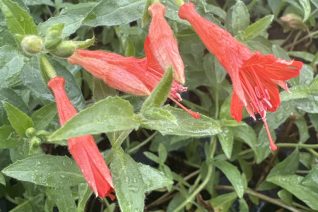
Another selection of Epilobium (Zauschaneria) that our friend Mark Wade made in SW Oregon. This is a lovely low growing form with smaller but profuse vivid lighter orange flowers and this selection supports pink stamens and pollen as well. To less than 6″ tall but spreading to an area of several square feet in a season. ‘Horse Sign’ bears sheets of these tubular flowers for several months beginning in August. Loved by hummingbirds it forms a vivid orange carpet of color. Enriched soil with a bit of all organic fertilizer will send this hardy perennial soaring. Water regularly for the first season, letting the soil dry in between. In subsequent years you can water much less if at all. Full sun to very light shade. Ideal for a slope and along rock walls at eye level. Very showy late season native perennial. Completely deciduous in winter with excellent hardiness to cold. This roaming perennial can inhabit and spill around other perennials, shrubs. Low and spreading, avoid large perennials nearby that could flop on top. Long lived and easy to grow excellent for late season pollinators and vivid color. Mix with other low growing, sun loving perennials such as Scuttelaria, Orginanum ‘Xera Cascade’ and Erodium ‘Spanish Eyes’. Mulch with compost the first winter, this will help energize it to roar out of the ground in mid spring. Foliage is smaller and green but with a silver cast. Very good looking native perennial. Oregon native plant
Xera Plants Introduction

Epilobium (Zauschneria ) ‘Solidarity Pink’
If shocking vermillion, red, and orange are a bit too vibrant for you enter this softly hued selection. Soft pink tubular flowers appear constantly from early August to October. Low spreading perennial to 8″ tall by 2′ wide in a short time. The very light green foliage is clad in soft hairs giving the whole plant a soft mien. Full sun and rich to average well drained soil is ideal. Slopes, rock gardens, walls, hellstrips all are appropriate for this low water plant. Water diligently to establish but never boggy. In subsequent years only light water on occasion is required. Spreads laterally underground by stolons. Long lived perennial if sited and somewhat cared for. Completely winter deciduous- cut away the previous years dead growth in February. Somewhat deer resistant. Mix with other late blooming perennial. Wonderful combined with Cuphea hirtella and the soft yellow flowers of Erodium chrysanthemum. West coast native plant that calls to hummingbirds far and wide. Takes blasting hot conditions in stride.

Epilobium (Zauschneria) ‘Bowman’
Possibly our second most popular California Fuchsia cultivar as it is more upright but also a free and early bloomer. To 20″ tall the fine green leaves that line the stems make the brilliant orange tubular flowers stand out. Blooms early August to October and spreading underground by stolons to form expanding colonies. To several feet wide- give it room. Rather than running over neighboring plants ‘Bowman’ flows around other plants never over topping or even crowding the. Ideal in full sun, well drained soil- or on a slope which will further assist in drainage. Brilliant flowers are a beacon to Hummingbirds. Completely drought adapted and requires little if any summer water. Long blooming western native perennial. Water regularly to establish the first year.

Epilobium (Zauschneria) ‘Carmen’s Gray’
California Fuchsia that is an excellent combination of hot orange tubular flowers set agains dusty gray foliage. To 18″ tall in bloom this Epilobium is a spreader especially in light to rich soil. Adapted to life on slopes and often between boulders on cliffs. There its roots penetrate the cool, wet cracks and that provides sustenance. Give this perennial at least 2′ x 3′ feet to roam. Wonderful performance in hell strips. Add a little compost and organic fertilizer and you’ll be off to the races. Most (Zauschnerias) require irrigation about once a month and no more than once a week to look and bloom their best. Though it is supremely drought adapted this occasional irrigation substantially improves looks. Loved by hummingbirds and bush tits too who play with the flowers and rip them apart- their goal I have no idea. Dies to the ground in winter- the only presence then is spent stems. Cut these away in early spring after a threat of a hard freeze has passed Companion plants in the wild are Diplaucus, Delphinium cardinalis, Sedum spathulifolium. California Fuchsias range into southern Oregon and technically they are native to our state. This is an excellent perennial with great contrast between the masses of hot flowers and gray foliage. Not bothered by deer. Loved by hummingbirds Oregon native plant.

Epilobium (Zauschneria) ‘Sierra Salmon’
Cool late blooming California Fuchsia with silver foliage a great foil for the soft coral and prolific September/October flowers. Spreading to 2′ wide and 1′ tall in bloom it prefers very well drained rich soil with little summer water. Full sun including hot aspects for the best results. Winter deciduous. A great flower color for the genus and pairs sweetly with autumn Salvias, such as ‘Playa Rosa’ and ‘Flower Child’. Drought adapted and cold hardy.This is the most cold hardy and drought adapted Zauschneria that we grow. It spreads and thrives on no additional summer water once established. The flowers are relatively large for this species and they are a wonderful color that meshes better than the orange/vermillion varieties. Long lived perennial.

Epilobium (Zauschneria) ‘Silver Select’
No other California Fuchsia has foliage that even approaches being as ashy white as this cultivar. Its as if the foliage is covered in dense white powder. The 1″ long hot orange/red flowers absolutely shine against this ghostly backdrop. Vigorous perennial for well drained sites and just light summer water. Full sun. To 20″ tall in bloom which starts in early August and continues into October. Hummingbirds dive down for this vivid sweet treat. Expanding to a clump 2′ wide in just a few years. Dies completely away in winter…only the stoloniferous roots remain to regenerate this sexy perennial in spring. Moderate deer resistance. The flowers are individually the largest of any cultivar that we grow.
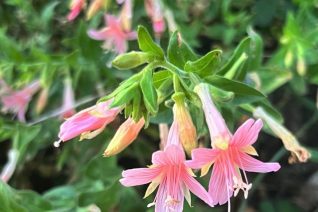
Epilobium (Zauschneria) cana ‘ Peach Surprise’
A beautiful color form of California Fuchsia. This is is a very long blooming, low, spreading perennial with downy gray green foliage and a constant procession of tubular peach/pink flowers. Loved by low flying hummer’s this plant is ideal for hot, locations in soil that never becomes boggy. To 6″ tall x 2′ wide and forming substantial patches in full sun. Excellent performance in hell strips. Most Epilobiums (Zauschneria) in our climate are drought tolerant but they perform better and are showier in bloom with light, occasional summer water. Water during the driest times of the year about once every two weeks. Blooms begin in late July and are resplendent well into autumn. Great long term performance in large containers, planters. Winter deciduous. Remove frost damaged tops when frost kills them. Best to match the vigor of this perennial with vigorous neighbors. It can swamp shy plants. Excellent in rock walls, at the top of walls. Combine with Sedum palmeri, Helichrysum thianshanicum, Chocolate cosmos for a community of perennials with identical requirements. Winter deciduous. Spreads laterally by underground stolons. Give Woody some room.
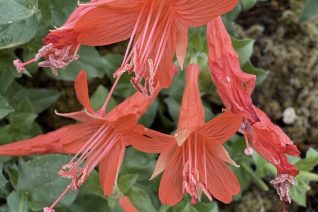
A friend of our nursery selected three Epilobium formerly Zauschneria in southwest Oregon. This species native throughout California just dips into the southern 1/3 of the southwest part of the state. This form is perhaps the most vivid of the three that Mark Wade chose. Electric salmon/orange flowers with large pink protruding stamens covers this massively blooming perennial. The habit of this form is spreading but lower- intermediate between the low growth of ‘Horse Wall’ and the height and vigor of ‘Illy’. The leaves on this form are more rounded and green and the tubular flowers are electric occurring from early August to October. Hummingbirds adore this plant and it will be visited by birds flying south for the season. To 8″ tall and spreading to 2′-3 wide in rich, well drained soil with regular water to establish. Add a handful of all organic fertilizer when planting , it will establish faster and grow much more vigorously. That said, its a very easy, climate adapted perennial and it can go without summer water when firmly established. These Epilobiums do appreciate a soak every few weeks in the driest part of summer. Totally winter deciduous this herbaceous plant is completely absent in winter. Mix with other climate adapted and vigorous perennials such as Salvia cohuilensis ‘Nuevo Leon’ and Verbena rigida. In habitat it consorts with Clinopodium and Sidalceas among many others. Excellent performance in containers and will last for years, spreading by the root to emerge from cracks in the pot or or like its natural habitat to root around rocks. Tidy the remnants in spring. Not bothered by deer. Full sun. Oregon native plant.
Xera Plants Introduction
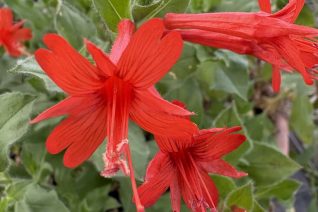
A friend of the nursery Mark Wade selected several forms of Caifornia Fuchsia that are native to southwestern Oregon. This form is low and spreading to 1′ tall and up to 3′ wide. It has large and exceptionally vivid orange flowers from July to October. The flowesr are perched as horizontal tubes that beckon hummingbirds. This form was found along the Illinois River in Josphine, County hence the name ‘Illy’. It has distinctively green foliage which is a great contrasting backdrop to the vivid flowers. Rich soil that drains in full sun with regular summer water for the first summer. Completely deciduous in winter, Common associates in the wild are Delphinium nudicaule, and Iris bracteata as well as Sidalcea asprella ‘Josephine’. Very easy to grow native perennial for hot sunny spots- the front of low borders, large rock gardens. Very long blooming selection that has enhanced cold hardiness. Avoid crowding from taller plants. Creeps underground by stolons up to 6″ away from the initial clump annually. Very drought adapted when established. Thank you very much Mark. Oregon native plant.
Xera Plants Introduction

Epilobium (Zauschneria) latifolia ‘Calistoga’
California Fuchsias are known for their striking hot orange flowers. This variety takes it even further with profuse flowers that range to vermillion red. To 1′ tall and 3′ wide in rich, well drained soil with little summer moisture. Full sun. This spreading gray leaved perennial begins blooming in August and extends to October. Excellent perennial for dry hillsides, large rock gardens. Combines well with Arctostaphylos and other low water plants. Loved by hummingbirds. Completely deciduous in winter. Give it room to spread. The vermillion orange flowers are larger than other cultivars and its impressive.

Epilobium (Zauschneria) septentrionalis ‘Select Mattole’
Our most popular hummingbird fuchsia because of its low habit, dense silvery foliage and early and extended bloom period. To just 6″ tall and spreading to form a patch 2′ wide quickly. Well drained rich soil with little summer irrigation once established. Hot vermillion orange tubular flowers are born continuously and en masse from July to October. Completely drought adapted when established. Great on slopes. Light summer water to establish. Winter deciduous. Loved by Hummingbirds. This species is native to the northern California and SW Oregon redwood region. Clumps expand stoloniferously (underground). Light summer water improves bloom in very hot locations.

Epilobium densiflorum
Spike primrose is a quiet but important long season hardy annual. It rises up to 2′ tall when happy. A dense thick spike of buds rises and the small pink flowers decorate the spike in a circle. Loved by pollinators and especially popular with butterflies. This drought adapted annual blooms from July to October. Mix with other hardy native annuals. Especially nice with Madia elegans as their bloom period are the same. Full sun in virtually any soil. Water in potted plants well and you will likely see seedlings in open disturbed sites in the spring. The seedlings of this Epilobium mimic several more weedy types (they are native but kind of rambunctious). This plant is never showy but its a primary nectar source for late in the summer. Very easy, climate adapted native hardy annual. Native in the Portland city limits. Found primarily in stable meadows on both sides of the Cascades. Oregon native plant.

Erica arborea ‘Albert’s Gold’
Very cool selection of Tree Heath that has exciting acid green/chartreuse foliage- brighter when new and masses of white flowers that smother the foliage in spring. Tough evergreen shrub for full sun and very little summer water when established. To 5′ tall and 4′ wide in 7 years for rich to average well drained soil in full sun with good air circulation. Spent flowers remain on the shrub and morph to a rust color with time- giving the whole shrub a rusty/chartreuse combination of colors. Not for formal gardens. This member of the mediterranean garrigue is drought adapted and cold hardy. Moderately fast growing. Showy in spring bloom.

Erica terminalis
Tree heathers fascinate us and this widespread species of southern to northwestern Europe makes a fantastic, drought adapted garden plant. Fine needle like green foliage lines strongly vertical growth. In mid summer the tips of the stems produce many urn shaped pale pink blossoms that are showy for up to 6 weeks. Following the bloom period these remain on the shrub and turn a russet color adding to its charm. To 3′ x 3′ in 4 years. Full sun and well drained average soil with light summer water to establish. Once you have it going it requires no supplemental water. Great for dry areas, gravel borders, hellstrips. Excellent fine textured shrub that develops a shredded gnarled brown trunk with time. Moderate deer resistance. Gains drought adaptation with age. As with most ericaceous plants it must build up a large root system over time and then it is drought adapted and will sail through the driest summers without fainting.

Erigeron glaucus ‘Bountiful’
Such a long, long, blooming tough and dependable native this forgiving perennial outshines all other cultivars in the size of each flower. The many rows of glowing lavender petals that characterize this fabulous perennial outline nearly 2″ wide flowers. They begin in earnest in late May and proceed unabated until early autumn. If the flowers become tired or scorched simply cut it back and wham! You’re quickly back in business. Adaptable to many soil types and will subsist on only natural rainfall but occasional deep soaks in summer reaps rewards. To 10″ tall forming a round perennial to 18″ wide. Full sun, to very light shade. Pollinator masterpiece. Oregon native plant.

Erigeron glaucus ‘Bright Lights’
Beach fleabane or beach daisy normally runs in a mauve, to periwinkle vein. This lovely selection turns it up with crystal white daisies and a bold yellow center. Long lived perennial that is very adaptable. To 6″ tall a happy clump will spread to 2′ wide or more. Low and spreading it displays the flowers upright in a mass. This beckons pollinates and they always find this easy going daisy. Full sun, rich to average soil with regular irrigation through the bloom period. This not only keeps the plant verdant it encourage re-bloom which can occur until September. The initial huge show of flowers begins in late May into July. Excellent perennial for the top of a wall where it will happily creep over the edge and follow the contours on the way down. It may be cut back hard after the initial large flush of flowers, this tidies the plant and sets the stage for another big show. Not bothered by deer and often left alone by rabbits. This daisy is most conspicuous in habitat on the cliffs adjacent to the beach. It also perches on sea stacks. Beach fleabane ranges from the Northern Oregon coast south all along the California coast. Mix with other Erigeron glaucus cultivars for depth of contrast- this is when all the flower colors look the most distinct. Very easy to grow and it also absorbs the heat of parking strips with no issues. Cold hardy. Oregon native plant

Erigeron glaucus ‘Cape Sebastian’
Beach Flea Bane or more popularly Oregon Beach Daisy is a phenomenal native perennial for our climate. Low and spreading a continuous supply of periwinkle/violet daisies with a yellow center appear from late spring to autumn and occasionally in winter. To just 8″ tall it forms 2′ wide spreading clumps. Simple spoon shaped green leaves. In its native environs which is the cliffs immediately adjacent to the beach it can cling precariously which shows it has sturdy roots. Full sun to light shade and regular irrigation or absolutely none when established. This floriferous and larger flowering selection is from the southern oregon coast. Excellent performance in hells strips..at the front of borders. This excellent semi-evergreen native perennial should be everywhere. Cut back hard after blooming to tidy the plant, keep it compact and encourage more flowers. Oregon native plant.

Erigeron karvinskianus
Santa Barbara Daisy or Mexican Fleabane. You choose. Either way its a great long long blooming perennial that thrives in our climate with good drainage. Masses of 3/4″ wide daisy flowers that open pink and then change to pure white. All the stages of color are present at once making it much more interesting. The fine, almost hazy texture that the daisies produce lightens borders, rock gardens and even containers. To 8″ tall x 2′ wide in a season. Rich, WELL DRAINED soil with light, regular summer irrigation. The more well drained the site the hardier to cold..thats why you often see it growing in walls or rock gardens. Its a fantastic long blooming carefree container plant as well. Completely winter deciduous. It also seeds around lightly. Very pretty, airy perennial native to Mexico. Full sun.

Erigeron speciosus
Showy daisy- though that is far too vague for this tough and graceful wildflower. Native in separate parts of the state this summer blooming perennial inhabits meadows and fields of the Willamette Valley. Rows of very fine soft pink petals surround a green/yellow center on 18″ stems June-August. The pretty daisies come in a group and then appear sporadically until frost. Loved by pollinators this is an authentic component of Willamette Valley meadows. Average to enriched soil with regular water to establish, in subsequent years it can survive on rainfall alone. Plant with Prunella vulgaris var, lanceolata, and Erigeron glaucus for a midsummer blooming native vignette. Long lived low maintenance perennial that goes completely deciduous. Widespread in the northwestern states of the US. Our version is from seed native to the Willamette Valley. Loved by butterflies and even good beetles. Clump expands to 2′ wide in time. Not bothered by deer. Simple, tough, wonderful native perennial. Full sun. Oregon native plant.

Erigeron x glaucus ‘Wayne Roderick’
Possibly a hybrid this is a spectacular perennial in our climate where it produces a non-stop supply of amethyst blue daisies with a yellow center from spring unabated to autumn. And occasionally in winter. A rosette forming perennial that sends up its clumps of flowers on vertical 6″ spikes. Loved by all pollinators with a special emphasis given to butterfies. Carefree, low water western native perennial with consistent excellent performance. To 18″ wide in time. Light, consistent summer water encourages re-bloom. Nice little cut flower. Rich, to average, well drained soil in full sun. Avoid rambunctious competition from other perennials. Mix with Agapanthus, Calamintha ‘Montrose White’. Even effective in containers. Oregon native plant.
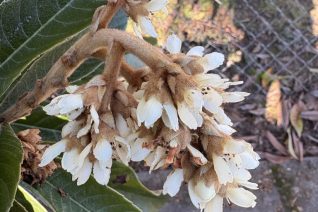
Eriobotrya japonica
Loquat is much hardier than most people think. Enormous specimens are ancient and scattered around Portland. In my previous garden I had a huge specimen that sailed through the worst winters (below 10ºF) and epic ice and snow with NO damage. Bold, broadleaved evergreen tree. The leaves are huge and look very tropical. In winter buds clad in brown fur support many very fragrant white flowers. Loved by overwintering Anna’s Hummingbirds. If the winter fizzles out and temperature fails to drop below 20ºF you may see the small, sweet fruits ripen in summer to early autumn. They can best be described as watery apricots. Primarily it is grown for its great foliage and convenient size. To 18′ tall and 10′ wide forming a rounded crown in 10 years. Full sun and rich to average soil. Completely drought adapted but summer water will increase the growth rate. Hardy to 5ºF . Avoid growing this tree in the windy eastern exposed suburbs of Portland. Excellent tree for a small garden. Japan.

Eriogonum fasciculatum
California Buckwheat is a shrubby perennial that occupies a wide variety of biomes in that state, Needle like leaves on a semi-woody subshrub. This is a common component of chaparral and beginning in late spring and carrying on virtually all summer rounded flat bloom clusters are mainly white but range to pink and even light red. For 2-3 months it is a beacon to pollinators and a prime food source for many butterflies. A very drought adapted plant that once established can thrive on no water at all. Excellent for blasting hot hell strips or large rock gardens. In habitat this subshrub is frequent between Manzanita and Ceanothus. To 2′ x 2′ slightly larger. In our climate this plant can freeze to the ground and return from the base. Best in soil that drains and goes very dry in summer. Fast drainage is important.. In autumn the flower heads remain and take on russet to pink to red tints before the spent flowers fall apart. It creates a lovely tapestry on hillsides throughout California for months. Mix with Yuccas,, Pensetmon, Manzanitas, Bupleurum. Pretty, tough wild plant. Hillsides and Hells trips. Full all day sun in a hot position.

Eriogonum umbellatum
Our native Sulphur Buckwheat that is among the best for general garden culture in our climate. This ubiquitous creeping plant of alpine areas of Oregon celebrates spring with umbels of (sulphur) yellow flowers on long stalks. The low and spreading rosette of leaves are thick green on top with silver indumentum on the reverse. Full sun in fast draining conditions- ideally rock garden conditions because that is where you find it. Crevasses between rocks is where it lives. This is easily reenacted in your garden at the top of a porous rock wall. Blooms May-July for an extended time. The flowers go through a fascinating metamorphosis in color as they open, reach their peak of hot yellow and then turn to russet/red seed heads. These abandon the spike through autumn and spent flower spikes may be removed in winter. Water until you see the rosettes actively increasing. Then taper to once in a while. This species has a total of 13 (!) subspecies in Oregon alone. We have yet to delve into specific subspecies but if we did I would look for Eriogonum umbellatum var. modocensis and Eriogonum umbellatum var. umbellatum. Both are endemic to Mary’s Peak the tallest point in the Coast Range (4097′). So, I know that those (with immaculate drainage) can easily cope with higher rainfall. Rock garden staple and can also self sow in happy places. Very fun, sunny, satisfying native to grow. Associated plants in habitat are Prunella vulgaris var. lanceolata and Achillea millefolium, Sedum oreganum, Castilleja minuta and Penstemon cardwelii. Excellently adapted to gravel, crevice, gardens with an arid aesthetic. Amend the soil as for Agaves and it will thrive. Pronounced Air-e-OG-oh-num. Rosettes to 3″ tall, blooming stems to 1′ tall. Spreads, give it room. Oregon native plant.

Eriophyllum lanatum
Oregon Sunshine is the cheery common name that greets this widespread native perennial. Silvery gray intricate foliage forms a spreading mat. In late spring and early summer brilliant golden yellow daisy flowers spangle 10″ stems. Loved by pollinators and we’ve been impressed with its draw to butterflies as well. To 2′ across and excellent on slopes where water never lingers. Add compost and this perennial will soar- give it room in that case.In the wild its a frequent of road cuts and other disturbed sites. It also competes admirably with exotic invasive weeds and will persist where other natives are swamped. Rock gardens, dry borders. Water to establish- the first season- but never boggy. The following year it will rely only on what falls from the sky. Full sun to light shade. Adapts to poor soils. Moderate deer resistance. Goes quickly dormant following bloom. Native to the Portland city limits. Very good planted beneath Pinus ponderosa var. benthamiana Pacific Ponderosa Pine this pair can frequently be found in the wild. Oregon native plant.

Erodium ‘Pickering Pink’
‘Pickering Pink’ Cranesbill. The name sounds like it will have an all pink flower. Not really. The simple five petalled flowers have two petals that are pink on top with a distinct black blotch. The two lower petals are soft pink almost white. This contrast of colors gives this small plant extra impact as well as a fun wild flower appeal. It forms a tight mound of soft, divided foliage to 3″ tall by 10″ wide. The cheery flowers are born on 6″ wiry stems. Blooms appear continuously from mid-spring to frost. Erodiums bloom and bloom with little intervention from the gardener. They also excel in the rough life of hellstrips. In borders, rock gardens, containers, even small meadow gardens this European native is excellently adapted to our climate. Light summer water increases the flower display and spent flowers can be snipped to not only spur more but to achieve a tidier look. Evergreen foliage and low stature also make it appropriate between pavers. Some deer resistance as well as rabbit resistance. Very easy to grow. Full sun.

Erodium chrysanthum
Cranesbills come in all colors but this is one of the most garden worthy, in fact its one of the best perennials for our climate. A GREAT PLANT PICK. Tightly clumping perennial with frilly silver intricate leaves. Beginning in spring and continuously to frost a constant supply of soft yellow cupped flowers on 5″ stems. They come in waves through the season. Pale yellow with silver. YUM. Full sun and rich to average WELL DRAINED soil. Light to little summer water- actually once its established I never water it and everything is just fine. Nice en mass. Rock gardens- thrives in the hellstrip. Not a fan of shade. Winter deciduous- unusual for an Erodium. Long lived.

Erodium x ‘Fran’s Delight’
If you’ve never grown any of these selections of Crane’s Bill- Erodiums which are close Geranium relatives you really are missing out. This cultivar is a Xera favorite. Low clumps of dense frilly gray foliage are evergreen and a cool canvas for the constant supply of outward facing luminous lavender purple flowers on 8″ stems. Continuously from March to October it produces these simple flowers that have a darker purple blotch on the bottom two petals. Much wilder looking than hardy Geraniums they are invaluable because they take up virtually no space- and again their bloom season is phenomenal. Not bothered by pests of any kind- including slugs and snails. Deer mostly over look them but they will dine if their attention goes that way. Full sun to quite a bit of shade which does not diminish their blooming power. Well drained soils of average to slightly enriched fertility. Remove spent flower spikes to to tidy and encourage more flowers. Forms a clump to 1′ wide in time. Fantastic plant. Come on join us in the world of Cranesbills.

Erodium x ‘Merstham’s Pink’
Flowery, easy rewarding perennial that blooms consistently from April to September. This sprawling plant assumes a rounded shape and bears 4″ stems with cup shaped rose pink flowers. Loved by pollinators and if it takes a break from blooming in the heat you can give it a hair cut and and some water and wham! you are back in business. The low, flush leaves are bright green and frilly and mostly evergreen. Great wildflower appeal that does not flail or swamp as most hardy geraniums do. It sticks to its place- about 1′ x 1′. Very good along steep walls or in a cottage garden. Excellent companions are Dianthus ‘Dainty Dame’, Scutellaria suffrutescens, and Penstemon ‘Enor’ for a low water flowery ensemble. Cut back hard in early spring. Light consistent water improves blooming. Great nectar source for Butterflies and bumble bees often nap in the cup shaped flowers. Cold hardy. Some deer resistance. Adaptable. Full sun to very light shade or high overhead shade. Great in containers. Long lived perennial cranesbill.

Erodium x ‘Spanish Eyes’
A blooming marvel is this perennial. I’ve had it in bloom in every month of the year. Beginning in early spring a truly phenomenal constant show of soft lavender flowers with a deeper purple blotch on the upper two petals. Very wildflower looking and it forms a contained clump about the size of an apple pie. The flowers born on 6″ stems should be lifted away when spent to encourage more. Not that much encouragement is needed. Full sun to quite a bit of shade in rich, well drained soil. Little summer water once established. A little water in the heat of summer will promote bloom. Evergreen low finely divided foliage is gray green and pretty with the flowers. No cutting back, easy, everblooming. Low water. What more could you want? Pictured below with Helianthemum ‘Henfield Brilliant’. What was once ‘Natasha’ is really ‘Spanish Eyes’ different name same great perennial.

Erodium x ‘Stephanie’
One of the most outstanding cultivars of the floriferous Cranesbills. Fine, dense, frilly aromatic grass green foliage makes a tight pie sized low clump. From spring and continuously to fall 6″ stems produce multiple pure white flowers. The upper two petals have a central blotch of inky black. Very cool effect. This is an easy to grow low maintenance perennial for full sun, well drained soil and light to little summer water. The front of borders, rock gardens even troughs. Seldom without flowers. Evergreen. A really pretty, floriferous perennial. Mass closely for a small scale ground cover. Dense growth will compete with weeds.

Eryngium agavafolium
Evergreen Eryngium that we love. The glossy deep green strappy leaves are fiercely armed and form large rosettes. In summer 28″ spikes produce bright green clover like orbicular flowers on a divided scape. You won’t draw rattlesnakes but you will draw bees. Cool looking plant that is easy to grow in rich to average well drained soil Good appearance even during winter. Remove the flower scape when the blooms start to turn brown- not as pretty. Sexy plant that requires no summer water and just full sun. Long lived. I see boulders and Cacti and grasses and gravel. Sexy rosettes.

Eryngium bourgotii
Very blue, oh so blue shorter Sea Holly that has pretty unusual leaves as well as stunning flowers. Crinkly sage green leaves are prickly and outlined in fine white. From this batch of foliage the flowering spike attains about 20″ inches before producing the metallic sky blue star shaped flowers. Very pretty and it will instantly draw pollinators. Remains in bloom for 4-6 weeks from early to mid summer. Full sun, rich, well drained soil and little summer water when established. Tough but pretty perennial that is very long lived. Increases in width each year to 2′ wide. Excellent candidate for the hellstrip, the front of the border or gravel gardens. High deer resistance. Completely deciduous in winter.

Eryngium pandanifolium var. lesseauxii
Fun tall growing sea holly that may be impossible to pronounce but its easy to grow. Upright growing finely serrated or prickly leaves first make a low 2′ wide rosette then when it feels like it- usually the second year a big as spike rises with a divided scape and tons of off white prickly clover like flowers dot the stem tips. Its cool. This whole perennial is cool and its slightly hardier than the species. Very cool. Evergreen perennial for full sun and just about any well drained soil. Flowers rise to 5′ tall and with time there will be many spikes. Pollinators arrive in droves to pollinate this very unusual but architectural perennial from South America. High deer resistance. Forms handsome evergreen rosettes in large colony over time. Very pretty foliage year round.

Eryngium proteiflorum MX
This is a spectacular plant and Brandon collected the seed outside of Mexico City- at a very high elevation. Still we are not completely sure of its ultimate hardiness so I’m going to guess. Based on other Mexican and S. American Eryngium and considering this is a widely spread species I’ll say its good in rich amended soil that drains to about 10ºF. That is somewhat irrelevant as the flower on this member of the Apiaceae (Carrot family)is phenomenal. In May-August HUGER 6″ wide flowers with a protruding central cone are metallic silver and sage green Unbelievable. Full sun to light shade in a protected location. Worth protecting in a pot as it makes a stellar container plant. The unearthly flowers are held on vertical stems to 3′-4′. As a cut flower it is a wet dream, lasting weeks and drying too. Kind of prickly a low rosette of serrated evergreen leaves is permanent. Cut away the spent flower stalk when it fades and you tire of it. Light, consistent water. Fantastic. Thank you to our great employee Brandon for capturing the seed.

Eryngium x tripartitum
Easy to grow, though short lived (2-3 years) this prolific seeder will never really disappear from your garden. A hybrid by two UNKNOWN species one from South America and the other one is anyones guess. First year its a rosette of spoon shaped green leaves. The following year it dramatically rises to 3′ in spring/summer and produces clouds of rounded steel blue flowers. Very pretty and airy and you must mix it with a nice tall ornamental grass for the ultimate effect. As I mentioned it then seeds around. Interesting cut flower. Drought tolerant and best in full sun. High deer resistance.

Eryngium yuccafolium
Rattlesnake MASTER! Great common name for a wonderful perennial that fits the modern aesthetic perfectly. Low rosettes of silvery serrated pointed leaves are subtle. In summer 30″ branched spikes produce rounded clover-like white balls- these are the flowers and they remain showy for weeks and weeks before finally turning brown in late summer- that the time to remove them. This robust member of the carrot family is sure draw for pollinators and even works well as a huge architectural cut flowers ( the flowers up close kind of smell bad- never smell an Eryngium you’ll regret it) but the fragrance is only detectable up close. Amazing with ornamental grasses. A flower with great presence that makes everybody else look better. Photographs well. Full sun to very light shade in any well drained site. Light to little summer water. Completely winter deciduous. High deer resistance. Rosettes increase with time and so do blooms spikes. Long lived.
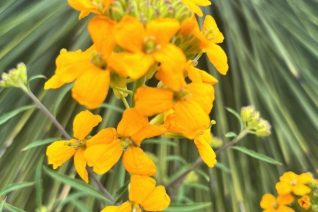
Erysimum capitatum
Western Wallflower is a very widespread biennial or short lived perennial. It occurs from Alaska to nearly Mexico and throughout the west coast. The first season is spent as a rosette of thin undulating leaves. In the second year it extends, forms branches and achieves multiple flower spikes. The species is best described as yellow/orange with some slight variation in these seed grown plants. In Oregon its is widespread but it has all but disappeared from some biomes, the Willamette Valley for instance, a victim of non native invasives. To 22″ tall in bloom. You may get a third season but it is much less of a show.Best to let this plant set seed and die ensuring a new generation of plants. Leave open disturbed sites for re-sowing. A gravel mulch will encourage this as well and it appreciates average to enriched soil and light consistent water to establish. The following year it can rely on only what fall from the sky. Blooms appear for several weeks in late spring. Loved by pollinators with a special draw to butterflies. Common associates in the wild are Dodecatheon hendersonii, Mitella , Ranunculus occidentalis, Nemophila. Oregon native plant

Escallonia bifida ‘Compact White’
Useful, tough and good looking evergreen shrub that has glossy deep green foliage and masses of small tubular white flowers for months beginning in June. To 5′ x 5′ in 12 years for virtually any well drained soil, including clay. Excellent cold hardiness and totally summer drought tolerant. No water necessary. Hedges, specimens, holding plant for rough areas. Takes any amount of pruning. Excellent performance at the Oregon Coast This ever blooming shrub thrives with little care in the roughest situations. Not bad in a woodland and very tolerant of deer. Unmolested from pests or disease in general. Clean looking shrub. May be pruned very hard to resize, rejuvenate, but that is rarely necessary. Pretty clean white flowers. Excellent fast evergreen hedge. Chile.

Escallonia x exoniensis ‘Gold Brian’
Brilliant gold shrub that lights up borders and makes a pretty showy hedge as well. In late summer sporadic hot pink small flower clusters provide added contrast. Tough evergreen for nearly any soil type. Drought adapted. Foliage does not burn in full sun- in fact it takes the hottest aspects. Fast growing to 4′ x 5′ in 4 years. Cold hardy to about 5ºF- but has recovered from the roots from below 0ºF Native to Chile. Takes well to pruning. Excellent performance at the Oregon Coast.
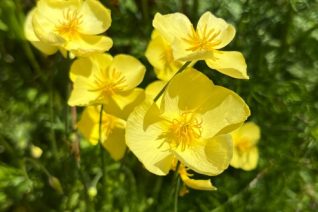
Eschscholzia caespitosa
Golden poppy is native to the inland valleys of southwest Oregon. This charming annual is much more delicate in habit and color than its more common bolder cousin Eschscholzia californica the ubiquitous California poppy. This little jewel demands a hot sunny location in soil that is average, and not improved. It will self sow locally but nothing like its cousin. This demure little poppy blooms from late April to mid-June. Full sun is vital. Mix this charmer with other similarly adapted annuals. Collinsia grandiflora, Plectritis congesta, Gilia capitata. Very deer and rabbit resistant. Water potted plants to establish, resown babies in the future can get by on natural rainfall alone. Oregon native plant

Eschscholzia californica ‘Cream’
A very favorite annual or short lived perennial. This excellent California poppy sports ivory to cream large flowers for an extended period in summer. Fine blue foliage is wonderful with the softly colored flowers. Blooms from April to August if you give it a little water- but never soggy. Full sun to the very lightest shade in average to enriched, well drained soil. Un irrigated plants will bloom for a shorter period and set seed. The seed comes true about 90% of the time. Cull orange or other colors that don’t please you. It may become a short lived perennial if treated well. New plants germinate en masse with the first autumn rains. Don’t be afraid to thin your patch a bit then. Rough areas, along gravel paths. Easy to grow. Containers, Hellstrips. Etc. High deer resistance. Oregon native plant.

Eschscholzia californica ‘Jelly Beans’
Spectacular mix of double flowered California Poppy in shades of pink, yellow, apricot, rose, red, orange, and yellow- and more colors than that. Easy to grow plants that can even be perennial if happily sited and cared for. Otherwise an incredibly showy annual that also makes a great cutflower- cut in bud and they will last several days. Sophisticated selection of our own native poppy and they will most likely reseed in open disturbed sites. Blooms May-August and sometimes longer. Remove spent flowers to encourage more. Leave the final round of blooms to set seed for the following season. To 1′ x 1′ with beautiful lacy glaucous foliage. Rough areas in full sun with light summer H20. Highly deer resistant. Oregon native plant.

Eschscholzia californica ‘Pretty in Pink’
True pink California poppy. Seed from this exceptional pink flowered selection comes true about 95% of the time. Deep rose pink semi-double flowers appear in late spring and continue sporadically until mid summer. A happy plant can become a short lived perennial but the majority will behave as bloomy annuals. Full sun and rich to average soil with good tilth (crumbly texture). It can even thrive in compacted soils. To 10″ x 10″ forming a compact plant with lacy blue foliage. The strident rose pink flowers are showy from a distance. Leave the last round of flowers to seed for the next several seasons. Excellent wildflower display in rough areas w/ low water. Water plants to establish then taper off. Remove spent flowers to encourage more. Wonderful flower color. Mix with Eschscholzia c. ‘Alba’ the white form. Deer resistant and drought adapted native plant. Oregon native plant.
Xera Plants Introduction

Eschscholzia californica ‘Willamette Valley Form’
Plants don’t really stay in the same place, They move according to climate and soils and with the help of humans. This famous poppy carpets meadows and glens and rocky hillsides in brilliant orange from SW Washington through Western Oregon into California to Baja but is happily grown throughout the globe. Sunny orange flowers with an edge of lighter yellow in our local form appear from mid spring to late summer. This form was identified in 1846 at the former town of Tonquin. Tonquin is about 500 yards from our nursery and this poppy is everywhere. Blue fine foliage on spreading plants to 14″ tall and up to twice that width. Full sun in any soil where water does not collect. Reseeds itself prolifically and can become your own introduced weed. Seedlings are easy to spot and dispatch if unwanted. Nice cut flower if you pick it in bud. Loved by pollinators. Easy to grow native annual/ sometimes a perennial. Water to establish plants then none necessary. Completely deer and rabbit proof. Oregon native plant.

Eschscholzia californica ssp. maritima
Just about every gardener is aware of our west coast native California Poppy. It has a huge range from far southern Washington State to Mexico. There are several subspecies, but this one is exceptional. This PERENNIAL California Poppy is very different than the species. ‘Martima’ or Coastal California Poppy is a low, tidy, mat that erupts in wave after wave of flowers from spring to autumn. The tight congested foliage is handsome blue green and pairs well with the golden flowers that have a central area of orange. This plant is native to sand/very well drained soils and if you replicate that in your garden this is a very long lived plant. It also excels in the very well drained soil of containers and will drape over the edge and follow the contours closely. Ideally this plant is adapted to slopes with just light water during the summer. No need to dead head this plant is naturally remontant- re-blooming without any intervention from the gardener. Loved by all native pollinators and cherished by big black and yellow native bumbles. To 4″ tall as foliage – 8″ in flower its spread on average is about 2′ x 3′ in a year. Detests all shade, do not even try. Eschscholzia californica maritima is native to the northern and central California coast. Avoid compost and enriched soils, average soil is best. Not bothered by deer, rabbits, slugs, snails. So, why isn’t everyone growing this fantastic plant?

Eucalyptus archeri
Alpine Cider Gum from high elevations in Tasmania has proven to be one of the reliable species of Eucalyptus for our region. Juvenile (young) growth is perfoliate and very very light gray blue- this is the foliage used as popular cut material. The tree may be cut back nearly to the ground regularly to retain this foliage- The tree must be established at least a year before you do this. Otherwise the adult foliage is totally different. Bright green and elongated leaves with a round tip hang densely on an upright growing nice looking tree. Eventually, the bark becomes amazing with pink and gray striations. Blooms in early spring with white flowers. Extremely fast growing tree to 35′ tall + that is a great evergreen garden tree. Good looking year round. Handles ice and snow like a champ- shedding snow and bending under ice without breaking. Full sun and rich to average soil with regular summer water through the first year. High deer resistance. Hardier to cold with age.

Eucalyptus dalrympleana
Mountain white gum or just Mountain gum is a wonderful cold hardy Eucalypt that can achieve the largest proportions of any that we grow. In Portland specimens of 60′ occur and it presents as a large spreading tree with sickle shaped leaves of deep green and glossy. Very aromatic when crushed and excellent material for wreaths. In time it develops fantastic powder white bark. Fast growing in youth to 6′ a year in rich soil with regular irrigation. Once established it is very drought tolerant. In time it forms a large spreading crown on a majestic and easy to grow tree. Requires a large site. Eucalyptus are intolerant of all shade and should be hit from all sides by sunlight. Otherwise they will grow sparsely and lean towards the sun. White flowers occur in late winter and are more curious than showy. Does have some leaf drop- take note near patios. Cold hardy to 5ºF when established. Gains cold hardiness with age. Moderately deer resistant.

Eucalyptus gunnii
Cider gum. This is a very successful Eucalyptus in Western Oregon. Native to the high central plateau in Tasmania it forms a handsome tree to 35′ tall and 20′ wide in 10 years. As with many Eucalypts this species begins with very different juvenile foliage that is bright blue/gray with rounded leaves. After several years of vigorous growth foliage morphs to longer, greener leaves with a somewhat weeping habit. In order to retain juvenile foliage for cut material let the tree establish well for a year or two. In March to April 15 the whole tree may be coppiced to the ground. Re-growth is rapid with the arrival of truly warm weather and light applications of water. Left strictly alone Cider Gum becomes large and stately. One of its most striking features is blue/gray stems which are visible at quite a distance. Mature trees have clumps of foliage at the end of longer stems. A distinct look. Very fast growing in youth- 3′-5’per year. Growth slows with maturity but it achieves tree like stature very fast. Excellent in snow and ice. Cold hardy to about 5ºF – provide a warm microclimate in cold rural gardens. Excellent performance in urban areas. Not as messy of a Eucalyptus as some. As the tree matures the trunk exfoliates to smooth gray/tan with pink mottling. Excellent performance on the Oregon coast. Not bothered by deer or elk. A very pretty tree in a short amount of time. Drought adapted with age.

Eucalyptus kybeanensis
Excellent little multi-trunked hardy Eucalyptus that we love for its height, graceful foliage, and handsome bark. To just 15′ tall after many years it grows quickly when young. The 3″ long medium green glossy leaves are thin and slightly curved. In winter the interior twigs are lined with wispy white flowers in clusters of six. Seldom sets seed in our climate. Excellently adapted and scaled for urban gardens. Very graceful and pretty year round. The leaves are held by vivid red petioles and cut material from this tree is excellent- if somewhat limited from size and slower re-growth. This small tree forms multiple trunks- no single trunk ever happens, and the bark is a soft glossy taupe. Very pretty tree. Related to and included in the category Snow Gum. Hardy without damage to just below 10ºF- and likely much lower.

Eucalyptus parvula
Little Leaf Gum is a handsome, graceful, cold hardy, obscure beautiful Eucalypt for our gardens. Extremely endangered in the wild it survives in just a few locations at high elevations – always above 3500′, in the SE Australian Alps. That alone gives us reason to grow this fantastic little tree. Fast growing small tree of very fine texture. To 22′ tall and half as wide in our climate. Single or multi-trunked the bark becomes glossy and shedding with time. Remarkably fast growing in youth, easily 3′-6′ in a single season- achieving tree status in just a few years. Wonderful fine textured evergreen that casts the lightest shade. Small groups of white flowers bedeck the stems in late summer and autumn- and sporadically through the year when older. Full sun and an open exposure. Very, very hardy to cold when established. There are two of this species planted along I-5 near the Woodburn Factory Outlets that have been there more than 35 years. They have endured temperatures near 0ºF at least twice in that locale with little to no injury. Takes summer drought but prefers a few good soaks when its really dry. Good garden tree. Dislikes shade. Open exposed location. The tree pictured is at the the Oregon Garden in Silverton. Excellent small garden tree.

Eucalyptus pauciflora ssp. debeuzevillei
Jounama Snow Gum is repeatedly one of the cold hardiest Eucalypts and it is excellently adapted to our climate. Gray/blue scimitar shaped leaves are pendant on a spreading umbrella shaped frame of a tree. Often the trunk forks just after emerging from the ground into multiple handsome stems. This increases the surface area where you can enjoy the ravishing exfoliating bark. Bark drops in late summer to reveal python like patches of taupe/grey/green and is showy through winter. In autumn the upper branches are decorated with small fluffy white flowers. One of the few Eucalyptus that will endure subfreezing wind- in fact this tree has been hardy to brief dips to 0ºF (-18ºC). Explosively fast growing when young to 35′ tall in just 7 years. Give it room. Light summer water in virtually any well drained soil- including clay. Do not stake. Let it produce its own sturdy leader. Sheds ice and snow like a champion. Though this is a subspecies of Eucalyptus pauciflora- a snow gum just like E. p. ‘Niphophila’ there are several differences from that tree. The leaves on E. p. debeuzevillei tend to be wider and more substantial than ‘Niphophila’. Also, that gum nearly always forms several trunks. This is less common with Jounama Snow Gum and in my experience it is a slightly taller tree. It can also vary in its habit from being very wide and spreading to skinny and fastigiate- its simply the luck of the draw and you cannot decipher this future habit as a seedling. Avoid heavy watering in hot conditions and site in a well drained place. Its completely drought tolerant and should be treated that way. Winter water when its cool is irrelevant. Overall it is a fast, healthy, and easy to grow tree in just a short amount of time.

Eucalyptus pauciflora ssp. niphophila
Snow gum is a wonderful cold hardy tree for the Pacific Northwest. Lance shaped gray foliage is pendant and handsome year round. This rapidly growing tree thrives in full sun and virtually any soil save for boggy conditions. In just a few years it develops amazing python mottled bark in tones of gray/tan/olive green. The bark sheds in mid-summer and can be a bit messy. Site accordingly. Grows 4′-5′ a year when young. Irrigation just increases this growth rate. Stake only when VERY young then let it form a sturdy trunk on its own. The vast majority of this Snow gum will form multiple trunks. Its possible to select one sturdy main trunk when young- pay close attention as they grow very fast. To 30′ tall and half as wide in 10 years. Snow gums have a weird habit of growing horizontally before reaching upwards. This is natural. Handles ice and snow no problem. Cold hardy to brief dips to 0ºF- but not lower. Mountains of Australia. White fluffy flowers in clusters in winter. Avoid all shade.

Eucalyptus perriniana
Spinning wheel gum is one of the prettiest of the cold hardier Eucalyptus. Named for its striking blue/gray perfoliate round foliage as a juvenile. In time as the foliage morphs to adulthood each new leaf becomes longer and more pendulous. A small tree in our climate to 18′ tall with a widely spreading crown. Fast growing tree, especially in youth. It may be damaged in our coldest winters- losing branches or even freezing to the ground if temperatures drop below about 8ºF. Re-growth which will be juvenile is rapid in spring and it can recover its full height in just two or three seasons. Damage occurs about once every 7 years- and slightly more often in rural settings. Best in the warmest possible part of the garden- and not for cold gardens or subfreezing wind prone sites. Excellent, highly aromatic cut foliage. White flowers line the stems like small sea anemones in winter. In time it develops a strongly weeping habit.

Euphorbia rigida
This plant is an early spring blooming staple of gravel gardens and pairs great, vivid, chartreuse flowers with symmetrical blue/gray succulent trailing foliage. To 18″ tall and up to 3′ wide when happy. Vivid flowers first color up in late winter and remain shockingly beautiful well into spring. Often re-seeds in open disturbed sites. Seedlings are easy to spot and dispatch or move. Give this trailing plant room to grow in full sun and very well drained soil of average to poor fertility. it thrives in rich soil and may become a tad rambunctious and may be shorter lived. Average conditions. A natural friend for blue flowered plants.
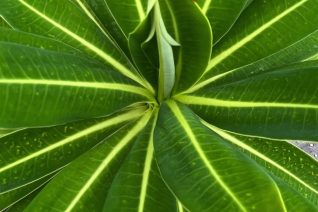
Euphorbia stygiana
A shrubby almost woody Euphorbia with large opulent green leaves and in spring honey scented chartreuse flowers. To 6′ tall and forming a patch as wide. Very lush appearance for a plant that is actually drought adapted when established. This is an incredibly rare plant in its habitat in the Azores. About twenty plants remain in the wild and that is all. A great reason to grow this large plant. Broken leaves emit white sap. Protect from subfreezing wind – a south or west aspect is best in a sheltered position. Grows quickly with light irrigation in soil that is enriched but drains. Established plants require water just once every few weeks, Very pretty under a low window where the honey like fragrance can be enjoyed. Might be deer resistant but protect this lush shrub in the beginning. Blooms late spring and is wonderful with other bold plants for full sun . Pair with our native elk clover (Aralia californica) and hardy banana (Must basjoo). Excellent performance at the Oregon coast and lovely backed by a stone wall. Regrows from the base if established plants freeze back. Be patient, recovers in mid-spring. Wonderful garden plant.

Euphorbia x ‘Dean’s Hybrid’
FANTASTIC long long blooming easy to grow and spectacular Euphorbia hybrid. Large clumps support wide umbels of electric gold flowers. They appear in spring and are effective on the plant well into summer. Foliage is fine, mid green and is a great backdrop to the never ending flowers. Semi-evergreen. A beautiful and valuable perennial for full sun and well drained soil. Little summer water required. Excellent heat tolerance and performance in hell strips. To 2′ tall and forming clumps a little wider. Mix with Salvias, Eryngiums for visual perfection and the same culture. Moderate deer resistance.

Euphorbia x ‘Purple Preference’
Excellent Euphorbia hybrid selected for deeply hued purple foliage that it pairs with early spring panicles of large chartreuse yellow flowers. Semi-shrubby evergreen perennial for RICH soil that drains quickly and light summer irrigation. The foliage goes through several hues before settling to deep green (purple to mustard to green). To 3′ tall and half as wide. Completely sterile hybrid that will not reseed or become a pest. Long season of bloom and interest. Appreciates the good conditions. raWonderful contrast between the chartreuse flowers and purple emerging new growth.

Fabiana imbricata ‘Violacea’
Chilean heather is not a heather at all rather it is in the solanum family- its related to tomatoes. Tubular violet purple flowers smother the very fine scale like foliage from late spring well into summer. In bloom its a pretty effect that attracts hummingbirds and other pollinators alike. Fast growing evergreen shrub for poor, unimproved well drained sites. To 5′ tall and 3′ wide in 5 years. Prune after flowering if you need to resize contain. Cold hardy and adapted to the poorest soils….its native on sand. Very drought adapted, little summer water when established. Excellent deer resistance. Flowers have a pervasive honey-like fragrance- and they look like miniature purple honey combs too.

Fargesia dracocephala ‘Long Leaf Form’
Intriguing CLUMPING bamboo that rises to only 6′ tall but arches as wide. Fine, arrow shaped leaves protrude in the same direction giving an airy symmetry. Takes pruning very well and is recommended for small spots. In the open give it room to arch. The 1/3″ wide culms clusteer tightly forming a moderately fast increasing clump. After 10 years the base of culms will be no more than 2′ wide. Full sun to part shade to shade in rich soil with consistent summer irrigation. Established plants can take far less. Wonderful in a woodland or as an asian accent in themed gardens. This is a very hardy bamboo- tolerating temperatures slightly below 0ºF. A great bamboo for those in the line of east winds. Plant on 3′ centers for a dense hedge. Prune in spring if needed or allow it to gently repose with natural grace. Moderate deer resistance. SW China.

Fascinating and cold hardy Bromeliad relative from the cooler and wetter parts of Chile. It forms large 2′ wide grassy rosettes of leaves, After a year each large rosette blooms in the middle and the results are spectacular. The center of the rosette hosts a dozens of turquoise blue flowers set tightly together. At the same time the innermost leaves become a brilliant scarlet red. This happens in our climate in late spring to summer but the red leaves remain showy long after the flowers are spent. Excellent plant for a rock garden in gritty soil with regular irrigation. In containers it excels as well as long as its very large-at least 20″ across. REGULAR irrigation through the summer, let it dry between watering. Full sun with protection during the hottest parts of the day. The first winter in the ground cover it with a cardboard box if arctic air – sub 20ºF, threatens. Remove with a thaw. Excellent tilted into rock walls and with regular irrigation it will adhere to the small areas of soil. After blooming each rosette dies and is replaced by new pups, remove the spent rosettes with a quick brush of your hand, they will detach with a light tug. Very easy and hardy greenhouse plant. Protect containerized plants from prolonged temps below 20ºF. Limited quantities.

Feijoa (Acca) sellowiana
Pineapple Guava is a remarkable evergreen shrub that is cold hardy in the maritime PNW and is best used as a specimen in a warm position. Slow growing to 7′ tall and 5′ wide in 7 years it produces small but dramatic flowers in summer with bright red stamens and 4-6 swollen red petals that when eaten taste like fruity cotton-candy- excellent for children, fruit salads. These edible petals appeal to birds who unwittingly pollinate the flowers when they are noshing on the sweet treats. Handsome gray foliage. Full sun, regular soil and water. Occasionally fruits in our climate. The fruits are avacado green and about the size of a fuzzy kiwi. If they ripen by November into December they have a spicy sweet pulp- cherished by many. Becomes much more hardy to cold when established. Established shrubs take 5ºF with no damage. Good for hot aspects. Prune after flowering. Dynamic, handsome, and fun shrub to grow. High elevations in Brazil- other S. American countries. Must have full sun- completely intolerant of shade. Drought tolerant when established but regular summer water speeds growth/establishment. Syn. Acca sellowiana.

Felicia aethiopica ‘Tight and Tidy’
Billions of blue daisies with a brilliant yellow center adorn profuse long stems. Bloom occurs unabated May-October. Remove spent flowers to encourage more. A more compact form of this shrubby tender perennial to 16″ x 36″ in a single season. Excellent performance in container plantings. This is a real work horse of a daisy whose airy sprays of daisies mix harmoniously with a number of schemes. In the ground this tender perennial can over winter in a mild year (above 20ºF). Excellent pollinator plant and a real hit in my garden with butterflies. Full sun to very light shade in rich to average soil. Light, consistent summer water. If it over winters cut it back hard after all threat of frost has past. Containerized plants can be moved to an unheated garage to over winter. Brilliant blue daisies are exciting. This plant will perform as a hardy perennial at the Oregon coast.

Festuca californica var. californica
California Fescue native to the Willamette Valley from Multnomah county south and once widespread before being pushed to the margins by exotics and development. The best place to find this clump forming cool season evergreen grass now is on slopes, almost always underneath native Oaks. As you go farther south it becomes more widespread. Our seed grown plants come from exceptionally blue foliaged plants. Grows during the winter and looks clean and fresh then. In spring 3′ tall inflorescences arrive and are straight and airy. Following bloom in summer the stems of these blooms take on raspberry tints and remain standing. Totally summer drought adapted but a little irrigation will improve summer looks. To 1′ x 2′ as a clump of evergreen foliage. Full sun to part shade in average to enriched, soil where water never stands. Light summer water. Best in wild areas and margins. Looks a tad too wild for some. Check it out in person and see how you feel. Excels around Manzanitas, Cistus, Ceanothus and in dry shade in woodlands. A great garden plant. One of our best native grasses. Oregon native plant.

Festuca roemeri var. roemeri
Roemer’s Fescue is a native bunchgrass found on upland prairies and slopes throughout the PNW. In the Willamette Valley it survives on the upward margins of woods, often under Oaks and accompanying California fescue. Roemer’s Fescue has much finer leaves and a tighter clump than Festuca californica. Its immediately identifiable by this thin blue green foliage. A cool season grower it spends the winter in its freshest and lushest state by the onset of summer drought it has already gone dry dormant. To 8″ tall and spreading. 1′ spikes with tan flowers appear in late spring and remain erect until the entire plant goes summer dormant. With regular water and good drainage this grass will avoid summer sleep and remain green and lush. A common component of Willamette Valley Oak Savanna and losing ground to invasive weeds. Excellent underplanting for drought adapted shrubs, or for the garden/wild lands interface. It spreads quickly by seed- its from here, you should expect that so keep it away from highly manicured areas. Its habitat in the Willamette Valley has shrunk to almost nothing. Bring this pretty native bunchgrass back to our gardens. Admirable lawn substitute. Evergreen. Oregon native plant.

Fragaria chiloense ‘Aulon’
Pacific coastal strawberry is a beach native- in fact it occurs all around the Pacific Rim and makes an adorable and durable ground cover on sand dunes. Well this version is like the giant hulk of strawberries. Huge in every way and vigorous? Wow, plant and get out of the way. The large glossy evergreen leaves are up to 6″ across and the single white flowers in spring and summer (sometimes in winter) are large also. The paltry fruit that follows is far from edible. It won’t kill you but you really have to like sour and gritty with millions of seeds. This is an ideal ground cover for rough sites in full sun to part shade. Don’t bother enriching the soil that will just make this trailing monster roar. Instead err on the side of a little neglect and watch what this native plant can do. Be wary of delicate plants in the vicinity. Evergreen, easy and drought tolerant. Oregon native plant.

Frangula (Rhamnus) californica ‘Eve Case’
Excellent evergreen west coast native shrub that is always at its best. Large, glossy deep green foliage clothes the stems densely on a compact but large growing form of California Coffeeberry. Insignficiant tiny green flowers in summer/autumn turn into crops of red then brown berries. Very showy until stripped by wildlife. This species is native from SW Oregon through Calfornia west of the mountains. Completely drought tolerant- in fact it resents summer water. To 8′ x 8′ in 5 years. Wild areas, informal low water hedges, blasting urban heat. We should take advantage of these climate adapted west coast plants for the toughest sites. Great deer resistance. Oregon native plant

Frangula (Rhamnus) californica ‘Leatherleaf’
A really cool version of California Coffeeberry which is also native to SW Oregon. Thick deep green rounded leaves clothe madder red stems densely on this large shrub that can achieve tree like status with time. Insignificant green flowers transform into brown then black berries eaten by wildlife. Incredibly drought adapted never needing ANY supplemental water. Well drained soils in full sun. To 9′ x 9′ in 8 years. Pruning can keep it lower and it would make an admirable hedge. Cold hardy to near 0ºF. Often not bothered by deer and one of the best deer resistant hedges for rural area- put a test plant out first to see if your deer are different It grows quickly with little to no irrigation.
Oregon native plant

Frangula (Rhamnus) purshiana
AKA Cascara or Cascara sagrada. This is a widespread small tree to shrub in the northwestern part of the United States to SW Canada. West of the Cascades its found in almost every biome. It can be a wind contorted shrub on blasting headlands at the coast. In the Willamette Valley its common where birds drop the berries/seeds on fence rows and it borders fields with native roses and Oso Berry. Its even found in the Bitteroot mountains in Montana/Idaho. It was frequently used by indigenous people as a laxative. Cascara is a small round crowned tree/shrub. In drier locations it is more shrub like but in deep, rich soil with access to water it can grow to be a thirty five foot tree. Large round alternate leaves turn dark green and glossy in summer. In May and June the tiny greenish flower appear and transform into red to black fruits by autumn. This is the mechanism that makes this plant so widespread, its dispersal by birds. A lovely little straight trunked shade tree that requires almost no water once established. It functions as an understory component as well. Full sun to quite a bit of shade, including dry shade. Easy to grow and climate adapted. Average life span 35 years. In winter its very symmetrical open branch structure is handsome. Fall color is soft yellow to chartreuse and not especially showy. *NOTE* In certain years this small tree can set a prodigious amount of black juicy, messy fruit. Not great on furniture, walkways etc.-take note. Oregon native plant

Fremontodendron x ‘California Glory’
Exotic looking shrub native to California that finds a happy home in the PNW- provided you are committed to almost total neglect. Poor, well drained soil with NO SUPPLEMENTAL water ever. Plant it. Water it. Leave it alone. Known and grown for its HUGE golden yellow flowers. The form a rounded bowl and are wonderful for the 4-6 weeks they occur in May-June. If you apply summer water you could easily kill this plant- its a victim of water molds that thrive with water + heat. Cold and wet- not such a problem. And if it survives summer water then it will grow fast and rank and not be hardy to frost at all. Grow it lean and mean- no love, no favors. Flannel Bush is evergreen and the whole plant is covered in a silica based fur. Avoid this. The hybrids get enormous in the PNW. Allow for this. 16′ x16′ is not unheard of in 6 years. Moderate deer resistance.

Fremontodendron x ‘San Gabriel’
For people with HUGE gardens that they don’t want to water but still require a floral show there is this west coast native Flannel Bush to occupy beautiful space. Fur covered maple shaped leaves are deep green on top with a reverse of tawny brown. Avoid this fur it causes dermatitis and you don’t need that. Rapid growing evergreen shrub for full sun and poor soils and absolutely NO summer water. That can lead to root molds and death and at the very least rank growth that does not harden for winter cold. Instead neglect and stand back as this 15′ x 15′ monster of the Chaparrel produces a two month parade of 4″ wide cupped gold flowers. A large specimen in full bloom causes the heart to stop. Nice espalier too. Moderate deer resistance. Neglect is the flannel bush’s friend.

Gaillardia aristata
Blanket flower or Great Gaillardia is a very showy native perennial that is found over a wide area. It has limited appearances in the Willamette Valley and even prairies in Puget Sound. It becomes much more common in the Columbia Gorge and points east. It is adapted to dry slopes with adequate drainage and the 3″ yellow flowers with a red central cone appear beginning in May with continuous re-bloom until autumn on plants that have had spent flowers removed. To 10″ tall in bloom a happy clump can measure 2′ across. In the wild, without supplemental summer irrigation the yellow flowers appear for 4-6 weeks before setting seed and going summer dormant. Plants that have irrigation will happily continue blooming. Water should be applied deeply but infrequently and the plant should dry between irrigation. This is the native form of Blanket Flower, it has simple yellow petals that surround a red central cone. A very adaptable American native perennial that has undergone extensive hybridization and solid colors from dusky solid red to brown are also available. The most commonly cultivated form has yellow petals with a continuous zone of red around the cone- this is not that. Charming native perennial that attracts a vast amount of native pollinators and is not bothered by deer (not sure about rabbits). Full sun and average to enriched soil. Tolerates extreme drought and cold. Thrives in the reflected heat of hell strips, asphalt, and hot walls. May self sow, and this is welcome. Often it will wind up in cracks and crevices- mimicking this plants life between rocks and boulders. Mix with Agastaches, Origanum, Oregon sunshine (Eriophyllum) for a long blooming pollinator paradise. Easy to grow great garden plant. Frequently visited by butterflies. Native in the Portland city limits. Oregon native plant.

Gardenia jasminoides ‘Chuck Hayes’
Famous for its hardiness to cold, this shrub eventually becomes very big with very large double, powerfully fragrant flowers. This fabulous Gardenia gains cold hardiness with age. Rich, moisture retentive soil that drains- see- LOTS OF COMPOST and regular summer water. That will not only speed growth and establishment it will encourage a constant supply of blooms from on average early July to September. To 4′ x 6′ in 7 years. Best in a protected location- especially from east winds. Full sun to full shade. Excellent with some overhead protection- tree branches , eaves, or a pergola. This slight protection provides the plant with less dramatic swings in temperatures which helps it harden off to cold. REGULAR irrigation is crucial for the first few years. Never let a Gardenia dry out entirely- no like. All the leaves from the interior out will turn yellow and drop. Not pretty. But a well grown shrub is gorgeous with large, deep green glossy foliage ensconcing the 3″ wide flowers. The fragrance will waft in warm summer conditions. Lovely. Excellent in containers – pay attention to irrigation and move the containerized Gardenia to an unheated garage or porch. Lucious and very tropical looking. Resprouts from the base if frozen. Put a cardboard box with a secure rock on top in the event of arctic weather remove it when it thaws.

Gardenia jasminoides ‘Micheal’
A very mysterious Gardenia that I got from the east coast and whose flowers are ENORMOUS and powerfully fragrant. Everything about this hardy Gardenia is big. The leaves are 5″x 3″ and are forest green and delightfully glossy. A moderately fast growing evergreen shrub to 6′ x 6′. Full sun but best in dappled shade in a protected location. Regular, consistent water is crucial. Gardenias like heat and water. Poorly irrigated plants will show yellow leaves on the interior of the plant before wilting. This is especially important since we’ve had consecutive dry springs and most likely you will need to water this plant beginning in April. Rich soil with regular water. Protect from subfreezing wind, and plant in rich soil with ample compost. Apply a handful of all organic fertilizer in early summer. The enormous flowers begin i July and continue to October. The only information I can find on this cold hardy cultivar is that it is particularly resistant to pests. Since Gardenias in our climate aren’t really pest magnets this is moot, but good to know. Spectacular flowers are 5″ across and semi-double. Excellent for corsages and even for floating in a bowl, one flower will perfume a wide area. It is crucially important that this shrub be well established going into winter otherwise its hardiness to cold will be compromised. Limited quantities.

Garrya fremontii
Mountain Silk Tassel is an evergreen shrub that can be found in the mountainous regions of western Oregon at elevations below 4000′. Rounded large evergreen shrub with handsome mid-green glabrous leaves. In early spring 3″ silver/green tassels decorate the whole shrub. Male and female plants are a little different. Male plants (which is our clone) have longer, showier tassels and female plants bear clusters of small blue berries. Full sun to light shade in average well drained soil. Best on slopes and it is found on steep grades throughout its range. Little to no summer water when established. Great tough, native shrub for hot urban sites with no water. Good clean, green foliage. Thrives in less than perfect conditions. Much hardier to cold than Garrya elliptica. To below 0ºF slightly when established. Thanks to our friend Patricia for giving us this clone. To 7′ x 7′ in time. Oregon native plant.

Garrya x issaquahensis ‘Glasnevin Wine’
Large exceptional evergreen shrub that is a hybrid selection between two native west coast species. To 12′ tall and nearly as wide the merlot red stems support wavy deep green leaves. From December to April 3″ long wine red tassels are graceful and showy. Fast growing shrub for average to rich well drained sites in full sun to high overhead shade. Little water when established. Slightly hardier to cold than G. elliptical ‘James Roof’. Great low water hardy fast screening shrub. Easy to grow. Give it space to fill out. Prune AFTER flowering has ended in spring if needed. Appreciates good air circulation in an open exposure . A great shrub for the high dry shade of native Oaks. The spent thread like flowers drop from the plant in mid-spring. By summer its just a handsome green shrub. Very drought adapted.

Gaura (Oenothera) lindheimeri
So so many new cultivars of this easy to grow free flowering perennial. And you know what? Some of them don’t even bloom that well and the color pink….a little nauseating. WE love the straight species and grow it from seed each year. Spreading rambunctious perennial with 3′ wands of five petalled white flowers. Full sun and virtually any soil- it can get really wild in rich soil, beware. Native to sand dunes on the barrier islands in Alabama/gulf coast but it loves it here. Begins blooming for us in late May and goes non-stop for months. If it gets tired or ratty simply cut the mother all the way to the ground, water it and wah lah there you go. Light summer water. Pollinator friendly perennial that has great drought adaptation when established. To 3′ wide.

Genista aetnensis
Mt. Etna Broom is a remarkable TREE from the slopes of Italy’s tallest active volcano. Unlike Scot’s Broom (Cytisus scoparius) this fine, leafless tree will NEVER become a pest in our climate. Rush like pendulous green stems are replete with yellow jasmine scented pea flowers for months in summer. This tree casts no shade but provides an elegant vertical element. The sweet perfume travels many feet on a warm day. Blooms May-August. Fast growing drought adapted tree to 18′ tall and 8′ wide in 10 years. Full, all day sun in a hot position in poor to average very well drained soil. Little summer water once established. Forms a very nice trunk in time. Plant with drought adapted shrubs/perennials. Wonderful small garden tree where you need height but don’t want shade. High deer resistance. Slightly tender when very young- fully hardy as an adult (3-4 years). Spectacular in bloom. No shade, it casts no shade.
Photo credit: Loree Bohl (Danger Garden) Photo credit below: David Hicks

Geranium cinereum ‘Lawrence Flatman’
Many hardy Geranium have lost favor because they are either huge and unwieldy perennials or they don’t bloom for long enough. This one does neither. A low compact tuft of silvery foliage mostly stays put. Beginning in spring and continuously through summer simple copious purple flowers appear with a lavender back drop and dramatic darker raspberry veining. Very pretty- in combination with the foliage its a winner. Floriferous enough to be used in seasonal containers. This hardy geranium appreciates full, hot sun and open site and well drained soil. Light but consistent summer water. The flowering stems will elongate and climb through nearby plants and flowers will show up where you least expect them. Foliage clump to about 18″ wide. Completely winter deciduous and not bothered by slugs or snails.

Geranium cinereum ‘subcaulescens’
Where one needs a little blast of neon magenta this extraordinary and long blooming hardy Geranium can oblige. Clump forming plant with wiry trailing stems that wind through other plants before displaying the 1″ wide neon flowers. Full sun and rich, well drained soil with regular summer water. An excellent species for our climate. Carefree and long lived and that flower color- wow, nothing quite like it. Magenta. 10″ tall and spreading to 20″ wide. Winter deciduous. Combine with light yellow flowers for a brilliant contrast. Slug resistant.

Geranium tuberosum
Cheerful perennial Geranium that comes from tubers. This vigorous, undemanding plant spreads liberally, even in difficult sites. April to June a continuous display of frosty purple and blue striped flowers. The mass of flowers wave above 20″ stems and create a haze of purple. The deeply divided leaves are typical Geranium. In summer heat and dry forces the entire plant into dormancy. Therefore, this plant can subsist on only what falls from the sky once established. This plant can increase rapidly in rich soils, err on the side of average to poor fertility. Nice cut flower. Not bothered by slugs or snails. Mix with other mid-spring flowers for a cottage garden effect. Each flower is nearly 1″ across. Mild deer resistance.

Geranium tuberosum ‘Slender Silver Leaf Form’
This is a really pretty take on the more common form of Geranium tuberosum. Rather than brilliant deep purple flowers this very distinct variety makes due with the hues pink and lavender. The foliage on this spreading bulb is what really shines. Deeply incised palmate leaves are brushed with silver hairs. This pairs with the more pastel colors of the flowers in a very good way. Rich soil to average soil in part shade. Once established rely only on what falls from the sky. Bloom is 4-6 weeks April to early June and the flowers wave above 18″ stems. Vigorous and healthy and not bothered by any pests, that includes slugs and snails who will leave it strictly alone. Goes quickly dormant with summer heat- disappears entirely. Very easy and satisfying perennial to grow in Cottage gardens, spring borders, will flower gardens. Combine with spring ephemerals and bulbs. Sophisticated cultivar that improves the species.

Geranium x ‘Rozanne’
Possibly the best hardy Geranium ever selected. Sky blue flowers with a slightly white center appear non-stop from June to frost on this vigorous and flowery perennial. To 18″ tall and twice as wide or more. Well drained soil of average to rich fertility with light consistent summer water. Planted adjacent to shrubs and trees this perennial may actually act as a climber- rambling up into lower branches and displaying its cheery blue flowers up high. Full sun to light shade and regular summer water. Winter deciduous. As with all hardy Geraniums it shows great resistance to slugs/snails. Unauthorized propagation prohibited. PP#12,175.

Geum ‘Blazing Sunset’
Gems are so useful for us because they virtually laugh at heavy clay soils and still perform. But better is rich amended soil and they will bloom- in the case of this cultivar almost non-stop through the heat of summer. 2′ tall divided spikes yield fully double large brilliant orange red flowers. Opulent but with a wildflower charm at the same time. A big ol branch of flowers makes a great cut flower that lasts for ore than a week. Full sun to light shade and regular summer water. Remove spent flowers to encourage more- and there will be quickly. Forms a substantial patch in a few years. Very long lived perennial. Match with blue flowered Salvias for a thrilling visual bonanza. Completely deciduous in winter.

Geum triflorum ‘Ochocos’
From one of our favorite mountain ranges in Oregon The Ochocos Greg spotted this great form of Prairie Smoke. Pretty spreading perennial with gray green divided leaves and in summer upright then nodding pink fur covered buds that mostly overlap small pink petals. Its glory shines when these flowers go to seed. The stems turn straight up and fluffy silver seed heads puff up and wave in the breeze like smoke. Full sun and well drained soil of average fertility. Light summer water. To 2′ x 2′ slowly. Completely deciduous in winter. Ultra cold hardy Oregon native plant.
Xera Plants Introduction.
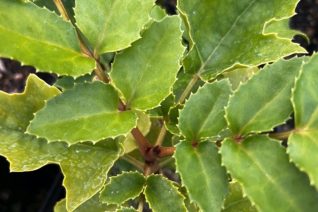
Gevuina avellana
Chilean Hazlenut is not a hazelnut at all its a protea. Glossy pinnate leaves are handsome all the time on this evergreen tree. The huge leaves hug the curly ivory colored flowers that stick out perpendicular to the stems. They are about 3″ long. After fertilization these flowers morph into tasty mellow nut like fruits that resemble red/ochre berries.. They are somewhat like Hazelnuts hence the name. Moderately fast growing to 25′ in our climate. It requires a protected location away from subfreezing wind. Excellent on the Oregon coast. The bark is mellow brown and handsome. It can freeze back substantially at 10ºF but recovery in spring is rapid. This means that this forest tree is almost always a shrub in our climate. Excellent espaliered against a south or west facing wall. Takes some shade but is happier in full sun. Fairly closely related to Macadamias but the nuts aren’t quite as sophisticated. Establish this plant well going into the first winter. Water once a week deeply for the first year. Good container plant that can be moved to a protected location when arctic air threatens. Blooms on wood from the previous season, prune if needed after flowering has ended.Prefers acidic soil and do not fertilize with phosphorous or potassium. Proteaceae. Chile/Peru/Argentina

Gilia achilleafolia
Yarrow Gilly Flower as the 49ers named this sweet little annual California wildflower. Frilly green foliage gives rise to 10″ stems supporting violet to sky blue flowers. Blooms May-July in our climate. Very easy to naturalize in open disturbed sites. A great reblooming pollinator wild flower. Makes sweet little bouquets as well. Full sun and loose un-compacted soil- turn the soil to incorporate oxygen before planting. Light summer water keeps things going. Or it will finish with drought setting seed for the next years performance. A reliable and useful re-seeding plant for open, rocky places, where no sane plant can find purchase. Often comes up in the ‘Alba’ white form which is fantastic and makes the blue form seem more intense. Great little cut flower. Very light H20 extends the show.

Gilia capitata ‘Willamette Valley Form’
Globe Gilia or Bluefields is a widespread annual wildflower from British Columbia to Baja. To 30″ tall and forming a substantial plant very quickly. From April to July and sometimes longer these striking sky blue flowers appear and rise on tall stems displaying the orbs of flowers. If you apply light consistent water and remove the spent flowers they can re-bloom. Otherwise, they persist until hot weather and then set seed and die. Studies at OSU on native pollinators ranked this #1 as their source for pollen/nectar. That alone gives you reason to include this re-seeding plant in your garden. Rich, to average disturbed sites are ideal. It often grows and self sows in the disturbed slopes of road cuts, dry hillsides. In the garden it LOVES good conditions and will be much larger, bloom longer, with flowers of a darker hue of blue. A great wildflower for the garden that makes a sweet cut flower. Loved by pollinators of all kinds. Wild areas, hell strips, dry gardens. Easy to naturalize if you contain the competition from other plants. Locally native in the Portland city limits. New plants germinate in autumn and overwinter happily. Oregon native plant.

Gilia capitata ssp pacifica
We once grew this form of Gilia capitata as our own local species. WRONG. We compared it to the southern Oregon Coastal variety ssp. Pacifica. That form is shorter but blooms are a distinctly darker blue. Everything as for the species Reseeds faithfully in OPEN disturbed sites with little competition from invasive weeds/turf grasses. This thick, stout variety makes a wonderful cut flower. It also has the same attractive properties that make it one of the best native pollinator plants. To 18″ tall and forming patches that reliably re-sows each year. See above care. WE love both forms of this Gilly Flower made famous by early European settlers. They’ve spread this wild flower around the globe where it has become naturalized in parts of New England into E. Canada. Not a bad weed but an example of something from here with adaptation to another climate. Oregon native plant.

Gilia tricolor
Bird’s Eye Gilia is a showy and delicate appearing but tough hardy annual from the central valley of California into the Coast Ranges as well as Sierra Nevada foothills. To 6″ tall each stalk bears multiple gorgeous purple to white flowers with a distinct dark eye. Give your pollinators a treat this diminutive plant will bloom for 4-6 weeks in late spring to summer in our climate. Give it open disturbed soil without competition form invasive grasses to complete its life cycle, where it will reseed with abandon. Lovely little west coast native annual for sunny, wild sites. Good in containers for a brief but brilliant wildflower display. Excellent in parking strips where it will love the reflected heat. Light consistent water until its time to go quietly to sleep. Good drainage helps.

Gladiolus dalenii ‘Bolivian Peach’
Hardy happy and elegant perennial gladiolus that is perhaps just a species but market…y’know. To 3′ tall it opens soft peach and yellow wild looking flowers up a sturdy scape. Multiplies quickly in rich well drained soil and a patch will form yielding multiple blooms and a great source of cut flowers. Nothing like hybrid garden gladiolus instead decidedly more wild looking and we LOVE that. Very easy to grow, tough and hardy. Emerges late often not until April be patient. Regular summer water and full sun will prevent the towers from falling over. If they do simply cut them and bring them in the house. Moderate deer resistance.

Gladiolus papilio
GLADZILLA! Thats what we call this rambunctious, prolific and all too easy species Glad. Blue/gray foliage gives way to serpentine spikes lined with curiously colored cup shaped flowers. The exterior of the petals is best described as dove gray. The interior is more complicated with zones of yellow, purple, and brown. Lovely cut flower.. The scape rarely stands straight up- accept that, it makes cool arrangements. In the ground its kind of a monster. It lives to multiply and in soil that too rich you will end up with 100,000 in a short time. Don’t torture it just don’t pamper it. Great plant for the rough life of the back 40 or a forgotten corner of your yard. Don’t recommend putting it in a hellstrip as it would spread so fast you would soon find Gladzilla monoculture. Completely winter deciduous- nothing there. Emerges relatively late in spring but it goes fast. Excellent cut flower. Strong deer resistance. Water? Yeah.. if you want.

Gladiolus papilio ‘Ruby’
This is an exciting new form of the butterfly glad, which we lovingly refer to as Gladzilla. So far, this cultivar is not nearly as rambunctious but is vigorous. Forming large colonies by bulb offsets as well as seed. Gray/green foliage rises to 16″ in clumps. In mid summer a large display of Ruby pink flowers appear in staggered stems up to 24″. If left to its on devices and just watered a good clump can yield more than a dozen stems. It makes a fantastic cut flower and unopened buds will be forced open in the vase. Full sun and AVERAGE soil with REGULAR water for the first season then light irrigation in subsequent years.It is vigorous enough that you can rely on water alone to check its growth. Very easy to grow cold hardy perennial Gladiolus. Very long lived. Mixes well with other vigorous perennials for full sun and regular water. Not bothered by deer or pests. To 2′ wide as a clump. Winter deciduous. South Africa.

Gladiolus tristis ‘Moonlight’
Unusual species gladiolus that is actually an early spring bloomer and at night possesses a wild sweet powerful perfume. Very thin grassy foliage forms clumps to 10″ tall. It appears in autumn with the first rains after summer dormancy. In March flower spikes rise to twice as tall as the leaves an open wild looking simple luminous yellow flowers. They have fancy markings on the inside lower two petals. At dusk the perfume arrives and does it flow. I’ve smelled this flower from 20′ away on mild spring nights. It makes a great cut flower but this mysteriously diminishes the perfume. Full sun and VERY WELL DRAINED soil- such as a rock garden or a hillside. It dislikes competition so give it space. Excellent with a mulch of gravel. Don’t plant this in a crowded bed in rich wet soil it will die out or it will quickly be overwhelmed. Fun plant to grow. Needs no supplemental water cause its totally dormant by summer anyway.
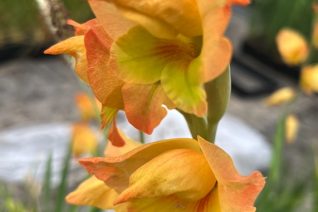
Gladiolus x dalenii ‘Boone’
Found by a NC extension agent at a very old homestead in Boone, a cold mountain town in the western part of the state. This very old hybrid cultivar of Gladiolus dalenii and ? Its also listed at the hybrid G. x gandavensis. A wonderful COLD HARDY perennial Gladiolus that we dearly adore. Pale orange outside simple petals surround a center of intricate coloring. Green, pink, yellow. Very wild compared to the big border babies but a true multiplying perennial that will quickly form a clump with a dozen or more flower spikes. Blooms appear for 4 weeks in the middle of summer. They rise above a healthy bunch of soft green spear shaped leaves. Full sun and rich soil with no standing water in winter. To 22″ tall and spreading to 1′ wide in about 5 years. Not bothered by deer – YAY and a great perennial for rural areas. In urban places the only protection it requires is from your flower arranger friends cause the subtle color combination in this flower can be tastefully echoed in a bouquet. Naturally cold tolerant and very easy to grow. Protect from Cutworms on emergence. Long lived perennial

Glaucium flavum
Yellow Horned Poppy is a Xera favorite perennial. This true poppy bears a long season of large irredesant light yellow flowers. They appear in succession for 6-8 weeks into the middle of summer. Flowers are replaced by long “horns” which are the seed pods. Incredibly blue glabrous rubbery foliage is wonderful with the glowing flowers. Full sun, well drained poor to average soil- adapts to rich soil with less water. Light summer water though established plants get by with nothing. To 2′ x 2′ in a single season. Dies back to a low rosette of leaves in winter. Will often seed around and you want this to happen cause the more of these the better. Average lifespan: 3-5 years. moderately deer resistant. No other pests. Excels in gravel gardens.

Glaucium flavum ssp. auranticum
The brilliant ORANGE flowered horn poppy. Variety is the spice of life and we had of course to grow this form of one of our favorite perennials. HUGE true orange flowers are up to 5″ across and they glow from quite a distance. In combination with the blue rubbery foliage- WOW. Full sun and well drained poor to average soil with light to no summer water. Adapts to richer conditions but this will shorten its lifespan. Large blue long “horns” protrude from every direction where a flower was present. Self sows and comes true from seed. Leave the seedling where they are- transplanting this genus can be dicey. Enjoy it as the feral wildflower that it is. High deer resistance. 2′ x 2′. Dies to a low rosette in winter. Average lifespan: 3-5 years.

Globularia cordifolia var. nana
Low growing globe daisy that makes a great small scale evergreen ground cover. In mid-spring rising up from the small paddle shaped leaves spikes are topped with spheres of fluffy steel blue flowers. Spreads moderately fast on well drained sites with light summer water. Full sun to part shade. To 4″ tall- foliage prostrate and spreading to 18″ wide in several seasons. Great in rock gardens. Cold hardy, drought adapted and easy small scale plant. Very dense growth pattern inhibits weeds on a small scale and the glossy deep green foliage is presentable year round. Not a widespread ground cover. Excellent between pavers and rocks. It handles compacted soils with aplomb. Light summer water but completely drought resistant when established. Charming plant.

Globularia repens ‘Nana’
Tiny, minute, so small the paddle shaped deep green leaves of this tiny groudcover hug the ground so tight you might over look it. In April/June you won’t miss the masses of relatively large fluffy steel blue globe shaped flowers that float above the plant. Excellent plant for massing in rock gardens, hot dry sites anywhere with full sun and free drainage and protection from marauding invaders. To 2″ tall in bloom a well grown patch can stretch several feet across. Gritty soil that drains quickly. Regular summer irrigation increases the growth rate which is never rapid. Adorable plant that creates a carpet of color and texture. Great plant for alpine troughs where you can keep an eye on it. Fairly spectacular in full bloom. Loved by bumble bees and bees in general. Classic rock garden plant. Native to the mountains of southern Europe.

Globularia trichosantha
The bluest of blue globe daisies. This species is rare but shouldn’t be. It forms low evergreen rubbery foliage that is flush with the ground in mid spring 5″ tall spikes terminate in foamy cobalt blue multipetalled orbs. So blue. Full sun and well drained soil. Full sun- doesn’t do shade at all. In time it forms a dense small scale ground cover. Rock gardens, Hot slopes, Troughs, Occasional light summer water. It really is an easy plant to grow. And blue, so damn blue.

Grevillea australis
Alpine Grevillea is a cold hardy, handsome, evergreen shrub that is good looking at all times. In late winter/early spring flossy white flowers explode over the bush and emit an intense honey fragrance. Each small leaf is olive/ochre green on the surface and silver below. Dense, fine textured very rounded compact shrub to 4′ tall and 5′ wide in 5 years. Maxes out at that height but continues to gain width. Avoid enriched, over-improved soil. Best in unimproved native or even poor soils with sharp drainage. Little water ever once established. Cold hardiest Grevillea taking temperatures to just near 0ºF with no problem. Tolerates subfreezing wind as well as ice and snow. Easy to grow if left strictly alone. It may be pruned in spring to limit the size- prune tips. Very good landscaping plant. The powerful honey fragrance of the flowers is detectable for quite a distance on warm days. But for this it would make a good cut flower- fragrance is a little too strong. Cut branches last for several weeks in a vase and foliage is handsome. Takes very well to pruning. Good deer resistance. Video below is of a plant in full bloom. Takes a moment for the video to load. Not tolerant of shade at all. Hates it. Revels in full hot sun. Limited quantities.
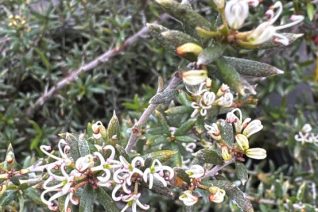
Grevillea australis var. prostrate
Interesting plant for the collector. This is a low and mounding form of the hardiest Grevillea species. The tiny leaves are pointed, not rolled as in the species and they have a uniform tan green hue. In spring- after several years in the ground tiny flossy white flowers swarm the foliage from every leaf axil. They emit a penetrating honey perfume for weeks. VERY VERY slow growing to just 8″ tall and barely 2′ wide after 7 years. Full sun- no shade at all and average to poor well drained soil. It does just fine in native soil that has not been amended and its ultimate preference is for loam. Excellent small evergreen shrub for rock gardens, small spaces. More of a collectors plant. Useful on steep hillsides. Very hardy to cold enduring 5ºF with no issues. Little to no summer water. Moderate deer resistance. Slow. Tasmania, SE Australian Alps. In the wild it cozies up to boulders to absorb radiant heat. This could be repeated easily in a garden. Rare. Limited quantities. This is a form selected and named in New Zealand.

Grevillea juniperina Firewoman™
About 15 years ago we planted this tiny seedling at the top of our propagation hill behind our wholesale nursery in Sherwood. After all those years and two trips down to 5ºF, numerous ice, snow, wind events it has remained completely happy and unblemished. This is closer to the species in form. To 4′ tall x 6′ wide in 5 years. Very prickly needles pose as the leaves forming a very formidable shrub. From January to July flaming red/orange flowers are curly and lick the tips of the stems like flames. And LOVED by hummers. Full sun to part shade, the very poorest, most well drained soil with no summer water once established. Takes clay soils on slopes. Completely drought adapted and it likes it that way. Great deer resistance. Long season of bloom on a charming architectural evergreen shrub. Excellent companion shrub for Arctostaphylos ( they both bloom in winter and attract hummers) as well as other drought adapted plants such as Italian Cypress and Arbutus. Our plant lives in what is termed ‘gravel reject’ which is the tailings from the gravel pit near by. It is 50% gravel and 50% fine soil- and is fairly challenging as far as summer drought goes. This plant has thrived. In richer soil expect faster growth. We do not give our stock plant supplemental water ever. Tough plant.
Xera Plants Introduction

Grevillea juniperina ‘Lava Cascade’
Low ground cover form of the Juniper Grevillea. Spreading to 6′ wide it rises to just 2′ when happy. Most of the time it is much lower. This selection is the most commonly seen orange form of this species. Spidery orange/red flaming flowers appear in clusters at the branch tips. The most likely bloom period is February-June- but older plants pump out sporadic flowers year round. Excellent on slopes- especially warm south facing slopes in a protected location. Surprisingly cold hardy enduring temperatures down to about 8ºF with no damage. Avoid subfreezing wind as well as boggy conditions and crowding from other plants. It likes to dry out in winter, and loathes wet plants laying on it. Extremely drought adapted requiring no supplemental water after a year or two. Highly deer resistant. Excellent evergreen- but prickily shrub for Hell strips. Loved by hummingbirds. We have since introduced G. j. ‘Xera Ember’ which is a more compact shrub 2′ x 4′ and has more deeply hued (bordering on red) flowers for a longer period. Gains hardiness with age. Pictured here with ‘Molonglo’.

Grevillea juniperina ‘Molonglo’
Juniper leaved Grevillea that is a low spreading ground cover. Grass green needle like foliage plays host and is often obscured by masses of curly apricot yellow flowers. They peak in late spring but occur almost any time of year. Poor, well drained soil in full sun with no supplemental water ever. To 2′ tall by 6′ wide in 5 years. Supremely adapted to the heat and drought of parking strips. Prickly foliage deters animals- and even people. Incredibly floriferous shrub that gains cold hardiness with establishment. Loved by hummingbirds. Protect from subfreezing wind. No fertilizer. Dense enough growth to smother weeds Best with total neglect. Loved by hummingbirds. Little water when established. Amazing in bloom.

Grevillea juniperina ‘Orange Zest’
We grew and selected this spiky long blooming juniper Grevillea years ago, After a few years hiatus we’ve brought it back. Upright then spreading evergreen shrub. Incredibly sharp needles pose as the leaves. Curly orange typical spider flowers for the species with profuse flowers. Bloom is year round on established plants but for the first several years it peaks in spring. To 3′ x 5′ in 6 years. Full sun to part shade- Increased bloom and a more compact habit will be achieved in full sun. Tolerates a wide variety of soils but seems to excel with at least moderate drainage. Adaptable to clay soils. This is one of the cold hardiest cultivars of this species enduring 5ºF with no damage. Best in an open exposure with reasonable air circulation. No crowding with other plants. Excellent in the back of a rock garden or in a shrub border with Manzanita and Halimium. Water to establish , once its growing in earnest you can taper off and drought adaptation is exceptional. Avoid enriched soils, best in average unamended soil. Double dig a wide hole to assist the plant in rooting into virgin soil. Extremely deer resistant but adored by hummingbirds and many other birds in general. Very fun shrub to grow.
Xera Plants Introduction

Grevillea juniperina ‘Pink Lady’
A pretty shrub for a protected location. Compact growing evergreen shrub with medium green needle-like foliage. To 2′ x 4′ in 5 years. Nearly year round-but peaking in spring, copious light pink curly flowers are loved by hummers. Protected location in virgin, un-improved soil. Drought adapted when established. Excellent on a hot south facing slope- avoid crowding by other plants or an exposed cold site. Its possible that this is a hybrid and not pure G. juniperina. However, there is so much variability in this species that we are unsure. Extremely drought tolerant but it seems to grow faster and bloom more profusely with light water in summer. This plant is great at the Oregon coast where it is in nearly full bloom year round. It has survived undamaged in my garden for 9 years and has endured temperatures to 10ºF undamaged. It could be much hardier (when established). Limited qualities.

Grevillea juniperina ‘Xera Ember’
Our improved selection of the Juniper Leaved Grevillea with darker orange to near red profuse flowers and a more compact habit. To 2′ x 4′ wide in time the prickly grass green foliage of this spreading evergreen shrub allows the vivid curly deeply colored flowers to shine. Blooms nearly year round with a peak in mid to late spring. Loved by hummingbirds. Completely drought adapted- never needs supplemental water. Poor to average soil that drains but has never been amended or fertilized. Awesome candidate for a hot hillside or a protected hot south facing wall. Spectacular in bloom. Requests neglect- you should oblige. Hardy to around 7ºF. Full sun. High deer resistance.
Xera Plants Introduction.

Grevillea miqueliana var. moroka
Round leaf Grevillea is a great hardy species from the highest elevations in the mountains of SE Australia. Handsome wavy round evergreen leaves frame showy pendant flower clusters from January to June. The sunset colored flowers feature orange/yellow/pink in various incarnations depending on the temperatures. Loved by over wintering Anna’s hummingbirds. Any reasonably well drained soil that has NOT been amended. Native soils are perfect, and tolerant of clay as well as sand. Great on slopes. Fast, large growing to 8′ x 8′ in 6 years. Sporadic flowers appear year round. Avoid fertilizers. One of the best climate adapted Grevilleas that we have grown. Grows very fast with little water. Full sun and a hot position. Listed as endangered/threatened in Australia where it occupies just a half dozen sites in the high mountains. Extra reason to grow this fabulous multidimensional shrub that is good looking year round and blooms for a long, long period. Light summer water is best as infrequent deep soaks when it is not hot. This shrub gains cold hardiness with establishment. Excellent sited where its roots can find protection and a cool respite. Large boulders, even pavers will help create this. A very rare Grevillea that is truly alpine in nature.

Grevillea rivularis
Surprisingly cold hardy to a point and is wonderful Grevillea that is threatened in the wild. Crinkly, prickily, finely divided leaves (bipinnapartite) create a haze of a frame to 5′ x 6′ in 6 years. This “cage” of foliage is intermittently decorated with soft purple flowers from spring to early autumn. These are tipped with a bright green style that is released in bloom. The flowers are often described as toothbrush like. Full sun to very light shade in average soil. Light summer water speeds growth but that is the only reason it is necessary. A protected location. Hardy to about 10ºF- and suffering no damage in the wild winter of 2016/17. Protect from subfreezing wind. Easy to grow with neglect and good siting. Same hardiness to cold as ‘Canberra Gem’. Give it room as it will steadily and methodically increase before you know it. Moderate deer resistance. AKA Carrington Falls Grevillea. Avoid fertilizers. If it never bloomed this shrub is fantastic for texture alone. Not for cold gardens- best with some urban protection. Very limited quantities.
Photo credit: Loree Bohl
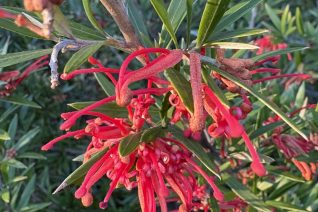
Grevillea x Foxy Red™
We selected this seedling long ago for its vigor, it was chosen from a batch of 50 as one of the best and it is. ‘Foxy Red’ is a mounding, low growing shrub that spreads. To 3′ tall x 8′ wide it produces a nearly year round parade of tomato red flowers. The elongated superior foliage is olive green on the upper surface and gray below and comes to sharp point. Fast growing in full sun to light shade. Average unimproved soils are ideal, dig a large hole and soften the soil on the outer edges. Water faithfully, once a week until good new growth commences then water less- once every two weeks/month depending on aridity. Nice looking winter blooming shrub that is ideal planted above rock walls where it can cascade down. Loved by hummingbirds, especially wintering Anna’s who see an out of season nectar source as gold. Mulch after planting- coarse bark, chips, gravel…. Established plants take summer drought without supplemental irrigation. Should be deer resistant. At some point we’ll test it for their consumption. Really nice looking shrub both in foliage and bright flower. May be pruned at any time of the year. Avoid strong subfreezing east wind. Protected site- south or west facing.
Xera Plants Introduction
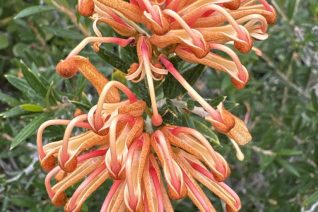
Grevillea x Xera Peach™
This seedling selection has multi-color peach flowers that are large and handsome small olive green foliage that is not prickly.- This is seed from a hybrid between Grevillea victorae x Grevillea juniperina ‘Gold’. I sowed a bunch of seed and this seedling stands out as superior to the other seedlings and to many other Grevilleas that we grow. This is an upright growing and then spreading evergreen shrub with distinctive small grass green wedge shaped leaves. The flowers are very large for a hybrid and the perianth is a soft citrus pastel orange. The style or pollen presenter begins life after opening with a red/melon color as it ages the style changes to light yellow from the tip down. The base of the style nearest the perianth remains dark melon red. Very heavy blooming selection. Flowers appear January-July and on older plants year round. The large clusters of un opened buds are shaded light pink before maturing. Upright growing then spreading laterally with age. To 4′ tall and 4′ wide. All Grevilleas are a beacon to Hummingbirds and all birds as is this cultivar. Full sun in average, un-amended soil. Dig a very large hole and water weekly until you see good new growth then taper to once a month. I’m very proud to offer this seedling, it is a vast improvement on other Grevilleas with similar size flowers- this one beats them all. Best in a warm, protected location. The smallest of our three hybrids.
Xera Plants Introduction

Grevillea x ‘Canberra Gem’
One of the easiest Grevilleas to grow in our gardens this free flowering hybrid requires a protected location but is surprisingly hardy when well sited. To 4′ x 6′ wide in 5 years, the needle like foliage is bright green and fairly crowded along the stems. Bloom begins in March and extends to July. A small amount of flowers appear year round.- clusters of spidery deep vivid magenta flowers. Very showy. Loved by hummers. Full sun and average to poor well drained soils. Great at the top of a hillside or next to the south wall of a house. No summer water, or compost necessary. You may water it weekly to establish and you can trail off as the plant grows. Native unimproved soils are what it loves. Cold hardy to the low teens. It has recovered from lower and we’ve seen established shrubs in protected places all over western Oregon. Fantastic performance at the Oregon Coast where it should become a staple landscape shrub. High deer resistance- and that includes Elk on the coast. Takes well to pruning after the first flush of bloom has ended. Hybrid between G. rosmarinifolia and G. juniperina. Evergreen. See video clip below.

Grevillea x ‘Constance’
This is an important hybrid that is among the best known in the United States of G. victorae x G. juniperina. A wiry rounded shrub with thin twisted green leaves that are rolled at the margins. Throughout the year a constant procession of orange/red flowers decks the whole frame. Loved by hummingbirds. To 7′ x 7′ in 7 years in average, well drained soil in full sun with little water once established. Not the hardiest Grevillea and has been superseded by cold hardier and superior varieties- such as ‘Neil Bell’. It is, however, an excellent evergreen shrub for the milder coastal regions. In Portland it is relegated to the warmest urban areas in protected locations. Easy fast shrub that you should protect from subfreezing wind inland. There are enormous specimens on the northern Oregon coast that adore that climate and it is naturally adapted to sandy soils. High deer resistance. Loved by hummingbirds. Prune to contain and maintain a compact habit. Hardy to about 13ºF- or slightly less hardy than ‘Canberra Gem’. Very floriferous.

Grevillea x ‘Leanne’
Handsome evergreen shrub that displays masses of gold/old gold spidery flowers nearly year round- peaking in late winter into spring. Clean paddle shaped leaves are olive green on top and silver gray on the underside- a great combination with the flower color. Dense growing to 4′ x 6′ in full sun and poor to average well drained soil. Little summer water when established- extraordinarily drought tolerant. Loved by hummingbirds. One of the easiest to grow and fairly spectacular in full winter bloom. Excellent everblooming shrub for slopes, dry hillsides, low water areas. Avoid compost, nutrients. Tip prune if growth is too fast or rank and endangers the plant from rocking. ‘Leanne’ thrives on our own unimproved native soils. Full sun to very light shade and neglect. Excellent cold hardiness. Hybrid between G. victorae and G. juniperina. Avoid summer water which can leave it susceptible to phytophthera. It can tolerate ANY amount of extreme drought with no problem. Nice mounding habit for hot hell strips. Mixes well with Arctostaphylos, other drought adapted shrubs. Gains cold hardiness with age- establishment. Excellent garden shrub. At one point this and many other hybrids were known for the ranch, Poorinda where they were discovered/bred. That first moniker has been dropped in all of the varieties (Save for x ‘Poorinda Queen’- which, well. Cuz.) So, this is just Grevillea x ‘Leanne’ now. Why they made this change I do not know. Crazy Australians.

Grevillea x ‘Marshall Olbrich’
Pretty and very large Grevillea that deserves the mildest parts of the garden. Small gray leaves are handsome and a great backdrop to the hot orange pendant clusters of flowers. Blooms year round with an especially large flush in spring. Loved by overwintering Anna’s Hummingbirds. Not the hardiest Grevillea- protect from subfreezing east wind- site on a south or west facing aspect. To 9′ x 9′ fast. Plant in UNAMENDED native soil- avoid compost and fertilizer. Supremely drought adapted. Avoid watering in summer. Excellent performance at the Oregon coast. Our stock plant which has thrived for 15 years in a very cold place is situated on a slope with the overhead protection of Douglas firs. Evergreen. High deer resistance.
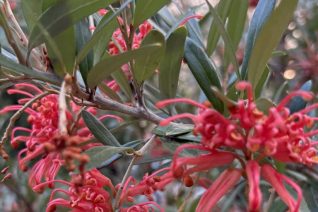
Grevillea x ‘Neil Bell’
A chance seedling in Neil Bell’s Monmouth, Oregon garden has yielded one of the finest Grevilleas that we can grow. Neil graciously shared cuttings of this seedling to us. It then bloomed and turned out to be a fantastic shrub and we named it after Neil. Large evergreen shrub with dapper paddle shaped leaves olive green on top and gray underneath. Year round spidery pendant tomato red flowers appear- waxing and waning with the weather- they favor cooler weather. Fast growing and completely drought adapted. Water to establish then none in subsequent years. Takes well to tip pruning. Well drained average to poor soils that have NOT been improved. Adaptable to clay especially on slopes. Loved by hummingbirds and predominantly staked out in winter by Anna’s who recognize it as a superior food source. It has been cold hardy to 5ºF planted in the ground suffering no damage. 8′ x 8′. Cold adapted Grevilleas have flower buds insulated with fine fine hairs- this protects them from the coldest temperatures. Open flowers may be damaged by lows colder than 23ºF but new, protected flower buds will open in the next thaw so the display resumes quickly. Prune in early summer- this produces a denser shrub and will spur it to into bloom. Grevilleas may have as much as 1/3 of their mass removed annually and will regrow rapidly. This can be useful for shrubs that have grown too fast or rank and need to be stabilized by resizing. Cut branches with flowers last in a vase in winter and its a great time to have vibrant cut flowers. Do not water during very hot weather- it is adapted to the most desiccating heat and dry with no ill effects. Fantastic shrub. Protected location. Flower buds do not abort in hot dry weather.
Xera Plants Introduction.

Grevillea x ‘Octopinky’
This seedling showed up in my garden about 6 years ago. It must have been from ‘Constance’ which froze out but this seedling remained. Curious shrub with congested deep green small leaves lining long arching branches. Shows little interest in branching on its own- you can fix this with a few snips of the terminal ends of the branches. I was amazed to find the peach/pink flowers that arrived one spring. Orange on the outside the perianth reflexes when open to pink and peach. Its parent plant had flowers of dark orange/red so this was a surprise. It blooms heavily with clusters of small curly flowers, the perianth reflexes and reveals a long style that is actually light brown. Curious shrub for the collector. Its been hardy below 10ºF in 2013 and since then has never shown cold damage . Full sun and average to poor well drained soil. Little to no summer water when established. The arching stems reminded me of an Octopus. Hence the name (with the clever help of Evan Bean). To 7” x 4′ at a moderate clip.
Xera Plants Introduction.

Grevillea x ‘Poorinda Queen’
Subtle but beautiful hybrid Grevillea with fine needle-like foliage that produces a nearly constant parade of soft citrus orange spidery flowers. The perianth is soft orange and the protruding style is red. No matter the weather this carefree shrub seems to be in bloom. Heaviest flowering is in mid-winter just when the gardener needs it most. Large spreading shrub to 8′ x 8′ in poor, well drained native soil. Little to no summer water when established. Very very cold hardy enduring 5ºF with no damage. Give it room to spread as it can grow very fast. Takes light overhead shade if not too dense. Incredibly drought tolerant. Very difficult to propagate but we are always trying to make as much of this awesome shrub as possible. The intensity of the flower color shifts with the seasons gaining vividness with cooler temps. Wonderful winter blooming shrub. Grevillea victorae x Grevillea juniperina. A Xera favorite. Protected location. Very good in the city of Portland.
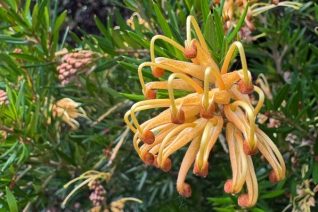
Grevillea x ‘The Precious’
Excellent introduction from Desert Northwest Nursery in Sequim, WA. This seedling of ‘Leanne’ exceeds that cultivar in several ways. First, it has decidedly smaller, needle-like deep green foliage. Second, its profuse flowers are a brighter and lighter yellow that is showy from a distance and great contrast with the darker foliage. This brand new plant is likely to reach 3′ x 5′ in 8 years. Moderately fast growing. Blooms begin in mid-winter and repeat to autumn. They take a brief break late in the year. They are a beacon to hummingbirds as well as gardeners in the the last cold days of winter. Full sun to very light shade in average, un-amended native soils. Good drainage is helpful. Very little to no water once established. Extremely drought adapted. Beautiful, free blooming shrub that has great promise.Somewhat open habit often with a twisting attitude. Lots of character. Thanks, Ian. High deer resistance.

Grevillea x gaudichaudii
Impressive ground cover Grevillea that can be difficult to locate. To less than one foot tall it spreads out laterally easily 8′ wide in 7 years. The distinctly oak shaped leaves on this shrub emerge deep red before settling to green. All the while it is producing red upward facing “toothbrush” shaped flowers. These appear from February to August primarily but can pop off occasionally year round. All together it forms an amazing ground cover shrub that features fantastic foliage and flowers in a bold tapestry display. Cold hardy to a bit less than 10ºF- it appreciates successively colder frosts to harden off for its ultimate frost resistance. Full sun to part shade in average, well drained soil. Light summer water increases the growth rate- and it can zoom once established. Avoid crowding from other plants- it seems to require good air circulation. Excellent performance on gravel mulch. Large rock garden plant or hot slope cover. Protect young plants from temperatures below 15ºF- it can burn the foliage. Hardiness increases with establishment. The very short trunk emerging from the ground can be surprisingly stout- several inches in diameter. Cover with frost cloth- held down for wind protection during extreme arctic events. Drought adapted when established. A protected location. One of the coolest shrubs we can grow. A naturally occurring hybrid from the Blue Mountains. Excellent around and over boulders which add radiant heat during extreme cold. Should only be attempted in the mildest gardens.

Grevillea x Xera Red™
A very interesting Grevillea. This is a seedling of ‘Marshall Olbrich’ that appeared in my former garden. For the past 13 years its thrived in that garden reaching 5′ x 6′ forming an open spreading shrub. The evergreen leaves are soft gray on the underside and distinctly pointed. True red flowers appear year round and are a beacon to all hummers. Handsome shrub that has shown consistent hardiness and ease of culture. Full sun and average, native, un- amended soil. Plant this shrub and water until you see good new growth then taper off. For rapidly growing shrubs tip pruning controls not only the size but encourages root stability AND promotes flowering. Prune after a large flush of flowers. Full sun to very light shade in a warm position. Avoid subfreezing wind exposure. In those areas of east wind locate on a south or west facing aspect. Best true red flowers as of yet on a hardy hybrid. Mulch after planting with bark or gravel. Drought adapted when established. Limited quantities. Absolute hummingbird dream.
Xera Plants Introduction

Grindelia integrifolia
Willamette Gumweed, Puget Gumweed is an important native late blooming pollinator plant. A native resident in the Willamette Valley along water courses and marshlands- It seems to excel in areas that are wet in the winter and bone dry in summer. That kind of adaptation begs for its inclusion in bioswales and to stabilize stream banks. In normal garden conditions gumweed – which derives its common name from the gummy coating on the leaves. It has a tar-like fragrance and is positioned on the leaves to decrease evaporation. It may also impart some resistance to saline conditions. In June-Sept. this large, spreading plant is decorated with corymbs of bright yellow daisy flowers. Immediately they are attended by pollinators. Its fascinating. The flower bud is densely armed with prickles giving this native daisy kind of a tough look. To 30″ x 30″. Full sun and rich to average conditions. Tolerates clay soils if you water it consistently to get the new roots into the clay soil. Once established it’s a very drought adapted plant. It also improves substantially under cultivation. Combine with Symphyotrichon subspicatum ‘Sauvie Sky’ and Solidago for a native prairie redux. Winter dormant. Seed grown from plants native to the Willamette Valley. Moderate deer resistance. Oregon native plant.

Hakea epiglottis
Beaked Hakea. Out of this world wiry shrub from Tasmania that forms nearly a tree with modified stems that serve as leaves. Fast growing see through plant that casts no shade for full sun and average to poor well drained soil. Proteaceous- avoid fertilizers and compost. Completely drought adapted needing no supplemental water once established. Water regularly until new growth commences . Forms a large piece of architecture. In early spring tiny sulphur yellow flowers crowd the leaf axils and emit a sweet clove fragrance. Very easy to grow. Cold hardy to 5ºF but avoid blasting subfreezing winds from the gorge. Completely deer resistant. Very inviting to small birds who will swarm the shrub to find protection in its wiry center- Bush tits adore this shrub To 8′ x 6′ in 5 years. Specimen, unusual hedgerow. Excellent cut material for groovy bouquets. Very fun to grow. Pronounced HAY-kee-uh.

Hakea microcarpa
Alpine needlebush is an unusual tree/shrub from cold high elevation areas of Australia into Tasmania with spiky modified phyllodes as leaves. The spiky leaves are blue green and it forms an airy conifer like large plant very quickly. In spring flossy white flowers crowd the blue green leaf axils and are showy for several weeks. Full sun and average to poor well drained soil. Little summer water once established. Fast growing in youth to its ultimate size. Cold hardy for us to 5ºF but avoid exposure to subfreezing winds. Proteaceous- do not fertilize or even add compost. Un amended native soils are ideal. Very attractive to birds who will use the leaves as perches. Humming birds love this plant in bloom as well. To 9′ tall and 6′ wide in 6 years. Great on slopes. Casts no shade- great textural element year round. High deer resistance. Very unusual plant- out of the ordinary and cool. Pronounced HAY-kee-uh.
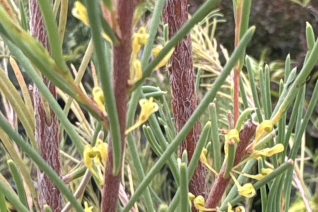
We love cold hardy plants in the Protea family, not only do they have exotic flowers, they can sport foliage that is just as interesting , Hakea nodosa is another shrubby Hakea that is known as yellow Hakea. Multiple fine stems emerge from the ground and are staunchly vertical. They have few side branches and each stem is clad in slightly swollen blue phyllodes, these are not prickly and are about 1 cm long. In spring, very small yellow flowers crowd the leaf axils on older wood.- not conspicuous but hummingbirds find them. An upright small shrub to about 6′ tall and 2′ wide. Pollinated flowers produce large seed pods that can cause the stems to nod, not sure if this is what the specific name refers to. Moderately fast growing in native, un-amended soil that drains, including clay soils that dry in summer. Water to establish then extremely tolerant of drought. A wonderful textural evergreen that we love at Xera. An excellent companion to Grevilleas, Ceanothus, Halimium, Arctostaphylos.. Fulll sun to very very light shade. This form has been cold hardy below 10ºF in western Oregon with a probable lowest temperature around 5ºF. Native to areas of South Australia into Tasmania. Ours are grown from high elevation, cold hardy seed from Tasmania. Lovely soft, rare shrub . Pronounced HAY- kee -uh. But with an Australian accent. Well adapted to the Oregon coast and can be cultivated on sand. Deer resistant, but protect newly installed plants from rabbits. Very easy to grow, a natural with ornamental grasses and large hardy succulents, Cactus, Agaves. Not prickly but rather soft.

Halimiocistus x wintonensis
Clever llttle rockrose that deserves a place in a protected, hot, sunny aspect. Sage green dense foliage is a great backdrop to the spectacular 3″ wide cupped flowers. They are white with a zone of maroon at the base around a yellow center. Fun! Blooms daily for 4 weeks in May-June. To 2′ x 2′ quickly in RICH well drained soil in full sun. Light summer water. Great performance in the reflected heat of hellstrips. Beautiful in bloom. Combine with native hardy annuals for a wonderful wildflower spring display. No water necessary. Forms a rounded shape. Best with occasional summer soaks but tolerates drought.. Moderate deer resistance. Very good performance at the Oregon coast.

Halimiocistus x wintonensis ‘Merrist Wood Cream’
For flowers alone this is the most spectacular Rockrose. A cross between Halimium and Cistus produced this remarkable low spreading evergreen shrub to 2′ tall and 3′ wide. In April to June 2″ cream colored single flowers, the base of each petal is a maroon blotch Flowers appear daily for weeks. Attractive felted sage green/gray foliage is handsome even out of bloom. Full sun and well drained ENRICHED soil- these hybrids prefer richer conditions. Little or no water for established plants. Tip prune after flowering to shape. Protected location. Excellent performance in Hell strips. Amazing flowers. Prune very lightly if needed after flowering.

Halimium ‘Sarah’
The very best cultivar of Halimiums as judged by quantity and length of bloom. Golden yellow silky flowers have a deep maroon blotch at the base of each petal. Evergray, rounded shrub to 3′ x3′ in 5 years. Full sun and poor to average, well drained soil. Light summer water to establish then light water.. Blooms for an extended period from early May to early July. Prune after flowering to encourage a denser form and more flowering wood. Excellent wildflower display that pairs well with blue flowered plants. Ceanothus thyrsiflorus ‘Victoria’ flowers simultaneously and appreciates the same cultural conditions. Moderate deer resistance. Average lifespan 6-8 years.

Halimium ‘Susan’
A very compact form of golden rockrose that is also an insanely heavy blooming machine. To barely 2′ tall and as wide in 5 years. Evergrey foliage is obscured in late spring to early summer with masses of daily golden flowers with a black center. Awesome wildflower effect that lasts for weeks. Full sun and average to poor well drained soil. Water to establish then no water or light water. Longer lived with neglect. Rock gardens, Hellstrips, etc.

Halimium lasianthum ssp. formosum
Big spreading Halimium with arching furry gray stems lined with furry gray foliage. In May-July profuse 1″ wide silky yellow flowers with a basal blotch of deep brown appear massively each day. During the heaviest of bloom the foliage is completely obscured. Flowers last until about 4:00 pm and then the petals drop dramatically all at the same time. Full sun and average to poor soil with little summer water once established. One of the hardiest and easiest to grow. To 3′ x 6′ in just a few years. Very drought tolerant. Tolerates clay soils on a slope. Moderate deer resistance.

Halimium ocymoides
Golden rockrose (Halmium) is the another genus in the Cistaceae apart from Cistus. This dense rounded shrub to 2′ x 3′ is clad in evergray foliage and appreciates average, well drained soil in full, all day sun. Water to establish then only light occasional summer water. Blooms which are bright yellow and silky have a central zone of burgundy. One of the common monikers is ‘Black Eyed Susan Shrub’. Produces a great wildflower display for weeks in May to July. Lifespan is about 9-15 years but flowering is so profuse and long the risk is worth it. Cold hardy to 5ºF. Mediterranean native. Plant with Cistus, Grevilleas, Arctostaphylos, Pacific Coast Iris. Prune lightly after blooming has ended to shape, encourage a denser habit.

Halimium x pauanum
Nice, upright golden rockrose with felted gray foliage and masses of flowers from May-July. To 3′ x 3′ in full sun and well drained soil of average fertility. Little to no summer water once established. The simple, silky, egg yolk yellow flowers shine for most of the day before dropping in late afternoon. They drop all at once- which is kind of cool. A massive new set of buds will be waiting for daily displays for weeks. Good cold hardiness unless soil in too enriched. Grow this baby mean and lean and you get better performance, a longer lifespan, and better cold hardiness. Hell strips, dry borders, gravel gardens. Light deer resistance. Average lifespan 5-7 years- longer with neglect. Prune after flowering has ended if needed. Excellent shrub for a new garden while you wait for focal plants to establish.

Hebe (Veronica )’Hinerua’
We love this tough and easy to grow whipcord Hebe. Ochre green upswept branches on a rounded evergreen shrub to 28″ tall and as wide. Full sun and rich to average well drained soil with light summer water. Takes very dry conditions when established. Perfectly hardy to cold down to 0ºF. In summer occasional white flowers decorate the top branches. Easy to grow always good looking little shrub. Extremely cold hardy for a Hebe and it will avoid damage even in the worst winters. Excellent in windy coast gardens and the gold green foliage is fresh and bright year round. Nice shrub.

Hebe (Veronica) ‘Wingletye’
One the best Hebes that we have grown that offers cold hardiness, showy flowers, and a useful low spreading habit. This ground cover Hebe with gray foliage and held on black stems spreads nearly prostrate to form a low dense shrub. In early summer the whole plant is smothered in deep violet purple flowers- among the showiest flowers of any cold hardy Hebe. Stems arch up and then immediately down cruising along at a moderate clip. To 6″ tall and 3′ wide in full sun and well drained soil. Light summer water when established. Excellent plant for slopes (the stems root where they touch the ground) as well as rock gardens. Placed near a wall or container edge and it will gracefully spill over the edge following closely the contour of any object. Plant density inhibits weeds effectively and it can make a useful ground cover placed on 2′ centers. Very tough little evergreen shrub and always good looking.

Hebe (Veronica) pinguifolia ‘Sutherlandii’
Indispensible alpine cold hardy Hebe with an astonishingly uniform dense habit. Rounded to 30″ tall and up to 4′ wide in time. Blue gray foliage is handsome at all times. In summer sporadic white flower spikes dot the plant. Full sun to light shade in average to rich well drained soil Light, but consistent summer irrigation. Especially important for it to be well hydrated before extreme heat (above 100ºF). Excellent hedge, massed as a tall ground cover. Very cold hardy- not bothered by our coldest winters and of alpine derivation in its home in New Zealand. Formerly known as Hebe sutherlandii. Excellent as low informal hedge or even massed as a symmetrical ground cover.This form has been consistently hardy down to 0ºF. Excellent performance in cold rural gardens. Tolerates some subfreezing wind. Xera favorite shrub.

Hebe (Veronica) venustula ‘Sky Blue’
Very architectural cold hardy Hebe with a tidy upright habit and masses of pale, sky blue flowers in summer. Light green/gold glossy round leaves are congested around vertical stems. Very pretty year round appearance. In time it develops a light tan/gray trunk which contrasts with the deep green foliage. To 3′ tall and usually half as wide for full sun an rich to average- to even poor soil that drains well. Light summer water- though this Hebe can take very dry summer conditions. Cold hardy below 10ºF. Very pretty shrub for tight spaces, rock gardens, borders. New Zealand.

Hebe (Veronica) x ‘Chehalem Purple’
One of our very wonderful customers gave this plant to us. She’s been a loyal customer for years and in that time I’ve known her to be keen with observation and details. Which is why I immediately accepted this plant. It was seedling in her garden and it had thrived for many years with nary a scratch from cold or disease. The uniform deep green foliage has an underside of madder red and the stems share that hue as well. When cold weather arrives the entire plant takes on maroon/burgundy tints. Very pretty. In August-November a prolonged show of vibrant purple flowers appear all along the tips. These cones of flowers are vibrant and are set perfectly against the deeply colored foliage. To 30″ x 30″ in 5 years. Full sun and soil that drains. Light consistent summer water ensures health. It has survived temperatures slightly below 10ºF so far with no incident. Handsome, showy Hebe for our gardens with a proven track record. Remarkable local Hebe selection.
Xera Plants Introduction

Helianthemum ‘Annabel’
For several reasons this is a fantastic Helianthemum (Sunrose). Felted green/gray foliage is handsome as a backdrop to the masses of fully double pink flowers that appear for weeks. The single forms of Sunrose have flowers that last just one day but this double flowered form has flowers that individually last for days. It significantly lengthens the bloom time on this charming low plant. Blooms appear from mid May to July. To 10″ tall and spreading to an area 2′ x 2′ in several years. Full sun and well drained soil of rich fertility. Beautiful small scale groundcover for banks, drier borders, rock gardens. Its best to cut Helianthemums back hard when blooming has ended. Remove the blooming stems and part of the current seasons growth. In return you achieve a dense compact plant that will yield more flowers the following year. For pink-o-philes this is a must have plant and one of our favorites at Xera. Light summer water. Some deer resistance. Not available in 2023

Helianthemum ‘Cheviot’
Sunroses are great flowery perennials for hillsides and the front of borders. Low growing gray evergreen foliage is a great foil to the 1″ pale pastel apricot flowers that obscure the whole plant for weeks in mid-late spring. To 8″ tall x 2′ wide. But back hard after flowering to encourage a denser more compact plant. Light, regular summer water is important- avoid total dust dry conditions. Mix with Pacific Coast iris and Penstemon heterophyllus ‘Electric Blue’ for a swoon worthy effect. Some deer resistance but not impervious. Each single flower lasts one day but masses of flowers appear opening in full sun, for weeks.

Helianthemum ‘Henfield Brilliant’
Fantastic low growing gray leaved evergreen Sunrose for sunny slopes. Gray foliage is a great backdrop to the masses of brilliant deep orange flowers that obscure the foliage for weeks in April/May. To 6″ tall and several feet wide in just a few years. Light, consistent summer water in rich, well drained soil in full sun. Cut back hard after flowering to ensure a more compact, tidy plant. Blooms simultaneously as Spanish lavender (Lavandula steochas) for a wonderful purple and orange blast of color. Low spreading trailing habit is ideal on slopes or at the top of a wall. Match with other low spreading plants for a tapestry of color.

Helianthemum ‘Stoplight’
This little gray leaved evergreen shrublet becomes a fire of true red flowers for 4-6 weeks in mid to late spring. To 10″ tall and spreading to several feed wide in rich, well drained soil with light but consistent summer water. Better in soil that has been enriched with a bit of compost and light organic fertilizer. Each flower lasts just one day but they come in such profusion that the display is continuous for weeks. Excellent slope cover- rooting where stems touch the ground- ideal erosion control. Cut back hard after flowering has ended. Cut approximately 1/3 of the plant away and new fresh foliage will emerge creating a solid mound of foliage. Very brilliant Sunrose that we love.

Helianthemum ‘The Bride’
The combination of silver evergreen foliage and the clear white pristine flowers of this perennial is exceptional. To 6″ and spreading May to June the foliage is obscurred by a daily supply of flowers. Very showy. Full sun and light but consistent summer water. Cut back hard when blooming has ended. This yields a more compact tidier plant. Good deer resistance. Banks, hillsides, parking medians. To 3′ wide.

Helichrysum thianshanicum
Useful and tough shrub that is the whitest gray that you can imagine. Evergreen plant that forms a rounded shrub to 2′ x 3′. In summer tall spikes carry umbels of striking soft yellow flowers. Very pretty and attractive to a host of pollinators. Adapted to the absolutely poorest soils and thrives without any appreciable irrigation. It may be cut back hard after flowering for a more compact plant. First rate foliage plant for contrast that does not rat out or go funky as older Lavender plants can. Extremely cold hardy and drought adapted.In fact this exotic competes very well with invasive weeds and no water landscapes. Native to Mongolia. Excellent plant for winter containers. Average lifespan 4 years.

Hemerocallis lilioasphodelus (syn. flava)
Wonderfully fragrant and early blooming this ravishing plant is one of our favorite perennials. In May towering scapes to 3′ tall are topped by clusters of widely opening citrus yellow flowers. They emit a powerful perfume and the intensity ramps up at night. Blooms 3-4 weeks from a lower clump of grassy leaves. Full sun and rich soil with regular irrigation in summer. Established plants can get by on water once every two weeks. Spreads to form colonies and this markedly increases the number of blooms. The floral perfume is detectable 10′ away and actually carries on the breeze. Mix with low shrubs or include in the center of a border. Lovely species that is very long lived and low maintenance. Completely winter deciduous. The flowers are edible and taste a little like the way they smell. This species can be hard to locate. (photo credit: Evan Bean).
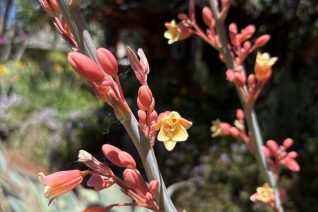
Hesperaloe parviflora
Red Yucca. Who would have thought that this remarkably adaptable plant would grow perfectly in such places as Phoenix, AZ AND Portland? We’re amazed and this excellent semi-succulent plant is one of our favorites for hot dry landscapes. The evergreen leaves form rosettes that spike up to about 2.5′ tall- blue green turning purple in colder weather. They are lined with little white hair filaments that add to the appeal. in summer flower spikes rise to 4′- many of them and hold tubular flowers that are succulent and red on the outside, when each yawns open it reveals a yellow center. Very cool. Full sun and average to poor well drained soil- though it does fine in any soil type that drains well. Excellently adapted to life in the blasting hot hellstrips. It can take any kind of reflected heat with no summer water and still perform beautifully. Clumps increase slowly in our climate. Excellent in containers as well. Loved by hummingbirds. Little to no supplemental water ever. Cold hardy below 0ºF. High deer resistance.

Heteromeles arbutifolia
Toyon. One of the most widespread shrubs in California this plant also known as Christmas berry ranges right up to the Oregon State line and appears just inside our border. Large evergreen shrub with finely serrated large green leaves. In late spring flat clusters of white flowers appear- they are pretty but nothing compared to the brilliant red berries that follow and ripen in early autumn- remaining showy through winter. Most often they are eaten by birds. AKA Hollywood this shrub is where that city got its name. heh. Fast growing to 13′ tall by 10′ wide in 10 years in our climate if left strictly unpruned. Slightly tender it requires a protected location. Most large established specimens I’ve seen around Portland are placed on the west or south side of large trees. They get the protection of the overstory and it shields them from the coldest winds. No water or regular water- either way, very adaptable shrub that really likes cultivation. Small tree in time. West coast native evergreen shrub for the mildest gardens. Oregon native plant.
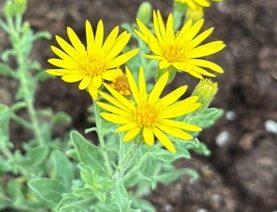
Heterotheca villosa
Hairy Solidaster is a stand out perennial west of the Cascades,never common it inhabits dry rocky areas and it is almost the only thing still in bloom in September. A somewhat sprawling evergreen perennial to 1′ x 2′ wide for full sun to very light shade in average, unimproved native soil. Bloom begins in July and it is yet another important late season pollinator plant for the Willamette Valley. Native primarily along the gravel slopes of major rivers. It can also be seen on occasion in abandoned rock quarries. Sunny yellow flowers are vivid and once this plant is established it can survive on rainfall alone. Very appropriate trailing over sunny rock walls. The leaves are somewhat sticky an adaptation to drought. Cold hardy and summer drought adapted. It may be cut back hard in early spring to refresh. Easy to grow with neglect. Combine with Epilobium (Zauschneria), Oenothera macrocarpa., Helianthemum ‘Henfield Brilliant’. Excellent butterfly attractant. Oregon native plant.

Heuchera sanguinea
Coral Bells. This is the original species that lept into gardens nearly a century ago. Native to the mid and higher elevations of the southwestern U,S. this is a tough, beautiful, long blooming species that will live for decades in a garden. Maple shaped leaves, occasionally decorated with white form rosettes and in time colonies. In April to July a fantastic display of red flowers on 16″ straight stems. They create a pool of color above the plants. We love this species also for its ease of cultivation. Full sun to part shade in rich to average soil with light summer water, or none when a patch is established. Excellent long lasting haze of red color for the front of a border or with in other perennials. Adored by hummingbirds and moderately deer resistant. Very easy to transplant and move around where you need some color. Evergreen to semi evergreen foliage. Rosettes to 1.5′ wide. Indispensable, old fashioned but always beautiful and reliable. Avoid heavily compacted soils.

Heuchera sanguinea ‘Count Dracula’
Pale green leaves are striking and fade to cream, the transition appears differently on each leaf and the gradation of colors give you a cool affect. Pair that- pale leaves with the darkest red flowers we have yet to see on this species and you get a phenomenal plant. Adapted to part shade to full sun – and it doesn’t burn or bleach in sun. A long lived perennial with blood red flowers and foliage the color of Draculas skin that spreads to form colonies 1′ x 2 wide. In bloom the straight dark stems rise to 18″ tall. The deep red but small flowers are full of nectar and call hummingbirds, butterflies and a host of other small pollinators. Blooms for an extended period from late April to early July. Rich soil with regular irrigation to establish for the first season then just light summer irrigation. Long lived pest free perennial. We adore it in light shade paired with Hosta ‘Blue Mouse Ears’ for a soothing gray blue back drop. A selection from this native of the south western U.S. into Mexico. Semi-deciduous in winter. Leaves shrink but there is a presence. Very showy in bloom. Avoid crowding by other plants.
Xera Plants Introduction

Heuchera sanguinea ‘Hot Mess’
We found this vigorous seedling in a batch of Heuchera sanguinea. The leaves are pale green and liberally splashed with white. Unlike, the red flower of the species straight spikes of HOT PINK flowers rise in a cloud above the playful foliage. This is just a seedling and unlike many variegated plants it shows excellent vigor and longevity. Evergreen clumps of foliage. Loved by hummingbirds in bloom from April to mid-July. Tolerates full sun to quite a bit of shade at the expense of blooming Excellent paired with ferns Hosta, Tiarella. To 14″ tall in bloom and spreading to about 2′ wide when happy. Rich, moisture retentive soil high in organic matter. Established plants are surprisingly drought adapted. Do not let other plants crowd or over top this perennial. The lack of light and competition will take it out. Instead match it with a similar sized perennial. See above. Easy, forgiving perennial.
Xera Plants Introduction

Hibiscus syriacus ‘Diana’
Bred and released from the National Arboretum this is perhaps one of the very best hardy Hibiscus shrubs for our climate. Enormous pure white flowers up to 4″ across begin in July and repeat until October. This cultivar was selected not only for its blooming power but for its lack of ugly seed heads. To 8′ tall by 4′ wide in 6 years. Full sun and deep but infrequent irrigation in summer improves performance. Moderately fast growing deciduous shrub that will handle quite a bit of drought once established. Fall color is yellow to non-existent. A very showy shrub at a great time of the year. Opulent large tropical like blossoms. Shrub borders, with Crape Myrtles whose bloom is simultaneous. This superior variety can be difficult to locate. We’re going to change that. AKA Rose of Sharon.

Holboellia angustifolia (Heronswood)
We got this form of Holboellia from Heronswood eons ago. It has much larger leaves than those being sold as angustifolia, And it bears larger flowers too. A vigorous, hardy, evergreen vine applicable to a large pergola, fence, or sturdy arbor. Twining vine to 20′ or more over time. On wood from the previous year large clusters of pendant white flowers have a soft sweet fragrance in close proximity. We have yet to see fruit set on this particular cultivar. Good year round appearance, not roughed up by winter in most years. The large palmate leaves are held on sturdy petioles that separates the whole leaf. Full sun to shade in rich to average soil w/ regular summer irrigation. Takes very dry conditions when established. Provide STRONG support- established plants can put on many feet of growth per year. Elegant layered appearance of the leaves gives this plant a graceful mein. Prune AFTER flowering if needed. You can prune it hard in late winter – this will sacrifice many flowers but re-growth is vigorous, if not instant. SW China.

Holodiscus discolor
Ocean Spray is a well known shrub west of the Cascades. It occupies dry woods in part shade to full sun. Large and spreading it displays foamy white clusters of flowers in early summer. They age to a tan color before falling apart. Handsome small scalloped leaves are very pretty and turn yellow to orange in autumn. To 9′ x 7′ very quickly in virtually any soil type. Extremely drought adapted when established- but amenable to light irrigation in summer. Wild look for wild areas, match with native perennials. Often suckers to form patches and it is common for seedlings to show up around the parent plant. These can be moved when young or dispatched. Birds adore the dried seeds in winter. Pretty native in the Rose family. Moderate deer resistance- but sometimes they attack it if it is newly planted so protect. Winter deciduous. Ours are raised from seed native to our wholesale site. Oregon native plant.

Hyacinthoides (Scilla) lingulata
We adore this little fall blooming bulb. In September to November it bears clusters of small off blue flowers. They emit a powerful fragrance that is detectable many feet away. Small to only 4″ tall but multiple spikes add substance. The rounded longer leaves emerge simultaneously with the flowers and persist over winter. Best in a summer dry environment. Which means that once established its best with just the rain that falls from the sky. Hellstrips, rock gardens, the front of borders. Average to enriched soil in full sun. These multiply surprisingly fast and in time you get expanding colonies. Dormant in the heat of summer. Delightful fall blooming bulb we wouldn’t be with out. Moderate deer resistance and not bothered by rabbits. Photo by Andy Stockton.

Indigofera amblyantha
Cool Indigo shrub that produces erect stems of light pink flowers w/ a touch of white. The flowers appear on new growth and as long as the plant is vigorous the display will be too. Deciduous woody shrub to 8′ tall by 8′ wide in a season. Established plants may be pruned to the ground in early spring and will vigorously rebound and bloom. Loved by pollinators. Not a dense shrub rather a light texture that is almost see-through. Very fun and flowery and easy to grow in full sun to light shade in average soil w/ regular summer water. I’ve never seen this species set seed in our climate. Cold hardy below 0ºF as a subshrub that can freeze to the ground below 10ºF. Pinnate leaves as for the species is a soft light green. Admirable cut flower- a whole branch yields many flower inflorescences. Remarkable shrub that can difficult to locate. Loved by butterflies. We grew this pretty shrub years ago and have brought it back.

Indigofera decora
Chinese Indigo is one of our favorite perennials/subshrubs. Arising from the ground in late spring the arching stems to 3′ support 6″ long pendant pale rose pink flowers for months and months. No intervention needed from the gardener. In time it suckers to form 4′ wide patches. Regular water to establish in average to rich, well drained soil. Full sun. Freezes completely to the ground in winter- cut back defunct stems from the previous year in early spring. When it does emerge its a very quick trip to up and blooming. Incredibly drought tolerant when established but light consistent watering seems to encourage new flowers- as it grows it blooms so you want to keep it growing. Incredibly elegant but tough plant that asks for so little but gives so much.

Indigofera heterantha
Incredibly tough and beautiful deciduous shrub that is fantastic all summer with a continuous supply of spikes of deep pink pea flowers. To 7′ x 5′ in 5 years in average to rich soil (where it will grow MUCH larger) and light summer water. Very drought adapted when established. Flowers are produced on new wood (growth from the current season) and as the plant grows it continually blooms. Loved by pollinators and it attracts the very coolest butterflies. Vivid flower color pairs well with dark foliaged plants. It may be cut back hard in early spring when established to provide more blooming wood, or to check the size. Very cold hardy. Purple Indigo. Moderate deer resistance.

Indigofera pendula
A very beautiful and obscure shrub that I obtained from Heronswood in the 90’s. Difficult to photograph this is one of the most spectacular False Indigos. Not entirely cold hardy it requires a warm location but is worth it. Soaring to 12′ tall in a single season in rich soil with regular water the tall wand-like stems support pendulous strings of rose pink flowers that extends to 2′ long or longer. Blooming all the way to the tips. As this shrub grows it continually produces these amazing flowers which are both graceful and somewhat modern. Loved by butterflies and bees. Seldom sets seed in our climate. Full all day sun. Excellent in large summer containers. Locate in a warm, protected location- against a south facing wall for instance. Prune back hard in spring after new growth commences. Often loses about 1/2 its wood during a normal winter. Cutting it back also results in more stems to display the fascinating and groovy flowers. Native to SW China. We grew this great plant years ago and have decided to bring it back into production. Cold hardy to 15ºF. Very difficult to photograph as the pendulous flowers are so long. VERY FUN to grow.

Ipomea purpurea ‘Grandpa Ott’s’
Can’t imagine summer without morning glories. This old time favorite we love for the intensity of the color as well as length of bloom. This rapidly twining vine gets going after truly warm weather arrives. Funnel shaped glories unfurl early in the morning and are resplendent until afternoon. Longer on cooler/ cloudier days. To 8′ in a single season for average to enriched soil in FULL SUN with regular summer H20. Easy to send scrambling a teutier, fence, lattice. Very fun to grow. Annual vine that is not so rambunctious as to smother even low perennials, to large shrubs. Remember that the flowers always point towards the strongest sun- which is south.

Iris bracteata
Siskiyou Iris is native to the southwestern part of Oregon. Though its named after the mountain range it is more often a valley species. You see it sparsely under Oaks, Madrones, and especially Ponderosa and Jeffrey Pine woods. Never at high elevations it grows in a host of soil types but the common component is that they all dry thoroughly in summer. Do not irrigate past the Fourth of July when established OR water only to establish the first year and then set it free. Forms almost caulescent evergreen fans that are red at the base. These rise to about 14″ and are not profuse. The plants which we raise from seed are a range of pale ivory to yellow all with conspicuous darker markings on the falls. Blooms April to May. Full sun to part shade and best with some protection from afternoon sun. In habitat it is found with Sidalcea malvifora var. Asprella , Erythronium hendersonii, and Vancouveria chrysantha with interspersed clumping Fescues. Long lived. This Iris among other Pacifica species do not compete well with invasive weeds and grasses. They are native to a fairly invasive free and less competitive balanced biome. Protect them by not allowing weeds grasses from getting a foothold around this Iris. Mulch with gravel to assist. Not bothered by deer or rabbits. Not as floriferous as other species but the flowers which are larger are much showier as well. Drought adapted. Oregon native plant.

Iris douglasiana (Pacifica) ‘Burnt Sugar’
A groovy selection of our coastal native evergreen douglas iris. From spikey grassy clumps rise 2′ tall flower spikes topped with multiple blooms that are amber and maroon, intricately marked on the interior falls. Blooms April to June. Vigorous clump forming perennial for any soil type where there is not standing water. Regular water to establish the first season then none in subsequent years. Full sun. High deer resistance. To 2′ wide in a few years. Oregon native plant.

There are 11 pacific coast Iris species, and 7 are native to Oregon. This is a deep purple flowered form of a species that is native from southwest Oregon to extreme northern California. Its type form, the form of the species that was discovered, is bright yellow and that was near the mouth of the Rogue River. Inland, however, up into the mountains this species is found in a remarkable range of flower colors – mostly deep purples or purple and white. This species also excels in the copious number of flowers per clump. Up to 12+ flowers open simultaneously for a rich display. The leaves give it its common name of grass iris – fine and evergreen they are a dull green and lay flat during the winter. Blooms April into May. Enriched to native soil in part shade to full sun. Water for the first season to establish – let it dry between watering and in subsequent years it can survive on natural rainfall. The clumps expand to about 1.5′ wide and the flowers rise on thin stems to 14″. Very resistant to deer and even rabbits. This is one of the more adaptable Pacifica species. It grows naturally with clumping grasses and even if grasses flop on top and obscure the foliage in summer/fall this tough iris will remain unaffected. A great candidate for meadows, partly shady slopes, Combine with Columbine (Aquilegia), Ookow (Dichelostemma congesta), Salvias, and native clumping grasses. Long lived perennial. Oregon native plant.

Iris unguicularis
The winter blooming Iris or grass Iris makes us smile as the intense purple/blue flowers with intricate yellow and white markings appear sporadically from November to spring. Grassy upright green foliage offers some weather protection for the flowers which come off and on in mild stretches. Not over the top showy but the individual flowers are stunning at a time of the year when stunning is in short order. Spreads to form evergreen colonies in full sun and well drained soil. Little supplemental water once established. High deer resistance. Long, long lived perennial persisting in old gardens for decades. Place it where you can see it in the winter. Near an entrance for example Mediterranean.

Iris x pacifica ‘Blue Moment’
How can you not fall in love with a blue iris? Its so classic. This vigorous and easy to grow Pacific Coast Iris does blue very well. The large sky blue flowers are marked in the center of the fall with more intricate yellow and black hatch marks. Large growing PCI to 16″ tall and forming imposing clumps of tall evergreen foliage. Blooms late April through May. Full sun to part shade in any soil that drains. Not fussy but dislikes standing water. Water though the first summer to establish then none in subsequent years. Evergreen foliage is nice looking- dies down a bit in winter and returns in spring. Highly deer resistant.

Iris x pacifica ‘Joey’
Kind of an obscure Pacific Coast Iris that Greg claims is a little more orange with brown striations than this picture depicts. Grassy leaves are evergreen and in May/June a continual parade of multi-colored flowers on 14″ cantilevered stems. Very easy to grow west coast native Iris hybrid that increases its bloom as the clump increases. The orange/ and maroon/cranberry flowers are visible from a distance and are particularly fetching when back lit. Completely deer and rabbit resistant perennial for part shade to full sun. Rich to average soil. Water diligently for the first summer, in subsequent years leave it strictly alone. Wonderful between and near Manzanitas, other west coast drought adapted shrubs.

Iris x pacifica ‘Meadow Pastels’
This is our own seed strain of Pacific Coast Iris. We save from specific plants and aim to include as many unusual colors as possible. Typically 1/3 are deep purple, 1/3 are amber/yellow and 1/3 are combinations of the two- whats left is the odd deep blue. Full sun to part shade in any reasonably well drained soil. Adaptable to clay. Regular summer water for the first year to establish then none in subsequent years. Blooms appear from late April through May. Height is variable but all make large clumps of grassy foliage over time. Do not disturb once established and remember that Pacific Coast Iris thrive on neglect. Excellent and wild looking cut flowers. Highly deer resistant. Xera Plants Introduction. The plant pictured is an example of an Amber seedling. Oregon native plant.
Xera Plants Introduction.

Iris x pacifica ‘Multiplicity’
One of the most striking pacific coast cultivars. Large somewhat flat flowers are a saturated orange/ rust color with contrasting purple nectary guides. Excellent plant that is not only extraordinarily heavy in bloom it blooms the LONGEST of any PCI that we grow. Often repeat blooming 1-3 times following the grand first display. Grassy evergreen leaves form spreading clumps to several feet wide. The large flowers rise on 10″ stems. Loved by pollinators. This intense flower color and propensity for heavy bloom endears this wonderful cultivar to gardeners and its often on the list of favorites. Full sun to light shade- ideally it may be grown best in an open north exposure. Such as the north side of a house with no overhead shade. Blooms late April-early June. Very deer resistant. Water consistently through the first summer than none in subsequent years. And once established it resents disturbance.

Iris x pacifica ‘Rio Dorado’
Yellow is a special color for Pacific Coast Iris and this selection does a great job at producing profuse large luminous yellow flowers for an extended period. To 14″ tall and forming spreading clumps. The vivid flowers are showy from a distance and resonate with the candy-like colors of other Pacific Iris. Mix with ‘Blue Moment’ for a classic blue and yellow combination. This Iris also blooms simultaneously with the clouds of blue flowers of Ceanothus. And they appreciate the same cultural conditions- a late spring vignette that gets by on no summer water! Evergreen. Not fussy about soil. Water consistently through the first summer to establish (established Iris will double their clump size in the first summer). Then only what falls from the sky in subsequent years. Heavy bloomer in April-June. High deer resistance.

Iris x pacifica ‘Tawny Meadow’
Our first deliberate cross of two Pacifica species has yielded a real looker. Half Iris innominata and half Iris tenax. It inherits the incredible amount of flowers from the first parent which is yellow and more intricate markings and purple hues of the latter. Fun to grow colony producing grassy iris for full sun to part shade. Begins blooming in late April and continues for 3 to 4 weeks. Adaptable to many types of soil, including clay soils. Water regularly through the first summer to establish then none in subsequent years. This little iris ( to 8″ tall) is very wild looking and reminds us of natural hybrids that occur in the wild. In time when you have many flowers per clump it makes a charming cut flower. Two Oregon native perennials. Heh. High deer resistance. Oregon native plant.
Xera Plants Introduction.

Iris x pacifica ‘Watercolor’
Of the 11 species of Pacifica species on the west coast the species I. munzii from the central Sierra Foothills imparts the best blue flower color. Typically a tall growing species to 16″ this cultivar creates amazing large flowers of soft washed blue with ivory edges. A very pleasant color that shows up well in gardens. Full sun to part shade in rich to average soil. This cultivar likes a bit more drainage than others- a product of its I. munzii parentage. Blooms late April through May. Upright grassy deep green foliage is evergreen and forms large clumps over time. Best with a good amount of neglect as all Pacific Coast Iris demand. High deer resistance.

Jasminum nudiflorum ‘Aureum’
Winter Jasmine cheers us greatly when its shocking yellow (scentless) flowers erupt along the arching and climbing bare green stems of this shrub/vine in winter. Beginning in December it opens flowers continuously until a crescendo is reached in late February. To 9′ tall trained as vine. The lithe stems must be corralled and pegged or twiddled through a lattice. Be patient it will get there. Blooms occur on wood from the previous season. Prune directly after bloom has ended. Fast growing as a scandent ground cover. To 3′ tall x 8′ wide very quickly. Very nice trailing over banks, walls. This form has gold splashed leaves that appear in spring adding another dimension to this plant. Light summer water or none when established. Rich, well drained soil is ideal in full sun to part shade. Winter deciduous. Moderate deer resistance.

Jasminum officinale ‘Affine’
I’m still astounded that very few gardeners are familiar with this vine. This is the improved form of Poet’s Jasmine. Poet’s Jasmine is a vine that is native from the middle east to China. Its a COLD HARDY, deciduous, vigorous twining vine with powerfully sweet scented flowers in June and then all summer. The sweet perfume is intense in the evening and morning and is conspicuous many feet away. This vine has been cultivated since antiquity and has been grown and loved in England since the 12th century. Its possible this vine returned to the British Isles via the crusades. But historians are vague. It is certain that it is featured heavily in Shakespeares time and the master himself included it in the details of his plays. Very fast growing, large, twining vine that require substantial support. To 15′ tall but it can spread laterally 30′ when excited. Provide #4 copper wire and eye hooks to give it ascent to any pergola, or fence. Do not grow it on that rickety stapled lattice from big box stores. It will kill it as sure as a boa constricts a gazelle. Fall color is often pink/coral and more effective in cold gardens. It has an initial huge display of pink buds that open to masses of white 3/4″ wide flower in June then they continue on new growth in a lesser show until September. New growth on this cultivar is a conspicuous maroon before settling to a refreshing grass green. Often the August flush of flowers yields the largest individual blossoms and that opulent display is accentuated by regular irrigation. Average soil with regular H20 to establish, then only light occasional water required. I prune mine back a bit after the first flush of flowers in June and that ensures a new round of flowers. Otherwise, it can be pruned in early spring. Perfect companion for climbing roses and it competes admirably with vigorous Clematis montana ‘rubens’. Moderately deer resistant. VERY long lived cold hardy classic vine that should be everywhere. In time the twining trunks become bare but develops a handsome cork-like bark.

Jasminum officinale ‘Argenteovariegatum’
One of the most wonderful cold hardy Jasmines. This form of Poet’s Jasmine has leaves boldly edged in ivory. The interior of the pinnate leaves are soft green. Vigorous twining vine to 15′ tall and as wide. In June a massive display of pink buds opens to powerfully fragrant sugar white flowers. Bloom continues through August. Very pretty multidimensional vine for a large pergola, fence, or very large trellis. The flowers are most fragrant in the evening and morning. Very stable variegation- I’ve never seen it revert. Winter deciduous. Adaptable to full sun to dappled shade. Mix with other vines or send this vine climbing with a good rose. Light summer water in rich to average soil including clay soil. Regular summer water speeds growth and establishment in the first summer. MMMMMM. Smells so good.

Jasminum officinale ‘Old Portland’
Years ago when I lived in southeast Portland, not far from where our shop is located I noticed a huge, old Poet’s Jasmine that straddled a fence with an 1840’s Bungalow behind it. I’ve always been a big fan of Jasmine so it was in my pervue. Fast forward 20 years and when we went to check out the lot for our shop that Jasmine was still there. Peeking over the fence. Since then it has become a prime feature in our border and with extra love and water its gotten huge. We’ve grown quite a few cultivars of Poet’s Jasmine and there is one prime difference that makes this an exceptional plant. Unlike most Jasminum officinale which are most fragrant in the evening to morning this selection pumps out perfume 24 hours a day. A hot day at the shop is a wave of sweet jasmine perfume. Vigorous, deciduous hardy vine with a huge flush of bloom beginning in June and extending to August with some spare flowers into autumn. To 15′ tall and spreading. This large twining vine requires space and a strong support. In time the trunk becomes a bare, gnarled corklike texture and is pretty in a rough way. Fall color is a little yellow to very little Sublime with white fragrant stars raining down for months.Excellent in concert up a pergola with roses. Also, I later found out that our 1840’s bungalow neighbor was the first home owned by Asian Americans on the east side of the Willamette River. I have a strong suspicion that this venerable Jasmine could be VERY old. Classic starry white flowers and fragrance on a tough, long lived vine. Native to central to eastern Asia. Moderate deer resistance.
Xera Plants Introduction

Jasminum parkeri
Adorable congested little shrubby Jasmine that is at home in rock gardens, shrub borders etc. Dense congested growth is arching. Tiny pinnate leaves line the stems in summer. In May-June a spectacular display of starry yellow flowers swarms this shrub. As new growth follows it holds a lesser show but flowers will appear sporadically until frost. Native to the Himalayan foothills in India, it forms a deciduous dome shape to 2′ x 3′ and dense and rounded. Established shrubs spread slowly by stolons as well. Cold hardy precious shrub for full hot sun and light to little summer water. Occasional summer soaks will yield increased bloom. The fragrance is sophisticated and light and most conspicuous on warm days. Prune after bloom has ended, but almost never necessary as will be evident once it starts to grow. Great self contained shrub that I’ve always thought deserves a place in public or commercial landscapes. Its precious in home gardens too. Loved by bees. Very easy to grow. Matches Hebe pinguifolia ‘Sutherlandii’ in density and formal appearance. Excellent in rock gardens, sunny hillsides. Great for erosion control. Slow and steady growth. Moderate deer resistance.

Jasminum x humile ‘Sunshine’
This form of Himalayan Jasmine we chose from seed after its incredibly fragrant yellow flowers drew our attention. Rather than cloying and sweet its a sophisticated aroma that is never over bearing. I always wish it was a bit stronger. Smaller leaves than the species and many, many more flowers in a huge display in late spring and sporadically until frost. Fast, large growing deciduous shrub that is incredibly tough and drought adapted. Takes any amount of pruning. May be trained as vine if you are diligent. To 9′ tall and 5′ wide quickly. Excellent plant for hedgerows and tough conditions out back. Black berries follow the flowers .Jasminum humile x jasminum wallachianum. Thousands of yellow stars.
Xera Plants Introduction.

Jovellana violacea
Charming beyond words this Chilean sub-shrub has been given an informal common name of cup flower. Petite, almost succulent foliage is deeply and irregularly serrated along semi-woody stems to 30″ tall and 3′ wide. In July-October on new wood clusters of downward and outward pointing up shaped soft lilac flowers have an interior of conspicuous spots. Gloriously fun plant for a protected location. Mulch for the first winter or two. Once established it has similar hardiness as hardy Fuchsias. Full sun and rich soil that drains. Regular summer water encourages a fast recovery from the base if frozen. Cut back hard in early spring when all danger of frost has past. Flowering commences with the heat of summer. Protect from blazing afternoon sun. Works well on an eastern aspect. Loved by pollinators and even hummingbirds. Long blooming charming sub-shrub. Not bad in containers, protect containerized plants from temperatures below 15ºF. Wonderful Chilean native. Not a bad cutflower. Related to Calceolaria (Pocket Book Flower). Protected location such as a south or east facing wall is beneficial.The flowers virtually glow.

Juniperus ‘Daub’s Frosted’
If you are going to grow a juniper then it better be good. This useful selection has new growth tipped yellow before turning to blue/green. The outside of the plant is always bright and the interior softer and darker- a happy combination. Low and spreading to 18″ high by 4′ across. Excellent drought tolerant easy to grow evergreen for tough sites. Banks, hellstrips, places where you would rather not have the pets potty. Full sun to very light shade. Regular summer water to establish and then none is necessary. Grows faster in better soil- slower where its impoverished. Either way it will grow and thats what you want.

Juniperus conferta ‘All Gold’
Nice, nice creeping juniper for lighting up hillsides or hellstrips. The needles on this low spreading plant are actually closer to chartreuse/lime green than gold. But its a vivid color and the 1′ tall x 5′ wide plant shines. Full sun and well drained soil. Light to little summer water when established. Excellent ground cover for a steep dry bank. Endures extreme cold as well as heat. Tiny flowers turn into blue fruits that contrast nicely with the foliage. Very easy to grow and good looking year round. Moderate deer resistance. Great performance at the Oregon Coast. Tolerates dense clay on slopes. Striking winter and spring appearance that glows from a distance. Well behaved plant. Combine with blue and gray leaved foliage for extra contrast. Hebe pinguifolia ‘Sutherlandii’ or Arctostaphylos pajaroensis ‘Warren Roberts’. You really can’t go wrong with blue/gray and chartreuse foliage. It provides just enough contrast that you can see the texture of each plant but is not an overall jarring contrast. Excellent garden juniper that we’ve all grown to love.

Juniperus deppeana
Alligator Juniper. So called for the rough pattern that develops on the trunk. A remarkable upright growing juniper that stuns with ghostly white foliage. Finely branching open habit on an 14′ tall by 6′ wide structure. Fast growing. POOR soil that has NOT been amended is ideal. In fact it thrives in heavy clay soils if on slopes. Enriched soil causes this shrub to grow prodigiously fast leaving it vulnerable to wind toss. Mixes well with other shrubs, makes a great light textured nearly white focal point. Good looking year round and ultra cold hardy. Little to no summer water once established. (Just makes it grow too fast) This is one elegant but tough shrub. Moderate deer resistance. This selection has extraordinarily blue foliage for the species. In time this forms a large tree- with a lot of years. Native to Texas and New Mexico into Mexico. Very difficult plant to root. So, we seldom have this tree/shrub in quantity. Even prior to developing the famous bark the over foliage is so brilliantly light blue that it is a first rate ghostly gray shrub.

Juniperus horizontalis ‘Pancake’
So many junipers and so few that are really interesting. This guy caught our attention for its relatively soft growth (to the touch) that is incredibly dense and flat to the ground (prostrate). In summer the foliage is a soft blue green and in winter it changes to soft lavender buff. Very pretty. Excellent solution for tough dry sites where you need to cover the ground completely. To just inches tall a single plant will spread 3′-4′ wide. Light to little summer water in full sun to very light shade. Easy to grow, useful plant. Nice looking year round. Growth flows around any obstruction- around, up and over. Excellent flowing over rock walls. Moderate deer resistance. This has been used as a groundcover/ lawn substitute and it really does work. As with all ground covers the object is not to cover the whole planet but to cover perfectly the space you need (be realistic) and this plant quickly does that. Pretty at the front of borders and combined with winter blooming Cyclamen coum. In time the stems will layer and aid in erosion control- it takes a few years for this process to kick in. Plant on 2′ centers for a fast and total cover. Water to establish and speed growth and then back off.
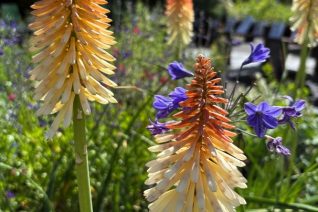
Kniphofia ‘Toffee Nosed’
Stunning poker with unusually colored flowers that are a kaliedescope of colors all within one spike. Opening tinted russet brown the expanding tubular flowers senesce to pale cream. To 4′ tall in bloom and forming prodigious clumps in rich, well drained soil. Regular summer irrigation spurs rapid re-bloom which can extend well into autumn. A clump with multiple flower spikes is spell binding. Hummingbird food. A fantastic and dramatic large cut flower. Foliage is semi-deciduous. Apply an annual layer of compost and a handful of all organic fertilizer in spring to increase vigor, blooming spikes. Fantastic with the ornamental grass Pennesetum spatheolatum. And any ornamental grass for that matter. Full sun to partial shade. To retain vigor and heavy blooming add a layer of compost or a handful of all organic fertilizer in spring. Light consistent summer water.

Kniphofia pumila
Little known but spectacular poker that we love for its HUGE late summer flowers of shocking acid green. Each flower spike includes up to 1′ long spike of tubular flowers. Forms a large tropical looking grassy evergreen clump. Full sun and rich well drained soil with regular summer irrigation. Apply an annual application of compost to increase vigor. To 4′ tall in bloom the clump of grassy foliage expands to 3′ wide. Give it the room that it needs. Depending on the weather flower spikes can occur any time from June on but mostly cluster in Aug-Oct. Semi-evergreen. Moderate deer resistance. Cold hardy.
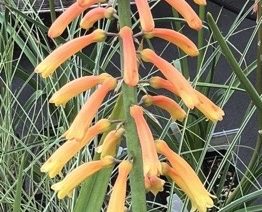
Kniphofia thompsonii var. snowdenii
Cool, interesting and actually spectacular Kniphofia that has flowers more reminiscent of an Aloe. The 4′ spikes of blooms have tubular downward facing flowers that are not clustered together but rather separate. They range in electric hues from near red/orange to yellow. Forms a grassy clump of deciduous foliage that rises to just one foot high. Spreads by runners- NOT A CLUMPER- give it room to spread, a single plant will roam several feet in every direction. Full sun to very light shade and RICH, well drained soil with light but consistent summer water. Excellent cut flower and dearly loved by hummers. Emerges late in spring.
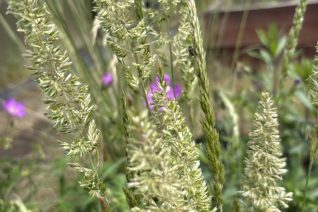
Koeleria macrantha
Prairie June Grass is a widespread cool season grass that was common in the Willamette Valley. A tight clumping grass with soft blue/green foliage that rises to about 18″ tall forming a clump as wide. In June-August feathery gray/tan plume of flowers erupt and soar above the grassy clump. In bloom it is about 30″ tall. A long lived grass for virtually any soil in full sun. Rich soil results in a very large plant. Average soil that has been double dug to add oxygen is usually all thats necessary. Water the first season to establish then none in subsequent years. Mix with other native perennials and annuals. A great companion for Sidalceas as well as Solidago and Douglas aster. Will often self sow. Keep it away from highly manicured areas. Otherwise the clump keeps to itself. Very easy to grow perennial grass that is found throughout the northern hemisphere. An authentic grass for a Willamette Valley prairie. Winter appearance is green and verdant. Summer brings tan drought dormancy. Oregon native plant.

Lagerstroemia fauriei ‘Townhouse’
Crape myrtles aren’t just about flowers we actually are even more attracted to the handsome, exfoliating bark. This selection from the disease resistant Japanese species has some of the best bark in the vegetable kingdom. Swaths of muscular mahogany, cinnamon red smooth regions create a fantastic tapestry. This is a very large growing Crape Myrtle with profuse but smaller trusses of FRAGRANT white flowers in mid- late summer. Fall color is bright orange/yellow/red and is very striking in its somewhat brief display. To 25′ tall in great age it grows approximately 3′-4′ per year when young. The first several years in the ground it will appear as large bush- patience it will soon assume an arboreal habit. Bark begins to develop coloration in 2-3 years. Most often multi-trunked this gives the gardener even more beauty to stare at.The most common form of this tree has a single trunk about 1′ tall with profuse multiple branching from there. Its a little odd but in time it forms great canopy that spreads to a dense umbrella shape. Completely disease resistant and because of that this tree first identified in 1956 on the Japanese island of Yakushima imparts this trait to its hybrid progeny. It also is the source for colorful bark found in many of the National Arboretum hybrids. Best with consistent summer moisture for the first few years then only occasional deep soaks. Deciduous- fall color is a saturated light orange/gold. A fantastic street tree with great dimensions and form. This selection – chosen for bark coloration can be difficult to locate. Beautiful tree.
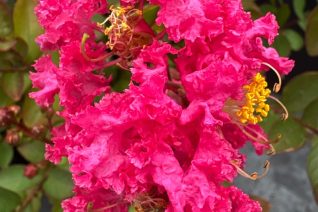
A dwarf/smaller crape myrtle that we raised from seed years ago and it has proven to be an excellent shrub with large vivid flowers . Small leaves on a compact plant to 6′ x 4 in 5 years with very large individual flowers that are hot pink and form large showy trusses. A naturally early blooming cultivar with low heat requirements it will be in full fabulous bloom in mid -July and continues until September. Fall color is bright orange and yellow. Extremely showy in bloom this slow growing plant will attract pollinators for 6 -8 weeks. Crape myrtles bloom so profusely and for so long that they are one of our best summer blooming woody pollinator plants. The individual flowers are very large- larger than the leaves and flowers obscure the foliage. Rich soil with regular summer water, a deep soak once a week in full sun in a hot position. Powdery mildew resistant and not bothered by any pests. Cold hardy and long lived. In time the thin trunks and stems exfoliate to a glossy tan/gray. Excellent specimen or showy member of a hedgerow. Very pretty in bloom. In great age 15+ years it will grow into a small tree. Accepts the hottest locations. Great plant for planting islands in parking lots. Reliable. Very good in large containers with regular irrigation and fertilizer. Thrives with heat.
Xera Plants Introduction
‘
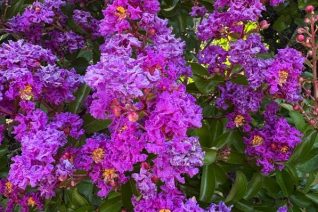
Lagerstroemia indica ‘Catawba’
One of the very first releases from the National Arboretum breeding program in 1967 and a fine purple flowered Crape Myrtle that has yet to be exceeded. Deep violet purple flowers occur en masse in August through October on this compact tree to just 12′ tall with a rounded crown. Full sun and rich soil with REGULAR summer irrigation to bloom. Water deeply once a week through the bloom period.Thrives and blooms in the hottest aspects. Regular water begun in April will assist in earlier and larger flower sets in summer. In autumn the foliage takes on brilliant neon orange/ red/ yellow tones that is just as spectacular as the blooms. In time the bark exfoliates to a smooth tan. Moderately mildew resistant- give it good air circulation in an open exposure. This tree makes a fine standard albeit of limited size. We grow it as a multi-trunked specimen. Long lived, easy to grow small tree. Catawba retains its popularity as there are few dark purple flowered crape myrtles whose blossoms don’t fade drastically after opening. This selection retains the intensity of purple.

Lagerstroemia indica ‘Centennial Spirit’
Good looking upright growing very floriferous crape myrtle. The large trusses of flowers born in August – October are a fascinating mix of colors. In cooler weather they are decidedly rose colored, The hotter the weather and the more consistently hot the flower color becomes a rich red. Either way this strong growing disease resistant Crape Myrtle is a winner in our climate. To 18′ tall and 9′ wide in full sun, virtually any soil with REGULAR deep irrigation in summer- without irrigation crape myrtles in our climate will stall and not grow or bloom. Fantastic garden tree. Fall color is red/orange and the bark exfoliates to a muscular soft tan/taupe. Grows 2′-3′ a year when well irrigated. Cold hardy. Not the best picture, but the truest flower color I could capture. Officially marketed as wine colored and thats a fair approximation. Glossy deep black buds erupt into brilliant flowers. Strong vertical habit makes it ideal as a street tree. Great crape myrtle.
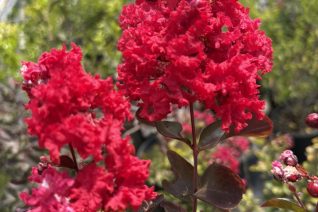
Reknowned not only for the vivid red flowers this cultivar that is frequently planted in North Texas is incredibly hardy to cold and does surprisingly well in the Willamette Valley. Upright, somewhat stiff habit to 18′- 20′ in maturity, width 1/2 that. The glossy round dark green leaves are tinted red and this is a back drop to the vivid, true red flowers that erupt from black buds in large trusses. Best in a very hot position in full sun and rich soil with reliable, once a week irrigation. Excellent results against a south facing wall of a building. Seems to have the same heat requirements and vivid flower color of the more commonly grown red variety ‘Dynamite’. In cool weather, between heat stretches, the flowers can emerge speckled with white- curious but uncommon. Bold red flowers are large and lightly fragrant. I have yet to observe mildew on this cultivar in the specimens I’ve located around Portland but I would give it good air circulation, full sun and regular irrigation, avoid dry shade. Full, hot all day sun. The trunks are colored very light tan which contrasts well with the dark foliage and vivid flowers. It exfoliates to a glossy sheen. Fall color is red/ orange. Loved by pollinators. Blooms Aug – Oct. Moderately fast growing, irrigation increases the rate of growth and aids in flowering. Not as easy to root as most cultivars, a limited quantity of this tree will likely always be available. Amazing in bloom.
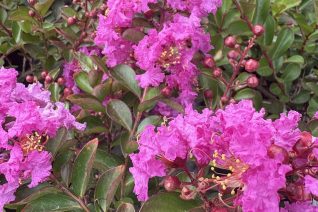
This wonderful small crape myrtle offers very early flowering and it repeat blooms all summer. To 7′ tall by 5′ wide in 10 years. In late June it begins opening soft purple flowers. This prolific blooming little tree requires very little heat to initiate flowers. It even accepts very light shade but full hot sun is what it wants. In time the thin trunks exfoliate to a solid glossy chocolate brown. In fall it becomes yellow to orange. Very easy to grow in enriched soil with regular summer water for the best performance. More drought adapted with time . This forgiving small tree can find a home in perennial borders or hedgerows. If you want a crape myrtle that blooms in Seattle this is perhaps your best bet. It requires only a half dozen days above 85ºF to bloom, but not adaptable to the Oregon coast. Tolerates the hottest positions and can handle fierce reflected heat. Cold hardy and long lived. Excellent size for small gardens. Naturally mildew resistant. Great landscape small tree/shrub.

Lagerstroemia indica ‘Nana Alba’
Extraordinarily rare and wonderful dwarf/smaller Crape Myrtle. This is one of the first crape myrtles in my garden to bloom each year. By the last week of June spectacular, fluffy, pure white flowers obscure the whole plant. Slow growing because it shoots into bloom very early. Cutting wood, therefore, is limited and so is the amount we can produce. To 5′ tall in 8 years and 3′ across, it will double that size in 10 more years. Extensive bloom period from June solidly through September. RICH soil that has been amended and a handful or two of all organic fertilizer will spur it to grow and bloom even better. REGULAR summer water and only in full, all day sun in a hot position. Wonderfully called for hell strips and small gardens. In just several years the stems exfoliate to a glossy sheen and though not large in diameter this is a showy feature in fall. Autumn color is bright yellow and brief. Mildew resistant. This L. indica variety is rare but was well known to the supreme crape myrtle breeder Donald Egolf at the National Arboretum. He used it extensively as a parent and in combination with Lagerstroemia fauriei to produce some of the most famous hybrids. Cleaner white than ‘Natchez’ and similar white purity to ‘Acoma’ but much, much smaller. Excellent crape myrtle for our climate with low heat requirements to bloom. Fantastic in bloom. Very limited quantities.
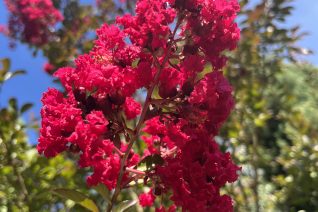
Lagerstroemia indica ‘PDX Red’
We discovered this seedling Crape Myrtle years ago in North Portland and we were amazed that it burst into bright red bloom beginning in July every year- despite all sorts of weather conditions. Upright growing dense tree to 10′ tall and 5′ wide in 10 years. Large trusses of red flowers begin in July and peak in coverage on the tree in August. This crape myrtle must have regular irrigation to thrive/bloom and it favors richer soils than other cultivars. Water deeply once a week through its bloom period. In time the straight trunks exfoliate to glossy tan. Fall color is red/ orange. Moderately fast growing to 2′-3′ per year when young. Full hot sun and good air circulation. Avoid crowding with other plants. Pretty tree.
Xera Plants Introduction.
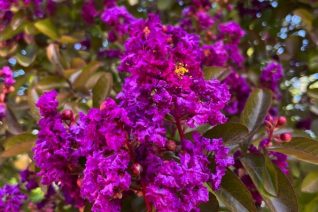
Lagerstroemia indica ‘Portland Purple’
One of the goals of crape myrtle breeders is to find a variety that has purple flowers that do not fade. This tree which can be found in old gardens in the Portland area including some ancient specimens fits that bill. Moderately fast growing tree with grass green leaves with a slight tan cast. The flowers could best be described as large and magenta purple and they hold that color for as long as they are in bloom. This is one of the most spectacular crape myrtles in bloom and since it can be found only as old specimens we have decided to offer it. Its one of my favorite Crape Myrtles and it also has glossy tan muscular bark and orange/yellow fall color. I have never seen it with mildew. At one point this very old variety was sold around the city- but even the youngest specimens are many decades old. We love this crape myrtle and are happy to offer it for sale. 15-20′ in antiquity, grows about 1′-3′ a year with good irrigation which it appreciates. Rich soil in full hot sun. Blooms August to September.
Xera Plants Introduction

Lagerstroemia indica ‘Twilight’
Large growing tree type crape myrtle to 20’+ tall with a wide spreading crown. Reliable soft, luminous purple large trusses of flowers begin on average the first week of August in the city and repeat bloom until October. Fast growing shade tree that can achieve 3′-5′ a year when young in optimal conditions. Free blooming tree that displays glossy, muscular tan trunks when the bark sheds in mid-summer. These contrast greatly with the deep green foliage and sumptuous purple blooms. Long lived, cold hardy, disease resistant cultivar that has shown its merits for many decades in the southern U.S. but less often grown in our region. Fall color is bright red/ orange/ yellow. Mildew resistant- good air circulation- proper cultivation eliminates this threat. As with all purple flowered crape myrtles the flowers can fade a bit after opening. When a non-fading purple crape myrtle becomes available we will be the first to let you know. Otherwise this is a great, dependable, garden tree. Deep, infrequent, summer irrigation. Six or more hours of hot sun per day. Long lived and cold hardy cultivar.
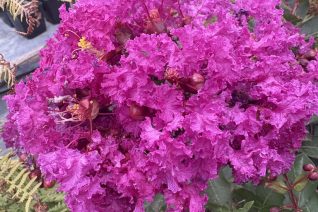
Lagerstroemia indica ‘Velma’s Royal Delight’
We love this smaller growing crape myrtle for its vivid, opulent huge magenta purple flowers The shocking color of the petals is amplified by being larger individually than normal. The flowers are born in large globose trusses mid August to early October. 9′ tall in 10 years it is renowned not only for its vivid flower color but for exceptional cold hardiness – it resprouted from an epic -24ºF freeze in Topeka, Kansas, one of the very few to survive. It also possesses very good disease resistance and I’ve never seen a drop of powdery mildew. In the Southern U.S. it is commonly recommended for these attributes. Upright then rounded habit. Fall color is red/ orange and brief and the slender but older stems exfoliate to a glossy tan. This is an exceptional flower color- excellent against a deep green backdrop. Full (all day) hot sun in rich soil with regular water beginning in May. It appreciates the hottest position you can give it. One tip if you want to maximize growth is to water it when its going to get hot – it should be well hydrated going into a heatwave. Glossy red buds release the vivid flower petals. This small, hardy excellent Crape Myrtle was bred by and then named for Mrs. Velma McDaniels a Wichita KS crape myrtle enthusiast. She did a phenomenal job. Crape myrtles are completely intolerant of shade- 6 or more hours of full sun per day. Delightful cultivar. Limited quantities.

Lagerstroemia indica ‘Victor’ (Red)
This has been a great performer in my garden and is one of my favorite smaller crape myrtles. In the past 10 years it has become a slender, graceful shrub with a wavy branch pattern upright to 9′ tall. In early to mid August glossy black buds erupt into frilly saturated red flowers. The upright large trusses feature the flower color very well and its showy from quite a distance. Disease resistant and very cold hardy-it can be grown without fear in Zone 6b (-5ºF). Fall color is red orange and the slender stems exfoliate to patches of dark brown and lighter tan. Full (all day ) hot sun in rich soil with regular summer irrigation. Grows about 6″ per year. Works well in larger containers with regular irrigation and annual applications of fertilizer. Slow to produce because of its dwarf stature this fine small tree will always be limited in quantity. LOVE the saturated red flowers. Elegant small tree, the trusses of flowers are very large for the size of the tree. . Limited quantities.
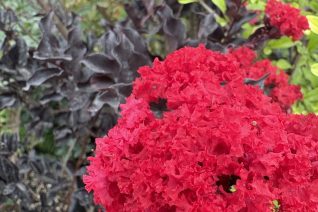
Lagerstroemia indica Black Diamond Red®
Striking crape myrtle with jet BLACK foliage that would be cool all by itself. The real kicker is intense true red flowers that smolder with the leaves. A naturally and reliably early blooming almost fastigiate tree. To 9′ tall but just 3′ wide in 7 years. Full hot sun and rich soil with regular summer irrigation for the best results. So far it has been completely mildew free as well. Imagine the late summer combinations? Blooms first appear in early August in urban areas- later in cooler hinterlands. If it never bloomed it would be a cool thing but that red. Wow. Fall color is non-existent.

Lagerstroemia indica Double Feature®
Play it again is another trade name associated with this confusingly named but gorgeous shrubby crape myrtle. We’re very impressed with its performance, the first round of rich, cranberry red flowers appears in July- the color is deep and intense. In this selection no seed is ever formed and the plant will re-bloom continuously on the same flower stem. Watch the spent scape closely new buds seem to bubble out from no where. A compact growing shrub to 4′ x 4′ in 7 years. New foliage is deep wine red and retains the deep intensity of green. The small flower trusses completely obscures the plant in bloom. For the hottest, sunniest position in rich soil with REGULAR summer irrigation. Less over the years. It really does re-bloom continuously. Fall color is vibrant red/ orange. In time the thin stems/trunks exfoliates to a glossy tan sheen. Propagation prohibited. PP#22, 559

Lagerstroemia indica Dynamite®
Red is an exciting and sought after flower color for Crape myrtles in our climate. Most varieties with reliable early bloom tend toward pink, white, and lavender. Enter this Carl Whitcomb hybrid with among the truest red flowers of any Lagerstroemia cultivar. Mr. Whitcomb is an Oklahoman Crape myrtle breeder and his visceral reaction to this seedling in the field was to exclaim “Dynamite” referring to the clear red flowers. He kept the name and this has become one of the most successful red flowered cultivars in the United States. In our climate it is a reliable bloomer if sited well and consistently irrigated. Although, I have noticed very good drought tolerance with this cultivar and indeed Carl Whitcomb plants his seedlings out in a field and then lets nature take its course- no supplemental irrigation. This is in NE Oklahoma a somewhat brutal climate. This predisposed his selections to low water requirements. He also selected it for good tolerance to powdery mildew. Best in a warm spot in full sun with rich to average soil with regular irrigation. Fast growing tree to 20′ tall and 10′ wide in time. Bloom begins in mid-August most years and diligent water will assist in flower set. Flowers are showy until early October. It has been used as a street tree in Portland with mixed success. Unfortunately, it was grafted. (grafted crape myrtles are not a good way to go) Very good with water and spectacular in summers that are warmer than normal. Brilliant true, stop sign red flowers are incredibly showy with an exotic flair. Very few hardy trees can match the color and opulence of its bloom. New growth is deep maroon changing to mid green at maturity. Wonderful tree. Fall color is brilliant orange/red and the bark exfoliates generously to reveal light tan trunks. Unauthorized propagation prohibited. Plant patent #10,296.
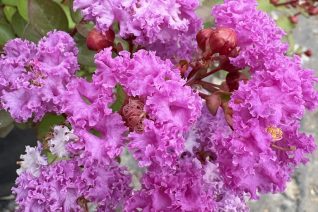
This is a very pretty and unusual Crape Myrtle selection that we made years ago. After more than a decade it has shown no sign of powdery mildew and has profuse frilly rich purple reliable flowers. This is a compact and slow growing shrub to 6′ tall in 10 years and half as wide progressively larger over time. In early July it alights in large trusses of clear purple flowers, in full bloom they obscure the foliage. Fresh green foliage emerges tinted pewter and changes to shades of orange and red in fall. Rich soil, in full all day sun in a warm position. Crape myrtles loathe any and all shade. The compact habit and measured growth means that pruning is seldom necessary. Thin trunks and stems exfoliate to a glossy tan and are showy in winter. Water once a week through bloom. This shrub creates a wonderful ball of purple for 6-8 weeks beginning in early July. The long bloom time means that this is a supreme pollinator shrub. Rich soil with mulch is ideal. Very adaptable to large containers and with regular water and annual applications of all organic fertilizer. Crape myrtles will stall, the leaves will turn red and not bloom if they have insufficient irrigation water once a week. A great small purple crape myrtle we specifically selected for the Willamette Valley.
Xera Plants Introduction
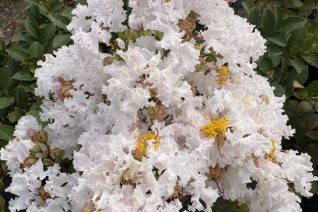
Our selection of a smaller scale crape myrtle with the purest white flowers that we have seen. Glossy, handsome disease free foliage is light green and glossy, on a very upright growing large shrub to small tree. Early and reliable flowering in our climate, in full hot sun, rich soil with a deep soak once a week in summer. Reliably in bloom by the early part of July and continuing for 6 weeks or more. Fall color is bright golden yellow. Moderately fast growing to 5′ tall in 5 years with an ultimate size at 15 years of 10′ – 12′ by 4′ wide. Cold hardy and naturally resistant to powdery mildew. Very showy and its masses of flowers draw a plethora of pollinators for many weeks. It requires a lower heat amount to propel it into bloom. The thin trunks exfoliates to glossy tan and is showy. Best in the sunniest hottest location. Crape myrtles are not just shade intolerant they loathe all shade. Full all day sun in a hot position. Specifically chosen for excellent performance in the Willamette Valley. Small scale and size fits into any garden.
Xera Plants Introduction
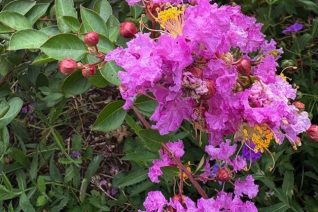
A dwarf, much smaller growing Crape myrtle that we raised from seed years ago. In the ensuing years it has proven to be resistant to powdery mildew and has shown great hardiness to cold with fantastic large vivid flowers. To just 4′ tall in 6 years and then progressively taller a very vertical crape myrtle for its diminutive size just 3′ wide. Beginning in July a continuous supply of enormous lavender-pink flower trusses. The individual flowers are larger than normal and it adds to a very voluptuous large truss of flowers. Flowering normally continues until late September. Easy to grow very flowery shrub for full hot sun in rich soil with regular summer water. Tolerates the hottest sites and in time the thin stems exfoliate to a silvery, glossy brown. Fall color is yellow with tints of orange. This would be a very good candidate for colder climates such as The Dalles. Very easy to grow and long, long blooming. It has lower heat requirements to bloom, usually in bloom by early July.
Xera Plants Introduction
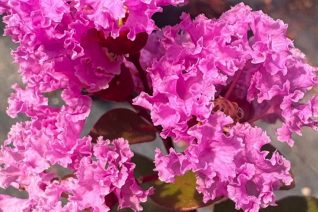
One of our smaller Crape myrtle introductions that produces masses of extra-frilly lavender/purple flowers from early July to September. This is a dense and compact shrub and will slowly achieve 6′ x 3′ wide in 5 years, progressively larger after that . Dark foliage is small and resistant to powdery mildew. This Crape myrtle has lower heating requirements to bloom and willl be in massive bloom by mid July. In autumn this compact shrub turns red and orange before losing its leaves . Full all day sun in a hot position. Rich soil with regular irrigation ,about one good soak per week in summer is ideal and will lead to flowering and re-flowering for months . Crape myrtles produce such a display of flowers for so long they are one of our best summer pollinator trees/shrubs. Very easy to grow, ideal hedge row or specimen shrub. Excellent in very hot locations and excels in frying, reflected heat. Cold hardy and mildew resistant. Pruning is seldom needed. Very long lived. The smaller stems exfoliate to a glossy tan with time.
Xera Plants Introduction

Lagerstroemia indica Pink Velour®
This Carl Whitcomb introduction is an excellent performer in our climate. An upright growing tree to 12′ tall and only 4′ wide. Very ruffled shocking pink flowers begin in early August and continue until early October. New growth is a sultry maroon and this is a great backdrop with the brilliant flowers. Eventually the foliage settles down to deep green. As with all Whitcomb cultivars it has slightly lower water requirements. Still, a deep soak once a week will be sufficient for a moderately fast growing tree. Full hot sun in a hot position. Highly mildew tolerant selection. The large upright trusses of flowers appear as torches and then as complete bloom commences it becomes a cloud of sizzling hot pink. Flowers en masse have a light, sweet fragrance. Easy to grow smaller cultivar. Give it good air circulation. In time the trunks lose their top layer of bark in patches and a tan/pink under coat is revealed. One of the best L. indica selections for the Willamette Valley. Very good cold hardiness here. Fall color is a brilliant if short lived display of red/orange/yellow. As brilliant as the flower color. Unauthorized propagation prohibited. Plant patent #10,319.
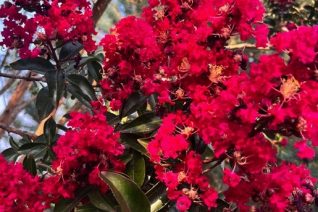
Lagerstroemia x ‘Arapaho’
The largest triple hybrid from the National Arboretum has yielded an excellent true red flowered, disease resistant and reliable Crape Myrtle. Fast growing to 20′ tall but just 8′ wide it forms a very upright tree. The huge true cranberry red flower trusses (to 8″ long) begin in urban areas in late July and continue unabated for two months. New growth is maroon and still retains hints of that as it changes to green- giving this tree a darker look. We have found that it is slightly tender when young- freezes back in cold winters but it rebounds quickly in summer and established trees see no damage. Rich to average (including heavy clay) soils with regular deep summer irrigation for earlier and more prolific bloom. Bark is xcllent becoming a mottled patchwork of tan. Fall color is brilliant red. Fast growing- easily 3′-4′ per year in well irrigated trees. Mildew resistant. Full, hot sun in a hot position. Lagerstroemia indica x limii x fauriei.

Lagerstroemia x ‘Cheyenne’
Wonderful release from the National Arboretum and this three hybrid small tree is also one of the most reliable red flowering varieties. To 11′ tall forming a very rounded tree about 3/4 as wide. Large, vivid trusses of strawberry red flowers appear in early August and are wildly showy for weeks into early autumn. Moderately fast growing (2′-3′ per year when young) to its ultimate size. Full, all day sun in a hot position. Appreciates rich soil and also loves clay soil. Consistent deep irrigation from late spring into summer spurs more reliable bloom. The brilliant flower color is showy from quite a distance. In time the bark exfoliates in patches to shades of pink and light brown. Fall color is orange/yellow/ light red and reliable. Excellent small tree for warm urban gardens. Once bloom commences it proceeds unabated for months. Disease resistant. Excellent for the hottest locations. This tree blooms quickly in a pot and thus is slower to bulk up than other varieties. Don’t let that deter you. In the ground it grows much more quickly. A Xera favorite crape myrtle. The second 3 way hybrid released by the National Arboretum. OOOOOOH, kinky.

Lagerstroemia x fauriei ‘Acoma’
Underused beautiful disease resistant Crape Myrtle that is free blooming with enormous pendulous trusses of pure white flowers. To 15′ tall with a somewhat weeping habit- especially in bloom. It creates a spreading crown on a small easy to grow tree for full, all day sun and regular summer water. The crystal white large flowers appear often as early as late July in hot summers and continues unabated to about the first of October. Fall color is yellow/orange and pretty. The sinuous trunks display taupe/beige glossy bark which is just as showy. Give this wide spreading small tree room to grow. Regular summer water and rich soil yields a growth rate approaching 3′ per year when young. As with almost all Crape trees it grows quickly to its ultimate size and then it slows considerably. Excellent garden tree. National arboretum selection.
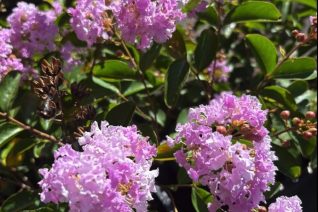
Lagerstroemia x fauriei ‘Apalachee’
Lagerstroemia indica is big on flowers but its also susceptible to powdery mildew among other afflictions (the varieties we grow are resistant). In 1956 a botanist named John Creech located a single specimen of what was to become Lagerstroemia fauriei- Japanese crape myrtle. Its famous for its amazing orange, brown, tan mottled bark and mildew resistance. So, it was incorporated into an existing breeding program by Dr. Egolf at the National Arboretum to eliminate disease and provide crape myrtles in different sizes. It did but also importantly it imparted the wonderful red/ mahogany bark of this species. Lagerstroemia fauriei has a very limited range on the island of Yakushima in Japan. It has larger leaves, smaller, fragrant white flowers- in of itself a fantastic tree. This is where such hybrids as ‘Natchez’, ‘Osage’, ‘Pecos’ among other get their fantastic colorful bark. A little later a second specimen of Lagerstroemia fauriei was located. It was such a beautiful tree that it was named ‘Kiowa’. Pure orange deep mahogany brown trunks are the hallmark of this second specimen. Only one cultivar was the result of crossing Lagerstroemia indica with Lagerstroemia fauriei ‘Kiowa’ to produce this extraordinary cultivar. It was released in 1986. Unfortunately, nursery people didn’t take to it. Dr. Egolf had previously released a LOT of lavender flowered cultivars and this one got overlooked. So good is this tree and with a different genetic makeup than the first fauriei crosses. Importantly it received that deep brown and mottled orange bark as well as fragrant strong lavender flowers. The National Arboretum re-released this tree in 2017 in an effort to redevelop popularity for this extraordinary cultivar. ‘Apalachee; has many outstanding qualities. Its bark is phenomenal, deep glossy brown with orange patches- very striking. The mildew free foliage is dark, lustrous green, and the flowers are sweetly fragrant. Altogether great qualities in an 18′ tall by 8’ wide upright tree. Fall color is a remarkable orange to deep red. This tree has superior flowers to ‘Natchez’ and personally I think the bark is much more showy. Blooms heavily beginning in July. Peaks in a crescendo in August into October. We are very happy to offer this extraordinary tree. Full hot sun in rich soil with regular irrigation for the first several year. Easy and spectacular multi-dimensional tree. Available in 2022.

Lagerstroemia x fauriei ‘Choctaw’
Obscure and exceptional tree type crape myrtle that was one of supreme breeder Donald Egolf’s favorite introductions from the National Arboretum. He introduced 30 Crape myrtles so thats saying a lot. Fast growing upright tree with phenomenal bark. Cinnamon red/mahogany/cream all are present on this 25′ tall arching tree. From late July to October a fantastic display of luminous soft pink flowers born on huge trusses. Fall color is vivid orange/yellow/red. In time it develops a spreading crown and makes a wonderful garden tree. Average to enriched soil with REGULAR summer water for the first few years. Deep soaks on established trees enhances bloom as well. Full, all day sun in a hot position. Excellent tree to garden with- roots are not intrusive and it happily accepts regular irrigation. Grows about 3′-5′ a year when young- slows down to its ultimate height. This is essentially an improved pink flowered form of ‘Natchez’. Limited quantities.

Lagerstroemia x fauriei ‘Hopi’
For our climate this is one of the very finest summer blooming small trees. Forming a perfectly round dome in time to 12′ tall and nearly as wide this free blooming tree also requires the least amount of water to sustain it and bloom. Beginning in mid-July large trusses of bubble gum pink flowers appear and they completely obscure the foliage of the crown re-blooming non-stop until the end of September. In fall reliable and incredibly showy orange to red and yellow fall color is stunning for an extended period of time. The bark sloughs off of older trees to reveal a glossy gray surface. Moderately fast growing this should be a standard landscape plant in our climate. Exceptional cold hardiness and no fear of disease.

Lagerstroemia x fauriei ‘Muskogee’
One of the first hybrid named cultivars released by the National Arboretum in 1978 and a fantastic cold hardy large free flowering tree. Fast growing tree to 25′ tall and half as wide in 10 years. Beginning in late June large trusses of lavender pink flowers appear and are lightly fragrant.. They increase in abundance and peak in a massive bloom in August. The tall trunks exfoliate to a glossy taupe/patches of tan. Very pretty and exotic looking tree when large. There is a 30′ specimen- one of the first hybrids planted on the west coast in 1974 in SE Portland. Its a spectacular shade tree. Fall color is a brilliant mix of orange and red. Exceptionally hardy to cold. Best with regular irrigation- which speeds growth markedly and improves bloom. Otherwise it takes summer drought in stride. Excellent for use as a street tree. Long, long, bloom season. Fantastic, well behaved large garden tree.

Lagerstroemia x fauriei ‘Osage’
After almost two decades of growing Crape Myrtles we can honestly say that we’ve come to the conclusion that the bark on this tree size cultivar is among the most exceptional of the group. Cinnamon red background with amorphically shaped maroon patches outlined in white. Its natures ravishing puzzle and we love it. Wide spreading, semi-pendulous tree to 16′ tall and 10′ wide. Enormous, loose trusses of light pink are early and reliable in our climate. Blooms on average from early August to October. In time it produces a spreading crown and makes an exceptional garden tree. Completely mildew resistant. In autumn the whole tree turns a uniform electric red. Stunning. A fantastic tree that should be known and grown more. Full hot sun, regular summer water. This is a potentially wide tree so give it room on all sides- especially as a multi-trunked form. Occasionally, we have it as a trained standard. Most tree type crape myrtles are shy to bloom their first several years in the ground. Be patient and diligent with summer water which speeds growth and establishment. Good but wide street tree. Requires summer water to perform. National Arboretum selection. It has been planted as a street tree in NW Portland. Good choice!

Lagerstroemia x fauriei ‘Pecos’
A deservedly popular tree in western Oregon for several reasons. Large globose panicles of clear pink flowers begin in urban areas as early as the beginning of July and repeat bloom until September. The open and vase shaped habit is graceful and bends gently under the weight of the huge flower trusses. In time this 15′ tree develops some of the best exfoliating bark of the genus. In late summer on trees older than 3 years the top layer of bark sloughs off revealing smooth, rich, chocolate brown trunks. Amazeballs. The bark is showy throughout winter. In autumn the foliage turns to shades of maroon and red. This crape myrtle MUST HAVE regular irrigation to grow and bloom. Excellent small garden tree with some of the lowest heat requirements to bloom. Water. You must water. National Arboretum release 1987, Spectacular tree in western Oregon. ‘Pecos’ has never been popular in the rest of the country. In fact, the main reason it was ever on the market is that the Nursery Monrovia is where many Oregon nurseries get their Crape myrtles. The two selected for the PNW and widely sold are ‘Pecos’- a great very early flowering pink. And ‘Zuni’ a rosy purple. But for Monrovias choice in marketing this tree might never have found popularity in the PNW. It is always the earliest and heavily blooming Crape myrtle in my garden. A splendid small tree.

Lagerstroemia x fauriei ‘Sarah’s Favorite’
A really good free blooming tree sized crape myrtle with profuse huge white flower trusses and astonishing orange bark. This is a fast growing tree and if properly irrigated can achieve easily 4′ a year. To 22′ tall and half as wide. Very similar to ‘Natchez’ with several distinct differences. It is a little hardier to cold. For those in cooler rural regions where there is insufficient summer heat to harden the wood for winter this is a good choice. The flowers are primarily held upright as opposed to pendulous on ‘Natchez’, The bark tends more towards pure orange (like a madrone) rather than mottled. Full sun and rich to average soil with regular summer water. Blooms early July to September. Fall color is vivid orange and red. Very nice garden tree and good as a street tree as well.
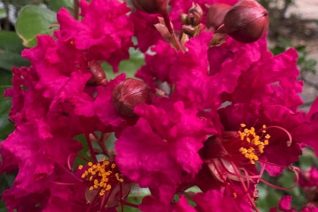
Lagerstroemia x fauriei ‘Tonto’
Sweet little tree that has some of the most vivid fuchsia/magenta flowers in the crape myrtle universe. To 14′ tall with a rounded crown. In late August to October huge trusses of vivid magenta flowers are quite showy. In the waning light of summer this vivid display is welcome. The trunks eventually exfoliate to a soft sandalwood brown with taupe blotches. Very nice. Completely disease resistant. Excellent small garden tree. Fall color is boisterous red and orange. Regular deep irrigation and full all day sun in a hot position. Grows approximately 2′-3′ per year when young. Excellent National Arboretum hybrid that is consistently one of the latest cultivars to bloom in our climate. Very good cold hardiness- this variety grows well in such places as E. Pennsylvania and New York city. Appreciates rich soil and little root competition from other plants. Brilliant floral display. We offer this small tree in a multitrunked form, seldom as a single trunked standard. Beautiful small tree year round. This is a good tree for hot urban conditions- takes the toughest, hottest sites. Pictures below are a great planting of ‘Tonto’ along NE Glisan st. in Portland.

Lagerstroemia x fauriei ‘Tuscarora’
One of the most popular tree type crape myrtles and it is frequently planted as a street tree in the city of Portland. Strongly upright growing tree- almost fastigiate that eventually forms a spreading crown. The silhouette is that of a hot air balloon. Full sun and rich to average soil including clay soils. REGULAR summer water not only ensures a huge flower display in August and September it rapidly speeds the growth rate. Well irrigated trees can put on up to 4′ a year. Otherwise it makes due with little summer water by blooming much later- September. Extremely large hot coral pink trusses are held vertically and are pleasantly fragrant. They can appear the size of a beehive. Less re-bloom than other trees. Fall color is orange/yellow/soft red and lingers. The exfoliating bark takes on a champagne pink glossy sheen when mature. Good garden tree. Excellent street tree. To 22′ tall and 8′ wide at maturity. Water, please water your street trees.

Lagerstroemia x fauriei ‘Wichita’
One of the very finest very large growing tree type crape myrtles from the National Arboretum breeding program. Tall and not very wide in time this very fast and upright growing tree sports a spreading crown. In late July to October huge panicles of bright lavender flowers remain showy for weeks. Its a soft color but the display is opulent. In time the bark exfoliates to patches of cinnamon red and mahogany. Very showy. Fall color is an intense display of reds/orange/purple. Full sun and virtually any soil- thrives in clay soils and the reflected heat of parking strips. Of all the Crape myrtle cultivars perhaps this free blooming 26′ tall tree is the best for a candidate as a street tree-though it is never grown as such. This somewhat rare Crape myrtle never gained popularity because it does not root easily in large numbers. That doomed this wonderful tree in the nursery business. We’re happy to offer it on a limited basis. Excellent cold hardiness as well as disease resistance. Well irrigated trees will easily put on 4′ of growth in a year. -Very pretty as a multi-trunked tree and virtually unheard of trained as a standard.
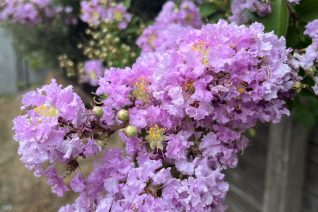
Lagerstroemia x fauriei ‘Yuma’
Extraordinary tree that displays HUGE trusses of almost double flowered glowing lavender blue flowers for nearly two months. Open spreading habit on a compact tree to 14′ tall and 8′ wide. The branching structure favors the huge opulent flower clusters which protrude in every direction and which always begin in my garden in early August and continues well into September. Fall color is a vivid orange and yellow combination and is reliable. The sinuous trunk displays pink/tan coloration Smooth and very pretty. Its consistently one of the youngest to show bark coloration. Another less renowned trait is its almost fluid, undulating branching pattern. In a nursery pot you seldom see the true glory of a crape myrtle- trust me, this is a first rate tree. Full hot sun and regular summer irrigation to bloom and thrive. Very cold hardy and disease resistant. An easy and spectacular tree that should be planted everywhere. Beautiful. Excellent small tree for small urban gardens. Mixes well with Japanese Maples and Stewartias. Best to begin irrigation in May if we’ve had an exceptionally dry spring. Wonderful tree year round and an exceptionally heavy and reliable bloomer. One of Paul’s favorite crape myrtle cultivars. Its amazing, Trust me. Combine with late blooming, white flowered Hydrangea paniculata ‘Limelight’ for a repeat of luscious, late cone shaped blooms. National Arboretum introduction.
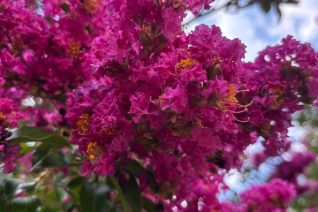
Lagerstroemia x fauriei ‘Zuni’
This has become a standard Crape myrtle in our climate. Excellent performance on a well scaled tree to just 17′ tall and very upright. Beginning on average in urban areas in late July large trusses of rosy lavender flowers appear in a huge display, it continues unabated for up to two months. The glossy green leaves turn to red/orange/yellow in autumn for a further display. In mature trees the bark exfoliates to a soft white/ gray- great contrast with the deep green foliage. Grows about 2′-4′ a year if well irrigated. Not fussy about soil just requires full all day sun and deep infrequent irrigation. Good air circulation. First rate small garden tree that is the size of many larger Japanese maples and pairs wonderfully with them in gardens. Very easy to grow tree.

Lagerstroemia x fauriei ‘Natchez’
Well known as the queen of crape myrtles ‘Natchez’ is a magical tree with many different kinds of beauty. In mid-summer to October large trusses of pure white flowers bend twigs gracefully. Its bark is among the most striking of any tree. Swaths of cinnamon red and taupe mottled patterns envelope the trunk. In fall red to yellow fall color is showy for several weeks. To 22′ tall and half as wide in 10 years. Average soil that drains as well as regular summer irrigation both speeds growth and encourages blossoming. A striking specimen and useful as a street tree that will never become entangled in overhead wires. Completely disease resistant. Fall leaves drop and decompose almost instantly. Very nice- no raking. Fast growing in youth. Best with regular irrigation. Often ‘Natichez’ is one of the first and most reliable bloomers for cooler areas

Lathyrus vernus
One of the great joys of spring. Vernal Pea erupts in a fountain of blue/purple/magenta pea flowers for many weeks in spring. New foliage and flowers emerge simultaneously in early spring but blooming continues for an extended period. As the plant expands it becomes a 2′ x 2′ round mound. Following flowers the deep green foliage remains handsome through summer. Full sun to very light shade in rich, well drained soil with light but consistent summer water. Very, very long lived perennial. Not often available in great quantities as it is raised by seed and our crop is dependent on the viability of each years seed set. Very easy to grow. Not bothered by slugs/snails. Mix with early spring ephemerals, bulbs, Hellebores. Nice small cut flower.

Laurus nobilis ‘Crispa’
Wavy Bay tree. Good, cold hardy form of this shrub/tree that is prized for culinary use. Fast growing pyramidal shaped dense shrub to 15′ tall and 8′ wide in 10 years. Full sun and rich, to average well drained soil. Little summer water when established- but tolerates regular water in gardens. Very easy and long lived in containers where you can observe the undulate, wavy edges of the leaves. Protect containerized plants from temperatures below 12ºF. Avoid subfreezing wind. Otherwise a hardy easy to grow evergreen. Give this shrub room- it has greedy roots and is not a good neighbor. Aromatic foliage is also useful for holiday garlands and wreaths. Small yellow flowers are not conspicuous in spring. Moderate deer resistance. Mediterranean.
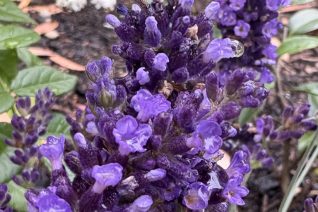
Lavandula angustifolia ‘Hidcote’
This strain of lavender that is grown from seed is remarkably uniform and produces superior compact plants with deep purple buds that open to lighter lavender spikes. Just 20″ x 20″ on average. The flowers are born on 8-10″ straight stems. Aromatic foliage is gray/green and dense. This is my favorite variety of lavender for the garden. Unlike, many larger types ‘Hidcote’ seldom splays or splits when in bloom, instead the compact plants hold their flower spikes vertically and in a tidy way. The flower color is deep and uniform. Lavender has a limited life span. It generally goes south or ages out after 5-7 years. You can extend this lifespan substantially if you take care of the plants. That means infrequent but deep irrigation, soil that is not overly enriched, and diligent hard pruning after bloom has ended. Don’t just cut the spikes off at their base, instead go about an inch lower into the stem. This will cause the plant to branch and retain a dense and compact habit. It will also extend the life of your lavender. Excellent variety for hedges, knot gardens, herb gardens or just a lovely bloomy summer subshrub. Blooms late May-July. Loved by all pollinators- not surprising for a plant in the mint family. Drought adapted when established. Moderate deer resistance. Full all day sun.

Lavandula angustifolia ‘Miss Katherine’
You don’t often think of lavender flowers in the color of pink, but this compact heavily flowering selection produces masses of clear pink flower spikes for months in summer. Mixed with purple and white flowered varieties and you get much more depth of contrast. The purple and white both look better. Compact gray foliaged shrub for average, well drained soil and light summer water. Full sun. To 2′ tall in bloom the foliage usually maxes out at a globe 14″ x 14″ . Cut back hard after blooming for a denser more compact plant. Fragrant flowers, foliage. Moderate deer resistance. Very easy to grow. Hedges, specimen. Etc.

Lavandula angustifolia ‘Pastor’s Pride’
When you have a small garden you want to get as much bang for your buck as possible. Enter this great cultivar of English Lavender that blooms not just once but over and over again until frost. Medium lavender blue flowers cluster at the top of straight wiry stems to 10″ long. A naturally compact plant to about 2′ x 2′ ultimately. Silver evergreen aromatic foliage. Rich, to average well drained soil in full sun with light summer water. Somewhat drought adapted. Looks better , re-blooms better with light water. Saches, Lavender wands, potpourri- everblooming fragrant hedge. Very good Pastor. Very good.

Lavandula x angustifolia ‘Purity’
We asked the man who knows lavender the best which white Lavender did he recommend? And he fired this off the top of his head and then brought one for us- Thank you Andy Van Helvingen. A REALLY stunning plant. Compact with many CLEAR WHITE flowers in dense clusters at the end of strong straight stems. The plant is compact and grows that way – much slower. To 16″ x 18″ with bloom spikes above. Flowers early June to August. A charming plant that does not cling to discolored brown flowers instead they just kind of melt away so it does have an extra pristine appearance at all time. Shear spent blooms to their base to encourage a more dense and floriferous shrublet in the future. Wonderfully aromatic hybrid with english Lavender. Moderate deer resistance. This would combine in a perfect way with pink and blue flowered varieties- ‘Hidcote’. Avoid planting closely with L. x intermedia, cause those will flop and smother this little gem. Great for small hedges, rock gardens, and herb knots. Pungent for drying, potpourri. Full sun and rich to average soil with reasonable drainage. Not good in shade. Lavenders also require very good air circulation- plant accordingly. Average life span 5-7 years, Light summer water.

Lavandula x lanata ‘Ana Luisa’
So many lavenders that we’ve decided to go with the very best. This hybrid is a cross between english lavender (L. angustifolia) and wooly lavender (L. lanata) and gives you wonderful almost white wooly foliage with deep purple thick flowers. To 2′ tall and 2′ wide in time this rounded evergreen shrub blooms for an incredibly long time beginning in early summer. Full sun and rich to average soil with light but consistent summer water. Very easy to grow in our climate. Shear the spent flower spikes and cut into about 1/2″ new growth for a compact and more densely blooming habit. Excellent landscape plant, informal hedge or specimen in a border. This Lavender looks good year round- better winter appearance than most. Lightly deer resistant. Not their first choice but not 100% immune to browse either. Aromatic foliage. Wonderful white foliage contrasts greatly with deep green foliage for depth in plantings. Bred and named by Andy VanHelvingen of Vanhelvingen Herbs.

Layia platyglossa
Tidy Tips a SW american desert daisy that puts on massive displays in famous high rainfall years. In our climate this hardy annual continues blooming for months as our cool summer nights seem to trick into an eternal spring. To 10″ tall forming a spreading plant in full sun and rich to average, well drained soil. Good drainage assists it in setting seed and that seed over wintering for germination the following spring. Remove spent flowers to spur more. Light consistent summer water. Otherwise let it go to seed. Nice cut flower. Loved by butterflies. Easy to save seed and toss out in spring in open sites after all threat of frost has passed.

Leptosiphon ‘Star Dust’
BABY STARS! Cute hardy annual that is actually a west coast native. Also known as Stardust this little plant produces adorable stars in pink, orange, yellow, and white. All together a tapestry of color on just 3″ tall plants. Reseeds prolifically in open disturbed sites. Just one potted plant will yield hundreds of seedlings for the following year. Blooms May- July then dies, goes to seed, is no longer there. Great bulb cover. Little to no summer water for self sown seedlings. Primarily composed of Leptosiphon parviflorus which is native to central California. Our own locally native Leptosiphon bicolor is similar and In the wild the flowers are primarily pink with a yellow eye- occasionally other colors. Adorable. Baby stars. Leave cleared space in your garden near these plants to allow these plants room to re-sow. Competition from other plants is the main reason that this plant loses its grip in the garden. Simply scratch a bare area near each patch and do not remove the spent plants until they are properly straw and dropping their fine seed. Delightful lining paths. Creates the most honest looking wildflower vignettes possible in our gardens. Full sun.

Leptospermum cunninghamii ‘Silver Form’
Beautiful species of tea tree with tiny leaves of pure silver. Its been grown for eons in England- native to higher elevations in the Great Dividing Range. Great fine textured shrub for a dry and protected area. To 6′ x 5′ in 5 years one of the most silver evergreen shrubs in our climate. Blooms prolifically in June covering the whole shrub in white stars. Easy to grow in full sun and average, well drained soil. Light, consistent summer water. Will often have random flowers year round as well. Fast growing. Avoid the coldest sites- best in warm, sunny, gardens. Mix with other shrubs- especially yellow or chartreuse foliage which really makes this shrub pop. Listed as tender in some fairly famous publications…which don’t know what they are talking about. We’ve had this shrub planted at our very cold nursery in Wilsonville for more than 15 years….and there it still happily thrives. Moderate deer resistance.

Leptospermum namadgiensis
Rare shrub that is destined to gain popularity. From the highest elevations of the Australian Alps this large evergreen tea tree is beautiful in all of its parts. Known locally as alpine downy tea tree the fuzzy silver small leaves crowd the stems densely. In early summer masses of 1″ white flowers deck the boughs like snow. To 8′ x 8′ quickly it can also be trained as a small tree which highlights its incredible exfoliating trunks. Silver, copper, green and tan are all present after the bark sheds in mid-summer. Full sun and virtually any soil. Totally summer drought tolerant when established. Great hedging candidate. If sheared it becomes immensely dense. And cutting does not mangle the tiny leaves. Moderate deer resistance. So far undamaged at 5ºF. Photo credit: Evan Bean

Leptospermum rupestre (Low Form)
Creeping form of Alpine tea tree from the highest mountains of Tasmania. Low evergreen shrub with deep green tiny leaves set densely on the stems. Forms a complete ground cover in time with the ability to inhibit weeds. The new stems are an attractive cinnamon red before switching to gray. In early summer tiny pink buds open to starry white flowers. For several weeks they obscure the foliage. To 1′ tall but usually much lower and spreading to 3′ x 3′ in several years. Full sun and rich, well drained soil with light but consistent summer irrigation. Drought adapted when established. Best on warm south or west facing aspects. Avoid exposure to intense subfreezing east wind- in those areas plant it in a protected location. Always handsome ground cover shrub. Amazing at the edge of containers or near boulders as this plant will faithfully follow every contour. Cool.

Leptospermum scoparium ‘Washington Park’
Manuka. This is a wonderful very upright wispy evergreen shrub with tiny leaves that turn maroon in winter and masses of white flowers in early summer. Flowers are born on wood from the previous season and are much larger than the foliage. The effect in early summer is a shrub clad in snow. To 8′ tall x 4′ wide in 5 years. Full sun and a protected position, such as against a south facing wall. This form is from the Washington Park Arboretum in Seattle where it has thrived for many years. A selection made from high elevation inland New Zealand. Grows very fast w/ light summer water. Excellent fine textured plant. Moderate deer resistance. Cold hardy to a little below 10ºF- it has been damaged but recovered from lower temperatures. Very easy to grow wild looking plant. Drought adapted when established.

Lewisia cotyledon ‘Rainbow’
This strain of our native Siskiyou Lewisia contains a stunning range of flower colors. Pink to orange to white to yellow and permutations in-between. One of our most cherished wild flowers this plant is found at high elevations in the southern part of the state. A succulent that forms an evergreen rosette it displays its flowers for literally months on end beginning in spring. Excellent, long blooming, easy to grow container plant but not difficult in the ground given rock garden conditions. Drainage is crucial, in average to enriched soil. Drought adapted but it blooms longer with light summer water. Full sun to very light shade. Excellent at the top of walls, spilling out of cliffs as it does in nature. To 6″ tall forming multiplying rosettes up to a foot across. Moderate deer resistance. Oregon native plant.

Libertia ixoides
Spikey evergreen Iris relative that forms substantial clumps quickly. This species has leaf blades in a fashionable taupe. To 14″ tall and eventually getting wider. In summer three petalled pure white flowers appear on panicles within the foliage. These are followed by small showy yellow berries. Full sun and rich, well drained soil with regular summer water. Sharp drainage is important for cold hardiness. Put this on a hillside or in a gravel bed. Water faithfully to establish. AKA White flag. Native to New Zealand. Great in containers. Excellent performance at the Oregon coast.

Libertia peregrinans
Orange sword. Striking spiky ever orange monocot in the iris family. Forms upright spreading colonies in rich, well drained soil in full sun to light shade. The curving thin blades color brilliant orange with any kind of environmental stress. Hardier to cold when established. Runs by stolons give it room. In summer with in the evergreen foliage three petalled pure white flowers transform into yellow berry-like structures. Grows well in pots if left undisturbed and protected below 15ºF. In extreme cases it can freeze to the ground (below 10ºF) and will vigorously return. Avoid boggy situations. Moderate deer resistance.
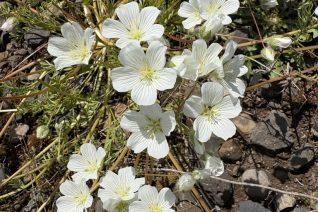
Limnanthes alba
Willamette Valley white Meadowfoam is such an unassuming plant with an incredible tough streak. Finely divided grass green leaves are completely obscured by the copious cup shaped white flowers. Opulent bloom begins in April and extends to early June. Forms connecting mounds that knit together into one sheet of ivory petals. Native to the central and southern Willamette Valley. It can be seen occasionally on road cuts and the gravel on street margins. But planted en masse it is spectacular. Excellent plant for tough, compacted, clay soils. To 4″ tall and each plant is about 1’wide. Leave spent dried stems where you want the next years display to be. Germination in autumn precedes most cold season weeds and forms an effective cover crop. Though prolific its well behaved enough to live between shrubs and even perennials. Excellent mixed with Baby Blue Eyes and Yellow and white Limnanthes douglasii. Water containerized plants at installation then none necessary. Self sown seedlings are MUCH more drought adapted and can germinate on soil as hard as concrete. Moderate deer resistance. Beautiful native wildflower. Oregon Native Plant.

Linum lewisii var. lewisii
When you want a wildflower effect why not turn to a true native wildflower- one that improves under cultivation. Blue flax is a native of prairies and hot hillsides on the East side of the Cascades. Thin multiple stems rise to 18″ tall and bear a succession of single sky blue flowers. Light and airy and blue and native. Easily grown perennial for full sun and rich well drained soil. Light summer water. Takes summer drought well but after the first round of flowers are spent give it a healthy haircut and the whole clump will bloom again and with irrigation it stays with us blooming until autumn. Drought adapted. Reseeds in open soil. Tiny rosette of leaves or none in winter. Oregon native plant.

Lobelia ‘Bruce Wakefield’
Years ago, a long time ago our friend and intrepid gardener Bruce Wakefield gave us a piece of this sumptuous, tropical appearing Lobelia. Turns out that Bruce got it from ANOTHER friend of mine. Jackson Muldoon of the now defunct Transpacific nursery found this “lobelia” in central Mexico. Its a cold hardy, vigorous, and long blooming large perennial that displays tubular flowers with an interior of yellow and orange and an exterior of red. To 4′ tall in bloom it spreads stoloniferously underground to form big patches. Give this spreading plant room in full sun and rich soil with regular consistent irrigation. Bloom begins in June and continues sporadically until frost. Loved by hummingbirds and flower arrangers. This is likely no longer a Lobelia and there are several options to choose from, until I am certain we will continue to refer to this as lobelia. Completely winter deciduous with the first hard freeze. Emerges in spring when truly warm weather arrives- Mother’s day. Mulch for the first winter to aid establishment. Once its yours expect a long lived plant. Thank you to our friends Jackson and Bruce. Photo credit: Bob Hyland.

Lobelia laxiflora var. angustifolia
Narrow leaved Mexican Lobelia is a showy long blooming perennial for very well drained sites in full sun. Rising to 3′ when happy this expanding clump has stems decked out in tubular red and orange flowers with a yellow throat. You just know its hummingbird central. Regular water speeds growth on this vigorous an heat loving perennial for full sun. To 3′ wide in time. Blooms May to August. Light, consistent summer water. Drainage is key with this perennial. Amend the soil with pumice and compost if your soil is heavy, cold and wet. Dies to the ground in winter re-emerges late in spring- be patient. Mexico Mountains.

Lobelia tupa
Big huge perennial Lobelia from Chile that is one of the most exotic perennials that we can grow. Spires of 5′ blood red flowers appear for weeks in the middle of summer as the flowers yawn open they reveal an orange throat. Hummingbirds delight. Large pale green leaves provide added contrast. Spreads to form large colonies (does not run). Full sun and rich, well drained soil. Great on hillsides. Light summer water. Completely deciduous in winter. Returns from the base in mid-spring. Give it room to stretch out- new plants are deceptively small. Water regularly for the first summer to establish. Spectacular perennial that is best in rich soil with regular water for the first few years. Improving drainage is helpful in heavy soils. If you have a cold garden- such as a rural colder place mulch for the first several winters until the clump is big. Insane cut flower.

Lomatia myricoides
River Lomatia is an elegant but always rare evergreen shrub that has been grown for decades in the PNW but has never been common. This high elevation Australian shrub has dazzling long thin foliage with fine and irregular indentations. The upper surface of the leaf is blue green with an underside of pale blue white. In May sweetly fragrant clouds of ivory colored curly flowers eminate from the the ends of each branch. They create a hazy effect over the handsome foliage. Multitrunked shrub to 12′ tall with a pronounced arching habit. You may prune errant horizontal branches in place of vertical to train the shrub to be more upright. Otherwise the splay stems clad in flowers are delightful and elegant rather than sloppy looking. Excellent performance in protected courtyards. Cold hardy near 0ºF (briefly) once established. Native primarily above 3500′ in the Australian mountains. Full sun and a warm position with light, consistent summer water. Accepts regular irrigation better than most proteoides. Tolerates ice and snow- very bendable branches. Cut foliage ( and flowers) is wonderful in arrangements. Could be deer resistant. Beautiful shrub.
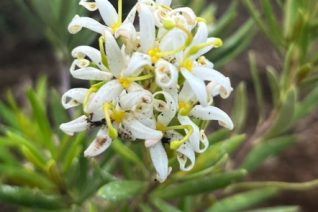
Lomatia polymorpha
One of the world’s most fascinating shrubs. Polymorpha in this case specifically refers to the leaves which are a different, form, shape, and texture on each individual plant. Very unusual for a hardy shrub. In early summer each form produces upright 5″ tall trusses of ivory/white flowers that are sweetly fragrant- blooms appear for 2 to 3 weeks. An evergreen shrub- usually of fine texture, that grows moderately fast to 3′-6′ in 5 years. In time the shrub will be larger. Full sun and light summer water, avoid sites with standing water in winter. Excellent on slopes. Native to the highest elevations of Tasmania. Its been cold hardy to about 5ºF. In cold gardens I would err on the side of protected. Does not tolerate shade of any kind. Full, all day sun. Light summer water. We have chosen three clones that we think are particularly handsome and we will be trialing those plants. Until then seedlings all with variable foliage are what we offer. Some have a very compact congested habit while others have stretched out and appear to be ultimately larger plants. Excellent as cut foliage as well as cut flowers. A large shrub in full bloom is a beautiful, sophisticated, party of curly ivory flowers. Fantastic. Might be deer resistant. Very good performance at the Oregon coast. Very rare shrub. Proteaceaous- avoid compost and fertilizers. Mulch with bark/ wood chips. Best as a single specimen. Most applicable common name ‘Variable leaf Lomatia’. That about covers it.

Lomatium grayii
One of our earliest blooming perennial umbels. This sweet little wild flower can be found in the central to eastern Columbia Gorge – closest to us. Extremely frilly blue gray foliage emerges in late winter and not far behind are the 8″ spikes of golden umbel flowers. A boone to early pollinators and welcome color in spring. Very well drained soil- best on a slope. In full sun with little to no summer water. Blooms February-April. To 1′ wide. Excellent in rock gardens, troughs, dry gardens. It can go summer dormant if too dry. For the first summer water it lightly but consistently through summer, in subsequent years it will be sustained by natural rainfall. High deer resistance. Oregon native plant.

Lomatium utriculatum
Spring Gold or Biscuitroot is a widespread spring perennial from British Columbia south into northern California. In our area it occupies steep slopes and delights in mid-late spring with complex umbels of brilliant gold/yellow flowers. This tap rooted plant requires regular water for the first season- but never boggy, In enriched to average well drained soil. Excellent performance on slopes. Over time the rosette increases in width and amount of spring flowers. Adapted to life between native clumping grasses. This is easily replicated in a garden. An important native pollinator plant that was also used by native Americans as a food source. To 6″ tall in bloom a plant will achieve 2′ wide in half a dozen years. Strongly resents disturbance and a happy plant will live for decades. Not bothered by pests. Once native in the Portland area, its original range in W. Oregon has been substantially diminished. Great companion plant with Manzanita. Goes quietly dormant over summer. Occurs with both Camassia leichtlinii and quamash, as well as Ranunculus occidentalis, Plectritis congesta, as well as Dodecatheon. Moderately deer resistant. Oregon native plant

Lonicera ‘Lemon Beauty’
Dramatic yellow foliage with an interior of deep green on the small evenly spaced evergreen leaves of this low spreading shrub. To 3′ x 4′ and forming something of a mound. Spreads low at first- gains height with age. Rich soil with light summer water in full sun to part shade. Very drought tolerant when established. Lights up borders, is easily clipped- without mangling the small foliage. Flowers are tiny and cream colored often followed by translucent purple berries. Sometimes reverts to all green – just cut those reversions cleanly out. Very easy to grow plant for foundation plantings, tough sites, hedges. There is some confusion over the exact species…if you look it up half say L. nitida and half say L. pileata. I’m going to have to go with L. ??. Shrubby honeysuckle.

Lonicera ciliosa
PNW Orange Honeysuckle is one of our most showy native vines. Our region is sparse on native vines so this pretty plant is welcome. In late spring to summer clusters of brilliant orange tubular flowers decorate the branch tips. Loved by hummingbirds as well as other birds which is obvious, its also important for all native pollinators. The flowers change to brilliant red fruit which is consumed by wildlife and seldom lingers. Deciduous mid green foliage is verdant all through the season. As with the vast majority of Honeysuckle vines this plant nearly always goes leafless at the base. Expect this and plan for it. Strongly twining plant to 12′ tall and almost as wide. Provide strong support. Light consistent summer water to establish then very little necessary once established. (Also accepts regular summer H20). Excellent vine for country fences, decorating mailboxes etc. Protect from deer, otherwise it is pest and disease resistant- occasional mildew in the autumn is virtually harmless – great news for a honeysuckle. Blooms on wood from the previous season, prune if needed after flowering. This vine can be very hard to find. We grow it from seed and quantities are limited. Oregon native plant
Not available 2022/23

Lonicera hispidula
Hairy Honeysuckle or wild pink honeysuckle is a common vine in the western part of our state. Ranging rom S. British Columbia to California. This sprawling and twining plant is most associated with the cover under white oak woodlands. This vine can crawl to impressive heights into trees. As a child near Eugene this grew extensively on our property. It would climb pole sized trees and I would strip the winding canes off the trees and use them as a trellis for annual vines. The strong wood lasted 10 years or more. It derives its name from the conspicuous hairs on the leaves. At terminal ends of the branches soft pink curly flowers appear in cymes from June to September. These are followed by brilliant red berries that are food for birds. It has no fragrance. Excellent plant for stabilizing banks and hillsides where its incredible tenacity and drought tolerance is an advantage. Never a tidy plant this vine can be sent up a trellis or large tree. Water to establish then set it free. This honeysuckle can be afflicted with aphids early in the season but I’ve never seen it actually inhibit the plant. Just make sure not to look to closely at the foliage in May-June. Evergreen to semi-evergreen with round leaves that surrounding the stem at the ends just before the flowers appear. Best in wild areas.- for some it can lack the sophistication of our other native honeysuckle Lonicera ciliosa. and is not as immediately beautiful. In habitat it consorts with Oregon White Oak (Quercus garryana) Poison Oak (Toxicodendron diversifolia) and Creeping snowberry (Symphoricarpos albus). Often found clambering up steep rocky slopes in dry woods. Oregon native plant.

Lonicera nitida ‘Twiggy’
British selection that is a golden dwarf form of L.n. ‘Baggesen’s Gold’. Low compact dense growing ever-gold shrub that is well scaled for small gardens. To 1′ tall and in a long time 1/1/2′ wide. Full sun to part shade in rich to average well drained soil. Leaf color is most vivid in full sun and hardiness to cold improves there too. We have never seen flowers on this cultivar of box leaf honeysuckle. Easy to grow. In very cold winters the foliage takes on maroon tints. Low hedges, massed as a ground cover.

Lonicera x americana
A hybrid between two European species has yielded one of the best climbing honeysuckles we can grow. Less prone to pests and disease this prolific blooming vine produces huge trusses of pink/yellow/cream highly fragrant flowers from late spring to autumn. A non-twining semi-evergreen vine that requires the support of something in which the canes can interweave and be supported. Often bare at the base- plan for this. To 12′ tall and as wide. Massive initial display of flowers in late spring and then sporadically until Sept. Full sun to light shade and regular summer water to increase vigor, spur re-bloom. The fragrance is not sweet and cloying rather a complex blend of cloves, cologne and petunia. It carries for quite a distance. A good sized specimen will perfume the entire block.

Loropetalum chinense var rubrum ‘Zhuzhuo Fuchsia’
A large shrub/ small tree that is one of the best adapted fringe flowers for our climate. New growth is deep maroon settling later to a deep maroon green. In spring a massive display of hot pink frilly threadlike flowers covers the whole framework. Flowers appear sporadically after that. Evergreen (loses some leaves below 15ºF- but regains foliage quickly in spring.). Moderately fast growing to 9′ x 8 ‘ in 7 years. Full sun to part shade in rich, well drained soil with average summer water. Takes dry conditions when established- its important to water it well during establishment. This immediately improves cold hardiness when young. Perfectly hardy as an established shrub. Wonderful arching stems support tiered graceful foliage.

Loropetalum chinense var. rubrum ‘Pippa’s Red’
Large growing cold hardy shrub/tree that we love for its deep purple/black foliage and masses of true red fringe flowers in spring. Fast growing shrub to 8′ x 6′ in 7 years. The flowers that appear en masse in spring occur sporadically at any time of the year. As far as we can tell this is the darkest foliage on a very cold hardy selection. Loropetalums are somewhat tender when young but gain complete hardiness in a season or two. Loses some leaves in exposed locations below about 10ºF. Avoid subfreezing wind- exfoliated plants (below 10ºF) regrow quickly in spring. Over time it makes a wonderful small tree.. Very graceful the way the pointed leaves alternate on the arching stems. Worth growing for foliage alone. Full sun to part shade in a warm position. Regular summer water rapidly increases the growth rate. Otherwise once established requires only light summer irrigation. One of the most popular landscape shrubs in the world in China where it is native and has been grown ornamentally for eons. Prune AFTER flowering if needed.

Luma apiculata
Chilean Myrtle is a very good looking dense evergreen shrub/tree in our climate. It requires a slightly protected location as it can be tender when young. Protect young plants from temperatures below 15ºF. With age and establishment it gains much, much more cold hardiness enduring 5ºF with just light leaf burn. The leaves are deep, dark green and rounded with a sharp tip. Almost formal looking. In protected gardens it can attain tree like status in about 8 years. Most often in our region its a shrub of about 12′. And perhaps the most impressive thing about this Chilean/Argentinian tree is the exfoliating orange to tan bark it achieves with age. In mid-summer masses of small white fragrant myrtle flowers with a central boss of exerted stamens smother the whole plant. These turn into sweetly edible if not a little mentholated black berries. They can be messy so locate away from paths, pavement. Birds almost always make off with the berries so that is helpful. Avoid direct exposure to subfreezing gorge winds. In gardens subject to that locate on a south or west facing wall. Very drought adapted when established, but consistent water and average soil will yield the best growth. Grows about 1′-3′ per year. Moderate deer resistance. Not a good plant for cold rural gardens. Tree size specimens are phenomenal and worth the effort to protect when young. Excellent performance at the Oregon coast.

Lupinus albifrons
Our locally native silver leaved lupine. A wildflower that beckons gardeners with incredible metallic silver foliage and spires of blue and white flowers from late spring into summer. It has some exacting requirements. Its best to know where you find it in the wild. Steep, steep cliffs and steep open road cuts. What do they have in common? Excellent drainage and little summer water. Spreading almost shrubby evergreen plant to 2′- 3′ wide on average. The very pretty fragrant flowers rise up to about 3′. It seems to resent a lot of competition from other plants- give it room, its own space and again, perfect drainage. Highly deer resistant also not as attractive to rabbits. Oregon native plant.

Lupinus bicolor
Dwarf Lupine or Pacific Lupine is a widespread small hardy annual that is found all along the west coast from British Columbia to Mexico. In the Willamette Valley its most conspicuous home is along the disturbed soil and gravel of highways/roads. Thats where you see masses of this diminutive lupine that rises to just 1′ tall. The intricate flowers erupt from the top and are mostly blue with purple and the bottom has a white lip. These are displayed above very furry palmate leaves. It forms a small rounded plant. Loved by all pollinators this tough little plant can inhabit the worst, shallow soils and still thrive. If given richer conditions this nitrogen fixer will soar to 1′ tall with a much larger flowers. Excellent in annual containers – it blooms for a long time April-August or until the ground goes completely dry. Horizontal bean pods hold three seeds each. Self sows in open disturbed sites with little competition from other plants. Only water if it is planted from a container otherwise no supplemental irrigation necessary. Very beloved by hummingbirds and butterflies. Mixes well with other long blooming hardy native annuals such as Madia elegans or Clarkia amoena. Seed that is released in summer germinates in autumn with the first fall rains. Easy to spot the palmate leaves. Oregon native plant.

Lupinus polyphyllus ssp. polyphyllus
Large leaf lupine. This is the form that is native to the western part of the state. There are 5 other subspecies, this is the Willamette Valley form. A large bushy perennial famous for the most showy flowers in the genus. This is the direct descendent that forms the colorful clumps along our freeways. A great large garden plant and not a long lived plant. Generally 3-5 years is antiquity for this species. The large palmate divided deep green leaves are coated in fine fur. This makes raindrops turn to pure mercury as they balance on the leaves. The most commonly seen flower color forms in the Willamette Valley are generally blue and purple and solid colors. The multi-color vastly larger selections are just as adaptable as the species. Large rocket like flower trusses rise to 3′ tall in late spring to early summer. Loved by insects the foliage is often fodder for native fauna. Excellent pollinator perennial or cut flower. Large peapods stick out horizontally from the spent flower stems. Reliably self sows if you contain the competition from foreign exotics and turf grasses. Potted plants should be watered regularly through their first summer. In subsequent years it can rely on natural rainfall. Very deer and rabbit resistant. To 3′ wide when happy. Protect from slugs/snails. Oregon native plant.

Lupinus rivularis
Streambank lupine or Riverbank lupine is widespread shrubby species native to western Oregon. Its full range is from extreme southwest British Columbia (where it is endangered) to northern California. Large growing, spreading plant that can almost achieve a sub shrubby habit. To 3′ tall in bloom forming an evergreen shrublet to 3′ across. From late April to early July spires of blue flowers with a white keel erupt from the plant. Very pretty in bloom and incredibly important to pollinators and insects who feast on the flowers as well as leaves. The true species has flowers that are all blue, its found primarily on sand bars in major rivers on the west side of the state. Most seed that is grown and dispersed is a selected bicolor flower. Short lived plant 3-5 years. Following the flowers conspicuous seed pods turn a dark color, These may be allowed to open and disperse in the OPEN DISTURBED SITES that it craves. Excellent in concert with California poppies where it has become a famous duo on our freeways in the spring. Good cut flower. Not bothered by deer. Water to estalblish then leave it to natural rainfall. Oregon native plant.

Lyonothamnus floribundus ssp. asplenifolius
Catalina Ironwood is a tree locally native to the Channel Islands off of Southern California. Surprisingly hardy once established and older this spectacular evergreen tree in the rose family boasts amazing divided foliage with symmetrical scalloped serrations along each margin. Very pretty. The glossy aromatic leaves are seen to great advantage against the straight, red exfoliating trunk. In spring flat umbels of white flowers appear all over the tree. Fast growing in youth to its ultimate size here 25’+ tall in 15 years. Requires a protected location- such as against the wall of a large building. Avoid direct exposure to subfreezing wind. Little water once established. Wonderful tree for courtyards- protected areas. Fantastic performance at the Oregon Coast. Protect young trees from temperatures below 15ºF- wrap or swaddle in burlap or remay until arctic weather has passed. Reaches its full hardiness several years in the ground. There is a wonderful mature specimen of this tree at the McMennamens in St. John in PDX and scattered large specimens occur around the city. Nice, nice urban tree.

Macleaya microcarpa
Plume poppy is one of our favorite big bold perennials. A true poppy it rises to 8′ tall and spreads vigorously forming large stands. Give it room to spread in average well drained soil with light summer water. In summer at the top of blue deeply lobed leaves (with a white underside) foam with coral colored plumes of bloom. All around a good looking plant. Doubles as a lush tropical looking presence. Plant with such things as the hardy banana ‘Musa Basjoo’ and large leaf Cannas. Spectacular. Moderate deer resistance. Drought adapted when established. Long lived perennial that is totally herbaceous in winter.

Madia elegans
Elegant tar weed or Hayfield tar weed is a locally native annual that occupies (or occupied) sunny dry hillsides in selected regions of the western part of the state. Elegant tarweed references both the light tar like fragrance of the sticky 2′ stems and the elegance of the 1″ wide flowers that are the most showy of the genus. Daisy-like flowers range from pure yellow to yellow with a ring of maroon, white, or red around the center. One of our longest blooming annuals flowers appear from April to November. Remove spent flowers apply light irrigation and it will happily continue its show. Nice cut flower- but remember flowers take an afternoon nap and revive with darkness- kind of cool. The dried seeds of this species were a very important food source for native people. They would grind the oily seeds to make a kind of flour or press them to extract oil. To 2′ tall forming multi branched clumps. Re-seeds in places that it likes, mostly sunny, open places with good drainage. Native to the city limits of Portland, though no longer likely present. Fix that. An ebullient pretty native. Moderate deer resistance. Oregon native plant.

Magnolia laevifolia
Excellent small scale evergreen Magnolia with handsome rounded leaves touched with brown indumentum (fur) and in mid spring masses of large 4″ ivory white intensely fragrant flowers. The flowers have a rich and penetrating lemon aroma. Following bloom buds form immediately in the leaf axils for the following year and are clad in brown fur- they add to the over all sophisticated aesthetic of this 9′ x 6′ shrub. Formerly Michelia yunnanensis. Full sun to light shade and average soil with light summer water. Very drought tolerant when established. This particular form we’ve grown for almost 20 years and it has proven to be a cold hardy clone (to 5ºF) year after year. In colder gardens provide a protected spot. In time this species can develop what is called a lignotuber. That is a swollen woody root-like structure at the base. This adaptation is possibly for fires and a plant can regenerate very fast if the plant is damaged above the lignotuber. Shoots will appear from this and grow regaining apical dominance and forming a straight leader. This is seldom necessary. Pruning of any kind should be done directly AFTER flowering.. This SW Chinese Magnolia does best in AVERAGE soil- or unamended native soil.

Mahonia aquifolium
Oregon Grape, our ubiquitous state flower. This evergreen shrub can be found almost anywhere aside from the immediate coast to high Cascades west of the mountains. Its native from B.C. to Southern California. Variable shrub to on average 5′ tall and suckering as wide. In rich, happy conditions it will soar to 8′ or more and in more impoverished conditions it makes its life as a spreading low plant. In late February-April the top of the plant erupts in golden yellow incredibly fragrant flowers that are one of the first joys of spring. By late summer these flowers have transformed into clusters of dusty blue incredibly sour fruits. Often employed in the toughest situations where its performance is some what rough. It thrives in cultivation with light, consistent summer moisture. Tolerates heavy clay soils and summer drought. The pinnate leaves often take on purple/maroon tints in winter. Ours are cuttings native to our wholesale nursery site. So its a local plant. Full sun to part shade to quite a bit of shade at the expense of blooming and a lankier outline. Excellent deer resistance when established. Oregon native plant.

Mahonia euryobracteata ‘Silver Seedlings’
This form of this wonderful Mahonia has leaves that are more silver and a little bit larger than the more commonly seen and finer textured selections of this species. It has also exhibited excellent cold resistance. To 5′ tall moderately fast the finely divided leaves shine. In spring clusters of fragrant yellow flowers are followed by dusty purple/blue berries. Full sun to part shade in average to enriched, well drained sites. Very easy to grow and gorgeous, long lived shrub that consorts with perennials or adds a light texture massed with bolder evergreens. Light consistent summer water speeds growth but established plants are more than drought adapted. Excellent in containers and wonderful winter appearance. Great deer resistance. Forms multiple stems in time to a width almost as tall as it is. These are seedlings from a particularly gray and cold hardy specimen. Easy.
Xera Plants Introduction

Mahonia nevinii
Nevin’s mahonia or barberry is a remarkably tough evergreen shrub for the roughest locations. A moderately fast growing evergreen with somewhat fiercely armed blue green leaves. New growth of divided leaves is conspicuously tinted red. In spring small yellow flowers appear and cover the whole shrub, by late summer these have morphed into translucent red berries relished by birds. Native to southern California and surprisingly cold tolerant – like zone 4b tolerant thats -25ºF. Its kind of funny that we didn’t go for this remarkable durable plant. a long time ago, instead we were saddled with the horror of English holly. Once established it requires absolutely no further irrigation. It’s perfectly adapted to our winter wet summer dry climate. Full sun is non-negotiable Excellent shrub for rural areas as it is incredibly resistant to deer and even rabbits, In time it becomes a dense rounded shrub- very handsome. Excellent shrub to deter unwanted folks or animals. I’ve often thought this would be an ideal rural hedge with little care beyond planting and watering to establish- then set it free. Virtually any well drained soil. Avoid standing water at any time of the year. Beautiful, tough west coast native shrub. 8′ by 6′ in 7 years.
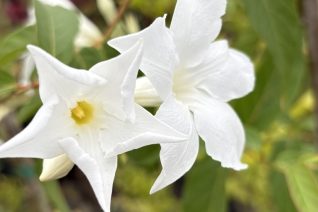
Mandevilla laxa
Chilean Jasmine is not common in our region but it has been grown for many decades and it does well in warmer gardens, protected places. Large entire deep green leaves are 3″ long and opposite on twining stems. This strongly growing vine requires heavy and reliable support (See #4 copper wire). Blooms on new growth, which is continuous, In rich soil it can achieve 15′ in a season. The 2″ long tubular white flowers have the familiar propeller petal configuration of this family the Apocynaceae . The fragrance to me is delicious on warm days and nights and close to the blossoms which appear in clusters. It is not a sweetly cloying scent but more sophisticated. I once had this vine around my front door. In full bloom on warm summer nights it would be a cloud of perfume. Deciduous and often freezes back either 1/2- 3/4 of the way in colder than normal winters. In horrendous winters (below 12ºF) it can freeze away. Choose a protected site in full sun with rich soil and ample water. The more verdant the growth the more profuse the display and fragrance. Blooms late May- October. Avoid, cold frosty sites, cold gardens. In rural areas place it against south facing wall. Because it blooms on new wood and grows so prolifically it may be cut nearly to the ground for a fresh start to the year- do this in late March. In most summers large two chamber connected bean pods are 8″ long and bright green. When they ripen to tan they will twist and release downy clad black seeds that sail on the wind. Several winters in a row and the seeds that germinate may survive. I almost always lose them but the climate is changing and don’t bet on self sowing any way -its rare Root hardy to about 5ºF- mulch for added protection. Exquisite vine. Native to central southern Chile.

Matthoila fruticulosa
Stock, the common early spring cut flower with that is wonderfully fragrant of cloves. The sweet perfume can be detected at quite a distance. This is a cold hardy, PERENNIAL version of that beloved flower. Forming a semi-woody dome like shrub multiple spikes to 10″ long eminate from the crown and bear pristine cleanly white flowers with that dazzling perfume. Great fragrant filler in bouquets. Native to mountainous areas around the mediterranean. To 2′ x 2′ and becoming a multi branched shrublet. Full sun and rich to average soil with light consistent summer water for the first season. Good drainage is important and its a natural plant for a slope. Established plants can get through summer without irrigation. The long strappy leaves are gray/green and add to the overall appeal especially when decked with white flowers. Average life span 5-7 years. Do not coddle. Combines well with Cistus, Halimiums, Helianthemums. Dianthus where it will compete for perfume. Very reminiscent of a Wallflower (Cheiranthus) and accepts the same cultural requirements. Blooms May-August. Pronounced muh-TOY-luh

Melaleuca squamea
Honey swamp myrtle hails from wet locations in Tasmania. Its a tender shrub inland but it thrives in zone 9 on the Oregon coast. A fur clad fine leaved shrub that is a true myrtle. In April-May the whole plant is home to stamen dominated purple bottlebrush flowers. Exquisite. Very easy container subject that can be moved to a protected place if severe cold (below 20ºF) threatens. Excellent shrub for sandy substrates though it takes well to heavy clay too. Light consistent summer water. To 5′ tall by 2′ wide in 7 years. Great plant for hummingbirds and butterflies. Inland we have yet to test the cold hardiness in the ground. It should easily take 15ºF but probably not lower. Evergreen foliage is fragrant when disturbed. Good deer and rabbit resistance. Absolutely titillating in bloom. Native to mid and high elevations of Tasmania. Seed grown.
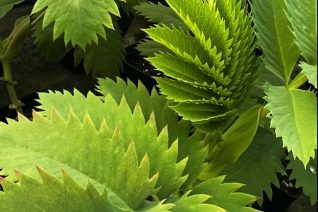
Melianthus major
South African Honey Bush that we grow from seed. This bold sub-shrub/perennial entrances people with the large blue symmetrical, pinnate, serrated leaves. Large plant to 6′ x 6′ in 5 years. Semi-evergreen it can freeze to the ground below about 20ºF and will vigorously regrow from the base in spring. Its important that Melianthus be very well established the first season going into its first winter. A large root mass ensures re-sprouting from the coldest winters. If the winter is mild 1′ tall inflorescences of black and red are odd, spectacular, and an ode to goth gardening in early summer. Rich soil that is never boggy in a warm, protected location with regular water to establish. Even if winter is only semi-cruel and the stems stand but with tattered leaves the whole plant can be cut to the ground AFTER ALL THREAT OF FROST HAS PASSED. Mulch for the first autumn w/ dry leaves and compost. Excellent at the base of a warm wall or a south facing aspect. Appreciates good care and water.. Mix with other large, bold perennials- Aralia californica (Elk clover) and Lobelia tupa (Devil’s tobacco) . Very dramatic in containers. Container grown plants should be protected from arctic cold (below 20ºF). The large leaves have the odor of peanut butter when disturbed/bruised. Its pungent and spot on. Not often bothered by deer. Might be somewhat rabbit resistant. Nice bold, tropical affect.We offer two other named cultivars, to be honest any one of these seedlings could be as good or exceed those cultivars.

Melianthus major ‘Antonow’s Blue’
Big and bold and blue this remarkable plant known for its enormous pinnate foliage makes a statement. To 7′ tall and as wide in time. Following mild years madder red rubbery flower spikes bear black flowers. yep. Its very important to establish your Melianthus happily before its first winter. That means you give it rich, well drained soil in full sun with REGULAR summer water. The bigger the root system the more vigorous the plant will return if frozen to the ground (below 20ºF). Luckily in the city this usually happens every four years or so. In colder outlying areas plant it next to a hot south facing wall and nurture the hell out of it. Mulch before arctic episodes is a good thing. Moderate deer resistance. South Africa.

Melianthus major ‘Purple Haze’
Nice selection of Honey Bush that shares tints of purple predominantly when new leaves are unfurling. The enormous blue/lavender serrated leaves are amazing. Lower growing than either the species or ‘Antonow’s Blue’. To 4′ tall (usually shorter) by at least 6′ wide. Red flowers are produced on the black scape that can follow mild winters. Technically a subshrub as it can freeze to the ground and fully recover from the root in a single season. IF it has been well established in its first season. For that reason we only sell Melianthus in 2 gallon sizes. A larger plant establishes faster and has more mass going into winter. Plant in a protected location- against a wall or with light overstory protection. Mulch for the first winter. Freezes to the ground at prolonged temperatures below about 20ºF. Re-sprouts in mid-late spring. Water and fertilize to speed the recovery. South Africa.

Metapanax (Nothopanax) delavayi
Such a cool tree for small gardens. Upright growing and then branches that also turn vertical fairly quickly- kind of like an upside down candelabra. The lush evergreen foliage is composed of palmate divided leaves which droop gracefully and give the plant a lighter mein. In summer masses of orbicular off white aralia flowers appear en masse at the branch tips. They are pollinator heaven. And they turn into clusters of black berries consumed by birds. To 16′ tall and half as wide. Perfectly hardy to cold, but can become semi-deciduous below 10ºF. New leaves come quickly in spring. Fast growing tree for rich soil and regular summer water in full sun to high overhead shade in woodland conditions. This pretty tree has a promising future.

Michelia (Magnolia) skinneriana
This is known as the improved form of banana shrub and it is. A slow growing broad leaved evergreen shrub to 6′ tall in 7 years by 3′ wide. In late spring to early summer the stems lined with glossy leaves have deliciously scented cream/pink flowers. The fragrance reminds most of banana but I think its a little more like a wine cask. As the flowers age they take on decadent stains of pink and yellow. Great shrub for a protected courtyard or a south facing wall. This close magnolia relative from SE China revels in heat with regular water during the summer. Excellent appearance year round the glossy leaves are ever handsome and the shrub itself is tidy and well behaved. Pruning is seldom necessary but if you do make sure to prune directly AFTER blooming. Blooms on twigs from the previous year. Rich soil and full sun to part sun in a warm position. Avoid areas exposed to subfreezing wind- a south or western aspect is best Cold hardy to about 5ºF and it gains hardiness with age. Wonderful fragrance, wonderful shrub. Mulch in autumn.
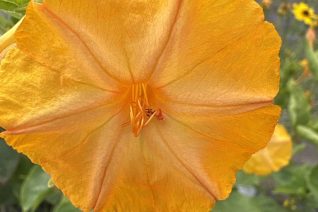
Mirabilis jalapa ‘Orange Flowered Form’
Four O’ clocks are a tried and true favorite summer blooming perennial. AKA the Marvel of Peru opens its sweetly scented flowers around that time. Forms a bushy plant 30″ x 30″ and it comes in a host of flower colors but pure orange- and not salmon is a new hue. Heavy blooming perennial, forms a tuber, same treat meant and hardiness as a Dahlia. Mulch in fall if you live in a cold area and be patient for it to return in May . Wonderful sweet flowers perfume the evening air. Loved by butterflies, bees and moths. Will often re-sow if the winter has been mild above 20ºF. Root hardy to about 10ºF and often persisting forever in the very close area near old house foindations . Rich soil in full sun with regular summer water for best growth and bloom but remarkably drought adapted when established Under ground tubers become the size of a small potato. Blooms last a day but the procession of flower goes from June to October. Great container plant as well.

Molinia caerulea ‘Variegata’
A purely awesome form of Moor grass that we find indispensable at Xera. A strongly clump forming grass that has comparatively wide leaf blades margined heavily in cream. The effect up close is alternative deep green and yellow/cream vertical stripes. Very handsome. In summer 2′ spike rise. The stems are the exact color of yellow/cream that appears on the leaves, it gives great continuity to the whole plant. At the tips of these bright vertical stems are deep tan inflorescences. Exciting. Forms a clump to 18″ wide fairly quickly. Responds best to enriched soil that is fertile, drains well and light, consistent summer water which will lead to a much less thirsty plant in the long run. Roots go down very very far, and an established clump is somewhat difficult to lift and divide. But it can go many, many years before this is needed. Completely winter deciduous- cut back the vertical stems any time it is dormant. A fine texture for great contrast in borders or massed. Long lived and very hardy grass.

Monardella macrantha ‘Marian Sampson’
Shockingly showy little perennial wildflower that display relatively huge brilliant red tubular flowers from a somewhat demure plant. Deep green/maroon foliage is aromatic but gives no hint at the ultimate showiness of the flowers. Blooms appear continuously from late spring to autumn. Very well drained soil of moderate fertility in full sun. Light summer water but occasional deep soaks spurs flowers. Hummingbirds actually get down to ground level for this 3″ tall by 14″ wide matt forming perennial. Good drainage aids in cold hardiness for this striking California native wildflower. Exceptional and long blooming in containers.
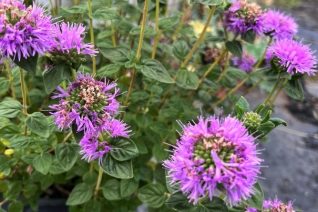
Monardella villosa ‘Russian River’
Incredibly long blooming native sub-shrub with clouds of fragrant purple flowers for all of summer into autumn. To 2′ x 2′ forming a semi-woody base. The aromatic round leaves cup the flower buds as the stems elongate. Loved by all native pollinators. A wonderful plant in the mint family that is very easy to grow and long lived for this genus. This selection sports slightly darker purple and longer blooming flowers. Found from Douglas County, Oregon south throughout California. Freezes back in very cold winters but sprouts quickly with warm weather in spring and commences bloom quickly. Great as a mass planting and ideal in a meadow. Also, adaptable to rock gardens and indeed thats where you find it in the wild- among gravel, rocks, and boulders. Mix with other long blooming native perennials such as Erigeron glaucus (sp & cvs) and among California fescue (Festuca californica). A very climate adapted plant. Cut back spent flowers and more will follow. Nice cut flower. Very long blooming. Light summer water to very little when established. Some deer resistance. AKA Showy coyote mint. Oregon native plant.

Moraea alticola
Cool Iris relative from South Africa in a genus that is common in warmer climates. This cold hardy high elevation species is peculiar in that it produces just a few very long evergreen leaves that mostly splay out on the ground. At the base of the leaves are fine netting- bulb netting that protects the bottom from damage. In May-July it sends up usually, just one solitary stem. At the top a large Iris flower of the softest yellow opens. The lower petals (the falls) are intricately marked with gray veining around a brighter yellow spot. Its a beautiful flower. But don’t remove it when its done because there are more to come from that very same stem- seemingly from no where a parade of flowers will erupt for weeks. Full sun and well drained rich to average soil. Very easy to grow and long lived. Avoid compacted clay and competition from other plants…it doesn’t like that. Thrives in the baking heat of hellstrips or in rock gardens. A very pretty flower that is an exceptional color. Moderate deer resistance.

Morella (Myrica) californica
Pacific Wax Myrtle is native along the direct coast from Santa Barbara California to near Tofino, on Vancouver Island, BC. It forms a large evergreen shrub to eventually a small tree in time and has thin, pretty dark green foliage. Aromatic if bruised the leaves are deep green and lustrous year round. Tiny brown flowers change to waxy gray berries that line the stems but are not terribly conspicuous. Fast growing to 12′ tall and 8′ wide in 7 years. Adaptable to a variety of soils, including winter inundation. Soil that is too rich can lead to prodigious growth and an unsteady plant until it bulks up. Judicious pruning can keep it much smaller. Prune at any time of the year. An excellent, drought tolerant, cold tolerant shrub for a hedge, screen or small garden tree. Our material is from locally cold hardy stock. Easy. Tolerates salt spray- including first line strand conditions. Recently changed from Myrica to Morella. In time it can become a handsome rounded evergreen tree with contrasting pretty white bark. Oregon native plant.

Muehlenbeckia astonii
Shrubby Tororaro or Wiggy Wig or more easily- Wire shrub from alpine New Zealand is a fun and fascinating shrub for texture and interest. The fine zig-zagging stems hold onto tiny green mitten shaped leaves. These quietly go away in winter revealing a cinnamon colored tracery of branches. So dense that you are at a loss to stick your hand through the center. Very dense and rounded in habit for full sun and poor to rich well drained soil Light summer water- though completely drought adapted. From a distance it creates a hazy effect rather than the bulk of a shrub and a wonderful texture all around. Perfectly hardy to cold. To 4′ x 4′ in 5 years. Grows much slower with no water and very fast if you give it a lot. Remember less water less pruning. Tiny off-white flowers spangle the stems in spring and can be followed by translucent white starfish shaped drupes. A Xera favorite shrub.

Muehlenbeckia ephedroides
Very cool shrub that we raised from seed that we received from a friend in New Zealand and it has turned out to be a great garden plant. Resembling ephedra or even a rush it bears many many vertical stems that are a soft radiant gray. It spreads slowly underground to expand its range as well as above ground. Not a fast plant. In winter the gray stems take on purple and blue tints. In summer tiny curious white flowers change to tiny star shaped translucent white fruits which spangle the upright stems. Full sun and well drained average soil. Light summer water – but incredibly drought as well as heat tolerant. Mixes well both culturally and aesthetically with things like Cacti and Agave or other dry appearing southern hemisphere shrubs. To 30″ x 30″. Moderate deer resistance.

Muhlenbergia lindheimeri
Most grasses in this genus native to North America really do prefer a hotter, longer summer than we have. But this one has surprised us and we are in love with it. Strongly clump forming evergreen grass with thin blue/green blades that rise to about 1′ tall. In late summer spikes erupt and as they unfurl they reveal a long feather like inflorescence that is up to 2′ long. The sun shining through this taupe/white group of flowers is purely luminescent. To 4′ tall and 4′ wide for full sun and average, well drained soil full sun. Excels on slopes- especially hot slopes. It requires just light summer irrigation but established clumps get by with none and still perform. Wonderful grass to plant among such things as Arctostaphylos and Grevilleas. Cut back to the foliage in spring. Really good looking dryland grass from the Texas Big Bend country.

Muhlenbergia rigens
Deer grass is native to large areas of the west coast from west central Oregon south through California. Its a tough and wild looking grass that peaks in autumn with a crescendo of dramatic flowers. Dense and fountain forming evergreen grass. Foliage to 2′ x 3′ very quickly. In autumn spikes of light tan thin but feather columns emerge and point out in every direction. The rise to about 5′ tall and remain as stiff skeletons well into winter. Full sun to very light shade in any soil that drains. Excels on slopes and raised beds. Wonderful lining a path or mass planted. Water to establish the first season then none in subsequent years. Its fully adapted to our dust dry summers. Very wild looking grass which can be tamed somewhat by planting in rows or symmetrical pattern. Otherwise it fits in perfectly between drought tolerant native shrubs like Manzanita and Ceanothus. Oregon native plant.

Myrtus communis ‘Andy’s Hardy’
Sweet Myrtle is a dapper clean evergreen shrub for full hot sun and poor well drained soils. This cold hardy selection of Sweet Myrtle has endured temperatures to 5ºF once established. Formal looking evergreen with sweetly fragrant foliage when disturbed. In summer to early autumn simple white flowers with a protruding showy boss of white stamens appear like little bouquets followed by elongated black berries. Incredibly drought and heat tolerant. Protect from subfreezing east wind. Takes west aspects that are blasting hot – all day or just for part of the day. Not often seen for sale this form grows moderately slowly to 3′ x 3′ in 6 years. Takes very well to pruning which should only be done in late spring. Moderately deer resistant. Little water when established, light irrigation speeds growth. Sweetly aromatic foliage. Damage that occurs from extreme cold events is erased by new growth in spring. Do not cut back burned foliage until new growth pushes. Recovery in one season is remarkable. Wonderful hardy pretty shrub.

Myrtus communis ‘Emerald Compact’
This is a seedling myrtle that showed up in our nursery. I moved it to a stock bed and observed it for several years. Its proven to be hardy to lower than 15ºF and its a dense and compact growing form. Good looking evergreen that has deep forest green foliage with a slight gloss. Dense growth forms a shrub to 3′ x 3′ in 6 years- progressively larger after that. In late summer to early autumn a procession of pure white flowers with a central boss of exerted stamens. This aromatic shrub is adapted to hot dry conditions and light to little water once established. In fact, the more lean the conditions the hardier this myrtle will be to cold. Black elongated drupes follow the flowers. Formal appearance that can be even more formal with pruning. Though, its naturally dense habit makes pruning less likely. Great against baking hot south facing walls. Loves the zone of south facing planters that are asphalt on one side and a hot wall on the other. Best as a specimen- not a hedge as it can be prone to damage in severe winters ( below 10ºF) which recovers quickly in spring but makes it less useful as a hedge. Great container subject. Moderate deer resistance. Tolerates VERY dry summer conditions. Full sun to quite a bit of shade at the expense of a dense habit. Very durable urban shrub. Protected location. Locate out of the path of subfreezing east wind.
Xera Plants Intoduction

Myrtus communis compacta ‘variegata’
We love Myrtles they are so drought tolerant and smell so good and we’re finding more and more cultivars that are hardy in Portland. This one is a real surprise because the green form of ‘Compacta’ is not nearly as hardy as this charming variegated version. A slow growing perfectly round shrub with light green leaves edged in cream- brush them- they smell so good. To 3′ x 3′ in 8 years. In summer small white flowers have a sexy little brush of white stamens. CUTE. Full sun to very light shade in a warm protected position. Mine are against my house on the south side and they’ve grown into a little hedge. They have only had slight tip damage in the coldest winters, but spring recovery is rapid. In fact it can freeze to the ground and resprout and regain its stature in a season. Don’t go planting this shrub out in the open, exposed to wind. It will fry. Instead keep it close and it will be fine. Extremely drought tolerant.

Myrtus communis ssp. Tarentina
Dense, dark green, and aromatic this form of sweet myrtle is also extraordinarily hardy to cold when established. Small glossy deep green foliage is sweetly fragrant when disturbed. Its held densely on upright stems on a compact growing shrub for full sun, a hot position, and average to poor well drained soil. In late summer its decked in white flowers with conspicuous protruding stamens. They are sweetly fragrant and turn into WHITE berries by autumn. This shrub is best in a protected hot spot with as little summer water as possible when established. Too much summer water leads to rank growth that does not harden in time for winter cold. Grow this shrub lean and mean and its perfectly hardy to cold. It can take any amount of summer drought. Slow growing to on average 3′ x 3′ and rounded in 5 years- larger with time and larger in richer soil. Full hot sun all day and good air circulation. Basically plant your myrtle, water it and then leave it strictly alone. Moderate deer resistance. Very good scale and adaptability to topiary. Foliage takes on deep purple tints in winter. Very easy to grow. Plant early so that it is well established going into its first winter
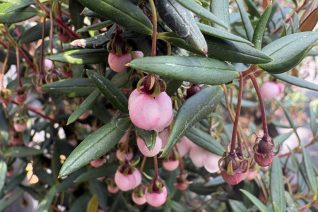
Strawberry guava as it is sometimes known is a sweet, slightly tender evergreen shrub with tasty edible berries. Compact growing myrtle with aromatic foliage. This resident of Chile/Argentina has been grown for hundreds of years in Europe and also the US. The fruits are about the size of a dime and have a sweet menthol -strawberry taste. Pendant pink/white flowers are born at the end of long stems. The evergreen foliage is small and matte, not shiny like most myrtles. 150 years ago this plant was a favorite fruit of Queen Victoria of England. To 6′ tall by 3′ wide in 10 years. Excellent container subject that you should protect if temperatures drop below 20F. In the ground choose a protected site, against a south or west facing aspect. Cover with cardboard box to shield from winds and temps below 20F. In extreme winters it can freeze to the ground below 10F but recovery from the roots is swift and it will regain stature quickly. Flowers/fruit are born on new wood, prune if needed when blooming has ended. Scale and culture as lends this shrub to topiary and also espalier which will aid in winter protection, Closely related to real Guavas. The fruit that ripens in late summer are worth it. Moderate deer resistance. Regular irrigation. Adorable shrub all around. Long season of interest, it is in bloom for an extended period 6 -8 weeks in mid-late spring and the dainty fruit take several months to form and ripen- normally by late summer and early autumn. Excellent performance at the Oregon coast.

Nasella cernua
Nodding needlegrass is a clump forming species native to western California south to northern Baja CA. Fine, fine medium green foliage appears in spring and is bright and fresh. In late spring stems rise to display the metallic tan, long needle like awns. They gracefully bend in every direction and are magical when tussled by the wind. They wave and sway gracefully and the light catches glints off the flowers. Very wild looking west coast grass that is at home in any well drained soil in full sun. Adaptable to light summer water and this improves the appearance and amount of blooms. To 2′ tall in bloom the basal clumps spread to about 1′ wide. Winter deciduous. Cut back hard in early spring before new growth starts. Completely adapted to summer drought once established and is a graceful and integral part of dry plantings. Seeds around a bit- expect this. Full sun.
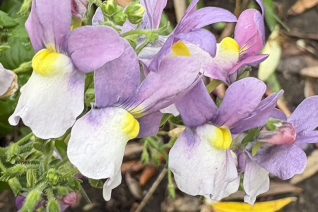
This is an interesting discovery in my garden. I bought this plant as part of a 6 pack of annual color years ago. This species is hardy in our climate but it usually comes back in a wimpy way. Enter this individual seedling that is extremely vigorous, cold hardy, and unlike the species it blooms continuously through the heat of summer. This Nemesia does not take a break in the mid summer heat. To just 6″ tall by 2′ wide this continuously blooming perennial has small snapdragon-like flowers in clusters that have a lower lip of white with a touch of yellow and upper petals that are gray and change to purple. Best in enriched soil with regular water in summer. It begins blooming straight away in May and continues until frost. Loved by hummingbirds and pollinators. It makes a great perennial container plant that is so prolific in bloom for such a long period you might think it was an annual. Loves rich soil and organic fertilizer. Cold hardy below 10ºF and disappears completely in cold winters, emerges in April. Excellent at the front of borders and trailing down rock walls. Easy and pretty perennial. Not bothered by rabbits. Native to high elevation South Africa. Mix with other smaller scale perennials such as Armeria or Diascia, Campanula ‘Dickson’s Gold’. Remove spent flowers to encourage more.
Xera Plants Introduction

Nemophila menziesii
Baby Blue Eyes is a hardy annual wildflower native to the southern coast in the blue form. In the Willamette Valley up to about Portland the variety Nemophila menziesii ssp. Atomaria is the native form. It has large cup shaped flowers that are white on the inside w/ fine intricate black spotting and blue on the reverse of the petals. That is the form that I grew up with in the country near Eugene. This is a fascinating annual that is adapted to just about any soil that is not boggy. Finely divided foliage forms sprawling rosettes that support the nickel sized sky blue to pale blue flowers. Blooms April to June. Reliably reseeds in open disturbed sites and with a little protection from slugs and lack of competition. The whole plant is dead and chucking seed by the heat of summer and ultimately disappears on its own. Adaptable to full sun to light shade. Self sown plants get by with no supplemental irrigation- plants from containers seem to like regular water. In habitat it occupies slopes usually under the canopy of Oaks. To 4″ tall and 1′ wide. Excellent, long, showy display in reconstructed Willamette Valley meadows. and laugh at summer drought by finishing their life cycle and simply spreading anew by seed. We are actively searching for the ssp. atomaria but the seed is hard to obtain. Occurs natively with Erythronium oreganum, Dodecatheon hendersonii, Ranunculus occidentalis as well as Plectritis congesta. Oregon native plant.

Nemophila menziesii ‘Frosty Blue’
Impressive selection of this wonderful native annual. Leaves are brightly frosted in white and make a great backdrop to the sky blue nickel sized flowers. Blooms April-June in part shade to full sun. AKA Frosty Blue Baby Blue Eyes. To 4″ x 6″ forming a spreading plant. Very attractive and it will reseed in the autumn or early spring- the seedlings are immediately identifiable by the silver foliage. Likes to germinate among other small plants/grasses for overwintering protection. Water to establish then only lightly until bloom has ceased and seed is set. The whole plant dies and decomposes almost instantly in the real heat of summer. Excellent in early season containers. This form was found in California but this is also an Oregon native plant.

Nepeta cataria ‘Citriodora’
Something for the kitties! Beautiful form of catmint with rounded, and quilted sage green foliage and clusters of violet blue flowers held in a little deep purple calyx. Massive bloom in May and June, shear off spent flowers and water and a new batch of sublime blue erupts quickly. Full sun and rich to average well drained soil. In our climate it shuns dry heavy clay so drainage is an issue. Forms a clump that spreads considerably. To 2′ x 2′ in an average season. Light consistent summer moisture. Completely winter deciduous. Loved by cats who consume and then laugh and laugh. Excellent combined with other low water perennials such as Epilobium (Zaushneria), Geranium cinereum cvs, Verbena rigida, Asclepias tuberosa or A. fascicularis, Kniphofia. She deer resistance. Easy.

Nerium oleander ‘Hardy Pink’
This is a relatively hardy selection of Oleander with profuse pale pink flowers at the end of summer. Not quite as cold hardy as ‘Hardy Red’- ‘Hardy Pink’ will show foliage damage at about 16ºF. Therefore, it should be placed in the most protected sites as possible. A south or west facing wall is ideal. Not recommended for gardens outside of the urban heat island – the city of Portland. To 5′ x 5′ and recovering quickly in spring if frozen over winter. Blooms from deep pink buds open to paler pink in August to September. High deer resistance. Thrives in the hottest sites possible. The more established the shrub the cold hardier it will be

Nerium oleander ‘Hardy Red’
Surprisingly hardy Oleander that is perfectly at home in warmer gardens. Upright then arching evergreen shrub to 5′ x 5′ in 6 years. In June to September a continuous supply of trusses of bright cherry red (hot pink) flowers. Very showy and welcome in summer. Foliage is hardy to approximately 12ºF and will be damaged below that. Recovery is very rapid and bloom will still commence. Prune before flowering if needed. Full, HOT sun in a protected location. Best against a south or west facing wall- out of subfreezing east wind. Light summer water when established. As our experiments have revealed this is a showy, hardy shrub. The hardiest Oleander we’ve grown and the best flowering. Toxic. Not bothered by deer or rabbits. Very showy in bloom. Thrives in the hottest locations – no problem.

Nerium oleander ‘Mathilde Ferrier’
Who would have guessed that one of the hardiest Oleanders would be a double flowering light yellow? Not me, but here she is and yes she is hardy in the city of Portland. Tall growing vigorous evergreen shrub to 8′ x 4′ in 5 years. In summer clusters of FRAGRANT double soft yellow flowers are profuse and sincerely beautiful. It blooms off and on until September. Full hot sun in a protected location- against a south or west facing wall is ideal. Injured by cold at about 13ºF and below but it recovers remarkably fast in spring when truly warm weather arrives and it will still bloom (blooms on new wood). It really is a pretty flowering shrub for a protected spot. The more heat it gets in summer the hardier to cold in the winter. Makes sense.

Nigella sativa
Wonderful multi-use hardy annual that we love for its flowers, seed heads, and edible seeds. Love-in-a-Mist is the common name in reference to the mostly dark blue flowers that are ensconced in a haze of fine green stems. This is a charming cut flower. Upon finishing the ovaries transform to a ballon shaped structure full of yummy black seeds. You can then detach that as a cut flower as well. The dried black seeds have a peppery taste and are excellent sprinkled on salads. Be sure to sprinkle them on the ground where next year’s crop will be. Truth is once you plant this it is pretty much as permanent as a perennial, so reliable and prolific a re-seeding plant. The ferny seedlings are easy to spot, move or dispatch. Let them flow through your perennial borders. They make a wonderful addition to a cutting garden. Best in rich, open, disturbed soil with supplemental H20 all the way until seed are produced- though not entirely necessary it produces larger plants- and there fore stems, flowers, and more seeds. Blooms June-July. Full sun to light shade. VERY EASY.

Oenothera fremontii
Excellent Rocky Mountain native that we love for its long long season of bloom. Large luminous light yellow flowers held against silvery fine foliage. Completely deciduous in winter it sprouts anew each spring to form a fairly compact spreading clump. In June and continuously for two months a parade of large flowers obscures the leaves. To just 10″ tall but spreading to about 1/1/2′ wide annually. Full sun, very well drained soil and little summer water when established. Give it an open exposure with little crowding from other plants. Impervious to the most enervating dry heat. Hellstrips, rock gardens, hillsides. Moderate deer resistance. Seed grown.

Oenothera incana var. macrocarpa
Excellent form of this sprawling Rocky Mountain native evening primrose. Super silver leaves are held upright on a spreading plant. Beginning in June huge 3″ wide shimmering, luminous light yellow fragrant flowers appear almost daily for months. Full sun and rich, well drained soil with little summer water once established. Excellent performance in rock gardens as well as parking strips. The flowers are a really good shade of yellow and harmonize brilliantly with the silver foliage. Winter deciduous.

Olea europea ‘Frantoio’
We’ve grown this extraordinarily cold hardy european olive selection for years. And its performance in the city of Portland is stellar. Fast growing somewhat wild looking, ever-silver tree to 20′ tall and 15′ wide in 10 years. In time it develops a gnarled trunk adding to the trees character. This is a self fertile selection and sets fruit very heavily even on singular trees. The fleshy moderately sized fruits are most prized for oil. They may be brined. (Follow any recipe on the internet). Be aware of autumn and winter fruit drop- not for patios, instead plant a large ground cover at the base for the unwanted fruit to drop and hide. Birds will eat the olives too- especially larger birds. Overall, its a pretty tree when the thin blue gray leaves are tossed by the wind revealing their silvery undersides. Fast growing especially if watering is frequent and diligent during youth. Water like crazy for the first summer to spur growth and establishment. Olive trees gain cold hardiness with age/size. Small plants are tender to dead below 15ºF but a three year old, well watered of the same variety will be undamaged at much colder temperatures than that. Excellent performance in ice and snow (see picture below)- bends but does not break. Protect containerized plants from temperatures below 15ºF. Drought adapted when established. A warm position.

Olearia lineata dartonii
A wisp of a shrub that is very hard to photograph but makes a great hazy gray light texture in the garden. Large see through evergreen shrub with thin gray leaves that are only 1/3″ wide but 2″ long. One of the famed daisy bushes from New Zealand, it is also one of the cold hardiest for us. Fast growing willowy appearance to 8′ x 4′ in 5 years. Full sun and average to poor well drained soil. Incredibly drought tolerant when established. Tiny white daisies appear along the stems below the leaves. Easy to grow. And if it gets too out of control simply cut it back hard in mid-spring- recovery and more dense growth will quickly follow. Plant with ornamental grasses and Arctostaphylos for a scintillating dry landscape look.

Olearia x haastii
Our most favorite New Zealand Daisy Bush this Olearia hybrid forms a large ever-gray rounded shrub. The small waxy thick leaves have a top of olive green and an underside of nearly white. Clusters of white daisy flowers in summer have a distinct vanilla fragrance that carries for some distance. And following those are fluffy tan seed heads. A tough and cold hardy Olearia – we’ve never seen it damaged by cold in PDX. To 6’x 7′ in 5 years for full sun and poor to average well drained soil. Completely summer drought tolerant- once established no water is required. Handsome shrub for wild areas, an informal hedge, coastal spray. In time the trunk becomes shreddy and gnarled. Prune after flowering if needed. Moderate deer resistance. Handsome plant.

Olysinium douglasii
Grass widows or Grass maidens is a beautiful and fascinating perennial bulb that is native over a wide but scattered part of our region. Most common east of the Cascades it finds a home in several drier portions of the Willamette Valley. The summit of Spencer’s Butte south of Eugene is one location as are appearances in dry prairie in Benton county. One of the very first conspicuous wildflowers to emerge in February/March. From shallow soils, it lifts to 8″ tall with a wide nodding purple flower- the exact hue of each plant is slightly different. A clump of leaves follows the flowers before going neatly summer dormant. Best in rock garden conditions where you rely only on natural rainfall. Spreads in time to form quaint colonies. Once a Sisyrinchium this member of the Iris family is one of the dearest wildflowers for our gardens. Full sun- no shade at all and amend the soil w/ a handful of pumice. Water after planting until summer heat induces dormancy. Then never again. Seed grown. Avoid crowding from other plants. It can and has been overwhelmed by invasive exotic grasses. High deer resistance. Oregon native plant.

Opuntia cycloides
Tall growing hardy Cactus native to cold New Mexico. The pads are armed with 2″ orange thorns that will make you think twice about messing around. To 5′ tall and 4′ wide in 5 years in our climate. Multiplies quickly and large erect pads build up to probably the tallest Opuntia in our climate. In early to mid summer 5″ brilliant yellow flowers are a show stopper. They open just when its hot and sunny enough- closing in any dim conditions. Full, hot, all day sun and very well drained appropriately amended soil. On a slope, double dig the soil to oxygenate it and incorporate hefty amounts of pumice and gravel in the soil. Water regularly through the first summer to establish growth and then none in subsequent years. Extremely cold hardy. Locate away from paths, anywhere you might get too close. Remove deciduous leaves that become ensconced in the pads in autumn. Otherwise it can lead to rot. Long lived. High deer resistance.

Opuntia ellisiana
The thornless hardy Prickly Pear. Well, it still has fine glaucids on the pads that can painfully stab into your hands. They are fine like slivers or hairs and are a pain to remove. (Try duct tape- thats what I do and its successful). Large big round pads pile onto each other to 4′ tall and quickly forming multiplying patches up to 8′ across. In summer it displays large single yellow flowers. Smooth and good looking Cactus year round. It has some of the best ability to deal with our winter wet. However, I’d still amend the soil heavily with gravel and pumice- sharp drainage is key. Sharp drainage on sunny slopes is ideal. Excellent under the south facing eaves of a house. Works well in containers too that are protected from extreme winter wet. (Move under cover in winter). Cold hardy below 10ºF but the combination of wet and then arctic cold can shrivel some pads. Recovery in spring is rapid. Anticipate that it will spread quickly and allocate room. Moderate deer resistance.

Opuntia macrocentra
Spectacular in bloom this is one of the easiest Opuntia (Prickily Pear Cactus) for our climate. Pads are fiercely armed and are blue/gray. The 2″ needles are formidable and begs that this plant be place away from paths. Spreading to 2′ tall x 4′ wide in very well drained poor soil with light summer water to establish. Avoid all shade- bright open conditions suite this native of the SW U.S. Avoid placing near deciduous trees where dropped leaves can collect on the plant- they are not only a pain in the ass to remove they must be to avoid rot in winter. Grows relatively fast- increasing before you know it. Amazing in large rock gardens as well as large containers. Amend the soil with pumice and gravel so that winter wet does not collect around the base. It will root through this deep into the ground. Once established it can get by with all that falls fro the sky. Huge yellow flowers with an orange center are 6″ wide an amazing when they appear in late spring to early summer. Highly deer resistant. Long lived.

Origanum libanoticum
From the middle East (Syria, Lebanon) this hop flowered species of Origanum has been a stalwart performer in our climate. Low and spreading stems create hop shaped structures that house the little protruding hot pink flowers. The hops are mostly light green but can take on pink tints. They are fully pendulous and the best way to display this plant is to site it on the edge of a precipice or wall or from the side of a container. To 8″ tall and 2′ wide when happy. Rich, well drained soil with light summer water. Begins blooming in May and continues unabated to September. One of the parents of several popular hybrids but we like the straight species quite a bit- it seems tougher. Graceful. Dies to a very low mound of foliage in winter. Cut back the previous seasons dead stems in early spring. Cold hardy and very showy.

Origanum x ‘Bristol Cross’
Unusual hybrid that has created some striking effects for an ornamental oregano. Distinctly upright stems to 2′ tall, beginning in June groups of up and outwards facing pink small hope like structures bear tiny violet pink flowers. Bloom goes on virtually for months and even when officially done these “hops” remain and change to a deep madder red. A large plant with dozens of upright stems bearing these remnants of flowers is really cool. Full sun and rich, well drained soil. Consistent light watering. Detach the whole stem from the base as a long lasting unusual cut flower. Dies to a low rosette of leaves in winter. Cut back the dead remaining upright stems in spring. Cold hardy. Photo credit: Grace Peterson- thanks Grace.

Origanum x ‘Xera Cascade’™
A chance hybrid announced itself in our nursery with these insanely long hop flowered blooms. A low spreading perennial with distinctively blue foliage. In summer many, many stems emerge bearing clusters of flowers. They are shaped like long skinny hop fruits with tiny violet flowers that protrude through the layers of the hop structure. That structure is remarkable. Taking on purple and blue tints it begins to elongate and doesn’t stop until its fully 4″ long. They come in multitudes- this plant lives to bloom. Full sun and rich, well drained soil with light summer water. To 1′ tall and 2 wide in a season. The floral display goes on well into fall. Place near a wall where it will happily cascade. Excellent in large containers. Hardy and easy to grow. Cut back old material in early spring. A new low batch of foliage will already be present.
Xera Plants Introduction.
Photo credit: Chris Hembree

Orlaya grandiflora
WE LOVE minoan white lace flower with its beautiful pristine white umbels held high above ferny green foliage. A true hardy annual native to the mediterranean. It makes a wonderful swath of lacey white to 18″-20″ tall. Long stems are ideal for cutting and this flowers lasts in vases wonderfully. Blooms repeatedly from late spring to mid summer.. Cut spent flowers and they re-bloom. Open disturbed soil that has been well dug- and a little organic fertilizer to spur vigor. Full sun. Borders, cutting gardens, cottage gardens- virtually anywhere. Re-seeds in open disturbed soils (no competition). Light summer water.

Osmanthus fragrans var. aurantiacus
One of the coolest shrubs that we can grow and incredibly rare in our climate. Large evergreen shrub or small tree to 12′ tall and forming a dome. Prolifically nestled among each leaf axil clusters of vivid but small ORANGE flowers with the fragrance of juicy fruit gum appear in October-November. A shrub in full bloom is detectable many many feet away. Handsome large leaves contrast with pale tan stems and bark. Full sun to part shade and rich to average well drained soil with light summer irrigation. Drought adapted when established. Grows 1′-2′ a year- picks up speed when older. Hardier to cold than most forms of regular Osmanthus fragrans. Protect from subfreezing winds. Seems to require summer heat to set flowers as well as harden off for winter weather. Unlikely to thrive in cool summer climates. (NOTE: this plant seldom looks good in a pot, one of the reasons its not often seen for sale. The fertilizer that is necessary also distorts new leaves- This is not a problem in the ground). We’ve been hesitant to sell this because of the weird leaf distortion but it goes away immediately with installation in the ground. And we just love it so much.

Osmanthus armatus Lemon Line ™
A wonderful sister to our variegated selection of Osmanthus armatus ‘Zipline’. This all gold form emerges tinted in red before the leaves turn to an illuminating lemon, lacquer yellow. The symmetrically spined leaves add to the display. Full sun to part shade. Variegation is brightest in full sun. Moderately fast growing and glowing evergreen shrub for average to enriched soils. Ligjht consistent summer water to establish, then occaisionally depending on aridity. To 4′ x 4′ in 6 years and then progressive larger. Shares the same toughness as the species enduring temperatures slightly below 0ºF. Tiny white flowers are adorable in fall but add little. Not fragrant that I can detect, but the glory of this shrub is in how vivid the foliage shines. Not perfectly drought tolerant, check it before heat waves. Other than that its handsome year round and gets better with age. Tolerates some subfreezing wind. Not the first shrub/tree on a deers list but you never know. Mine is home to the deep blue flowered Clematis ‘Rhapsody’ for a brilliant contrast.
Xera Plants Introduction

Osmanthus armatus Zipline™
Sometimes the garden goddess smiles on us. I found this sport (a variegated stem) on my Osmanthus armatus ‘Jim Porter’ and I separated and rooted it. It has become a fantastic extremely showy shrub. This is welcome because Osmanthus armatus is not a particularly conspicuous species. It has serrated deep green leaves and small white flowers in autumn that emit a faint but sweet fragrance. Variegation improves the species markedly. The variegation is very stable, I have yet to see any reversions. Each leaf is symmetrically serrated and the variegation is vivid and adds an incredible amount of depth. Large growing shrub to 9′ x6′ in 10 years. Excellent cold hardiness on a brilliant evergreen. Full sun gives the best variegation and I have yet to see it burn in the hottest conditions. Excellent specimen, hedge, or screen. Cut foliage lasts for about 1 week in a vase. Light consistent summer water to establish then very tolerant of dry summer conditions Cold hardy slightly below 0ºF and durable and long lived. In time it can make small tree status which makes a very striking tree. A wonderful shrub and a happy discovery, See video below.
Xera Plants Introduction

Osmanthus decorum ‘Baki Kasapligil’
Osmanthus are incredibly handsome and useful shrubs/trees and turkish Osmanthus fits that trend Renowned for fragrance this tough species excels at its tidy and uniform look year round. Long pointed deep green leaves are exceedingly handsome and immediately one thinks of this 8′ x 8′ shrub as an ideal hedge subject and it is. In mid spring small tubular flowers crowd the leaf axils and emit a vanilla aroma that is detectable many meters away. Moderately fast growing evergreen for full sun to quite a bit of shade it is adapted to most well drained soils, including heavy clay. Exceptionally tolerant of drought when established and very long lived. In time, sans pruning, it will achieve small tree status. Cold hardy to 0ºF and not terribly sensitive to subfreezing wind. Not often bothered by deer- protect young plants with age and familiarity they will leave it alone. Very good replacement hedge for voracious and invasive cherry laurel or disease riddled Photinia. Somewhat formal appearance. Lovely no water/low water shrub when established. Prune after flowering- blooms on old wood This is one of the parents of Osmanthus x burkwoodii. .This form was selected from the wild in Turkey/Anatolia.

Osmanthus delavayi
Regal, tough, evergreen shrub that loves our climate and performs beautifully in a host of situations. Small holly like deep blue green leaves are completely obscured by masses of small, white, sweetly fragrant, tubular flowers that crowd the stems in April. Beautiful. To 4′ x 6′ in 6 years. Full sun to quite a bit of shade which doesn’t diminish bloom. Rich, to average soil including dry clay soils but never anywhere there is standing water. Extraordinarily drought tolerant when established and will still thrive and bloom with none. Elegant clipped hedge which will become dense and still bloom heavily. The leaves are small enough that shearing does not mangle them. Long lived and cold hardy to 0ºF. Easy, elegant broad leaved evergreen. AKA Delavay Tea Olive.

Osmanthus fragrans
Long ago I dismissed this tall sweetly scented Tea Olive as hopelessly tender in our climate. Then in a garden in Lake Oswego under towering firs I ran head on into an 18′ tall perfectly happy specimen. Looks like it had never suffered damage. It was just a really nice broadleaved evergreen tree. Copious amounts of small off white flowers crowd the stems beginning in autumn in our climate and then sporadically until spring. The POWERFUL fragrance they emit is that of apricot/freesia/rose and it travels- detectable 20′ away when in full bloom. To 15′-20′ tall apparently. Requires protection as a young plant and it really should not be in an exposed site. Instead locate near a house wall- where you can open the windows and let the perfume flow- and gain added protection. Gains much, much, greater hardiness with age. Summer heat seems to play a role- the more heat in summer the hardier in winter. Full sun to high overhead shade. Grows 2′-3’/yr. when young- aided by consistent summer water. Otherwise established trees need little. Not a plant for cold gardens.
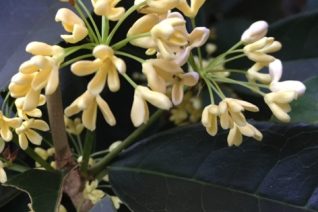
A local form of Fragrant Tea Olive that was discovered as a seedling in Phil Thornburgs wonderful SE Portland garden. He has a large estabished collection of the genus Osmanthus and this seedling has turned out to have several exemplary attributes- So we named it for the gardener. A moderately fast growing evergreen small tree to 16′ in 10 years. Large glossy foliage emerges tinted a very striking russet red before settling to deep green. This new growth follows the flowers which in our climate appear from late fall to early spring – on wood that is more than one year old. Parchment colored tiny flowers ring the stems and emit one of the most penetrating perfumes in the floral kingdom- sweet apricot and freesia These flowers are dried and used to flavor tea in China. The trunk/stems are a soft taupe color that contrasts nicely with the dark green foliage. We have observed excellent cold hardiness but it should still be protected from subfreezing east wind during arctic events. The west side of a building is ideal- and you can appreciate the sweet perfume in winter just by opening a window. Somewhat formal looking small tree that has a conical habit in youth and then a spreading crown with age. Water to establish, then light water during summer drought. Full sun to light shade. Gains hardiness with age/ establishment. Protect young plants from temperatures below 15F- cover with a cardboard box. Excellent tree for courtyards, the slim areas between modern architecture. Wonderful tried and tested local selection of an infamous tree native to large parts of Asia. Durable, almost formal, verdant look year round.
Xera Plants Introduction

Osmanthus heterophyllus ‘Akebono’
An exceptional Tea Olive that we love. New growth emerges pink before changing to lacquer white and finally deep green. This period of transition lasts for months and is far showier than the small white flowers that cluster at the leaf axils in autumn. They do, however, emit a sweet perfume that is detectable for many yards. Great cold hardiness for a broad leaved evergreen enduring temps below 0ºF with no harm. Tolerates subfreezing wind and would be a fantastic and showy hedge to block the east wind. To 7′ tall in 7′ years eventually reaching small tree size. Full sun to part shade in average to enriched soil where there is never standing water in summer. Tolerates clay soils on slopes and it is best with about 3 deep soaks per summer once well established. Mulch when planting. Avoid reflected heat. Moderately deer resistant. Blooms on old wood. Prune if needed AFTER blooming has ended. Naturally dense habit. As the shrub matures the leaves which are mildly prickly in youth change to smooth edged entire leaves. Pretty, tough, dynamic shrub. Japan.

Osmanthus heterophyllus ‘Fastigiata’
Fastigiata is very much a misnomer in the case of this excellent hardy Tea Olive. After growing it for 15 years we can tell you that it in fact forms a perfectly round dense ball. After all that time it is just 4′ x 4′ and perfectly round. In October-November tiny fragrant white flowers crowd the stems. Full sun to part shade in any well drained soil that does not harbor standing water in winter. Very drought tolerant when established. So useful as a NO PRUNE hedge. Perfect size for small gardens. Hardy below 0ºF. The leaves change from prickly to smooth and entire with age. Excellent hedge and very tolerant of subfreezing wind.

Osmanthus heterophyllus ‘Goshiki’
Wonderful, useful, well scaled variegated hardy Tea Olive that is also incredibly hardy to cold. To 4′ x 4′ in 8 years this slow growing dense shrub has new leaves that emerge tinted pink, mostly cream and then settles to green leaves with splashes of cream. Excellent appearance year round. Great shrub where subfreezing winds are brutal. In October to November the tiny white flowers cluster around the leaf stems and crowd the twigs- they emit a sweet perfume detectable quite far away on mild days. Good deer resistance when established. Average to enriched, well drained soil. Light summer water. Full sun to quite a bit of shade. Very drought tolerant when established. Pretty.

Osmanthus heterophyllus ‘Purpureus’
Remarkable form of the holly leaf tea olive with new growth that emerges a deep purple black. It settles to dark green in summer on a large growing shrub to 8′ x 8′ in 7 years. Full sun to very light shade in all soils that drain well. Very drought adapted when established. Mature shrubs bear masses of tiny white flowers in the leaf axils in October-November that cast a sweet perfume. Excellent cold hardiness. This is one of the few broad leaf evergreens that is perfectly hardy to the subfreezing wind of the gorge. Troutdale, this shrubs for you. Great hedge as well as specimen. Flowers occur on wood from the previous year- prune in winter after flowering.

Osmanthus heterophyllus ‘Rotundifolius’
A really cool looking broadleaved evergreen shrub with thick glossy leaves that are essentially square with undulate (wavy) margins. Dense growing shrub that can get quite large without pruning intervention. In October to November masses of tiny white flowers cast a hyacinth fragrance in the autumn air. Full sun to part shade in well drained soil of average fertility. No summer water necessary when established. Excellently adapted to our climate. Makes a novel hedge or a pretty specimen. Extraordinarily cold hardy – below 0ºF. 8′ x 8′ in 10 years. Grows 1′-2′ per year when well cultivated.

Osmanthus heterophyllus ‘Variegatus’
Excellent cold hardy, drought tolerant shrub that reaches tree like proportions with great age. The pretty variegation presents as prickly leaves outlined in white. With age/maturity the leaves lose their prickles and become smooth and entire. The variegation on this plant is incredibly stable. I have yet to see a reversion of any consequence. Ancient specimens that are now 20′ trees can be found in old, old gardens. Its obviously been grown in this climate for eons. Very, very cold hardy evergreen that is not only hardy below 0ºF it makes a great hedge even near the Gorge where it endures subfreezing wind with no ill effects. Tolerates regular irrigation which increases the rate of growth- on average about 2′-3′ per year can be expected. 8′ x 6′ in 7 years is typical. Full sun to shade. Avoid permanently boggy soils- otherwise very adaptable- including heavy dry summertime clay. In October-December tiny fragrant white flowers crowd the stems. Moderate deer resistance. Long lived.

Ozothamnus ‘Sussex Silver’
Big silvery fine textured ever-silver shrub for the hottest driest locations. To 8′ tall and 6′ wide very quickly. Upright wands of needle like silver foliage line the stems. In spring flat clusters of white flowers appear at the branch tips. A nice effect. Full sun and well drained soil of average soil fertility. High deer resistance. New Zealand. Selection made in England. May be cut back hard after blooming to resize, reinvigorate. Forms a gnarled shredding trunk in time. It can be very wispy when young. Cutting back rank growth leads to a denser more compact shrub. Do this after blooming has ended.

Ozothamnus rosmarinifolius ‘Silver Jubilee’
Wonderful ever-silver plant for texture and low water environments. Fine silver/steel blue foliage lines very upright wand like stems. Dense shrub to 4′ x 4′ in 4 years. In early summer the tips of the plant are crowned with flat clusters of pink buds that open to tiny white flowers. In time the flowers go to seed and turn a tan hue. Fast growing shrub for full sun and any well drained soil of average to poor fertility. Avoid over amended soils- average native unimproved soils are ideal. Excellent on dry slopes, among other drought adapted plants. Light to little summer water. May be pruned back hard after blooming to resize, refresh the plant. High deer resistance. Flowers remain effective into autumn. This is a truly xeric plant going all summer with no irrigation once established, and looking great. New Zealand.

Pachystegia insignis
Marlborough Rock Daisy is a shrub that is a wonderful piece of architecture. This compact slow growing plant has large round leaves that are concave and steel gray on the upper surface and pure white underneath. In spring 6″ pure white stems elongate to pure white buds that open the most crisp white daisies you’ve ever seen. Each flower has a double set of white petals around a yellow center. Clean and wonderful plant that we find to be tender below 15ºF so it requires a very protected spot or makes a great, easy, long lived container subject. A beach plant in its native New Zealand it is excellently adapted to life on the milder coast. It is even somewhat tolerant of salt spray and will seldom be bothered by cold. Slow growing and dense to 3′ x 3′ in 6 years. Protect containerized plants form temperatures in the teens. Drought tolerant, low water requirements.

Panicum virgatum ‘Heavy Metal’
Native of the high grass prairies of the midwest this form of Switch Grass delights with soft blue foliage and foamy inflorescences and a staunchly upright habit. Blooms appear in early August and remain effective through winter. In autumn the whole plant is awash in tones of raspberry and red before going cere for winter. Surprisingly even in dry dormancy snow or ice and knock this grass over and when the thaw comes- pouf! It stands straight back up. Winter deciduous- but the clump does remain in place for the majority of winter. Cut back hard- to the ground in spring just before new growth appears. Full sun and rich, to average, well drained soil with consistent light summer water. Drought adapted when established- to an extent. Looks better with water. To 5′ tall and in bloom and forming an expanding clump to 2′ wide. Ultra hardy grass that can be planted en mass or alone as a vertical blue focal point.

Papaver miyabeanum
A poppy with chartreuse green flowers? Yes it exists. From a small rosette of blue green leaves a continuous supply of large flowers from May to August. The flowers are supported by 4″ stems and virtually glow against the blue foliage- also when backlit by the sun. Full sun and RICH, well drained soil with regular summer water. Excellent for a solitary ledge in a rock garden or in containers. Do not let this plant be crowded by others. It will die, instead leave it out in the open and give it the good stuff.

Passaflora caerulea ‘Becky’s Blue & White’
Blue crown passion vine is an incredibly popular if huge vine in our climate. This form has the typical 3″ intricate flowers with the tinker toy center but the filaments that encircle the middle are deeper blue w/ a contrasting zone of brighter white. The result is bolder coloration and contrast. Rampant evergreen vine to about 13ºF . The vine is root hardy to about 0ºF- especially when established. Give this big vine room and proper support. To 18′ tall and wide very quickly in average, well drained soil. Evergreen lobed leaves are glossy and this vine blooms profusely on new growth. The more it grows the more it blooms. Winding tendrils assist its climb and will adhere to anything with a diameter smaller than a regular sharpie pen. This includes screen…and if it is too close to a house and they attach to the screen….bad scene getting them off. Otherwise provide a trellis or pergola that can accommodate its size. Flowers appear from May-Frost. It may be cut back very hard in spring to refresh, supply new blooming wood, or just to restrain. Overly rich soil leads to rampant growth and less flowering. So, average soil that drains is ideal. Flowers often transform into golf ball sized orbs that are sweet tasting but not really food. Established passion vines will often sucker quite a way from the parent plant. Plant for this and be vigilant. There is no vine, however so magical in flower form that it transfixes people and is a special joy for children. Little water once established. Deer resistant. Mountains of Brazil.

Passaflora caerulea ‘Snow Queen’
Ravishing pure white intricate flowers flow from this passion vine, which can be rambunctious in the wrong place. Large growing plant to 20′ (long) tall and attaching itself firmly by tendrils. Full sun in average soil with a lot of water to establish. Once established it is on its own. Too much irrigation and soil that is too rich leads to prodigious growth that can get rank and lack bloom. So, don’t starve it, just put it in reasonably good soil, that you have double dug. Water faithfully to spur growth. Semi-deciduous to evergreen in our climate.In winters below 15ºF and depending on the length of cold it can be totally deciduous. Good performance on the Oregon coast. 5″ wide flowers have a light sweet fragrance. Moderate deer resistance- it can also climb out of reach. Wonderful white passion vine.

Passaflora x ‘Betty Myles Young’
Stellar passion vine with distinctly purple tepals and deep black to blue on the interior of the flower. Vigorous vine for a protected location in full sun. To 12′ in a season and blooming continuously from June to October. Attaches itself by winding tendrils. The flowers appear on new wood, as the vine grows it produces new flowers. Average to rich soil with REGULAR irrigation during the first season and then occasionally. Passafloras must be well established going into their first winter. In half of the winters (below 20ºF) it can freeze to the ground. It will then rapidly break from the base when truly warm weather arrives. Mulch heavily the first winter, Place on a trellis against warm, sunny wall for the best performance. The intricate and beautiful flowers are about 4″ across. Sometimes sets inedible fruit. Passion vines are loved by everybody but especially children. The toy-like flowers enchant. Sweetly fragrant flowers up close. Loved by hummingbirds. One of the best hybrid Pnassafloras for our gardens. Moderate deer resistance

Passaflora x caerulea ‘Damsel’s Delight’ ®
Fantastic new hybrid Passion vine with impressively huge, spectacular flowers and a more restrained habit. 4″ wide brilliantly colored flowers feature deep blue and purple and white alternating stripes on the row of filaments that encircle the center. The sepals- petal like structure surrounding the flower alternated between white and lavender. To only 8′ tall in a season and remaining compact for all of its life. Happy evergreen vine that climbs by tendrils.- provide support. Small enough to find a long happy life in containers. Rich, well drained soil in full sun and a warm position. Evergreen to about 15ºF- the vast majority of winters. This passion vine has the largest flowers by far of any cold hardy selection. Truly beautiful and impressive. Flowers emit a light sweet scent and we have yet to see fruit produced. Loved by children and adults as well as the occasional butterfly. Blooms on the current seasons growth. Prune whenever you feel like its necessary- rare for this compact and easy vine.

Passiflora x ‘Star of Surbiton’
We’ve tried a lot of Passion Vines and to be honest the majority of hardy varieties are just basically a variation on that old house eating vine ‘Blue Crown Passion’ Vine (Passaflora caeulea). This guy is a surprise though. While it can freeze to the ground below about 20ºF it is evergreen in the majority of normal winters and its an early and heavy blooming vine- that is pretty as well. The white sepals surround a row of light purple filaments. Very delicate and intricate flower that we adore. Plant in a hot sunny aspect with support for its little tough twiners to adhere. And they will as the whole plant rises to 12′ tall in a single season. Blooms on new growth- as its growing it is constantly blooming. Loved my hummers, butterflies, pollinators in general. Mulch the base going into the first winter. Once it is established no arctic blast will affect the roots. Fast re-growth in in spring. Rich, well drained soil with regular summer water to speed growth. Flowers are approximately 4″ wide and very showy. Not a vine for cool shady gardens or arctic cold spaces.

Pelargonium ‘Black Boar’
Sumptuous zonal geranium with deep black and green foliage and vibrant coral pink flowers non-stop for months. To 20″ tall and as wide. Seems to go up for a while but always ends up with horizontal stems. Blooms heavily and constantly- Very pretty delicate appearing flowers. This is a fantastic zonal for containers, its thrives in rich soil with regular irrigation. Rich, soil that drains. Add a table spoon of all organic fertilizer at planting. This guy loves food. Tender to cold. Over winter in an unheated but not arctic garage or try something new next year. This plant has become a real favorite of ours. Its also a fantastic conservatory plant and might work as a houseplant in a very sunny window. Full sun to very light shade.

Pelargonium ‘Vancouver Centennial’
One of the very finest Pelargoniums or (Geranium- annual) with stupendous jagged foliage and vivid flowers. Each palmate leaf has a center of dramatic bronze and is outlined in bright chartreuse green. The star shaped hot orange flower is a bright and elegant contrast with this foliage. Compact growing habit. Excellent seasonal container subject or even bedded out. To 20″ x 20″ by the end of the summer. Rich, well drained soil with light consistent summer moisture. Remove spent flower spikes to tidy, encourage more. Moderately deer resistant. Avoid over watering. This Pelargonium is a VERY HEAVY FEEDER. Use ample amounts of all organic fertilizer. It also responds to foliar feeding with liquid fish. But fertilizer is essential. Easy, striking plant and our favorite Pelargonium.

Pelargonium x ‘Alpha’
There is something so classic and special about this zonal Geranium. Chartreuse leaves are banded with a darker zone on each leaf. This forms a repeating pattern that is very vivid. Long stems with clusters of neon coral/pink flowers appear continuously from May to frost. This zonal geranium does not just grow up. It spreads laterally in time and a single plant in a container will trail gracefully over the edges. Full sun to very light shade in rich, well drained soil with regular irrigation. This zonal really likes hot conditions and good air circulation. Classic occupying a row of terra cotta pots. Vivid in containers and a very good mixer. Very easy, bright, and satisfying tender perennial.

Pennisetum spatheolatum
Veldt grass from South Africa has easily turned into one of our favorite ornamental grasses. Spreads to form bright green evergreen foliage that rises to 20″ tall and spreads several feet wide. From late spring to early autumn a continuous supply of 3′ – 4′ stems that have a catkin like inflorescence at the tip. It begins white and slowly turns to to tan. They wave gracefully in the wind and point in every direction from the clump. Immensely graceful grass that has an incredibly long season of interest. Rich, well drained soil with little summer water once established. Remains good looking through winter. Cold hardy and easy for full sun. Create an excellent instant meadow effect. Evergreen. Moderate deer resistance.

Penstemon ‘Enor’
Stellar border Penstemon with several qualities that rises above the rest. To 30″ tall forming multiple spikes of deep purple tubular flowers. The flowers appear continuously if spent spikes are removed. Glossy deep green foliage is disease resistant, and for a border type it is exceptionally hardy to cold. Forms a bloomy, long lived perennial for flower borders or hillsides or meadows in full sun to light shade. Light, regular summer water in rich, well drained soil. Cut back hard in early spring. Blooms continuously until frost and beyond. Remove spent flowers and water to repeat the flower performance over and over. Not a bad cut flower. A very reliable perennial in our climate.

Penstemon heterophyllus ‘Electric Blue’
An easy to cultivate blue flowered Penstemon that is an exhilarating color and is incredibly showy for the 4-6 weeks it remains in bloom. Flowers begin in May and slack off with really hot weather. A semi-woody perennial native to the baking hot Sierra Nevada foothills of California. Full sun and fast draining soil with light summer water. Excellent performance in blazing hot hell strips. To 14″ tall and as wide. Cut back hard in early spring. Mulch annually with compost. Provide good air circulation.Seems to thrive and live longer in average soil, and slope is a plus. I’ve had this west coast native Penstemon persist in my garden for 8 solid years. Very good. Nice cut flower. And if you give it a drink after cutting it back it may reward you with another show. Handles reflected heat very well.

Penstemon kunthii
One of our very favorite of all perennials at Xera. This extraordinary Penstemon is actually native to south central Mexico, but glory be its actually cold hardy here. Smaller, profuse tubular intense red flowers line strong stems. This bushy plant expands with the season and there will be scores of bloom spikes. To 2′ x 2′ but it can and has exceeded that. This EVERBLOOMING perennial is incredibly adaptable as well as an almost over performer. The flowers are small enough that they create a haze of red rather than a wall of red and it finds color compatibility with purples, and oranges. Full sun in rich to average soil that is never boggy. Slight improvement to the soil will result in a cloud of flowers for months. Irresistible to hummingbirds and pollinators in general. Bloom which is constant can even extend well into winter shrugging off light frosts. Considering its native origin in Oaxaca its fantastic that it thrives to perfection in our climate. So far its happily weathered temperatures down to 5ºF. This is a outstanding perennial with a sophisticated flower color and a massive display of bloom for months. Cut back by 2/3 in early spring. It will resume growing almost immediately. We obtained this plant from our friend David Mason and we are forever in his debt. Glossy thin foliage is handsome.

Penstemon pinifolius
Pine leaved Penstemon is a native of the southern Rocky Mountains and its a long lived, easy to grow evergreen perennial for rock gardens, hot aspects and slopes. Well drained soil in full sun to very light shade in rich to average soil. Light but consistent summer moisture increases vigor which in turn increases the amount of flowers. Incredibly heavy blooming wildflower with masses of 7″ spikes holding tubular hot orange flowers. Very showy and irresistible to Hummingbirds. Blooms May to July. Cut back spent flowers to tidy. Low mat forming plant with grass green pine like foliage. Easy to grow perennial with a wonderful wildflower display. Very adapted to our climate. Photo credit: Bob Hyland. Hyland Garden Design.

Penstemon pinifolius ‘Melon’
Excellent and very heavy blooming color form of Pine leaved Penstemon. Forming a spreading evergreen mat of bright green needle like foliage it erupts in a multitude of 8″ spikes with soft melon orange tubular flowers suspended on the wiry stems. Blooms begin in May and extend to July. Full sun and well drained sites in average to enriched soils. In clay soils add a handful of pumice to the planting hole. Full sun and light but consistent summer moisture. A wonderful flower color with a fantastic floral display on this easy to grow long lived perennial. Spreads eventually to about 18″ wide (foliage is low- goes no higher than 4″). Excellent hummingbird plant. Native to the southern Rocky mountains- it loves our climate as well.

Penstemon pinifolius ‘Mersea Yellow’
Pine leaved Penstemons are great, long lived evergreen perennials in our climate. They decorate rock gardens and rock walls in the most common color which is orange. This is a striking departure. Lemon yellow tubular flowers appear in late May and continue to July. The foliage is what you might expect small needle like leaves cover winding stems. You may remove the spent flowers from the first round, give it a soak and you might get more flowers. Either way you have saved yourself a chore in the future. Full sun to the very lightest shade (at the expense of blooming). Rich, well amended soil and regular summer water through its bloom cycle- then you may back off. Evergreen small trailing shrublet. To 6″ x 12″ wide and 9″ tall in bloom. The flowers on this species will always point in the same direction which is charming. Moderate deer resistance. Combine with Penstemon heterophyllus ‘Electric Blue’ and Erigeron x ‘Wayne Roderick’ for similar cultural requirements and simultaneous bloom time. Excellent in troughs, permanent planters. This species is native to the mountains of New Mexico. Sunny yellow flowers.

Penstemon pinifolius ‘Nearly Red’
A really cool color switch for this normally bright orange species. The dusty red tubular flowers rise taller on this cultivar than others to 18″ and it forms a less dense clump of pine leaved low evergreen foliage. Found and named by David Salman of High Country Gardens we’ve found this to be an excellent performer in our climate. Full sun and enriched, well drained soil with light consistent summer water. The flower appear for weeks from May to July. Very forgiving perennial that thrives in rock gardens or dry slopes. Long lived. Hummingbirds. Moderate deer resistance

Penstemon x ‘Schooley’s Coral’
Immensely showy and easy to grow Penstemon with many 2′ spikes lined in bright coral tubular flowers. Blooms May to July from a basal rosette of deep green foliage. Full sun and well drained, enriched soil. Add a layer of compost yearly to spur vigor. Good air circulation. Remove spent flowers and often more will appear. Light consistent summer water.

Perideridia oregana
Eepah or Yampah is a native perennial in the carrot family that was used as an important food source for first nation people. To 20″ tall 1-3 stems emerge from swollen edible roots and produce pure white umbels of flowers. All parts of this plant are edible and the roots are high in vitamin c, protein, and Potassium. Eaten fresh it has a juicy crispy texture and taste similar to a water chestnut. Cooking Eepah root yields a nutty flavor with a sweet consistency of sweet potato. The large green seeds have a flavor very similar to Caraway and were eaten fresh or dried. Simple looking perennial that is very similar in appearance to introduced wild carrot or Queen Ann’s Lace Daucus carota. Oregon Eepah is native from extreme southwest Washington, much more common in Oregon and northern California. It has lost large amounts of its lowland population to invasive weeds and development. Where it occurs much more frequently is at higher elevations where there is less weed competition. Full sun to very light shade in average to rich soil. Irrigate for the first season, in subsequent years it can survive on rainfall alone. Winter deciduous. NEVER EAT A WILD PLANT unless you are 100% certain of its identity, if not ask an expert before consuming any unknown plant. Great plant for butterflies and pollinators. Its wild appearance lends it to cottage gardens, serious vegetable gardens. Blooms May-july. Its a very pretty cut flower and was once a common component of Willamette Valley meadows (mainly on hillsides). Oregon native plant

Phacelia campanularia
Perhaps there is no more blue flower than desert blue bells. An excellent and long blooming hardy annual that is at home in container as well as the ground. Often it will reseed prolifically from just one pot. To 6″ tall and as wide. Full sun and rich to average well drained soil. Light, consistent summer water keeps it going. Otherwise it will go away but not before setting seed for the following season. The vivid blue bell shaped flowers attract pollinators. Good western wildflower.

Phacelia viscida
Sticky Phacelia is a hardy annual native to southern California chaparral into northern Baja. It bears intense blue flowers in late spring to early summer. It will often reseed in open disturbed sites if we have a mild winter. Incredibly attractive to bees and pollinators as all blue flowers seem to be. Full sun and well drained soil. Mixes well with summer perennials and if you give it a light shear and a drink when the first round of flowers are spent often more will erupt. To 11″ tall and spreading a bit. Fantastic wildflower effect. Native west coast annuals deserve a respected place in our gardens. Blue- scintillating blue. Works well in containers also. Light, consistent water to bloom.

Phaenocoma prolifera
So many amazing plants from South Africa, we love this as a fascinating container subject. A wiry shrub with nobby gray green leaves on purely gray stems. It forms a rounded plant to 4′ x 4′ – smaller if kept in a container. The odd foliage becomes a fantastic back drop to straw flowers that open bright red and senesce to pink. The 1″ wide flowers pepper the shrub in July- August. Full sun to very light shade, its more dense and blooms better in full sun. Loved by pollinators this member of the diasy family calls them from afar. Add a handful of all organic fertilizer at the beginning of the season. Water when the surface of the soil is dry. Easy to grow plant that is definitely worth protecting. It also excels in mixed containers, the bloom period is a month but the fascinating foliage holds its own as well. Not hardy below 25ºF. Wonderful plant. It thrives at the Oregon coast and is adapted to sandy soils.

Philadelphus lewisii
Western Mock Orange is a locally native deciduous shrub with masses of showy white flowers in June to July. These are seedlings of a shrub native to our wholesale nursery site. A certain percentage of the seedlings will be fragrant to a varying extent. The fragrance is most conspicuous after several seasons in the ground. Full sun to part shade in rich to rocky soils with regular water to establish and then set it free. Moderately fast growing to 8′ tall by 4′ in several years and then larger. Tough shrub that accepts a lot of soil types, in habitat it is most often seen on hillsides and even appears in riparian situations. Its most typical on the edges of forests. Associated plants in the wild are Western Hazel, Corylus cornuta californica and Oso Berry Oemleria cerasiformis, and Ocean Spray, Holodiscus discolor.Fall color is most often yellow and not spectacular. The pretty mid green foliage blends in to the landscape before and after its profuse period of bloom. Accepts summer drought when established to regular irrigation . Climate adapted shrub for wild areas to shrub borders. Blooms on OLD wood, prune after blooming if necessary. Oregon native plant.
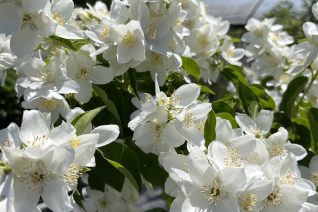
Philadelphus lewisii ‘Cumulonimbus’
This seedling Mock Orange appeared in our nursery rooted right into our gravel substrate. It was either a seedling of a few Philadelphus from eastern Oregon that we raised a several years ago or it is a seedling of a naturally occurring plant about 50 meters away on the forest margin of our wholesale nursery. Either way its an astonishing shrub in full bloom. Rather than small clusters of white flowers with a yellow center this shrub creates 6″ long stems with clusters of up to 10 on each. The effect is a billowing cloud of white flowers for many weeks in June to July. No other native Philadelphus we have seen compares in number of flowers. The foliage is literally obscured by the lightly orange blossom scented white flowers. Fast growing even in less than perfect conditions to 9′ tall by 4′ wide in 7 years. The parent plant gets no supplemental water whatsoever relying on only what falls from the sky. The handsome mid green leaves take on yellow tints in autumn but is not a show stopper. In bloom, however, it is. Loved by pollinators. Full sun to very light shade in average to enriched soil. Water consistently for the first season to establish then none in subsequent years. Wonderful specimen or hedgerow member . Extraordinary in full bloom. Blooms on wood from the previous season, prune if needed AFTER blooming . This form has a nice sweet scent that becomes most apparent several years after being in the ground. Associated plants in the wild are Corylus cornuta californica and Oemleria cerasiformis in the Willamette Valley. Oregon native plant.
Xera Plants Introduction

Philadelphus lewisii ‘Snow Velvet’
No offense to natives but I’ve always found our native mock orange to be kind of a dull one note shrub. Sure, its showy in bloom and certain specimens can be sweetly fragrant but once its done blooming…yawn. What do you do with it? Instead plant this highly improved selection with enormous semi-double white sweetly fragrant flowers. Each blossom is fully 2″ across and they come in such abundance in June that whole 9′ x 8′ frame is flocked like an enormous wedding gown. Some repeat bloom through summer. Same tough adaptation as the species which is nice- but incredibly showy in bloom. Full sun to part shade in average, well drained soil. Drought adapted. Great scaffold for summer Clematis. Blooms on old wood, prune AFTER flowering if needed. Forms a distinctive large vase shape. Fall color is soft yellow and brief. Adaptable to both cultivated and feral/wild areas. Tough and climate adapted shrub. Oregon native plant.

Philadelphus x microphyllus ‘Charles Price’
Excellent smaller shrub with distinctive very small silver foliage and in June a plethora of single white flowers with the intense, penetrating fragrance of grape soda. To 5′ x 3′ forming an upright rounded deciduous shrub. Full sun and regular water to establish the first year then none in subsequent years. This may or may not be a hybrid- it really looks like the straight species. P. microphyllus which is native to the American Southwest. Tough and hardy and very drought tolerant shrub that is well scaled for smaller gardens. Fall color is bright yellow. Blooms appear on wood from the previous season. Prune directly after flowering is over- if needed. Selected by our friend garden designer Charles Price, he gave this to us and we thought it was distinct enough to deserve his name.
Xera Plants Introduction.

Phlomis ‘Sunningdale Gold’
Wow, a species with golden leaves. Not variegation. How cool is that and it is a cool old gold color that the felted thick leaves glow. Rounded evergreen shrub to 30″ tall and 3′ wide forming a dome. In summer whorls of large yellow flowers surround the stems and kind of blend in with the foliage. Wonderful year round appearance. A plant I nominate as #1 Hellstrip plant of the year. It thrives in the heat reflected off the asphalt and it requires absolutely no water whatsoever when established. Plant for foliage and the flowers will follow. Glows in the dead of winter. Moderate deer resistance.

Phlomis (anitolica) ‘Lloyd’s Variety’
Aka Jerusalem Sage. This is a very compact but floriferous form of this evergreen perennial/subshrub. To 3′ x 5′ and forming a dome of thick gray/green foliage. In summer spikes extend and display yellow flowers in whorls around the stem. Very symmetrical and loved by pollinators. Surprisingly up close it is very fragrant reminding me somewhat of the sweet clovey scent of Dianthus. Long, blooming for 4-6 weeks. Full hot sun and rich to average well drained soil. Ideal on hot slopes. Light summer water aids vigor but it can take very dry conditions once established. Easy to grow, long lived plant. Mix with other hot sun dwellers and other mediterranean natives. Moderate deer resistance. Evergreen.

Phlomis fruticosa ‘Quilted Leaf’
A really handsome and unique form of Jerusalem Sage. The large gray leaves are spongy and quilted and good looking all the time. This woody perennial forms a large spreading plant to 4′ tall and 5′ wide in full sun and rich to average well drained soil. Regular light summer water- to establish then drought adapted. Very drought adapted when established. Blooms June to August in our climate and makes a great paring with smaller low water full sun woody shrubs such as Cistus or Ceanothus. The whorls of soft yellow flowers born on upright stems have the sweet fragrance of cloves in close proximity. A very cool cut flower that lasts for more than a week in a vase. Loses some leaves in winter- gets them back quickly in spring. Wonderful on sunny hillsides. Moderate deer resistance. This form will often have a re-bloom with the return of fall rain. Give it room to spread out horizontally.

Phormium tenax ‘Atropurpureum’
The most commonly seen New Zealand Flax in our climate and arguably one of the most hardy to cold. Deep maroon/purple evergreen foliage in a large clump to 5′ x 5′ ultimately in a hot position and full sun in rich, well drained soil. Regular summer water increases the growth rate which in turn establishes the plant more thoroughly. The more established the Flax the more vigorously it returns if it gets hit by cold. If it does, try not to cut the whole thing to the ground but leave as many viable leaves as possible for food to aid in the recovery. Great plant for hot hellstrips and containers. Borders. etc. Following mild winters (above 20ºF) it may send up 6′ spikes with duckbill shaped yellow flowers in summer. Thrives at the Oregon Coast where it seldom is ever bothered by cold and where it absorbs blasting salt laden winds happily. High deer resistance.

Phormium tenax ‘Portland Night’
We selected this incredibly dark foliaged New Zealand Flax from a huge seed batch. It was the darkest maroon/black and exhibited great vigor. To 3′ x 3′ in rich, well drained soil with light but consistent summer moisture. Soak once every two weeks once established. Full sun to light shade in a somewhat protected location. When established it is capable of freezing back in extreme winters and recovering fully by early summer. Following mild winters (above 20ºF) 6′ spikes may appear with tubular yellow flowers on a much branched inflorescence. If in containers move to a freeze free location in the event of an arctic blast (about once every four years). Arching stems are graceful. High deer resistance. Great performance on the Oregon Coast. Evergreen.
Xera Plants Introduction.

Phygelius x ‘Native Sons’
There are so many Cape Fuchsia cultivars on the market and to be honest a lot of them are dogs. Winning flower colors but losing in vigor and hardiness. Or they flop hopelessly. Enter this remarkable form with beautiful dusty magenta red tubular flowers. A strong growing and blooming selection that provides spikes of the pendant vibrantly colored flowers continuously from June to frost. To 4′ tall and 4′ wide for rich to average soil. Regular summer water spurs repeat bloom but it can lead to a rather rambunctious plant. Give this big guy room to spread. It will happen quickly. Full sun to light shade. May be cut to the ground in early spring to resize and supply new wood for flowers. Recovery is rapid. Cold hardy and loved by hummingbirds. Easy

Phygelius x rectus ‘Peach Trombone’
We selected this Cape Fuchsia for its compact habit and profuse display of pendant soft yellow to orange to red tubular flowers. To 3′ x 4′ and spreading it begins blooming in May and continues through September. Removing spent flower spikes will encourage more. Full sun and rich, moisture retentive soil for a plant that needs room- spreads underground by stolons. Do not plant delicate plants in the vicinity of this perennial, instead match vigor with vigor. Light summer water to none when established. Though water enhances bloom. Loved by hummingbirds and pollinators too. Great landscape plant. Cut back hard in mid-spring to refresh the plant and spur new blooming wood. Semi-evergreen.
Xera Plants Introduction.

Pieris japonica ‘Cavatine’
This is a very pretty and very useful plant that is tough as nails when established. To just 3′ tall by as wide in 10 years. In late winter the whole shrub is a garland of white urn shaped flowers on fine filaments. Bloom begins in February and remains effective for months. Medium green evergreen foliage with great year round appearance. Fits in small places in full sun to quite a bit of shade. Regular water to establish then light water to eventually none on well established shrubs. Rich soil with high organice/wood content that is acidic. Very easy to grow in our climate and one of the best Pieris. Flowers buds are set the previous summer and are attractive for months until they open. New growth is tinted red. Very cold hardy enduring subfreezing wind and temperatures below 0ºF. Not bothered by deer- for the most part. Wonderful small hedge or specimen. Long lived.

Pimelea prostrata
Wonderful little small scale ground cover that delivers tiny blue/gray leaves and masses of small white flower clusters in summer. Semi-woody shrub that rises to only several inches tall (3″) but spreads densely to several feet wide in a circle. Excellent weed suppressing ground cover for tough sites. Light to average summer water speeds growth. Completely cold hardy. Full sun is ideal but you can hedge a little in part shade. Its worth it to prepare the soil and enrich with organic matter- double dig to de-compact the soil and add oxygen. Deep soaks in summer- to establish. Great in parking strips- not a full scale rampant groudcover- rather one that you use for a small area. Small shrubs and perennials can grow through it when planted at the same time. Evergreen. Mountains of New Zealand. Deer resistant. AKA Creeping Rice Flower.

Pinckneya bracteata ‘Precocious’
Fever tree is an extraordinary rare endemic in Georgia to South Carolina. Its a monotypic species.. And in a family that is decidedly tropical. We’ve carefully tested this cultivar and we are happy to say it performs here beautifully. Conical spreading small tree to 15′. Large tropical looking mid green leaves are opulent. In July to October it blooms. The real flowers are tubular and white and about 1″ long you only notice them as an after thought because you are immediately drawn to the large and colorful pink fading towhite bracts that surround the tiny flower. Its a wonderful effect, a bit like a pink poinsettia. Deciduous with no appreciable fall color. Locate in rich soil in full hot sun to very light shade. Regular water for at least the first two years to establish- then at least once a month. Beautiful rare tree that has been known to take years to commence bloom. This ‘precocious’ cultivar blooms when its barely 1′ tall and from then annually. Cold hardy to near 0ºF. Not for perpetually cold gardens or hot and dusty dry. Average conditions at least. A tree covered in these bracts/flowers is truly spectacular for weeks. Spectacular and something your neighbors WILL NOT HAVE. Thank you too my friend Mike See for sending me this tree to test in our climate. Its a real stunner and not difficult in any way. Limited qualities.

Pinus ponderosa var. benthamiana
Pacific ponderosa pine is a lovely tree native west of the Cascades from about the Portland area (with some outliers farther north) south to northern California. Our form is from locally collected seed. Slow growing in youth this pine picks up speed in its teens and grows almost exponentially from there. Pacific ponderosa pine is known for it tall straight crowns of lush green needles in clumps of three. This tree is excellently adapted to our winter wet/summer dry climate and even small trees can endure the very longest, driest, hottest summers with no visible stress. Its adaptable to all types of soil – not fussy and is even found in the most well drained stranded flood cobbles of major rivers. To 125′ in time with ulitimate height of close to 200′ in great age – expect a 3′ tall tree to be about 15′ tall in 10 years. Full sun- not very shade tolerant and when planting with other trees anticipate at least a 25′ wide crown in the future. Needles can drop profusely in September which is a bit of a mess. Take note of this. Underplant with other drought adapted natives. Water to establish for the first summer then none in subsequent years. A regal pine that is among the tallest in the world. Oregon native plant.

Pinus sabiniana
Gray Pine or Foothill Pine native almost exclusively to the mountains of California- but there are several outlying native populations in Douglas, Josephine and Jackson, Counties in Oregon so we can claim it as our own as well. Known as the tree that casts no shade, its almost completely true as the long gray needles allow almost all light through. Large pine tree with gray foliage- usually forks about 1/2 way up into two main trunks, these are buttressed to support the huge cones which can weigh 5lbs or more. Excellent performance in the Willamette Valley where many are seen around old farm houses and older neighborhoods. Perfectly hardy to cold in our climate and incredibly drought adapted. In fact it shuns all irrigation and is ideal for hot dry locations. Grows very fast in youth, settles down a little with age. Its ultimate height is around 35′-45′ in our climate. A smokey, silvery, shadeless skyline tree. Oregon native plant.

Pittosporum divaricatum
Unless you look REALLY REALLY closely you would never even think this was a Pittosporum, let alone even in that family. But life was tough in alpine New Zealand and this baby would have none of the grazing by huge Moa Birds. So the twiggy, zig zaggy stems evolved (the official term is divarication). The tiny, tiny leaves are serrated if you look closely (you might even take out glass to amplify the details). Tiny white flowers line the stem and mostly go unnoticed in spring. What it does provide is a very architectural compact shrub with stunning black stems in winter that change to ashy grey in summer. Perfectly hardy to cold down to below 5ºF. Full sun and average to enriched soil with little summer water once established. Groovy, somewhat rare shrub for excellent effects. To 6′ x 3′ in 8 years. Moderate deer resistance. Great structural shrub for containers.

Pittosporum heterophyllum
Large growing evergreen shrub that we love because in spring each branch tip is home to masses of tiny off white flowers that pump out a sweet and pervasive citrus blossom perfume. Bloom lasts for a month and in that time perfume will waft throughout your whole garden. Fast growing to 8′ x 8′ in 6 years. Full sun and well drained soil. Incredibly drought tolerant when established. Cold hardy to 5ºF or lower and an excellent hedge. Fantastic performance in tough urban environments. Foliage is thin and glossy and good looking year round. Easy, fragrant shrub. Water to establish then little summer water when firmly happy. Prune AFTER blooming has ended in late spring. Plant on 3′ centers for a fast dense hedge. Sometimes listed with the common name of Fragrant Pittosporum…which seems vague to me but there you go. Wonderful shrub. Avoid subfreezing wind.. Native to SW China.

Pittosporum illicioides var. angustifolia
Groovy evergreen cold hardy Pittosporum that provides unusual textural effects. Long thin leaves are glossy and bright green and only 1/3″ wide they stretch to 5″ long. Wispy effect of a shrub to 8′ tall and 5′ wide in 6 years. Beyond that it will assume the demeanor of a small tree. Adaptable to any soil type aside from boggy. Incredibly drought tolerant- established plants need little summer water whatsoever. Full sun to quite a bit of shade. Forms an umbrella shape in time and casts light shade. In spring not very conspicuous little yellow flowers appear at the end of thread like stems. Cold hardy and long lived. Fantastic and graceful. Prune after blooming in late spring. May be pruned hard as there are numerous dormant buds along the stems- and will re-sprout from bare trunks. Brush heavy snow off this shrub but its cold hardy enough not to require winter protection. This shrub is at its best in the ground, overly enriched conditions in containers belie its future great beauty. Excellent cover for native birds and critters. SW China.
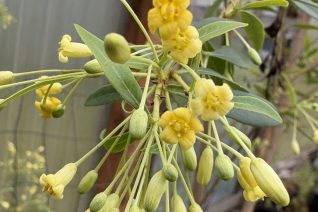
This is a curious small tree that i got years ago, at that point I was in a mode of accession of Pittosporums. This plant begins its life as a humble and somewhat spindly habit, thin, small, evergreen leaves do not form an opaque canopy and you think it willl not amount to much. I have since seen a mature small tree and not only does the density of foiiage increase for a nice, dense canopy, in bloom it is fairly spectacular. Clusters of small, tubular soft yellow flowers in clusters on long stems radiate from each branch tip. In full bloom the flowers emit a sweet citrus blossom perfume for several weeks in April to May. To 12 ‘ tall and only about 4’ wide its grows to a small evergreen tree with a conical habit. Full sun, blooms less and is not very pretty in too much shade. Cold hardy to 5ºF for brief periods. I have never seen it damaged by cold. Blooms on wood from the previous season. Tip prune after flowering to increase density if needed. Excellent tree for a small courtyard or garden. Native to SW China. Small yellow berries form in summer and are taken by birds. Fun, interesting, and powerfully fragrant small evergreen tree. Summer drought adapted when established, though summer water markedly speeds growth and flowering. In bloom the flower clusters look like exploding stars. Adaptable to average soils, including clay soils.

Pittosporum tenuifolium ‘Emerald Sentry’
We selected this form of New Zealand Pittosporum because its been cold hardy in Portland for the past 15 years! Not bad- for a species that can range to tender- those are great odds. Upright growing evergreen with deep green very glossy foliage with wavy edges. Black stems support the leaves and provide elegant contrast. In mid-spring small but profuse jet black flowers appear on the stems from the previous years growth. Prune, if needed AFTER spring bloom has ended. To 5′ tall and 3′ wide in 7 years. Full sun to part shade in a protected location. We selected this form after enduring temperatures below 10ºF with no damage. Slow growing shrub with great drought tolerance. Always fresh and good looking. Light water speeds growth in summer. Avoid full exposure to subfreezing east wind. Best on a west or south facing aspect. Nice as formal sentries to a sunny entrance. Great urban performance. Fantastic performance at the Oregon Coast.
Xera Plants Introduction.

Pittosporum tenuifolium ‘Marjory Channon’
Surprisingly hardy and spectacular variegated evergreen shrub for protected locations. Each sage green glossy leaf is margined in white and held on contrasting black stems. Very very pretty shrub to 5′ x 4′ in 7 years. In spring small jet black flowers emerge from the leaf axils. Best surrounded by other evergreen shrubs against a wall or with light overhead protection. This cultivar has come through low’s below 10ºF with only light tip damage and recovery was complete in spring. Slightly tender when a young plant it gains cold hardiness with establishment. Takes pruning very well which will increase the plants density. Great in containers that you protect from lows below about 18ºF. Excellent performance at the Oregon Coast. Do not plant this in a location exposed to strong subfreezing east wind- keep it close with friends. New Zealand. Extremely drought tolerant in full sun to part shade.

Pittosporum tenuifolium ‘Variegatum’
One of the cold hardiest selections of this species native to New Zealand. This stunning evergreen shrub of unknown origin shines in the garden with round leaves edged in white with an interior of soft green. And these bright leaves are held on dramatic black stems. In spring small black to maroon flowers decorate the leaf axils. Moderately fast growing pyramidal shrub to 8′ tall x 4 wide in 7 years- and gradually larger. In winter the leaves become even more colorful taking on bright pink tints. Requires a somewhat protected location- avoid exposure to subfreezing winds directly. Best sited with protection from east winds. Full sun to high over head shade. Accepts regular summer water which will increase the rate of growth- but established plants are remarkably summer drought tolerant. Excellent cut foliage for arrangements. A luminous shrub that virtually glows in the landscape. Cold damage begins at about 10ºF- but spring recovery is rapid. Limited quantities.

Pittosporum tobira ‘Green Compact’
We found this very handsome form of Pittosporum tobira in the south where it is regarded as one of the cold hardiest forms. Upright and then spreading to 6′ tall and 6′ wide in 7 years. Much larger glossier deeper green leaves than the species. Reputedly hardy into central Tennessee. Pretty good. We’ve never had it damaged by cold. Extremely fragrant small off white flower clusters at the branch tips in May. A great hedge or specimen. Very, very drought and heat tolerant. Formal appearance year round. Prune after flowering if needed. Avoid standing water at any point. In very cold winters (below 15ºF) it may lose some of its interior leaves. They are replaced in spring. Protect from subfreezing wind. Very fragrant flowers. Authentic in Japanese themed gardens.

Pittosporum tobira ‘Tall and Tough’
Seed from the northern extent of its natural range in Korea has yielded this cold hardy tough and wonderful evergreen shrub. AKA evergreen mock orange this dense growing shrub displays white then yellow small flowers in May and June with the pervasive sweet fragrance of citrus blossoms. Incredibly drought tolerant and moderately fast growing. It also tolerates regular irrigation. To 8′ x 8′ in 6 years- then progressively larger. Fully one zone hardier to cold than the species form typically seen in our gardens. Formal looking shrub that was more popular in the mid-20th century. Deep green matte foliage has leaves curled under at the sides. Prune if needed AFTER flowering has ended in late spring- blooms on wood from the previous year. Always handsome foliage is used as cut material- it remains good looking for weeks in a vase or even as a wreath. Long lived, somewhat formal, easy shrub.

Pittosporum tobira ‘Variegata’
An old shrub that deserves a new lease on life. Venerable old specimens are found throughout Portland proving its durability over time. The rounded evergreen leaves are edged in cream with an interior of soft sage green. In May/June masses of small white deliciously citrus-blossom scented flowers perfume a wide area. Not as dense or fast growing as the species- and prone to losing older leaves in colder than normal winters- so it can have an open appearance. Excellent evergreen specimen shrub for a hot location. A south or west facing wall is ideal and it can withstand the most withering afternoon heat. Slow growing to 6′ x 6′ in 10 years. Very drought adapted when established, but it will happily take regular summer water. The foliage is so fetching that it is often seen for sale as cut material in bouquets. It lasts for several weeks in a vase. Full sun to quite a bit of shade. Nice foundation shrub. Established shrubs are cold hardy to about 5ºF. Avoid exposure to strong subfreezing winds. Easy and pretty urban plant.

Pittosporum tobira ‘Wheeler’s Dwarf’
Useful somewhat formal looking ground cover shrub that is always good looking . To 2′ x 3′ slowly the dense deep green foliage is arranged handsomely. In May/June clusters of off white fragrant flowers appear- Not as heavily as the species but pretty none-the-less. Excels in hot dry situations- including the reflected heat of walls. Hardier to cold than generally thought. My 10 year old plants have never been damaged by cold- down below 10ºF. Avoid freezing cold exposed sites, however. Useful as a massed weed smothering ground cover. Deep green uniform appearance of foliage is just what many people are seeking. Drought tolerant. Evergreen. Hardy to 5ºF when established. Excellent appearance year round.

Platystemon californicus
This charming true poppy relative is also known as Cream Cups. Easy to see when the cup shaped flowers open during the sunniest time of the day. The petals are various shades of yellow with cream veining. Or is it the other way around? Either way its adorable beyond measure as this little thread leaf clump forming true annual pops into bloom in our climate from late April to early June. Not a prolific self seeder but I’ve heard once you get it where it likes it then its yours. To 5″ tall when the flowers top out. Full sun and average to rich well drained soil. Not difficult. West coast annuals are wonderful not only for their color, texture, and forms but of their endearing nature. They are tough little plants with a delicate appearance. Light summer water extends the bloom before high heat finally ends the show and seeds go flying. No shade. Rock gardens, spring borders. High deer resistance. This little beauty though mainly found in California comes just into Oregon in Curry and Josephine counties. Oregon native plant.

Plectritis congesta
Sea Blush, or more commonly Rosy Plectritis is a locally native hardy annual in the Valerian family. In April-June it swarms meadows and glens with orbicular globes of dense fragrant pink flowers. They rise on average to about 10″ tall. Rich soil will yield larger plants. Excellent bulb cover for late narcissus, tulips etc. Fun to grow heavily reseeding annual that also makes a sweet cut flower. It can be found in the western third of the state. Also wonderful with Pacific Coast Iris as they bloom concurrently. Sets seed and dies by mid summer when the spent carcasses may be removed- when doing that give them a shake where you want next years display to occur. Make sure not to cover the seed, native annual seed requires light to germinate and it will very quickly sprout with the first cool fall rains. Traditionally, Rosy Plectritis can be found in a mix of perennial and annual communities. In its many habitats it can be found with Oregon Iris (Iris tenax) and often Giant Blue Eyed Mary (Collinsia grandiflora). Water to establish as plants- then none. Full sun to very light shade. Seedlings have paddle shaped true leaves with a rubbery texture. High deer resistance. Native in the Portland city limits. Photo credit: Matthew Hubbard Oregon native plant.

Podocarpus lawrencei ‘Purple King’
Wonderful dense, arching and low growing conifer for full sun and only occasional water when established. This cold hardy conifer is native to the highest elevations of Tasmania up into eastern Australia. In the summer the fine but substantial needles turn to dusty blue. The arrival of colder weather brings a distinct and beautiful soft purple cast. To 2′ tall and arching to 5′ tall in 7 years. Long lived and carefree conifer for full sun to very light shade. Dense and blocks weeds. Excellent large scale, weed supressing low water shrub. This cultivar originated in New Zealand and was released as a cultivar in 1994. Very good deer and rabbit resistance. Excellent appearance year round. It has been hardy slightly below 0ºF. Easy to grow.

Podocarpus macrophyllus ‘Maki’
Shrubby Japanese Yew Pine is a dwarf form of what can become a large tree. The deep green needles are much shorter in length and held more densely along the stem. In our climate it is a slow growing conifer of wonderful texture rarely exceeding 12′ and usually just 3′ wide or less. In summer little pointed green flowers protrude from between the needles and turn into round blue fruits by autumn. Extremely drought tolerant shrub for tight spots. Takes very well to pruning. Excellent in containers for year round good looks. Tolerates regular irrigation as well and is not fussy about soil. It thrives in high heat and summer is when most of the growth takes place. An old fashioned plant that we’d like to give a new lease on life. Very pretty focal point in authentic Japanese gardens. This true dwarf form can be difficult to obtain in the trade. This is the true form. Adapted to the hottest reflected heat of walls- parking lot islands. Average water to none, when established. Prune in early spring if required.

Potentilla aff. gelida
We’ve grown this stunning perennial for years but there has always been some question to the exact species. All we know is that for foliage there really is nothing like it. Large spreading rosettes of pure metallic silver pinnate leaves are gorgeous all season. In summer and not very prolifically sporadic spikes of small yellow flowers rise above the foliage. Not the point of this plant and they can be removed if they are a distraction. To 1′ tall and forming a large patch in RICH, moisture retentive soil in full sun to light shade. Established plants can get by with much less water. Performance is equally as good in either position. Completely deciduous in winter. Beautiful leaves.

Prunella vulgaris var. lanceolata
As a child in the country near Eugene western self heal was one of the first wildflowers I learned to identify. And its a beautiful and fascinating native perennial. This ‘weed’ circles the world but our locally native form is an exceptional improvement. Lance shaped basal leaves (the trick for identifying our local sub-species) forms stout upright stems. They are crowned with ‘cones’ that have whorls of showy deep purple tubular flowers- they appear continuously for up to 6’weeks into August decorating the tops of a 1′ tall plant. Spreads to form a clump as wide and appreciates average to enriched soil in full sun. Regular summer water increases vigor and lengthens the bloom time. A very charming native cut flower that produces new blooms continuously after its picked. This is a very important plant for native pollinators. Also, it differs from the pan-weedy form in larger cones and much showier flowers. Its a larger plant as well. Adapts to clay soils with regular irrigation to establish. A natural magnet for butterflies. Blooms May-August. In our region it is now found primarily away from the valley in upland valleys to alpine meadows and scree. A good native weed that is a great garden plant as well. Oregon native plant.

Punica granatum ‘Double Orange’
Very showy ornamental Pomegranate that we love for the insanely double hot orange congested flowers. They are like you are on acid. Far out man. No other shrub that we grow has a flower color this intense. It blooms beginning in June and continue to September. Most years one or two or more ornamental pomegranate form. They rarely ripen in our climate but are very ornamental and can be detached and brought inside. Where they last for months in arrangements Full hot all day sun in rich, well drained soil. Water the first year regularly to establish then only once a month in summer from then on. To 9′ tall forming a multitrunked vase shaped outline. Glossy green leaves turn electric yellow in autumn before dropping. In spring it tends to break dormancy late, not until late April. Patience. Blooms on wood from the previous year, prune if needed AFTER flowering. Best in the warmest possible position. Very long lived shrub in the city of Portland.

Punica granatum ‘Grenada’
If ever there was the chance to ripen a Pomegrante in our climate this cultivar is the best bet. Large growing deciduous shrub for full hot sun and any well drained soil. Light to little summer water is necessary once established. Amenable to regular water as well. Beginning in June a continuous supply of red/vermillion/orange single flowers appear. If pollinated they will form fruit which would ordinarily (in a hot fall climate) ripen by October. In our much cooler climate it requires the hottest spot possible. Against a south facing wall would be ideal- for fruit to possibly ripen. Otherwise the large pomes with a blushed red outside are very ornamental. They can be left on the shrub or brought inside to dry where they will last for months in a dish. Very pretty. In autumn ‘Grenada’ turns a clear and luminous yellow before the small glossy leaves drop. Breaks dormancy late in spring- usually late April- be patient. Blooms on wood from the previous year- prune directly after flowering if needed. Avoid all shade. High deer resistance.
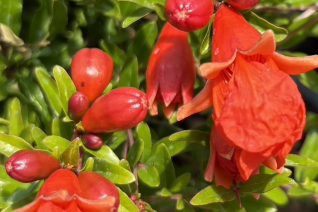
Punica granatum ‘Nana’
Excellent ornamental Pomegranate for our climate. This heat loving (and tolerating) deciduous shrub is also incredibly tolerant of summer drought. To 5′ tall by 3′ wide it greets the heat of summer with electric orange small crape petalled flowers. Each is held in a thick calyx that is to become a small blushed ornamental fruit. Full, hot sun in a hot position with summer water to speed growth and establishment. Well drained soils of average fertility. Fall brings brilliant yellow foliage before it drops. Late to break dormancy in spring- waits until the first truly warm days. Be patient Cold hardy to near 0ºF. Blooms heaviest on wood from the previous season and sporadically on new growth. Tolerates extreme reflected heat. Gains drought tolerance with age and then it is great. Good compact shrub for small gardens, hot locations, and often shunned by deer. Though this is listed as a dwarf with smaller over all dimensions it will reach the full dimension that I’ve listed. Plan ahead.

Pyracantha x fortuneana ‘Graberi’
The best firethorn for our region. Glossy evergreen foliage is handsome year round. In summer flat clusters of off while small flowers transform into clusters of vivid true red berries. They ripen by autumn and remain showy all winter. Often they are completely consumed by birds. Extremely drought tolerant shrub for full sun to quite a bit of shade. Very fast growing in any well drained soil to 9′ x 8′ in 5 years. It makes a fantastic espalier tolerating the hottest walls. Prune AFTER flowering has ended. Blooms/fruits on wood from the previous year. Respectably deer resistant. Thorny- be careful in siting. Very fast growing even with no irrigation. Easy to prune. Plant on 3′ centers for a dense hedge. Beautiful RED berries. The berries are frequently eaten by american robins in autumn.

Quercus chrysolepis
Canyon live oak is a vastly underused, beautiful evergreen native tree. Found from Lane county, Oregon south through California, slight parts of Nevada around Lake Tahoe and sporadically in Arizona and even New Mexico. This venerable tree is found on the steepest slopes of canyons and mountain ridges. In Oregon it represents the northern most native Live Oak or evergreen oak in North America. Leaves are glossy army green on the the top with a conspicuous furry gold underside. This is a rugged, tough tree that should be used in both gardens and as a street tree. In the Alameda neighborhood in Portland there is an ancient specimen to 60′ tall and wide with a large trunk. This heritage tree was reportedly brought to the city from southern Oregon via horse and wagon. Slow growing in youth it picks up speed exponentially several years after planting. To 40′ x 20′ in 30 years with a broad spreading crown. In the wild it often forms a gnarled multi-trunked rounded outline. Its very possible to train this tree to a single trunk/leader to extend the crown skyward. Extraordinarily cold hardy enduring temperatures slightly below 0ºF with no difficulty. The large acorns are born in a showy golden hued furry cups- and are produced profusely in banner years. Water to establish for the first season then none in subsequent years. Full sun. Beautiful, native Oak that we cherish at Xera. Oregon native plant.

Quercus hypoleucoides
Silver Leaf Oak from Arizona is a favorite tree at Xera. Tall, rounded evergreen tree with skinny but thick leaves that are sage green on top and silver white on the underside. Its handsome all the time and even prettier when the gold catkins protrude from the foliage in spring. Naturally develops a straight trunk. Fast growing tree in our climate to 35′ in 12 years. Casts dense shade but tolerates limited summer water. Extraordinarily cold hardy. It has endured subzero readings in Eugene without injury and I even encountered one in a garden in Denver. The leaves were kind of toasted from the previous winters -17ºF(!) but it was obviously thriving. Native to the mountains of SE Arizona at very high elevations and that translates to LOVE for our climate. Exceptional leaf form and shape. Be aware that in time this tree can cast quite dense shade. Wonderful on hot summer days but also inhibiting sun loving gardening. Makes you think. Wonderfully pest and disease resistant foliage- it always looks good.
Photo credit: Amy Campion

Quercus rugosa (SW Form)
This is a remarkable oak whose geographic center is in high elevation Mexico. There are several forms of this evergreen tree with remarkable qualities. Its range extends from the SW U.S. south throughout Mexico into northern Guatemala. This southwest form has shown great cold hardiness and adaptability. These are started from acorns in a garden in Medford. The parent tree was pole straight with a boisterous green rounded crown. It is remarkably tolerant of drought and is cold hardy reliably to 0ºF. Full sun in average soil for a moderately fast growing tree. The outline of its crown is oblong at first and if you remove the lower limbs it will send the crown skyward. As I said the trunk was pole straight on a tree that was 35′ tall (18′ wide) and very pretty. Doing research on this tree it was found in California that this tree literally collects pollutants from the sky with its rough leaves. Its proposed to be planted along intersections and freeways and could be a boon to lower the particulate count. Dark green foliage looks good year round. Water to establish and then none in subsequent years. Grows fast for an oak and it really adores our climate. The bark is rough with gray striations. It makes many acorns and this should be taken into account in siting. Good candidate for a street tree or a garden shade tree. Average soil, including clay soils. Full sun from every direction for the straightest tree. Syn. Quercus reticulata. This would also be a good candidate for a formal large screen. Sometimes called net leaf oak or southwestern net leaf oak. Casts moderately dense shade with time.

Quercus suber
Cork oak. The commercial source for high quality cork comes from this evergreen mediterranean native. A large growing tree with a rounded crown. To 35′ tall and half as wide. As the trunk grows (expands) it develops the corky bark very quickly. Harvest correctly and it does not harm the tree. In mid-spring golden tassels eventually become acorns- loved by wild life. Frequently planted as a street tree in the city of Portland. Very, very drought tolerant, in fact it really should not see any water during the summer. Eventually casts a good amount of dark shade. Beautiful tree that is amazingly adaptable to freezing rain and snow. Grows about 2′- 4′ per year when established. Very climate adapted.

Quercus wislezenii ‘Dense Form’
I collected the acorns of this tree near Lake Isabella, CA in the southern Sierra Nevada. It was a particularly handsome form of what can be a less than majestic species. Densely foliaged with a straight upright trunk about 25′ tall with a rounded crown. Wow. We hope the progeny are as cool. Interior Live Oak of California. Evergreen tree to 25′-35′ tall with a spreading crown. Was native in Oregon in the past as hybrids known as Mohr Oaks (Quercus kelloggii x Quercus wislezenii) still can be found. Hardy to short shots to 0ºF. Grows about 2′-3′ a year in youth. Water to establish the first year then none in subsequent years.

Ranunculus occidentalis
Western Buttercup is our own wonderful wildflower. This is the real thing and NOT the invasive Ranunculus ficaria or repens. Traditionally it occupies open Oregon Oak woodlands and meadows including vernally wet meadows. Though it handles winter inundation it is also adapted to upland situations and in every biome it goes quickly summer dormant. Rosettes of pretty pinked leaves elongate in bloom to an airy spray of bright yellow flowers. Intimately, the petals have a glossy sheen. And growing up in the country it was traditional to put a picked flower under your chin and the reflected color yellow revealed that indeed you did like butter. Great cut flower that peaks on May Day and has made many a wild flower bouquet with purple Oregon Iris and purple Dodecatheon hendersonii- Shooting stars. Pictured here with Common Camas Camassia quamash at the Camassia reserve in West Linn, Oregon. Blooms from mid-April to early June. Vast meadows of western Oregon still harbor this sweet short lived perennial. Adapted to heavy clay soils- reseeds when happy. Suitable for mowed meadows as long as it has gone to seed by the time you mow. Wait until June. Good competitor with invasives and absolutely integral to a Willamette Valley meadow. High deer resistance. Oregon native plant

Ratibida columnifera ‘Pulcherrima’
Mexican Hats are iconic flowers of the southwest american prairies. Slender plants that rise up to 2′ feet with adorable flowers, red petals reflexed around a black prominent cone. The red petals are mostly outlined in yellow. Forgiving wildflower for full sun any well drained soil with regular summer water. Remove spent flowers to spur more- this will keep it in continuous bloom. Cute cut flower and the little flowers really do look like sombreros. Winter deciduous. Will often self sow in open disturbed soils.

Ratibida pinnata
The biggest black eyed susan daisy of them all. Towering to 7’+ the sturdy straight stems of this hardy American plains native perennial displays very large yellow flowers with drooping petals reflexed away from a prominent black central cone. The thick stems rise up from a low mound of foliage. Blooms all summer long and often into October. Loved by pollinators of all kinds it also makes a really cool and surprisingly long lasting cut flower. Put this beauty in the back of a border where its sunny yellow flowers can wave to the sky. Light summer water in any well drained soil. Full sun to avoid flopping.

Rhamnus alaternus ‘Variegata’
One of the finest variegated evergreen shrubs. The finely pointed leaves of this fast growing large drought adapted shrub are boldly edged in cream with a deep green center. Tiny flowers turn into small bright red berries. Often used as cut foliage- especially around the holidays as the leaves remain fresh for many weeks as cut material. Full sun to part shade in average, well drained soil. Very light summer water to none once established. This mediterranean buckthorn is supremely adapted to drought. In rich soil with summer water it will grow insanely fast and large often toppling under these conditions. Accepts any amount of pruning and its best to do this to produce a denser more root stable plant. It thrives in the worst conditions. 12′ tall by 12′ wide but radical and consistent pruning keeps it much smaller and improves density. Excellent summer scaffold for Clematis. Plant on 3′ centers for a fast, dense hedge. Prune out the very rare green reversions if they appear. Best with neglect.

Rhaphiolepis umbellata
Yeddo Hawthorne long grown in the PNW and an excellent low, evergreen, very drought tolerant shrub. In spring spikes are lined with multiple clear white fragrant flowers. The flowers are easy to identify in the rose family. Moderate to slow and dense growing shrub to 4′ tall by 4′ wide in 6 years. The rounded thick leaves are resistant to black spot which can afflict this genus- it also appreciates an open exposure with good air circulation. Small blue berries follow the flowers- kind of showy. Takes intensely hot locations with no summer water and thrives. Also, it accepts regular irrigation no problem. Average to rich, well drained soil. Not deer resistant at all- Rose family- deer lunch. Excellent performance in harsh urban conditions. Japan.

Rhaphiolepis umbellata ‘Blueberry Muffin’
Excellent release from the JC Raulston Arboretum in Raliegh, NC. This dense and rounded shrub is useful for its size- 2′ x 3′ in 7 years- or longer. But it has many other fine points. The leaves are thinner than normal with this species which is native to Japan. It is very very black spot resistant and the leathery glossy leaves turn from olive green/gray in summer to amazing stains of maroon and purple with cooler temperatures. New growth is light beige and coated in furry indumentum before becoming glossy. A fascinating and beautiful display. White flowers appear in May and are followed by fairly showy blue berries. Extremely drought tolerant and tolerant of high heat. Excellent on south facing walls or exposed urban situations with reflected heat. Handsome at all times and very easy to grow. Grows about 4″ per year. Nice measured growth that forms a rounded upright shrub. Excellent companion for other drought adapted shrubs-landscapes. It also accepts regular irrigation in summer- a useful adaptation for an already useful shrub. Full sun to part shade.

Rhaphiolepis umbellata ‘Emerald Waves’
Our selection of the tough and adaptable evergreen Yeddo Hawthorne. Each glossy, thick rounded leaf on this cultivar is wavy (undulate) and gives this smaller shrub extra substance. In spring large clusters of pure white flowers cover the whole plant. Often showy blue berries follow. Great resistance to black spot- the best of any we’ve grown. Full sun to very light shade in average to enriched soil. To 3′ x 3′ in 6 years. A long lived shrub that tolerates a great amount of summer drought but greets regular irrigation with equanimity. A frequent component of Japanese style gardens for its simple and clean habit. Takes blasting heat very well, including blazing western exposures that are shady for most of the day. Cold hardy to 5ºF or briefly lower. Great low water landscape plant. Rose family- not deer resistant. Japan.
Xera Plants Introduction

Rhaphiolepis umbellata var. minor
Excitement doesn’t really well up with this genus. The reason we grow this plant is that it is healthy, drought adapted, and handsome all the time. And its a great scale and is slow growing. Dense evergreen shrub with wavy deep green foliage. New growth is conspicuously tinted red. In spring clusters of pure white flowers are pretty if not enough to stop a car. To 3′ x 3′ in 8 years. Yep. Slow growing and a great size for full hot sun to light shade and rich to average soil. Drought adapted when established it will also accept regular irrigation. Somewhat formal appearance and a great backdrop to other plants. A nice formal hedge plant or left to its own devices an informal hedge. Clusters of blue berries often follow the flowers and are added interest. NOT DEER RESISTANT. Rose family. Excellent performance in tough urban sites. Including unwatered parking strips. Grouped tougher it can form a low groudcover (3′ high). Regular water to establish. Dwarf japanese yedda hawthorne.

Rhaphiolepis x delacourii
Unusual hybrid India hawthorn that you rarely see anymore in our area. Its a great, tough, extremely drought tolerant evergreen shrub. To 4′ x 4′ in 7 years. Waxy deep green leaves emerge a soft pink/amber. In early to mid spring upright clusters of pink flowers are very pretty. They can then occur sporadically all year. Slow growing shrub for full sun and good air circulation. Excellent shrub to combat Rhododendron fatigue in spring. Good looking year round. Accepts regular summer water but thrives on none when established. Useful for blasting hot locations. Easy to grow long lived hardy broad leaved evergreen. Rhaphiolepis indica x Rhaphiolepis umbellata. Nice plant.

Rhazya orientalis
Asian Blue Star is so closely related to our American native Amsonias that many believe it should be in the same genus. Tough, elegant, cool perennial that rises to 2′ tall and is topped by clusters of NAVY BLUE starts in late spring. Bring on the bumblebees. Forms a slowly increasing clump in rich to average soil with regular summer water. Though established plants can easily handle drought. In autumn the whole plant turns from green to bright yellow and holds that color for an extended time. Very showy. Long lived, hardy perennial for full sun. No pests or disease. Winter deciduous.
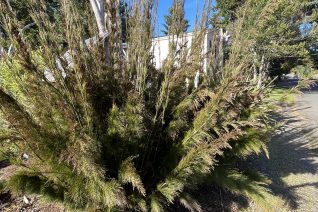
Rhodocoma capensis
Restios are ancient plants native to South Africa their closest relative is conifers but they look like grass/reeds. None is perfectly hardy in our climate and you should only plant this spectacular evergreen perennial in a protected location. The 9′ stems are clad in curtains of soft fine leaves that hang down. The affect is brilliant. Green/ochre foliage looks good year round or until we drop to 16ºF which is fatal. That being said this spectacular plant can live in gardens for 10 years or more. Its fantastic at the milder Oregon coast. This clumping perennial gains width and height with every year. It prefers average to slightly enriched soil and mulch is beneficial- especially in autumn. Let the plant dry between watering. This bold plant also makes an exemplary container plant. Definitely plan for it to double in size in a year. Not bothered by deer. Wonderful with other perennials or shrubs that are drought adapted. Inland locate this plant in the most protected spot in your garden preferably against a south or west facing wall. Not permanent but worth it as a risk. Able to freeze to the ground and return.

Rhodohypoxis baurii ‘Venetia’
Sweet little bulb that multiplies to form big sheets of color in full sun and well drained soil. To 3″ tall and blooming non-stop beginning in May and through summer to autumn. Regular water encourage more flowers. Funny hot pink flowers that don’t seem to have a traditional center. Seeds around in time. Foliage is winter deciduous. Rock gardens, meadows, Easy, just make sure the drainage is good add a handful of pumice in the whole for stingy clay. Very fun to grow and long blooming. This variety has larger flowers that are much more vivid.
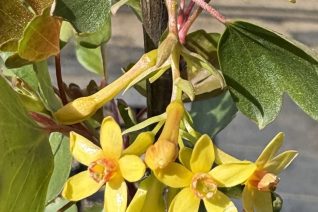
Golden Currant is a tough and beautiful deciduous shrub native to large areas of the arid west. In our area its closest native habitat is in the eastern Columbia River Gorge. A vertical shrub with fantastic glabrous (rubbery texture) tri- lobed leaves that flutter in the wind much like Quaking Aspen. In mid spring a pretty display of bright yellow flowers with a small red corolla in bunches all over the plant. Fast growin to 6′ tall by 4 ‘wide in full sun and any decently draining soil. Established shrubs can get by on natural rainfall alone. Very pretty hedgerow plant or specimen. Loved by birds. In summer bright red edible fruits decorate the stems, mostly eaten by wildlife. In well drained soils this native shrub can handle summer irrigation. Full sun to very light shade, If you want more fruit set plant two or more plants to increase pollination. Very easy to grow and long lived. Avoid planting near 5 needle pines. Fall color ranges from yellow to tints of orange. Blooms on wood from the previous season, prune if needed after flowering. Oregon native plant.

Ribes malvaceum ‘Dancing Tassels’
Really excellent form of Chaparral Currant with 3″ soft pink flowers that appear at any point during winter well into spring. A summer deciduous shrub to 8′ x 5′ in 7 years. Leaves drop completely by September and then re leaf as fall rains progress. Surprisingly hardy for its origin- California’s Channel Islands. Full sun to part shade and well drained average soil. Great on a slope. Loved by overwintering Anna’s hummingbirds. Flowers are surprisingly cold hardy and are undamaged to the upper teens. If those that are open are spoiled by frost more will follow after the thaw. Very very drought tolerant, No supplemental water required when established. Loses most of its leaves in summer drought. Grows fairly quickly and is never a dense shrub- all the better to see the pendant flowers. Dry borders, shrub borders, winter gardens. This shrub loves our climate and is supremely adapted to a winter wet/summer dry regime. Moderate deer resistance. Excellent winter blooming shrub. A beacon to Anna’s Hummingbirds.

Ribes roezlii
Sierra gooseberry or sticky gooseberry is a pretty if prickly native deciduous shrub for rough areas. Charming in bloom , the 1/2″ pendant flowers have sepals that are reflexed and red around a pendant white corolla. After opening they both change to light red and remain showy for several weeks. They line zig zagging stems with three thorns at each node. That means you must site this 7′ tall by 4′ wide arching plant carefully. The flowers are pretty viewed up close and turn into prickly translucent green/red drupes. These are eaten by a huge variety of wildlife and especially smaller birds. Often the shrub will be completely stripped of berries by the time the soft orange fall color appears. Native from the Cascades of Marion county south throughout inland California down to San Diego county CA. Its most often found in dry gravelly areas on slopes in full sun to deep woods where its habit is more restrained and open. Blooms appear in mid spring. Water lightly to establish the first summer then only what falls from the sky in subsequent years. Adaptable to dry shade if it is not completely dark. Moderate deer resistance. Very similar to another native Gooseberry Ribes lobbii which is discrete in its dull non sticky leaves. Wonderful native shrub.Rarely seen in habitat below 1000′. Oregon native plant
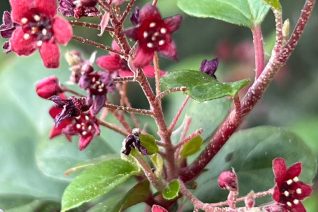
Ribes viburnifolium
Catalina perfume is the common name for this lovely, tough evergreen currant from Southern California. The round evergreen leaves which do remind one of a Viburnum are resinous and spicily fragrant, especially on warm days. To 3′ tall and spreading about 6′ -this low shrub is best adapted to part shade and little to no summer water. It is incredibly drought adapted. In late winter to mid spring panicle of rose red flowers are light and airy- followed by green fruit. This is an ideal groundcover shrub under native Oaks. It also makes an almost formal ground cover in landscapes . Found specifically on Santa Catalina in the Channel Islands off of southern CA. There it grows with other Channel island endemics. Tolerates full sun in our climate but its home is beneath the canopy. Water for the first year to establish then none in subsequent years. Not bothered by deer- unsure of rabbits. Prune it if needed after blooming. Blooms on wood from the previous year. Excellent combined with Vancouveria chrysantha and Camas liechtlinii. for a culture and climate adapted grouping. Grows very fast when happy.

Romneya coulteri ‘Butterfly’
Improved version of the Matilija Poppy that we love to let colonize our dry hillsides. Enormous 8″ wide ruffled pure white flower petals surround a furry central yellow zone. This cultivar has bigger flowers, more of them and bluer foliage. Unfortunately, it is no less vigorous and will take all the real estate you can give it. Thats easily 10′ x 35′ in 5 years. Best in contained areas. Full sun and average, well drained soil. To 8′ tall in bloom. Transplant very carefully, do not disturb the roots- rather dig a hole and gently set the whole undisturbed rootball in there. Water regularly for the first season to establish then none in subsequent years. Stems will usually freeze to the ground in winter. Removes these in February before new growth starts. Strongly deer resistant. Native to S.California.

Romneya coulteri seedlings
These are seed grown Matilija Poppies. They are very vigorous and will produce 5″ wide pure white flowers with a yellow center from June to September. Soft blue-gray foliage rises on 7′ stems which support the flowers. Full sun and very well drained soil and room to roam. Can travel many tens of feet in unobstructed space. Dies to the ground in winter. Cut back dead stems in spring when new growth emerges. Fried Egg Flower from Southern California. Moderate deer resistance. Wild areas, hillsides, the back 40. Spectacular in bloom.

Rosa ‘Betty Prior’
With all the knock out, fleurshrubselekt® and every other patented type of rose its reassuring that this old gal still rocks them all. Betty bears clusters of slightly fragrant large single pink flowers. They are light pink w/ a slightly darker sheen to the surface of the petals which almost always open skyward. These upright facing groups of flowers yield not only a lot of color- it blooms constantly from May to frost, it gives the plant a wild appeal not seen in overly bred shrubs. The disease resistant foliage is mid green and handsome as well. To 8′ x 4′ forming a tall bloomy shrub. left unpruned it makes a great climbing rose and will unobtrusively scale small trees, deck railings. It may be hard pruned in early spring if necessary. Remove spent flowers and more will quickly appear. Tough plant that gets by on a less than perfect watering regime. Regular, deep watering (once a week max) will yield great performance. Established plants can take drought at the expense of re-blooming. Very easy to grow charming rose. Ultra cold hardy.

Rosa ‘Darlow’s Enigma’
Curious climbing rose that puts on a non-stop display of sprays of intensely fragrant flowers that are diminutive, white, and semi-double. The anise/fruit scented flowers begin in mid-spring and continue unabated until autumn. A large growing rose to 12′ tall and 8′ wide in time. Excellent trained on a trellis or pergola. Blooms on wood from the current season and may be hard pruned in early spring. This rose seedling was discovered in a garden in Eugene and its popularity has spread throughout the globe. The sweet fragrance will perfume an entire garden on a warm summer day. Captivating cut flower. Disease resistant and very tough rose that gets by on a minimum amount of summer water and still blooms. Regular water in rich soil amplifies this roses performance dramatically. Winter deciduous. Extremely cold hardy. On its own roots.

Rosa ‘Koko Loko’
This has become a famous favorite floribunda rose of gardeners all over. It does especially well in our climate and even endures and blooms in considerable shade. The very full double flowers are 4.5″ across. They begin as buds that are colored distinctly brown, as the flower unfurls it changes to more of a parchment color then to lavender and finally silver white. It has a moderate sweet fragrance and it re-blooms continuously and heavily until frost. Full sun to quite a bit of high overhead shade. Disease resistant foliage on an upright vase shaped shrub to 3” x 3′ wide. Rapid and heavy re-bloom provides cut material all summer into autumn. This old fashioned faded flower color is brilliant with other more solidly colored double roses of pink or orange. The pointed buds are formed on long stems. Rich soil with regular summer water for the fastest re-bloom. Prune hard AFTER PRESIDENTS DAY ( about FEB 20th). Prune off everything with a diameter smaller than a pencil. Very easy forgiving rose that makes all others look fantastic. I would never be with out this charming, bloomy excellent rose. A floribunda rose that is prolific but whose flowers are much more like a hybrid tea. Appreciates three applications of a handful of organic rose food + a handful of Alfalfa meal around the base per season. On its own roots. Wonderful multicolor morphing magic rose.

Rosa ‘Radway Sunrise’
Years ago I was searching through old and obscure rose catalogs with one goal in mind. Find a single rose that changes color after it opens. The idea was to mimic Rosa x mutablilis but in different color shades or on a hardier plant. Man did we score. If we could grow only one rose this would be it. ‘Radway Sunrise’ produces large single flowers in clusters that open pale yellow- change to orange and arrive at strong carmine pink. A brilliant multicolored effect on a strong growing virus free and disease resistant rose. Typically grows to 7′ tall in a single season and is amenable to life as a climber too. Rapid re-bloom all summer. Rich, moisture retentive soil with regular summer water. Prune this shrub rose hard in mid-February. The fragrant flowers will form hips that ripen in autumn. Great, great rose. On its own roots.

Rosa ‘Sally Holmes’
This is one of the very best of all shrub roses. Huge, single white flowers open in trusses . Each flower is 5″ across and open from dainty pointed blush pink buds. The enormous truss of flowers can have as many as 60 individual flowers and n full bloom it will obscure the foliage. Continual blooming after a huge initial late spring display this shrub is recommended as one of the very best of all white roses. Compact, upright habit is always good looking. The large foliage is disease free and in scale matches the large flowers nicely. Deciduous and the last round of flowers can be left to produce small red hips at the tips. To 5′ x 5′ for full sun to very light shade, in rich soil with regular irrigation (once per week in summer). Good looking from bloom to deciduous with red hips. This is a Xera favorite endorsed by each one of us. Blooms on new wood. Light fragrance.. Also attracts insects including bees. On its own roots.

Rosa glauca (rubrifolia)
The invaluable red or purple leaved rose. Beautiful foliage has hints of blue and with the single pink flowers in May/June its sublime. These are followed by clusters of showy orange hips. To 7′ x 7′ very quickly in full sun and well drained soil of average to rich fertility. Avoid standing water in winter. Very drought tolerant and easy to grow rose with a minimum of thorns. Large arching habit makes it a natural summer scaffold for smaller Clematis. Long lived, cold hardy. Orange fall color. Extremely cold hardy to zone 2 (-40ºF). Tends to be thornier when young. Older established plants have less. Blooms on wood from the previous year, prune if needed after flowering has ended. Hips are bold and last well in wreaths, swags, bouquets. This tough plant finds a home from the back of pampered borders to freeway verge plantings in Washington State. Long lived. Remove spent wood in winter- it will appear gray. Grown from seed.

Rosa nutkana ‘Xera Pink’
Silently living its beautiful life in a seasonally flooded ditch near our wholesale nursery we spotted this deep pink flowering variant of our locally native Nootka rose. Intensely fragrant deep pink single flowers appear from May-July. followed by brilliant red hips that ripen in fall. The first and second year canes carry a heavy mahogany tone that is as conspicuous as the deep pink showy flowers. An incredibly tough and adaptable native rose that can endure both seasonally flooded locations and desiccating summer drought. Even the foliage has a sweet fragrance. Carefree shrub that spreads to form colonies and rises to about 4′ tall on average. Laughs at the heaviest, driest clay soils. Red/orange fall color. Not a shrub for shy neighbors, this rose will win. Give it ample room and plan ahead. Oregon native plant.
Xera Plants Introduction

Rosa sericea var. pteracantha
Blood thorn rose. Justifiably famous for the sanguine glowing red hue of the thorns on new growth. Back lit by the sun it would make a vampire very very hungry. Large growing species rose that also features 1″ fragrant single white flowers en masse on wood from the previous season. Established plants (1-2 years in the ground) may be coppiced in early spring to emphasize and create new wood clad in thorns. If allowed to mature a year or two the thorns fade to gray but then you are rewarded with fragrant flowers in May/June. Full sun and virtually any soil, including heavy clay. But avoid standing water in winter. Average, regular irrigation in summer keeps it looking fresh. Old specimens can make do with little water. If you do coppice this plant for thorns make sure you follow up with a bit of fertilizer (a handful of all organic fertilizer 9.3.4) and regular water to ensure regrowth is robust. Winter deciduous- fall color is orange red and brief. Bright red, shiny hips follow a profuse blooming season. Long lived. To 8′ x 8′ if left unpruned. Regrowth on hard pruned shrubs in a season can be almost as big. Disease resistant, virus free and produced on its own roots. Light deer resistance.

Rosa x ‘Bengal Fire’
Nothing says I love you like a single red rose and this single red rose is perfect. Large 4″ single deep red flowers with a hint of magenta appear continuously from May to frost. Easy, disease free rose with dark foliage that cups the intensely hued flowers. To 6′ x 6′ in a season. May be pruned in early spring to resize, increase density and blooming wood. Rapid rebloom all season. Great landscape rose. Very nice as a component in a border. Simple and clean and colorful. Full sun to light shade in rich, moisture retentive soil. Consistent summer water yields the best bloom but when established this tough rose can sail through a summer with very little water. Mostly deciduous. This, as all of our roses, is produced on its own roots.

Rosa x ‘Flamingo’
This large hybrid shrub rose was a spontaneous volunteer at the Bellevue Botanical Garden in Washington. Big, soft green pinnate leaves are almost floppy. Beginning in May and repeatedly through summer 4″ wide rosy pink flowers with raspberry red stamens appear. They age slowly to light lavender in a few days. The huge single flowers are often followed by large orange/then red hips. Each flower is so enormous that it bends the branches considerably when the flower is open. Remove spent flowers to encourage more. Wonderful, informal, and showy shrub to 6′ x 6′ in a season. Blooms on wood from the current season. Prune heavily in early spring. Not bothered by most diseases, locate with good air circulation to stymie powdery mildew which it can be afflicted in cool, wet springs. Cool, floppy, cut rose with a slight fragrance. Thorny but not deadly. Regular water in rich soil. Add at least one handful of all purpose organic fertilizer in spring and again in summer. This rose is propagated on its own roots. Give this large, spectacular rose room to spread out.

Rosa x odorata ‘Mutabilis’
Butterfly Rose! One of the most popular roses for its multicolor effect and ease of culture. Single flowers open amber/cream and move to dark pink after several days. Great in combination with the maroon new foliage. Adaptable and will grow just about anywhere there is full sun. Rich soil sends this easy to grow plant soaring to 8′ x 8′ in just a few years. Judicious pruning will keep it in check. Rich, to average well drained soil Blooms continuously from May to frost. Best in warm sunny aspects. Disease resistant.

Rosmarinus (Salvia) officinalis ‘Portland Violet’
After almost 30 years of selling plants I can say that usually the first plant to go into a garden is Rosemary. And why not? It loves our climate. Its drought tolerant beyond measure and heck its even edible. And that fragrance. One thing you might not think of is winter flowers. This form from an ancient plant that has unique flowers. From September to June it is alight in clouds of soft violet blue flowers. Flowers all winter! Excellent as a specimen or hedge. This cold hardy variety can inhabit the coldest gardens. And my god there is always pork. To 3′ tall x 5′ wide in 10 years. Full sun and average soil that drains. Light to little summer water required. Moderate deer resistance. Salvia rosmarinus
Xera Plants Introduction

Rosmarinus (Salvia) officinalis ‘Carollina’
This beautiful, deep sky blue flowered rosemary we found planted at a 100 year old farmhouse in Milwauke, OR. The flowers are scintillating and this plant- installed in the early 1980’s, has proven longevity as well. To 3′ tall by 5′ wide eventually. Blooms appear unabated from autumn to summer. Vigorous evergreen shrub with an upright and then spreading habit. Full sun and no water necessary once established. It can take light, regular water in summer as well. Otherwise, it thrives on only what fall from the sky. A very showy winter blooming shrub for hot locations, south facing hillsides, adjacent to walls, asphalt anywhere another less heat durable plant would fry. Moderate deer resistance. Pungently aromatic and great for culinary use. Prune- if needed, in late spring following bloom. Blooms on wood from the previous season. This variety would make an admirable upright, clipped hedge. Named by and for our friend Carol. Thanks Carol. Salvia rosmarinus.
Xera Plants Introduction

Rosmarinus (Salvia) officinalis ‘Gorizia’
A really good and kind of rare form of Rosemary that was selected for much broader and larger leaves. Which makes it ideal for culinary use. The intense pine scent that pervades the whole evergreen shrub is delightful. Makes me think of pork. Heh. Upright growing cultivar that easily achieves 4′ x 4′ in 5 years. Pale blue flowers are prolific from September to May- peaking in midwinter. Full sun and average, well drained soil. Light summer water then none when established. Takes very well to pruning. This form is especially cold hardy and survives temperatures down to 0ºF easily. Excellent specimen, winter blooming component to a dry border, or an herb garden. Incredibly tough long lived cultivar. Moderate deer resistance. Syn. Salvia rosmarinus

Rosmarinus (Salvia) officinalis ‘Hardy Prostrate Form’
You might be surprised to find that some Rosemaries are tender to cold. In general the clones of prostrate forms are less hardy. This is cuttings from a low growing plant that has weathered the coldest winters of the past 10 years- so we’re confident its reliable. Mounding evergreen shrub to 2′ tall x 6 wide in time. The branches closely follow the contours of anything in its path and is fetching as it trails over rock walls, boulders, anything that gets in the way. Soft blue flowers almost year round but peaking in the winter. Little water needed once established in soil that drains. Water to establish or to speed growth. Wonderful herb for cooking. Takes the hottest, most blasting sites with no stress. Moderate deer resistance. Excellent on steep slopes as it will root where stems touch the ground- important for erosion control. Very pretty planted with yellow flowered Grevillea juniperina ‘Molonglo’. Similar cultural conditions and concurrent bloom. Syn Salvia rosmarinus). Full hot sun.

Rosmarinus (Salvia) officinalis ‘Majorca Pink’
We can’t all have ordinary blue flowered Rosemary. Not when there are options. This upright growing very aromatic selection has surprised us with its hardiness to cold. To 3′ x 3′ in 5 years in average to poor, well drained sites. Full sun. This happy shrub displays small but profuse red/pink flowers from September to March and often later than that. Excellent culinary use. Extremely drought tolerant. Little water once established. Great form for topiary. Very pretty in bloom. Foliage is smaller and a distinctive gray green. Moderate deer resistance. Salvia rosmarinus

Rosmarinus (Salvia) officinalis ‘Ticonderoga’
Hard to believe that Rosemary has been officially lumped into the genus Salvia. (Sigh). Its still a wonderful shrub and this variety delights us with the MOST luminous blue flowers that we’ve seen on a hardy variety. The effect is similar to the slightly tender cultivar ‘Tuscan Blue’. Each flower is luminous and they obscure the leaves for most of winter into spring. Upright growing cultivar that spreads with time. To 4′ tall x 4′ wide in short order. Full sun and soil that drains with little summer water once established. It will take moderate irrigation as well but we like to rely on the iron clad drought resistance of this culinary herb. Mix with Arctostaphylos, Grevilleas for a shrubby winter blooming party. Very easy to grow. Nice informal or even clipped dense hedge. Develops a handsome gnarled trunk with time. Moderate deer resistance. Salvia rosmarinus.

Rosmarinus officinale (Salvia) ‘Mozart’
The blue flowers of the common and loved herb rosemary rivals that of Ceanothus and Lithodora. That is on certain varieties. Bloom typically begins in December and peaks in early spring continuing until late spring on the best varieties. This is the best variety for blue flowers. The obvious Salvia flowers on ‘Mozart’ are thick on the stems and are entirely dark blue- no interior dots of white or white splotches. Full sun and water to establish in average soil. Extremely drought adapted when established. This strongly arching shrub goes up to about 30″ and spreads to 4′ wide. Hillsides, the top of rock walls, containers subjected to reflected heat. Pork roast. Very good culinary use/taste for this plant. Hardy to about 5ºF. Good drainage improves cold hardiness. Tolerates the hottest places with no stress. Aromatic waxy resin will attach to your fingers. Blooms on wood from the previous season. Prune or harvest when needed after blooming has ended. Some deer resistance. Extraordinarily drought adapted. Great performance at the Oregon coast.

Rudbeckia hirta ‘Autumn Colors’
This short lived, very showy perennial is tough as nails. This strain enchants with huge flowers that are almost always single but come in tones from black to yellow, brown, orange, and red.. They immediately remind me of a blanket made by native Americans. To 28″ tall ( compact ) with enormous flowers up to 5″ across. They come in a profusion from mid summer to early autumn. This strain has a natural life span of 3-5 years – but it does re-sow itself in open and opportune places. Open soil that has been slightly enriched with compost / fertilizer. Full sun and regular water until fall rains take over. Mix with other sunset orange/ brown toned flowers. I pick the searing true red of Salvia ‘Royal Bumble’ as sell as the soft green spikes of Kniphofia pumila both will bloom simultaneously with the Rudbeckia Excellent in summer containers and beloved for its long bloom time. Remove spent flowers for the first few rounds to encourage more bloom. leave the last round to be pollinated and set seed. Excellent pollinator perennial. Regular water for the first season , less the following year. Some deer resistance.

Rudbeckia triloba ‘Prairie Glow’
Impressive new perennial black eyed susan with three inch wide flowers in firey sunset colors. The interior of the petals has a zone of orange red fading to yellow tips. To 34″ tall forming an increasing clump. 20 or more flower stalks display the flowers from mid-late summer. Loved by pollinators as well as cut flower enthusiasts. Flowers last a week or more in a vase. Rich, well drained soil with regular summer irrigation. Deep soaks every 10 days is sufficient. Great companion for Echinacea, Erigeron, ornamental grasses. Winter deciduous but the dead scaffolding left holds seeds for songbirds. Easy to grow perennial for full sun to the very lightest shade, Plants are very upright and seldom topple. Re-bloom will occur if spent flowers are removed. Moderate deer resistance.

Ruschia pulvinaris
More of a shrub this branched ice plant species is one of the easiest to grow in our climate. To 10″ tall and as wide in a circular ball. The succulent gray foliage is densely attached to and obscures the stems. In early summer for several weeks hot pink feather daisy like flowers cover the plant. They open in full sun and close when its dim- including cloudy days. Loved by pollinators. Very pretty evergreen succulent shrublet for rock gardens, gravel gardens, slopes. Light summer water but completely drought adapted when established and growing. Very showy in containers, troughs. Double dig the soil and incorporate oxygen before planting. Avoid compacted soils. Very pretty.
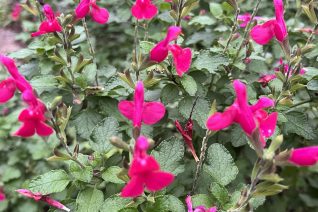
Salvia ‘San Carlos Festival’
Always on the lookout for cold and wet tolerant Salvias, this one has been a winner. Forms a woody structure topped by lush light green foliage. Beginning in July and continuing until frost hot magenta pink flowers appear again and again. Loved by hummingbirds and all sorts of pollinators. Incredibly long blooming plant that gets by on a minimum amount of water each summer. Very well drained rich soil. Regular summer water speeds growth and makes a bigger plant that is ultimately hardier to cold. Laughs at the reflected heat of hellstrips. To 2′ x 2′ in a season. Regenerates from the roots following a hard winter. Cut back in early spring after all danger of frost has passed. Faithful deep soaks will propel it to bloom well into autumn.

Salvia barrelieri
We love North African Sage from the higher elevations of Morocco it performs beautifully in our climate. A rosette of low large sage green leaves is your first clue that this is a cool species. In summer 4′ spikes in whorls of blue and white flowers are spectacular. The blooms last a long time (6-8 weeks) and are awesome for cutting and including in huge, wild flower arrangements. Forms large clumps in time and there will be more and more flowers. Full sun, rich, well drained soil with regular summer water to establish after which light to little summer water is necessary in our climate. Very easy to grow and cold hardy. May self sow in open disturbed sites. Great Salvia but surprisingly difficult to find.

Salvia cohuilensis ‘Nuevo Leon’
This may be a simple species but since we acquired it with this cultivar name I am loathe to change it until I am perfectly sure. A hardy long blooming Salvia that can become fairly woody with time but also spreads underground by stolons to form expanding patches. Full sun, very well drained rich soil with regular summer water. Thrives in the reflected heat of the hellstrip. To 1′ tall and 2′ wide in 5 years. Do not cut back until new growth pushes in spring. Flowers are deep purple/blue and appear from spring to autumn taking a break during 100ºF stretches. Aromatic foliage. Hummingbird favorite.Regular summer water for the first summer speeds establishment in subsequent years light summer water.’

Salvia gregii ‘Rossetto’
Excellent seedling of ‘Playa Rosa’ with deep clear pink flowers for months and increased cold hardiness. To 20″ x 20″ in a season this is a ‘woody’ sage that forms a small shrub. The vivid pink flowers begin in late May and continue to frost. It takes a break from blooming in extreme heat (above 95ºF) but flowers return when cooler air arrives. Full hot sun to part shade in rich, WELL DRAINED soil. A slope is ideal- especially if it faces south. Light, consistent summer water, speeds growth, establishment and spurs rounds of bloom. Loved by hummingbirds and butterflies. Do not cut back until early spring- when all signs of a hard freeze have passed. It may be cut back hard then and will quickly erupt into a blooming machine. Great in seasonal containers. ‘Rossetto’ is lipstick in Italian. Thanks to my friend Ann Amato for the name.
Xera Plants Introduction

Salvia microphylla ‘Flower Child’
This species has yielded some very good cold and wet tolerant cultivars. This selection from Monterey Bay Nursery in Watsonville, CA has proved to be one of the best performers. Masses of outward facing candy pink flowers swarm the stems of this large, semi-woody Salvia. The flowers begin in May and continue unabated to frost. This is a very good hue of pink, very mixeable with other colors without clashing. To 2′ tall x 2′ wide in a single season. Well drained soil of rich to average fertility. Double dig the soil before planting to incorporate oxygen and improve drainage as well as water permeability. It excels on slopes in full all day sun with just light summer water. Flowers continue through the hottest weather- good trait in our climate where many others take a break in in the mid to upper 90’s. Drought adapted when established. Do not cut back until new growth emerges in spring- then it can be taken back by 2/3rd. New growth will erupt from semi-woody stems around the base and you are up and running. Herbaceous below about 15ºF. Returns from the base if established. Hummers, butterflies, chicks without bras dancing around like nymphs. Its got it all. Moderate deer resistance.

Salvia microphylla ‘La Trinidad Pink’
This species of semi-woody Salvia has produced some of the best for our climate. Shocking pink, relatively large flowers decorate the upward stems of this vigorous and long blooming perennial. To 26″ tall and forming a semi-woody shrub. In essence it is a subshrub which is woody with time but capable of freezing to the ground and returning from the base. The vivid flowers appear from May to frost and are a delight for pollinators, hummingbirds and pink-o-philes. Full, hot sun in a warm position in rich, WELL DRAINED SOIL. Double dig the soil before planting to incorporate oxygen and make it easier for water to reach the roots. Do not prune back in spring until you see new growth. Either from the tips or the base depending on how cold the previous winter. Cut back hard then and it will zoom back to its former stature in no time. Hot sunny places, hell strips, containers. Excellent on hot slopes.

Salvia microphylla ‘Royal Bumble’
This is red, no pink, very little orange, true blasting red. Our employee Chris thought we needed it and after observation I heartily agree. Bushy semi-woody perennial to 30″ x 30″ for full sun and rich well drained soil. A slope is best. Blooms unabated from May to frost. It takes a break in temperatures above 97º but resumes blooming with a cool down. This is redder ( with no white) than Hot lips with very large flowers in deeply colored calyxes. We have been impressed with the cold and wet tolerance of Salvia microphylla. Of utmost importance is to refrain from cutting them back until all danger of frost has passed, then you can go for it and regrowth to bloom is rapid. Obviously a hummingbird attractant. They stake them out, they fight and its all good fun. Long blooming Light deer resistance. Drought adapted when established.

We all agree at Xera that this is a fantastic new color form of cold hardy little leaf sage (Salvia microphylla). The large flowers begin as dark blue in bud and open to a wonderful true light blue. Compact growing to 2′ x 2′ and it blooms continuously for all of summer into early autumn. The flower color is vastly different than ‘Flower Child’ pink and ‘Royal Bumble’ red. It is not only a wonderful border plant its compact habit and continuous flowering make it a wonderful container member as well . This is one of the most visited plants for hummingbirds. Enriched soil that drains in full sun. It will perform well in morning sun only or afternoon sun only. Regular summer water leads to the best blooming. Combines deliciously with chartreuse foliage or paired with lavender flowers. Do not cut back this perennial hard until all chance of frost has passed in spring (after Apri 15th) You may tidy overgrown plants at the end of summer or into fall, but do not cut back hard. Very easy to grow perennial and a wonderful flower color. Semi-deciduous to deciduous in winter. Excellent performance at the Oregon coast.

Salvia muelleri
This purple flowered royal sage has impressed us for years with its hardiness to cold, true purple flowers and tolerance of cold winter wet. A loose spreading perennial that adorns its tips with royal purple flower from June to frost. Never dense it prefers full hot sun and very well drained soils and light but consistent summer water. To 18″ tall by 2′ wide in time. Do not cut back until new growth pushes in spring. It needs a woody framework of branches to protect the overwintering crown. Takes blasting hot conditions. Moderate deer resistance. Very long blooming perennial that doesn’t flinch at heat and drought. The royal purple flowers are held in black calyxes. Excellent on slopes. Some wonderful companions are Epilobium (Zauschneria) septentrionalis ‘Select Mattole’ and Cuphea cyanea ‘hirtella’. Long lived perennial.

Salvia nutans
Nodding Sage. There is no Salvia quite like this remarkable species from the mid-asian steppes. A basal rosette of large leaves supports towering 4′ stems that erupt from the center of leaves. In May-August each stem hosts multiple nodding clumps of extremely showy blue flowers. Elegant, beautiful and hardy. Forms increasing clumps in rich to average well drained soil in full sun to very light shade. Appreciates good drainage and light consistent summer water. The blue flowers are a magnet for pollinators and they swarm en masse. Excellent and groovy cut flower for large arrangements. Otherwise a stellar perennial for borders, even rock gardens. Completely winter deciduous. Blooms a long time. A Xera Plants favorite perennial.

Salvia spathacea
Hummingbird Salvia is a Californian Sage. In rich soil it spreads liberally by underground runners to colonize large areas. That is if winter does not knock it back. Large quilted soft green arrow shaped leaves appear in early spring, by late spring 28″ tall chalice’s of rich red/pink (Raspberry) flowers erupt from dramatic and well spaced whorls. Rich to average soil that drains well. Water well in the first season to establish then very light to none in subsequent years. A Salvia of southern and central California it has a distinctive aroma that is loved by some, despised by others. Mulch with dry leaves for the first winter or two. Doesn’t like wet plus subfreezing cold. Good, and restrained in a container. Protect containerized plants from extreme cold (below 20ºF). Nice and very dramatic cut flowers. Blooms March repeatedly until June. Great for hummingbirds, butterflies, and pollinators. Semi-deciduous in winter.

Salvia transylvanica
Excellent, cold hardy, easy to grow, showy blue Salvia that can be hard to find. Forms a rosette of large felted deep green leaves and in summer multiple candelabras of rich blue flower spikes appear. They are wonderful for weeks. If you remove spent spikes more will appear. Blooms (re-blooms) until September. Full sun, in rich well drained soil. Rises to 30″ in bloom and forms spreading clumps to as wide in several years. Wonderful border Salvia as it accepts regular water and rich conditions. Completely deciduous in winter. Emerges mid-spring- protect new growth from marauding slugs. Once its up thats much less of a problem. Combine with Lobelia tupa, Kniphofia ‘Lightning Bug’. Easy and spectacular. Loved by hummingbirds and pollinators.
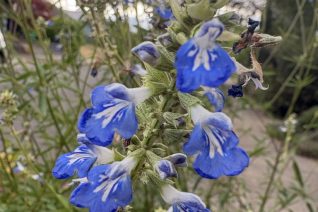
Salvia uliginosa
Swamp sage is actually very tolerant of dry to average conditions. This special sage from South America is surprisingly cold hardy and is a large reliable perennial. 6′ tall wand-like stems terminate in rows of sky blue flowers. There is a white nectary guide on the lower lip. Forms semi-woody clumps that expand at a moderate rate to about 2′ across. Freezes to the ground below about 20ºF but is root hardy near 0ºF. Rich to average soil with regular irrigation through summer. Full sun to very light shade. Blooms appear from early June to early autumn. Excellent in the back of a border or swimming in a sea of large ornamental grass. The medium green leaves are elongated with indentation and rise up along the stem. One of the easiest and showiest of sages. Nice cut flower. Moderate deer resistance.
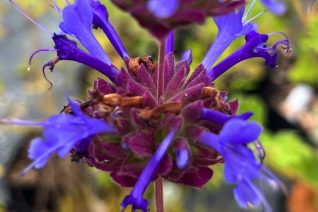
A hybrid between two southern California shrubby Salvias has yielded an amazing plant for our gardens. The parents of this hybrid are S. clevelandii ‘Alpine’ x S. pachyphylla and it continues the amazing foliage fragrance of Salvia clevelandii and the deep blue flowers in purple bracts echo pachyphylla. A shrub/ sub shrub for the very warmest parts of the garden. Against a south or west facing aspect. This Salvias parents come from poor, mineral soils and eventually the pale blue foliage builds to a 30″ x 4′ evergreen shrub. It loses some leaves in harsh winters . In mid to late summer upright stems support whorls that emit striking long deep blue flowers, these are held in a dark purple calyx – the each whorl is dark purple and showy before and after bloom as well. Takes the hottest locations and appreciates it. Strategically placed among large boulder that radiate heat is also useful as is in Hell strips where heat builds. The stems elongate in bloom up to 2′ and are lined with mutiple whorls. Perhaps no animal loves this sage or Salvias in general more than hummingbirds. And the radiant blue tubular flowers are perched just for them. Long blooming aromatic drought adapted sub-shrub. Good drainage, full sun, and regular water to establish, let it dry between watering during summer. Mix with Manzanita, Epilobium – Zauschneria, Grevilleas. Do not cut back until new growth begins in mid spring. Beautiful in bloom. Excellent with a gravel mulch and on south facing slopes. Protect from prolonged temperatures below 15ºF, cover with a cardboard box or a tarpaulin. Naturally drought adapted.

Salvia x ‘Christine Yeo’
Very good Salvia that blooms non-stop medium purple flowers for months in summer well into autumn. Tall growing to 3′ and somewhat wispy. A possible hybrid with the blue flowered Salvia chamaedryoides. Hummingbirds love this free blooming hardy perennial. Freezes to the ground below the mid 20’s. Returns from the base in spring. Rich, WELL DRAINED soil in full sun. Drainage in winter is the key. Add some pumice and gravel to the planting hole and water consistently to this plant good and established. Do not cut back in the spring until you actually see new growth pushing. Then remove all the dead material. Regains stature quickly in spring.

Salvia x ‘Silke’s Dream’
Brilliant and tall and hardy (!) Salvia that blooms continuously from late June usually up until frost. Large spikes of large tubular flowers are a curious hue. We’ve decided on Melon Red. How’s that for marketing? Other people say orange and still others scream red. The picture we have is the true color. To 30″ tall from a woody base. Not a real dense plant- kind of airy actually and benefits by having a more handsome plant in front. Hummingbirds die for this plant. Rich, WELL DRAINED soil in full sun with regular summer water. If it gets tired looking in mid summer simply give it a hair cut and water it and boom! Back at ’em. Do not cut back the plant in fall or winter- that will make it much less hardy to cold. Instead remove dead top growth when new growth emerges- usually around mid-April. Excellent performance at the Oregon Coast.

Salvia x jamensis ‘Nachtvlinder’
Exquisite hybrid Salvia that forms a semi-woody subshrub and is clad in velvety purple with reddish toned flowers for months. Its also among the most cold hardy selections that we grow. To 2′ x 3′ forming a bush. The opulent flower color pairs well with almost any hue. Its especially commanding near yellow or chartreuse. Full sun to very light shade in rich soil that drains. Add all purpose fertilizer to the hole and keep it very well watered throughout its first summer. Do NOT cut it back until new growth shows in spring. Then you will know what to remove. The woody structure of the previous years growth actually acts as an insulator during the winter- this is why we recommend not trimming it until all danger of frost has passed. Excellent container subject and irresistible to hummingbirds. Aromatic foliage. Harbors some deer resistance. Remove spent flowers to encourage more. This and many Salvias takes a break from blooming when the temperature is above 95ºF. It will quickly resume blooming when cooler weather arrives. ‘Nachtvlinder’ is Dutch for night butterfly. Exceptionally cold hardy.

Salvia x jamensis ‘California Sunset’
These hybrids come in such wonderful colors. This dashing Sage displays light orange flowers on tall stems from spring well into autumn. Forms a semi-woody shrub and relishes good drainage and hot locations. Great seasonal container plant as well. Best way to grow this Salvia is to double dig the soil to incorporate oxygen and then berm it up a bit. Plant and water faithfully all summer to spur bloom as well as increase the plants mass and establishment. This will ensure a sturdy plant going into winter. I wait to prune it back in spring until all danger of frost has past. In these conditions it will endure our coldest winters with no problem. Hell strip loving plant to 30″ x 30″. Hummingbird plant. Long blooming. Light deer resistance.

Salvia x jamensis ‘Elk Blue Note’
This is one of the best flower colors that we’ve encountered in a Salvia in quite a while. Always on the lookout for blue flowered Salvias this beautiful sage is blue right on point. Upright growing semi-woody Salvia that produces a non-stop supply of sky/ to periwinkle blue flowers. The spires of flowers rise to about 20″ tall forming a rounded sub-shrub as wide. Flowers begin in May. Long blooming perennial for hot, sunny spots. This Salvia would benefit from the added heat of reflected walls and sidewalks. Great near the curb in rich soil with regular water in summer. Flowers take a break in extreme heat but as soon as a cool down they begin again in earnest. Cut back hard in spring AFTER all danger of frost has past (mid-April) and no sooner. Excellent in containers as well. Easy, bloomy, lovely blue. Hummingbird favorite as well as a butterfly magnet. A xera favorite. Moderate deer resistance.
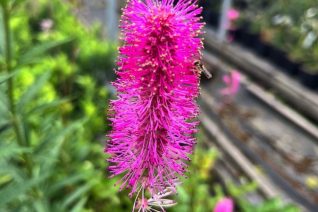
Sanguisorba hupehaensis
A great perennial all around, with handsome pinnate foliage and 30″ spikes that hold furry upright magenta catkin-like flowers. Beautiful. Blooms June-August in rich soil with regular irrigation. Not a fussy perennial by any means but it hails from Japan a summer rainfall climate and if you mimic that watering regime in your garden its simple. Completely herbaceous (deciduous). Seems to respond to rich conditions very well. Match with other perennials of similar culture such as Echinacea, Agastache, Erigeron. Forms tight but expanding clumps. Wonderful cut flower. Excellent pollinator perennial as well as visitations from Butterflies. Long lived perennial. Full sun to very light shade. If you remove spent flowers you may get a second round of flowers Tolerates heavy soil, with irrigation.

Sanguisorba tenuifolium ‘Korean Snow’
Big, Big, late blooming perennial that is very easy to grow and incredibly showy in bloom. 2″ catkin-like white flowers foam 5′-6′ above the plant in August-October. Excellent cut flower, Full sun and rich to average soil that is moisture retentive. Great in the back of a border where it will tower and wave its lovely pure white flowers in the breeze. Full sun leads to much more vertical plants. Regular summer water. Forms spreading patches. Completely winter deciduous.

Sanicula crassicaulis
Pacific Snakeroot is a fascinating native perennial that is native west of the Cascades from British Columbia south -to the tip of South America. A summer deciduous perennial whose presence is really from January to July- before slipping into summer/dry dormancy. This unique plant forms handsome palmate leaves that are edged in black when young. As summer approaches the plant elongates up to 30″ tall and begins to bloom. Tight gold/charteuse inflorescence that must attract very specific pollinators. I know for a fact that it draws butteries because I vividly remember them visiting this plant in the country. I’ve always found this easy growing plant pleasant and I have to admit that it is present in just about every biome west of the Cascade Crest. At the coast it is nearly evergreen – no need for summer dormancy. The small spiny seeds that perch at the top of plant are carried away by animals. Adapted to a LOT of soil conditions including compacted xeric clay. Forms increasing rosettes to 18″ across. More than likely you will find seedlings. Found in the Willamette Valley with Dodecatheon, Camassia, Rosa, and in shade with Symphoricarpos and Polystichum. Full sun to full shade. Not eaten by deer. Oregon native plant.

Schizachyrium scoparium ‘The Blues’
A fantastic grass that performs wonderfully well in our climate. A clumping grass with very upright blue foliage. In summer inflorescences rise above the leaves with fine fluffy whitish flowers- provides a dramatic hazy effect. In autumn the 28″ tall grass becomes a whole other color palette. Deep raspberry and purple with tints of red before going over to all all reddish orange. An excellent color trip not the way to dormancy. When dormant it remains a presence and looks nice through winter. Cut down to the ground in late winter/early spring to make way for fresh new foliage. Not evergreen. Average to enriched well drained soil with light summer water. Established plants in reasonably good soil will sale through summer drought with no ill effects. Clumps expand over time to 2′ wide. Full sun. Easy grass. May self sow in open disturbed soil.
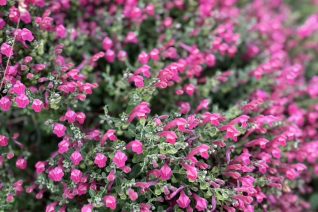
Scutellaria suffrutescens
Texas Cherry Skullcap – its actually native to N. Mexico -is a wildflower with a mission. To bloom – not just a little but in sheets for all of summer with no supplemental irrigation. And I’ll be damned if it doesn’t do that. Forms lows domes to 5″ high by 1′ wide and is smothered in cherry pink flowers from June well into autumn. Rich to average well drained soil and occasional summer irrigation. Cut back in spring after new growth has commenced. Full all day sun, reflected heat and not much else. Long lived and virtually carefree. One of the best surprises in my garden of the past 10 years. Excellent perennial that survives, grows and blooms prolifically with no summer water. Even in the drought and heat of 2021. Extraordinarily adapted to baking hellstrips.

Sedum confusum
Useful and pretty evergreen Sedum that thrives in diverse biomes but always looks good. In dry dappled shade it will create a dense spreading deep green colony. To 5″ tall by several feet wide. In full sun it will grow a little slower but regular water will speed things up. The bright green rosettes of leaves are perched atop stems. In early spring the whole plant is awash in gold flowers and attending pollinators. Rich, well drained soil with light but consistent summer water. The more shade the less water is required. Nice ground cover for small areas. Dense and evergreen. Surprisingly cold hardy and amenable to life in our climate. Mexico.

Sedum divergens
Oregon native Sedum that is found at mid and high elevations of the Cascades. It makes its home on recent road cuts and rocky, gravelly cliffs. Small rolly polely green succulent leaves line trailing stems. Very juicy. Forms a thick evergreen mat in full sun to part shade in well drained soil. Excels in enriched soil that also drains. Light to regular summer water to retain luster otherwise completely adapted to summer drought. Rock walls, containers, rock gardens. Easy to grow native that is one of our most attractive stone crops. In late spring 4″ stems rise with clusters of bright yellow/gold star shaped flowers. As with all Sedums they are coveted by pollinators. Takes on red tints in cold weather. Evergreen. Oregon native plant.

Sedum oreganum
Not hard to tell where this stone crop is endemic. It resides mostly in the middle elevations of the western Cascades. Rocky slopes, cliffs, and road cuts is where you find the clusters of small green rosettes that makes large colonies. In summer 4″ stems arrive topped with bright gold/yellow flowers- a pollinators dream. Little spreading plant to just inches high but expanding to several feet wide in well drained, somewhat enriched soil with light summer water. Full sun to quite a bit of shade. Forms a dense mat and may be used as a small scale weed blocking ground cover. Easy to grow plant. Roots into the ground as it spreads- evergreen. Excellent winter container subject, it will happily trail over the edge of pots. The yellow flowers are specific to some of our most endangered pollinators. Very cold hardy. Oregon native plant.

Sedum oregonense ‘McKenzie River’
Creamy stone crop is a common succulent of mid to higher elevations of the Oregon Cascades – it can also be found in the Siskiyous. This is a common plant on rocky slopes, scree its even adaptable to heavier soils. Gray white leaves are crowded into rosettes. In spring stems rise to 6″ tall and produce creamy light yellow colored flowers. Absolutely adored by pollinators this very easy to grow perennial adapts very well to gardens. Its useful in rock gardens, troughs, containers in full sun to very light shade. Light summer water to very little, A classic plant of the Oregon Cascades. Primarily above 2000′. Evergreen. 3″ tall out of bloom and spreading to form large clumps several feet across. Not bothered by deer or rabbits. Lovely Oregon native. The cream/ivory flowers are a welcome respite where all other Oregon sedums are bright yellow. . Oregon native plant.

Sedum rubrotinctum
One of our favorite trailing succulents for containers. This is a half hardy Sedum (Zn8b) that will persist in most gardens most winters. Rolly poly emerald green foliage takes on dramatic red tints- especially on the older leaves. To 6″ tall and 20″ wide in a season. Rich, WELL DRAINED soil with light summer water. Full sun to part shade. I don’t think I’ve ever seen it bloom and I don’t really care. Trails 1′ over the edge of containers. Mix with other succulents or low water perennials such as Erodium or Scutellaria. Excellent performance at the Oregon coast.

Sedum rupestre ‘Angelina’
Immensely useful, if rambunctious sedum that glows in vivid gold to chartreuse. The needle like leaves are vivid and line trailing stems. The stems root where they hit the ground- good local solution for erosion. Fast growing plant that spreads indefinitely in sun to quite a bit of shade. So easy to grow that I suggest you plant it in AVERAGE well drained soil. No need for amendments because the truth is once you have this plant you will always have it. Evergreen. Easy to remove from unwanted places. Simply pick it up off the ground and dispose. Or move it. I use this plant as a fast low water place holder when I’m deciding what to put in next. To plant simply toss it on the ground and water. You can bury it a little but its really not necessary. Avoid strongly compacted soil. Yellow flowers in early spring. Nice ground cover under trees. Hardy. Oh, so hardy.

Sedum sediforme ‘Spanish Selection’
A really good Sedum that I got from a friend who collected it on the Iberian Peninsula in the Spanish mountains. Very soft blue gray foliage is shaped like pine needles lining trailing stems. Forms a good ground cover very fast. In summer 10″ vertical stems support clouds of soft off white flowers. Very different from so many other Sedums that bloom yellow. This soft color is very effective in the garden and of course draws pollinators from miles around. When spent the stems remain erect and turn gray- they may easily be collected by simply giving each a soft tug- or a whole a handful and they will break cleanly. Full sun to very light shade. Average to enriched soil that is not compacted. Good looking year round appearance. Not quite as dense or prolific as Sedum reflexum but still good. Slopes, between shrubs, as competition for weeds. Roots along the ground as it grows. Moves with ease and may be used as a temporary place holder while you think of what to plant next. Simply scoop up the foliage and move it to another place. Actual planting is not necessary. Share with friends. Great in seasonal as well as winter containers. To several feet wide. Light summer water or none when established. Easy plant.
Xera Plants Introduction.

Sedum spathulifolium ‘Cape Blanco’
An old standard form of our native and widespread Stonecrop. This form is unique for its very pale gray almost white rosettes of leaves. It spreads vigorously in rich to average well drained soil with light summer water. Soil should be light and not compacted. It makes a very good small scale ground cover. Also excellent in rock gardens and even winter containers. Great long lived and easy container subject. To just inches high a single plant can reproduce to several feet wide. In late spring 6″ stems grow upright to display masses of brilliant yellow flowers. Adored by all pollinators. When cold wet weather arrives the entire plant takes on red/raspberry tones. Very pretty. Easy to grow native perennial. Full sun to quite a bit of shade. Oregon native plant.

Sedum spathulifolium ‘Carnea’
Interesting form of Stone crop that has foliage that takes on brilliant red/purple tints in cold weather or with drought stress. Powdery blue foliage is arranged in rosettes at the end of 3″ stems. Starting with the outer most leaves the vivid tints become most apparent in mid-late summer through winter. Red stems support clusters of gold/yellow flowers in early summer. Excellent pollinator plant as are all Sedums. Easy to grow in any soil that drains reasonably well. In regular ground double dig the soil to incorporate oxygen into the soil and avoid compaction. It will spread to multiple feet across in short order. In rock gardens it can be a little rambunctious around delicate plantings. Give it room and plan for it to spread. Great in seasonal containers, troughs, rock walls. Light summer water speeds the growth rate- it also inhibits the bright color. Oregon native plant.

Sedum stenopetalum var. douglasii
Pine Sedum is common in the rocky outcrops of foothills and mid-elevation mountains throughout the state. You’ll find it clustered around crevices and on scree at the base of cliffs. Fine stems support clusters of deep green pine needle-like foliage. In summer its crowned by clusters of deep yellow flowers. Not as showy as other native Stone crops but pretty none-the-less. To just 3″ tall and forming clumps to 1′ wide. In the garden give it enriched, fast draining soil with light, consistent summer water- this improves the overall appearance. An interesting native Sedum for containers, rock gardens, borders, dry gardens. Evergreen. Very cold hardy. Oregon Native Plant.

Sempervivum ‘Koko Flanel’
There are so many good Sempervivums (Hens and Chicks) but it seems that you only see the same 3 kinds over and over. We dug a little deeper and found a collection of exceptional cultivars. This girl/guy forms a very dense rosette with closely spaced leaves in a spiral arrangement. The older the leaves the more red as an under color with soft white hairs all throughout. New leaves have an aquamarine glow. Nice little symmetrical multicolor effect. Things go more towards green in the heat of summer. Pink flowers rise up on 6″ spikes spring to autumn- whenever it feels like it. Great container plant or small scale ground cover- this one multiplies very fast by offsets. Baby you’ve come a long way. Rich, well drained soil with light but consistent summer moisture. Rock walls, troughs, winter containers.

Sempervivum ‘Lotus’
OOOMMMMM. Large growing Hens and Chicks with pale lavender gray rosettes to 5″ across. Very showy and multiplies moderately fast. Full sun to part shade in rich, well drained soil. Regular water speeds growth and size of the plants. Otherwise extremely drought tolerant..in really dry conditions the rosette will shrink and go to sleep- awakened by autumn rains. Nice small scale, dense ground cover. Striking in living walls and a natural for containers. 5″ spikes send up pink flowers spring – autumn. Good looking year round. This one is the size of a small Echeveria and would make a good replacement that is actually permanent. Easy.

Sempervivum ‘Maria Laach’
Pretty Maria. Bloody Maria. We have no idea why they named this stunning blood red Semp after her but I’ll bet its quite a story. As this is quite an extraordinary Hens and Chicks. Blood red tipped leaves often fade to green near the center of the rosette. Redder in summer in full sun in average, well drained soil. Each 3″ wide plant is in a continuous color change so its a varied pattern. Forms expanding colonies quickly. Full sun to part shade. Light summer water. Very good for contrast in rock gardens, rock walls, crevice gardens. In summer 4″ stems display red flowers. Easy to detach and move babies. Tolerates drought by shrinking, puffs back up with the first rains.

Sempervivum ‘Pacific Zofic’
Fast multiplying Hens and Chicks that is covered in white fur. The silvery white fur covers new foliage in the center that is aqua changing to pink on the external rosette. In spring to autumn it can produce 5″ spikes of pink flowers. The rosette where the flower spike originates then dies but there are so many offsets you barely notice. Excellent in containers, rock walls, as a small scale ground cover. Good appearance in winter. Rich to average soil with regular summer irrigation to speed growth. Otherwise very tolerant of dry conditions – the rosettes shrink a bit in this phase. Sempervivums LOVE fertilizer. Enrich the soil with all purpose organic fertilizer before you plant and enjoy much LARGER plants. Rosettes to 3″ across.

Sempervivum ‘Reinhard’
A really fun and rightfully famous cultivar. Celery green leaves are tipped in black. Very dramatic and the kind of contrast that makes a plant stand out. Rosettes are 4″ across and offsets are produced constantly. Very pretty dense small scale ground cover. Rich, well drained soil with regular summer irrigation. Deals with drought by shrinking. They rehydrate with the first rains. They look better and grow faster with water. Excellent in containers, crevice gardens, rock gardens, rock walls, troughs. I’ve never seen this variety bloom but I assume the flowers would be red or white…doesn’t matter thats not the point. Detach babies and give to neighbors with the official name. Increases its specialness, impresses the neighbor. This would be a good variety for a living wall.

Sempervivum ‘Saturn’
Probably the best standard red Sempervivum. Its been around forever and its a good cultivar. Given rich soil that drains well but is enriched with fertilizer a single rosette can swell to 6″ wide. its impressive. So fertilize your Hens and Chicks and turn up the scale. Forms prodigious offsets quickly. These can be stuck in the soil wherever you can’t get enough of Sempervivum ‘Saturn’. Full sun give the best color red as well as a bit of stress. Red persists through winter which is useful for winter containers. Makes a good small scale ground cover that is dense enough to suppress weeds. Don’t try to cover an area more than a few square feet. This plant doesn’t do that. Living walls, crevice gardens, rock gardens, rock walls. Hot slopes. Drought stressed plants don’t die they shrink and plump back up quickly with irrigation. Pink flowers in summer.

Sempervivum ‘Virgil Ford’
Collectively this handsome Hens and chicks is one of our favorites. Soft pink to lavender and tipped with purple in cold weather. Nice. Large rosettes to 5″ across when happy. Boisterous multiplier and forming large colonies quickly. Rich, well drained soil with regular water to keep up appearances. Containers, rock walls, rock gardens, as a small scale weed smothering ground cover. Full sun to light shade. Even dry shade when established. Detach the babies and give them to a friend. Or chuck them at a Trump voter. Pretty plant. High deer resistance.

Sempervivum arachnoides ‘Robin’
RED Robin! Thats how we remember the name of this snappy Hens and Chicks. Tightly growing leaves in a medium sized rosette to 3″ across. The interior of the leaves are bright red with green leaf tips. Multiplies quickly. Retains these bright colors well throughout the year- where as some can become rather dull in winter. Spring – Autumn it may shoot up a 5″ spike bearing pink/red flowers. The rosette then dies but there are so many offsets that you would never know. Move them around the garden like furniture. Easy. Give them to friends, knock squirrels out of the tree with them. Fun to grow. Interact with your sempervivums and all will be good. Full sun and regular summer water to remain vigorous and bright and showy.

Sempervivum arachnoides var. pittonii
Cob webs cover this adorable and fast multiplying Hens and chicks. The hairy webbing is a successful strategy to stop transpiration of liquid from the leaves and cool the surface as well. 2″ wide rosettes create many offsets in a short amount of time. It makes a good small scale ground cover From spring to autumn it may produce a 5″ stem directly from the center of the rosette and bear rows of rosy pink flowers. That rosette then dies but it produces prodigious amounts of babies. Full sun to part shade in enriched, well drained soil with light summer irrigation. Without irrigation it will survive but shrink. Containers, rock gardens, gravel gardens. Good appearance year round.
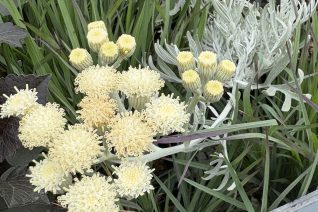
Senecio vira vira
This is a fantastic perennial for soft white/gray foliage and soft cream ray flowers. Wonderful in container plantings this tough plant can squeeze into the tightest places. To 2′ tall x 2′ tall in a season. The bold houndstooth foliage shines with bright or more pastel flowers. Hardy to about 10ºF it is winter deciduous most winters and you can lose it in our hardest winters. Add a little mulch in the autumn to establish and then its fine in subsequent years. Mixes exceptionally well with dark leaved Dahlias or the more pastel flowered Cuphea c. ‘Subhirtella’. Rich soil with light consistent irrigation in full sun. The petal free flowers are a nice cream color (as opposed to yellow) and marry’s the foliage for a continuous look. Native to the Canary Islands.

Seseli gummiferum
Moon carrot Moon carrot. Trendy, cool, avant garde and of course its an UMBEL! Umbels are in, Umbels are in! Full sun and well drained soil of average to rich fertility. The second season a crazy number of tall flowers yield groups of umbels. Umbels upon umbels. Can you dig it? To 30″ tall and as wide. Moderate deer resistance Great cut flower. Blooms for up to two months. Easy to grow. Dislikes shade intensely. Biennial or short lived perennial.

Sesleria autumnalis ‘Campo de Azul’
An autumn moor grass with distinctive differences. Very blue upright, stiff foliage forms a large expanding clump. In mid summer through autumn (and beyond) 18″ straight vertical stems support gray/black flowers frosted with light yellow pollen. Excellent appearance year round for an evergreen grass to 1′ tall and 2′ wide in several seasons. Well drained average to enriched soil. Light, consistent summer water in full sun. Excellent massed, plant on 2′ centers. Flowers slowly decay over winter and spent stems may be cut away. Refrain from cutting this plant back to the ground. Winter damage will be covered quickly by new growth in late winter to early spring. Establishes quickly. Cold hardy below 0ºF. Native to Italy/Croatia- its adapted well to a summer dry climate. Nice looking grass.

Sesleria autumnalis ‘Campo Verde’
Crazy cool grass that is handsome year round- not entering dormancy in winter and they bloom on compact plants for several months. This mediterranean native grass forms lose but not unkempt bunches of arching evergreen foliage. The floral spikes rise another several inches above the foliage for a complicated texture. Full sun, well drained soil, little water once established. To 14″ tall and 20″ wide. 1′ tall in bloom. Very drought tolerant and does not really go through a down time remaining the same aesthetically all year. Accepts regular irrigation with excellent drainage.

Sidalcea asprella ssp. elegans ‘Josephine’
Beautiful Oregon Native Checker mallow that has handsome deep green glossy scalloped leaves and for all of summer a continuous supply of long stems clad in rows of cup shaped pink flowers. Adapted to heavy soils that dry out completely. But improves greatly under cultivation. Flowering stems stretch horizontally and wind their way through neighboring plants. Cute cut flower. Excellent in borders or no water landscapes alike. To 18″ tall in bloom and spreading to about 3′ wide. Long lived and easy to grow. Native to western Oregon. Our selection of a deep pink and prolific bloomer. One of the naturally longest blooming varieties that can remain in bloom for months. Excellent perennial for drawing butterflies. The long stems of cup shaped luminous pink flowers work well as cut flowers. Light summer water and rich soil prolong its performance. Palmate leaves are glossy and good looking. Oregon native plant.
Xera Plants Introduction

Sidalcea campestris
The Willamette Valley is the center of the Sidalcea universe. Willamette Checker Mallow is a fantastic long lived native perennial that thrives in gardens. In May-July and sporadically later stems rise up from low foliage to 14″-36″ and support many soft pink flowers. Loved by pollinators and very easy to grow. This perennial inhabits slopes around the Willamette Valley in very heavy clay soil that dries out to concrete in summer. Adaptable to richer conditions, it also encourages a longer bloom season. Full sun to part shade. Native in Oregon Oak woodlands with Oregon Iris, Shooting Stars (Dodecatheon hendersonii). Pretty meadow flower that combines well with native grasses and the aforementioned perennials. Established plants can get by with very little water. Forms a spreading clump to 2′ wide. This species and several others have a natural range that is defined by the Willamette Valley. Its a special member of the Valley biome. Common associates in the wild are Rosa nutkana var, nutkana as well as Lupinus of various kinds. Good cut flower. Winter deciduous Long lived perennial. Very important for native butterflies. Its a host plant for gray hairstreaks and a nectar source for Fendler’s Blue butterfly. Oregon native plant.

Silene alpestris ‘Flore Pleno’
I love the crisp detailed pure white flowers that float like little pieces of perfect oragami on 6″ stems. Forms continuous evergreen patches in well drained soil with light summer irrigation. Full sun to very light shade. Incredibly long bloom season, March to November. And sometimes longer. Excellent in rock gardens, as a trough plant, or container plant in general. Hardy and easy to grow. Makes a precious delicate cut flower. So white. So, crisp and white. Not tolerant of shade. Excellent long blooming small scale ground cover to line paths, create a pool of crisp white flowers. Europe.

Sisyrinchium ‘Quaint and Queer’
Sweet little blue eyed grass with a penchant for being different. Eschewing the purple and yellow and blue flowers commonly assigned to this genus this little freak puts out simple flowers with petals that alternate soft tan and purple. Its a groovy combination and adds a wild flower flare on long thin stalks to 18″ tall. Forms increasing clumps of grassy blue/green foliage. Deciduous in winter. Full sun and rich to average well drained soil with light but consistent summer water when established. A good sized clump can measure about 10″ across after several years. A charming perennial that we have found is excellently adapted to the open mindedness of the west coast as well as climate. Easy. Gay Iris relatives are few and far between. Treasure them. Moderate deer resistance.

Solanum (laxum) jasminoides
White Potato Vine is an incredibly floriferous plant. Large and profuse clusters of stunning star shaped flowers are clear white and appear continuously from May to frost and if winter fails to materialize even longer. Semi-tender in our climate it requires protection for the base and rich, well drained soil. Vigorous climber to 12′ in single season. If it freezes the ground- this happens below about 20ºF it can break from the base and regrow quickly. In Portland this happens about every 3-4 years. Climbs by modified leaf petiole and requires substantial support. Personally, I think the best way to grow this everblooming vine is in containers, even window boxes where the plant will become a trailing cloud of white stars for months. Blooms on new wood, it may be pruned at anytime. Mulch the base in fall with compost or leaves and place against a warm wall or in-between close shrubs that will bolster further protection. Loved by bees and bumbles. Regular deep summer water produces the best results. Full sun to very light shade. Spectacular performance on the Oregon Coast. Native to Chile/Argentina.

Solanum crispum ‘Glasnevin’
Purple Chilean Potato Vine is a flowering powerhouse. It may be grown as a free standing shrub but its true habit lends it to the treatment of a vine. Fast growing huge canes soar up and then over all the while branching. At the tips dramatic deep purple/blue clusters of flowers each with a yellow central “Beak”. The effect is reminiscent of a hydrangea in form.- and flowers obscure the foliage for the first two months in bloom. To 12′ tall in short order and then larger. Allowed to scale a sufficient tree it can clamber up to 20′ tall in no time. Blooms April to October. Large flush of flowers in late spring then sporadic clusters to autumn. Semi-evergreen to deciduous. Blooms on wood from the current season prune before or after blooming. Regular summer water extends the bloom time well into autumn. Sometimes forms yellow berries- not particularly showy but not messy. Full sun to part shade in rich, well drained soil with light summer water. Hardy to 5ºF and not below. Long bloom time makes it an excellent pollinator plant. VERY showy in bloom.

Solanum pyracanthum
My half hardy perennial can kick your perennials ass. And this spiky creature is a damned fine plant. Large lobed leaves are fiercely armed with bright orange spikes down the midrib. Violent orange spikes also cover every stem and virtually glow when backlit. All summer long this large tender plant (to 3′ x 2′) bears large solanaceous 5 petalled purple flowers with a central orange beak. The overall effect is beyond charming, its a fierce plant with attitude and we adore it. Great in containers but mind that this sucker does have a bite, locate away from traffic. Very fun to grow in the ground as well. Hardy to the low 20’s and sometimes makes it through a mild winter. Orange fruits follow the flowers but are not assured. One of the amazing plants native to Madagascar. Full sun and rich soil with regular water. Basically grow it just like a tomato. Highly deer resistant.

Solidago canadensis var. elongata
Our own west coast form of Golden Rod which can be found in vernally wet locations or even fence rows. Vigorous, strong growing perennial that erupts in plumes of golden flowers from August to October. Spreading via runners it can take up quite a bit of space in lush environs. Best to grow it in un-amended soil with light summer water. Full sun to very light shade. Handsome mid-green leaves line nearly woody stems to 32″ tall. Spreads as far as you let it. Sleeps the first year- LEAPS the second and you have been warned. That having been said its a wonderful romping native perennial for late season pollinators. Its very easy to grow and long blooming. I wouldn’t plant a Willamette Valley meadow without this plant. And my, do you get good bugs. VERY good bugs. Lightly fragrant flowers are great in late season arrangements. Best to pair it with a companion that is just as rambunctious- we select Symphyotrichum subspicatum our native Douglas Aster. Not only do they match each other they make a splendid floral complement and bloom simultaneously. And it will triple the amount of pollinators. Foliage can take on orange/yellow tints in late fall. Cut back in early spring. – but fairly self sufficient. Oregon native plant.

Solidago elongata ‘Bee’s Knees’
This is a wonderful compact and shorter growing golden rod that we found from seed. To just 1′ tall and spreading to form a colony this smaller version fits in tighter places. The large conical flowers are erect at the top of the plant. An excellent version of one of the best pollinator perennials for late summer and early autumn. Average soil with light water to establish. Occasional water after that speeds growth. Mix with other late season native perennials such as Douglas and Halls aster. Winter deciduous and the stems become semi woody and can be left to supply seeds for birds throughout winter. The woody stems can be removed in early spring. This well sized and showy perennial is not only climate adapted its a very long lived perennial. Adaptable to heavy clay soils and drought. Adorable native perennial. To 3′ wide in time. Oregon native plant.
Xera Plants introduction

Solidago lepida ssp salebrosa
Big in every way this Golden Rod of the west rises on sturdy semi-woody stems to display a chalice of fragrant gold flowers. Better put in latin the broad flowers are pyramidal paniculiform arrays, That about says it. Large growing perennial that is found in specific wetland sites around the state (and the west). It spreads laterally by strong rhizomes with stems that rise to 4′ tall. The PYRAMIDAL PANICULIFORM gold flowers emit a sweet pollen fragrance. This and the fact that it is in the daisy family draws a broad amount of pollinators from far and wide. It dies down in winter and the previous years stems can be taken away then. Give it at least 5′ x 5′ to roam. Water to establish then a light consistent water in summer for best flowering. Full hot sun not tolerant of shade at all. A large, regal cut flowers for big displays July-September. This form was found in the Columbia River Gorge near the river. It can also be found around wetlands in arid parts of the state as well as river courses along the west side. The underside of the stems flashes silver with green on top. These incredibly sturdy vertical stems will never topple. Mix with Hall and Douglas Asters for similar space, bloom time and vigor and you’ll quadruple your pollinators. Oregon native plant.

Sollya (Billardiera) heterophylla
Australian blue bell creeper is a tender evergreen vine that we adore for seasonal containers and its long season of bloom. Oblong mid green foliage lines woody twining stems. On wood from the previous season and new wood a continuous display of pendant small sky blue flowers. The clusters are both nestled in the foliage and on the exterior of the plant for a very complete show. Blooms continuously from May to as late as early August. Lozenged shaped blue drupes follow the flowers. A reserved growing vine to 6′ in a single season and branching well. Best in a container with a sturdy support such as a metal obelisk. Cold hardy to about 22ºF – and has great performance on the Oregon coast. Move containerized plants to an unseated garage to protect from temperatures below 20ºF. Most winters it is semi-deciduous no matter the weather, quickly gaining new foliage in spring. The dainty, profuse flowers give this member of the Pittosporum family charm. Very easy to grow. You may cut it almost to the ground in Spring to refresh and definitely apply a handful of all organic fertilizer. This vine can expend the nutrients from a container in a season. Regular H20 speeds new growth which in turn produces new flowers. Native to South Australia where it has escaped as an invasive in other parts of that continent. No problems here. Very pretty.

Sphaeralcea ‘Hot Pink’
Globe Mallow. Fun and easy to grow perennial that behaves like a sub-shrub. Semi woody wands of very silvery small maple shaped leaves wave to 3′ tall. Lining these silver stems are bowl shaped hot pink flowers. They begin as early as late May and continue unabated for months. As time goes on this perennial for dry, hot locations with good drainage becomes a showy hot pink mass of blooms. Excellent on hot slopes with light but consistent summer water. Very drought adapted but light water appears to improve the performance. Loved by bees, butterflies and other pollinators. By autumn this 3′ x 3′ shrub should be left intact to over winter. In spring when new growth is breaking from the base it may be cut back hard and recovery to bloom is rapid with the onset of warmer weather. Cold hardier if given very good drainage. As far as I can surmise it will take temperatures down to about 10ºF. A selection or possible hybrid from two southwestern globe mallows.

Sphaeralcea ‘Newleaze Coral’
An American western native wildflower that was selected for its unique flower color in the UK. Well, welcome home my pretty globe mallow. A tall growing semi-woody perennial with soft gray/green foliage. From June to September and longer cupped vivid coral flowers line the 3′ stems. It blooms non-stop for up to two months. Very pretty. Full, hot sun and rich, to average WELL DRAINED soil. A natural for a slope or included in a border where you water just on occasion. Very drought adapted for full hot sun. Do not cut this big wavy perennial back in autumn- leave the top growth as added winter protection. Cut back by 2/3 when you see new growth pushing in spring. Good drainage is key for the combination of wet + arctic air. Dry its hardy way below 0ºF- moist- well, a lot warmer. Excellent long blooming tall plant for seasonal containers as well. Does not like shade. Don’t even try. To 2′ wide.

Sphaeralcea incana
We’ve been impressed with the performance of this striking very upright globe mallow. Spikes clad in soft orange flowers appear continuously for months in summer. To 4′ tall ultimately this forms a semi-woody clump to 2′ wide. Full, HOT sun and WELL DRAINED soil with light summer water. Freezes back in winter almost to the ground and vigorously resprouts for the base and grows quickly when hot weather arrives. Excellent on slopes, hot gravel gardens. Not bothered by rust or other diseases that can afflict mallows. Mulch lightly for the first winter for added protection. Stunning in bloom and carefree once established. Cut back dead top growth in mid-spring. Some deer resistance. Takes blasting reflected heat well. SW native plant.

Spiraea betulifolia var. lucida
This is the true Varnished leaf Spiraea that is native in the Portland area. The large fluffy inflorescences – almost furry and true tiny petals. This too is a wonderful shrub that is tolerant of a host of situations. It is native in the Portland, city limits and knowing where it grows will lead to success with this easy going native. To about 3′ x 3′ and increasing laterally by stolons. This low deciduous shrub is primarily a resident of high douglas fir overstory, but it can alsmost make appearance at the wetter end of oak savanna. The flowers appear from late spring to early summer. They are natural landing pads for butterflies even hummingbirds appear. Best in an open north exposure with regular H20 then the following year less to none. Its naturally one of the most drought adapted of this genus. Give this plant room to spread, interweave its way around Holodiscus and Symphoricarpos, Gaulthria shallon. in rich soil ( to begin its life and establish) Fall color can be yellow to peach and can also not really happen. Wonderful plant. Oregon native plant.

Stachys coccinea ‘Coral’
For flowers in this genus this is THE plant. Upright growing plant from a clump that rises to 2′ and produces multiple spikes of bright coral colored flowers. They are arranged in symmetrical whorls up the stem. Loved by hummingbirds who constantly seek nectar from the flowers that appear from late spring to late summer. When flower spikes are spent simply cut them away and water and more will arrive. Very easy to grow long blooming perennial for full sun to part shade in rich, well drained soil with light but consistent summer water. Very drought adapted when established. Works well in borders and even seasonal containers. The leaves have a very familiar lemon lime aroma. Dies to a low clump of foliage in winter.

Stachys lavandulifolia
Curious and pretty small perennial that has lovely leaves that have symmetrical black veins. As the plant expands it sends up spikes clad in frosty hairs around violet purple flowers. The don’t exactly go straight up but wind around a little bit. This gives the whole plant an overall haze that is truly fantastic. Appreciate sunny dry environs with sharp drainage but as rich of soil as you can muster. Ideally it finds a home in a dry border or rock garden. Winter deciduous perennial to 18″ x 18″ in a season. Blooms repeatedly all summer. Light summer H20 and drought adapted when very established. Mixes well with Cranesbill (Erodium) and Scutellaria suffrutescens. Pretty little cut flower that acts as a boa in a small arrangements. Very good butterfly and pollinator perennial. Absorbs blasting hot locations. Flowers when spent turn to light brown wands of fuzz- this extends this plants season of interest.
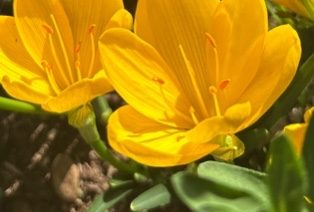
Fall Daffodil, this is one of the brightest and most cheerful of all fall blooming bulbs. This vivid yellow flowers emerge and bloom with the first fall rain and it blooms for an extended period from early September into October. It forms multiplying clumps in full sun and rich soil. The leaves follow the bloom and they are deep green and rise to 6″ tall and persist all winter.. No supplemental water is needed once established , it simply avoids summer heat and dry by going dormant when truly hot weather hits. There is no presence in summer and mark the spot so that you do not plant something in that void during summer. Very easy to grow and long lived. In rich well drained soil, they multiply faster, but it is not fussy and tolerates rockhard dry clay soils. Truly related to Narcissus this bulb has great deer, rabbit, and pest resistance. Native to hillsides in Crete. Beautiful bulb for September in rock gardens, the front of borders, lining paths. The upright yellow goblet shaped flowers recall a large Crocus. Perfect for mediterranean plantings with species from there. Often persists in the oldest gardens.

Stipa barbata
Silver Feather Grass- our favorite ornamental grass. From humble blue leaves that form an upright grassy clump stems rise to 4′. As the flower open they unfurl- curling 18″ long horizontally and covered in soft downy hairs. The slightest wind puts these streamers into graceful motion. Blooms June-July. When the flowers ripen and begin to detach they can be gathered and made into a bouquet and the tails will curl up and form a soft tan haze. An arrangement lasts forever. Often self sows in open conditions- and this is good because it is not an easy grass to germinate and does not work from division. Easy to move when small. Give it an open position where you can observe the streaming flowers unobstructed. Very hardy and little summer water once established. Full sun. Semi-evergreen foliage in winter. High deer resistance. Spectacular grass. See video below.

Stipa gigantea
This is the giant straight species that is so popular for its soaring silver stems and golden drooping awns. To 12′ tall in bloom from a tight but large basal clump of fine deep green leaves. Perfectly evergreen with a great winter appearance. Very easy to grow grass that provides spectacular garden effects. Incredibly drought tolerant in any well drained soil- including clay if it is not allowed to become bone dry concrete. Flowers make a great see through “scrim” in gardens. Fun to grow. Moderate deer resistance. Site where you want a see through hedge or texture that towers above you. Very cold hardy. Native to countries adjacent to the mediterranean. See video below IMG. 6620.

Stipa gigantea ‘Little Giant’
As if a wonderful grass couldn’t get any better this smaller version thrills us with so many more applications. A low clump of arching dense dark green evergreen foliage has a nice presence year round. In spring and continuing all throughout summer into autumn 3′-4′ spikes terminate in clouds of metallic golden awns. They sparkle in full sun and sway in the breeze- but are determinedly upright. The basal clump of leaves spreads slowly to 2′ wide in 5 years. Full sun and well drained soil- bud adaptable to anything but a bog. Evergreen. Cut back spent flowers in winter- or let them stay and wave around beckoning birds and wildlife. Moderate deer resistance. Little to no summer water when established.

Sycopsis sinensis ‘Narrow Leaved Form’
We have been so impressed with the performance of this small evergreen tree species that when we saw this charming narrow leaved form we snagged it. An upright growing but not wide tree to 18′ tall. The thin leaves are 4mm wide but up to 6cm long and are thinly produced so that the tree has a fine texture and is even better to view the late winter and early spring red brushy, flowers. Moderately fast growing it is also very drought tolerant. Water to establish and in summer or to speed growth otherwise it can get by on natural rainfall. Very neat and tidy and cold hardy to -5ºF. This tree is a good candidate for areas affected by subfreezing east wind- its exceptionally tolerant of that for a broad leaved evergreen. Full sun to high overhead shade ( with less of the red flowers). In time the cut branches can be brought inside and forced into bloom for arrangements. Not deer food, but i’m not as familiar with this form. Unusual, tough and beautiful. Narrow leaved Sycopsis. Tolerates many soil types including heavy soils in upland situations. SW China

Symphoricarpos albus
Common snowberry is very widespread in our state and is found in a host of biomes This small, deciduous, suckering shrub begins spring with leaves of the freshest green, so fresh they flutter on the late spring early summer breeze. After several weeks of foliage the small white tinted pink flowers are shaped like small bowls and line the stem at every leaf axil. These morph into plush, plump pure white berries that are quite a bit larger than the relatively insignificant flowers. The berries (drupes) are perched in groups on the stems. Their pure white hue is easy to spot for humans and especially birds.They relish the berries while they are toxic for humans. To 32″ tall forming a dome shaped suckering shrub twice as wide. Water to establish the first season then none in subsequent years. Mulch heavily. The berries last well into winter before becoming animal snacks. The gray thin arching stems create a haze on the forest floor that becomes acid green as leaves appear. Spreads by stolons underground to expand its territory. Its adaptable to both upland quite dry situations as well as vernally wet spots in floodplains and fields. In the Willamette Valley its common associates are with Pseudotsuga menziesii (Douglas Fir) Quercus garryana ( Oregon White Oak) and Fraxinus latifolia ( Oregon Ash) as an understory component. Its tolerant of dense shade as long as its deciduous to full hot sun, Very well adapted to the driest summers. In summer the acid green leaves change to a dark blue green and are often afflicted by a strain of powdery mildew- my whole life I’ve known this shrub and I’ve never seen powdery mildew cause any permanent damage- mostly its just a poor aesthetic look for late summer to autumn. Fall color is soft yellow and brief. Branches may be carefully cut in berry and will hold them in arrangements for quite a few days. An excellent forage and cover plant for native fauna. A great native shrub for beginners. This is the taller form of the two species that we grow. Native to the Portland city limits. Moderate deer resistance. One of our best shrubs for seasonally dry shade. Oregon native plant.

Symphyotrichum chilense ‘Short Sands Purple’
Pacific Aster. Our selection of a widespread beach aster species that circles much of the temperate Pacific Rim. This form tops out at a compact 30″ on an upright plant that forms expanding clumps in rich to average soil ‘Short Sands’ is a purple form from seed of a very dark purple specimen that Greg found. It is by far the darkest purple that we have encountered in this species. The majority are white to very light lavender. Most often its habitat is adjacent or very near the coastal strand. Its adapted to all kinds of soils from sand to clay and it appreciates deep infrequent water during the summer season. Blooms begin in August and open until mid November. This aster is often seen along the sides of HWY 101. In fleeting glimpse you can capture small periwinkle daisies late in the season. A pollinator master piece. All sorts of natives recognize this showy perennial. Full sun to light shade. It seems to be most vertical in full sun and average soil. Over amended soils, too much water, or too much shade will lead to a splaying flop. The flat upturned daisies come in rows of two for a fuller look and are a natural landing pad for butterflies. Winter deciduous, very tolerant of dry conditions when established but does better with deep infrequent summer drinks. Cut back hard in spring- a new batch of leaves will just be arriving. This sophisticated native is at home in pampered borders or wild areas. Associated plants in habitat are Mianthemum dilitatum, Calamagrostis nutkensis, and Vaccinium ovatum. Its habitat is dwindling as Everlasting Pea (Lathyrus latifolius) and Ox Eye Daisy (Dendranthema) have crowded this special plant out Excellent garden plant. Oregon native plant
Xera Plants Introduction

Symphyotrichum subspicatum ‘Sauvie Star’
One of our color selections of the locally native Douglas Aster. This cultivar originates from seed collected on Sauvie Island. This is the predominant wild Aster of the Willamette Valley. A boisterous long blooming perennial at home in wild areas. Rich to average soil with light summer water. Blooms- in this case, periwinkle blue open in early August and continue unabated to October. They are beacons to all pollinators and are constantly in motion as they bloom. To 32″ tall forming wide patches. Runs by underground stolons. Nice cut flower. Wetland remediation, forest verges, denuded road cuts. Those are jobs for you Douglas Aster. Oregon native plant.
Xera Plants Introduction.

Tanecetum densum ‘Amani’
You can’t resist the finely divided feathery nearly white foliage of this great small scale ground cover. Foliage to 4″ tall and spreading to 2′ wide in full sun and well drained soil. Light summer water. Small flowers lacking petals have a center of off white/gold in early summer. Excellent performance on slopes as well as rock gardens. Evergreen. Loves life in the hellstrip.

Tetrapanax papyifera ‘Steroidal Giant’
Big form of the already big Japanese Rice Paper plant. Enormous 3′ wide leaves look jurassic and erupt in spring from seemingly spindly bare stalks. Fast growing deciduous shrub/tree that also suckers to form wide colonies. To 18′ tall in 5 years with multiple trunks in deep rich soil with regular irrigation. Full sun to part shade. Be aware that this plant travels. It moves stealthily underground and can be many feet away from the parent plant before you notice it. The more root disturbance the more errant suckering. Give it room and respect. Light summer water. Almost blooms each autumn before running out of heat and daylength. Bare sticks in winter. It may also be contained the same as bamboo. It is, however, easy to pull the suckers by hand. Wait until they grow several leaves and then grab it by the stem and wiggle, slowly at first then in wide arcs and pull. It will pull right up. Also, there is a conspicuous indumentum (brown fur) all over the plant and especially the leaves, these tiny hairs when rubbed off or disturbed can cause skin irritation in some people. Wear gloves and a rain coat while pruning.

Teucridium parviflorum
A stylish shrub/subshrub that is native to the drier parts of New Zealand, and offers great fine texture. The stems which are the only thing that differentiates this from the genus Coprosma- they are square. are golden orange woody stems that rise up to about 4′ tall by 3′ wide. Tiny round green leaves decorate these stems and in late spring and early summer small white flowers appear in the leaf axils. This plant can quickly return from the roots if chopped back severely or frozen to the ground. Established plants can regain their stature in several months. Average to enriched soil that is never boggy in summer. The fine foliage common adaptation in New Zealand, most likely the fine texture of the shrub was to foil grazing giant moa birds and other predators. Very good in containers ( it will be less hardy in a container as with everything) and it can be crowded heavily and still thrive. In the ground give it enriched soil and regular summer water for its first season. Let it grow as much as possible and develop a resilient root system- in the case of an arctic event it will be well prepared to regrow.. Mulch in fall for the first year. The luminous stems and see through appearance make it combine well with bolder textured plants. Regiar water in summer speeds growth and establishment the first year, in subsequent years it only requires irrigation once every two weeks. Freezes the ground at about 20ºF, returns quickly in spring when the soil warms. Not bothered by deer, not sure about rabbits. Excellent architectural plant. We took a break from growing this plant for years, we’re happy that its back.

Teucrium aroanum
Low ground cover Germander that is at home in hot sunny aspects in well drained conditions. The fine gray foliage rises to 5″ tall and forms a spreading plant. Beginning in early summer and extending to fall soft purple to lavender clusters of flowers cover the surface of the plant. Though small this plant is a huge hit with pollinators. Full, hot sun and light summer water to establish. Not a fan of heavy soils and sodden conditions In the wild this plant is primarily a resident of rocky sites and hillsides of the Mediterranean. This ever gray perennial is good looking in winter. Foliage is aromatic and has fruity tints to the fragrance. Mix with other smaller rock garden plants or develop a small area that acts as a groundcover. Loathes shade. Good container or trough plant. Grows up to 18″ wide in several years. Pollinator masterpiece. Moderate deer resistance.

Teucrium fruticans
Silver Germander is a wiry shrub with gray foliage and even lighter gray/white stems. All summer it bears pale blue small flowers with a prominent central lip. Traditionally used in topiary or as a trimmed hedge, it takes amazingly well to heavy shearing. It responds by becoming incredibly dense. Its malleability leads people to also trim it into any whimsical shape they can dream of. Full sun, average, well drained soil. Little to light summer water when established. Requires full sun and a hot position with protection from subfreezing wind. Classic mediterranean shrub. Grows as well at the cool coast as it does in the hot inland areas. To 4′ x 4′ if left unpruned.
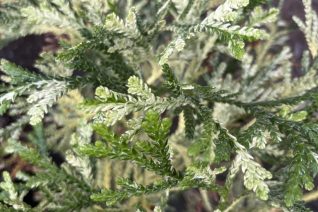
A fantastic, tough and exotic looking evergreen (conifer) that is striking and easy to grow. To 4′ in 10 years, a slow growing shrub that is often as wide as it is tall. The scale leaves are deep glossy green liberally splashed with cream. The large leaflets protrude from a single trunk and is layered like a gigantic moss. The foliage is glossy on the surface and dull beneath. Wonderful specimen or even small hedge. Scaled very well for large rock gardens. This is a very rare form of this enchanting species native to Asia. Full sun and water to establish, let it dry between irrigating, then in a year or two it can survive on natural rainfall alone. Very cold hardy and takes the subfreezing wind from the east with no damage. Excellent in the Columbia River Gorge. Not bothered by deer,and likely not bothered by rabbits, but we are not 100% sure, but its worth a try. Good appearance year round.

Thymus vulgaris ‘Peter Davis’
Form of the useful culinary herb that is also a nice looking little evergreen shrublet. To 6″ x 6″ the gray green foliage is aromatic and most useful before it blooms. In early summer it becomes a ball of light pink flowers- very pretty. Wait a bit until the blooms have receded to harvest again. A first rate, semi-woody evergreen garden plant that is good looking for most of the year. Average to rich, well drained soil in full sun. Light summer water. Very easy go grow. Takes quite a bit of drought when established.

Tigrida x pavonia
Is this hardy? Why, yes, yes it is. Mexican Shellflower or just Tigridia is a fun bulb that produces large, immensely showy flowers that last but a day. Three large petals emanate from a wildly speckled center. White, red, orange, yellow, and pink flowers are all represented in this mix. Rich, well drained soil in a warm position- mine are on the south side of my house in average soil and they not only multiply year to year they self sow. The wonderful flowers appear individually for weeks in mid to late summer. Add a handful of all purpose fertilizer when planting and water consistently through bloom. Full sun- no fudging here. Very easy to grow. To 20″ tall in bloom on average. Flowers 3″ wide. -Emerges late in the spring- usually mid-May. Patience.

Trachelium caeruleum
Flossflower- this short lived perennial is a wonderful long blooming plant. Umbels of blue flowers rise to 20″ tall. Remove the first set of blooms and it will sprout vigorously from the sides, rows of flowers. Loved by butterflies and pollinators in general. This Mediterranean native has been raised as a cut flower forever, blooming continues to October if you remove spent flowers. They last in a vase for a week or more and deliver a light, sweet fragrance. Freezes to the ground below 20ºF, and is root hardy to about 10ºF. Typical lifespan for an individual plant is 3-5 years but it almost always guarantees seedlings which will sprout in adventitious places. Full sun to very light shade and rich soil with light consistent summer water. It may go very dry and recover from a deep soak. Very easy to grow plant for spectacular effects. Perennials borders, cutting gardens. Hummingbird manna. Forms arching clumps. A distant relative of Campanulas. Rich soil and regular water guarantees a much larger, bloomier plant that will have a longer lifespan.

Trachelium caeruleum ‘Dark Purple’
Florists variety of Flossflower that we think makes a nifty garden plant too. Large rich violet umbels repeat through summer. Remove spent flowers to encourage more. Full sun and rich, well drained soil. Lightly fragrant and a stupendous cut flower. To 30″ tall and 20″ wide. Deep green foliage and black stems are handsome. Short lived perennial- approximately 3-4 years per plant. Freezes to the ground below 20ºF- resprouts from the base if temperatures never drop below about 10ºF. Often self sows in open disturbed sites- even following hellacious winters that compromise the parent plant. Best in rich, soil that drains, double dig the soil to incorporate oxygen into the root zone and allow water to penetrate deeply. Light summer water- extends bloom. If you cut the main bloom on each stem- and it will last for 10+ days in a vase, the sides of the plant will erupt in further bloom and continue to autumn. Loved by butterflies who find an accommodating landing pad and copious amounts of nectar filled flowers. Iberian peninsula and Mediterranean.

Trachelospermum asiaticum ‘Chirofu Chirimen’
Cool little Asian Star Jasmine with tiny variegated leaves that forms dense mounds as a ground cover or in time it can reach up as a cute and not strangling vine. Each leaf is margined and splashed with white. New growth has distinct pink tints for a distinct multicolor effect. Forms a fine textured plant but as a small scale ground cover it will block weeds. To 1′ tall x 30″ wide as a ground cover. To 8′ tall or higher as a self clinging vine in wind free places. Rich, well drained soil with regular summer water. Definitely double dig the soil before planting to incorporate oxygen as well as assist in absorption of water. Add organic fertilizer as well. Trachelospermums appreciate good drainage and regular summer irrigation to do their best. Otherwise drought tolerant but slow growing. Nice on fences or screens or up the trunk of a Trachycarpus (Windmill Palm). Good deer resistance. Evergreen.

Trachelospermum asiaticum ‘Fragrant Form’
About 30 years ago I was introduced to this form of Asian Star Jasmine in Eugene. It was passed around as a clone that survived the disastrous freezes of 1989 and 1990. Its also sweetly fragrant where most varieties of Asian Star Jasmine are not or faint. This is an actual pleasant aroma, not as heady as the more common Star Jasmine Trachelospermum jasminoides, but pleasantly sweet. The parchment colored flowers appear for an extended period from June to September. A huge flush of flowers in early summer and then sporadically for months. Rich to average soil with regular summer water to establish and speed growth. Asian Star Jasmine waits to grow until truly warm weather is consistent. Regular water + warmth leads to a spreading ground cover or in wind free places it can self attach to surfaces and climb. To 12′ tall as a vine 18″ tall x 3′ as a ground cover. Full sun to considerable shade but not competition from tree roots. Very cold hardy form tolerating temperatures below 5ºF for short periods. Glossy undulate leaves are handsome year round. Wonderful, durable, ground cover. Establish this plant well before its first winter and mulch for added protection. One of our favorite forms of Asian Star Jasmine. This performs just as consistently as other clones that have proved their durability. Not bothered by deer. Tolerates dry shade when very well established. Both as a ground cover and as a vine it clothes itself densely in foliage never any bare knees. Roots along the ground as it goes, great on slopes.
Xera Plants Introduction

Trachelospermum asiaticum ‘Variegatum’
Variegated Asian Star Jasmine. Excellent evergreen ground cover with playful foliage that looks great year round. Lovely entire leaves are spaced and outlined in cream. Great contrast to the sage green leaf interior. Trailing ground cover (occasionally it can rise up to be a vine- in windfree locations with support) but mainly its value is a year round showy and consistent look. Mounding and trailing it will root into the ground when it feels like it. To 10″ tall and 3′ wide as a ground cover. To 10′ tall as a vine. Full sun to dense shade in rich, well drained soil. But it adapts to harsher sites if given regular water. Excellent under trees, shrubs. Dense enough to discourage weeds. Very cold and drought tolerant. Seldom blooms. Moderate deer resistance. This and all Trachelsospermum asiaticum have two distinct forms of foliage. Juvenile and adult. Juvenile foliage is associated with long trailing and vining material. In wind free, still locations it can rise up as vine and thats when it becomes adult. This plant ONLY BLOOMS ON ADULT foliage. So, that is one reason you seldom see flowers on Asian star jasmine. Over time adult foliage will appear on ground covers. Its less vining and more bushy. Again, until adult foliage forms there will be no flowers.

Trachelospermum jasminoides ‘Madison’
Reputed to be a hardier form of Star Jasmine, we really haven’t witnessed that. It seems just as hardy as the commonly grown clone. But it has several important differences. The large deep green leaves are conspicuously convex and thick. In June to September it alights with tons of ivory colored sweetly fragrant pinwheel shaped flowers. These are slightly smaller but come in such fragrant abundance that it doesn’t seem to matter. Evergreen from the base to the top which is nice. No bare knees. Full sun to quite a bit of shade in rich, well drained soil. Summer water speeds both growth and early establishment. Then light regular summer water. Moderate deer resistance. Twining to 15′ provide support. Fences, pergolas.

Trachelospermum jasminoides ‘Variegatum’
Nice form of star jasmine with large sage green leaves edged in cream. New growth emerges a very pretty pink. From June to August a continuous supply of clusters of sweetly fragrant ivory flowers. To 12′ tall and twining. Provide sturdy support. A nice attribute of Star Jasmines is their habit of keeping their foliage densely to the ground- never any bare knees. Takes full sun to quite a bit of shade- and still blooms. Slightly more tender than the species it requires a protected location- against a wall is ideal. Regular summer water speeds growth and this intensifies the re-blooming. Evergreen. Moderate deer resistance.

Trachycarpus fortunei
A classic palm in the PNW. Windmill Palm or Trachys as they are also known are extremely popular. And they should be. Moderately fast growing palm to about 18′ tall in 10 years. The trunk is covered in fur and this acts almost like insulation to protect the interior meristem from cold. Very cold hardy to near short dips to 0ºF- many venerable and ancient Windmill Palms can be found in old neighborhoods having gone through the very worst winters of the last 50 or more years. The fronds usually have drooping filifers on the species but that can vary. Male and female and requires one of each for viable fruit set. Following huge aromatic cream colored flower structures pollinated berries drop and will often germinate in open ground. Full sun to full shade. Drought tolerant but regular irrigation in rich soil will speed growth. Excellent performance in tight spaces. Occasionally young palms become nitrogen starved and turn yellowish. To correct simply feed with all organic fertilizer and mulch and water well through summer.

Trachycarpus fortunei var. wagnerianus
Waggies! Our fave hardy palm at Xera. The fronds on this slower growing tree are stiff and tidy and have none of the drooping filaments on the branch tips that the species T. fortunei possesses. To 12′ tall in 7 years. A very clean and tidy looking palm with a distinct asian look. The fronds are even finely outlined in white hairs…more definition for this stately plant. Grows about 2′-3′ a year if well watered. You really can’t water Trachycarpus too much in the ground, it just makes them grow faster. Same wooly trunk as the species. Waggies are recommended for windy cold areas as they are not affected by those conditions. Fantastic cold hardiness not suffering damage until temps dip below about 5ºF. This is a great palm for colder gardens and tolerates quite a bit of shade. Always looks it’s clean best.

Trifolium wildenovii
Tomcat clover is one of our showiest native clover species. A tough hardy annual that is found from about Salem to Newport south to California. Its a common component of waste places and dry rocky environs. In poor soil it is a somewhat meager plant with just a little fertility its a completely different animal. To 12″ tall but usually half that this sparse but showy clover beckons pollinators when its pink to red and white delicate looking flowers that erupt into bloom in May-July. Very easy to grow in containers with other native annuals. This shares the fecund trait of other clovers and it will already have shed seed by the time you see it in bloom. Excellent forage for native bees- and purported to supply a tangy taste to Tomcat Clover Honey. Water plants from containers to establish, self sown plants get by on natural rainfall alone. Leave the plant well past bloom to shed the following years crop. Give it open disturbed spaces to self sow. The leaves are very much like a clover but the leaflets are a lot thinner. Also found on dry stream banks and with native clumping grasses. Full all day sun. Oregon native plant.

Triteleia hyacinthina
Fool’s Onion, though this close relative of Brodiaea is easy to tell apart from Allium as the leaves and stem have no onion odor. A sunny native perennial bulb that forms colonies of white in May-July in meadows, glens, and swales. To 15″ tall in bloom but usually shorter the leaves emerge in mid winter and persist until summer drought. About that time the flowers erupt into clusters of white flowers. Great native bulb for naturalizing, Water if planting from a pot, otherwise it requires only what falls from the sky with a distinct dry period in summer. Associated plants are Ranunculus occidentalis- Western Buttercup, and Brodiaea elegans- Cluster lily, and Plectritis congesta- Sea Blush. Native in clay soils that dry completely in summer. Goes very neatly dormant in summer- nothing is left. Excellent in rock garden conditions. Full sun to very light shade. Moderate deer resistance. Native though out western Oregon. Sweet cutflower Very good for butterflies as well. This plant once occupied large areas of the Willamette Valley, that territory has shrunk considerably. Oregon native plant.

Tulbaghia natalensis
Cute little perennial Society garlic with wonderfully sweet fragrant flowers, Best described as intense violets. To 10″ tall and forming expanding but diminutive clumps that are deciduous in hard freezes. Blooms May-August. Excellent for warm rock gardens or containers. Protect containers from temperatures below 20ºF. In the ground it has survived slightly below 10ºF in rich, well drained soil and full sun. Best in a warm position where you can catch a whiff of the wonderful soft lilac colored flowers. Wonderful and sweet cut flower. The foliage on this species lacks the pungency of the more common T. violacea. Moderate deer resistance. Light, consistent summer water. Mulch with leaves if extreme cold threatens. South Africa.

Tulbaghia violacea ‘Edinburgh’
Society garlic. This form of the popular South African perennial has performed fantastically in our garden. Aromatic clump forming foliage that rises to 10″ tall and to 2’wide in time. In June and continuously until frost spikes emerge, to 2′ and hold clumps of luminous, soft lavender flowers. Each spike is in bloom for a week or more. New flowers are continuously produced. Remove spent spikes to tidy. Full sun and WELL DRAINED rich soil with regular summer water. Very drought adapted when established. In cold gardens its best on hot slopes. Freezes to the ground in winter, returns quickly in mid spring. Foliage is intensely aromatic of garlic when disturbed. Useful, pretty, long blooming. Moderate deer resistance. This form was selected in Edinburgh, Scotland.

Verbascum ‘Clementine’
OH MY DARLING, OH MY DARLING, OH MY DARLING Clementine you are lost ….Not lost at all this wonderful Verbascum is delightful and blooms repeatedly from spring to late summer. To 3′ tall or taller in ideal conditions, spires of soft orange to pale yellow depending on the temperature have a central bee of lavender feathers. Adorable and conspicuous as a cut flower thats blooms itself out in the vase. Loved by butterflies and native bees and hover flies. The spires of flowers erupt directly from the center of a basal rosette of flat green leaves. Full sun, average to enriched soil that drains with light, consistent summer water. Remove spent blooms and another round will begin. Does not seed around. Mix with other sun-loving perennials with similar cultural requirements. Agastache, Digitalis lanata, Penstemon ‘Enor’ for a LONG LONG flowering spectacle. Winter dormant. Cold hardy and easy to grow. Great flower color for mixing or for tone on tone continuity- for that try it combined with Digitalis x ‘Honey Trumpet’. Cottage gardens, rock gardens, containers. Long blooming and versatile.

Verbascum bombyciferum ‘Arctic Summer’
Big ol magical biennial and we couldn’t imagine a garden without it. The first year it produces a large (2′ wide) rosette of huge furry white leaves. They lie flush with the ground. The following year total transformation occurs. A spike from the center of the rosette and soars to 6′ or taller. Its lined densely with furry white buds that pop open to reveal electric yellow soft looking flowers. The inflorescence will often wind this way and that. Even after bloom is through this tower remains spreading quantities of seed all over. Germinates best in open disturbed soil. Move them or thin them in spring. Snow white perennial with oodles of architecture. Full sun and rich, well drained soil. It makes due with less than perfect conditions but this way is the most impressive. Loved by pollinators. Light summer water if it looks like it needs it. Established plants get by with no water. Remember the first year is leaves, the second its flowers.

Verbena rigida
Vigorous and floriferous perennial Verbena for tough areas. Spreading by underground stolons in rich to average well drained soil this deep purple flowering perennial covers ground in short order. Full sun and light summer water when established to lengthen bloom time. Even then it begins flowering in June and continue unabated for two months. To 2′ tall and 4′ wide. Give it room to spread and do not pair with delicate neighbors. Hellstrips, Insanely hot and dry south facing hillsides. Freezes to the ground in winter- returns from the ground when truly warm weather arrives. Moderately deer resistant. Water twice weekly to establish and once growing you can taper off. It is important to do this for the first season, un-established plants may not make it through winter.

Veronica liawanensis
Turkish speedwell is an excellent low water creeping ground cover that performs wonderfully in our climate. Flush with the ground this evergreen creeps in well drained average to enriched soil to several feet wide in several seasons. In April to May carpets of sky blue flowers obscure the entire plant. Very pretty. Roots as it grows, excellent for erosion control on a small scale on steep slopes. Regular summer water speeds growth but once established it takes summer drought very well. Full sun to the very lightest shade. Dies out in compacted soils- make sure to double dig the area around where it is to go to incorporate oxygen in the soil. For tired plantings simple overspread compost on top of it and let it settle between the leaves in early spring. Easy to grow hardy little ground cover. Moderate deer resistance.

Veronica peduncularis ‘Georgia Blue’
Its been around for a long time and its an introduction that has stood the test of time. This low mounding evergreen perennial is beyond delightful when it alights in masses of deep blue flowers from late February to late April. Each simple blue flower has a small white eye but the effect from a distance is a pool of blue. To 8″ tall and forming large 2′ x 2′ wide patches in full sun in rich to average well drained soil. It excels on slopes and in rock gardens. The new growth that follows is tinted mahogany before become strong glossy green. Cut back by 1/3rd after blooming to create a much denser and ultimately more floriferous plant. Light, consistent summer water. Excellent bold backdrop to early and mid blooming bulbs. We suggest large white Crocus vernus followed by Narcissus ‘Blushing Lady’. Very easy to grow. Long lived for a speedwell.

Veronicastrum virginicum ‘Album’
The white flowered form of culvers root- but seldom called that in the PNW. Slender perennial with multiple vertical stems clad in symmetrically space pointed foliage surrounding the stem. At the tips in early summer multiple spires of pure white flowers give a really cool ethereal effect. Massed it is simply one of the coolest plants. Our form rises to just 4′ tall and forms slowly increasing clumps. In autumn the foliage that lines the stems often turns bright yellow and remains for a while- a second season of interest. Full sun to the very lightest shade in any soil of good fertility. Does well even in unamended clay as long as summer water is dependable. Long lived perennial that never requires division or fussing. Cool cut flower for big wild arrangements. Bees love it.

Viburnum tinus ‘Variegatum’
Spring bouquet viburnum or Laurusitinus is a common shrub in our climate. This form lightens up what can be a very pedestrian plant. The edges of the evergreen leaves are margined in cream with an interior of soft green. This makes a shrub that glows year round and can be used to lighten up dark corners. In autumn clusters of pink buds form and hold until mid winter. Then as the days begin to lengthen it opens these clusters which are lightly fragrant and white. Strong growing shrub that requires very little water once established. To 8′ tall and 5′ wide in 6 years. Full sun to part shade to high overhead shade. Nice looking, tough shrub native to the Mediterranean very easy to grow and long lived. If a green sport appears simply prune it off to the base to retain the variegated form. Water to establish. Not deer resistant. Excellent backdrop to a mixed border or trimmed into a contained hedge. Nice fast growing screen. Blue berries sometimes follow the flowers. Buds and flowers put on a show for months. Blooms on wood from the previous season prune after flowering if needed. Naturally dense and rounded.

Viola corsica
One of the parents of modern violas this perennial is short lived but while its around its never out of bloom- year round. Slender indigo blue flowers are small but profuse on a compact plant to just 6″ tall and barely wider than that. Seeds itself around prolifically…how the seeds find their way so far from the parent plant is natures mystery. It will germinate anywhere – cracks, beneath rocks. Sun, Shade. Very hardy to way, way below 0ºF. Light summer water during the hottest weather. Part shade in nearly any texture soil. Mediterranean wild flower.
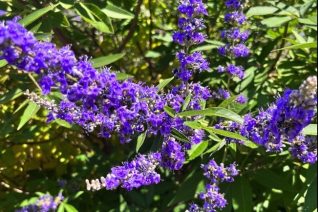
Vitex agnus-castus ‘Sensational’
Excellent California selection of Chaste tree with thicker, bluer flowers. Large growing shrub with aromatic finely divided leaves in mid-July in PDX spires of blue flowers erupt from each branch tip. It remains in bloom for 3-4 weeks. And if you remove spent flowers more will appear. Full sun and poor to average well drained soil. No summer water when established. Attains tree-like status with great age. May be pruned back hard in spring to contain the ultimate size. Blooms on new wood. Long lived and hardy below 0ºF. Leaves appear late in spring- often not until mid-May. Be patient. Loved by pollinators and bumble bees specifically. A shrub in full bloom will be a haze of drunken bumbles who after a day of working will often fall asleep in the flowers of this shrub. Tolerates the hottest sites and is very long lived.

Vitis californica x vinifera ‘Roger’s Red’
This wonderful grape vine was originally found along the Russian River by Roger Raiche and is absolutely stunning in autumn. This very large growing deciduous grape will eventually grow to 20′ and develop a sturdy, gnarled trunk. Grows about 3′-6′ per year. This is a wild hybrid between the European Wine grape and our native vitis californica. What that yields is one tough plant that handles our climate like a champion. Best used in wild areas and if you are going to plant it to grow up a tree make sure the vine you start with is small and the tree you put it in is big. In September-November a long display of brilliant claret red foliage- the individual leaves can be 10″ across. Simultaneously it will sport dark purple edible fruit in large clumps. The medium green foliage is leathery and is best in part shade to full sun. Especially brilliant draping evergreen oaks as it was found in the wild. Climbs by tendrils but provide very strong support at least #4 copper wire. Leaves arrive in mid spring. Very drought adapted when established. Water for the first season to establish then set it free. Vitis californica can be found in bot the Rogue and Umpqua river basins in Oregon.

Watsonia latifolia
A very large flowered Watsonia and one of the hardiest of the genus. Wide green spikey leaves rise to 2′ tall in spring. In late spring to early summer 5′ tall spikes of tubular red opening to orange flowers line the stems. Loved by hummingbirds and cut flower aficionados alike. Rich soil in full sun in a protected position- a south or west facing wall is ideal. Freezes to the ground below 20ºF- re-sprouts in spring. Forms an expanding clump to several feet across. A fun genus to experiment with in our climate. Rated as zone 7 in its native high elevation South Africa. We think its more like 10ºF in our climate. Plant with royal red Lobelia tupa and Rosa ‘Bengal Fire’ for a red extravaganza. Excellent performance at the Oregon Coast. Somewhat deer resistant. Mulch for the first few years. Nearly evergreen for the first several years. Established clumps can go dormant with summeer drought. Resist the urge to remove these dead leaves until spring. It will resprout with spring warmth.

Watsonia pillansii
This is one of the hardiest species of Watsonia Lily. It forms large evergreen clumps of spikY foliage to 3′ tall. In early summer 6′ spikes of tubular brilliant orange flowers are stunning. They bloom for weeks. A protected location such as close to a south or west facing wall. Capable of freezing to the ground in extreme cold (below 20ºF) but regrowing vigorously and still blooming in late spring to early summer. Rich, well drained soil with regular summer moisture. If allowed to go completely dry in summer this as with other Watsonias will go dry dormant. It returns with the first rains in autumn. Amazing cut flower. Mulch your clump in autumn. Wonderful South African perennial that is glorious at the Oregon Coast. To 3′ wide eventually.

Watsonia x pillansii ‘Coral and Hardy’
We love Watsonias but the most successful climate is truly on the coast. This form is seed from a persistently hardy, well blooming plant that has survived in Portland. The majority of these seedlings will be coral/ orange/ light pink. To 20″ tall forming clumps in RICH, well composted soil in full sun. Regular summer water increases both the growth rate and the cold hardiness. Larger more established clumps are hardier to cold. Amazing cut flower that will produce several dozen spikes off of one good clump. Mostly evergreen. Foliage looks burnt below 20ºF and can freeze to the ground. This winter growing bulb is also immensely drought tolerant with a period of summer drought inducing dormancy. Place in a warm, protected location Near a south facing wall or fence. Mulch for the first few winters with dry leaves. Place in a location where summer dormancy is not an issue. Very fun to grow South African bulb. Excellent performance at the Oregon Coast. Not bothered by deer or elk- well the elk might step on them but they won’t eat them. Fantastic cut flower and clumps become huge there.
Xera Plants Introduction

Wyethia angustifolia
Mules Ears are rare in cultivation. These cheery bold perennials make the transition of our wild flowers from spring into real summer. So named for its long leaves it forms very permanent spreading colonies in clay soils in habitat. The brilliant yellow sun flower blossoms rise up on sturdy stems directly from the ground. Each ebullient large flower is about 4″ across. Blooms appear from late April to early June. This plant usually finishes blooming just as summer drought commences. Its a memorable sight in wild meadows where it blooms simultaneously with native Rosa nutkana and Farewell to spring (Clarkia amoena var. lindleyi) and Giant blue eyed mary (Collinsia grandiflora). Wonderful cut flower and immediate and popular pollinator perennial. This plant was once very common in the Willamette Valley but civilization has immensely shrunk its native range. Good, long lived garden plant that goes summer dormant quickly after blooming has ended. The leaves turn gray and brittle and can easily be removed then. Give it a summer rest w/ little to no summer water once established. Full sun to very light shade. Water to establish its first season then none in subsequent years. Fun to grow and LONG lived. To 14″ in bloom forming a plant several feet across. Moderate deer resistance. Native to the Portland city limits. Very slow to finish in a salable size. Patience. Limited quantities. Oregon native plant

Yucca (nana) hermmaniae
Adorable and rugged little dwarf Yucca from southern Utah. Tight round quills are decorated with filaments on the leaf edges. Not a friendly guy and very slow growing. Forming spheres of spikes to 1′ across and multiplying to produce colonies with pups. Full sun and very well drained soil of average to poor fertility. Requires excellent air circulation- no crowding. Plants that are smooshed with little air circulation protest heavily and it then takes a while for recovery. Open and free in rock garden conditions produces the happiest plants. At home nestled with boulders or as a finer texture element with Agaves. In time it produces adorable and conical shaped hoods of flowers- a gnome wedding. Excellent in containers- open, well drained containers. Light summer water during hot weather seems to speed growth. Locate away from paths. Owwie. Strongly deer and rabbit resistant.

Yucca rostrata
Beaked Yucca does fantastically well in our climate and is one of the Yucca species that will form a dramatic trunk. Blue thin leaves radiate out in a perfectly round orb. Slowly rises to 8′ tall in our climate. Full hot all day sun in a warm position. Very well drained soil with light summer water during the hottest stretches to encourage growth. Occasionally, with age 4′ spikes appear holding large trusses of ivory flowers. Perfectly hardy to cold, way below 0ºF. Avoid cold wet sites- to really do well it needs heat and exposure. Not prone to bacterial leaf blight that affects other Yucca species. Good air circulation. Lives happily in large containers for eons. Focal point in many of the best gardens in our region. High deer resistance. Evergreen.