

Vine Maple is perhaps our most beautiful native maple. Found from SW British Columbia to Northern California in the Shasta area. Its a pervasive understory tree throughout the western part of the state. It derives its name from its almost vine like habit in shade. This winding and sun seeking component leads to the most graceful natural forms. In full sun it is a compact, multi-trunked shrub. In autumn in both habitats it turns to shades of fiery orange and yellow and red. Vivid against the pure green trunks and stems. One of the most dramatic places you will see this shrub is at 4500′ on Belknap crater on McKenzie Pass where it lives among the lava. In early fall the brilliant colors of the maples contrasts wonderfully with the black lava. Its very hot and very dry but its also very high in elevation. The symmetrically serrated round leaves rival any Japanse maple. In shade established trees get by with little summer water. In the sun irrigation is welcome. Rich to average soil with regular applications of mulch. To 16′ tall in shade and again quite a bit shorter in full sun- very wide in shade. Avoid the reflected heat of south facing walls. This shrub/tree belongs on the north side or under substantial shade. Some deer resistance. Excellent underplanted with native ferns and Gaultheria. A common native that should be a more common ornamental. Tiny red flowers turn into sunny orange samaras by autumn and persist past the leaves. Avoid very dry shade of un-irrigated over hangs. This is a semi-mesic maple. Oregon native plant
Biome: Western Native

Native is a relative term. Plants don’t follow political boundaries and in fact they cluster and move according to climate and to a lesser extent soils and soil moisture. Turns out for instance, that the climate of Portland is not too dissimilar from the middle elevations of the Sierra Nevada in California. We also have a nearly identical climate curve to Lyon, France . And as the planet waxes and wanes through ice ages you’d be amazed at the distance plants migrate due to climate. In fact, if you went back in time 11,000 years ago at the end of the last ice age the taxa composition of the Portland area was identical to what you currently find on the upper slopes of Mt. Hood at 5,000′. Cold, snow, montane with Mountain Hemlock, Engelmann Spruce, Lodgepole pine and Aspen. In reality plants are always on the move.
Between ice ages- the last interstadial
More relevant is our most recent inter-glacial, the warm period between ice ages that peaked around 6500 years ago- the Holocene thermal maximum. Ice ages are broadly caused by the obliquity of the earths orbit known as the Milankovitch cycles and changes in the axis. Serendipitously during the height of this last warm period perihelion (the sun’s closest axis to earth) occurred in the Northern Hemisphere summer increasing solar insolation- sun heat energy. Currently, perihelion occurs in winter (Jan. 5, 2020) and that cancels out the effect. This increased solar insolation during the warm inter-glacial did several things: First, it increased the annual temperatures to those we have only surpassed recently and it decreased precipitation and increased the length of the annual summer drought. During these warm periods there is a great shift in south to north flora movement. At the peak of the Holocene thermal maximum the Eugene area most likely had a climate and flora composition of the Grants Pass area today. Portland likely had a climate and taxa somewhat similar to modern Roseburg, 180 miles to the south. That would be a lot more Oaks and Madrone and much less Maple and Douglas Fir. This passage to the north of flora extends poleward and it is also during this period we see the intrusion of Pacific Madrone and Oregon white oak into British Columbia. Climate change is mimicking our warm inter-glacial so far. Species from the south are rapidly moving north- and faster all the time. They have no choice.
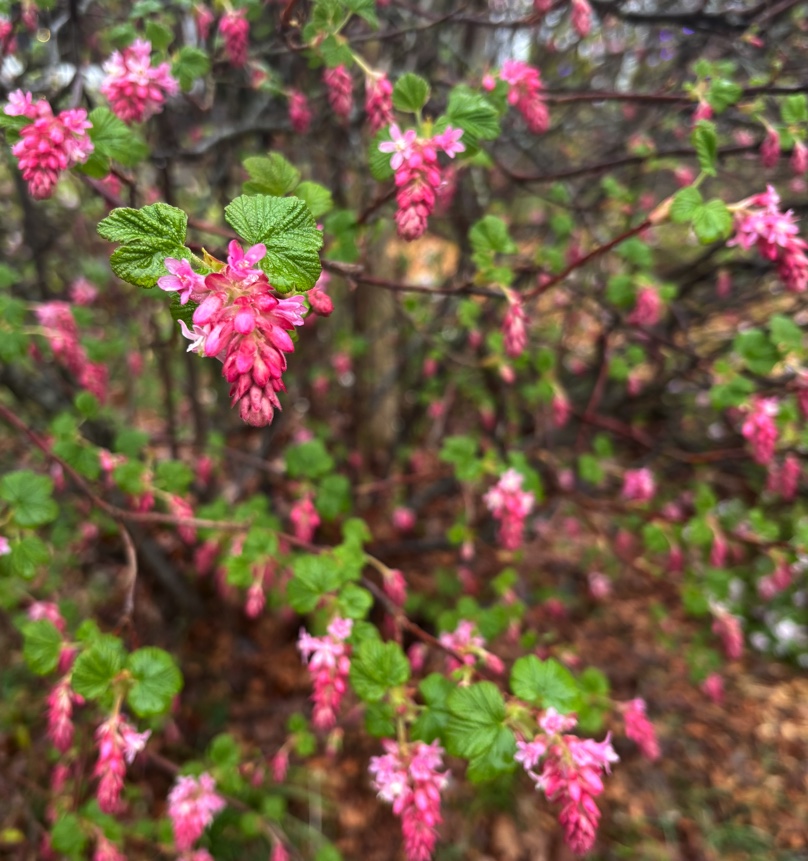

Broadening the description
So, we choose to list WESTERN NATIVES and not just Oregon Natives in one category. We should always include natives in our gardens. They are not only climate adapted, they give our gardens a regional identity and most importantly they support indigenous fauna. Climate change adds complexity to the mix. Our planet will be heating up too fast for plants to migrate. That means that many will find the safest homes in our gardens. We seek out the most unusual natives. Our attempt to expand the palette rather than the six same species that are used (abused) over and over. By all means go native!
Climate Adapted Plants for Gardeners in the PNW

Acer glabrum ssp. douglasii
Rocky mountain maple or locally also known as Douglas maple is our form of a widespread and sweet small tree that ranges from the Yukon in Canada to the highest mountains of northern Mexico. Our local variety is found in all of the mountainous parts of the state. This demure tree is the least planted of our native maples and deserves much more inclusion in our gardens. In the coast range it is found primarily above 2000′ and it can even be found lower in the Cascades. It follows the spine of the Ochocos in eastern Oregon up into the Blue mountains and Wallowa Mountains in the far north east. Rarely pole straight in stature its often multi-trunked and single trunked trees are in the minority in the wild. Ours are single trunks but multiple stems do not take away from the fresh green leaves and pretty to stunning fall color. The familiar maple leaves can achieve anything from dull yellow to shots of vermillion. Depending on the weather and tree. Soft gray bark. To 25′ tall moderately fast. Tiny green flowers morph into rosy hued samaras in autumn. Regular water for the first several years. This tree does appreciate rich soil that retains moisture in the Willamette Valley. Excellent woodland tree or even more appropriate on the edge of a stand of trees where it receives at least half a day of sun. The most recent years stems are often sanguine red, nice contrast with the grass green elegant leaves. The most striking fall color is achieved with more sun. A mesic maple that often follows water courses or lines wet ground. Single trunked trees are conical shaped and multi-trunked forms are more rounded and spreading. Deciduous. Avoid blasting heat and drought. Oregon native plant.

Achillea millefolium
This is the green foliage form of our wild yarrow. A rambunctious, easy to grow evergreen perennial for rough sites in well drained soil in full sun. Continuously from spring to autumn ‘umbels’ of pure white flowers rise 18″ above low spreading aromatic, finely divided ferny foliage. Most often it is green with variants that have gray foliage from time to time. Low water perennial that can even be used as a lawn substitute. A single plant spreads to several feet wide. Moderate deer resistance. Butterflies oh the butterflies.This is a pioneer perennial and will often out compete less robust native perennials. Its best use is as a contained weed. It is great for pollinators Individual plants rarely persist more than 3 years. Oregon native plant.

Achillea millefolium ‘Pretty Woman’
Of all the selections of our native yarrow this stands out for many reasons. The ‘umbels’ of flowers are a rich red which holds the color for an extended period. It fades only slightly to a rust red with time. Its vigorous and easy to grow. And it re-blooms reliably if spent flowers are removed. All the way until frost and sometimes longer. A very, very good long-lasting cut flower. To 18″ tall forming spreading colonies. Semi-evergreen. Low water when established in well-drained soils. Excellent to moderate deer resistance. Appreciates an annual application of compost. Oregon native plant.

Achillea millefolium ‘Salmon Beauty’
Yarrow is an unbeatable native perennial that blooms for a LONG time with a minimum amount of effort from the gardener. Foamy, ferny gray green leaves creates a low carpet of evergreen foliage. Rising up on 2′ spikes flat umbels of soft salmon flower create landing pads for pollinators. The flowers fade lightly after opening for a wonderful multicolor effect. Remove spent flowers, apply a little water and it will repeat bloom until frost. Best in lighter soils that are enriched but drain quickly. Best floral displays occur with light consistent summer water though it is very drought tolerant when established. Tolerates the toughest, hottest sites. Admirable if a little pungent cut flower. LOVED by pollinators. Creates a growing patch to several feet wide quickly. Blooms spring- autumn. Moderately deer resistant. Borders, dry borders, hell strips, etc. Oregon native plant.

Achillea millefolium ‘Willamette Gray’
Greg got seed of this distinctive form of Yarrow near Oregon City. Unlike most garden varieties that are derived from European stock which very much appreciates rich soil and regular water to perform and those forms are also not pungent. We wanted our locally native yarrow that is incredibly durable, has gray foliage that is pleasantly aromatic with broad white flowers. This is a much more climate adapted perennial. Its found throughout all of the state, and can be found anywhere from meadows to surprisingly deep woods. This is a very thrifty plant and once established it really doesn’t need supplemental summer water. Spreads to form finely divided low gray foliage. The flat umbels of pure white flowers are very large and this is a landing pad for all pollinators as well as butterflies. To 20″ tall in bloom. Excellent meadow component with clumping grasses, annuals, and bulbs. A great plant for hell strips and hot aspects too. Very easy and forgiving perennial. Blooms May-August. Mostly evergreen save for the very harshest winters. Not bothered by deer. Oregon native plant.
Xera Plants Introduction

Adelinia grande
Great Hounds Tongue or Giant Pacific Forget-me-Not is one of our most remarkable native perennials. On the property where I grew up near Eugene it was native. There was a clump of this majestic perennial that was there for nearly my whole life. Unfortunately, we sold the property but this plant was still there last I checked. In the Willamette Valley and out into the Columbia Gorge you see these luminous blue flowers on a sturdy spikes in the dry areas under oaks. They usually senesce to pink. Often seen with Wyethia -Mules ears which blooms later. Large fleshy leaves form a substantial clump. In early to mid spring 2′ spikes reveal outrageously large versions of Forget-me-nots. Established plants will then go dormant with summer drought. Adapted to xeric clay soils that dry in summer. Not only does it not require water established plants can resent it and rot. Place in a wild, shady, unwatered part of your garden. Amend the soil lightly with compost and water in well. Pairs with other native perennials such as Sidalceas. In the wild it is accompanied by Erythronium oreganum , Lathyrus nevadensis, Fritillaria affinis, Dodecatheon hendersonii, and Ranunculus occidentalis. That is what grew with our patch, under white and black native oaks, with a madrone here and there. Impressive native perennial whose intense blue flowers are hard to convey in a photograph. It takes an extended time from seed to a growable plant. Patience because of limited quantities. SLOW Oregon native plant.

Adiantum aleuticum
Western Maiden Hair Fern is native from the Aleutian Islands in Alaska south mainly through shady wet spots in the west south as far as Chiahuahua, Mexico. Its even locally native from Maryland to New Foundland. Its a long lived and vigorous fully deciduous perennial for perpetually wet sites. To 2′ tall and spreading almost indefinitely where conditions suite it. Heavy clay soil that retains consistent moisture in part shade to shade. Often found lining water falls in Oregon or in deep cool moist gullies. The multi fingered leaves are a soft green and are held erect on jet black stems. Very good sited at the bottom of a downspout. Very easy to grow given consistent moisture. Oregon native plant.

Agastache ‘Lilac Moon’
Cool bicolored Hummingbird Mint that has masses of flowers that appear from orange buds which quickly change to luminous light lavender when open. To 20″ tall and forming a clump this very, very, long blooming perennial is delightful for hummingbirds, bees and butterflies. A soft pastel coloration that pairs wonderfully with light yellow flowers and even blue. Great in seasonal containers. Blooms non-stop from June to October. Do not remove flower spikes as new flowers will appear continuously from the same spike. Rich, WELL DRAINED soil with light, consistent summer water. Its best to water Agastaches consistently during their first year in the ground- to establish a large root system. Ideal on slopes- to assist in drainage in winter. Double dig soil to incorporate lots of oxygen in the soil. One of our favorite introductions. An amazing combination of flower colors on a single plant. Do not cut back until new growth has flushed out in spring and all threat of a hard freeze has passed.
Xera Plants Introduction

Agastache ‘Berry Princess’
We believe this to be a cross inheriting some of the coloration of A. auranticus as well as A. cana. To 28″ tall this clump forming, everblooming perennial brings bright red buds that open to purple flowers. The colorful combination lasts all summer into autumn. New flowers are born on the same spikes so do not remove. Moderate consistent water through the first summer to establish. Double dig soil to incorporate oxygen into the soil and aid in irrigation to the roots. Established plants get by with a little less. Loved by hummers and pretty decent cutfower as well. Full all day sun for best performance, will not be quite as floriferous in part shade. Sweetly scented foliage is an extra benefit. To 18″ wide and slowly increasing. Excellent on berms as well as slopes. Mulch in fall. Small rosette of winter foliage is protected by the previous years defunct stems. Prune these away after all threat of a hard freeze has passed.
Xera Plants Introduction

Agastache ‘Electric Punch’
One of our all-time best introductions ‘Electric Punch’ is a floral powerhouse of a hummingbird mint with exceptional adaptation to our cold and wet winters. Rising to 34″ tall in bloom, a clump can become enormous in rich, WELL DRAINED soil with light, consistent summer water. Also, accepts no water but with interruptions in bloom. Incorporate plenty of oxygen into the soil and slopes are ideal. Do not remove flower spikes during the season- new orange aging to pink flowers appear from the same inflorescence. Best to wait until spring to cut back the previous seasons defunct stems. Moderate deer resistance. Agastache are best watered well for their first season, in subsequent years they will use much less.
Xera Plants Introduction.

Agastache ‘Mandarin Dream’
This is our selection of an improved form of the species Agastache auranticus. It has deeper orange flowers on taller stems and exhibits excellent winter/cold/wet hardiness. To 30″ tall, the vivid blooms erupt from June to October. Tightly clump forming perennial whose tall wand-like stems require more horizontal room as well. Hummingbird Mint excels in very well-drained soils with consistent, light summer water. Full sun- you can fudge in light shade and still get results. Remove the previous seasons spent stems in March. Agastache are plants that like oxygen in the soil and they often seed themselves happily between large stones. They appreciate soil that is rich but permeable at all times. We advise to wait until March to remove the previous year’s stem. The hollow stems that remain over winter actually provide oxygen to the roots. If you cut them back too early (Fall, winter) you also leave the new growth at the base unprotected from the elements. So, the stems should remain to both give the plant oxygen and protect the next seasons clump of foliage. Double dig the soil heartily and add a little compost and even pumice if your soil is stingy. Water regularly for the first season to establish a large root system which will require less H20 in subsequent years. This is a vibrant orange that mixes well with deep purples and blues.
Xera Plants Introduction.

Agastache ‘Rainbow Sorbet’
One of our larger growing introductions this is a flowering machine with large individual flowers that open pale orange and senesce to pale pink. Overall this is a pastel flower palette. To 36″ tall and as wide in full sun and well drained soil with light, consistent summer water. Agastaches are excellent as container subjects- they will accept the most cramped roots and still perform. Wait until March to remove the previous years spent stems. Give this guy room. Hummingbird nirvana. Good winter hardiness.
Xera Plants Introduction.

Agastache pallida ssp. neomexicana
Cute flowering hyssop that makes a clump of strongly vertical stems clad at the tips with soft mauve/purple flowers. A boon to pollinators as well as hummingbirds. Blooms June to October continuously from the same spikes. To 18″ tall and barely half as wide. Agastaches like light soil. Double dig the soil well to incorporate oxygen and apply a handful of all organic fertilizer at planting. This will establish the plant much faster. Excellent performance on slopes where it achieves the drainage that it likes. Middle of the border or massed in a meadow- this easy to grow perennial performs for a long time. Do not cut back until after Valentine’s Day. Consistent water for the first summer then light water in subsequent years. Excellent performance in mixed container plantings. Moderate deer resistance. Foliage is sweetly pungent.

Agave americana ‘Medio Picta Alba’
Tender <sigh> but perhaps the most spectacular variegated Agave. It makes a great container plant for LARGE containers. To 5′ x 5′, it grows a little slower in containers. Make sure it’s sturdy and well built too because this puppy has been known to grow so vigorously as to shatter its own home. Use well drained cactus mix and add a handful of all organic fertilizer. Move to a freeze free environment such as an unheated garage if temperatures threaten to drop below 20ºF. Otherwise move it to a dry place for winter- under a south facing eave is ideal. Move it back out in the open when rain dwindles. Light summer water will speed growth. Leaves on this form are blue on the edges with a dramatic pure white stripe down the center. Wow.

Agave harvardiana
Spikes! A very upright and pokey Agave with steel blue/gray foliage that forms large rosettes. To 3′ across eventually this cold hardy Agave demands excellent drainage but is worth the effort. VERY well drained soil- amend with liberal amounts of pumice and gravel. Excellent on a slope. Plant with the rosette tilted to shed winter water. Makes new pups happily and they will often come up quite a distance from the parent plant. To 3′ tall when up and established. Great in containers that you protect from winter wet. Move to a covered place in fall- a south facing eave is sufficient. Cold hardy below 0ºF- when established. Best to plant in March or April so that it has the longest possible season to develop a root system going into its first winter. Light summer water to none. High deer resistance.

Agave ovatifolia ‘Frosty Blue’
A real winner in our climate this is perhaps among the easiest bold Agaves to cultivate. Large rosettes of flared deadly leaves are a luminous light blue. The whole rosette can achieve 3′ wide and nearly as tall but smaller is more common. Excellent tolerance of the combination of cold and wet that Agaves mostly despise. This plant also is less prone to injury from necrosis of damage- slugs, snails etc. Full sun to a surprising amount of shade, though you’ll want to avoid the overhead detritus of trees into the rosette. In full sun such as a bare parking strip it revels in heat, exposure and fast drainage. Amend the soil to at least 1/2 pumice and 1/2 virgin native soil. Water to establish then only what falls from the sky. Obviously site away from paths- stab wounds suck, literally. In Mexico they planted large agaves in front of the bedroom windows of their female children. The idea I guess was to deter suitors with bad intentions. But its a neat story and you could see how it would work. Obvious awesome deer resistance. Sometimes called Whale Tongue Agave.

Agave parryi ‘Flagstaff’
From the very far north end of this variable species range in Northern Arizona near—‘Flagstaff’. High elevation form that is found above 7000′ in the wild. Very cold hardy moderately large Agave. Full sun and very well drained soil. You must amend the soil with pumice and gravel to avoid wet accumulating around the crown in winter. This is made all the more easy by placing on a slope. The rosettes should be tilted to shed winter wet. Very stiff and sharply tipped steel blue leaves form a rosette that is at first upright then spreads out a little. Remove leaves from deciduous plants that collect in the rosette in autumn- they blow in from god knows where and leaving them can encourage rot. Excellent in containers. Move containerized plants under an eave or overhang to keep it dry in winter. No water required after initial establishment. Beautiful form of this cold hardy species. High deer resistance.

Agave parryi ssp. couesii
A really pretty pale blue Agave with sharp angular leaves in a remarkably symmetrical rosette with age. Cold hardy and it requires very well drained soil in a hot position. A south facing slope is ideal in soil that has been amended with liberal amounts of pumice and gravel. And you should tilt the rosette so that water does not collect in winter. This variety is a little slower than others. Aside from perfect drainage it requires a little bit of heat and patience. To 20″ tall by 30″ wide in time. Great container subject- make sure the container is sturdy and large enough to accommodate both a spreading primary rosette and prolific pups which crowd the base. In time it can form bold colonies. Move containerized plants to a dry location in winter. Remove deciduous tree leaves that collect in the rosette in autumn to stave off rot. SW U.S. High deer resistance.

Agave parryi ssp. neomexicana
New Mexico Agave is a spike wonder. Much more upright-growing than the species with sharp-tipped leaves that terminate in a blood red thorn. OW. Forms a very symmetrical plant with many leaves of steel blue. Full sun and VERY WELL-DRAINED soil. Excellent on hot slopes where it will tilt the rosette to avoid winter wet. Pups, heh, freely and you will soon have many rosettes. Amend the soil with pumice and gravel. Make sure there is plenty of air in the soil and no place where water could collect. Fantastic specimen plant for a dry garden/gravel garden. Water through the first summer to establish then none in subsequent years. Clean out the rosette when deciduous leaves collect in there- a shop vac works great. The leaves will cause rot when they decompose….so they must go. Great in containers- large, sturdy containers. Cold hardy. High deer resistance.

Agave parryi ssp. truncata
Consistently one of the most successful Agaves for gardens in our region. Soft gray rosettes have leaves with a distinct upright habit. At the tips of the wide leaves is a single (deadly) black thorn. Very nice. Full sun and very well drained soil with little to no summer water when established. This Agave requires soil that is never soggy- amend heavily with pumice and gravel to create air pockets. Plant this (and all) hardy Agaves in our climate on a tilt. The tilted rosette sheds rainwater and it keeps it much drier in winter. Ideally, this Agave should be sited on a hot, south facing slope. In autumn deciduous leaves from (everywhere) seem to blow into the rosette and collect. You must remove these immediately so that they do not rot the center of the plant. A shop vac works wonders…so do bar-B-Q tongs. Excellent in containers. Its best to plant hardy Agaves in early spring to early summer. They require a long season to develop a root system which ensures that they are cold hardy. No root system and not so hardy. Hardy below 0ºF when dry. Highly deer resistant.

Allium acuminatum
This delightful onion has a wide range in our state. Primarily you see it in dry, exposed sites a little way up from the bottom of the Willamette Valley. Mid green slightly fragrant grassy leaves give way to an 8″ stems in May-June with a chalice of multiple pink/lavender pink upward facing flowers. Full sun to part shade and adaptable to many soils as long as there is a dry rest in summer. This onion quickly goes summer dormant directly after seed set and disappears entirely by mid summer. Great pollinator bulb for Willamette Valley meadows. Its nearly always on a slope where it is found. Replicate this and give it only the rain that falls from the sky in subsequent years. In time the bulb multiplies and it can also self sow. Leave a disturbed area around the plant and keep it free of weeds and they can mature and bloom in several years. Light deer resistance. aka Slender leaved onion. Very attractive food source for butterflies. Oregon native plant.

Allium amplectens
Slim leaved onion is very easy to identify in Western Oregon though it occupies more than one biome. Where I grew up it was always found in the same meadow. The meadow was primarily Festuca californica and Festuca roemeri. This onion was found between those grasses and usually intertwined at the base with native mountain strawberriy (Fragaria virginiana var. platyphylla) and rosy plectritis. Its ease of identification comes with a pinch of the leaf or flower- resinous onion odor. This 10″ tall allium supports clear white flowers (occasionally they range to pale pink in these seed grown plants). This is a petite but very ornamental native onion. Its bloom time coincides with onset of summer drought. June into July. It forms enlarging bulbs and as soon as the starry flowers are spent the seed ripens and bursts casting it all around. Full sun and average to enriched soils. Water to establish potted plants then in subsequent years natural rainfall will suffice. This local native is sold in Europe as a cultivar called ‘Graceful Beauty’- its just the species A. amplectens but graceful is a great description of this wildflower. Excellent planted among Rosa nutkana and a perfect and natural accompaniment with native hardy annuals. Each bulb produces multiple flowers which increase over time. Attractive to a vast group of pollinators- local bees and hover flies make repeated visits. Adaptable to all soils that drain. Avoid standing water. Adaptable to clay soils. Oregon native plant

Amelanchier alnifolia
Service berry, Saskatoon Berry, is a widespread shrub to small tree in the northwest. In western Oregon it occupies every biome from the high Cascades to coastal bluffs. Deciduous to 15′ tall most often with multiple trunks. Trees in poor soil with less water can grow as very low shrubs , in rich soil,in the Willamette and Umpqua Valley’s it achieves small tree status. Long lived with round small leaves with fine serrations on the edges. They emerge after bloom with a downy pubescence and fresh green. The leaves toughen up and turn blue green by summer. Always in April the limbs become flocked in clusters of pure white wispy petals-after several weeks they become small drupes that mature to dark purple by mid summer. They look and taste like very miniature plums when ripe. They are seldom larger than a caper. These are heavily coveted by wild life and that is part of its strategy of distribution. In the Willamette Valley it is primarily an understory or margin of the forest tree. Its a favorite of old mans beard moss (Usnea) and its common understory companions are Oso berry (Oemleria) Ocean Spray (Holodiscus) and Buckbrush (Ceanothus cuneatus). and Oregon Viburnum ( Viburnum ellipticum) Water once a week for the first summer, let the soil dry between irrigation . Give the plant good air circulation and it will produce clear yellow foliage for an extended time in October/November. Adaptable to any soil, including drought tolerant in heavy clay and will only grow slower and stay smaller in poor conditions but not die. Deep rich, clay soil is its preferred habitat. Rose family protect from Rabbits and deer when small. Seed raised only. Slow growing. Best planted when small. Oregon native plant.


Pearly everlasting is a widespread North American perennial that is common in our area at slightly higher elevations but it is found in every biome. A vigorous spreading perennial in the daisy (Aster) family with thin olive green leaves with a silver underside. On average to 2′ tall. In richer conditions and following disturbance it can become prolific and overwhelm clear cuts and fire scars until it is out competed and shaded out. The bright white phyllaries appear as pure straw petal -like flowers that gives its common name. Once the golden center of the flowers goes over it emits an incredible amount of fluffy seed. So prolific it can coat nearby trees and shrubs with downy seeds. It makes a very useful native perennial that can be used to out compete invasive non native weeds. Very easy to grow. Water regularly after planting let the soil dry between summer irrigation. Water until established, then tolerant of summer drought in subsequent years. Full sun to very light shade. A great perennial for bioswales. and rain garden. It can have a brief lifespan- 3 -5 years, but copious seed constantly regenerates this plant. Loved by native bees and bumbles. Combine with other vigorous natives such as Douglas aster (Symphyotrichum subspicatum) and our native Golden rod (Solidago c. elongata) to keep everyone in check and provide a summer long display of pollinator flowers. Blooms, depending on elevation from May in the lowlands to mid summer in alpine areas. Cut back hard in winter to emerging leaves. 1′ to 5′ wide per plant. Do not enrich or amend the soil, water, water to establish in virtually any soil that is not boggy. Drought adapted when established. Deer and rabbit resistant. Dislikes nursery pot culture, often looks poor in containers. Easy in the ground where its roots can spread. Oregon native plant.

Anemopsis californica
Yerba mansa is a water loving perennial herb that is native in south central Oregon south into California. It comes into our state from the south in Klamath County. There it is found in vernally wet to permanently wet sites. The only member of its genus this plant with large round leathery leaves organized in basal rosettes roams by long runners to colonize large areas. The cheerful flowers appear from late spring into early summer. Excellent perennial for bios wales as it handles inundation and even limited drought. To 5″ tall in the foliage with spikes displaying true flowers on a tall cone surrounded by pure white lower bracts to 14″ tall. This plant performs very well in rich soil with regular summer H20 as well. It has been used as a medicinal herb by both indigenous groups and early settlers. Winter deciduous and cold hardy. Great for sunny stream banks, vernally wet sites, and even containers. Oregon native plant.

Apocynum androsaemifolium
Spreading Dogbane is a pretty semi-shrubby native perennial that is found in every biome in our area. David Douglas mentioned this billowing perennial with clouds of light pink/white bells. Mostly he hated tripping over it in the Willamette Valley. This very permanent plant spreads to form big drifts in the wild. Streambanks, prairies, alpine meadows it can appear. The rounded downward pointing leaves emerge on semi-woody stems. In June-August clouds of flowers appear for weeks. Loved by pollinators and birds specifically attractive to native hummingbirds and butterflies. To 2′ tall and spreading by stolons to a wide area. Water to establish then none in subsequent years. Mulch after planting. Virtually any somewhat rich soil type including amended sand. Full sun to part shade. Wonderful plant and floral texture for meadows. I have great childhood memories of this plant in July in full bloom perched with our huge native black bumble bees. Very convenient bloom time- it begins to bloom just as most other natives are finished. Dogbane is toxic when consumed by humans or animals- hence the common name. When stems are broken a milky sap is exuded. Moderate deer resistance. Distantly related to milkweed. Once very common in the Willamette Valley its territory has shrunk. Great performance in hellstrips and verges that are lightly or completely non-irrigated. Give this plant room to spread and plan ahead. Limited availability. Oregon native plant

Aquilegia chaplinii
Native to the Guadalupe Mountains of New Mexico and extreme west Texas this adorable columbine enchants us with its whimsical soft yellow flowers and fine blue foliage. To 18″ tall in bloom the petite flowers have long fantastic tails. They appear from April-June, and occasionally again if you remove spent flowers and prevent seed set. This smaller plant has wonderful finely divided blue green foliage that forms a fountain before and after bloom. Often self sows in open sites. The original plants live about 5 years but the distinctive leaves will give away the seedlings. They seem to favor cracks in pavement, stones. Full sun to very light shade in rich to average soil with regular summer water. Mix with our native Columbine (Aquilegia formosa) for a color echo on the yellow perianth of both. Very popular with pollinators including native pollinators. Winter deciduous. Moderate deer resistance. Charming and easy to grow wild flower.

Aquilegia formosa
Western Columbine is a wonderful native wildflower that forms almost permanent colonies in part shade. 20″ stems support pendant flowers of vivid orange and yellow. Blooms April-June. Rich, well-drained sites that retain moisture in part shade.Little summer water once established. Finely divided, blue-green leaves are pretty as well. Excellent perennial for naturalizing in part shade and cool environs. Often seen living in a basin of moss and this may be repeated in the garden. Self sows and blue green foliage is distinctive almost immediately. Long-lived when established. Associated plants are Sidalcea campestris, Symphoricarpos albus, Tellima grandiflora. Works well with smaller ferns too. Oregon native plant.

Aquilegia longissima ‘Long Spurred’
Stunning columbine native to the American SW that we cherish for its huge flowers trailed by improbably long tails held against blue foliage. Easy to grow late spring bloomer that thrives in many soil types in part shade to full sun with regular summer irrigation. To 14″ tall and becoming a long lived perennial. Winter deciduous. Mix with gold foliaged plants for- a flower color echo. Lovely flower form that hummingbirds and butterflies find delectable. Easy to grow. High deer resistance. Soaring wonderful, whimsical flowers.

Aquilegia x ‘Xera Tones’
A little wacky columbine sex in our nursery between our native orange and yellow flowering Aquilegia formosa and the brown and green flowered (and fragrant) Aquilegia viridiflora. The color range of the flowers is truly insane. And many of them are fragrant. They also have inherited the very good leaves of A. formosa- which are decidedly blue and delicate looking. They appear to be long lived perennials just as their parents and you just know that these buggers are going to reseed themselves. Part shade to full sun with regular water.
Xera Plants Introduction.

Aralia californica
Elk Clover. Our native large herbaceous Aralia that forms large, tropical-looking clumps along moist places in the central southern part of the state. To 8′ tall and as wide when established in rich soil with an adequate summer moisture supply. A native plant that takes very well to cultivation. In summer 2′ long spikes reveal white orbs. Showy and a little exotic for a native as well. This is a great large scale plant for tropical effects- mix with Hardy Banana (Musa basjoo) and you have got yourself a big bold look. Black berries follow the flowers and are somewhat showy as well. Completely winter deciduous. Native to the southwest part of the state with a disjunct population in the Cascade foothills of Lane county. Oregon native plant.

Arbutus menziesii
Pacific Madrone, iconic tree of the Pacific Northwest. Famous for its glossy, russet orange sinuous trunks, exfoliating bark, and round, evergreen foliage. In spring, clusters of white flowers are showy and turn into vivid red berries by autumn. These are loved by birds- especially western tanagers who will quickly strip a tree as flocks move from one to the next. Must be grown from seed and it must be transplanted when small. Just the way it is. Plant it in average, well drained soil. Water lightly through the first summer in subsequent years leave it strictly alone. Full sun is best- tends to wander towards the sun in shade. Underplant with low water natives such as Arctostaphylos, Ceanothus, Vancouveria. Slow at first it picks up speed after about 4 years- then it can grow 2′-4′ a year. Somewhat messy tree- loses older leaves in summer and the bark exfoliates all over the place too. Know this and live with it. Ours are raised from seed of trees native to our wholesale nursery site- so its a local strain. Pacific madrone is native from the highest mountains of southern California to southern British Columbia. It is the northern-most broadleaved evergreen tree (native) in North America. Oregon native plant.
*Cultural note: Pacific Madrone is best established with a little attention. Remember that the first year is the most important. Madrones are adaptable to a host of soil types, thats why you see them in such varied places but err on the side of good drainage, a slope etc. If the soil is dry when you plant do this, dig a wide area and loosen the soil. This will add oxygen and allow the water to percolate and get to the roots. (If the soil is already moist plant as per your regular routine.) Water after planting to settle the soil. Let the plant go dry and depending on aridity and heat- you may have to water more in hot weather, less in cool weather. This is only relevant in the first summer after planting. To water give the Madrone seedling about 1/2 gallon of water. This will be just enough to wet the root ball and keep the seedling from wilting. It should grow a little bit too. if the plant shows signs of wilting this amount of water will also revive it. Stop watering when cooler weather arrives (September) and winter rains resume. In subsequent years you should not water your Madrone at all. Do not amend the soil at all, native unimproved soils are what they are adapted to. Remember they are native right here and are perfectly adapted, trust this adaptation. Also, do not crowd your madrone immediately, mulch it lightly with fine bark and give it good air circulation for its first several years.

Arctostaphylos glandulosa ssp. glandulosa ‘Demeter’

Our employee Adinah spotted this distinct form of our native glandular manzanita in extreme SW Oregon. This form boasts very silver foliage with sharply pointed leaves and the conspicuous glands that identify the species. In mid winter to early spring clusters of pink buds open to pendant urn shaped white flowers. Loved by over wintering Anna’s hummingbirds. A low and spreading Manzanita to 4′ tall by 6′ wide in 7 years. Not as rapid of growth as other varieties. Full sun and average, well drained soil. Do not amend the soil but rely on our own native soils perfect fertility. To further enhance success double dig a wide area around the plants new home. This incorporates oxygen into the soil in a wide area and also allows the percolation of water. Mulch after planting with a coarse bark. Very pretty, very gray dome shaped shrub which eventually reveals contrasting mahogany glossy peeling trunks. A very pretty species that is uncommon in Oregon but whose range extends south all the way to Baja Norte. Once established, do not water- neglect and perfect climate adaptation will do the rest. Oregon native plant.
Xera Plants Introduction

Arctostaphylos ‘Greensphere’

Very cool and tough Manzanita that is a true dwarf and therefore it is slow to get to market. We anticipate having more of this dense growing, cold hardy, disease-resistant shrub. To 30″ x 30″ with great age forming a perfectly round sphere. New growth is bright red settling to blue green. Leaves are held densely on the stems. Full sun and good air circulation in average, well-drained soil. Excellent cold hardiness to near 0ºF. A natural for hellstrips or anywhere space is a premium. Pink flowers in late winter are showy and profuse. Mahogany glossy bark- in time. Very limited quantities. Probably available in autumn. Very slow growing. Limited availability- Order via email.

Arctostaphylos ‘Monica’

She’s a big girl, but so pretty and adaptable and easy to grow we love her. Soaring to 9′ tall and almost as wide the pretty, large, deep forest green foliage is particularly disease resistant. In late winter to early spring profuse clusters of pink flowers transform into russet berries (bird food). Fast growing shrub with amazing glossy mahogany stems and trunks. Full sun, well drained to average soil with no summer water. One of the most garden tolerant of the gigantic cultivars. Cold hardy to at least 5ºF. Spectacular turned into a small tree.

Arctostaphylos auriculata ‘Diablo’s Blush’
Excellent garden-tolerant smaller Manzanita. New growth is blushed pink as are the winter flowers. Settling to soft gray, this dense rounded plant achieves about 5′ x 7′ in 7 years. The bark becomes reddish and shaggy with age. Full sun and very well drained soil with no supplemental water once established. Gray foliage is organized symmetrically around the thick stems. This is a good scale for smaller gardens and a handsome shrub at all times. Provide good air circulation in an uncrowded environment. Found, selected and named by Bart O’Brien. This has been a fantastic shrub in our climate and we’re proud to offer it.

Arctostaphylos auriculata ‘Knobcone Point’

Interesting and very handsome compact Manzanita that retains what appears to be juvenile foliage. Each rounded leaf has small indentations that give the plant a finer mein. Silver/ gray foliage is handsome all the time and the leaves clasp the stems in a symmetrical way. In January to April clusters of pinkish/ white urn shaped flowers appear at the branch tips. Not the heaviest blooming Manzanita. The mature trunks and stems revert to a solid mahogany glossy finish with time. Dense growing to 4′ x 4′ in 6 years- larger in time. Beautiful, architectural shrub for full sun and dry summer conditions. No supplemental water when established. Rounded good looking plant for hillsides, parking strips, dry shrub borders. This species is native to mid to higher elevations of the Bay area and has performed wonderfully in our gardens. A naturally dense growing plant.

Arctostaphylos bakeri ‘Louis Edmonds’

One of the most picturesque Manzanitas, this selection bears lovely gray-green leaves that are nearly circular, held perpendicular to the stems. The bark is one of the best of all species and selections, deep burgundy/purple and smooth. Vivid pink flowers that appear in late winter to spring transform into small russet red apple-shaped fruits. To 6’ tall and 4’ wide in 5 years. Requires well drained soil with little additional irrigation when established. Cold hardy. Good looking year round. Good gray foliage adds contrasts to other Manzanitas and is resistant to black spot. Very upright growing cultivar that can fit in skinnier locales. Either way limit pruning to tip pruning after flowering to control size and remove leafless shaded branches from the base. Adaptable to garden conditions- if you make sure to skip any irrigation during the summer. Brilliant pink flowers are among the most vivid in the genus. aka Arctostaphylos bakeri ssp. bakeri.

Arctostaphylos canescens ‘Gunmetal’
Our selection of native Hoary Manzanita and one of the finest. We’ve driven by this shrub for years on the highway to N. California and for years it captured our attention. A smaller rounded shrub of metallic silver gray with white flowers. we formerly listed this as a hybrid and it may not be the pure species. Either way its a stellar garden Manzanita and thrives in harsh conditions. This native Oregon species bears its clusters of showy white flowers in winter/spring. The bark is a wonderful contrasting smooth deep mahogany- a great foil to the foliage. To 4′ x 6′ in 8 years. Moderaterately slow growing for an Arctostaphylos. In habitat it perches on a nearly vertical cliff of basalt. So, its adaptable. Not prone to black spot and it hails from an area with a naturally high rainfall. Avoid all supplemental water when established. It literally thrives on neglect. Silver foliage shines year round but is especially showy silver in winter. Arctostaphylos canescens is one of the most difficult species to propagate : Limited quantities. A Xera Plants favorite. Oregon native plant.
Xera Plants Introduction

Arctostaphylos canescens var. sonomensis

Our very, very favorite Manzanita and one of the very rare ones in the wild. Occurs on two ridges in northern California- Horse Mountain was one of them and Greg’s dad just happened to have a cabin there. Not an easy Manzanita to cultivate. Low, dense, spreading, very gray shrub to 3′ x 5′ wide in time. The bark is a great glossy mahogany and the winter/spring flowers are white tinted pink. Russet berries are quickly consumed by wild life. Spectacular shrub for full sun, average to poor, well-drained soil and absolutely no summer water. Loathes the combination of water and heat. Neglect is its friend and you will reap great rewards with this beautiful shrub by strictly ignoring it once it is established. Ultra cold hardy- hailing from over 4500′ in elevation and recommended for cold gardens. This species is native to southern Oregon, and though not technically native to Oregon this is our favorite form of this species. Not the easiest to propagate so quantities are often limited. Absolutely NO summer water. Ever. Forms rounded balls of soft silver. Dynamic on slopes. Easily prone to death from soil pathogens if watered in summer. Absolute neglect.

Arctostaphylos columbiana ‘Blue Point’

We’re intent on expanding our offerings of our cold hardy native Hairy Manzanita. This form we found in the Hood River Valley and it was conspicuous to us for several reasons. The plant which has long pointed blue leaves was exceptionally disease resistant. It also was tolerant of quite a bit of shade as well. Hairy Manzanita from this part of the state is exceptionally cold tolerant. It will happily live on both sides of the Cascades. The long blue/gray foliage is perpendicular to large stems. The bark becomes deep mahogany and glossy with age. Best in unimproved native soils. To establish water it regularly once a week until you see good new growth then set it free. Drought adapted. To 7′ x 6′ a large shrub that grows quickly to its ultimate size. Full sun to quite a bit of high overhead shade. Always good air circulation. The very early spring flowers are pure white and large on this cultivar. Russet berries that follow attract wildlife. Wonderful shrub, easier to grow than ‘Wolf Creek’. Cold hardy well below 0ºF. Oregon native plant.
Xera Plants Introduction

Arctostaphylos columbiana ‘Mountain Blue’
This exceptional form of hairy manzanita we discovered on the north side of Mount Hood. The large foliage is distinctively blue and is held perpendicular to the stems. In very late winter to early spring pearl pink/white flowers decorate the branch tips and appeal to both hummingbirds and native bees. A large rounded shrub to 6′ x 8′ forming a wide dome. Its best attribute is its distinctive deep mahogany glossy bark which contrasts with the blue foliage. Russet berries follow the flowers and are consumed by wildlife. Full sun to very high overhead shade in average to poor unimproved soil. Water once a week to establish, when new growth begins taper off then drought adaptation is exceptional. Its also exceptionally hardy to cold to at least -15ºF and is as happy in the Willamette Valley as Central Oregon. Moderately fast growing. Disease resistant, Best to grow Arctostaphylos columbiana as lean as possible. Give it just enough water to establish and then only bark/chip mulch. A very pretty cultivar that is one of our favorite manzanitas. Oregon native plant
Xera Plants Introduction

Arctostaphylos columbiana ‘Pacific Coast’

This is a compact, dense growing form of Hairy Manzanita from the city of Manzanita on the coast. These are Greg’s collections. He chose several forms that had nice foliage, foliage color, habit, and resistance to disease. This form is one of the most compact of the three. Slightly smaller leaves are born densely on a more reserved growing plant. In late winter to spring clusters of white flowers followed by drupes that turn distinctly red. Inland forms of this Manzanita have maroon to russet berries so this is a distinct difference. Beautiful dark, glossy maroon bark as for the species. To 6′ x 6′ in 7 years. Adapted to average to poor soils which will allow it to grow at a more reserved rate. Arctostaphylos columbiana reacts to richer soils, even clay soils with exuberant growth. Best in our native soils that are unimproved. Dig a large hole and provide regular water until you see good new growth then taper off. In subsequent years only what falls from the sky. Arctostaphylos columbiana (Hairy Manzanita) is a proto species one of the first and it is the most widespread Manzanita in Oregon and Washington. Genetically it dominates and most of Calfiornia’s northern species are derived from ancient Hairy Manzanita. Provide full sun and good air circulation. Excellent underplanted with native annuals and Sedums. Good looking siver/ gray foliage year round. Extraordinarily drought adapted. Associated plants with the coastal species are Vaccinium ovatum, Pinus contorta ssp. contorta Garrya elliptica, Baccharis pilularis and Salal (Gaultheria shallon). Often found with Festuca rubra on stabilized sand dunes. Oregon native plant
Xera Plants Introduction

Arctostaphylos columbiana ‘Parkdale East’

This form of our native Hairy Manzanita was found quite far east of the Cascade crest and offers greater hardiness to cold. Unfortunately, it has the same characteristics of the species- it is unpredictable. To 4′ x 7′ with sage gray leaves and white to pink-tinted flowers in spring. Very well-drained soils in an open position with NO summer water when established. Dramatic smooth mahogany bark is an outstanding feature. This is the variety that is best suited to life in the Columbia River Gorge and possibly eastern Oregon in sheltered sites. It should easily tolerate -15ºF. Best with total neglect and full sun. Russet berries follow the flowers into summer and autumn- always consumed by wildlife. Very limited quantities. This form has been successful in cold gardens east of the mountains where all other California varieties failed. Nice looking shrub. Oregon native plant.
Xera Plants Introduction

Arctostaphylos columbiana ‘Wolf Creek’
Our native Hairy Manzanita is one of the most widespread species in the PNW. It is very susceptible to overwatering and overly enriched soils. .This can be avoided by strictly avoiding all irrigation once established and planting in average, unamended soil. Large-growing shrub with gray green leaves, the telltale hairy leaf petioles and white flowers in spring. Russet berries follow. Its best attribute is its smooth exfoliating mahogany bark. And in time you can remove the tired lower branches to reveal it as well as improve air circulation. To 8′ x 8′ very quickly in average, well-drained soil. No summer water and little intervention from the gardener. Wild areas, dry hillsides. This form we selected from the southern Willamette Valley. It occurs in specific sites around the Valley and is common at the coast /coast range as well as the Cascades. Its populations are most stable on steep rocky slopes and sandy substrates at the coast where plants live longer in impoverished situations. During the warm interstadial (8000-4000 yr BP) when our climate was a bit milder but with a much more pronounced summer drought it was much more widespread- once found in the city limits of Portland at two sites those have been usurped by development. Excellent performance in hot dry urban sites. Oregon native plant.
Xera Plants Introduction.

Arctostaphylos densiflora ‘Type Form’
This is the species that is an important parent in some of the most popular hybrid Manzanitas. From a very restricted range in Sonoma County CA this lovely Manzanita sports gray green sharp tipped foliage and wonderful glossy mahogany bark. Moderately fast growing evergreen shrub to 7′ x 7′. In winter white tinted pink urn shaped flowers occur in conspicuous clusters. Very pretty. Orange tinted glossy berries follow but are quickly consumed by wildlife. Easy shrub for full sun to very light shade and everage, un-amended native soil. Avoid anywhere that there is standing water in winter. Excellent on slopes and somewhat formal in appearance as opposed to many species. Very rare in commerce. Excellent shrub that is beautiful year round. No summer water when established. This species is critically endangered in Sonoma County, CA. In fact it is possible due to extensive fires recently that this plant is functionally extinct in the wild. Handsome shrub.

Arctostaphylos edmundsii ‘Big Sur’
This handsome low growing and compact Manzanita has great performance in our climate. Glossy mid-green foliage clothes a dense growing plant to 2′ x 4′. Admirable low ground cover as a massed subject but individual plants have glossy mahogany trunks that develop character with age. Masses of small light pink urn shaped flowers appear in late winter to early spring. Healthy looking at all times and not prone to black spot. Takes reflected heat well and even tolerates a light amount of shade. No water necessary once established, but it will take light water on slopes. Great small scale for small gardens. In time you can lift the plant up by pruning to reveal the small trunks. Long lived. One of the finest smaller varieties. Avoid the coldest gardens. Central CA coast.
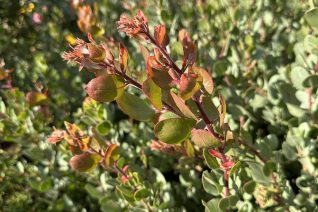

An excellent form of a great Manzanita species. This form of Big Berry Manzanita was a seedling in the Santa Barbara Botanical garden. The species has a wide range in California and I am personally familiar with this shrub, it grew on property that i owned in the Sierra foothills in California. The very tough and uniform rounded blue gray green leaves are handsome but this form has new growth stained in red and then slowly blush before permanent pale blue. The tips often retain the color year round. Cold hardy and extremely drought tolerant, it also takes well to garden cultivation with no supplemental summer water. This form to 3′ tall x 8′ wide in 7 years. It would make an ideal bank cover and low limbs will self layer aiding in soil stabilization. White flowers in winter followed by relatively large pea sized drupes in bold clusters. Full sun to very light shade, the best color will be in full sun and average soil with no supplemental water . The color of the foliage steals the show. In time the stems exfoliate to cinnamon orange. Cold hardy to brief drops to 0ºF. A very pretty, tough Manzanita. ( Photos: Chris Hembree )

Arctostaphylos hookeri ‘James Roof’
Smaller growing Manzanita that assumes the twisted form of a bonsai with age. In fact this 2′ x 4′ wide decumbent shrub makes a wonderful, long lived container plant. In the ground it excels on slopes and other places where standing water never occurs. Full sun to high overhead shade (a high tree canopy). In late winter scattered smaller white urn shaped flowers decorate the branch tips. They morph into highly prized fruit for wildlife. Sage green diamond shaped foliage it lightly twisted and terminates to a sharp tip. Twigs, branches, and trunks all have a glossy mahogany finish. Great shrub for covering low slopes. Effectively blocks weeds. Water to establish and then set it free. Several plants may be massed to produce a small scale, drought adapted ground cover. Exceptionally garden tolerant selection that is exceptionally handsome. This species is native to the central CA coast and has been one of the best for garden culture in our region. Accepts light irrigation in summer. Excellent performance at the Oregon coast. It thrives on sandy soils. Nice smaller growing selection. Naturally summer drought adapted. Orange drupes are showy.

Arctostaphylos hookeri ‘Wayside’

At the North Willamette Experimental Station in Wilsonville where OSU conducted a trial of scores of Arctostaphylos species and cultivars this special ground cover Manzanita has been consistently one of the best performers. Deep green pointed leaves are held perpendicular to the sun on cinnamon red stems. In time it forms glossy red bark that is very showy. Low and dense growing to 2′ tall and 6′ wide. Excellent bank cover or ground cover in any soil that is not amended or boggy. Profuse white flowers in spring. First rate weed suppressing plant for hellstrips, rock gardens, dry borders. Excellent appearance year round. No summer water. Take advantage of its low dense growth to cover and suppress weeds. Wonderful plant for baking hot locations. Very easy to grow.

Arctostaphylos manzanita ‘Dr. Hurd’
An old and venerable cultivar of this species. This small tree achieves 12′-15′ with great age forming a showy and jaw dropping evergreen. Pale sea foam green/ grayish foliage is large and very circular giving this tree a billowing appearance. In winter white tinted pink flowers erupt from all the branch tips. These morph into large russet berries consumed by birds. The mahogany twisting, muscular bark is the most outstanding feature. Fast growing in youth (2′-5′) per year when excited. Give this dry loving shrub EXCELLENT air circulation in an open exposure. It can be afflicted by black spot in wetter than normal springs. ‘Austin Griffiths’ which is 1/2 this cultivar is more resistant to black spot. In time you can remove the lower shaded branches to show the trunk and improve air circulation as well as general good looks. Tall and often half as wide. Locate in a hot sunny place and water to establish then set it free. Very striking tree that is best planted as a smaller plant. Large specimens will NOT live as long and will be more difficult to establish.

Arctostaphylos manzanita ‘St. Helena’
A tree type manzanita that has been a stellar performer in our gardens. Rapid growth to 10′ x 10′ in 8 years. Broad, rounded sage gray-green foliage is held perpendicular to the cinnamon red stems to avoid moisture loss (no flat leaves baking in the sun). In winter to early spring, clusters of white flowers are effective and visited heavily by pollinators. Russet red berries follow but do not last long because of animal predation. Open habit with time that exposes the muscular, smooth mahogany trunks. (Its thought the bark exfoliates to deter moss and lichen growth). This is a very hardy drought adapted west coast native shrub to small tree for average, well drained soils and NO summer irrigation. Full sun and room to spread. Avoid rich, amended soils- leaner conditions produce a much hardier and longer-lived plant. Very similar in scale to ‘Austin Griffiths’ but leaves are grayer and flowers are distinctly white. Great garden performance. Good air circulation.

Arctostaphylos nummularia ‘Select Form’
Stunning glossy perfectly round leaves line wiry stems on this dense, mounding, very happy low-growing Manzanita. New growth is tinted red and settles to bright green. To 2′ tall and 4′ wide creating a dense weed-suppressing dome of foliage. White flowers in spring. Very garden tolerant for full sun to very light shade. Moderately fast growing. Excellent candidate for hellstrips, hillsides, etc. Great performance at the Oregon Coast. Little to no summer water once established. Very very good looking plant. It thrives in perfect conditions- neglect and sun and is much more fussy in shade. Cold hardy to 5ºF. Nummularia= coin shaped, referring to the leaves Takes a little bit of shade- especially if there is a very high tree canopy. Adapted to coastal conditions including sandy soils. The glossy leaves and dense nature of this shrub make it hard to capture in photographs.

Arctostaphylos pajaroensis ‘Lester Rowntree’
Virtually the same as ‘Warren Roberts’ it is completely interchangeable with that cultivar. Why do we grow ‘Lester’? Aside from having amazing blue foliage and clusters of deep pink flowers from January to March we LOVE Lester Rowntree. She was an amazing, intrepid self-taught botanist who roamed California in the 1930’s in her simple pickup truck camping and botanizing throughout that state. Her incredible book ‘Hardy Californians’ is a must read for any gardener on the west coast. And its not just about plants- Check it out. This shrub is large in time to about 4′ tall by 8′ wide. The pink flowers born on the blue foliage is a sublime combination. Following bloom new spring growth is a fantastic red/ orange before settling to blue. Bark is a smooth mahogany with time and the trunks are sinuous and winding. This is an excellent shrub in our climate. Once established it requires absolutely no supplemental water- ever. Sailing through temps in the 100’s and bone dry with NO visible signs of stress. Our kind of shrub. It is cold hardy and completely climate adapted. Hell strips, dry borders, informal shrubberies. Mix with Ceanothus, Grevilleas, Halimiums. Very pretty year round.

Arctostaphylos pajaroensis ‘Myrtle Wolf’
Always at the top of the list of Arcto Afficianados this is not often seen in gardens. An excellent winter blooming Manzanita that has been a fantastic performer in the PNW. Upright growing shrub with blue foliage- new growth is briefly tinted red. In January to March copious bright pink clusters of urn shaped flowers appear. Anna’s hummingbirds are not far behind. To 5′ x 5′ in 6 years in full sun and average, well drained soil. No summer water when established. Excellent winter blooming shrub that is always good looking. This is a reliable cultivar for spectacular floral shows. Place close to an exit or entrance where you can stare into the pendulous pink flowers and the winding branch structure. Supply good air circulation. Photos by Chris Hembree

Arctostaphylos pajaroensis ‘Warren Roberts’
Big beautiful Manzanita that has thrived at our very cold wholesale nursery for almost 20 years and has never been harmed by weather. To 4′ tall and up to 8′ wide the new growth emerges a fiery orange red before settling down to a nice gray/blue. In late winter pink tinted urn shaped flowers decorate the whole shrub. The combination of the blue foliage and strongly pink flowers is magical in winter. Well drained average to poor soil in full sun is ideal but it can get by with less than ideal conditions. Water to establish the first summer then none in subsequent years. This is a great landscape shrub that retains its good looks year round. Very adaptable to garden situations where water is curtailed. Long season of bloom in February to April. Blushed small apple shaped fruits are stripped quickly by wildlife. Foundations, hillsides, sterile road cuts. Adaptable and very pretty shrub.

Arctostaphylos pumila ‘Grey Leaf Form’
Surprisingly happy in our climate in its native Monterey Bay area of California its known colloquially as Dune manzanita. Very gray blue leaves are not huge and hug the stems tightly on a compact moderately growing Manzanita. To 5′ tall and wider over time. In mid winter to early spring white flowers tinted pink appear in clusters at the tips of the plant. The trunk becomes deep mahogany brown over time and contrasts greatly with the light colored foliage. All around fantastic shrub for full sun and average, unimproved soils with little irrigation once established. Not as fast growing as other Manzanitas, usually less than 5″ per year.Very pretty plant that mixes wonderfully in droughty shrub borders, and even as a foundation shrub. Makes a nice life in a containers for years. Long lived. Probably harbors some deer resistance. Extraordinarily drought adapted. Native to a restricted range on the central California coast. Great performance on the Oregon coast.

Arctostaphylos pumila ‘Small Leaf Form’
Immensely handsome dense rounded Manzanita that has smaller than average silver foliage and fantastic bark. Moderately fast growing shrub to 4′ tall x 5′ wide in 8 years. In late winter each branch tip is bedecked in clusters of small white flowers- they are born in profusion and expand from pink buds. Russet colored berries often follow and are consumed by wildlife. The black/mahogany glossy bark is beyond striking with the silver foliage. It splits, rolls up into ribbons, and exfoliates in late summer. In time it may be pruned to reveal trunks–for most of its youth they are hidden by dense almost formal looking foliage. Adaptable to many soils including clay soils- especially on slopes. Excellent long term landscape plant that looks great year round. Very good cold hardiness enduring 0ºF with no problem. Dig a hole 3x as big as the rootball in the pot to loosen the soil and allow the new roots to penetrate virgin soil. Water regularly through the first summer- then little to none in subsequent years. Combine with green leaved Arctos for great foliage contrast. Perfect on slopes, areas with intense reflected heat such as parking lot planter islands. Great urban shrub. Appreciates good air circulation.


Highly recommended by a fellow Manzanita enthusiast this hardy variety native from Mt. Tamalpais in the Bay area NoCal south deep into Baja and east over to the Big Bend in Texas. Aka pointleaf manzanita or Mexican manzanita this is a very upright and skinny manzanita to 6′ tall but less than 3′ wide. The blue green foliage is handsome at all times and the large pearl pink clusters of flowers are pendant and very showy in winter. Russet fruits follow beloved by birds. Its finest attribute aside from being tall and thin is that bright, glossy, orange exfoliating trunks contrast in a ghostly way with the blue green leaves. Tolerates some sub freezing wind in east Portland, out of the wind zone it takes temperatures down to 5ºF for brief periods. A wonderful Manzanita with a smaller foot print. The leaves are distinctly long and pointed. This gives this Manzanita an almost willowy feel. Moderately fast growing.

Arctostaphylos rudis
Roughbark Manzanita is a little known species of Arctostaphylos from the central California coast that has turned out to be a great garden plant. Nearly round leaves cling to the winding upward pointing stems. In a short amount of time it forms a rounded, spreading shrub to 3′ tall by 5′ wide (5 years). Late winter bring profuse blush pink urn shaped flowers- followed by clusters of large tight blushed red drupes. Full sun and average, well drained soil with good air circulation. No summer water at all when established. This not only gives it the neglect it adores it increases hardiness to cold in winter. Avoid, exposure to subfreezing winds… not a Manzanita for Gresham or Troutdale but in milder parts a great landscape shrub. Group with other drought adapted shrubs. Handsome smaller scale shrub for hot sunny sites. Develops shredded cinnamon red bark with time. Performs very well in containers. Photo credit below: Lance Wright.

Arctostaphylos silvicola ‘Ghostly’

Ghostly white fur covered foliage is almost too pale to believed and ‘Ghostly’ is an apt name. A distinctive Manzanita to 8’ tall and 4’ wide in 5 years. Fast growing in our climate. Do not be afraid to cut back lanky new growth for a more upright and sturdier plant. Tends to send out a lot of vertical stems, those may be cut to initiate denser branching. Prune in July. In late winter and early spring clusters of white urn shaped flowers appear at the branch tips and delight hummingbirds. There is no more silver/white foliaged Manzania that we have seen. Truly spectacular in well drained soil with good air circulation and little summer water once established. From a species native to the Santa Cruz Mtns. in California and surprisingly cold hardy.

Arctostaphylos viscida ‘Sweet Adinah’
White leaved Manzanita is endemic to southern Oregon into northern California. The leaves are large, round, and very pale blue/gray. This species which also grows on serpentine soil. is incredibly tough and requires special treatment. Adinah found this very pale selection just outside of Ashland, OR.. Extremely drought adapted this species is best in VERY WELL drained soil with light water to establish, Once up and going it will do best with NO SUMMER WATER. This is one of the most striking Manzanitas that we grow.Its also a little bit tough to cultivate, and can up and go away for no real reason, so keep that in the back of your mind- absolute neglect is its best friend. Having said that is easily one of the most striking shrubs native to Oregon. To on average 4′ x 4′ it should be planted in poor to average soil. Avoid all fertilizer, and rich conditions. New growth emerges striking orange/red following clusters of white tinted pink flowers from January to March. Very cold hardy enduring temperatures near 0ºF with no issues. Rock gardens, dry shrub borders, drought adapted screen or specimen. A mature shrub kind of gives me the impression of a big white bubble. Extremely heat and drought adapted native shrub. Limited quantities Some deer resistance. Full sun to very light shade. Oregon native plant.
Xera Plants Introduction

Arctostaphylos x ‘Austin Griffiths’
This is probably one of the very best garden Manzanitas in general. Large growing shrub with sage green foliage, copious, large clusters of pink flowers in winter, and the tell tale famous mahogany peeling bark. To 9′ x 7′ wide in 6 years, fast growing and well adapted to most well drained sites, including heavy clay soils on slopes. Little to no supplemental irrigation. Very resistant to black spot a leaf disease that can afflict Manzanitas. Specimen, or small garden tree. Good looking year round. Flowers appear in late December and are effective through February- not at all affected by cold. Anna’s hummingbirds are immediately in attendance. Provide a wide open exposed site with excellent air circulation. A wonderful garden shrub. We have a large specimen of this shrub in a container at the shop. Though the box it is in is huge it restricts the roots enough to make this Austin smaller than it would be in the ground. It begins blooming in mid-winter. Excellent garden Manzanita all around. Hybrid between A. manzanita ‘Dr. Hurd’ and A. x densiflora ‘Sentinel’. Wonderful plant. Dependable heavy flowering. Center bottom photo credit: Loree Bohl Danger Garden.

Arctostaphylos x ‘John Dourley’
Exceptional low growing Manzanita with new growth emerging electric red and settling to a mature gray/blue. In late fall to early spring copious pale pink flowers appear- very pretty in concert with the vibrant new foliage and older blue leaves. To just 3′ tall by 6′ wide very shortly. Bark is cinnamon colored in time. Full sun and average well drained soil with great air circulation. Little to no summer irrigation. Extremely drought adapted hybrid that many consider to be one of the best. Excellent slope cover. Good appearance at all times. This durable and adaptable Manzanita is excellent for landscapes where little maintenance is required. Its handsome mounding dense habit precludes pruning and it blooms for an extended period, often beginning as early as November and continuing to spring. Great drought adapted, weed smothering evergreen shrub that is constantly attended by Anna’s hummingbirds in bloom. Very easy to grow.

Arctostaphylos x ‘Pacific Mist’

Wonderful low spreading Manzanita that we have grown for more than 20 years. Silver/gray pointed leaves densely clothe the spreading stems of this adaptable shrub. In time the lax, decumbent stems point upward at the tips. In spring white flowers are a bonus. To 2′ tall and 6′ wide in 5 years it may be employed as an informal ground cover. Full sun to light shade and well drained soil of average fertility. Little to no summer water when established. Nice looking plant year round. In time it develops glossy cinnamon colored trunks/stems. Excellent on slopes. Takes more shade than most cultivars. Excellent cold hardiness. Plant on 30″ centers for a large ground cover. Tips may be pruned in spring to encourage density, otherwise it covers the ground densely. A hybrid of obscure parentage that has been around for decades.

Arctostaphylos x ‘Pajaro Hybrid’
Amazingly showy Manzanita that is a delight when new growth emerges stained in raspberry red before settling to a soft gray mauve mature tone. A dense and spreading shrub that always seems to be in growth and therefore never without the colorful foliage. From December to March a non-stop copious display of white tinted pink flowers, in concert with the foliage color its a knockout. To 4′ tall and 8′ wide in 7 years. Best in poor soil or native soil that has NOT been amended. Its an adaptable plant. Let it adapt. No summer water once established. Striking colorful shrub year round. Ground cover, hedges, focal points, blasting hot hellstrips. Anna’s hummers are invariably drawn to this showy winter bloomer. Easy.

Arctostaphylos x ‘Sunset’
One of the very best landscape shrubs for western Oregon. Named for the 50th anniversary of Sunset Magazine way back in 1977- its an excellent, garden tolerant Manzanita. Dense growth emerges orange/red before settling to a mature fashionable army green. The stems and leaf margins are outlined in fine white hairs- an elegant detail. In spring sporadic white flowers appear. Rounded dense shrub for full sun and average to poor soils, including the most compacted. This should be a basic landscape shrub in our climate- To 4′ x 6′ in 5 years, it covers the ground well. A perfect candidate for such places as frying hot circular planters in a sea of asphalt. This remarkable shrub will thrive and not flinch without a drop of supplemental irrigation- and it will still always look good. In fact, soil that is too rich or too much additional summer water leads to an initially massive plant that is then not long lived. A little rough living adds years and slows down what has got to be natural hybrid vigor. May be tip pruned to encourage density if required- and may even be sheared quite severely and still maintain its self respect. The shredding cinnamon/brown bark is handsome with time but the foliage mostly obscures it. Excellent cold hardiness. A truly climate adapted shrub. A Xera favorite shrub that we’ve grown for close to 20 years.

Arctostaphylos x coloradensis ‘Panchito’
Several wonderful attributes makes this a great Manzanita for widespread use. Its extremely cold hardy, a naturally occurring hybrid from southern Colorado- it can handle temperatures lower than -20ºF. Its a great size- slow growing to just 3′ x 3′ in 8+ years. The matte green foliage is dense (almost boxwood-esque) and is a great foil for the clusters of pink buds that relax to lighter pink when open. Full sun and average, unimproved soil. Water to establish then only what falls from the sky. This dainty almost formal looking shrub finds a happy home in smaller gardens, rock gardens, and thrives in Central Oregon. In time the trunks exfoliate to glossy maroon- it take quite a few years for this to be an outstanding feature. Mounded and dense for the first part of its life- expect just several inches of growth per year.. Open exposure with good air circulation. Great performance in Gorge outflow. A perfect substitute for ‘Greensphere’ that is both hardier to cold and a little easier to cultivate. Russet red berries that follow are a treat for the birds that get there first. Accepts the hottest aspects, drought, and brutal cold. Bienvenidos, Panchito!

Arctostaphylos x densiflora ‘Sentinel’
Consistently one of the very best performers in Western Oregon. ‘Sentinel’ accepts many soil types and aspects with superior cold hardiness as well as disease resistance. Fast growing rounded shrub to 7′ x 7′ in 4 years. Attractive sage green leaves are held perpendicular to the red stems to avoid moisture loss. The bark exfoliates to a smooth muscular deep mahogany with time. Excellent specimen or even informal hedge row. In late winter pink urn shaped flowers appear in clusters and turn to russet fruits consumed by birds. Little to no supplemental water ever. Easy to grow. Provide good air circulation. A great Manzanita. ‘Sentinel’ can compete with invasive grasses and still grow and perform. Immensely drought adapted. It may be aggressively tip pruned or sheared carefully to produce a smaller, denser plant. First rate landscape evergreen shrub.

Arctostaphylos x densiflora ‘Harmony’
A handsome, easy, and adaptable Manzanita that is a great plant for beginning gardeners. Sharp tipped bright green rounded leaves clothe stems of smooth mahogany/orange. Fast growing evergreen to 7′ x 7′ in 7 years. Average, unimproved soil that has good drainage. Even adaptable to heavy clay soils if strictly unwatered in summer. Urn shaped pink flowers change to white upon opening and draw hummingbirds. The maroon berries that follow are gobbled by birds and seldom spend much time on the shrub. Full sun to light shade and little to NO summer water. Tip prune after blooming to limit size, encourage density. As with all Manzanita it abhors crowding and should be given excellent air circulation. Dependable, hardy and easy to grow.

Arctostaphylos x densiflora ‘Howard McMinn’
A FANTASTIC Manzanita ‘Howard’ forms an extremely handsome evergreen shrub to 7’ tall and as wide in as many years. Striking mahogany bark is smooth with dark glossy deep green leaves. Profuse clusters of pink urn-shaped flowers appear in late winter and change to white over a period of six weeks. Maroon berries follow in summer. One of the most adaptable to landscapes, tolerates some summer irrigation but absolutely avoid boggy conditions and heat. A fantastic performer in our climate. Excellent as a specimen, basic landscaping shrub, or even informal hedge. Tip prune in summer to limit size and shape if required. Somewhat formal appearance year round. Very nice as an informal hedge and wonderfully adapted to steep slopes. Very good black spot resistance. Verdant and healthy year round. Adaptable to very HIGH overhead shade in woodlands. Avoid rich soils and do not improve. Best in un-amended native soils. Great formal looking shrub for rough conditions. Cold hardy to 5ºF. Exceptionally long lived in our climate.

Arctostaphylos x hookeri ‘White Lanterns’
Stellar small scale Manzanita that is a winner in gardens. Smaller leaves have a finer texture than most shrub types. Forms a symmetrical, dense dome to 3′ x 5′ in 5 years of medium green foliage. Massive bloom as clusters of white flowers (tinted pink in cold weather) occur from every branch tip in January to March. Very showy russet/mahogany bark. One of the best performers in our climate and scaled well for smaller gardens. Wonderful performance in Hell Strips, even large rock gardens. In time you may remove the lower tired branches that have become shaded out and reveal the smooth spectacular peeling trunks. Little to no summer water. Full sun to very light shade in well drained to average soil. Excellent cold hardiness as well as resistance to black spot. As with all give it good air circulation. Adaptable.

Arctostaphylos x media ‘Martha Ewan’
Our former employee Dan found Martha growing in the cemetery of the coastal town of Manzanita. It was bound to happen. This naturally occurring hybrid between Hairy Manzanita (Arctostaphylos columbiana) and the ground cover Kinnick Kinnick (Arctostaphylos uva ursi). Fantastic low growing evergreen shrub that is a superior ground cover. Dense growth clad in deep green leaves covers the ground on a 2′ x 6′ framework. White flowers in spring are followed by large red berries which are then consumed by wild life. Full sun to very light shade in most well drained soils. No summer water when established. Fast growing with little care. Amazing on slopes where it efficiently blocks weeds and the best ground cover Manzanita that we grow.. Better, easier, and faster ground cover than Arctostaphylos uva ursi- Kinnick Kinnick- dense growth is more vigorous and requires less maintenance or even supplemental water. Handsome and immensely easy plant. Though not technically a shade plant this variety can handle quite a bit of shade- avoid low dark shade, high overhead shade is best. Oregon native plant.
Xera Plants Introduction.
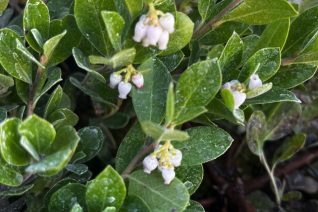
Arctostaphylos x media ‘Xera Pacific’
Our discovery of a naturally occurring hybrid Manzanita on the Oregon Coast. Low and spreading to 2′ tall and 5′ wide in 5 years. Light green paddle shaped leaves. White urn shaped flowers in spring. Bark exfoliates to mahogany and shredding with time. First rate dense weed smothering groudcover. Black spot resisitant. Full sun to part shade in average, well drained soil. No summer water- though it tolerates it better than most. Great Oregon native shrub. Cold hardy. Russet/red berries follow the flowers and are consumed by wildlife. Very similar in habit and use as ‘Martha Ewan’, they are almost interchangeable. The foliage is more rounded and lighter green than the previous. Oregon native plant.
Xera Plants Introduction.

Artemisia douglasiana
Many learn this plant as Douglas Mugwort but its more official common name is Douglas Sagewort. This aromatic vigorous perennial is common throughout western Oregon. It happily inhabits everywhere from ditches to the headlands at the beach. The plant has medicinal qualities that were used by native Americans and they also used the pungent smoke to ward off the spirits of the dead. To 3′ tall and spreading underground by rhizomes. This is a very vigorous plant when established, give it room and the respect it requires. In improved situations it can swamp other plants so best to leave your patch of sagewort to its own devices. Mix with other plants of similar vigor- Spiraea x pyramidata or Rosa nutkana. Give it at least 5′ x 5′ feet to roam. In summer plumes of off-white flowers produce a haven for pollinators. This member of the daisy family brings them from long distances. Very long lived deciduous perennial with long indented leaves that are dark green on top with an underside of pure silver. This makes this almost woody perennial very easy to spot in breezy conditions It appreciates average soil and light water to establish.. If it flags in drought you may give it a deep drink in summer to refresh. Loved by a host of butterflies. Doesn’t need much love to perform. Oregon native plant.

Aruncus dioicus var. acuminatus
Goats Beard is a big bold and easy to grow perennial for part shade and perpetually wet sites. To 4′ tall and as wide with large fountains of pure white flowers in late spring to early summer. Native in seeps and along watercourses, mimic those conditions in your garden and you’ll have success. Long lived plant that develops a woody base. Completely winter deciduous. Excellent combined with other mesic water loving plants. Tolerates some inundation but not during the growing season. Often found on cliffs away from the browse of deer. Very large permanent perennial in time. Fall color is often yellow. Widespread in the PNW. Native in the Portland City limits. Oregon native plant.

Asclepias fascicularis
Narrow leaved milkweed is an Oregonian butterfly weed that has a great wildflower demeanor and is just as attractive to pollinators as well as Lepidoptera (butterflies). Full sun and well drained soil, though it accepts clay soil on slopes that are strictly unwatered in summer , otherwise light consistent irrigation to establish- then natural rainfall alone. To 22″ tall and making a spreading plant. Mix with fine textured ornamental grasses,such as Tufted fairy grass – Deschampsia caespitosa and tall spiky perennials such as simultaneously blooming Kniphofias. Light summer water when companion planted. Flower color is most often creamy white but ranges to light pink. Often seen on road cuts and in ditches in the Willamette Valley. Blends in with grasses and other plants but pollinators find it no matter what. Spreads to form colonies by underground stolons to 2′-3′ wide. Nice cutflower. Important food source for Fendler’s Blue Butterfly which is very endangered and locally indigenous. Winter deciduous. Blooms open in June and persist to August. The large seed heads are pointed and release their downy seeds on the wind in August-September. Oregon native plant.

Asclepias speciosa
This widespread species is native to the floor of the Willamette Valley and is locally common in the Columbia Gorge where it occupies dry rocky hillsides in full sun but tolerates heavy clay soil. In the best conditions (loam) it is huge spreading perennial that requires pre-planning and some real estate. Gray green stalks and leaves rise up to about 4’tall and bear deliciously fragrant pink orbicular flowers. These are irresistible to butterflies, including Monarchs, and if you want one to visit your garden this plant is good insurance. However, all butterflies find it irresistible. Spreads underground vigorously by stolons and can come up quite a way from the initial clump. Full sun and well drained soil. Completely winter deciduous and emerges relatively late in spring. Be patient. see video below. IMG 6323. Oregon native plant.

Baccharis pilularis ssp. consanguinea
This is the Willamette Valley form of coyote brush (bush)- also known as chaparral broom. A relatively short lived evergreen shrub in the aster family. Indeed this form blooms in autumn through winter with small brushes of white plumed flowers on female plants. Smaller yellow flowers on males. Typical of the steepest cliffs abutting the ocean and in the Willamette Valley it populates recent road cuts and fire zones. Often it will be seen all alone in the center of a Willamette Valley field. Native inland from northern Marion county to Douglas county. Very fast growing and drought adapted daisy bush for rough sites and poor soil. Improved soil will yield an enormous shrub so its difficult to pin point an exact size but everything from 4′ tall in poor soil with no summer water to 12′ x 12′ in rich soil with irrigation. I suggest no irrigation after planting. Excellent fodder for insects and birds. It may be pruned heavily in spring and will quickly regenerate. Foliage is deep glossy green but fine textured. Not bothered by deer. Excellent native companion for Manzanita, Grevilleas. VERY EASY to grow. average life span 10 years. Good instant plant for a native garden, but not long term. Native from N. Oregon coast south to Baja California. A prominent component of the California beach chaparral and on the Oregon coast as well. Common associated plants on the coast are Salal (Gaultheria shallon) and Mahonia nervosa. In the Willamette Valley its primary role has been ursurped by Scot’s Broom. Too bad. Oregon native plant.

Berlandiera lyrata
The so called Chocolate Daisy of the great plains we love for the sweet chocolate scented yellow daisy flowers in summer. Forms a rosette of humble green leaves and then repeatedly in summer it sends up the wonderfully scented flowers on long stems to 1′ high. Full sun and well drained soil of average to rich fertility. Regular summer water encourages more bloom but it takes dry conditions when established. Rock gardens, gravel gardens, borders, containers. To 18″ wide when happy. Full all day sun. Lifespan: 3-5 years in our experience in Oregon. The yellow petals surround a soft green center- makes a nice scented cut flower.

Blechnum spicant (Struthiopteris spicant)
The second most common fern in western Oregon Deer fern is a lovely native evergreen clumping perennial that is invaluable. The tiered upright and then settling to horizontal mid green glossy fronds are handsome all the time. To 2′ wide and 2′ tall (when fronds are emerging). Rich, moisture retentive soil high in organic matter. Light summer water in part shade to shade. Familiar fern of the Oregon Cascades but very widespread. High deer resistance. Excellent native fern for life between Rhododendrons and Pieris that are ancient. This fern loves part shade and cool moist soils but has a bit of drought adaptation as well. Its supremely adapted to to the rough life of competition. Useful plant that looks very good year round. Design by Vanessa Gardner Nagel Seasons Design. Oregon native plant.

Bouteloua gracilis
Mosquito Grass or Gramma Grass is a widespread native of the interior west. Slowly spreading to form substantial clumps of fine light green/gray leaves. To 18″ tall the funny flowers born at the tips of the fine stems feature a horizontal inflorescence- to me it resembles a little blond mustache. Blooms appear in midsummer and are attractive well into fall. Full, hot sun and rich to average well drained sites. Mass for a fine textured effect of a blowsy low meadow. In autumn as it enters dormancy it retains a dried to cere presence deep through winter. It may be cut back hard in spring. Light summer water though extremely drought tolerant when established. Oregon native plant.

Brodiaea coronaria
Crown Brodiaea is in my opinion the more showy of the two that are common in Western Oregon, the other is Brodiaea elegans Harvest lily. This little naked lily inhabits dry hillsides and meadows from British Columbia to California. Cylindrical leaves emerge in autumn and a clump is green until spring. Then as the leaves go dormant it sends up a chalice of rich blue flowers with distinct white petals on the interior of the flower The 4-6 flowers measure nearly an inch wide each when open. To 8″ tall and spreading primarily by seed, this corm will also multiply to form local colonies. Blooms May to July, just as the accompanying grass is going tan summer dormant. Brodiaea has been placed in the Amaryllis family, then the Asparagus family and now it resides, but probably not permanently, in the Lily family. Loved by pollinators and native bumble bees are especially fond of the pretty flowers. Disappears completely after seed set. Full sun and an open aspect. Average soil and tolerant of xeric clay soils that dry to concrete with summer drought. Adored by butterflies. In the Willamette Valley it is common to find this corm among creeping strawberry Fragaria Virginiana platypetala Roemer’s Fescue Festuca roemeri var. roemeri, Prairie stars Lithophragma sp.as well as Ookow Dichelostemma congestum . Once established no supplemental water is required, in fact its best to give this beautiful little flower a dry rest in summer. No summer water zone. Not well adapted to compete with introduced invasive turf grasses. Oregon native plant.

Brodiaea elegans
Wonderful native bulb that has several common names. Harvest lily is one as well as cluster lily. This gorgeous inhabitant of dry hillsides from British Columbia to southern California erupts in clusters of blue flowers just as summer drought ensues. To 14″ tall but normally shorter a clump of scrappy green leaves comes out in autumn and persists until bloom time. As the leaves go dormant the bulb sends up its bloom. Easy to grow if you accept its requirements. Bulbs that are potted should be watered after planting but established plants should rely only on what falls from the sky. Best to not irrigate in summer. In time it spreads by both increasing bulblets as well as seed. Excellent planted among Festuca roemeri var. roemeri as well as Festuca californica where it occurs naturally. Excellent pollinator bulb in the lily family. Leaves are deer resistant but flowers are not reliably deer proof. Full hot, all day sun in soils that dry completely in summer. Native throughout the Willamette Valley and into the gorge locally. Oregon native plant.

Calamagrostis foliosa
Mendocino Reed grass is a regal plant from the northern California coast. Well scaled for gardens a 1′ x 2′ wide clump eventually forms with stiff, tidy blue green arching leaves that are blue with purple highlights. In spring to mid-summer 1′ tall spikes of flowers that begin russet and age to soft tan appear and are immensely showy and symmetrical. A back lit plant in bloom is a festival of brilliant tones. Best in light shade and average to rich, well drained soil with light summer water to improve vigor and appearance. A cool season grass that looks wonderful in winter as well as summer. Excellent garden plant that has proven to be easy and adaptable, Unfortunately, it can be hard to propagate and availability is spotty. Evergreen.
NOT AVAILABLE 2022/23

Calamagrostis nutkaensis
Pacific Reed grass is a large and stately grass that is found close to the coast/ beach. A tall growing species with large flat green foliage and tall flowers that are at first green and then age to straw in summer. To 3′ tall on average, this plant can even perform as an epiphyte as is sometimes seen in forests adjacent to the beach. Spreads to form large clumps that are staunchly evergreen. Native from S. Alaska to N. California. This makes a wonderful casual plant with stiffly upright flower spikes. To 3′ wide and clumping. Average to amended soil, adaptable to clay soils. This is a great first line grass at the beach. It endures salt spray and poor soils. Easy to grow native grass for rough areas, meadows, forest verges. Full sun to quite a bit of shade. It may be cut back hard in the early spring, but appearance is very stable throughout the year. Deer resistant. Very easy to grow. Light consistent water inland, but drought adapted at the coast. Associated plants in the wild are Polypodium scopulorum, Picea sitchensis, Gaultheria shallon (Salal). One of our best native evergreen grasses for our gardens. Oregon native plant.

Calandrinia (ciliata) menziesii
Red Maids. A lovely native hardy annual for the sunniest spots. Rosettes of semi-succulent paddle shaped leaves are about 5″ wide. Found primarily in poor soils in hot sunny locations. Thats where you find it in habitat, the sides of gravel roads, rocky hillsides and good drainage. Beginning in May a constant procession of 1/3″ hot magenta flower are showy when they open in full sun. Native primarily to western Oregon its found through out the west. Resows reliably especially in gravelly soil. Calandrinia should be watered when they are planted from containers just to get it established. Self sown plant are incredibly drought adapted in our climate. This plant literally grows from desert to the mountains. Loved by a lot of pollinator its especially attractive to butterflies. Great in containers as well. Shocking magenta pink. Oregon native plant.

Calochortus tolmiei
Cat’s Ear’s or furry mariposa. This bulb is exclusive to the west side of the Cascades from central Puget Sound south to northern California. In Oregon it occupies a host of biomes. Most commonly its seen in grassy places or steep rocky slopes. On our property near Eugene it was primarily a woodland plant with forays out into the sun. We shamelessly picked this delicate flower for short lived bouquets. Picking it snuffs out the plant. To 8″ tall and sporting multiple flowers on a divided stem. The flowers have a peaked sweet fragrance that gives away the species. A fascinating flower for pollinators. Three rounded petals with a sharp tip are layered in purple to white to blue fur. This is imposed over the base color of the petals which is often white shading to purple. When planting from a container water when you plant it and then nature takes its course. It quickly goes summer dormant after setting seeds in downward shaped capsules. Do not disturb once established. Plants can put up leaves for several years before bloom commences. Patience. No summer water. Protect from deer who will snack on the flowers. Native associates are Sanicula crassicaulis, Dodecatheon hendersonii, Lithophragma parvifora, Nemophila menziesii, Iris tenax, and Carex tumulicola. Emerges quickly in spring- does its thing and then goes back to sleep. Charming.A critical bulb for Willamette Valley meadows, excellent under Oregon white oaks.. Oregon native plant.

Calycanthus occidentalis
Western Spice bush is native throughout semi shady and shady glens primarily in central and northern California with outliers in Oregon found north of Medford. A large deciduous shrub with a lush quality. The late leaves are medium glossy green and large. In summer double petalled madder red /brown flowers appear. The 2″ wide flowers have the distinct fragrance of a wine cask. Its most noticeable up close, but a large shrub in full bloom is a fruitful fragrant cloud. To 7′ x 7′ and adaptable to full sun to quite a bit of shade. Water to establish in its first year and then only occasional. This very tough drought adapted shrub should be used a lot more in our climate. Fall color is bright yellow but does not stop traffic. Tends to hit its ultimate height and then spreads laterally from there. In habitat its associates are Ceanothus, Aristolochia, Aesculus, Smilax. Very easy and long lived Oregon native shrub. Plant with Frangula, Ceanothus, etc in shrub borders or as an informal hedge. The more flowers you have the more dramatic the perfume. Seed heads that follow the flowers are large round semi woody urns and they are showy as well. Loved by hummingbirds and native insects. Moderately deer resistant protect when young. Oregon native plant.

Camassia leichtlinii ssp. suksdorfii
Great Camas is the larger and some say showier cousin to common Camas (Cammasia quamash ssp. maxima). Its found throughout the western valleys of the state. Rising to 2′ tall in mid spring the petals of great Camas are not only larger they are stiffer as well. The large star shaped flowers open from the base to the top. They range greatly in color from pale blue to the most common dark blue. Its a luminous color that beckons pollinators. Small black hover flies gather on the flowers to collect pollen. Forms increasing colonies in rich soil that retains moisture. Its often seen in winter wet areas, but it can be found under oaks and firs in woodlands as well. It grows and blooms simultaneously with its common associates, Sidalcea malviflora ssp. virgata and occasionally even with Iris tenax (Oregon Iris). Its most striking neighbors in the wild are wild Parsnip (Hieracleum maximum) as well as Ranunculus occidentalis (Western Buttercup). Leaves precede the flowers and the whole plant goes cleanly summer dormant after seed set. Very adapted to heavy soils. No supplemental irrigation is required once established. In the wild it is found from full sun to quite a bit of shade on the verge of woodlands. Oregon native plant.

Camassia quamash ssp. maxima
Common Camas one of the wests great wild flowers. ‘Maxima’ is the form that is most common in the Willamette Valley. In April to June meadows, glens, and floodplains turn sky blue. Occurs natively in vernally wet sites, that means that part of the winter it is submerged or very saturated. However, it does thrive in upland situations in heavy clay soils that are sodden for at least half the year. Prior to European development first nation people relied on this starchy bulb as a food source. They managed it by low intensity fires which cleared away the competition but did not injure the deep bulb. In turn the Camas thrived. They ate it baked or steamed like a small potato. An important pollinator plant that also attracts some critically endangered Willamette Valley butterflies. Nice cut flower. The spike of flowers opens at the base and moves to the top. To 20″ tall in bloom. The whole plant goes quickly dormant with summer heat. Leaves emerge in early spring and precede the flowers. Full sun. Common associated plants are Ranunculus occidentalis, Thalictrum fendleri, and Delphinium trollifolium.. (Photo credit Guy Meacham) Oregon native plant.

Carex hendersonii
Timber sedge is an evergreen somewhat floppy Carex that is found extensively in western Oregon. It blooms in spring with thin green spikes and upward facing catkin like flowers. The rich green smooth foliage is distinctively pleated and about 4mm wide. Forms a sprawling clump and will seed around, especially in moist locations. It is ideal under native oaks and firs where it is found in the wild. Often in clear cuts in the Coast range there is a distinct period when this sedge dominates before being succeeded out. Tolerant of full sun to high overhead shade. Best at the edge of a forest with half day sun Light consistent water to establish then you can set it free. Tolerates heavy clay soils well. To 1′ tall in bloom to 18″ wide and never tidy. Fairly good winter appearance but it can be cut back in early spring to refresh. Plant with Carex lepidota and Aster chilense. Oregon native plant.

Carex pachystachya
Chamisso Sedge is a wonderful, common and extremely widespread sedge native to the W/NW parts of the US. Upright growing evergreen clumper to 10″ tall x 10″ wide in a season. The complex flowers are brown awns clustered in orbs at the top of very straight 20″ stems. Adaptable to a wide range of conditions from wet riparian zones to drier upland sites. In the wild it accompanies such perennials as Delphinium trollifolium, to Iris tenax. Good looking year round with just a slightly beat up look after the hardest winters. Spreads moderately fast in rich to average soil. Better year round appearance with a light application of compost. Excellent in a Willamette Valley meadow that is wet in winter and bone dry in summer. Each clump is dense enough to inhibit weed competition. Spreads very lightly by seed. Clumps that lose their luster in summer drought can be irrigated. Good garden performance. Great massed plant on 1′ centers. Oregon native plant.

Carex pansa
California meadow sedge is native to stream banks, and vernally wet places at the beach from British Columbia south in to Baja. A deep green winter growing sedge which each plant reaches about 18″ across and 10″ or so inches high. It flops over gracefully and has a very uniform appearance through the year with light irrigation. This is a winter growing plant that resumes growing and greens up with winter rains. In very cold weather (below 20ºF) it can take on russet tints. A FANTASTIC LAWN SUBSTITUTE where it has been used extensively for that application in California. We should use it here too. Plant on 1′ centers for a lawn (faux lawn) cover from one gallons and water regularly through the first season. No water plantings can go summer dormant but in wetter environs this can be avoided and it will remain green and verdant. Water once a week in summer to remain green. Fantastic ground cover, slope cover as it will out compete weeds and form a uniform cover. Tolerates clay soils well, but some amending will reap rewards with a faster growing plant. Tolerates mowing very well. Oregon native plant.

Carex praegracilis
Meadow Sedge or Field Sedge is found primarily in meadows and grasslands east of the Cascades. An evergreen fine textured clumping sedge that is gracefully employed in mass plantings, lawn substitutes even freeway margins. Very adaptable plant for average soil with regular water for best appearance. It will make due with conditions that are much less optimal. To 14″ tall but bending immediately in a cascading motion that mimics movement by wind – even when its still. Forest margins, riparian sites. Very useful plant with good winter presence. Full sun to very light shade. Very useful in meadow plantings. Rarely seeds itself and is well behaved. And remember Sedges have edges, rushes are round and grasses like asses have holes. HEH. Oregon native plant.

Carex praegracilis ‘Chisai’
Excellent dwarf form of our native meadow sedge. To just 6″ tall it forms dense spreading evergreen patches. In spring to summer both male and female flower spikes rise to just a few inches above the foliage. Nice looking compact plant that retains its verdancy through the winter. An admirable substitute for lawn and mowing is not necessary. This species is most widespread east of the Cascades. Its native throughout the west and this form was identified in California. Plant on 10″ centers for a modern massed ground cover. The mid green to ochre green leaves are dense and smother competition. This creates less of a hummock affect and more of a small dome. Very easy to grow. Excels in containers. Full sun to light shade, also very high overhead shade (a tall tree canopy). Amending the soil with compost and fertilizer will increase vigor and green appearance and quicken establishment. Spreads by slowly expanding rhizomes. Excellent between stones or pavers. Tolerates light foot traffic. Not really large enough to be bothered by deer once established. Hardy below 0ºF. This useful plant has great smaller scale, ease of culture, and consistent good looks. This would be an excellent smaller grassy component of a meadow. Established plants can take quite a bit of summer drought. Carex praegracilis is an Oregon native plant.

Carex tumulicola
Foothill Sedge is commonly found from the central Willamette Valley south into California. A tightly clumping sedge with medium green foliage and 8″ wiry stems with attending flowers that are tan in spring/summer. In our region this plant can be found in upland situations where it is moist for at least half the year. Its also diminutive and almost hard to find in the wild. Under cultivation its an entirely different beast. Clumps are dense but expand with a pronounced weeping habit. To 8″ tall x 18″ wide for each individual plant. Good massed or as a lawn substitute. Takes mowing if its limited to once a year. Regular irrigation keeps it green and happy. Summer drought sees blades of tan as well as green and not so verdant. It does not run nor become a seeding pest- sticking surprisingly to itself. Plant on 1′ centers for a modern, mounding effect. Takes clay soils well. Water regularly to establish the first summer then taper off (continue watering if you want it to stay staunchly green). Combines well with perennials including native perennials such as Checkermallow (Sidalcea) and, Ranunculus occidentalis (Western Buttercup), as well as Shooting Stars (Dodecatheon) are found in closely related communities with this plant. Full sun to light shade, or high overhead shade. In California it is also known as Berkeley Sedge. Oregon native plant.

Carex tumulicola ‘Willamette Gold’
Wow, when nature smiles on you then you need to take advantage. We found this stable variant of our locally native foothill sedge that is pure gold. As for the species a clumper that forms trailing 12″ foliage. The tight clumps keep to themselves and do not seed or run. Brilliant color all season long in average to enriched soil in full sun to light shade. Water consistently through summer for the best, consistent color. Attending flowers are on wiry straight stems with buff flowers in late spring to early summer. Mass for a much more drought adapted and vivid effect as Hakenochloa- Japanese forest grass on a smaller scale.. Easy to grow climate adapted native sedge. This is from a seedling batch of Willamette Valley native seed. Tough and good looking all the time. Evergreen- ever gold. To 6″ tall and 1′ wide. Plant on 1′ centers for a massed effect. Excellent in concert with other drought adapted natives, Manzanita etc.Limited quantities Oregon native plant.
Xera Plants Introduction

Carpenteria californica
Bush Anemone is a locally rare native of the Sierra Nevada foothills in Fresno County in central California. This tough evergreen shrub with thin deep green leaves set against pale exfoliating glossy bark is perfectly hardy to cold and drought. In May/June 3″ wide pure white flowers with a central yellow boss of stamens are sweetly fragrant. Full sun to almost full shade in any soil with adequate drainage. Adaptable to dry clay soils and able to endure extreme drought. Extraordinarily climate adapted- enduring summer drought and winter rain. Appreciates good air circulation. No crowding. To 8′ tall and 5′ wide in 6 years. Often left alone by deer- but they will definitely try newly installed plants. One of our most treasured west coast native shrubs. Very long lived sited correctly and denied summer water. Accepts blasting reflected heat. In time you can limb up the shrub to reveal the white/taupe exfoliating bark which appears glossy with age- this also assists in the air flow that this shrub craves. A monotypic genus. There’s just one species. Limited quantities.
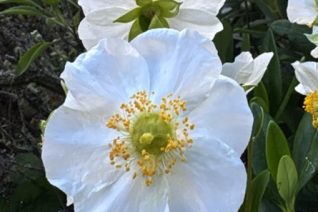
Carpenteria californica ‘Elizabeth’
A wonderful selection of Bush Anemone that was chosen because it produces more flowers (though they are a tad smaller than the species) born in multiple sprays. And this form is slightly more compact as well. An evergreen shrub with lanceolate leaves w/ a rolled margin (revolute). The deep green leaves are attached to tan stems and trunks that with age exfoliate to a glossy metallic sheen. To 6′ tall by 4′ wide in 5 years. Full hot sun to very light open shade in average, well drained soil. For clay soils its best planted on a slope. Water to establish then none after the first summer- in fact this extremely drought adapted shrub prefers to go with out water. Provide good air circulation. Adaptable to the hottest sites, including western and southern exposures. Moderate deer resistance- they will try young plants so protect them. Long lived, climate, adapted shrub. Cold hardy to about 0ºF. The white flowers that occur in May/June are sweetly fragrant. Prune, if needed AFTER flowering.

Caulanthus inflatus
DESERT CANDLES. This fascinating annual thrills us. Most often seen in the wild in its native California, and is commonly seen in the wildflower mecca of Carrizo Plain. Poppies, gillias, Brodiaea accompany this relative of brassicas. A small rosette of fleshy leaves gives way to an extending inflated hollow spike. Its colored bright yellow/chartreuse and glows from a distance. The MAROON flower not only cluster at the top they symmetrically line the tall stems. All together a glowing sentinel of a plant that is almost never seen for sale. The period of exceptional showiness is brief – 4-6 weeks but it such a bizarre and showy display that we wouldn’t be without it for early/mid spring containers. Might self sow in open disturbed sites. Better to save your own seed. Such a cool west coast native it needs to be appreciated for its unique and luminous beauty. To 30″ tall. Draws native insects including hover flies. Sets seed and dies in early summer completing its life cycle.

Ceanothus ‘Concha’
Big and arching evergreen shrub that becomes an unbelievable sea of ultramarine blue flowers in April. To 8′ x 8′ very quickly in full sun and well drained soil. Amenable to clay if unwatered in summer. Once established NO summer water at all. Grows quickly to its ultimate size give it room. Leaves burn below about 12ºF but recovery is rapid in spring and seldom sacrifices blooms. Rapid growing in our climate it consorts well with native wildflowers and especially bulbs. Completely drought adapted in our climate. One of the most stunning wild lilacs ever released. Pictured below at an elementary school. Planted on the playground, the children use it as a shelter. Kind of cool.

Ceanothus ‘Victoria’
This is one of the most popular shrubs in western Oregon of the last two decades. And rightfully so. This wild lilac sports excellent cold hardiness, prolific flowers, and glossy handsome evergreen foliage year round. A strong growing shrub that can literally explode in growth in rich soil but is much more restrained in poorer mediums. Remember this when planting it. It performs the best in average, un-amended soils in full sun with regular summer water for the first season to establish and then none in subsequent years. Sky blue flowers are profuse covering this dense shrub in a haze of color for 3-4 weeks in May to June. Later blooming that most other Ceanothus. This good looking shrub is so durable its made its way as highway verge mass plantings but it is just as stellar of a garden plant as well. Cold hardy to about 5ºF- it survived -5ºF in the southern Willamette Valley in 2013 by freezing to the snow line and then vigorously re-sprouting. Durable, dependable Ceanothus. Avoid the summer heat + water that it abhors- it leaves it open to root water molds that can do it in and fairly quickly. Excellent shrub for the beginning gardener. Loved by pollinators of all kinds and is virtually rolling in bees during its fabulous bloom. NOT DEER RESISTANT. Most likely a hybrid with C. thyrsiflorus which must be responsible for at least half of its make up. Found in Victoria, Canada- hence the name. Likely it is the old cultivar ‘Skylark’ that was re-named upon its survival there of a hideous winter. The old name was forgotten and the glee of survival and discovery led to the renaming. To be clear ‘Victoria’ and ‘Skylark’ are exactly the same thing. Very fast growing to on average 8′ x 8′. Excellent with all west coast natives. Blooms simultaneously with yellow Halimiums. A fantastic floral and cultural combination.

Ceanothus ‘Blue Jeans’
One of the cold hardiest blue flowered cultivars and one of the earliest to bloom as well. An open spreading shrub with prickily deep green leaves. In March/April the whole shrub is obscured in violet blue clouds of flowers. Upon first viewing in bloom most people are shocked at how showy this evergreen shrub is. To 7′ x 5′ in five years in any well drained soil with little to no summer water. Very adaptable to clay soils, especially on slopes- as with all Ceanothus avoid boggy sites. One of the toughest cultivars that also takes very well to pruning which should be done after blooming to increase density if needed. Blooms on wood from the previous year and the button shaped flower clusters are so profuse that they obscure the foliage. Tolerates blasting reflected heat and is great in hot urban situations. Makes a wonderful informal hedge for wild areas but is just as at home clipped into urban scenes. Full sun. Moderately deer resistant- unusual for a Ceanothus. Cold hardy to 0ºF. The cultivar name might obliquely refer to the flower color but its an apt comparison to this tough , tough, shrub as well. No summer water. See clipped hedge below.

Ceanothus ‘Italian Skies’
A UK selection of our own west coast native wild lilac. And they did a good job. Large mounding evergreen shrub that puts on a spectacular display of deep blue flowers for nearly all of April into May. Fast growing to 5′ x 7′ very quickly in average well drained soil. Little to NO summer water. This cultivar has HUGE trusses of scintillating blue flowers. The largest of any Ceanothus that we grow- the reason why it is such a brilliant plant in bloom. Loved by pollinators of all kinds and especially tempting to large black and yellow bumble bees. Prune after blooming if you need to re-size the plant. Good cold hardiness. Best in a hot aspect. Good job to our friends in the UK.

Ceanothus ‘Midnight Magic’
We’ve been impressed with this extraordinarily deep blue flowered Wild Lilac released by Suncrest Nursery. A fine textured deep green evergreen shrub to 4′ x 8′ and forming a graceful cascading dome. Profuse cobalt blue flowers appear for 2-3 weeks in April. Extremely drought tolerant shrub for full sun and average to poor well drained soil. Little to no summer water required. Locate out of the path of subfreezing gorge winds. One of the most graceful and showiest of the genus. Grows very quickly to its ultimate size. Excellent performance on steep hillsides. Covers the ground like an umbrella with an great, intense, flower color. Excellent underplanted with yellow Pacific Coast Iris.

Ceanothus cuneatus ‘Blue Sierra’
For cold gardens this is an excellent cultivar and its a version of a species native to the Willamette Valley south into California. Small green wedge shaped evergreen leaves on an arching, somewhat angular shrub. In April and May clouds of soft violet blue flowers swarm the whole shrub. Beautiful. To 7′ x 7′ very quickly in poor to average well drained sites. No summer water once established. Handsome at all times. Excellently adapted to rough urban life where compacted soils, reflected heat and little water is present in summer- thrives in all those conditions. Full sun. Easy. Surveys by the California Chaparral Institute report that this is the most common component shrub of that community in both California and Oregon. Fixes nitrogen with its roots and is common following disturbance. Classic west coast shrub. Excellent accompanied by native bulbs and annuals. Beautiful with Pacific Coast Iris. Oregon native plant.

Ceanothus cuneatus ssp. cuneatus ‘Adair Villiage’
This is a Willamette Valley native form of Buckbrush found in the SW part of the Valley. This species is found historically from the Portland/Oregon City area in the Willamette Valley and throughout the southern half of the state well into California.Small isolated populations occur in central Washington- revealing a much larger range at some point. It has lost large areas of its northernmost natural range to development and fire suppression. It is a fire adapted species that requires disturbance to distribute. Thats a pity because this is a fantastic native shrub for hot dry sites. It is now employed by ODOT for freeway plantings and we are happy to see that. A large, angular evergreen shrub with small deep green paddle shaped leaves. In April the whole shrub is swarmed with pure white flowers.This is a beacon to all pollinators and the sweetly fragrant flowers will literally be buzzing in bloom. Fast growing incredibly tough shrub for areas of intense drought and reflected heat. To 8′ x 8′ very quickly in any soil that does not become boggy. Excellent performance in tough urban situations. Irresistible to bees and butterflies. Associated plants in the wild are Rubus ursinus, Dodecatheon hendersonii, Iris tenax and Ranunculus occidentalis. Extremely cold hardy to below 0ºF. No summer water. Moderate deer resistance. Oregon native plant.

Ceanothus cuneatus ssp. cuneatus ‘Mary’s Peak’
This is a different form of our locally native Buckbrush. We found this at approximately 2200′ on Mary’s Peak in the Coast Range in a forest that was comprised primarily of Douglas Fir and Golden Chinquapin. This shorter shrub with smaller deep green leaves is most conspicuous in its slick gray stems. To 3′ tall by 4′ wide in 5 years. Full sun and average to poor soil. Blooms April to May with ivory colored panicles that cover the whole plant on old wood. The sweetly fragrant flowers are always buzzing with pollinators. A true low water shrub that can easily get by on only what falls from the sky, once established. This is a cold hardy and locally native evergreen shrub. Often it grows in an arching and then angular kind of way. This form is less upright. Red seedheads follow the flowers. This is a very well known and stable population in the wild that is regenerating nicely. Extraordinarily tolerant of heat and drought. Traditionally this shrub follows disturbance and was widespread in the Willamette Valley often as a meadow component with Rosa nutkana and Amelanchier, Excellent with native clumping grasses, perennials, and annuals. Oregon native plant.
Xera Plants Introduction

Ceanothus gloriosus ‘Anchor Bay’
A very good looking mounded, evergreen shrub that is best appreciated in milder gardens. In colder gardens provide a warm protected site. The small holly-like leaves are mat green and good looking year round. This moderately fast growing shrub at first spreads out and then with time mounds up. To 30″ tall by 4′ wide in 6 years. Dense growth suppresses weeds. In Apri/May for 3 weeks button shaped flower cluster are pale sky blue and appear on wood from the previous year. Prune, if needed after bloom has ended. This is seldom necessary. Consistent summer water for the first season then none in subsequent years. Excellent adaptation to the Oregon coast. Cold hardy to 8º-10ºF briefly. Very good performance in hot sunny hell strips. Accepts part shade (at the expense of bloom) and poor soils. Somewhat formal in appearance it avoids the brush pile look with dense, closely layered leaves. Not as palatable to deer. Good appearance year round.

Ceanothus gloriosus ‘Emily Brown’
The glory of this large, wild evergreen shrub occurs in April when the branches are awash in deep violet blue flowers.The darkest hue among this species. A fast growing very large shrub to 4′ tall by 12′ wide in time. Excellent for wild uncultivated areas. A handsome spreading deep green evergreen of great drought tolerance. Tolerates most soils that never become boggy. Good cold hardiness to 5ºF. No summer water when established. Loved by bees and butterflies. Takes well to pruning. Blooms on wood from the previous year, prune if needed after blooming. Excellent pollinator shrub for steep hillsides, rough areas. Evergreen foliage is handsome year round. Tolerates part shade. Blooms best in full sun. Photo below by Evan Bean.

Ceanothus gloriosus ‘Pt. Reyes’
The most popular ground cover Ceanothus and an important plant in our climate. Evergreen ground cover shrub that covers the ground densely. In March the entire plant is smothered in light violet blue flowers. Stems root where they touch the ground making it a valuable erosion control. Full sun to light shade in any well drained soil. Excels on steep slopes. To 10″ tall and 3′ wide very quickly. Plant on 3′ centers for a fast dense ground cover. If the shrub grown as a ground cover gets too tall it may be sheared after bloom has ended. Water to establish for the first season, this also speeds growth. Excellent performance in Hellstrips. Little water once established. Moderate deer resistance.Avoid direct exposure to subfreezing east wind. Very well adapted to the Oregon coast.

Ceanothus impressus ‘Vandenburg’
Most Ceanothus are famous for their intense blue and profuse flowers, this interesting shrub has the typical masses of sky blue flowers which obscures the tiny warty foliage. To 5′ x 8′ and spreading wider than tall it becomes a cloud of blue in April and pollinators take notice. Rolling in bees and every other awake pollinator a shrub in full bloom is a buzzing fountain of activity. Fast growing, wiry, dense shrub with extraordinarily dark green tiny leaves. This gives the shrub the distinct appearance of a cloud. Full sun and average to poor soil including heavy clay soils that dry in summer. No summer water once established. Remarkably drought adapted west coast native shrub. Very easy to grow large, showy, shrub for wild areas, blasting hot urban hell scapes. Not totally deer resistant but better than most other species. Excellent performance at the Oregon coast. Endures sandy substrates and even a bit of salt wind. Attracts some of the first butterflies to emerge. Cold hardy to slightly below 10ºF for brief periods. Recovers from cold damage completely by bloom time. NOT FOR SALE 2023

Ceanothus integerrimus
Deerbrush is a widespread species in Oregon favoring areas with extensive summer drought. Its found primarily in the southern 1/3 of southwest Oregon and the north central part of the state into southern Washington. A small population exists on Skinners Butte in Eugene. Wide spreading semi-deciduous to deciduous shrub with young stems that remain green. Locally it is most common from about Dog mountain in the Gorge to the east and is extensive throughout Hood River and Wasco counties. This is an ideal shrub for revegetation areas, it naturally responds to fire, in fact the seeds must be exposed to boiling water to germinate. This species comes in a very wide range of colors. from clear white to deep blue and occasional shades of lilac pink. It may only be raised from seed so flower color is naturally variable. The plumes of flowers are large and airy displaying the color of the flower vividly. The most common flower color in Oregon is light blue. In late May and June a wonderful wildflower drive is up the Hood River Valley. These frothy blue, to pink to white flowers literally foam out from under native oaks and conifers. Its very conspicuous at that time too on the Rowena plateau. A word of warning not only does this shrub encourage deer browse it is also the unfortunate home of many deer ticks. Photograph carefully. Here it is found with such associates as Holodiscus, Toxicodendron, Symphoricarpos and Arctostaphylos. This brushy plant derives its name from the familiar sight of black tail deer breast height chomping away in extensive groves. Not a long lived shrub 10-15 years but it fixes nitrogen efficiently and improves the soil for successors. Full sun to very light shade, best on a dry slope. Water to establish then only what falls from the sky in subsequent years. Very hardy to cold enduring subzero temperatures. Beautiful pollinator heaven in bloom. To 3-7′ tall and as wide in several years. Oregon native plant.
Photo Credit: Dii Mazuz, Bruce Hegna

Wonderful smaller growing Ceanothus that makes a circular shrub to 30″ tall and 4′ wide. A named selection from UC Davis this low and spreading Ceanothus has wedge shaped leathery green foliage In early spring (March- April) button shaped clusters of violet blue flowers swarm the stems. Blooms on wood from the previous year , pruning is rarely needed but if it is prune after blooming has ended. Full sun to very light shade, an open exposure . It has shown very good cold hardiness in the Portland area. and that includes some tolerance for subfreezing wind. Fast growing to its ultimate size. This specis native to the central California coast lives longer than most species. Average soil, ideal on slopes stems can root where they touch the ground. Water to establish then no irrigation in subsequent summers. Very easy to grow. Loved by pollinators and butterflies and a pollinator master piece. Very good performance at the Oregon coast.. Leaves are smooth not prickily. Handsome year round.

Ceanothus sanguineus
The most widespread native Ceanothus in our region. Its known by two common names, red stem Ceanothus which is fairly self explanartory and Oregon tea. A large growing shrub to small tree with conspicuous sanguine stems clad in large mid green leaves, this completely deciduous shrub is not known for fall color making due with yellow and off green before abandoning it. Fast growing to 12′ tall in May-July depending on elevation frothy white, fragrant flowers loosely decorate this sparse plant. In full sun and with regular irrigation it achieves tree-like status quickly. In the shade it makes rounded twiggy plant that is much less graceful. A wonderful native for pollinators and birds. Pollinators relish the flowers and birds make off with the black and brown seeds. Very graceful when well grown and that means average soil and water to establish then none in subsequent years. Excellent bordering woods and thickets. Naturally occurring with Frangula (Rhamnus) purshiana and Rosa nutkatensis var. nutkatensis. Tolerates more summer water than most Ceanothus but none is necessary. Not deer resistant. Native in the Portland city limits. Oregon native plant.

Ceanothus thyrsiflorus ‘Oregon Blue’
This form of Blueblossom we found on the southern Oregon coast in the far northern part of Curry County. There seems to be two forms of Ceanothus thyrsiflorus in Oregon. The immediate coastal species up to Lane county has broader leaves. Inland you find a much taller form with smaller juvenile leaves. An example of this is our large selection ‘Oregon Mist’. This is the standard broad leaved form you find adjacent to the beach. Glossy rounded leaves are lustrous and deep green year round. In late April to early June an extended period of profuse sky blue flowers. Adored by pollinators and rolling in grateful bees. A large native shrub with a rounded outline. To 8′ tall and possibly a little wider in AVERAGE soil in 5 years. Amended soil leads to prodigious growth and lack of hardiness. Fast growing low water shrub for full sun to very light shade. This plant that we collected in the wild is actually very similar to the cultivar ‘Victoria’- the primary difference is earlier bloom by several weeks. And a slightly lighter blue flower. This is a good standard form of the beach species as found in our state. Its been cold hardy to 5ºF with good pest free foliage. Ceanothus fix nitrogen with their roots and improve the soil. Also, years of detritus from the shrub collects to form wonderful enriched soil as well. Average life span increases the less this plant is watered once established but expect 9-15 years. Durable shrub for urban to rural places. Extraordinarily drought adapted as well as tolerant of dry clay. Pretty and utilitarian. Available, autumn 2020. Oregon native plant.
Xera Plants Introduction
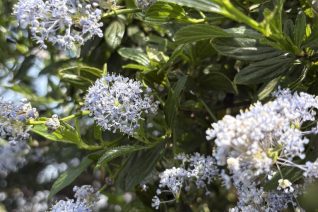
Ceanothus thyrsiflorus ‘Oregon Mist’
Greg and I found this distinctive form of Coast Blue Blossom in the wild. This species ranges from Lane County, Oregon to Santa Barbara County, California. A fast growing seral species that follows fire and disturbance. Very near the location where we discovered this handsome small tree was to the largest Ceanothus thyrsiflorus ever discovered in 1925- it was nearly 30′ tall. This is a large and fast growing evergreen tree with copious amounts of scintillating flowers. It has smaller deep green leaves and huge trusses of soft turquoise flowers in late April to early June. A tall growing tree/shrub that attains heights of 15′ very quickly if allowed. This drought tolerant native takes very well to pruning too- which should be done after blooming. Full sun and average well drained soil- including clay soils. Little to no summer water when established. Excellent for use as an instant screen or informal hedgerow. Pretty in the background of dry borders. Loved by bees and butterflies in bloom. Very easy to grow native evergreen shrub that should be used more. Life span 15-20 years. Oregon native plant.
Xera Plants Introduction.
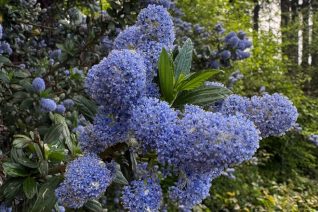
Ceanothus thyrsiflorus ‘Rogue Sky’
A selection of Coast Blue Blossom or Ceanothus thyrsiflorus that we made very far inland from its natural range in SW Oregon. Typically relegated to the coastal strip we found this variety more than 35 miles inland. This improves cold hardiness. A rapidly growing shrub/tree to 16′ tall and 8′ wide in 7 years. Robin’s egg blue flowers smother the whole plant in May. Extremely drought tolerant this fast grower may be either used as a cool, evergreen, native, blue flowered tree or it may be pruned aggressively after blooming to limit the size- increase density create a screen or hedge. Loved by honey bees and all pollinators in general. No summer water once established. Excellent background tree that delights in bloom but fades to a green screen the rest of the year. Plant with other drought tolerant plants- Arctostaphylos, Cistus, etc. Grows 3′-4′ per year when established. The flowers are a soothing blue- which is hard to capture in photographs. The effect in bloom is a blue cloud. Takes partial shade and the worst soils. Oregon native plant.
Xera Plants Introduction

Ceanothus thyrsiflorus ‘Umpqua Sky’
A very large growing, vigorous and pretty tree type Ceanothus native to the extreme SW part of the state. This fast growing evergreen tree (3′-4′ per year) puts on a huge display of soft blue flowers in late April to early June. Full sun to light shade (high overhead shade) and average soil that drains. Adaptable to clay soils, especially on slopes and not watered at all in summer. Completely drought adapted, no water necessary once established. To 18′ tall and half as wide in 7 years. Great screen, blue flowered tree that is beautiful in bloom but fades to a background for the rest of the year. Prodigious pruning can keep it much lower and it makes a great large hedge in no time. Good cold hardiness to 5ºF. We chose this variety in the wild because it was found quite a bit away from the coast which increases cold hardiness and it was immensely heavy in bloom. Prune AFTER flowering if needed. As a hedge or smaller plant it only requires pruning once a year- especially if strictly unwatered. Extraordinarily heavy bloomer and the trusses of flowers are often divided into six or more sub-branches for a very full look in bloom. Pairs well with Madrone and Arctostaphylos. Oregon native plant.
Xera Plants Introduction

Ceanothus thyrsiflorus var. griseus ‘Kurt Zadnick’
What a surprise this very dark, dark, dark blue flowered Ceanothus has turned out to have excellent cold hardiness. In our climate it is a low and spreading evergreen shrub with glossy leaves. To 3′ tall by 6′ wide in 6 years. In April/May a profuse display of the darkest cobalt blue flowers mass over the whole plant. Its so dark that it can seem like shadows over the plant but closer inspection reveals the intensity of the color blue. Full sun to light shade in average soil. Tolerates clay soil as well as withering summer drought. Prune if needed lightly after blooming has ended. This is a great drought tolerant, heat tolerant low shrub for hell strips. No summer water please. Well scaled for hell strips, low massing or a higher ground cover for hillsides. Fast growing to its ultimate size.

Ceanothus velutinus var. laevigatus
Mountain balm, snowbrush, tobacco brush and var. laevigatus is the western Oregon form of this widespread aromatic evergreen species. Fast growing and not terribly long lived this shrub has widely dispersed seed that germinates upon disturbance, especially fire. Large glossy aromatic foliage gives away its common names as it emits a sweet balsam some say tobacco fragrance. The heavily veined leaves are large and round and seem to be varnished with this sweet perfume. Rapid growth to 12′ x 12′ in 10 years. The more fertile the soil the larger and shorter lived this pretty shrub will be. Give it average conditions and no supplemental summer water. In May to early June cones of frothy fragrant white flowers protrude from the glossy foliage. Black seeds follow and they are dispersed explosively as well as eaten by birds. These black seeds can remain dormant for generations until they wake. It is found locally in the northern Willamette valley especially around the Tonquin scablands a kolk remnant of the Bretz flood just south of Portland. Expect a lifespan of about 15 years, more with neglect. Blooms on wood from the previous season prune if needed after blooming in June. This is a large shrub and it will reach its ultimate size very quickly, Give it room. Ultra cold hardy to -5ºF on the west side of the Cascades. This fast growing shrub does not appreciate pot culture, plant from the smallest size possible Oregon native plant.

Ceanothus x ‘Julia Phelps’
Wonderful and extremely showy wild lilac that has shown superior performance in our area. Small deep green warty leaves are glossy and are the ideal back drop to the foaming cobalt blue flowers that erupt from red tinted buds in April. Fast growing evergreen that is wider than tall. Typically 6′ tall and 8′ wide in 5 years. This begs for its use on steep unwatered slopes or as a dramatic backdrop to a wildflower garden. Full sun to very light shade in average soil with water to establish then none in subsequent years. Loved by all pollinators and insects will be rolling on the flowers to collect pollen. Avoid direct exposure to subfreezing east wind. Very good in urban situations where it performs in poor soils, little irrigation and reflected heat. In colder gardens place near a south facing wall or at the top of a hill where cold air drains away. Blooms simultaneously with Pacifica Iris and they match each other well in cultural requirements. Remember Ceanothus do best in average unimproved soil. Rich soil can lead to prodigious growth and quite a bit less hardiness to cold. Wonderful cultivar. This and many cultivars will lose flower color with very heavy rain. It literally washes some of the blue color away. Ceanothus blossoms mixed with water will yield blue soap suds ( there are saponins in the flowers).

Ceanothus x ‘Peg’s Pride’
Beautiful ground cover Ceanothus that bears dense sky blue flowers in a vivid carpet in April to May. To 2′ tall and mounding it stretches out to 8′ wide. The dense evergreen growth blocks weeds effectively. Very good on steep slopes. Loved by all pollinators and especially important to native bees. This is one of the cold hardier ground cover hybrids taking 5ºF with no issue. Excellent combined with Cistus and Halimiums. Fast growing to its ultimate size. Best in full sun but will tolerate light shade with sparser bloom. Regular water for the first season to establish then none in subsequent years. Supremely drought adapted. Very good at the Oregon coast and adaptable to sandy substrates.Mid green round leaves are semi gloss and handsome year round. Spectacular in bloom. Plant on 4′ centers for a large evergreen groundcover.

Ceanothus x ‘Xera Azul’
Very fortuitous, we planted 5 species/cvs of Ceanothus in our stock beds and they of course got a little frisky. We ended up with one stellar seedling that has impressed us so much that we showed it to Ceanothus Guru Dave Fross of Native Sons Nursery and he was impressed. In its 3rd year its produced copious blooms that are about the darkest blue that I’ve seen. Only the cultivar ‘Kurt Zadnick’ has deeper tones but this plant displays them differently. Large fluffily black/blue trusses of flowers on a lower and spreading plant. To 4′ tall by 6′ wide very fast. Glossy undulate leaves look nothing like their prospective parents. It has shown great cold hardiness as well as drought adaptation. Um…..we’ve never done anything to it. It hasn’t ever even had supplemental irrigation. So, extraordinarily climate adapted. Also, most Ceanothus seedlings require 3-4 years to commence bloom. This precocious little seedling bloomed its second year. All of this adds up to a great new cultivar. Full sun to very light shade and average soil. Water for the first season to establish then none in subsequent years. Blooms late March to late April and occasionally on new wood through summer. This would make a great bank cover with Cistus and Helianthemum, Eriogonums. So cool we named it Azul. The beginning of a GREAT Ceanothus.
Xera Plants Introduction

Ceanothus x deslilianus ‘Topaz’
Possibly the darkest blue flowering cultivar that blooms in the summer. This hybrid is technically supposed to be deciduous but for us it never has been. Large panicles of cobalt blue flowers erupt from the current seasons growth in June to July. Remove spent flowers and more may follow. To 5′ x 3′ in average to enriched soil with REGULAR summer water. Good drainage. Easy to resize as it blooms on new wood, it may be cut to as low as 18″ in early spring. Black seed capsules follow the flowers and persist until birds relieve them of their contents in autumn. Excellent in borders, as a specimen, or informal hedge-row. Not as drought adapted as most of the genus. This plant is best with consistent moisture through its bloom period- not boggy (ever) but consistent. Remarkable flower color- moody, deep indigo. Click on Ceanothus video in green script.

Cercis occidentalis
Western Redbud is a wonderful showy spring blooming tree that gets by on no summer water. Native to California also Utah, Arizona this is primarily a large shrub in the wild. We have found in our climate with a longer rainy season it forms a small tree. In April this entire tree comes to life smothered in tiny but profuse magenta pink pea flowers. They line all the stems and even appear on the trunk. After three weeks of glory the handsome new leaves appear. Round and blue green they have a slight rubbery texture. To 14′-18′ tall and forming a spreading crown. Fall color is orange to yellow but not reliable. Large purple colored seed pods are showy and persist after the leaves have gone. Moderately fast growing (2′-3′) per year when happy. Full sun and well drained soil of average fertility. Water through the first summer to establish then no summer water in subsequent years. Thrives in our climate.

Chamaecyparis lawsoniana ‘Barry’s Silver’
Most native Port Orford Cedars that are grown eventually die out of the root pathogen phytophthera so imagine our delight when this small shrub form with gorgeous white foliage has persisted. Not that its totally resistant but it doesn’t just up and die when it gets water on the first 85ºF day. Really at its best as a stunning container subject where one can appreciate the almost white foliage that slowly morphs to aqua green. A nice bicolor effect. Unlike other variegated conifers this one does not get nasty after exposure to an arctic winter and summer sun. Instead it remains fresh. To 5′ tall and 3′ wide in 7 years- in the form of a tear drop. No summer water once established. Regular water is safe in containers. Part shade to full sun and average, well drained soil. Slow growing conifer that always looks good. Oregon native plant.

Choisya x ‘Aztec Pearl’
Interesting hybrid between two Mexican Oranges and wow, you get an incredible shrub that adores this climate. Rounded evergreen shrub to 5′ x 5′ after 6 years. In spring (and again in autumn) the whole bush becomes a cloud of fragrant white blossoms. They show up well with the finely divided leaves. Easy to grow shrub that is very forgiving. Drought tolerant when established and it has been hardy to near 0ºF. It takes very well to pruning which will increase both the shrubs density but the amount of flowers as well. The palmate leaves look like thin fingers or even bamboo especially as it becomes dense and layered. Moderate deer resistance. Perfectly adapted to the climate of Western Oregon. Full sun to part shade. Any reasonably well drained soil. Blooms on both old and new wood. Prune after the first flush of spring flowers has ended.

Circium occidentale
Western Thistle or Ghost Thistle is native to the mountainous regions of southern Oregon into California. Its frequently seen lining road cuts in recently disturbed very well drained soils. To 3′ tall and all white and cobwebby it produces deep magenta flowers on large candelabra type structures. Flowers appear in June and remain until August. Loved by pollinators as well as birds. Leave the structure to over winter and go to seed and you’ll get even more birds. Forms a rosette the first year and blooms the second. No summer water once established. Loves sharp drainage in average to slightly enriched soils. If you have clay amend the soil with pumice or plant on a steep slope. Avoid competition from other plants. Not a weed. Oregon native plant.

Clarkia amoena ‘Dwarf Pink’
Farewell-to-spring is a common wildflower of meadows and glens in Western Oregon. It gets its name because it is often the last wildflower to bloom before the summer drought ends the show. This form differs by its pure pink profuse flowers on a dwarf plant. (The wild form is lavender with a red blotch in the center of each petal.). An amazing display of bloom that appears as if someone dropped a bouquet on the ground. You see no evidence of leaves when its in full fettle. Blooms June to October in a garden setting with regular summer water and rich soil and the gardeners diligence removing spent flowers. Reseeds in open disturbed soil. to 10″ tall and a little wider forming a dome. Nice cut flower. Fun variation on a native. Very attractive to native pollinators. True hardy annual. Oregon native plant.

Clarkia amoena ‘Dwarf White’
Excellent little selection of our locally native wildflower ‘Farewell to Spring’. To just 10″ tall this plant(s) become a solid dome of white flowers from May-August. Cute little cut flower. Full sun in rich, to average well drained soil with just light competition from other plants. Re-seeds reliably in open disturbed sites. A great native derivative for hell strips and even containers. Regular summer water – or it will shut down go dormant and think its time to set seed and then make its melon. Rough areas, cut flower. Oregon native plant.
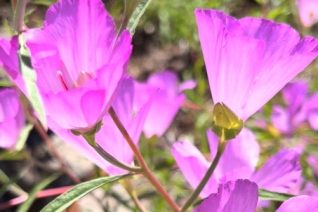
Clarkia amoena ssp. lindleyi
Farewell to Spring is so called because it is one of the last conspicuous native wildflowers to bloom before the onset of summer drought. And bloom it does all the way to late August. Its seen in mass populations waving above the already sear grass on hillsides that dot the valley. Little water is needed but a little supplemental water and removing spent flowers will extend the show. Otherwise it will die upon setting seed. The 2′ tall stems support multiple luminous pink cup shaped flowers. They appear superficially like a poppy. This is the variety that is locally native in the Portland area. The distinctly lavender pink flowers fade to a lighter interior near the center. But it will also appear with a darker pink/red blotch in the center of each petal on a minority of seedlings. These assist in guiding pollinators and this plant is a prime source for all native bees and butterflies. Excellent cut flower that lasts for quite a while in a vase. This is the source species of all the fancy cultivars that are raised in the cut flower trade. Reseeds happily in open disturbed sites. Excellent plant for wild areas and is often employed on road cuts and freeway embankments in deliberately sown wild flower mixtures. I’ve noticed that this local subspecies re-sows itself annually where other subspecies and especially the showy florist varieties are shy to do so. If you want a robust, climate adapted wildflower then go with this subspecies. It comes back strong. Probably our showiest and longest blooming native annual. Reseeds- leave stems to dry and disperse seed and remember to leave open spaces for next years show. Wonderful with yellow Madia elegans for a months long display of brilliant native annuals. A Xera favorite plant. See video below (IMG) taken at the William Finley Wildlife Refuge just south of Corvallis. Oregon native plant.

Clarkia rubicundra
This is a wonderful hardy annual from the central California coast ranges and foot hills. Its closely allied to our native Clarkia amoena var lindleyi and though a bit taller the most conspicuous difference is the base of large pink cup shaped flowers are stained in bright red. Thats where it gets its descriptive common name of Claret Cup Farewell to spring. To 32″ tall if forms a candelabra of 2″ flowers that point upwards. The bright red on the base of the petals act as a nectary guide, think of this as landing lights for pollinators. Blooms June to August and it makes a large plant. The flowers spikes make long lasting cut flowers. LOVED by carpenter bees who will cut circles out of the petals to line their nests. So cute. Re seeds in open disturbed sites or even better a gravel mulch. Mix with all other native hardy annuals. Great long blooming container plant. No supplemental irrigation required. Very long blooming. Seeds germinate in early autumn and overwinter as tiny plants.

Claytonia sibirica
Lovely ubiquitous woodland flower that brings waves of glorious airy stars for weeks in late spring to mid summer. Occasionally pink the flowers most often are white. Handsome somewhat bold foliage provides a plant that is more than suited to competition on the forest floor. Often self sows and this is welcome. Plant containerized plants in spring and water faithfully through the first summer- but never boggy. Then it is yours. Let it romp among ferns, Hosta, Japanese Forest Grass for a sparkling NATIVE treat. Mix with other natives such as Vancouveria and deer fern. Very easy to grow. Blooms for a very long time and longer if we have a cool beginning to summer. AKA Candy flower. To 10″ x 10″ on average. Summer deciduous and emerges early in spring. Not bothered by pests. Forms spreading colonies in rich, humus enriched soil in part shade to shade. Locally native in the Portland city limits. Oregon native plant.

Clinopodium (Satureja) douglasii
Yerba buena is a fine trailing herb native to southeast Alaska south into northern California. Its a common scrambling component of woods and forest margins. The round slightly scalloped leaves emit a sweet herb/mint fragrance that reminds me of childhood and they line trailing stems. This 4″ tall by 2′ wide perennial is commonly found among shrubs and clumping grasses as well as perennials. It can be found in the wild with such plants as Vancouveria hexandra (Inside out flower) and Whipplea modesta (Whipple Vine). In late spring to early summer barely conspicuous tiny white snapdragon flowers appear in the leaf axils. Evergreen. Often the leaves turn maroon red in cold weather. The sturdy semi-woody stems root where they attach to the ground and it may be used as a deer resistant small scale ground cover for stabilizing smaller scale slopes. This member of the mint family can be used to flavor iced tea or any cold drink. Shade to part shade in average to slightly enriched soil. Combines well with clumping grasses and smaller scale shrubs such as Symphoricarpos (Snow Berry). Good in containers as well. Yerba buena (the good herb). Excellent native pollinator perennial in the mint family. Oregon native plant.

Collinsia grandiflora
Native annuals often get over looked in our gardens. They occupied vast stretches of the Willamette Valley and civilization has caused those displays to suffer. In our gardens they are precious reminders that we should include every category of native plant. Giant Blue Eyed Mary is one of our most delicate looking and stunning in floral detail, It makes a hazy cloud of beautiful blue and white small snapdragon flowers from late April to Mid June. A true annual that dies once the floral display is done. But leave the skeletons of the plant for several weeks longer to form and shed seeds for next years display. This 20″ tall grassy plant occupies open sunny sites as well as the margins of forests. In our gardens it appreciates open slightly disturbed soil. Seedlings germinate in autumn and over winter as small plants. They will heavily occupy an area about the size of a 9″ pie. Excellent plant to succeed mid and late spring bulbs. Water lightly after planting and to establish then none required. Native to the Portland city limits as well. Fantastic displays of this plant can be seen at Camassia in West Linn all through late spring. This is a very reliable re-seeder if you give it some open ground and check for slugs. Seedlings germinate quickly following the first rains and are incredibly cold hardy and drought tolerant. Don’t worry, they are from here, they know what to do. Attracts a wide variety of native pollinators including a wealth of smaller hover flies. Oregon native plant.

Collomia grandiflora
Wild Phlox is a native hardy annual that occurs from the prairies of the Willamette Valley to the sage brush country east of the Cascades. Clusters of flowers open sherbet orange and then fade to white with conspicuous blue pollen for a multi colored effect. Adaptable plant that will occupy any open disturbed site. Reseeds prolifically. To 2′ tall. Cute cut flower. Nice native to let wander your garden. Low water. Locally native in the city of Portland and to our nursery site in Sherwood. A charming plant that should be given average conditions and not pampered- otherwise it will contract powdery mildew which is harmless but kind of ugly. The unique, nearly indescribable color of this flower certainly is not. Oregon native plant.

Coptis laciniata
Oregon cut leaf gold thread is a widespread but not common evergreen perennial that is found in dry shade on the west side of the Cascades. Native primarily to Oregon it extends north into Washington and is rare south into California. A colony creating perennial that has handsome, intricate deep green foliage. The arrow shaped leaves are arranged in rosettes along the expanding yellow stolons. The effect is a dense cover that expands at a slow rate. In spring sparse thread like flowers are curious followed by swollen seed pods arranged in a circle. Rich to average soil in shade to dappled shade, though if pushed it can tolerate a little sun. Good year round appearance. It may be cut back at the end of winter, but I haven’t really found this to be necessary. Use its best attributes, adaptation to dry shade and evergreen good looks as a limited groundcover beneath woodland perennials or at its best on the forest floor. Not a wide scale groundcover and clumps expand at a slow/moderate pace. Not adapted to compacted or clay soils. Best in heavy duff on the forest floor. Great in shade containers at the foot of Aspidistra . Not bothered by deer. Limited quantities. It derives its common name from the bright yellow roots and stolons. Water until you see good new growth then set it free. Oregon native plant.

Coreopsis tinctoria var. atkinsoniana
Columbia Coreopsis or Columbia tickseed is a locally native annual but more often biennial that is found along the Columbia River and into the gorge. Also, native throughout eastern North America. Its first season is spent as a rosette of curly, finely divided leaves that have a glossy sheen. The following early summer it erupts into groups of gold flowers, slightly reflexed petals and a red dot that surround a brown protruding cone. Loved by pollinators and they come en masse. To 22″ tall on average in bloom. For rich to average soil in full sun. The sun part is non-negotiable. Mix with native Oregon perennials and annuals such as Sidalcea virgata or Clarkia amoena var. lindleyi as well as Madia elegans for a summer long show. Very good butterfly plant. It has a scattered population in the Willamette Valley but should be grown here much more often. Self sows in open disturbed sites. Very prolific in bloom with clouds of golden flowers unobscured by pesky foliage. Nice cut flower. One stem can be an entire bouquet. light consistent summer water improves the show but this is a tough, climate adapted biennial. Reseeds itself prolifically, Moderate deer resistance. Oregon native plant.

Cornus nuttallii
Pacific Dogwood is one of our most beloved native flowering trees. From BC south to the Sierra Nevada of California this understory to margin tree alights in April and May in pristine white bracts/ true flowers appear. They perch on upward arching stems for a perfect display. This large conical shaped tree can achieve 35′ in great age. Water deeply and infrequently during its first summer in the ground, once it is firmly established it can go with natural rainfall. In full hot sun more irrigation may be needed. Native to the Portland city limits and a firm spring decoration on our freeways. Pacific dogwood contrasts wonderfully in bloom with deep green conifers. Average growth when young is 2′-3′ per year. In certain seedlings this spectacular species may re-bloom in August/September. Its a fairly small percentage but when it occurs its a refreshing display at the end of hot summer. Fall color is pink/red/orange and is conspicuous in the understory. Full sun to overhead shade in the understory. In autumn red fruits decorate the branch tips and are food for birds. Give this native tree good air circulation and mulch after planting. Oregon native plant.

Cupressus (Hesperocypress) macrocarpa ‘Citriodora’
Fantastic form of the incredibly tough Monterey Cypress. Foliage on this fast growing large evergreen tree is brilliantly hued in chartreuse/gold and acid green. Pinch the foliage and the fragrance of lemons is released. Fast growing tree for poor to average well drained soil. Avoid overly rich soils- which causes rank, unsteady growth. Average un-amended native soils are best. Light summer water to initiate growth and then completely drought tolerant. To 35′ tall x 25′ wide in 15 years. In time it develops a really cool flat spreading crown that this species is so famous for. Great drought and cold tolerance at our nursery. Give it amble room, full all day sun and not much else. Cold hardy to 0ºF. Long lived tree. This species has been placed in the genus Hesperocypress.

Cupressus glabra ‘Sulphurea’
Remarkable form of the hardy Arizona Cypress. This variety has foliage frosted in chartreuse/cream with interior foliage closer to sea green. A great affect. To 15′ tall but only 4′ wide this is a decidedly fastigiate form of this species. Fast growing tree for screens, specimen. Poor to average soil- avoid rich soil- this causes Cypress to grow to fat and fast in our climate- they get rank and rocky. So plant in average to poor soil with light irrigation until you see appreciable new growth and then none- ever. This produces a more measured growth rate and a sturdier plant. Full sun- from ALL directions- no shade at all. Open exposed sites are best. Very pretty plant that adores our climate. Cold hardy below 0ºF. Rare tree and quantities are limited. Completely drought tolerant.

Cupressus macrocarpa ‘Wilma Goldcrest’
We love Wilma and have found that she’s a great landscape plant and not just relegated to seasonal containers. Fast growing dense, columnar acid green/gold tree to 9′ tall and 2′ wide in 7 years. Average, well drained soil. Do not plant this in rich amended soil, it will grow rapidly and rank and likely tip over in the first windstorm of the autumn. Instead rely on its adaptation to poorer soils to create sturdy, measured growth. You’ll thank yourself in the end. Foliage can be burned by strong subfreezing wind- plant this out of the path of east wind. It recovers quickly in spring and you’d never know there was winter burn by about May. The foliage has an intense lemon fragrance. Great in containers. Little to no summer water. Moderate deer resistance- they won’t eat it but they may rut on it.

Cylindropuntia whipplei ‘White Spine’
Love this small growing Cholla that has the most amazing luminescent white spines. Densely branching low plant to 2′ tall by 3′ wide in time. Not terribly fast growing. Fast draining soils that have been amended heavily with gravel and pumice and ideally on a slope will make this a focal point in the dry garden. Light summer water will speed growth. Extremely cold hardy and not terribly fussy. Give it an open position with sun all day long. Wonderful in rock gardens. Flowers we have not seen but we assume with this species that they will be pink/purple in summer. Highly deer resistant. Great container plant. Move to a dry position in winter just for extra protection from wet.

Dasylirion wheeleri
Sotol or Desert spoon is an excellent Yucca relative that does amazingly well in our climate given the correct conditions. Native to the northern Chihuahuan Desert of northern Mexico into Arizona and stretching to the east through New Mexico into Texas is where you will find this handsome desert dweller. Rosettes of serrated blue green leaves radiate out in a circular orb. The ends of each leaf become frizzy and add an overall hazy texture to the plant. In time, when happy 9′ spikes erupt from the center and display columns of small white flowers. Very well drained soil in a full, hot position. Excellent on hot, south facing slopes but perfectly at home in the dry gravel garden. Foliage to 3′ x 3′ slowly. Evergreen. Light summer water to establish then none in subsequent years. Great in containers. High deer resistance.

Datura wrightii ‘High Altitude Form’
LOCO WEED. We discovered this native SW perennial growing very high up east of the crest of the Sierra at above 6500′. Damn it gets chilly up there. Herbaceous perennial that emerges with large, bold, silver-blue leaves. Sprawling to several feet wide in a full, hot position with exceptional drainage. All summer huge white goblet like flowers unfurl from curiously colored gray buds. You can literally watch the flowers open in the evening. They glow in the moon light and emit a soft fragrance. By 2:00 the following day the flower has withered. <sad face> but more are in the wings. Begins blooming in late June and repeats to frost. Completely deciduous (gone) in winter. Good drainage in a hot position- where the soil warms early. Spectacular. Toxic- but what garden plants are not? High deer resistance. Native to the american southwest and northwest Mexico. It has become naturalized in arts of the Willamette Valley, Columbia Gorge, and Eastern Oregon. Rarely seeds itself in our climate. The seedpods that develop following the flowers are round and spiney.
Xera Plants Introduction.

Delphinium menziesii
Menzie’s Larkspur is one of the most widespread species west of the Cascades. That doesn’t mean it easy to grow, and as a crop it can be a pain, That said its one of the ultimate spring flowers and its lost immense amounts of its range in the Willamette Valley to development. This widespread perennial is a grassland Delphinium that can be found in oak woodlands with Dodecatheon hendersonii, and Plectritis congesta and Romanzoffia californica. The soils that it inhabits run the gamut from sand near the beach to xeric clay in and around the Willamette Valley. This can be a tricky species to establish, my best advice is to double dig a wide area where there is very little competition from other plants. Add a small amount of all organic fertilizer to the hole. Water in well and water again once a week until June. Then you can permanently taper off. That means in subsequent years it will rely on natural rainfall alone. Upright perennial to 20″ tall multiple brilliant blue flowers often with a lighter bee. I’ve also seen them in a deep black/blue velvet purple. Sets seed and goes dormant in mid-summer. Its very very important to protect the emerging plant or seedling from snails and slugs. Bait heavily when you first see growth in late winter. Though widespread but no longer common this Delphinium seems to adapt best to cultivation with a light gravel mulch. This protects the plant from slugs and provides a perfect medium to germinate the seeds. Very popular pollinator plant visited by all sorts of bees, fly bees, hover flies, butterflies and more. The seedlings are conspicuous and the leaves mimic the parent plant. Full sun to light shade. Oregon native plant.

Delphinium nudicaule
Brilliant orange/red tubular flowers each with two spurs on the rear of the flower. They appear to be swarming around the green wiry stems that support them. To 20″ tall, blooms rising from a basal rosette of leaves. Blooms May-July in Portland. Somewhat tricky southern Oregon native wildflowers that needs a bit of care and correct siting to establish and become perennial. Rich, well drained soil with light but consistent summer moisture. Native to very steep slopes and cliffs with excellent drainage but with groundwater in the form of seeps near by. Wild areas, gravel gardens for the ultimate wildflower effect. Established plants will often re-bloom if spent flower spikes are removed. Hummingbirds. Moderate deer resistance. Oregon native plant.

Delphinium trolliifolium
Giant Larkspur or Cow Poison, I prefer the first common name for this stunning large growing native Delphinium. In vernally wet sites to moist upland sites it forms large spectacular colonies. In late spring and early summer stems that soar to nearly 4′ tall are loosely decorated with marine blue flowers with a lighter central bee. In habitat its common associates are Oregon Ash (Fraxinus latifolius) and Oregon white oak (Quercus garryana) where it can be found in the shade of these deciduous trees. The one variable with this Delphinium is that it is found in cool places- never hot and dry. These shadowy environs can make this plant hard to spot even in full bloom. Often they will be in standing water during the winter months and they are adapted to very heavy wet clay soils. In cultivation the need for moist conditions continues and it does appreciate at least an application of all organic fertilizer and compost at planting time. Keep it well watered through its bloom cycle, then it can go drier but never dust dry- in time it can handle much less irrigation. An annual mulch is beneficial. Wonderful, bold cut flower , but its loved by pollinators as well ( what is it about blue flowers? ). Forms spreading colonies in time. Give it room to stretch out. Its often found with our native Cow Parsnip (Hieracleum maximum) and great Camas ( Camassia leichtlinii) in habitat. This could easily be replicated in a garden. Native to the Willamette Valley into the Columbia River Gorge. Once widespread in the Willamette Valley its territory has shrunk precipitously. Long lived perennial. Very good deer resistance. Extremely showy in bloom. Oregon native plant.

Deschampsia caespitosa
Tufted Fairy Grass is an Oregon native that forms bright green fine clumps but is in its glory in bloom when tall vertical stems display hazy tan flowers at the tips. Easy to grow grass that improves under cultivation. Native to semi-shady to sunny aspects in rich soil that drains but also retains moisture. Adaptable to wet sites that dry in summer. To 10″ x 1′ as a clump of foliage but rises to 3′ tall in bloom. Very wild looking grass that can be massed for a hazy meadow effect, or placed in straight lines a modern aesthetic that combines a wild plant with spaced symmetry. Excellent among shrubs and with other wild looking meadow perennials. Winter deciduous. Cut back dead growth in spring. Relatively long lived. Native in the Portland city limits. Graceful. Winter deciduous. A pan global plant- this is our local form. Click on the link for a video of the dried seed heads. Oregon native plant.

Dicentra cuccularia
Dutch Man’s Breetches. One of the first wildflowers that I learned mostly because of the funny common name. Native to selected spots in Oregon- in the Columbia River Gorge as well as along parts of the Clackamas River. Adorable little thing closely related to bleeding hearts. Ferny blue foliage emerges in early spring and is followed by a precious display of two spurred upside down white flowers. Each patch holds many. By the time hot weather has arrived this true spring ephemeral has disappeared completely- a good rest during the summer drought. Part shade to high overhead shade in a protected location in rich, moisture retentive soil. Occasional summer water is good- even though it is dormant. Mix with other spring delights like Erythronium (Dog tooth violets) and mid spring small bulbs like Scilla or Chionodoxa. Moderate deer resistance. Oregon native plant.

Dicentra formosa
Oregon bleeding heart is a widespread lush, long blooming perennial wildflower for moist conditions in shade to full sun. A somewhat rambunctious plant that spreads quickly by stolons. Do not plant it near shy or small plants that can become swamped. It tolerates quite a bit of shade and if in full sun it thrives with supplemental water and a massive flower display. Divided soft green foliage is very good looking, in April-July a continuous supply of rose colored downward pointing clumps of flowers on an 18″ spike. The foliage rises on average to half that height. Responds vigorously to amended soils and regular irrigation. In hot dry situations it will go quickly summer dormant. In the shade with water leaves persist to autumn and re-bloom occurs. Not bothered by pests, including deer and snails and slugs. Frequently found in shady ditches in the Willamette Valley. Winter deciduous, if not already summer drought deciduous. An easy to grow, self sufficient perennial for wild areas. Mix with other vigorous and scaled plants. Very easy to grow. Oregon native plant

Dicentra formosa var. oregana ‘Langtrees’
Excellent form of our native bleeding heart that is an incredibly long blooming perennial for gardens. Remarkable blue foliage is beautiful if it never produced 1′ spikes of clear white pendant flowers. Blooms begin in spring and with regular summer water in rich soil continue throughout summer. Shade to full sun (with regular water). Forms widely spreading colonies. Give it room to spread. This tough, adaptable plant handles any soil situation from perpetually moist to quite dry. Resistant to pests- that includes slugs and snails as well as deer. (They will briefly browse it before ditching it for better things- it recovers quickly). Completely winter deciduous. To 10″ tall in bloom, Irrigate reularly for the first reason to establish. Excellent companion for ferns and Hosta. Colonies increase and jump around via underground stolons. Completely deciduous in winter. Oregon native plant.

Dichelostemma congestum
OOKOW. The common name for this wonderful native bulb. A naked lily closely related to Brodiaea. Also, referred to as cluster lily though that isn’t even remotely as fun to say as OOKOW. Stems to 22″ tall support 6 to 15 showy purple flowers clustered at the stem tip. Dry sunny hillsides in clay soils to meadows throughout western Oregon. Its native range goes a bit to the north into Washington and south to central California. This happy bulb spreads to form colonies in time. It will also spread by seed. An integral part of Willamette Valley meadows. Excellent cut flower that lasts a week in a vase. Water to establish when planting from containers. In subsequent years it will rely only on what falls from the sky. in habitat it can be found with native clumping grasses such as Koeleria and Festuca roemeri var. roemeri. Sisyrinchium idahoense is a frequent associate. The flowers do not nod on the stems as other closely related species Smalll grassy foliage appears in early spring and disappears cleanly following bloom. Adapted to heavy clay soils that are wet for 6 months of the year that dries in summer. Full sun. Loved by Hummingbirds and butterflies. Native to the Portland city limits. Oregon native plant.

Dichelostemma ida-maia
Firecracker flower. This bulb is native from southern Lane County in west central Oregon south into California. Its an easy to grow showy bulb that performs very well in gardens. It should be grown more often. I first saw this plant in the wild near Elkton, Oregon. I was driving by not very slowly and I saw a flash of red in front of a fence. i went back to investigate and found this plant in full bloom. In its habitat it occupies dry sunny slopes that face south. Soil is loam to clay but all of them dry completely in summer. Blooms mid- to late spring for an extended length of time for a bulb. A handful of scrappy leaves forms a rosette . And the blooms extend to about 18″ tall. They are not always straight and can wind, vinelike around and through other plants. The red buds reflex when open to reveal a yellow interior. I’ve had many hummingbirds visit mine. Let it go completely dry in summer- in fact it excels in wild environments and competes very well with weeds. Leaves disappear quickly after bloom. Increases over time. Deer resistant. Oregon native plant.

Diplacus grandiflorus
Slender Monkey Flower is the inland version of the coastal varieties. AKA Azalea flowered Monkey Flower this subshrub blooms continuously through the season with soft apricot colored tubular flower. Blooms May-August- sometimes later. Average to enriched, very well drained soil- excellent on slopes and rock gardens. To 30″ x 30″ when really happy. Loved by hummers and west coast pollinators in general. This species ranges from the coast to the Sierra Nevada in CA- this form is from colder inland areas and is easier to overwinter in our climate. Forms a semi-woody sub-shrub. Cut back the plant hard after all danger of frost has passed. Not palatable to deer. wonderful long blooming plant for low water to no water landscapes. Light summer water increasing blooming but is far from necessary. Many of the apricot flowers are pictoteed in white for an almost florist quality. Thrives in the wild following fires, disturbance. Butterfly food. West coast native- California.

Dodecatheon hendersonii
Henderson’s shooting star or more appropriately foothill shooting star. Thats where you see them in meadows and glens usually underneath or near Oregon white oaks. Common composition of the flora seen with this plant are giant baby blue eyes Nemophila m. ‘atomaria’., Ranunculus occidentalis – western buttercup as well as Lithophragma- Prairie Stars. Rubbery near round leaves emerge in mid winter and persist as rosettes for months until real heat pushes them into sleep. The charming flowers rise up to 14″ on tall straight stems. The nodding flowers gives away its familial association with Cyclamen and Primrose and reflexed magenta purple petals shoot straight up. The interior of the flower is a spike decorated like a single cake with a red brick a brack design if you look closely. Great cut flower and where ever you throw the spent flowers they will still ripen and set seed and quickly a new patch will be created. Full sun to part shade in clay soils that dry in summer. No water once established. They quickly go dormant and disappear to escape summer heat and dry. Relatively easy native wildflower to grow. Deer resistant. Native from northern California north to SW British Columbia. Found throughout the western half of the state. This wildflower made extensive colonies around my childhood home near Eugene. It always bloomed around my birthday and over the years I built up huge colonies. It was so charming with Erythronium oreganum- Oregon fawn lily- they grew side by side. In our ‘backyard’ there were huge colonies of native Dodecatheon. I would pick bouquets of them from the backyard and when the flowers were spent I would chuck them off the front deck into the woods. Over time I realized they were still setting viable seed as we had a huge population in the front in a few years, . Blooms late March to early May. Oregon native plant.
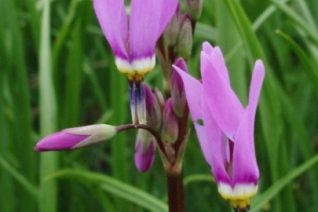
Dodecatheon pulchellum var. macrocarpum
This is the second and less common shooting star native in the Willamette Valley locally into the Gorge, its more common to the north. AKA Alaska shooting star it has several important differences. The flower structure and petal color are very similar to Dodecatheon hendersonii foothill shooting star but they are closer to pink than purple and the color gets darker at the base of the petal. The face of the flower is white and yellow with a bright orange filament around the center. And the leaves are large and distinctively long. As for culture this species is endemic to rich soils that retain moisture in the moist parts of meadows in full sun to very light shade Near Eugene where i grew up this was the wet loving shooting star that you could find along moist stream banks. The more common D. hendersonii is almost exclusively an upland perennial. Loved by early pollinators when the striking flowers appear April-June. To 18″ tall in bloom. The whole plant retreats into dormancy with hot weather- it disappears. This more moisture tolerant species is easier to cultivate with more traditional perennials. In habitat its close friends are Camassia quamash maxima and Camassia l. suksdorfii, Plagiobothyrs figuratus , Mitella oregana and Delphinium trollifolium. Excellent perennial for a rain garden. Nice cut flower too. Oregon native plant.

Downingia elegans
Calico flower is a widespread showy annual of vernally wet sites throughout our region. A low spreading plant that rises up in bloom to reveal shovel shaped blue and white flowers. They closely resemble annual Lobelia (Lobelia erinus) to which it is closely related. Blooms appear from Mid May to early August. Rich soil with regular summer water. Downingia is native to areas that are often submerged in winter. And in the garden it appreciates ample water. Full sun and resists competition from other plants. Very good in rain gardens. One potted plant will expand to 2′ with rising showy flowers. Loved by pollinators of all kinds. Excellent container plant. You can simply remove it when it has completed its life cycle- replace with warm season annuals. A food source for the endangered Willamette Valley endemic Fendler’s Blue Butterfly. Leave established plants in place once they have died to distribute seed for the following year in the ground. Oregon native plant

Dudleya brittonii
Giant Chalk Dudleya or Giant Live Forever, this is in our estimation the largest and showiest of this genus native to the West Coast of North America from Oregon to Mexico. This spectacular succulent is native to the northern coast of Baja where it attaches to volcanic cliffs above the ocean. To 12″-18″ wide in a year or two the softly spiked rosette is covered in fine white powder (bloom) that can be rubbed off- that can result in a less pristine white form. Avoid pawing or poking the foliage. In spring to summer 18″ stems support clusters of orange/pink/yellow downward pointing flowers. Very pretty and it draws hummingbirds and butterflies. A fantastic container plant that can live for years happily in succulent cactus mix. Protect from severe cold (below 26ºF) and put containers in a cool unheated greenhouse in autumn. Or move to a dry under eave position. Water deeply and infrequently and able to tolerate summer water much better than others. Our Oregon native Dudleya farinosa can be kind fussy about that. Very easy to grow. Part shade to full sun. Shockingly beautiful plant. This and many Dudleyas have been vastly and illegally over collected in the wild. Ours are raised from seed which is not difficult and is even more of a pity that they are stolen in the wild.

Echinacea purpurea ‘White Swan’
Echinaceas are irresistible and this pure white flowered seed grown plant even turns it up with a soft, sweet fragrance. Echinaceas in our climate thrive but they need to have the proper beginning and soil to really work their charms. To 30″ tall and forming spreading clumps, regular water – once a week for the first year is critical. Also, I’ve had great luck amending the soil with a little gravel added to the compost that I dig in. It seems they really need a good start to perennialize and expand. In subsequent years only occasional water is necessary. Also necessary is total and complete sunshine. That seems to gird them to establish too. So, no fudging with shade. This single flowered form is pollinator magnet and you’ll find a host of native bees and bee friends visiting the flowers. It also makes a great container plant and will happily over winter no problem. ‘White Swan’ has been a Xera favorite for years. Great, long lasting cut flowers (Surprise). Long lived low care spectacular perennial. Moderate deer resistance. July to mid September. Remove spent flowers and more will often follow.

Echinacea x ‘Cheyenne Spirit’
We love this seed strain of Echinacea the least of which is that they seem to establish and over winter in a superior way. Multiple colors in these hybrids from reds to orange and yellow. large up facing flowers with a central fragrant yellow cone. Clump forming perennial for rich soil that is very well drained with consistent light irrigation in summer. Blooms naturally appear fro July to September- and occasionally longer. Remove spent flowers and more will likely appear. Great pollinator plant. Awesome cut flower. Over winters better if there is plenty of oxygen incorporated in the soil. Mulch annually with compost. Full sun to light shade. Excellent in our region on slopes.
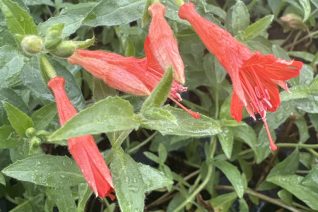
Another selection of Epilobium (Zauschaneria) that our friend Mark Wade made in SW Oregon. This is a lovely low growing form with smaller but profuse vivid lighter orange flowers and this selection supports pink stamens and pollen as well. To less than 6″ tall but spreading to an area of several square feet in a season. ‘Horse Sign’ bears sheets of these tubular flowers for several months beginning in August. Loved by hummingbirds it forms a vivid orange carpet of color. Enriched soil with a bit of all organic fertilizer will send this hardy perennial soaring. Water regularly for the first season, letting the soil dry in between. In subsequent years you can water much less if at all. Full sun to very light shade. Ideal for a slope and along rock walls at eye level. Very showy late season native perennial. Completely deciduous in winter with excellent hardiness to cold. This roaming perennial can inhabit and spill around other perennials, shrubs. Low and spreading, avoid large perennials nearby that could flop on top. Long lived and easy to grow excellent for late season pollinators and vivid color. Mix with other low growing, sun loving perennials such as Scuttelaria, Orginanum ‘Xera Cascade’ and Erodium ‘Spanish Eyes’. Mulch with compost the first winter, this will help energize it to roar out of the ground in mid spring. Foliage is smaller and green but with a silver cast. Very good looking native perennial. Oregon native plant
Xera Plants Introduction

Epilobium (Zauschneria ) ‘Solidarity Pink’
If shocking vermillion, red, and orange are a bit too vibrant for you enter this softly hued selection. Soft pink tubular flowers appear constantly from early August to October. Low spreading perennial to 8″ tall by 2′ wide in a short time. The very light green foliage is clad in soft hairs giving the whole plant a soft mien. Full sun and rich to average well drained soil is ideal. Slopes, rock gardens, walls, hellstrips all are appropriate for this low water plant. Water diligently to establish but never boggy. In subsequent years only light water on occasion is required. Spreads laterally underground by stolons. Long lived perennial if sited and somewhat cared for. Completely winter deciduous- cut away the previous years dead growth in February. Somewhat deer resistant. Mix with other late blooming perennial. Wonderful combined with Cuphea hirtella and the soft yellow flowers of Erodium chrysanthemum. West coast native plant that calls to hummingbirds far and wide. Takes blasting hot conditions in stride.

Epilobium (Zauschneria) ‘Bowman’
Possibly our second most popular California Fuchsia cultivar as it is more upright but also a free and early bloomer. To 20″ tall the fine green leaves that line the stems make the brilliant orange tubular flowers stand out. Blooms early August to October and spreading underground by stolons to form expanding colonies. To several feet wide- give it room. Rather than running over neighboring plants ‘Bowman’ flows around other plants never over topping or even crowding the. Ideal in full sun, well drained soil- or on a slope which will further assist in drainage. Brilliant flowers are a beacon to Hummingbirds. Completely drought adapted and requires little if any summer water. Long blooming western native perennial. Water regularly to establish the first year.

Epilobium (Zauschneria) ‘Carmen’s Gray’
California Fuchsia that is an excellent combination of hot orange tubular flowers set agains dusty gray foliage. To 18″ tall in bloom this Epilobium is a spreader especially in light to rich soil. Adapted to life on slopes and often between boulders on cliffs. There its roots penetrate the cool, wet cracks and that provides sustenance. Give this perennial at least 2′ x 3′ feet to roam. Wonderful performance in hell strips. Add a little compost and organic fertilizer and you’ll be off to the races. Most (Zauschnerias) require irrigation about once a month and no more than once a week to look and bloom their best. Though it is supremely drought adapted this occasional irrigation substantially improves looks. Loved by hummingbirds and bush tits too who play with the flowers and rip them apart- their goal I have no idea. Dies to the ground in winter- the only presence then is spent stems. Cut these away in early spring after a threat of a hard freeze has passed Companion plants in the wild are Diplaucus, Delphinium cardinalis, Sedum spathulifolium. California Fuchsias range into southern Oregon and technically they are native to our state. This is an excellent perennial with great contrast between the masses of hot flowers and gray foliage. Not bothered by deer. Loved by hummingbirds Oregon native plant.

Epilobium (Zauschneria) ‘Sierra Salmon’
Cool late blooming California Fuchsia with silver foliage a great foil for the soft coral and prolific September/October flowers. Spreading to 2′ wide and 1′ tall in bloom it prefers very well drained rich soil with little summer water. Full sun including hot aspects for the best results. Winter deciduous. A great flower color for the genus and pairs sweetly with autumn Salvias, such as ‘Playa Rosa’ and ‘Flower Child’. Drought adapted and cold hardy.This is the most cold hardy and drought adapted Zauschneria that we grow. It spreads and thrives on no additional summer water once established. The flowers are relatively large for this species and they are a wonderful color that meshes better than the orange/vermillion varieties. Long lived perennial.

Epilobium (Zauschneria) ‘Silver Select’
No other California Fuchsia has foliage that even approaches being as ashy white as this cultivar. Its as if the foliage is covered in dense white powder. The 1″ long hot orange/red flowers absolutely shine against this ghostly backdrop. Vigorous perennial for well drained sites and just light summer water. Full sun. To 20″ tall in bloom which starts in early August and continues into October. Hummingbirds dive down for this vivid sweet treat. Expanding to a clump 2′ wide in just a few years. Dies completely away in winter…only the stoloniferous roots remain to regenerate this sexy perennial in spring. Moderate deer resistance. The flowers are individually the largest of any cultivar that we grow.
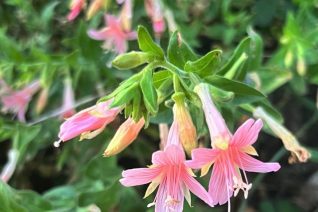
Epilobium (Zauschneria) cana ‘ Peach Surprise’
A beautiful color form of California Fuchsia. This is is a very long blooming, low, spreading perennial with downy gray green foliage and a constant procession of tubular peach/pink flowers. Loved by low flying hummer’s this plant is ideal for hot, locations in soil that never becomes boggy. To 6″ tall x 2′ wide and forming substantial patches in full sun. Excellent performance in hell strips. Most Epilobiums (Zauschneria) in our climate are drought tolerant but they perform better and are showier in bloom with light, occasional summer water. Water during the driest times of the year about once every two weeks. Blooms begin in late July and are resplendent well into autumn. Great long term performance in large containers, planters. Winter deciduous. Remove frost damaged tops when frost kills them. Best to match the vigor of this perennial with vigorous neighbors. It can swamp shy plants. Excellent in rock walls, at the top of walls. Combine with Sedum palmeri, Helichrysum thianshanicum, Chocolate cosmos for a community of perennials with identical requirements. Winter deciduous. Spreads laterally by underground stolons. Give Woody some room.
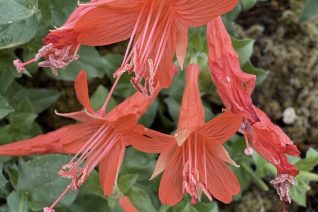
A friend of our nursery selected three Epilobium formerly Zauschneria in southwest Oregon. This species native throughout California just dips into the southern 1/3 of the southwest part of the state. This form is perhaps the most vivid of the three that Mark Wade chose. Electric salmon/orange flowers with large pink protruding stamens covers this massively blooming perennial. The habit of this form is spreading but lower- intermediate between the low growth of ‘Horse Wall’ and the height and vigor of ‘Illy’. The leaves on this form are more rounded and green and the tubular flowers are electric occurring from early August to October. Hummingbirds adore this plant and it will be visited by birds flying south for the season. To 8″ tall and spreading to 2′-3 wide in rich, well drained soil with regular water to establish. Add a handful of all organic fertilizer when planting , it will establish faster and grow much more vigorously. That said, its a very easy, climate adapted perennial and it can go without summer water when firmly established. These Epilobiums do appreciate a soak every few weeks in the driest part of summer. Totally winter deciduous this herbaceous plant is completely absent in winter. Mix with other climate adapted and vigorous perennials such as Salvia cohuilensis ‘Nuevo Leon’ and Verbena rigida. In habitat it consorts with Clinopodium and Sidalceas among many others. Excellent performance in containers and will last for years, spreading by the root to emerge from cracks in the pot or or like its natural habitat to root around rocks. Tidy the remnants in spring. Not bothered by deer. Full sun. Oregon native plant.
Xera Plants Introduction
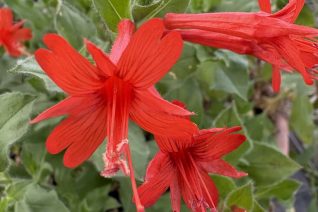
A friend of the nursery Mark Wade selected several forms of Caifornia Fuchsia that are native to southwestern Oregon. This form is low and spreading to 1′ tall and up to 3′ wide. It has large and exceptionally vivid orange flowers from July to October. The flowesr are perched as horizontal tubes that beckon hummingbirds. This form was found along the Illinois River in Josphine, County hence the name ‘Illy’. It has distinctively green foliage which is a great contrasting backdrop to the vivid flowers. Rich soil that drains in full sun with regular summer water for the first summer. Completely deciduous in winter, Common associates in the wild are Delphinium nudicaule, and Iris bracteata as well as Sidalcea asprella ‘Josephine’. Very easy to grow native perennial for hot sunny spots- the front of low borders, large rock gardens. Very long blooming selection that has enhanced cold hardiness. Avoid crowding from taller plants. Creeps underground by stolons up to 6″ away from the initial clump annually. Very drought adapted when established. Thank you very much Mark. Oregon native plant.
Xera Plants Introduction

Epilobium (Zauschneria) latifolia ‘Calistoga’
California Fuchsias are known for their striking hot orange flowers. This variety takes it even further with profuse flowers that range to vermillion red. To 1′ tall and 3′ wide in rich, well drained soil with little summer moisture. Full sun. This spreading gray leaved perennial begins blooming in August and extends to October. Excellent perennial for dry hillsides, large rock gardens. Combines well with Arctostaphylos and other low water plants. Loved by hummingbirds. Completely deciduous in winter. Give it room to spread. The vermillion orange flowers are larger than other cultivars and its impressive.

Epilobium (Zauschneria) septentrionalis ‘Select Mattole’
Our most popular hummingbird fuchsia because of its low habit, dense silvery foliage and early and extended bloom period. To just 6″ tall and spreading to form a patch 2′ wide quickly. Well drained rich soil with little summer irrigation once established. Hot vermillion orange tubular flowers are born continuously and en masse from July to October. Completely drought adapted when established. Great on slopes. Light summer water to establish. Winter deciduous. Loved by Hummingbirds. This species is native to the northern California and SW Oregon redwood region. Clumps expand stoloniferously (underground). Light summer water improves bloom in very hot locations.

Epilobium densiflorum
Spike primrose is a quiet but important long season hardy annual. It rises up to 2′ tall when happy. A dense thick spike of buds rises and the small pink flowers decorate the spike in a circle. Loved by pollinators and especially popular with butterflies. This drought adapted annual blooms from July to October. Mix with other hardy native annuals. Especially nice with Madia elegans as their bloom period are the same. Full sun in virtually any soil. Water in potted plants well and you will likely see seedlings in open disturbed sites in the spring. The seedlings of this Epilobium mimic several more weedy types (they are native but kind of rambunctious). This plant is never showy but its a primary nectar source for late in the summer. Very easy, climate adapted native hardy annual. Native in the Portland city limits. Found primarily in stable meadows on both sides of the Cascades. Oregon native plant.

Erigeron glaucus ‘Bountiful’
Such a long, long, blooming tough and dependable native this forgiving perennial outshines all other cultivars in the size of each flower. The many rows of glowing lavender petals that characterize this fabulous perennial outline nearly 2″ wide flowers. They begin in earnest in late May and proceed unabated until early autumn. If the flowers become tired or scorched simply cut it back and wham! You’re quickly back in business. Adaptable to many soil types and will subsist on only natural rainfall but occasional deep soaks in summer reaps rewards. To 10″ tall forming a round perennial to 18″ wide. Full sun, to very light shade. Pollinator masterpiece. Oregon native plant.

Erigeron glaucus ‘Bright Lights’
Beach fleabane or beach daisy normally runs in a mauve, to periwinkle vein. This lovely selection turns it up with crystal white daisies and a bold yellow center. Long lived perennial that is very adaptable. To 6″ tall a happy clump will spread to 2′ wide or more. Low and spreading it displays the flowers upright in a mass. This beckons pollinates and they always find this easy going daisy. Full sun, rich to average soil with regular irrigation through the bloom period. This not only keeps the plant verdant it encourage re-bloom which can occur until September. The initial huge show of flowers begins in late May into July. Excellent perennial for the top of a wall where it will happily creep over the edge and follow the contours on the way down. It may be cut back hard after the initial large flush of flowers, this tidies the plant and sets the stage for another big show. Not bothered by deer and often left alone by rabbits. This daisy is most conspicuous in habitat on the cliffs adjacent to the beach. It also perches on sea stacks. Beach fleabane ranges from the Northern Oregon coast south all along the California coast. Mix with other Erigeron glaucus cultivars for depth of contrast- this is when all the flower colors look the most distinct. Very easy to grow and it also absorbs the heat of parking strips with no issues. Cold hardy. Oregon native plant

Erigeron glaucus ‘Cape Sebastian’
Beach Flea Bane or more popularly Oregon Beach Daisy is a phenomenal native perennial for our climate. Low and spreading a continuous supply of periwinkle/violet daisies with a yellow center appear from late spring to autumn and occasionally in winter. To just 8″ tall it forms 2′ wide spreading clumps. Simple spoon shaped green leaves. In its native environs which is the cliffs immediately adjacent to the beach it can cling precariously which shows it has sturdy roots. Full sun to light shade and regular irrigation or absolutely none when established. This floriferous and larger flowering selection is from the southern oregon coast. Excellent performance in hells strips..at the front of borders. This excellent semi-evergreen native perennial should be everywhere. Cut back hard after blooming to tidy the plant, keep it compact and encourage more flowers. Oregon native plant.

Erigeron speciosus
Showy daisy- though that is far too vague for this tough and graceful wildflower. Native in separate parts of the state this summer blooming perennial inhabits meadows and fields of the Willamette Valley. Rows of very fine soft pink petals surround a green/yellow center on 18″ stems June-August. The pretty daisies come in a group and then appear sporadically until frost. Loved by pollinators this is an authentic component of Willamette Valley meadows. Average to enriched soil with regular water to establish, in subsequent years it can survive on rainfall alone. Plant with Prunella vulgaris var, lanceolata, and Erigeron glaucus for a midsummer blooming native vignette. Long lived low maintenance perennial that goes completely deciduous. Widespread in the northwestern states of the US. Our version is from seed native to the Willamette Valley. Loved by butterflies and even good beetles. Clump expands to 2′ wide in time. Not bothered by deer. Simple, tough, wonderful native perennial. Full sun. Oregon native plant.

Erigeron x glaucus ‘Wayne Roderick’
Possibly a hybrid this is a spectacular perennial in our climate where it produces a non-stop supply of amethyst blue daisies with a yellow center from spring unabated to autumn. And occasionally in winter. A rosette forming perennial that sends up its clumps of flowers on vertical 6″ spikes. Loved by all pollinators with a special emphasis given to butterfies. Carefree, low water western native perennial with consistent excellent performance. To 18″ wide in time. Light, consistent summer water encourages re-bloom. Nice little cut flower. Rich, to average, well drained soil in full sun. Avoid rambunctious competition from other perennials. Mix with Agapanthus, Calamintha ‘Montrose White’. Even effective in containers. Oregon native plant.

Eriogonum fasciculatum
California Buckwheat is a shrubby perennial that occupies a wide variety of biomes in that state, Needle like leaves on a semi-woody subshrub. This is a common component of chaparral and beginning in late spring and carrying on virtually all summer rounded flat bloom clusters are mainly white but range to pink and even light red. For 2-3 months it is a beacon to pollinators and a prime food source for many butterflies. A very drought adapted plant that once established can thrive on no water at all. Excellent for blasting hot hell strips or large rock gardens. In habitat this subshrub is frequent between Manzanita and Ceanothus. To 2′ x 2′ slightly larger. In our climate this plant can freeze to the ground and return from the base. Best in soil that drains and goes very dry in summer. Fast drainage is important.. In autumn the flower heads remain and take on russet to pink to red tints before the spent flowers fall apart. It creates a lovely tapestry on hillsides throughout California for months. Mix with Yuccas,, Pensetmon, Manzanitas, Bupleurum. Pretty, tough wild plant. Hillsides and Hells trips. Full all day sun in a hot position.

Eriogonum umbellatum
Our native Sulphur Buckwheat that is among the best for general garden culture in our climate. This ubiquitous creeping plant of alpine areas of Oregon celebrates spring with umbels of (sulphur) yellow flowers on long stalks. The low and spreading rosette of leaves are thick green on top with silver indumentum on the reverse. Full sun in fast draining conditions- ideally rock garden conditions because that is where you find it. Crevasses between rocks is where it lives. This is easily reenacted in your garden at the top of a porous rock wall. Blooms May-July for an extended time. The flowers go through a fascinating metamorphosis in color as they open, reach their peak of hot yellow and then turn to russet/red seed heads. These abandon the spike through autumn and spent flower spikes may be removed in winter. Water until you see the rosettes actively increasing. Then taper to once in a while. This species has a total of 13 (!) subspecies in Oregon alone. We have yet to delve into specific subspecies but if we did I would look for Eriogonum umbellatum var. modocensis and Eriogonum umbellatum var. umbellatum. Both are endemic to Mary’s Peak the tallest point in the Coast Range (4097′). So, I know that those (with immaculate drainage) can easily cope with higher rainfall. Rock garden staple and can also self sow in happy places. Very fun, sunny, satisfying native to grow. Associated plants in habitat are Prunella vulgaris var. lanceolata and Achillea millefolium, Sedum oreganum, Castilleja minuta and Penstemon cardwelii. Excellently adapted to gravel, crevice, gardens with an arid aesthetic. Amend the soil as for Agaves and it will thrive. Pronounced Air-e-OG-oh-num. Rosettes to 3″ tall, blooming stems to 1′ tall. Spreads, give it room. Oregon native plant.

Eriophyllum lanatum
Oregon Sunshine is the cheery common name that greets this widespread native perennial. Silvery gray intricate foliage forms a spreading mat. In late spring and early summer brilliant golden yellow daisy flowers spangle 10″ stems. Loved by pollinators and we’ve been impressed with its draw to butterflies as well. To 2′ across and excellent on slopes where water never lingers. Add compost and this perennial will soar- give it room in that case.In the wild its a frequent of road cuts and other disturbed sites. It also competes admirably with exotic invasive weeds and will persist where other natives are swamped. Rock gardens, dry borders. Water to establish- the first season- but never boggy. The following year it will rely only on what falls from the sky. Full sun to light shade. Adapts to poor soils. Moderate deer resistance. Goes quickly dormant following bloom. Native to the Portland city limits. Very good planted beneath Pinus ponderosa var. benthamiana Pacific Ponderosa Pine this pair can frequently be found in the wild. Oregon native plant.

Eryngium agavafolium
Evergreen Eryngium that we love. The glossy deep green strappy leaves are fiercely armed and form large rosettes. In summer 28″ spikes produce bright green clover like orbicular flowers on a divided scape. You won’t draw rattlesnakes but you will draw bees. Cool looking plant that is easy to grow in rich to average well drained soil Good appearance even during winter. Remove the flower scape when the blooms start to turn brown- not as pretty. Sexy plant that requires no summer water and just full sun. Long lived. I see boulders and Cacti and grasses and gravel. Sexy rosettes.
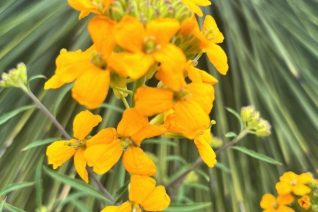
Erysimum capitatum
Western Wallflower is a very widespread biennial or short lived perennial. It occurs from Alaska to nearly Mexico and throughout the west coast. The first season is spent as a rosette of thin undulating leaves. In the second year it extends, forms branches and achieves multiple flower spikes. The species is best described as yellow/orange with some slight variation in these seed grown plants. In Oregon its is widespread but it has all but disappeared from some biomes, the Willamette Valley for instance, a victim of non native invasives. To 22″ tall in bloom. You may get a third season but it is much less of a show.Best to let this plant set seed and die ensuring a new generation of plants. Leave open disturbed sites for re-sowing. A gravel mulch will encourage this as well and it appreciates average to enriched soil and light consistent water to establish. The following year it can rely on only what fall from the sky. Blooms appear for several weeks in late spring. Loved by pollinators with a special draw to butterflies. Common associates in the wild are Dodecatheon hendersonii, Mitella , Ranunculus occidentalis, Nemophila. Oregon native plant

Erythronium hendersonii
Henderson’s Fawn Lily or Pink Siskiyou Fawn lily is one of our most beautiful species. Native from the Siskiyous in southern Oregon into extreme northern California. Of the eleven Erythroniums that are native in Oregon this is by far our favorite. In late March to late April umbrella shaped luminous pale pink petals reflex on 10″ stems. The interior of the downward pointing flowers shows markings of yellow and deep maroon. Surprisingly FRAGRANT and the perfume is noticeable at quite a distance in mature stands on warm spring days. Wonderful native bulb that must be grown from seed. The tiny bulb which is no bigger than a very small bean sinks lower into the ground each year. By blooming size the bulb may be 1′ below the surface. It takes approximately 3 -4 years to bloom from seed. Forms open colonies and spreads in the wild and garden by seed. As the bulb enlarges multiple scapes will appear from a single clump. In late winter a basal rosette of mottled leaves appear at ground level. Protect newly planted Erythroniums from slugs. Established plants seem to escape their damage. Best in unamended average soil on a slight slope. In habitat they are almost always under oaks and madrone. So, light shade to afternoon shade. Very light water after planting then none in subsequent years. Rock gardens, dry woodlands. Exquisite fawn lily. Goes quickly summer dormant. Oregon native plant

Erythronium oreganum
Oregon fawn lily is widespread in the western third of the state. In late winter and early spring leaves arrive mottled like a spring fawn. Soon the flowers follow on straight stems and yield a cream colored umbrella of petals. They reflex around a yellow center with protruding stamens. This glorious little plant is perfectly adapted to our climate. By mothers day it has set seed and gone back to sleep. Flowers are single on average plants or in poorer soil. In rich soil it soars to 20″ tall and can have a spike with two flowers. Gorgeous ephemeral plant that requires a dry rest period in summer. Competes well with invasives and in time it will seed itself to form patches. Seedlings of this bulb take approximately 2-3 years to bloom. Water to establish potted plants. Once established, only the rain that falls from the sky. Full sun to full shade in average soils, including clay soils. Do not water in summer or it will rot and die. In the wild its found under Oaks where it competes on the forest floor with Lonicera hispidula and other forbs. Blooms from early April to early May in the Willamette Valley- later at higher elevations. A wonderful native plant that should grace every garden. Found in the wild with Dodecatheon hendersonii, Nemophila menziesii var. atomaria, Carex tumulicola, Festuca roemeri var. roemeri and Festuca californica. Occurs on upland soils, never boggy. Extremely well adapted to our soils and climate. Wonderful woodland bulb. Best in part shade to shade, where the flowers last longer. Oregon native plant.
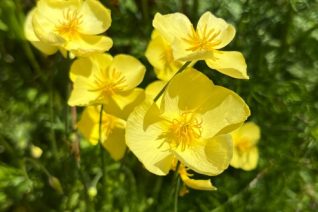
Eschscholzia caespitosa
Golden poppy is native to the inland valleys of southwest Oregon. This charming annual is much more delicate in habit and color than its more common bolder cousin Eschscholzia californica the ubiquitous California poppy. This little jewel demands a hot sunny location in soil that is average, and not improved. It will self sow locally but nothing like its cousin. This demure little poppy blooms from late April to mid-June. Full sun is vital. Mix this charmer with other similarly adapted annuals. Collinsia grandiflora, Plectritis congesta, Gilia capitata. Very deer and rabbit resistant. Water potted plants to establish, resown babies in the future can get by on natural rainfall alone. Oregon native plant

Eschscholzia californica ‘Cream’
A very favorite annual or short lived perennial. This excellent California poppy sports ivory to cream large flowers for an extended period in summer. Fine blue foliage is wonderful with the softly colored flowers. Blooms from April to August if you give it a little water- but never soggy. Full sun to the very lightest shade in average to enriched, well drained soil. Un irrigated plants will bloom for a shorter period and set seed. The seed comes true about 90% of the time. Cull orange or other colors that don’t please you. It may become a short lived perennial if treated well. New plants germinate en masse with the first autumn rains. Don’t be afraid to thin your patch a bit then. Rough areas, along gravel paths. Easy to grow. Containers, Hellstrips. Etc. High deer resistance. Oregon native plant.

Eschscholzia californica ‘Jelly Beans’
Spectacular mix of double flowered California Poppy in shades of pink, yellow, apricot, rose, red, orange, and yellow- and more colors than that. Easy to grow plants that can even be perennial if happily sited and cared for. Otherwise an incredibly showy annual that also makes a great cutflower- cut in bud and they will last several days. Sophisticated selection of our own native poppy and they will most likely reseed in open disturbed sites. Blooms May-August and sometimes longer. Remove spent flowers to encourage more. Leave the final round of blooms to set seed for the following season. To 1′ x 1′ with beautiful lacy glaucous foliage. Rough areas in full sun with light summer H20. Highly deer resistant. Oregon native plant.

Eschscholzia californica ‘Pretty in Pink’
True pink California poppy. Seed from this exceptional pink flowered selection comes true about 95% of the time. Deep rose pink semi-double flowers appear in late spring and continue sporadically until mid summer. A happy plant can become a short lived perennial but the majority will behave as bloomy annuals. Full sun and rich to average soil with good tilth (crumbly texture). It can even thrive in compacted soils. To 10″ x 10″ forming a compact plant with lacy blue foliage. The strident rose pink flowers are showy from a distance. Leave the last round of flowers to seed for the next several seasons. Excellent wildflower display in rough areas w/ low water. Water plants to establish then taper off. Remove spent flowers to encourage more. Wonderful flower color. Mix with Eschscholzia c. ‘Alba’ the white form. Deer resistant and drought adapted native plant. Oregon native plant.
Xera Plants Introduction

Eschscholzia californica ‘Purple Gleam’
One of my favorite separate strains of CA poppy. ‘Purple’ gleam is a tiny bit of an over statement. More accurate its pink w/ purple overtones and a lighter center. Blooms from April August in a wave of big flowers that tossles over compact plants with filigree blue foliage. Full sun and average to even poor soil. Often potted Eschscholzia will perennialize and live for a year or two in the ground. Otherwise its an annual and will succumb when the whole plant blooms itself out. To 10″ x 12″ forming a spreading plant. Remove spent flowers to continue the show. Many plants will take a break over summer and then resume blooming w/ cooler autumn rains. Great pollinator plant. Containers, dry areas, borders. Reseeds reliably w/ about 80% true to parent type. Wonderful with Clarkia unguiculata ‘White’ and Collinsia grandiflora. High deer resistance. Leave open disturbed soil for it to reseed. Light summer H20. Oregon native plant

Eschscholzia californica ‘Willamette Valley Form’
Plants don’t really stay in the same place, They move according to climate and soils and with the help of humans. This famous poppy carpets meadows and glens and rocky hillsides in brilliant orange from SW Washington through Western Oregon into California to Baja but is happily grown throughout the globe. Sunny orange flowers with an edge of lighter yellow in our local form appear from mid spring to late summer. This form was identified in 1846 at the former town of Tonquin. Tonquin is about 500 yards from our nursery and this poppy is everywhere. Blue fine foliage on spreading plants to 14″ tall and up to twice that width. Full sun in any soil where water does not collect. Reseeds itself prolifically and can become your own introduced weed. Seedlings are easy to spot and dispatch if unwanted. Nice cut flower if you pick it in bud. Loved by pollinators. Easy to grow native annual/ sometimes a perennial. Water to establish plants then none necessary. Completely deer and rabbit proof. Oregon native plant.

Eschscholzia californica ssp. maritima
Just about every gardener is aware of our west coast native California Poppy. It has a huge range from far southern Washington State to Mexico. There are several subspecies, but this one is exceptional. This PERENNIAL California Poppy is very different than the species. ‘Martima’ or Coastal California Poppy is a low, tidy, mat that erupts in wave after wave of flowers from spring to autumn. The tight congested foliage is handsome blue green and pairs well with the golden flowers that have a central area of orange. This plant is native to sand/very well drained soils and if you replicate that in your garden this is a very long lived plant. It also excels in the very well drained soil of containers and will drape over the edge and follow the contours closely. Ideally this plant is adapted to slopes with just light water during the summer. No need to dead head this plant is naturally remontant- re-blooming without any intervention from the gardener. Loved by all native pollinators and cherished by big black and yellow native bumbles. To 4″ tall as foliage – 8″ in flower its spread on average is about 2′ x 3′ in a year. Detests all shade, do not even try. Eschscholzia californica maritima is native to the northern and central California coast. Avoid compost and enriched soils, average soil is best. Not bothered by deer, rabbits, slugs, snails. So, why isn’t everyone growing this fantastic plant?
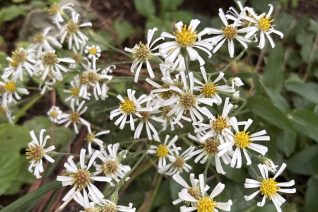
Rough leaf Aster or also referred to as False Aster. The description of a rough leaf is apt and you can immediately identify this inhabitant of dry woods throughout western Oregon and north more sporadically into Western Washington by a rub of the scratchy leaf. It even makes an appearance in the Ochoco Mountains of Central Oregon. My experience with this sprawling, late blooming perennial was as an under story component of black and White Oak woodland in the southern Willamette Valley. At higher elevations it can be found in Fir/Pine woodlands. It is a profuse follower of fires and will quickly occupy recently opened space. Simple white minimalist daisy blooms appear in large clusters from August to October. An established plant is incredibly drought adapted as long as it is out of full sun. The scratchy leaves become smaller near the flower truss . To about 2′ tall but decumbent (trailing) in most circumstances, Adaptable to clay soils that dry in summer. An excellent late season pollinator plant for shade/dry shade. Water regularly the first season in sightly enriched soil in part shade to high overhead shade . Not the showiest perennial but it does its job well. Hardy perennial . Does not compete well with invasive grasses -protect. Best with clumping native grasses primarily California Fescue Festuca californica . Expect this semi-evergreen to flop and accomodate that- 2′ x 2′ but never full. Very easy to grow. Plant with Symphyotrichum hallii Hall’s Aster’ and and Achillea millefolium ‘Willamette Gray’ in a dry understory. Accepts regular summer irrigation as well. Oregon native plant

Festuca californica var. californica
California Fescue native to the Willamette Valley from Multnomah county south and once widespread before being pushed to the margins by exotics and development. The best place to find this clump forming cool season evergreen grass now is on slopes, almost always underneath native Oaks. As you go farther south it becomes more widespread. Our seed grown plants come from exceptionally blue foliaged plants. Grows during the winter and looks clean and fresh then. In spring 3′ tall inflorescences arrive and are straight and airy. Following bloom in summer the stems of these blooms take on raspberry tints and remain standing. Totally summer drought adapted but a little irrigation will improve summer looks. To 1′ x 2′ as a clump of evergreen foliage. Full sun to part shade in average to enriched, soil where water never stands. Light summer water. Best in wild areas and margins. Looks a tad too wild for some. Check it out in person and see how you feel. Excels around Manzanitas, Cistus, Ceanothus and in dry shade in woodlands. A great garden plant. One of our best native grasses. Oregon native plant.

Festuca roemeri var. roemeri
Roemer’s Fescue is a native bunchgrass found on upland prairies and slopes throughout the PNW. In the Willamette Valley it survives on the upward margins of woods, often under Oaks and accompanying California fescue. Roemer’s Fescue has much finer leaves and a tighter clump than Festuca californica. Its immediately identifiable by this thin blue green foliage. A cool season grower it spends the winter in its freshest and lushest state by the onset of summer drought it has already gone dry dormant. To 8″ tall and spreading. 1′ spikes with tan flowers appear in late spring and remain erect until the entire plant goes summer dormant. With regular water and good drainage this grass will avoid summer sleep and remain green and lush. A common component of Willamette Valley Oak Savanna and losing ground to invasive weeds. Excellent underplanting for drought adapted shrubs, or for the garden/wild lands interface. It spreads quickly by seed- its from here, you should expect that so keep it away from highly manicured areas. Its habitat in the Willamette Valley has shrunk to almost nothing. Bring this pretty native bunchgrass back to our gardens. Admirable lawn substitute. Evergreen. Oregon native plant.

Festuca rubra var. juncea ‘Patrick’s Point’
A west coast native grass that ranges from British Columbia to Southern California- usually near the beach. This form is exceptionally blue and so pretty as a year round evergreen presence. To 9″ tall and spreading at a measured rate by stolons slowly expanding the plant to several feet wide. Forms an incredibly dense cover and weeds will seldom compete with this climate adapted grass. In late summer and not profuse 8″ stems hold gray floral spikes. This is along lived, easy to grow grass that does not die out in the center or poop out after a few years. In fact it would make an admirable lawn substitute. This form is from Humboldt, County in CA and was named for the small town where Greg lived as a child- so we had to grow it. And damn it turned out to be a fine, evergreen, native grass. Full sun to light shade and little to no summer water once established. Not fussy about soil and not a rambunctious thug unless soil is overly enriched- instead give it oxygenated average soil. Excellent among drought adapted shrubs and especially nice interplanted with Pacific Coast Iris. Fine dense foliage is bright blue in summer turning to more of a greenish hue during the cooler months. Excellent winter appearance. High deer resistance. Oregon native plant.

Fragaria chiloense ‘Aulon’
Pacific coastal strawberry is a beach native- in fact it occurs all around the Pacific Rim and makes an adorable and durable ground cover on sand dunes. Well this version is like the giant hulk of strawberries. Huge in every way and vigorous? Wow, plant and get out of the way. The large glossy evergreen leaves are up to 6″ across and the single white flowers in spring and summer (sometimes in winter) are large also. The paltry fruit that follows is far from edible. It won’t kill you but you really have to like sour and gritty with millions of seeds. This is an ideal ground cover for rough sites in full sun to part shade. Don’t bother enriching the soil that will just make this trailing monster roar. Instead err on the side of a little neglect and watch what this native plant can do. Be wary of delicate plants in the vicinity. Evergreen, easy and drought tolerant. Oregon native plant.

Fragaria vesca var. bracteata
Woodland strawberry that is native to large parts of Oregon. This upright growing smaller strawberry is delightful when pristine white flowers morph into sweet pendant red fruits. To 10″ tall and as wide this clumping plant expands at a moderate clip forming patches in rich to average soil with light, consistent summer moisture. Blooms in April- fruit arrives in June. This is the locally native form of this widespread plant. it differs from the European version in that it produces runners. I In France the same species is famous as Fraise du Bois. Our local species in Oregon will produce several rounds of fruit with reliable irrigation. It will increase by RUNNERS, the european variety does not run, but clumps. This is not a long lived species and it seems to find its happy place on its own. Expect several years lifespan and leave fruit on the plant annually to ensure reseeding and nurture new plants at the end of stolons. This is our local selection and it is very drought adapted. The European variety much less. Great in containers. Use in partly shady borders, its a diminutive plant and fits nicely among larger perennials. Great for fresh eating…and dogs like them too so protect from marauding pooches. Very natural lining woodland paths. Semi-deciduous to winter deciduous. Native to the Portland city limits. Oregon native plant

Fragaria virginiana var. platypetala ‘Mt. St. Helens’
Broadleaved strawberry or mountain strawberry is a widespread native species with large white flowers in spring that turn to small delicious red fruits in June. A low spreading perennial that also spreads liberally by runners. This tendency ramps up in richer conditions. This tough native form was found by our employee Brandon at Mt. St. Helens. This clone shows impressive vigor and is useful in a number of ways. A tough species that naturally thrives in clay soils (and clay strawberry pots). It competes admirably with grass and is best between native clumpers. Associated plants in the Willamette Valley are Dichelostemma congestum, Carex tumulicola , Lathyrus nevadensis, and Calochortus tolmiei. Mostly evergreen with many bright red leaves in winter but leaves remain present in all but the coldest situations. In the garden give it rich to average soil and regular irrigation to establish. This variety has enough summer drought adaptation that it will grow sufficiently with little summer water. Cold hardy, tough little plants. Bears one crop of fruit per year. Rescue them from snails and ants. Widespread throughout the region. On the west side it is found everywhere from oak savannas to alpine meadows. In the eastern part of the state it is primarily in the mountains in partly shaded zones where there is adequate moisture. Each plant spreads to about 6″ across and runners expand out more than a foot from that. Oregon native plant.
Xera Plants Introduction

Frangula (Rhamnus) californica ‘Eve Case’
Excellent evergreen west coast native shrub that is always at its best. Large, glossy deep green foliage clothes the stems densely on a compact but large growing form of California Coffeeberry. Insignficiant tiny green flowers in summer/autumn turn into crops of red then brown berries. Very showy until stripped by wildlife. This species is native from SW Oregon through Calfornia west of the mountains. Completely drought tolerant- in fact it resents summer water. To 8′ x 8′ in 5 years. Wild areas, informal low water hedges, blasting urban heat. We should take advantage of these climate adapted west coast plants for the toughest sites. Great deer resistance. Oregon native plant

Frangula (Rhamnus) californica ‘Josephine County’
(California) Coffee Berry. Greg collected the berries/seed from this evergreen shrubby species in southwestern Oregon. In Josephine county it is a common dry shade understory component of both the forest and in open stands in chaparral. A light and gaunt evergreen with slightly glossy convex leaves that hang on the tips of the gray branches. In spring/ summer tiny green flowers morph into the familiar berries. They start green move to red and arrive at black/brown. To 6′ tall x 6′ wide on average. Growth in rich soil is much more verdant and dense. In dry shade, its natural haunt, it assumes its most common form. Birds will spread this tough shrub that is ideal for wild scaping, xeric landscaping, rural areas. Perhaps its most wonderful characteristic is that it is deer resistant- they will munch but it will cause the plant to return twice as dense and verdant. Leaves are glossy on top and blue/gray on the reverse and persist for 3-5 years. Full sun to quite a bit of shade in average to slightly enriched soil. Water to establish, or ideally plant in fall then natural rainfall alone. It will tolerate quite a bit of shade as well as root competition but not low shade, high overstay shade is better. . Informal shrub- good year round appearance. Extreme drought adaptation when established. In habitat this shrub is found with Arctostaphylos canescens, viscida, and Rhododendron occidentale and macrophyllum. Overstory is Chamaecyparis lawsoniana, Pseudotsuga, Pinus attentuata, Umbellularia californica. Quercus sp. Cold hardy. Great for wildlife. Seed grown., Oregon native plant
Xera Plants Introduction

Frangula (Rhamnus) californica ‘Leatherleaf’
A really cool version of California Coffeeberry which is also native to SW Oregon. Thick deep green rounded leaves clothe madder red stems densely on this large shrub that can achieve tree like status with time. Insignificant green flowers transform into brown then black berries eaten by wildlife. Incredibly drought adapted never needing ANY supplemental water. Well drained soils in full sun. To 9′ x 9′ in 8 years. Pruning can keep it lower and it would make an admirable hedge. Cold hardy to near 0ºF. Often not bothered by deer and one of the best deer resistant hedges for rural area- put a test plant out first to see if your deer are different It grows quickly with little to no irrigation.
Oregon native plant

Frangula (Rhamnus) purshiana
AKA Cascara or Cascara sagrada. This is a widespread small tree to shrub in the northwestern part of the United States to SW Canada. West of the Cascades its found in almost every biome. It can be a wind contorted shrub on blasting headlands at the coast. In the Willamette Valley its common where birds drop the berries/seeds on fence rows and it borders fields with native roses and Oso Berry. Its even found in the Bitteroot mountains in Montana/Idaho. It was frequently used by indigenous people as a laxative. Cascara is a small round crowned tree/shrub. In drier locations it is more shrub like but in deep, rich soil with access to water it can grow to be a thirty five foot tree. Large round alternate leaves turn dark green and glossy in summer. In May and June the tiny greenish flower appear and transform into red to black fruits by autumn. This is the mechanism that makes this plant so widespread, its dispersal by birds. A lovely little straight trunked shade tree that requires almost no water once established. It functions as an understory component as well. Full sun to quite a bit of shade, including dry shade. Easy to grow and climate adapted. Average life span 35 years. In winter its very symmetrical open branch structure is handsome. Fall color is soft yellow to chartreuse and not especially showy. *NOTE* In certain years this small tree can set a prodigious amount of black juicy, messy fruit. Not great on furniture, walkways etc.-take note. Oregon native plant

Fremontodendron x ‘California Glory’
Exotic looking shrub native to California that finds a happy home in the PNW- provided you are committed to almost total neglect. Poor, well drained soil with NO SUPPLEMENTAL water ever. Plant it. Water it. Leave it alone. Known and grown for its HUGE golden yellow flowers. The form a rounded bowl and are wonderful for the 4-6 weeks they occur in May-June. If you apply summer water you could easily kill this plant- its a victim of water molds that thrive with water + heat. Cold and wet- not such a problem. And if it survives summer water then it will grow fast and rank and not be hardy to frost at all. Grow it lean and mean- no love, no favors. Flannel Bush is evergreen and the whole plant is covered in a silica based fur. Avoid this. The hybrids get enormous in the PNW. Allow for this. 16′ x16′ is not unheard of in 6 years. Moderate deer resistance.

Fremontodendron x ‘San Gabriel’
For people with HUGE gardens that they don’t want to water but still require a floral show there is this west coast native Flannel Bush to occupy beautiful space. Fur covered maple shaped leaves are deep green on top with a reverse of tawny brown. Avoid this fur it causes dermatitis and you don’t need that. Rapid growing evergreen shrub for full sun and poor soils and absolutely NO summer water. That can lead to root molds and death and at the very least rank growth that does not harden for winter cold. Instead neglect and stand back as this 15′ x 15′ monster of the Chaparrel produces a two month parade of 4″ wide cupped gold flowers. A large specimen in full bloom causes the heart to stop. Nice espalier too. Moderate deer resistance. Neglect is the flannel bush’s friend.

Fritillaria affinis
Mission Bells or Western Checker lily. This is a handsome native bulb that is found extensively throughout the west side of the Cascades. It can inhabit Oregon oak savanna or Douglas fir forests. It is a prime Willamette Valley prairie component. This was one of the first native plants that i ever grew. In our backyard in the country under white/black oaks you would see them sporadically. When I put up a fence to block the voracious deer I inadvertently protected a patch of uncultivated forest floor. Where there was one meager Mission Bell the first year blossomed literally into 25 the next year and 50 the following year. Apparently, the deer had been eating them. So,learn my lesson protect this native plant from deer. To 20″ tall in bloom in April to June. The flowers are large for a Fritillaria and are most often black brown with green checkers and nod dramatically. To be honest this is a flower to view up close, from a distance this mostly green and brown plant blends right in to the forest floor. Tolerant of many soil types, ours grew in heavy silica based clay that dried to concrete in summer. Once established this tough bulb thrives and each lives many years. Spreads by seeds and bulbils and offset bulbs. Goes completely summer dormant with true heat- no presence in summer. Attracts quite a few pollinators including butterflies. No supplemental water in summer.Full sun to quite a bit of shade. Oregon native plant.

Gaillardia aristata
Blanket flower or Great Gaillardia is a very showy native perennial that is found over a wide area. It has limited appearances in the Willamette Valley and even prairies in Puget Sound. It becomes much more common in the Columbia Gorge and points east. It is adapted to dry slopes with adequate drainage and the 3″ yellow flowers with a red central cone appear beginning in May with continuous re-bloom until autumn on plants that have had spent flowers removed. To 10″ tall in bloom a happy clump can measure 2′ across. In the wild, without supplemental summer irrigation the yellow flowers appear for 4-6 weeks before setting seed and going summer dormant. Plants that have irrigation will happily continue blooming. Water should be applied deeply but infrequently and the plant should dry between irrigation. This is the native form of Blanket Flower, it has simple yellow petals that surround a red central cone. A very adaptable American native perennial that has undergone extensive hybridization and solid colors from dusky solid red to brown are also available. The most commonly cultivated form has yellow petals with a continuous zone of red around the cone- this is not that. Charming native perennial that attracts a vast amount of native pollinators and is not bothered by deer (not sure about rabbits). Full sun and average to enriched soil. Tolerates extreme drought and cold. Thrives in the reflected heat of hell strips, asphalt, and hot walls. May self sow, and this is welcome. Often it will wind up in cracks and crevices- mimicking this plants life between rocks and boulders. Mix with Agastaches, Origanum, Oregon sunshine (Eriophyllum) for a long blooming pollinator paradise. Easy to grow great garden plant. Frequently visited by butterflies. Native in the Portland city limits. Oregon native plant.

Garrya elliptica ‘James Roof’
Wavy Leaf Silk Tassel is a beautiful winter blooming evergreen shrub native to the Oregon coast from Lincoln county south to Santa Barbara county California. Amazing 1′ long silver gray tassels from late fall last through winter. Large shrubs have the appearance of a chandelier. Tassels dry and abort the plant by late spring, then its just a clean evergreen To 12′ x 12′ for well drained soil in full sun with good air circulation. Some leaf burn in the coldest winters. Eventually it can become a multi-trunked tree. Extremely drought tolerant when established, never needing supplemental summer water. Prune AFTER flowering. Excellent espalier. Spectacular in full bloom– which lasts for two months in mid-winter. Full sun to quite a bit of overhead shade. Avoid strong subfreezing east wind. Oregon native plant.

Garrya fremontii
Mountain Silk Tassel is an evergreen shrub that can be found in the mountainous regions of western Oregon at elevations below 4000′. Rounded large evergreen shrub with handsome mid-green glabrous leaves. In early spring 3″ silver/green tassels decorate the whole shrub. Male and female plants are a little different. Male plants (which is our clone) have longer, showier tassels and female plants bear clusters of small blue berries. Full sun to light shade in average well drained soil. Best on slopes and it is found on steep grades throughout its range. Little to no summer water when established. Great tough, native shrub for hot urban sites with no water. Good clean, green foliage. Thrives in less than perfect conditions. Much hardier to cold than Garrya elliptica. To below 0ºF slightly when established. Thanks to our friend Patricia for giving us this clone. To 7′ x 7′ in time. Oregon native plant.

Garrya x issaquahensis ‘Glasnevin Wine’
Large exceptional evergreen shrub that is a hybrid selection between two native west coast species. To 12′ tall and nearly as wide the merlot red stems support wavy deep green leaves. From December to April 3″ long wine red tassels are graceful and showy. Fast growing shrub for average to rich well drained sites in full sun to high overhead shade. Little water when established. Slightly hardier to cold than G. elliptical ‘James Roof’. Great low water hardy fast screening shrub. Easy to grow. Give it space to fill out. Prune AFTER flowering has ended in spring if needed. Appreciates good air circulation in an open exposure . A great shrub for the high dry shade of native Oaks. The spent thread like flowers drop from the plant in mid-spring. By summer its just a handsome green shrub. Very drought adapted.

Gaultheria shallon
Salal. An iconic native shrub that occupies the understory of the forests from the coast to the Cascades- in the Willamette Valley its restricted to the shadiest, mesic environs. A mounding evergreen that forms large colonies in time. Ranges in height from 2′ to 6′ depending upon its situation. Spread is indefinite when happy. In spring chains of white urn shaped flowers transform into edible berries. Very handsome foliage is used as long lasting cut material and is sometimes marketed as ‘lemon leaf’. Can be tricky to establish. Shade to part shade is best in rich, humus rich soil with regular water. To establish water, water, water. And apply a liberal deep mulch. Avoid hot sun and compacted dry soils. Once it gets going, its yours forever. Occurs naturally in mesic/shady environs around Portland. Mulch annually to accumulate a layer of organic material that this spreading shrub craves. Oregon native plant.

Geranium oreganum
Not many gardeners are aware that we have our own native hardy Geranium. And its a really good garden plant. Bushy herbaceous perennial that displays very large magenta-pink flowers in late spring to mid summer. It peaks in June and is quite a display. To 2′ x 2′ and completely deciduous in winter. Excellent in manicured borders or areas that receive a bit of extra irrigation in summer. Adapted to clay soils it improves considerably under cultivation. Mix with native Sidalceas for a bonafide native combination. Native throughout western Oregon but also native in the Rocky Mountains. One of our finest natives that should be used more often. Fall color is yellow before going cleanly away. Not bothered by slugs or snails (!) but not entirely deer resistant. Full sun to light shade to very high overhead shade (a tall tree canopy). Best in enriched soil with consistent summer moisture. Associated plants in the wild are Sidalceas, Achillea. Very good performance in rain gardens. Oregon native plant.

Geum triflorum ‘Ochocos’
From one of our favorite mountain ranges in Oregon The Ochocos Greg spotted this great form of Prairie Smoke. Pretty spreading perennial with gray green divided leaves and in summer upright then nodding pink fur covered buds that mostly overlap small pink petals. Its glory shines when these flowers go to seed. The stems turn straight up and fluffy silver seed heads puff up and wave in the breeze like smoke. Full sun and well drained soil of average fertility. Light summer water. To 2′ x 2′ slowly. Completely deciduous in winter. Ultra cold hardy Oregon native plant.
Xera Plants Introduction.

Gilia achilleafolia
Yarrow Gilly Flower as the 49ers named this sweet little annual California wildflower. Frilly green foliage gives rise to 10″ stems supporting violet to sky blue flowers. Blooms May-July in our climate. Very easy to naturalize in open disturbed sites. A great reblooming pollinator wild flower. Makes sweet little bouquets as well. Full sun and loose un-compacted soil- turn the soil to incorporate oxygen before planting. Light summer water keeps things going. Or it will finish with drought setting seed for the next years performance. A reliable and useful re-seeding plant for open, rocky places, where no sane plant can find purchase. Often comes up in the ‘Alba’ white form which is fantastic and makes the blue form seem more intense. Great little cut flower. Very light H20 extends the show.

Gilia capitata ‘Willamette Valley Form’
Globe Gilia or Bluefields is a widespread annual wildflower from British Columbia to Baja. To 30″ tall and forming a substantial plant very quickly. From April to July and sometimes longer these striking sky blue flowers appear and rise on tall stems displaying the orbs of flowers. If you apply light consistent water and remove the spent flowers they can re-bloom. Otherwise, they persist until hot weather and then set seed and die. Studies at OSU on native pollinators ranked this #1 as their source for pollen/nectar. That alone gives you reason to include this re-seeding plant in your garden. Rich, to average disturbed sites are ideal. It often grows and self sows in the disturbed slopes of road cuts, dry hillsides. In the garden it LOVES good conditions and will be much larger, bloom longer, with flowers of a darker hue of blue. A great wildflower for the garden that makes a sweet cut flower. Loved by pollinators of all kinds. Wild areas, hell strips, dry gardens. Easy to naturalize if you contain the competition from other plants. Locally native in the Portland city limits. New plants germinate in autumn and overwinter happily. Oregon native plant.

Gilia capitata ssp pacifica
We once grew this form of Gilia capitata as our own local species. WRONG. We compared it to the southern Oregon Coastal variety ssp. Pacifica. That form is shorter but blooms are a distinctly darker blue. Everything as for the species Reseeds faithfully in OPEN disturbed sites with little competition from invasive weeds/turf grasses. This thick, stout variety makes a wonderful cut flower. It also has the same attractive properties that make it one of the best native pollinator plants. To 18″ tall and forming patches that reliably re-sows each year. See above care. WE love both forms of this Gilly Flower made famous by early European settlers. They’ve spread this wild flower around the globe where it has become naturalized in parts of New England into E. Canada. Not a bad weed but an example of something from here with adaptation to another climate. Oregon native plant.

Gilia tricolor
Bird’s Eye Gilia is a showy and delicate appearing but tough hardy annual from the central valley of California into the Coast Ranges as well as Sierra Nevada foothills. To 6″ tall each stalk bears multiple gorgeous purple to white flowers with a distinct dark eye. Give your pollinators a treat this diminutive plant will bloom for 4-6 weeks in late spring to summer in our climate. Give it open disturbed soil without competition form invasive grasses to complete its life cycle, where it will reseed with abandon. Lovely little west coast native annual for sunny, wild sites. Good in containers for a brief but brilliant wildflower display. Excellent in parking strips where it will love the reflected heat. Light consistent water until its time to go quietly to sleep. Good drainage helps.

Grindelia integrifolia
Willamette Gumweed, Puget Gumweed is an important native late blooming pollinator plant. A native resident in the Willamette Valley along water courses and marshlands- It seems to excel in areas that are wet in the winter and bone dry in summer. That kind of adaptation begs for its inclusion in bioswales and to stabilize stream banks. In normal garden conditions gumweed – which derives its common name from the gummy coating on the leaves. It has a tar-like fragrance and is positioned on the leaves to decrease evaporation. It may also impart some resistance to saline conditions. In June-Sept. this large, spreading plant is decorated with corymbs of bright yellow daisy flowers. Immediately they are attended by pollinators. Its fascinating. The flower bud is densely armed with prickles giving this native daisy kind of a tough look. To 30″ x 30″. Full sun and rich to average conditions. Tolerates clay soils if you water it consistently to get the new roots into the clay soil. Once established it’s a very drought adapted plant. It also improves substantially under cultivation. Combine with Symphyotrichon subspicatum ‘Sauvie Sky’ and Solidago for a native prairie redux. Winter dormant. Seed grown from plants native to the Willamette Valley. Moderate deer resistance. Oregon native plant.

Helianthus bolanderi
Serpentine Sunflower or Bolander’s Sunflower. Who doesn’t like sunflowers? I don’t know about you but they make me smile. There are several native sunflowers but this one is the cream of the crop. Native to extreme S. Oregon and extreme N. California this wonderful plant shines on the most difficult soils. Known as Serpentine Sunflower – Serpentine soil is a special substrate full of heavy metals- zinc, iron, copper. It prevents many plants from growing. These conditions are widespread in Southern Oregon into California, where this soil reaches the surface it produces zones of very specialized plants- they LOVE the harsh conditions and poor nutrients and tolerate the toxic elements. It can be quite a transition in plant communities from normal soil to serpentine- in just a few steps. This lovely annual sunflower though is EASY to grow in average to enriched soil- It handles just about everything so long as there is full sun. To 3′ tall and forming multiple spikes of 3″ electric yellow flowers with a contrasting black center. Amazing cut flower and if you remove flowers it will encourage more . Nice long stems for summer bouquets- they appear floppy but are in fact wiry and stiff- perfect for arranging. And a pollinator madhouse. Blooms June- October- one of our longest blooming native annuals. Forms a multibranched plant with shining flowers sticking out in all directions. Light consistent irrigation in summer. Makes a fantastic hedge of flowers. Re-seeds in open disturbed sites. Moderate deer resistance. Easy to grow. Oregon native plant.

Heracleum maximum
Cow parsnip is a widespread bold perennial;that can be found around western North America. Its a familiar large plant of the west side of the Cascades where it can be found in just about every biome in cool moist soil. This and other members of this genus have sap that can cause a rash, avoid exposure to skin. Larger in rich conditions it can exceed 6′ tall with ample moisture The leaves become enormous up to 18″ in favorable conditions. Adapted to clay soils as well and this large perennial is common under the drip zone in the shade of oaks in the Willamette Valley. The plant erupts out of the ground in very early spring and then extends to reveal large (6″) wide pure white umbels of flowers. Best to place this native away from paths, It is a integral pollinator perennial as well as food source for butterflies. Long lived deep rooted perennial. Goes deciduous with true heat and can leave a candelabra of dead stems through winter Very competitive with invasive grasses. Blooms May-July. Associated plants are Quercus garryana, Fraxinus latifolius, Viburnum ellipticum, Delphinium trollifolium. Oregon native plant.
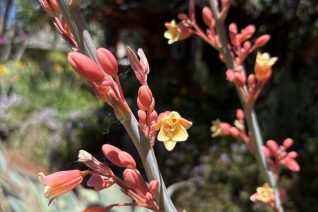
Hesperaloe parviflora
Red Yucca. Who would have thought that this remarkably adaptable plant would grow perfectly in such places as Phoenix, AZ AND Portland? We’re amazed and this excellent semi-succulent plant is one of our favorites for hot dry landscapes. The evergreen leaves form rosettes that spike up to about 2.5′ tall- blue green turning purple in colder weather. They are lined with little white hair filaments that add to the appeal. in summer flower spikes rise to 4′- many of them and hold tubular flowers that are succulent and red on the outside, when each yawns open it reveals a yellow center. Very cool. Full sun and average to poor well drained soil- though it does fine in any soil type that drains well. Excellently adapted to life in the blasting hot hellstrips. It can take any kind of reflected heat with no summer water and still perform beautifully. Clumps increase slowly in our climate. Excellent in containers as well. Loved by hummingbirds. Little to no supplemental water ever. Cold hardy below 0ºF. High deer resistance.

Heteromeles arbutifolia
Toyon. One of the most widespread shrubs in California this plant also known as Christmas berry ranges right up to the Oregon State line and appears just inside our border. Large evergreen shrub with finely serrated large green leaves. In late spring flat clusters of white flowers appear- they are pretty but nothing compared to the brilliant red berries that follow and ripen in early autumn- remaining showy through winter. Most often they are eaten by birds. AKA Hollywood this shrub is where that city got its name. heh. Fast growing to 13′ tall by 10′ wide in 10 years in our climate if left strictly unpruned. Slightly tender it requires a protected location. Most large established specimens I’ve seen around Portland are placed on the west or south side of large trees. They get the protection of the overstory and it shields them from the coldest winds. No water or regular water- either way, very adaptable shrub that really likes cultivation. Small tree in time. West coast native evergreen shrub for the mildest gardens. Oregon native plant.
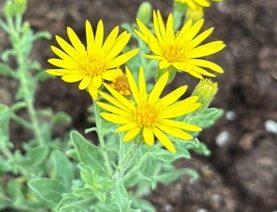
Heterotheca villosa
Hairy Solidaster is a stand out perennial west of the Cascades,never common it inhabits dry rocky areas and it is almost the only thing still in bloom in September. A somewhat sprawling evergreen perennial to 1′ x 2′ wide for full sun to very light shade in average, unimproved native soil. Bloom begins in July and it is yet another important late season pollinator plant for the Willamette Valley. Native primarily along the gravel slopes of major rivers. It can also be seen on occasion in abandoned rock quarries. Sunny yellow flowers are vivid and once this plant is established it can survive on rainfall alone. Very appropriate trailing over sunny rock walls. The leaves are somewhat sticky an adaptation to drought. Cold hardy and summer drought adapted. It may be cut back hard in early spring to refresh. Easy to grow with neglect. Combine with Epilobium (Zauschneria), Oenothera macrocarpa., Helianthemum ‘Henfield Brilliant’. Excellent butterfly attractant. Oregon native plant.

Heuchera chlorantha
One of our prettiest native Heucheras that can be found in partly shady locations from the Willamette Valley to the Cascades. A low rosette of handsome maple shaped leaves looks good for most of the year. In late spring very vertical straight stems erupt and cruise to 14″ tall. They terminate in rows of green flowers. As the flowers fade and change to seed the erect stems turn a soft red. Blooms are effective for months. A colony forming plant that spreads in rich to average soil with regular summer irrigation. Best in moist shady locations but is amenable to full sun- which will dramatically increase the number of flowers. Climate adapted perennial that improves under cultivation. Mass for a soft green floral effect. Mix with other woodlanders or even in full sun in rock gardens. Semi-deciduous. To 18″ wide. Moderate deer resistance. Excellent plant for partly shady meadows, which is its native haunt. Native to the city limits of Portland. Excellent plant. Oregon native plant.

Heuchera cylindrica
Green Alum Root. Fantastic native Heuchera found east of the Cascades but a stellar garden plant on the west side too. Handsome scalloped leaves form a tight evergreen clump. For weeks and weeks in late spring to summer 20″ spikes have columns of small green flowers at the top. Very pretty. Amazing massed in part shade and rich to average well drained soil. Regular summer water though established plants thrive on very little. A pretty Oregon native perennial. Thrives in such diverse places as partly shady hellstrips to the front of borders. Not bothered by pest and disease and much more durable than the hybrids. Easy to grow. Climate adapted. Oregon native plant.

Heuchera micrantha
Crevice alum root is one of the most widespread of our native Heucheras. This rosette and colony forming perennial is almost always found on near seeps on wet slopes and cliff faces. The handsome green foliage is typically maple shaped and evergreen. In late spring to early summer clouds of very fine white flowers erupt on 2′ stems. Its a wonderful wispy effect. Rich to average soil with regular summer water. Established plants can handle much drier situations. The rosette colonies can be quite large. Lush and verdant evergreen for shady borders, hillsides, rock walls. Very easy and adaptable. Loved by pollinators and a great native pollinator perennial for part shade to shade. It will also accept full sun, but you have to pay closer attention to irrigation. Not bothered pests. In habitat it is often left alone by deer as it can grow on the most vertical cliffs. It makes a great but limited ground cover and the more plants you have the more flower spikes and the more showy and ethereal the affect. Combine with Struthiopteris spicant (Deer fern) and Oxalis oregana, Tiarella. A good container plant as well. A perennial for the north side of the house. Oregon native plant

Heuchera sanguinea
Coral Bells. This is the original species that lept into gardens nearly a century ago. Native to the mid and higher elevations of the southwestern U,S. this is a tough, beautiful, long blooming species that will live for decades in a garden. Maple shaped leaves, occasionally decorated with white form rosettes and in time colonies. In April to July a fantastic display of red flowers on 16″ straight stems. They create a pool of color above the plants. We love this species also for its ease of cultivation. Full sun to part shade in rich to average soil with light summer water, or none when a patch is established. Excellent long lasting haze of red color for the front of a border or with in other perennials. Adored by hummingbirds and moderately deer resistant. Very easy to transplant and move around where you need some color. Evergreen to semi evergreen foliage. Rosettes to 1.5′ wide. Indispensable, old fashioned but always beautiful and reliable. Avoid heavily compacted soils.

Heuchera sanguinea ‘Big Red’
This is a very old selected form of Coral Bells. The brilliant red flowers are much larger than the species. A very long blooming perennial beginning in April and contenting solidly to July. The soft green maple shaped leaves are handsome year round. Spreads to form expanding colonies. To 2′ tall in bloom above a congested rosette of leaves. Adored by hummingbirds and a very adaptable plant. Full sun to light shade in rich to average soil. Established colonies of this showy spring perennial can live for decades. Excellent massed tougher for a bold blast of color or spread out for explanation points of bright red. Light consistent summer water. Though established plants make due with much less. Mix with other similarly designed perennials. Very a good with Wulfenia schwarzii, Saxafrage x geum dentata, or even lower and airy growing Dianthus. Light deer resistance. Native to the southwestern United states mountainous areas.

Heuchera sanguinea ‘Count Dracula’
Pale green leaves are striking and fade to cream, the transition appears differently on each leaf and the gradation of colors give you a cool affect. Pair that- pale leaves with the darkest red flowers we have yet to see on this species and you get a phenomenal plant. Adapted to part shade to full sun – and it doesn’t burn or bleach in sun. A long lived perennial with blood red flowers and foliage the color of Draculas skin that spreads to form colonies 1′ x 2 wide. In bloom the straight dark stems rise to 18″ tall. The deep red but small flowers are full of nectar and call hummingbirds, butterflies and a host of other small pollinators. Blooms for an extended period from late April to early July. Rich soil with regular irrigation to establish for the first season then just light summer irrigation. Long lived pest free perennial. We adore it in light shade paired with Hosta ‘Blue Mouse Ears’ for a soothing gray blue back drop. A selection from this native of the south western U.S. into Mexico. Semi-deciduous in winter. Leaves shrink but there is a presence. Very showy in bloom. Avoid crowding by other plants.
Xera Plants Introduction

Heuchera sanguinea ‘Hot Mess’
We found this vigorous seedling in a batch of Heuchera sanguinea. The leaves are pale green and liberally splashed with white. Unlike, the red flower of the species straight spikes of HOT PINK flowers rise in a cloud above the playful foliage. This is just a seedling and unlike many variegated plants it shows excellent vigor and longevity. Evergreen clumps of foliage. Loved by hummingbirds in bloom from April to mid-July. Tolerates full sun to quite a bit of shade at the expense of blooming Excellent paired with ferns Hosta, Tiarella. To 14″ tall in bloom and spreading to about 2′ wide when happy. Rich, moisture retentive soil high in organic matter. Established plants are surprisingly drought adapted. Do not let other plants crowd or over top this perennial. The lack of light and competition will take it out. Instead match it with a similar sized perennial. See above. Easy, forgiving perennial.
Xera Plants Introduction

Heuchera x ‘Canyon Delight’
This is a really good garden Fairy Bells that has performed for years in our garden. Its derivative of two western species and boy does it know how to bloom. From a low evergreen matt of nice looking maple shaped green leaves it send many many 2′ stems bearing clouds of true red flowers. Each flower is clad minute fur giving the extra substance. A saturated color that appears in our climate for up to two months beginning in April. Full sun to quite a bit of shade in rich, well drained soil with light summer water. Avoid boggy soils in summer. Its a carefree, long lived perennial that really performs in landscapes. Visited frequently by hummingbirds (yep). Create a clouds of rich red. Evergreen.

Holodiscus discolor
Ocean Spray is a well known shrub west of the Cascades. It occupies dry woods in part shade to full sun. Large and spreading it displays foamy white clusters of flowers in early summer. They age to a tan color before falling apart. Handsome small scalloped leaves are very pretty and turn yellow to orange in autumn. To 9′ x 7′ very quickly in virtually any soil type. Extremely drought adapted when established- but amenable to light irrigation in summer. Wild look for wild areas, match with native perennials. Often suckers to form patches and it is common for seedlings to show up around the parent plant. These can be moved when young or dispatched. Birds adore the dried seeds in winter. Pretty native in the Rose family. Moderate deer resistance- but sometimes they attack it if it is newly planted so protect. Winter deciduous. Ours are raised from seed native to our wholesale site. Oregon native plant.

Hosackia gracilis
Curious and rare western oregon native plant that can be found in permanently wet sites. This gives you a clue about how to grow this striking little pea. Wide stretching arms deliver pink and yellow flowers in clusters at the tips. Blooms April to July. Native along the immediate coast from the Bay Area in California north to British Columbia Inland it clusters around permanently wet sites. . Never common in its range. Stream banks, seeps, the margins of ponds for full sun and perpetually moist soil. Excellent for use in rain gardens (bioswales). Often short lived in gardens where it is dry. You must supply constant moisture. To 8″ tall by 4′ wide. Not difficult to grow and very climate adapted pea that is welcome in gardens. Oregon native plant.

Hosackia pinnata
Bog deer vetch is a beautiful native perennial found in wet to seasonally wet sites throughout Oregon, but primarily Western Oregon. This rhizomatous perennial erupts from the ground in early spring with pinnate leaves that are deep purple. As the plant extends it changes to dark green and begins to bloom in crowns of pea flowers that are yellow and white. Very pretty. The symmetry of the flowers is especially attractive. To 2′ tall x 3′ wide. Blooms April to June. Lovely native perennial for boggy sites. Amenable to average culture in rich soil with regular H20 in summer. Easy to grow long lived perennial for meadows, swales, vernally wet sites. Excellent perennial for a rain garden. Takes dry conditions when established and goes deciduous with summer heat. Competes well with invasive grasses. Possibly deer resistant. Often seen along streams in NW Oregon. Riparian perennial. Oregon native plant.

Iris bracteata
Siskiyou Iris is native to the southwestern part of Oregon. Though its named after the mountain range it is more often a valley species. You see it sparsely under Oaks, Madrones, and especially Ponderosa and Jeffrey Pine woods. Never at high elevations it grows in a host of soil types but the common component is that they all dry thoroughly in summer. Do not irrigate past the Fourth of July when established OR water only to establish the first year and then set it free. Forms almost caulescent evergreen fans that are red at the base. These rise to about 14″ and are not profuse. The plants which we raise from seed are a range of pale ivory to yellow all with conspicuous darker markings on the falls. Blooms April to May. Full sun to part shade and best with some protection from afternoon sun. In habitat it is found with Sidalcea malvifora var. Asprella , Erythronium hendersonii, and Vancouveria chrysantha with interspersed clumping Fescues. Long lived. This Iris among other Pacifica species do not compete well with invasive weeds and grasses. They are native to a fairly invasive free and less competitive balanced biome. Protect them by not allowing weeds grasses from getting a foothold around this Iris. Mulch with gravel to assist. Not bothered by deer or rabbits. Not as floriferous as other species but the flowers which are larger are much showier as well. Drought adapted. Oregon native plant.

Iris douglasiana (Pacifica) ‘Burnt Sugar’
A groovy selection of our coastal native evergreen douglas iris. From spikey grassy clumps rise 2′ tall flower spikes topped with multiple blooms that are amber and maroon, intricately marked on the interior falls. Blooms April to June. Vigorous clump forming perennial for any soil type where there is not standing water. Regular water to establish the first season then none in subsequent years. Full sun. High deer resistance. To 2′ wide in a few years. Oregon native plant.

Iris douglasiana (Pacifica) ‘Canyon Snow’
Pretty, floriferous and reliable form of Pacific Iris that forms large impressive evergreen patches and in April/May large white flowers with a touch of yellow on the lower petal. To 18″ and spreading to form large colonies in full sun to quite a bit of shade. Virtually any soil. Tolerates summer irrigation if the drainage is excellent otherwise follow a dry summer regime. High deer resistance. Evergreen. Oregon native plant.

There are 11 pacific coast Iris species, and 7 are native to Oregon. This is a deep purple flowered form of a species that is native from southwest Oregon to extreme northern California. Its type form, the form of the species that was discovered, is bright yellow and that was near the mouth of the Rogue River. Inland, however, up into the mountains this species is found in a remarkable range of flower colors – mostly deep purples or purple and white. This species also excels in the copious number of flowers per clump. Up to 12+ flowers open simultaneously for a rich display. The leaves give it its common name of grass iris – fine and evergreen they are a dull green and lay flat during the winter. Blooms April into May. Enriched to native soil in part shade to full sun. Water for the first season to establish – let it dry between watering and in subsequent years it can survive on natural rainfall. The clumps expand to about 1.5′ wide and the flowers rise on thin stems to 14″. Very resistant to deer and even rabbits. This is one of the more adaptable Pacifica species. It grows naturally with clumping grasses and even if grasses flop on top and obscure the foliage in summer/fall this tough iris will remain unaffected. A great candidate for meadows, partly shady slopes, Combine with Columbine (Aquilegia), Ookow (Dichelostemma congesta), Salvias, and native clumping grasses. Long lived perennial. Oregon native plant.

Iris tenax
Oregon iris or Tough leaved iris is the most northerly species of Pacifica Iris- extending its native zone as far as SW Washington. Its common throughout the western part of our state where it decorates grassy hillsides in full sun to quite a bit of shade with jolly purple flowers April-June. That was the most common color where I grew up SW of Eugene. Turns out this Iris comes in quite a few colors. Pink, blue, white, golden yellow, red- all hues that have been recorded for this species. Conspicuous also, among the 11 Pacifica species this is a winter deciduous perennial and its the hardiest of the lot. Forms grassy clumps in fan shaped displays to about 10″ tall. A large clump can be 30″ across and filled with nearly 20 flowers- these rise on cantilevered stems to 14″ tall. Not very tolerant of disturbance and to be honest it has stymied us quite a few times. They HATE division. Therefore, we feature seed grown plants- local seed. These plants feature extra vigor and usually bloom with in 3 years. They also establish better. Best in light shade, dappled shade on slopes. Average, clay soil is what it wants and you can increase vigor by double digging the hole very wide to incorporate oxygen in the soil and water lightly and consistently through the first summer. Then none to light in subsequent years. An admirable competitor with introduced invasives and as per all Iris it is supremely deer and even rabbit resistant. Winter deciduous- also, it may go drought deciduous in extremely dry summers. Mixes well with native annuals. Established clumps live for decades. The flowers have the light fragrance of root beer (at least to me) and are the only fragrant Pacifica species that I can detect. First nation people used the incredibly tough leaves to braid into ropes, traps. Which is cool. Oregon native plant.

Iris tenuis
Clackamas Iris is a rare endemic to only three counties in northern Oregon. Though it appears in scale with Pacific Coast Iris, it is not related and is more closely aligned with bearded Iris. Pale green 15mm wide leaves first emerge vertically before settling to a more horizontal position. Light lavender buds unfurl to white with yellow on the falls in May-July. In its native range this smaller iris is everywhere which begs the question; Why isn’t its natural range larger? Not bothered by deer or pests this is a supremely climate adapted perennial. To 12″ tall in bloom the arching leaves equal that and spreads out. Light consistent summer water to establish, then only what falls from the sky. Full sun to quite a bit of shade. In habitat it is an understory component with Sword Ferns and shrubs such as Hazel, Oso Berry, and Viburnum. Provide deep rich soil and room to spread. This Iris makes very large colonies quickly- to 3′ wide. The broad leaves are winter deciduous. Wonderful Iris for gardens and wild areas. Oregon native plant.

Iris x pacifica ‘Baby Lilac’
I found this naturally occurring hybrid at the intersection of the species Iris tenax and Iris douglasiana in the southern Oregon coast range. There are 11 Pacific coast species and finding a true hybrid with knowledge of the parents in the wild is rare. Pacific coast iris are most closely related to Siberian Iris. These guys crossed the land bridge from Alaska and speciated. Its still possible to cross Pacifica Iris with Iris sibirica. These are known as Calsib hybrids. This is a sturdy evergreen large clump forming Iris with large pale lilac flowers with intricate markings on each lower petal. Full sun to part shade in virtually any soil with little summer water. Water to establish the first season and then none necessary in subsequent years. Excellent plant for wild areas. Cold hardy. Leaf clumps are evergreen and flop a bit in the winter. A very heavy blooming plant- a large clump can have 25-30 flowers. Highly deer and rabbit resistant. Oregon native plant.
Xera Plants Introduction.

Iris x pacifica ‘Big Wheel’
Astonishing flower color is one reason to love this large flowered Pacifica hybrid. Orange/coral/pink all morphed into one hue with a central zone of deep purple near the center. To 1′ tall and forming spreading clumps of evergreen foliage. Blooms April-June. The large flowers are showy from quite a distance. Part shade is ideal but endures full sun and tolerates total shade. Water regularly through the first summer to establish- the clump should increase by twice its size then none in subsequent years. Resents disturbance best left where it is to live. Great deer resistance. A very unusual color for a PCI.

Iris x pacifica ‘Blue Moment’
How can you not fall in love with a blue iris? Its so classic. This vigorous and easy to grow Pacific Coast Iris does blue very well. The large sky blue flowers are marked in the center of the fall with more intricate yellow and black hatch marks. Large growing PCI to 16″ tall and forming imposing clumps of tall evergreen foliage. Blooms late April through May. Full sun to part shade in any soil that drains. Not fussy but dislikes standing water. Water though the first summer to establish then none in subsequent years. Evergreen foliage is nice looking- dies down a bit in winter and returns in spring. Highly deer resistant.

Iris x pacifica ‘Geoff’s’
Our good friend Geoff Beasley gave us this very easy to grow, pretty and floriferous selection of Pacific Coast Iris. The broad flowers are a combination of amber, maroon and even black hatch marks. To 14″ tall and produced from grassy spreading evergreen clumps. Full sun to part shade in virtually any soil with a modicum of drainage. Long lived perennial that is best left undisturbed once established. Blooms appear from late April through May. Highly deer resistant. Water for the first year to establish then none in subsequent years.

Iris x pacifica ‘Joey’
Kind of an obscure Pacific Coast Iris that Greg claims is a little more orange with brown striations than this picture depicts. Grassy leaves are evergreen and in May/June a continual parade of multi-colored flowers on 14″ cantilevered stems. Very easy to grow west coast native Iris hybrid that increases its bloom as the clump increases. The orange/ and maroon/cranberry flowers are visible from a distance and are particularly fetching when back lit. Completely deer and rabbit resistant perennial for part shade to full sun. Rich to average soil. Water diligently for the first summer, in subsequent years leave it strictly alone. Wonderful between and near Manzanitas, other west coast drought adapted shrubs.

Iris x pacifica ‘Meadow Pastels’
This is our own seed strain of Pacific Coast Iris. We save from specific plants and aim to include as many unusual colors as possible. Typically 1/3 are deep purple, 1/3 are amber/yellow and 1/3 are combinations of the two- whats left is the odd deep blue. Full sun to part shade in any reasonably well drained soil. Adaptable to clay. Regular summer water for the first year to establish then none in subsequent years. Blooms appear from late April through May. Height is variable but all make large clumps of grassy foliage over time. Do not disturb once established and remember that Pacific Coast Iris thrive on neglect. Excellent and wild looking cut flowers. Highly deer resistant. Xera Plants Introduction. The plant pictured is an example of an Amber seedling. Oregon native plant.
Xera Plants Introduction.

Iris x pacifica ‘Multiplicity’
One of the most striking pacific coast cultivars. Large somewhat flat flowers are a saturated orange/ rust color with contrasting purple nectary guides. Excellent plant that is not only extraordinarily heavy in bloom it blooms the LONGEST of any PCI that we grow. Often repeat blooming 1-3 times following the grand first display. Grassy evergreen leaves form spreading clumps to several feet wide. The large flowers rise on 10″ stems. Loved by pollinators. This intense flower color and propensity for heavy bloom endears this wonderful cultivar to gardeners and its often on the list of favorites. Full sun to light shade- ideally it may be grown best in an open north exposure. Such as the north side of a house with no overhead shade. Blooms late April-early June. Very deer resistant. Water consistently through the first summer than none in subsequent years. And once established it resents disturbance.

Iris x pacifica ‘Native Warrior’
Pacific Coast Iris can be dodgy to divide. You have to do it at the exact correct time in the fall just before they grow roots for the new year. Even then it takes a careful and gentle hand to produce viable divisions that will grow on and bloom. Native warrior must derive its name from from its ease of division. Either way its a fantastic PCI that begins blooming in late April and continues almost to June. Red and raspberry colored flowers are dramatic on a very compact plant to just 10″ tall. Grassy evergreen clumps of foliage do not obscure these precious flowers. Full sun to quite a bit of shade in any soil with reasonable drainage, including clay soils. Water for the first season to establish then none in subsequent years. Highly deer resistant. Long lived. Do not disturb once established. Neglect is its friend.

Iris x pacifica ‘Rio Dorado’
Yellow is a special color for Pacific Coast Iris and this selection does a great job at producing profuse large luminous yellow flowers for an extended period. To 14″ tall and forming spreading clumps. The vivid flowers are showy from a distance and resonate with the candy-like colors of other Pacific Iris. Mix with ‘Blue Moment’ for a classic blue and yellow combination. This Iris also blooms simultaneously with the clouds of blue flowers of Ceanothus. And they appreciate the same cultural conditions- a late spring vignette that gets by on no summer water! Evergreen. Not fussy about soil. Water consistently through the first summer to establish (established Iris will double their clump size in the first summer). Then only what falls from the sky in subsequent years. Heavy bloomer in April-June. High deer resistance.

Iris x pacifica ‘Tawny Meadow’
Our first deliberate cross of two Pacifica species has yielded a real looker. Half Iris innominata and half Iris tenax. It inherits the incredible amount of flowers from the first parent which is yellow and more intricate markings and purple hues of the latter. Fun to grow colony producing grassy iris for full sun to part shade. Begins blooming in late April and continues for 3 to 4 weeks. Adaptable to many types of soil, including clay soils. Water regularly through the first summer to establish then none in subsequent years. This little iris ( to 8″ tall) is very wild looking and reminds us of natural hybrids that occur in the wild. In time when you have many flowers per clump it makes a charming cut flower. Two Oregon native perennials. Heh. High deer resistance. Oregon native plant.
Xera Plants Introduction.

Iris x pacifica ‘Violetta’
Deep, delicious – one of he darkest purple Pacifica hybrids that we’ve encountered. This hybrid heavily draws from the excellent and floriferous species Iris innominata- native to southwest Oregon, Its known for having yellow flowers in the type form but deep purple forms exist. Grassy fine foliage is evergreen and lays flat over winter. The flowers are large and showy and begin in late April and proceed through May. One of the more adaptable Pacifica hybrids, its vigorous and long lived as well. Best in enriched soil with regular water for the first season. Let the soil dry between irrigation. Part shade- especially under deciduous trees such as native oaks, maples to full hot sun. An established clump can produce quite a show of 8+ flowers open simultaneously. Plant with other part shade or perennials, Clinopodium douglasii (Yerba Buena), Vancouveria, Mitella, Dicentra. Beautiful on slopes. Water more in full sun, less in shade. To 14″ tall in bloom forming fan shaped colonies of spikey foliage to 8″ tall. Excellent deer and rabbit resistance.

Iris x pacifica ‘Watercolor’
Of the 11 species of Pacifica species on the west coast the species I. munzii from the central Sierra Foothills imparts the best blue flower color. Typically a tall growing species to 16″ this cultivar creates amazing large flowers of soft washed blue with ivory edges. A very pleasant color that shows up well in gardens. Full sun to part shade in rich to average soil. This cultivar likes a bit more drainage than others- a product of its I. munzii parentage. Blooms late April through May. Upright grassy deep green foliage is evergreen and forms large clumps over time. Best with a good amount of neglect as all Pacific Coast Iris demand. High deer resistance.

Juniperus communis ‘Hoodview’
Low growing incredibly blue common juniper that we found on the slopes of Mt. Hood on the eastern side of Multnomah county. To just 10″ tall but usually much lower it creeps slowly and densely to 3′ wide in 5 years. Rich, well drained soil in full sun though it makes due with less than ideal conditions. Handsome blue cast to the foliage is nice looking all the time. Growth is dense and blocks out weeds. Nice to have a locally native Juniper from a relatively low elevation. Long lived and care free. Water or once established do not. Oregon native plant.

Juniperus deppeana
Alligator Juniper. So called for the rough pattern that develops on the trunk. A remarkable upright growing juniper that stuns with ghostly white foliage. Finely branching open habit on an 14′ tall by 6′ wide structure. Fast growing. POOR soil that has NOT been amended is ideal. In fact it thrives in heavy clay soils if on slopes. Enriched soil causes this shrub to grow prodigiously fast leaving it vulnerable to wind toss. Mixes well with other shrubs, makes a great light textured nearly white focal point. Good looking year round and ultra cold hardy. Little to no summer water once established. (Just makes it grow too fast) This is one elegant but tough shrub. Moderate deer resistance. This selection has extraordinarily blue foliage for the species. In time this forms a large tree- with a lot of years. Native to Texas and New Mexico into Mexico. Very difficult plant to root. So, we seldom have this tree/shrub in quantity. Even prior to developing the famous bark the over foliage is so brilliantly light blue that it is a first rate ghostly gray shrub.
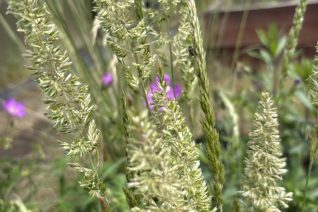
Koeleria macrantha
Prairie June Grass is a widespread cool season grass that was common in the Willamette Valley. A tight clumping grass with soft blue/green foliage that rises to about 18″ tall forming a clump as wide. In June-August feathery gray/tan plume of flowers erupt and soar above the grassy clump. In bloom it is about 30″ tall. A long lived grass for virtually any soil in full sun. Rich soil results in a very large plant. Average soil that has been double dug to add oxygen is usually all thats necessary. Water the first season to establish then none in subsequent years. Mix with other native perennials and annuals. A great companion for Sidalceas as well as Solidago and Douglas aster. Will often self sow. Keep it away from highly manicured areas. Otherwise the clump keeps to itself. Very easy to grow perennial grass that is found throughout the northern hemisphere. An authentic grass for a Willamette Valley prairie. Winter appearance is green and verdant. Summer brings tan drought dormancy. Oregon native plant.

Layia platyglossa
Tidy Tips a SW american desert daisy that puts on massive displays in famous high rainfall years. In our climate this hardy annual continues blooming for months as our cool summer nights seem to trick into an eternal spring. To 10″ tall forming a spreading plant in full sun and rich to average, well drained soil. Good drainage assists it in setting seed and that seed over wintering for germination the following spring. Remove spent flowers to spur more. Light consistent summer water. Otherwise let it go to seed. Nice cut flower. Loved by butterflies. Easy to save seed and toss out in spring in open sites after all threat of frost has passed.

Leptosiphon ‘Star Dust’
BABY STARS! Cute hardy annual that is actually a west coast native. Also known as Stardust this little plant produces adorable stars in pink, orange, yellow, and white. All together a tapestry of color on just 3″ tall plants. Reseeds prolifically in open disturbed sites. Just one potted plant will yield hundreds of seedlings for the following year. Blooms May- July then dies, goes to seed, is no longer there. Great bulb cover. Little to no summer water for self sown seedlings. Primarily composed of Leptosiphon parviflorus which is native to central California. Our own locally native Leptosiphon bicolor is similar and In the wild the flowers are primarily pink with a yellow eye- occasionally other colors. Adorable. Baby stars. Leave cleared space in your garden near these plants to allow these plants room to re-sow. Competition from other plants is the main reason that this plant loses its grip in the garden. Simply scratch a bare area near each patch and do not remove the spent plants until they are properly straw and dropping their fine seed. Delightful lining paths. Creates the most honest looking wildflower vignettes possible in our gardens. Full sun.

Lewisia cotyledon ‘Rainbow’
This strain of our native Siskiyou Lewisia contains a stunning range of flower colors. Pink to orange to white to yellow and permutations in-between. One of our most cherished wild flowers this plant is found at high elevations in the southern part of the state. A succulent that forms an evergreen rosette it displays its flowers for literally months on end beginning in spring. Excellent, long blooming, easy to grow container plant but not difficult in the ground given rock garden conditions. Drainage is crucial, in average to enriched soil. Drought adapted but it blooms longer with light summer water. Full sun to very light shade. Excellent at the top of walls, spilling out of cliffs as it does in nature. To 6″ tall forming multiplying rosettes up to a foot across. Moderate deer resistance. Oregon native plant.
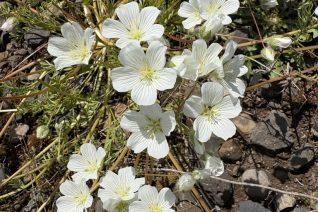
Limnanthes alba
Willamette Valley white Meadowfoam is such an unassuming plant with an incredible tough streak. Finely divided grass green leaves are completely obscured by the copious cup shaped white flowers. Opulent bloom begins in April and extends to early June. Forms connecting mounds that knit together into one sheet of ivory petals. Native to the central and southern Willamette Valley. It can be seen occasionally on road cuts and the gravel on street margins. But planted en masse it is spectacular. Excellent plant for tough, compacted, clay soils. To 4″ tall and each plant is about 1’wide. Leave spent dried stems where you want the next years display to be. Germination in autumn precedes most cold season weeds and forms an effective cover crop. Though prolific its well behaved enough to live between shrubs and even perennials. Excellent mixed with Baby Blue Eyes and Yellow and white Limnanthes douglasii. Water containerized plants at installation then none necessary. Self sown seedlings are MUCH more drought adapted and can germinate on soil as hard as concrete. Moderate deer resistance. Beautiful native wildflower. Oregon Native Plant.

Limnanthes douglasii
Meadow foam is a native hardy annual that occupies the flood zones in the valleys in most of Central and northern California up to the southern Willamette Valley, mainly in seeps and floodplains, To 4″ tall and up to a foot wide the grass green finely divided leaves are a great backdrop to the yellow flowers which are cleanly tipped white at the edge of the petals. Vigorously reseeds in any soil in full sun to part shade. Leave the dead straw to disperse the seeds or simply shake it where you would like next years display to be. And it WILL RESEED PROLIFICALLY- by early autumn you will achieve an enormous patch. Don’t worry if they are crowded the seedlings seem to work it out. This is a fantastic method for inhibiting winter weeds- YOU get to chose your weeds and this is an easy to deal with plant. A great annual to eclipse the fading foliage of bulbs. No supplemental water required. Completes its life cycle by the heat of summer and has already set hundreds of seeds for the following years crop. This from just one 4″ pot. Winter weeds are the worst cause we aren’t out there on patrol so this is greatly helpful. And the cycle begins again each year. Meadowfoam honey is wonderful btw. Very sweet with a sharp clover tang. Oregon native plant
See video click on IMG 4574

Limnanthes douglasii var. nivea
White meadow foam is a prolific native hardy annual that covers the bottom of inland west coast valleys in white in mid- late spring. Demure plants are actually a floral power house with tons of pure white flowers creating a foaming ivory carpet in bloom. By the heat of summer this true annual ends its life cycle but not before producing millions of seeds to renew the display for the next year. Takes all kinds of soil including compacted dry clay. No additional water is required once established. Each plant is 4″ tall by 6″ wide and they grow together to form an impenetrable layer. One planted potted plant yields hundreds of seedling. White meadow foam is a stunning western native that deserves more use. Native to the Portland city limits. Oregon native plant.

Linum lewisii var. lewisii
When you want a wildflower effect why not turn to a true native wildflower- one that improves under cultivation. Blue flax is a native of prairies and hot hillsides on the East side of the Cascades. Thin multiple stems rise to 18″ tall and bear a succession of single sky blue flowers. Light and airy and blue and native. Easily grown perennial for full sun and rich well drained soil. Light summer water. Takes summer drought well but after the first round of flowers are spent give it a healthy haircut and the whole clump will bloom again and with irrigation it stays with us blooming until autumn. Drought adapted. Reseeds in open soil. Tiny rosette of leaves or none in winter. Oregon native plant.

Lomatium grayii
One of our earliest blooming perennial umbels. This sweet little wild flower can be found in the central to eastern Columbia Gorge – closest to us. Extremely frilly blue gray foliage emerges in late winter and not far behind are the 8″ spikes of golden umbel flowers. A boone to early pollinators and welcome color in spring. Very well drained soil- best on a slope. In full sun with little to no summer water. Blooms February-April. To 1′ wide. Excellent in rock gardens, troughs, dry gardens. It can go summer dormant if too dry. For the first summer water it lightly but consistently through summer, in subsequent years it will be sustained by natural rainfall. High deer resistance. Oregon native plant.

Lomatium nudicaule
Bare stem biscuit root is a locally native perennial that is found in rocky dry areas among clumping native grasses. The stemless rosette bears upright trifoliate glabrous blue leaves. 20″ stems rise up in late spring to earl summer with umbels of sulphur yellow flowers (sometimes purple). To establish, water thoroughly through the first month in the ground. Winter deciduous it emerges very early in spring. Loved by pollinators of all kinds. In the Willamette Valley this biscuit root grows in various biomes but is most common on dry hillsides. Festuca californica and Festuca roemeri are two native grasses seen with this plant in the wild. Full sun to light deciduous shade. Avoid standing water in winter. Long lived perennial once established. Excellent in gravel gardens. Leaves remain handsome after blooming. Spreads slowly to form colonies. Locally native in the Portland city limits. Drought adapted when established. Moderate deer resistance. Resents disturbance once established. Widespread in the west. Important pollinator plant. Common associates in the wild are Potentilla gracilis ssp. gracilis Slender Cinquefoil, and Sidalcea m. virgata Pictured below. Oregon native plant.

Lomatium utriculatum
Spring Gold or Biscuitroot is a widespread spring perennial from British Columbia south into northern California. In our area it occupies steep slopes and delights in mid-late spring with complex umbels of brilliant gold/yellow flowers. This tap rooted plant requires regular water for the first season- but never boggy, In enriched to average well drained soil. Excellent performance on slopes. Over time the rosette increases in width and amount of spring flowers. Adapted to life between native clumping grasses. This is easily replicated in a garden. An important native pollinator plant that was also used by native Americans as a food source. To 6″ tall in bloom a plant will achieve 2′ wide in half a dozen years. Strongly resents disturbance and a happy plant will live for decades. Not bothered by pests. Once native in the Portland area, its original range in W. Oregon has been substantially diminished. Great companion plant with Manzanita. Goes quietly dormant over summer. Occurs with both Camassia leichtlinii and quamash, as well as Ranunculus occidentalis, Plectritis congesta, as well as Dodecatheon. Moderately deer resistant. Oregon native plant

Lonicera ciliosa
PNW Orange Honeysuckle is one of our most showy native vines. Our region is sparse on native vines so this pretty plant is welcome. In late spring to summer clusters of brilliant orange tubular flowers decorate the branch tips. Loved by hummingbirds as well as other birds which is obvious, its also important for all native pollinators. The flowers change to brilliant red fruit which is consumed by wildlife and seldom lingers. Deciduous mid green foliage is verdant all through the season. As with the vast majority of Honeysuckle vines this plant nearly always goes leafless at the base. Expect this and plan for it. Strongly twining plant to 12′ tall and almost as wide. Provide strong support. Light consistent summer water to establish then very little necessary once established. (Also accepts regular summer H20). Excellent vine for country fences, decorating mailboxes etc. Protect from deer, otherwise it is pest and disease resistant- occasional mildew in the autumn is virtually harmless – great news for a honeysuckle. Blooms on wood from the previous season, prune if needed after flowering. This vine can be very hard to find. We grow it from seed and quantities are limited. Oregon native plant
Not available 2022/23

Lonicera hispidula
Hairy Honeysuckle or wild pink honeysuckle is a common vine in the western part of our state. Ranging rom S. British Columbia to California. This sprawling and twining plant is most associated with the cover under white oak woodlands. This vine can crawl to impressive heights into trees. As a child near Eugene this grew extensively on our property. It would climb pole sized trees and I would strip the winding canes off the trees and use them as a trellis for annual vines. The strong wood lasted 10 years or more. It derives its name from the conspicuous hairs on the leaves. At terminal ends of the branches soft pink curly flowers appear in cymes from June to September. These are followed by brilliant red berries that are food for birds. It has no fragrance. Excellent plant for stabilizing banks and hillsides where its incredible tenacity and drought tolerance is an advantage. Never a tidy plant this vine can be sent up a trellis or large tree. Water to establish then set it free. This honeysuckle can be afflicted with aphids early in the season but I’ve never seen it actually inhibit the plant. Just make sure not to look to closely at the foliage in May-June. Evergreen to semi-evergreen with round leaves that surrounding the stem at the ends just before the flowers appear. Best in wild areas.- for some it can lack the sophistication of our other native honeysuckle Lonicera ciliosa. and is not as immediately beautiful. In habitat it consorts with Oregon White Oak (Quercus garryana) Poison Oak (Toxicodendron diversifolia) and Creeping snowberry (Symphoricarpos albus). Often found clambering up steep rocky slopes in dry woods. Oregon native plant.

Lupinus albifrons
Our locally native silver leaved lupine. A wildflower that beckons gardeners with incredible metallic silver foliage and spires of blue and white flowers from late spring into summer. It has some exacting requirements. Its best to know where you find it in the wild. Steep, steep cliffs and steep open road cuts. What do they have in common? Excellent drainage and little summer water. Spreading almost shrubby evergreen plant to 2′- 3′ wide on average. The very pretty fragrant flowers rise up to about 3′. It seems to resent a lot of competition from other plants- give it room, its own space and again, perfect drainage. Highly deer resistant also not as attractive to rabbits. Oregon native plant.

Lupinus bicolor
Dwarf Lupine or Pacific Lupine is a widespread small hardy annual that is found all along the west coast from British Columbia to Mexico. In the Willamette Valley its most conspicuous home is along the disturbed soil and gravel of highways/roads. Thats where you see masses of this diminutive lupine that rises to just 1′ tall. The intricate flowers erupt from the top and are mostly blue with purple and the bottom has a white lip. These are displayed above very furry palmate leaves. It forms a small rounded plant. Loved by all pollinators this tough little plant can inhabit the worst, shallow soils and still thrive. If given richer conditions this nitrogen fixer will soar to 1′ tall with a much larger flowers. Excellent in annual containers – it blooms for a long time April-August or until the ground goes completely dry. Horizontal bean pods hold three seeds each. Self sows in open disturbed sites with little competition from other plants. Only water if it is planted from a container otherwise no supplemental irrigation necessary. Very beloved by hummingbirds and butterflies. Mixes well with other long blooming hardy native annuals such as Madia elegans or Clarkia amoena. Seed that is released in summer germinates in autumn with the first fall rains. Easy to spot the palmate leaves. Oregon native plant.

Lupinus polyphyllus ssp. polyphyllus
Large leaf lupine. This is the form that is native to the western part of the state. There are 5 other subspecies, this is the Willamette Valley form. A large bushy perennial famous for the most showy flowers in the genus. This is the direct descendent that forms the colorful clumps along our freeways. A great large garden plant and not a long lived plant. Generally 3-5 years is antiquity for this species. The large palmate divided deep green leaves are coated in fine fur. This makes raindrops turn to pure mercury as they balance on the leaves. The most commonly seen flower color forms in the Willamette Valley are generally blue and purple and solid colors. The multi-color vastly larger selections are just as adaptable as the species. Large rocket like flower trusses rise to 3′ tall in late spring to early summer. Loved by insects the foliage is often fodder for native fauna. Excellent pollinator perennial or cut flower. Large peapods stick out horizontally from the spent flower stems. Reliably self sows if you contain the competition from foreign exotics and turf grasses. Potted plants should be watered regularly through their first summer. In subsequent years it can rely on natural rainfall. Very deer and rabbit resistant. To 3′ wide when happy. Protect from slugs/snails. Oregon native plant.

Lupinus rivularis
Streambank lupine or Riverbank lupine is widespread shrubby species native to western Oregon. Its full range is from extreme southwest British Columbia (where it is endangered) to northern California. Large growing, spreading plant that can almost achieve a sub shrubby habit. To 3′ tall in bloom forming an evergreen shrublet to 3′ across. From late April to early July spires of blue flowers with a white keel erupt from the plant. Very pretty in bloom and incredibly important to pollinators and insects who feast on the flowers as well as leaves. The true species has flowers that are all blue, its found primarily on sand bars in major rivers on the west side of the state. Most seed that is grown and dispersed is a selected bicolor flower. Short lived plant 3-5 years. Following the flowers conspicuous seed pods turn a dark color, These may be allowed to open and disperse in the OPEN DISTURBED SITES that it craves. Excellent in concert with California poppies where it has become a famous duo on our freeways in the spring. Good cut flower. Not bothered by deer. Water to estalblish then leave it to natural rainfall. Oregon native plant.

Luzula subsessilis
Prairie wood rush is such poetic name for a sedge that is widespread on the west side of the Cascades from BC to N.California.The common name describes its love of both open conditions as well as woodlands. Its adapted to winter wet summer dry conditions and is found in a lot of different biomes. Soft green leaves terminate in a blunt tip. The leaves are covered with fine hairs. In spring wiry stems grow to 11″ tall with tawny black flowers followed by seed heads. that are swollen and brown. A component of oak woodlands in part shade to the verge of wetlands where it is found in full sun. Forms a wispy clump that expands slowly. As with most sedges it will respond to better conditions vigorously. Excellent for insect and wildlife. Semi evergreen., especially if drought stressed, (plants much be established well to do this and survive). Part shade to full sun with regular irrigation to establish then little to none in subsequent years. Pretty wispy sedge with a poetic name. Oregon native plant.

Lyonothamnus floribundus ssp. asplenifolius
Catalina Ironwood is a tree locally native to the Channel Islands off of Southern California. Surprisingly hardy once established and older this spectacular evergreen tree in the rose family boasts amazing divided foliage with symmetrical scalloped serrations along each margin. Very pretty. The glossy aromatic leaves are seen to great advantage against the straight, red exfoliating trunk. In spring flat umbels of white flowers appear all over the tree. Fast growing in youth to its ultimate size here 25’+ tall in 15 years. Requires a protected location- such as against the wall of a large building. Avoid direct exposure to subfreezing wind. Little water once established. Wonderful tree for courtyards- protected areas. Fantastic performance at the Oregon Coast. Protect young trees from temperatures below 15ºF- wrap or swaddle in burlap or remay until arctic weather has passed. Reaches its full hardiness several years in the ground. There is a wonderful mature specimen of this tree at the McMennamens in St. John in PDX and scattered large specimens occur around the city. Nice, nice urban tree.

Madia elegans
Elegant tar weed or Hayfield tar weed is a locally native annual that occupies (or occupied) sunny dry hillsides in selected regions of the western part of the state. Elegant tarweed references both the light tar like fragrance of the sticky 2′ stems and the elegance of the 1″ wide flowers that are the most showy of the genus. Daisy-like flowers range from pure yellow to yellow with a ring of maroon, white, or red around the center. One of our longest blooming annuals flowers appear from April to November. Remove spent flowers apply light irrigation and it will happily continue its show. Nice cut flower- but remember flowers take an afternoon nap and revive with darkness- kind of cool. The dried seeds of this species were a very important food source for native people. They would grind the oily seeds to make a kind of flour or press them to extract oil. To 2′ tall forming multi branched clumps. Re-seeds in places that it likes, mostly sunny, open places with good drainage. Native to the city limits of Portland, though no longer likely present. Fix that. An ebullient pretty native. Moderate deer resistance. Oregon native plant.

Mahonia aquifolium
Oregon Grape, our ubiquitous state flower. This evergreen shrub can be found almost anywhere aside from the immediate coast to high Cascades west of the mountains. Its native from B.C. to Southern California. Variable shrub to on average 5′ tall and suckering as wide. In rich, happy conditions it will soar to 8′ or more and in more impoverished conditions it makes its life as a spreading low plant. In late February-April the top of the plant erupts in golden yellow incredibly fragrant flowers that are one of the first joys of spring. By late summer these flowers have transformed into clusters of dusty blue incredibly sour fruits. Often employed in the toughest situations where its performance is some what rough. It thrives in cultivation with light, consistent summer moisture. Tolerates heavy clay soils and summer drought. The pinnate leaves often take on purple/maroon tints in winter. Ours are cuttings native to our wholesale nursery site. So its a local plant. Full sun to part shade to quite a bit of shade at the expense of blooming and a lankier outline. Excellent deer resistance when established. Oregon native plant.

Mahonia nervosa
Cascades Mahonia is found throughout the western part of Oregon occupying shady environs under the tree canopy. Low growing creeping evergreen with large deep green leaves. They emerge in spring tinted bright salmon before settling to their mature color. In spring spikes of fragrant light yellow flowers appear and then turn into small edible blue berries. Which also attracts birdlife to the forest floor. To just 2′ tall but a single plant can spread to 5′ wide in 6 years. Part shade to shade in rich, humusy soil with regular summer water. Established plants get by with nothing. Takes some patience to establish and a lot of water. Mulch annually. Moderately deer resistant. Oregon native plant.

Mahonia nervosa var. mendocinoensis
Rare but excellent form of Cascades Mahonia that is actually found only in the redwoods of N. California to southern Oregon. A TALL upright growing shrub with thick trunks to 9′ eventually. It forms a clump of stems and can increase by suckering closely to the main clump and sending up new stems. Handsome foliage- pinnate dark green leaves to 1′ + long. In winter the whole shrub takes on great plum purple tones. In mid-spring trailing clusters of yellow flowers are followed by blue berries. Moderately slow growing evergreen shrub for part shade to dense shade. Established plants take dust dry conditions in shade. Accepts regular summer water as well- in well drained soil that is not compacted. Mulch each year with a coarse bark. Easy to grow. Appearance is very much like the M. x media hybrids. New growth emerges red. High deer resistance. Oregon native plant.

Mahonia nevinii
Nevin’s mahonia or barberry is a remarkably tough evergreen shrub for the roughest locations. A moderately fast growing evergreen with somewhat fiercely armed blue green leaves. New growth of divided leaves is conspicuously tinted red. In spring small yellow flowers appear and cover the whole shrub, by late summer these have morphed into translucent red berries relished by birds. Native to southern California and surprisingly cold tolerant – like zone 4b tolerant thats -25ºF. Its kind of funny that we didn’t go for this remarkable durable plant. a long time ago, instead we were saddled with the horror of English holly. Once established it requires absolutely no further irrigation. It’s perfectly adapted to our winter wet summer dry climate. Full sun is non-negotiable Excellent shrub for rural areas as it is incredibly resistant to deer and even rabbits, In time it becomes a dense rounded shrub- very handsome. Excellent shrub to deter unwanted folks or animals. I’ve often thought this would be an ideal rural hedge with little care beyond planting and watering to establish- then set it free. Virtually any well drained soil. Avoid standing water at any time of the year. Beautiful, tough west coast native shrub. 8′ by 6′ in 7 years.

Maianthemum stellatum
An incredibly widespread North American wildflower that is known by many different common names. In our region the preferred common moniker is Low False Solomons Seal. This rhizomatous perennial forms expansive colonies when happy. It appears as strongly arching stems clad in alternate wide green leaves. In late spring to early summer and dependent upon altitude small, white, starry flowers appear at the tips. After bloom they slowly morph into black berries. These can easily be dispersed by birds. Part shade in naturally mesic sites, that means woods on the north side of a slope in the Willamette Valley in shade beneath Douglas Firs and often consorting with sword ferns. To 10″ tall and forming expanding colonies. Winter deciduous, fall color is often a lingering gold before the whole plant disappears. Tellima grandiflora (fringe cups) and Claytonia sibirica ( candy flower) are common associates. Part shade to shade in humus enriched soil with regular summer water. VERY established clumps can get by with natural rainfall. Avoid, hot dry sites, and stubborn dry clay. Mulch heavily after planting. Moderate deer resistance. Oregon native plant.
Melica harfordii
Harford’s onion grass isn’t really an onion, its a true grass and is widespread in Western Oregon. A handsome blue green clumping grass on average to 2′ tall- bigger in rich soil with irrigation. smaller in natural rainfall only plants. The blue green blades which are up to 4.5 mm wide arch on a vase shaped plant. In mid spring to early summer infloresences that soar up and out with the stems lined in larger seeds. Superfically, they resemble.rice plants thought this is a drylands grass. Wonderful meadow component. Summer drought adapted, competes well with foreign invaders as well. Currently its most stable populations occur on the upper dry banks of rivers. This native grass goes summer dormant with drought. Self sows, best in an environment where this is not a problem. Handsome, graceful, useful native grass. Combine with Sidalcea virgata and Iris tenax. Oregon native plant.
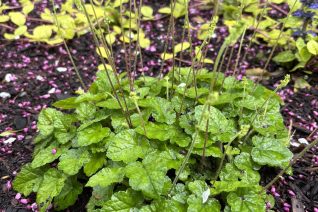
Mitella (Pectiantia) ovalis
Coastal (Yellow) mitrewort is a little seen but wonderful native primarily in Oregon- going to BC in the north to very far northern California to our south. In Oregon its found primarily on open north exposed aspects and steep hillsides, often near seeps. Glossy foliage is the same shape as Tellima grandilflora which has dull lighter green leaves. In spring to summer 12″ straight stems unfurl intricate chartreuse yellow flowers that line a scape. Evergreen to semi evergreen perennial for part shade to full sun. Closely related to Heuchera this member of the Saxifrage family improves greatly under cultivation. As a small scale ground cover in part shade its a good native for the dry areas around trees. Light summer supplemental water – but never boggy and hot. Established plants are robust and handsome and are NOT afflicted by powdery mildew. The vertical yellow flowers lined with little intricate 3-d flowers brings many tiny pollinators. To 18″ across forming an expanding clump. This is a very good native perennial that is almost never seen in gardens but is local and excellently adapted to our climate, again it also improves greatly under cultivation and it responds to enriched soil. Drought adapted in shade. Winter foliage is smaller and takes on bright red tints. Common in the Oregon Coast Range as well as the western Cascade foothills. Super saxifragaceae for your stumpery. Adorable in bloom. Associated plants in the wild are Oxalis oregana, Tellima grandiflora, Adiantum aleuticum, Heuchera chlorantha. A very handsome plant. Oregon native plant.

Monardella macrantha ‘Marian Sampson’
Shockingly showy little perennial wildflower that display relatively huge brilliant red tubular flowers from a somewhat demure plant. Deep green/maroon foliage is aromatic but gives no hint at the ultimate showiness of the flowers. Blooms appear continuously from late spring to autumn. Very well drained soil of moderate fertility in full sun. Light summer water but occasional deep soaks spurs flowers. Hummingbirds actually get down to ground level for this 3″ tall by 14″ wide matt forming perennial. Good drainage aids in cold hardiness for this striking California native wildflower. Exceptional and long blooming in containers.
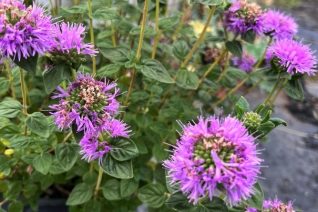
Monardella villosa ‘Russian River’
Incredibly long blooming native sub-shrub with clouds of fragrant purple flowers for all of summer into autumn. To 2′ x 2′ forming a semi-woody base. The aromatic round leaves cup the flower buds as the stems elongate. Loved by all native pollinators. A wonderful plant in the mint family that is very easy to grow and long lived for this genus. This selection sports slightly darker purple and longer blooming flowers. Found from Douglas County, Oregon south throughout California. Freezes back in very cold winters but sprouts quickly with warm weather in spring and commences bloom quickly. Great as a mass planting and ideal in a meadow. Also, adaptable to rock gardens and indeed thats where you find it in the wild- among gravel, rocks, and boulders. Mix with other long blooming native perennials such as Erigeron glaucus (sp & cvs) and among California fescue (Festuca californica). A very climate adapted plant. Cut back spent flowers and more will follow. Nice cut flower. Very long blooming. Light summer water to very little when established. Some deer resistance. AKA Showy coyote mint. Oregon native plant.

Morella (Myrica) californica
Pacific Wax Myrtle is native along the direct coast from Santa Barbara California to near Tofino, on Vancouver Island, BC. It forms a large evergreen shrub to eventually a small tree in time and has thin, pretty dark green foliage. Aromatic if bruised the leaves are deep green and lustrous year round. Tiny brown flowers change to waxy gray berries that line the stems but are not terribly conspicuous. Fast growing to 12′ tall and 8′ wide in 7 years. Adaptable to a variety of soils, including winter inundation. Soil that is too rich can lead to prodigious growth and an unsteady plant until it bulks up. Judicious pruning can keep it much smaller. Prune at any time of the year. An excellent, drought tolerant, cold tolerant shrub for a hedge, screen or small garden tree. Our material is from locally cold hardy stock. Easy. Tolerates salt spray- including first line strand conditions. Recently changed from Myrica to Morella. In time it can become a handsome rounded evergreen tree with contrasting pretty white bark. Oregon native plant.

Muhlenbergia rigens
Deer grass is native to large areas of the west coast from west central Oregon south through California. Its a tough and wild looking grass that peaks in autumn with a crescendo of dramatic flowers. Dense and fountain forming evergreen grass. Foliage to 2′ x 3′ very quickly. In autumn spikes of light tan thin but feather columns emerge and point out in every direction. The rise to about 5′ tall and remain as stiff skeletons well into winter. Full sun to very light shade in any soil that drains. Excels on slopes and raised beds. Wonderful lining a path or mass planted. Water to establish the first season then none in subsequent years. Its fully adapted to our dust dry summers. Very wild looking grass which can be tamed somewhat by planting in rows or symmetrical pattern. Otherwise it fits in perfectly between drought tolerant native shrubs like Manzanita and Ceanothus. Oregon native plant.

Nasella cernua
Nodding needlegrass is a clump forming species native to western California south to northern Baja CA. Fine, fine medium green foliage appears in spring and is bright and fresh. In late spring stems rise to display the metallic tan, long needle like awns. They gracefully bend in every direction and are magical when tussled by the wind. They wave and sway gracefully and the light catches glints off the flowers. Very wild looking west coast grass that is at home in any well drained soil in full sun. Adaptable to light summer water and this improves the appearance and amount of blooms. To 2′ tall in bloom the basal clumps spread to about 1′ wide. Winter deciduous. Cut back hard in early spring before new growth starts. Completely adapted to summer drought once established and is a graceful and integral part of dry plantings. Seeds around a bit- expect this. Full sun.

Nemophila maculata
Five spot is a showy and adorable west coast native true hardy annual that delights under oaks with 1″ wide white and blue flowers. One deep blue dot at the tip of each of the five petals. To 4″ tall and sprawling to 8″ wide the cheery flowers appear from late March to June before the plant completes its life cycle and dies and goes to seed. Reseeds reliably in open disturbed sites. Fine leaves on small rosettes tell the story in autumn. Self sown plants require no supplemental water. One potted plant will yield hundreds of seedlings for the following spring. West coast annuals are cool. Found in a small part of Josephine and Jackson counties in southern Oregon. Oregon native plant.

Nemophila menziesii
Baby Blue Eyes is a hardy annual wildflower native to the southern coast in the blue form. In the Willamette Valley up to about Portland the variety Nemophila menziesii ssp. Atomaria is the native form. It has large cup shaped flowers that are white on the inside w/ fine intricate black spotting and blue on the reverse of the petals. That is the form that I grew up with in the country near Eugene. This is a fascinating annual that is adapted to just about any soil that is not boggy. Finely divided foliage forms sprawling rosettes that support the nickel sized sky blue to pale blue flowers. Blooms April to June. Reliably reseeds in open disturbed sites and with a little protection from slugs and lack of competition. The whole plant is dead and chucking seed by the heat of summer and ultimately disappears on its own. Adaptable to full sun to light shade. Self sown plants get by with no supplemental irrigation- plants from containers seem to like regular water. In habitat it occupies slopes usually under the canopy of Oaks. To 4″ tall and 1′ wide. Excellent, long, showy display in reconstructed Willamette Valley meadows. and laugh at summer drought by finishing their life cycle and simply spreading anew by seed. We are actively searching for the ssp. atomaria but the seed is hard to obtain. Occurs natively with Erythronium oreganum, Dodecatheon hendersonii, Ranunculus occidentalis as well as Plectritis congesta. Oregon native plant.

Nemophila menziesii ‘Frosty Blue’
Impressive selection of this wonderful native annual. Leaves are brightly frosted in white and make a great backdrop to the sky blue nickel sized flowers. Blooms April-June in part shade to full sun. AKA Frosty Blue Baby Blue Eyes. To 4″ x 6″ forming a spreading plant. Very attractive and it will reseed in the autumn or early spring- the seedlings are immediately identifiable by the silver foliage. Likes to germinate among other small plants/grasses for overwintering protection. Water to establish then only lightly until bloom has ceased and seed is set. The whole plant dies and decomposes almost instantly in the real heat of summer. Excellent in early season containers. This form was found in California but this is also an Oregon native plant.
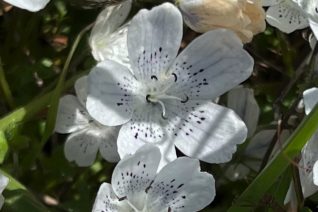
Nemophila menziesii var. atomaria
Giant baby blue eyes is kind of a misleading common name. The flowers in our locally native form of Baby blue eyes are a pure white with black dots on the interior. The only blue that appears on this subspecies is on the reverse of the petals which is often blushed with navy blue. This delightful wildflower grew natively in my back yard where I grew up. In early April to early June it would make sheets of cup shaped blooms under the native white and black oaks. There it bloomed simultaneously with Foothill shooting star (Dodecatheon hendersonii), Prairie stars (Lithophragma parviflora) and western buttercup (Ranunculus occidentalis) and mission bells (Fritillaria affinis) – a really cool native vignette. Wonderful annual for many kinds of native pollinators. Native bees favor this plant and if you look diligently they will be visited over and over. It will resow itself very reliably if foreign invasive plants are kept away. Mixes really well with (Collinsia grandiflora) Giant Blue Eyed Mary and (Plectritis congesta) Rosy plectritis. A truly exquisite west coast and Oregon native that is adapted to life between clumping grasses. Non native turf grasses will quickly over run and out compete this plant. So, invasive weed control is paramount in maintaining consistent years. In my own backyard it grew between (Festuca californica) California fescue and California three awn (Danthonia californica). Water in potted plants.Protect seedlings in spring and fall from slugs. Oregon native plant.

Notholithocarpus densiflorus (Lithocarpus)
Tan bark oak or Tan Oak is native to the SW corner of Oregon south into the mountains of southern Califiornia. The large convex leaves emerge clad in gray fur as this wears off it reveals a mature deep green with an underside of silver. Moderately fast growing evergreen tree to 45′ tall x 25′ wide in 30 years. Grows on average 2′-4′ per year when young. This close relative of Oaks produces acorns that are light tan and born out of an indumentum covered prickly cup. In Oregon this tree mostly of mountains can be found most extensively from Douglas and Coos County south to the coastal border. It is found in the higher elevations of the mountains of northern California where quite a bit of heavy wet snow occurs. This tree will bend in snow and ice and it will not break. Conical and spreading crown. Tan Oak which was harvested in the 19th and early 20th century for the collection of commercial tannins. Full sun, it grows well but is slower and a bit spindly as an understory tree. The furrowed bark is dark brown to black. Its range is almost the same in Oregon as Canyon live oak (Quercus chrysolepis) and cold hardiness is equivalent too, hardy just below 0ºF. Wonderful, stately, native evergreen shade tree. Ours are raised from acorns collected at the northern extent of its range in Douglas County. Oregon native plant.

Oemleria cerasiformis
Oso berry is a classic west coast shrub. Its one of the earliest shrubs to burst into leaf and flower long before anyone else- often as early as early February. Exceptionally fresh green leaves emerge vertically and for a time appear as rabbit ears lining the stems. On female plants fragrant chains of white flowers are showy in a very spring like way. Following pollination chains of charming fruit (the drupes or plums)first turn yellow then red/orange and arrive at deep purple. They are reputed to be good. And even though I’ve known this plant my entire life i’ve never tasted a ripe fruit. Seems like they disappear to wildlife very fast. There was a thicket of this early spring shrub near the bottom of our long driveway and it would leaf out and bloom in February and March. When I spotted those acid green leaves I knew that winter was over. To 8′ x 8′ quickly from a massively suckering central shrub. Branches soar up and arch out. All the better to observe the colorful fruit. Native, often under Oregon white oaks and in dry woods with Holodiscus discolor/ Ocean spray, Corylus cornuta californica /Western Hazel. By late spring this shrub has all but faded into the background. Often it will lose many or all leaves in a very dry summer, but its drought tolerance is phenomenal. Fall color is soft yellow and shows up nicely on the dark forest floor. Its natural range is from the N. Bay area in CA north to extreme SW British Columbia. Always on the west side of the mountains. Stems force well when brought inside in December- January. Deer resistant and possibly rabbit resistant. This is a very wild looking shrub, goes well with other plants of that mein. Stirs early pollinators and even Anna’s Hummers. These are unsexed seedlings. Best in part shade to shade though it will tolerate full sun with a less refined overall look. Water lightly but consistently for the first summer then none in subsequent years. Virtually any soil type including heavy clay. Simultaneous bloom with flowering currants (Ribes sanguineum). A great garden pairing. The sexes are revealed in their flower. The female pendant white flowers have somewhat shaggy petals ( the flower pictured is a female) Male flowers are also pendant but the white petals are sharply flat no shagginess, and appear up to a week before female flowers . Oregon native plant.

Oenothera fremontii
Excellent Rocky Mountain native that we love for its long long season of bloom. Large luminous light yellow flowers held against silvery fine foliage. Completely deciduous in winter it sprouts anew each spring to form a fairly compact spreading clump. In June and continuously for two months a parade of large flowers obscures the leaves. To just 10″ tall but spreading to about 1/1/2′ wide annually. Full sun, very well drained soil and little summer water when established. Give it an open exposure with little crowding from other plants. Impervious to the most enervating dry heat. Hellstrips, rock gardens, hillsides. Moderate deer resistance. Seed grown.

Oenothera incana var. macrocarpa
Excellent form of this sprawling Rocky Mountain native evening primrose. Super silver leaves are held upright on a spreading plant. Beginning in June huge 3″ wide shimmering, luminous light yellow fragrant flowers appear almost daily for months. Full sun and rich, well drained soil with little summer water once established. Excellent performance in rock gardens as well as parking strips. The flowers are a really good shade of yellow and harmonize brilliantly with the silver foliage. Winter deciduous.

Olysinium douglasii
Grass widows or Grass maidens is a beautiful and fascinating perennial bulb that is native over a wide but scattered part of our region. Most common east of the Cascades it finds a home in several drier portions of the Willamette Valley. The summit of Spencer’s Butte south of Eugene is one location as are appearances in dry prairie in Benton county. One of the very first conspicuous wildflowers to emerge in February/March. From shallow soils, it lifts to 8″ tall with a wide nodding purple flower- the exact hue of each plant is slightly different. A clump of leaves follows the flowers before going neatly summer dormant. Best in rock garden conditions where you rely only on natural rainfall. Spreads in time to form quaint colonies. Once a Sisyrinchium this member of the Iris family is one of the dearest wildflowers for our gardens. Full sun- no shade at all and amend the soil w/ a handful of pumice. Water after planting until summer heat induces dormancy. Then never again. Seed grown. Avoid crowding from other plants. It can and has been overwhelmed by invasive exotic grasses. High deer resistance. Oregon native plant.

Opuntia cycloides
Tall growing hardy Cactus native to cold New Mexico. The pads are armed with 2″ orange thorns that will make you think twice about messing around. To 5′ tall and 4′ wide in 5 years in our climate. Multiplies quickly and large erect pads build up to probably the tallest Opuntia in our climate. In early to mid summer 5″ brilliant yellow flowers are a show stopper. They open just when its hot and sunny enough- closing in any dim conditions. Full, hot, all day sun and very well drained appropriately amended soil. On a slope, double dig the soil to oxygenate it and incorporate hefty amounts of pumice and gravel in the soil. Water regularly through the first summer to establish growth and then none in subsequent years. Extremely cold hardy. Locate away from paths, anywhere you might get too close. Remove deciduous leaves that become ensconced in the pads in autumn. Otherwise it can lead to rot. Long lived. High deer resistance.

Opuntia macrocentra
Spectacular in bloom this is one of the easiest Opuntia (Prickily Pear Cactus) for our climate. Pads are fiercely armed and are blue/gray. The 2″ needles are formidable and begs that this plant be place away from paths. Spreading to 2′ tall x 4′ wide in very well drained poor soil with light summer water to establish. Avoid all shade- bright open conditions suite this native of the SW U.S. Avoid placing near deciduous trees where dropped leaves can collect on the plant- they are not only a pain in the ass to remove they must be to avoid rot in winter. Grows relatively fast- increasing before you know it. Amazing in large rock gardens as well as large containers. Amend the soil with pumice and gravel so that winter wet does not collect around the base. It will root through this deep into the ground. Once established it can get by with all that falls fro the sky. Huge yellow flowers with an orange center are 6″ wide an amazing when they appear in late spring to early summer. Highly deer resistant. Long lived.

Oxalis oregana ‘Klamath Ruby’
Far and away our most vigorous clone of our native Oregon Sorrel. So named for the bright red underside of the leaves. In spring and sporadically into summer pure white flowers peek over the foliage. This is a fast colonizing plant that goes by underground stolons and it can cover several feet in a year. In time it will cover anything in part shade to shade in rich, hummus laden, moisture retentive soil. Piles up to about 6″ deep in no time. This form is decidedly evergreen. Use for wild areas to obstruct smaller weed growth- under decks, shady glens, other areas too dark for plants to grow. Oregon native plant.

Oxalis oregana ‘Select Pink’
Not the most original cultivar name but its aptly descriptive. Vigorous evergreen ground cover with dramatic hot pink flowers for weeks in spring. Spreads by underground stolons in rich, fertile, woodland conditions with regular summer water. To 4″ high and spreading many feet across shortly (in ideal conditions) . Part shade to shade. Very easy native perennial to grow. This is the second most vigorous Oxalis o. clone that we have behind ‘Klamath Ruby’. Simple pink flowers are pretty and rise up just above the foliage. AKA Redwood Sorrel or Oregon Sorrel. Long lived. Edible. Oregon native plant.

Oxalis oregana ‘White Flower Form’
There are quite a few selection off Redwood Sorrel or Oregon sorrel. This is the most common light green leaved form that you see carpeting shady dells and tree rootwells in the deepest shade. To 8″ tall and spreading vigorously by underground stolons. Clear white flowers in mid to late spring. Edible. Very simple plant to grow in part shade to shade. It will even thrive on an open north exposure. The soft foliage is semi-evergreen and has a great rebirth in spring. Not bothered by pests or deer. Spreads to several feet wide in rich soil high in humus. Do not plant with smaller delicate neighbors this plant will easily swamp them. Avoid full sun and compacted soils. Established plants can get by the summer with minimal to no irrigation. Oregon native plant.
t

Oxalis oregana ‘Wintergreen’
A GREAT PLANT PICK. This staunchly evergreen form of our native sorrel has deep green leaves marked with a silver chevron on each leaflet and large pink flowers in spring. Creeps to form an inpenetrable ground cover. To just 4″ tall but spreading to several feet wide within several years. Spreads underground by traveling stolons. A great native small scale ground cover for part shade to even dense shade. Regular summer water is beneficial but not necessary once the plant is up and going. Very easy to grow climate adapted evergreen perennial ground cover. Oregon native plant.

Oxalis oregana ‘Xera’s Blush’
I found this form of our native Redwood Sorrel in a drier and hotter part of the Siskiyous than what is normally the range for this woodland plant. Large soft green leaves have a silver chevron in the center of each leaflet. In spring very large pale pink/lavender flowers appear with a central yellow eye. Very showy. ideal candidate for dry shade- give it mulch and plenty of water to established then this form seems much more drought and heat adapted than the familiar forms on the market. Forms a semi-evergreen ground cover in shade. Edible. Part shade, shade, regular summer water. Spreads underground by stolons. Oregon native plant.
Xera Plants Introduction.
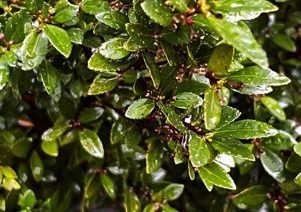
Oregon boxwood or mountain lover, the first name is more descriptive even though the second is also true. This formal looking evergreen is most often seen above about 3500′ in the Cascades, on very steep slopes in humus rich soil. where it forms a common understory beneath conifers. It can also be found in the cool coastal zones and the higher peaks of the Coast Range In eastern Oregon it follows the Ochocos up into the Blue and Wallowa mountains . This is a widespread shrub that is seldom seen in gardens, even in its natural range. This is not a fussy plant but it does have exacting requirements. Amend the soil heavily with compost and water faithfully for the first few years. This formal looking evergreen averages 3′ tall on average and can range a bit wider. It takes some pruning but it does require regular summer water to become established. In the Celastraceae Oregon boxwood is most closely related to Euonyous. This can be seen in the simple 4 petal tiny red flowers that cluster in the leaf axils in spring. Very cold hardy to -30ºF and it ranges far into Canada. One of the best native evergreen shrubs for formal appearance. Plant with Vaccinium ovatum for a similar cultural and textural effect. The small berries are eaten by wildlife. Tolerates extreme snow and ice, not bothered by subfreezing wind. Moderately deer resistant. Associated plants in the wild are Cornus canadensis and Mianthemum stellatum and Mahonia nervosa Pronouncd puh-KISS-ti-muh – or can be remembered as Pa kissed Ma. Oregon native plant.

Penstemon ‘Enor’
Stellar border Penstemon with several qualities that rises above the rest. To 30″ tall forming multiple spikes of deep purple tubular flowers. The flowers appear continuously if spent spikes are removed. Glossy deep green foliage is disease resistant, and for a border type it is exceptionally hardy to cold. Forms a bloomy, long lived perennial for flower borders or hillsides or meadows in full sun to light shade. Light, regular summer water in rich, well drained soil. Cut back hard in early spring. Blooms continuously until frost and beyond. Remove spent flowers and water to repeat the flower performance over and over. Not a bad cut flower. A very reliable perennial in our climate.

Penstemon heterophyllus ‘Electric Blue’
An easy to cultivate blue flowered Penstemon that is an exhilarating color and is incredibly showy for the 4-6 weeks it remains in bloom. Flowers begin in May and slack off with really hot weather. A semi-woody perennial native to the baking hot Sierra Nevada foothills of California. Full sun and fast draining soil with light summer water. Excellent performance in blazing hot hell strips. To 14″ tall and as wide. Cut back hard in early spring. Mulch annually with compost. Provide good air circulation.Seems to thrive and live longer in average soil, and slope is a plus. I’ve had this west coast native Penstemon persist in my garden for 8 solid years. Very good. Nice cut flower. And if you give it a drink after cutting it back it may reward you with another show. Handles reflected heat very well.

Penstemon kunthii
One of our very favorite of all perennials at Xera. This extraordinary Penstemon is actually native to south central Mexico, but glory be its actually cold hardy here. Smaller, profuse tubular intense red flowers line strong stems. This bushy plant expands with the season and there will be scores of bloom spikes. To 2′ x 2′ but it can and has exceeded that. This EVERBLOOMING perennial is incredibly adaptable as well as an almost over performer. The flowers are small enough that they create a haze of red rather than a wall of red and it finds color compatibility with purples, and oranges. Full sun in rich to average soil that is never boggy. Slight improvement to the soil will result in a cloud of flowers for months. Irresistible to hummingbirds and pollinators in general. Bloom which is constant can even extend well into winter shrugging off light frosts. Considering its native origin in Oaxaca its fantastic that it thrives to perfection in our climate. So far its happily weathered temperatures down to 5ºF. This is a outstanding perennial with a sophisticated flower color and a massive display of bloom for months. Cut back by 2/3 in early spring. It will resume growing almost immediately. We obtained this plant from our friend David Mason and we are forever in his debt. Glossy thin foliage is handsome.

Penstemon ovatus
Broad leaved Penstemon is one of the few species that is actually native in the Portland city limits. In fact it can still be located in its pristine feral state on the bluff very near the University of Portland. Its a steep slope on clay and loam with lots of rocks. The patches of this semi-evergreen perennial are nestled underneath native Ponderosa and Madrone- don’t even try to go down there as the understory is pure poison oak. The broad rosettes produce tall flower trusses that are arranged in whorls on a 30″ stem. Beautiful luminous blue with lavender mother of pearl tints. Full sun to high overhead shade in average to slightly amended soil. Water for the first summer to establish , let the soil dry between irrigation. Soil should never be soggy. Not really that difficult. Its literally from here so if I ever fail with this perennial god help me. LOVED by all flying things and an excellent back of the border plant for native beds. Combine with Adelinia , Pectinatia, Iris tenax for a similar biome and culture. To 30″ tall in bloom the rosettes of broad leaves expand to several feet wide. Seed grown. Oregon native plant.

Penstemon pinifolius
Pine leaved Penstemon is a native of the southern Rocky Mountains and its a long lived, easy to grow evergreen perennial for rock gardens, hot aspects and slopes. Well drained soil in full sun to very light shade in rich to average soil. Light but consistent summer moisture increases vigor which in turn increases the amount of flowers. Incredibly heavy blooming wildflower with masses of 7″ spikes holding tubular hot orange flowers. Very showy and irresistible to Hummingbirds. Blooms May to July. Cut back spent flowers to tidy. Low mat forming plant with grass green pine like foliage. Easy to grow perennial with a wonderful wildflower display. Very adapted to our climate. Photo credit: Bob Hyland. Hyland Garden Design.

Penstemon pinifolius ‘Melon’
Excellent and very heavy blooming color form of Pine leaved Penstemon. Forming a spreading evergreen mat of bright green needle like foliage it erupts in a multitude of 8″ spikes with soft melon orange tubular flowers suspended on the wiry stems. Blooms begin in May and extend to July. Full sun and well drained sites in average to enriched soils. In clay soils add a handful of pumice to the planting hole. Full sun and light but consistent summer moisture. A wonderful flower color with a fantastic floral display on this easy to grow long lived perennial. Spreads eventually to about 18″ wide (foliage is low- goes no higher than 4″). Excellent hummingbird plant. Native to the southern Rocky mountains- it loves our climate as well.

Penstemon pinifolius ‘Mersea Yellow’
Pine leaved Penstemons are great, long lived evergreen perennials in our climate. They decorate rock gardens and rock walls in the most common color which is orange. This is a striking departure. Lemon yellow tubular flowers appear in late May and continue to July. The foliage is what you might expect small needle like leaves cover winding stems. You may remove the spent flowers from the first round, give it a soak and you might get more flowers. Either way you have saved yourself a chore in the future. Full sun to the very lightest shade (at the expense of blooming). Rich, well amended soil and regular summer water through its bloom cycle- then you may back off. Evergreen small trailing shrublet. To 6″ x 12″ wide and 9″ tall in bloom. The flowers on this species will always point in the same direction which is charming. Moderate deer resistance. Combine with Penstemon heterophyllus ‘Electric Blue’ and Erigeron x ‘Wayne Roderick’ for similar cultural requirements and simultaneous bloom time. Excellent in troughs, permanent planters. This species is native to the mountains of New Mexico. Sunny yellow flowers.

Penstemon pinifolius ‘Nearly Red’
A really cool color switch for this normally bright orange species. The dusty red tubular flowers rise taller on this cultivar than others to 18″ and it forms a less dense clump of pine leaved low evergreen foliage. Found and named by David Salman of High Country Gardens we’ve found this to be an excellent performer in our climate. Full sun and enriched, well drained soil with light consistent summer water. The flower appear for weeks from May to July. Very forgiving perennial that thrives in rock gardens or dry slopes. Long lived. Hummingbirds. Moderate deer resistance

Penstemon x ‘Schooley’s Coral’
Immensely showy and easy to grow Penstemon with many 2′ spikes lined in bright coral tubular flowers. Blooms May to July from a basal rosette of deep green foliage. Full sun and well drained, enriched soil. Add a layer of compost yearly to spur vigor. Good air circulation. Remove spent flowers and often more will appear. Light consistent summer water.

Perideridia oregana
Eepah or Yampah is a native perennial in the carrot family that was used as an important food source for first nation people. To 20″ tall 1-3 stems emerge from swollen edible roots and produce pure white umbels of flowers. All parts of this plant are edible and the roots are high in vitamin c, protein, and Potassium. Eaten fresh it has a juicy crispy texture and taste similar to a water chestnut. Cooking Eepah root yields a nutty flavor with a sweet consistency of sweet potato. The large green seeds have a flavor very similar to Caraway and were eaten fresh or dried. Simple looking perennial that is very similar in appearance to introduced wild carrot or Queen Ann’s Lace Daucus carota. Oregon Eepah is native from extreme southwest Washington, much more common in Oregon and northern California. It has lost large amounts of its lowland population to invasive weeds and development. Where it occurs much more frequently is at higher elevations where there is less weed competition. Full sun to very light shade in average to rich soil. Irrigate for the first season, in subsequent years it can survive on rainfall alone. Winter deciduous. NEVER EAT A WILD PLANT unless you are 100% certain of its identity, if not ask an expert before consuming any unknown plant. Great plant for butterflies and pollinators. Its wild appearance lends it to cottage gardens, serious vegetable gardens. Blooms May-july. Its a very pretty cut flower and was once a common component of Willamette Valley meadows (mainly on hillsides). Oregon native plant

Phacelia bolanderi
Native perennial with a comfy sophisticated look. In the wild it occupies the land just up the flood plain from rivers in part shade and rich moist soil. Its also found just up on the first bench of land past the beach where it grows among native Cow Parsley and Salal. Under dry conditions it simply goes summer dormant. Large felted leaves form a dome from the top of which pale blue outward facing flowers appear in late spring to summer. To 16″ tall and as wide in part shade and well drained soil. This plant improves under cultivation. Light summer moisture or none when established. Native in the central and southern Oregon coast range with a disjunct population in Grays County, Washington. One of our showiest Phacelias and most garden worthy. Winter deciduous. Oregon native plant.

Phacelia californica
Scorpion weed is a beautiful native perennial found on rocky slopes/ hillsides/road cuts throughout California and western Oregon. Handsome corrugated trifoliate leaves are silver and have a pointed tip. In May-July curled flower inflorescences arise unfurling as they bloom to reveal rows of mauve/blue flowers. To 2′ tall in bloom it forms a handsome dome of evergreen foliage to 14″ across. The leaves are the most striking and conspicuous feature of this plant. Pollinators adore the flowers and its especially important for native bees. Full sun to very light shade, average, well drained soil. Light summer water. Excellent in the front of borders. Wonderful bold contrast with other fine leaved silver beauties- it even shines with lavender. As you hike throughout the mountainous parts west of the Cascade Crest the incredibly handsome leaves are sure to catch your eye. Easy to grow and perfectly climate adapted. Oregon native plant.

Phacelia campanularia
Perhaps there is no more blue flower than desert blue bells. An excellent and long blooming hardy annual that is at home in container as well as the ground. Often it will reseed prolifically from just one pot. To 6″ tall and as wide. Full sun and rich to average well drained soil. Light, consistent summer water keeps it going. Otherwise it will go away but not before setting seed for the following season. The vivid blue bell shaped flowers attract pollinators. Good western wildflower.

Phacelia heterophylla ssp. virgata
The most sought after plant for native bees is varied leaf Phacelia. For anyone who has hiked and camped in Oregon you are likely already familiar with this silvery plant. The divided and rounded leaves are clad in silver fur and are the highlight of this widespread perennial. The flower which shows great promise as it rises from the cool leaves. It opens and then unfurls and you expect a purple or even red flower but no disappointly- dingy off white is what unfurls. Either way its a pollinator paradise. Size is dependent on the fertility of the soil. Often you see this plant in its early rosette forms along just about any path in the state. Western Oregon to Eastern Oregon this widespread plant is specific to our native pollinators. To 18″-3′ (in really rich soil). Short lived Oregon native perennial. About 3-5 years. Reliably reseeds. Seedlings are easy to spot as they mimic the parent plant. Full sun to a considerable amount of woodland shade. Associated plants in habitat are Sword ferns (Polystichum minutum) and Vancouveria hexandra. Moderately deer resistant. Native in the Portland city limits. Oregon native plant.

Phacelia viscida
Sticky Phacelia is a hardy annual native to southern California chaparral into northern Baja. It bears intense blue flowers in late spring to early summer. It will often reseed in open disturbed sites if we have a mild winter. Incredibly attractive to bees and pollinators as all blue flowers seem to be. Full sun and well drained soil. Mixes well with summer perennials and if you give it a light shear and a drink when the first round of flowers are spent often more will erupt. To 11″ tall and spreading a bit. Fantastic wildflower effect. Native west coast annuals deserve a respected place in our gardens. Blue- scintillating blue. Works well in containers also. Light, consistent water to bloom.

Philadelphus lewisii
Western Mock Orange is a locally native deciduous shrub with masses of showy white flowers in June to July. These are seedlings of a shrub native to our wholesale nursery site. A certain percentage of the seedlings will be fragrant to a varying extent. The fragrance is most conspicuous after several seasons in the ground. Full sun to part shade in rich to rocky soils with regular water to establish and then set it free. Moderately fast growing to 8′ tall by 4′ in several years and then larger. Tough shrub that accepts a lot of soil types, in habitat it is most often seen on hillsides and even appears in riparian situations. Its most typical on the edges of forests. Associated plants in the wild are Western Hazel, Corylus cornuta californica and Oso Berry Oemleria cerasiformis, and Ocean Spray, Holodiscus discolor.Fall color is most often yellow and not spectacular. The pretty mid green foliage blends in to the landscape before and after its profuse period of bloom. Accepts summer drought when established to regular irrigation . Climate adapted shrub for wild areas to shrub borders. Blooms on OLD wood, prune after blooming if necessary. Oregon native plant.
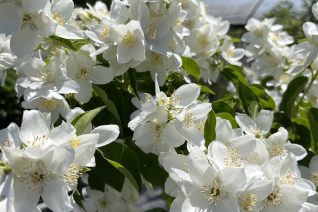
Philadelphus lewisii ‘Cumulonimbus’
This seedling Mock Orange appeared in our nursery rooted right into our gravel substrate. It was either a seedling of a few Philadelphus from eastern Oregon that we raised a several years ago or it is a seedling of a naturally occurring plant about 50 meters away on the forest margin of our wholesale nursery. Either way its an astonishing shrub in full bloom. Rather than small clusters of white flowers with a yellow center this shrub creates 6″ long stems with clusters of up to 10 on each. The effect is a billowing cloud of white flowers for many weeks in June to July. No other native Philadelphus we have seen compares in number of flowers. The foliage is literally obscured by the lightly orange blossom scented white flowers. Fast growing even in less than perfect conditions to 9′ tall by 4′ wide in 7 years. The parent plant gets no supplemental water whatsoever relying on only what falls from the sky. The handsome mid green leaves take on yellow tints in autumn but is not a show stopper. In bloom, however, it is. Loved by pollinators. Full sun to very light shade in average to enriched soil. Water consistently for the first season to establish then none in subsequent years. Wonderful specimen or hedgerow member . Extraordinary in full bloom. Blooms on wood from the previous season, prune if needed AFTER blooming . This form has a nice sweet scent that becomes most apparent several years after being in the ground. Associated plants in the wild are Corylus cornuta californica and Oemleria cerasiformis in the Willamette Valley. Oregon native plant.
Xera Plants Introduction

Philadelphus lewisii ‘Snow Velvet’
No offense to natives but I’ve always found our native mock orange to be kind of a dull one note shrub. Sure, its showy in bloom and certain specimens can be sweetly fragrant but once its done blooming…yawn. What do you do with it? Instead plant this highly improved selection with enormous semi-double white sweetly fragrant flowers. Each blossom is fully 2″ across and they come in such abundance in June that whole 9′ x 8′ frame is flocked like an enormous wedding gown. Some repeat bloom through summer. Same tough adaptation as the species which is nice- but incredibly showy in bloom. Full sun to part shade in average, well drained soil. Drought adapted. Great scaffold for summer Clematis. Blooms on old wood, prune AFTER flowering if needed. Forms a distinctive large vase shape. Fall color is soft yellow and brief. Adaptable to both cultivated and feral/wild areas. Tough and climate adapted shrub. Oregon native plant.

Philadelphus x microphyllus ‘Charles Price’
Excellent smaller shrub with distinctive very small silver foliage and in June a plethora of single white flowers with the intense, penetrating fragrance of grape soda. To 5′ x 3′ forming an upright rounded deciduous shrub. Full sun and regular water to establish the first year then none in subsequent years. This may or may not be a hybrid- it really looks like the straight species. P. microphyllus which is native to the American Southwest. Tough and hardy and very drought tolerant shrub that is well scaled for smaller gardens. Fall color is bright yellow. Blooms appear on wood from the previous season. Prune directly after flowering is over- if needed. Selected by our friend garden designer Charles Price, he gave this to us and we thought it was distinct enough to deserve his name.
Xera Plants Introduction.

Pinus ponderosa var. benthamiana
Pacific ponderosa pine is a lovely tree native west of the Cascades from about the Portland area (with some outliers farther north) south to northern California. Our form is from locally collected seed. Slow growing in youth this pine picks up speed in its teens and grows almost exponentially from there. Pacific ponderosa pine is known for it tall straight crowns of lush green needles in clumps of three. This tree is excellently adapted to our winter wet/summer dry climate and even small trees can endure the very longest, driest, hottest summers with no visible stress. Its adaptable to all types of soil – not fussy and is even found in the most well drained stranded flood cobbles of major rivers. To 125′ in time with ulitimate height of close to 200′ in great age – expect a 3′ tall tree to be about 15′ tall in 10 years. Full sun- not very shade tolerant and when planting with other trees anticipate at least a 25′ wide crown in the future. Needles can drop profusely in September which is a bit of a mess. Take note of this. Underplant with other drought adapted natives. Water to establish for the first summer then none in subsequent years. A regal pine that is among the tallest in the world. Oregon native plant.

Pinus sabiniana
Gray Pine or Foothill Pine native almost exclusively to the mountains of California- but there are several outlying native populations in Douglas, Josephine and Jackson, Counties in Oregon so we can claim it as our own as well. Known as the tree that casts no shade, its almost completely true as the long gray needles allow almost all light through. Large pine tree with gray foliage- usually forks about 1/2 way up into two main trunks, these are buttressed to support the huge cones which can weigh 5lbs or more. Excellent performance in the Willamette Valley where many are seen around old farm houses and older neighborhoods. Perfectly hardy to cold in our climate and incredibly drought adapted. In fact it shuns all irrigation and is ideal for hot dry locations. Grows very fast in youth, settles down a little with age. Its ultimate height is around 35′-45′ in our climate. A smokey, silvery, shadeless skyline tree. Oregon native plant.
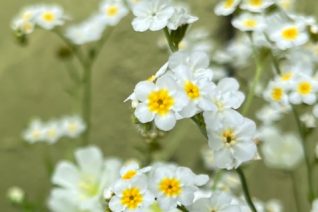
Plagiobothrys figuratus var. figuratus
Fragrant Popcorn flower is a wildflower limited to western Oregon with its largest populations in the Willamette Valley. This hardy annual is an inhabitant of wet meadows and vernally wet fields. Closely related to forget me nots (Myosotis) this plant erupts into waves of pure white flowers with a tiny yellow eye. The flowers foam between grasses and shrubs for several weeks in late May to July. To 10″ tall unfurling flowers on a plant of small stature. Excellent performance in rain gardens and a very reliable re-seeding plant. Full sun and water potted plants to establish. Self sown seedlings get by with no supplemental irrigation. Excellent with Rosa nutkana, Camas, Ranunculus occidentale. Moderately deer resistant. On warm summer days a field in full bloom emits a sweet perfume.Very good performance in containers and is often superseded in its habitat by Downingia. Excellent native pollinator flower. Especially important to native bumbles. Oregon native plant.

Platystemon californicus
This charming true poppy relative is also known as Cream Cups. Easy to see when the cup shaped flowers open during the sunniest time of the day. The petals are various shades of yellow with cream veining. Or is it the other way around? Either way its adorable beyond measure as this little thread leaf clump forming true annual pops into bloom in our climate from late April to early June. Not a prolific self seeder but I’ve heard once you get it where it likes it then its yours. To 5″ tall when the flowers top out. Full sun and average to rich well drained soil. Not difficult. West coast annuals are wonderful not only for their color, texture, and forms but of their endearing nature. They are tough little plants with a delicate appearance. Light summer water extends the bloom before high heat finally ends the show and seeds go flying. No shade. Rock gardens, spring borders. High deer resistance. This little beauty though mainly found in California comes just into Oregon in Curry and Josephine counties. Oregon native plant.

Plectritis congesta
Sea Blush, or more commonly Rosy Plectritis is a locally native hardy annual in the Valerian family. In April-June it swarms meadows and glens with orbicular globes of dense fragrant pink flowers. They rise on average to about 10″ tall. Rich soil will yield larger plants. Excellent bulb cover for late narcissus, tulips etc. Fun to grow heavily reseeding annual that also makes a sweet cut flower. It can be found in the western third of the state. Also wonderful with Pacific Coast Iris as they bloom concurrently. Sets seed and dies by mid summer when the spent carcasses may be removed- when doing that give them a shake where you want next years display to occur. Make sure not to cover the seed, native annual seed requires light to germinate and it will very quickly sprout with the first cool fall rains. Traditionally, Rosy Plectritis can be found in a mix of perennial and annual communities. In its many habitats it can be found with Oregon Iris (Iris tenax) and often Giant Blue Eyed Mary (Collinsia grandiflora). Water to establish as plants- then none. Full sun to very light shade. Seedlings have paddle shaped true leaves with a rubbery texture. High deer resistance. Native in the Portland city limits. Photo credit: Matthew Hubbard Oregon native plant.

Polemonium carneum
Our native pink Jacob’s Ladder is a great plant for gardens. Hailing from valleys adjacent to the Cascades as well as the coastal strip the finely divided foliage of this clumping perennial is attractive but enhanced when the clusters of very pretty flowers open the palest pink aging to lavender over several days. Full sun to part shade in rich moisture retentive soil. To 28″ tall and somewhat spreading. Blooms for an extended period from April to June. Summer drought will bring dormancy but a little bit of water keeps it green. Great tolerance to dry clay soils and it persists in conditions that would end lesser perennials. Mixes well at the margins of woodlands or the front of perennial borders. Even in its habitat it tends to flop, or rather lean on its neighbors. Expect this and use it to an advantage. The softly colored flowers will wind into other plants playfully and you can achieve really cool and wild appearing vignettes. Very good in concert with native Geranium oreganum as they bloom simultaneously. A really pretty native perennial. Adaptable to heavy clay soils. Soars in rich, amended soils and can be quite a bit larger than I’ve listed. Fairly good cut flower. Oregon native plant.

Polypodium glyceryrrhiza
Our native Licorice Fern that has a backwards season. It emerges all fresh and happy with the first cool weather and rains in autumn and persists that way until hot weather takes hold, then it quietly (and cleanly) disappears. Forms spreading colonies on any light surface including the vertical slopes of rocks and trees. The base of the plant forms an interconnected series of rhizomes that cling to anything. It escapes all drought and heat by summer dormancy. Neat trick. If you detach the fronds and bite into the base of the petiole it delivers a strong anise/licorice flavor. This remarkable plant should be common in living walls and green roofs that would require no supplemental irrigation- and actually thrive and look healthy. Excellent performance in the ground in rich, well drained soil. Water as they say is irrelevant. Highly deer resistant. Oregon native plant.

Polypodium scouleri
Coast Polypody or creeping leather fern is an evergreen colony forming plant that is native from British Columbia south along the coast to even the Guadelupe Island off of Baja. It makes its home as an epiphyte trees, logs, rocks, the ground almost anywhere it finds adequate moisture and shade. During the summer it will take a surprising amount of dryness but we recommend light consistent irrigation for the best appearance and to spur multiplication. Fronds to 10″ long with rounded lobes. Excellent garden plant, grows very well in rich to average soil as well. Good year round appearance. A native fern that should be grown all the time. Great in winter containers- excellent winter appearance with little maintenance. Protect from hot sun. Highly deer resistant. A natural for the Oregon coast which is its native home. Oregon native plant.

Polystichum minutum
Western sword fern is one of the most ubiquitous plants on the west side of the Cascades. In many forests in the Coast Range and Cascade foothills it is the sole understory plant. Western sword fern is a large species with long arching fronds. Adaptable to a host of situations. Often self sown spore will show up in the oddest places. I’ve seen it as an epiphyte and even self sown into hot concrete steps. In rich, acidic soil this evergreen fern soar- provided soils rich in humus, organic matter and protected from direct sun with consistent access to water. Very well adapted to our winter wet/ summer dry climate- it will cruise through dry summers unscathed. In the garden it does useful duty in the toughest, dry, shadiest sites. Along with Cast Iron Plant (Aspidistra elatior) and Ophiopogon (Lily turf) it is one of the best dry shade inhabitants. As an understory component it is often accompanied by Cascades Mahonia (Mahonia nervosa), Inside-out-flower, (Vancouveria hexandra), and Pacific Blackberry (Rubus ursinus). To 4′ x 4′ in ideal situations. Though it is evergreen western sword fern does go through a transitional period before new croziers unfurl in spring. The 3′ long fronds begin to lie flat on the ground by winter. This is the time to remove tired, old leaves. and make way for fresh, new, unfurling foliage. Though very tough western sword fern does look its best with consistent light water. Supremely deer and rabbit resistant. Long lived and not a slow grower. Oregon native plant.

Polystichum setiferum var. divisilobum
Soft Shield fern is native to Alaska- well points north in general. That means its bone hardy to cold but its also a fantastic evergreen fern for dry shade in our region. Finely divided fronds taper to 2′ long. The central stem is a soft furry brown- good contrast. Spreading colony creating fern to 3′ across. It has the unique habit of vivipary. It makes small new plants spontaneously right off the frond. Useful. Good looking appearance year round. Rich, moisture retentive soil with regular water to establish. Incredibly drought adapted when older – as long as its in shade. High deer resistance. May be cut back hard in early spring to refreshen. Grows very quickly.

Potentilla gracilis ssp. gracilis
Slender Cinquefoil is a common, somewhat quiet but easy to grow long lived native perennial. Palmate leaves are conspicuously serrated on long stems. In early to mid summer 20″ stems support multiple clumps of sunny single yellow flowers. Full sun to part shade in average to enriched soil. Water to establish the first season then let it go with seasonal rainfall. Wild looking perennial that shines in borders, among shrubs and along the urban wild lands interface. Very pretty clustered at the foot of Holodiscus whose bloom is simultaneous. Loved by pollinators and an important food source for many butterflies. Native from SW. British Columbia south to San Diego County California. Often found in Ponderosa pine forests. Blooms much more heavily in full sun and improves under cultivation. Winter deciduous. Little deer resistance. Rose family. These are seed raised from Willamette Valley populations so it is the local form. Oregon native plant.

Prunella vulgaris var. lanceolata
As a child in the country near Eugene western self heal was one of the first wildflowers I learned to identify. And its a beautiful and fascinating native perennial. This ‘weed’ circles the world but our locally native form is an exceptional improvement. Lance shaped basal leaves (the trick for identifying our local sub-species) forms stout upright stems. They are crowned with ‘cones’ that have whorls of showy deep purple tubular flowers- they appear continuously for up to 6’weeks into August decorating the tops of a 1′ tall plant. Spreads to form a clump as wide and appreciates average to enriched soil in full sun. Regular summer water increases vigor and lengthens the bloom time. A very charming native cut flower that produces new blooms continuously after its picked. This is a very important plant for native pollinators. Also, it differs from the pan-weedy form in larger cones and much showier flowers. Its a larger plant as well. Adapts to clay soils with regular irrigation to establish. A natural magnet for butterflies. Blooms May-August. In our region it is now found primarily away from the valley in upland valleys to alpine meadows and scree. A good native weed that is a great garden plant as well. Oregon native plant.

Quercus chrysolepis
Canyon live oak is a vastly underused, beautiful evergreen native tree. Found from Lane county, Oregon south through California, slight parts of Nevada around Lake Tahoe and sporadically in Arizona and even New Mexico. This venerable tree is found on the steepest slopes of canyons and mountain ridges. In Oregon it represents the northern most native Live Oak or evergreen oak in North America. Leaves are glossy army green on the the top with a conspicuous furry gold underside. This is a rugged, tough tree that should be used in both gardens and as a street tree. In the Alameda neighborhood in Portland there is an ancient specimen to 60′ tall and wide with a large trunk. This heritage tree was reportedly brought to the city from southern Oregon via horse and wagon. Slow growing in youth it picks up speed exponentially several years after planting. To 40′ x 20′ in 30 years with a broad spreading crown. In the wild it often forms a gnarled multi-trunked rounded outline. Its very possible to train this tree to a single trunk/leader to extend the crown skyward. Extraordinarily cold hardy enduring temperatures slightly below 0ºF with no difficulty. The large acorns are born in a showy golden hued furry cups- and are produced profusely in banner years. Water to establish for the first season then none in subsequent years. Full sun. Beautiful, native Oak that we cherish at Xera. Oregon native plant.

Quercus garryana var. garryana
Oregon white oak. A monarch of a tree locally native and forming Oak Savanna communities in the Willamette Valley that preceded European development. Slow growing tree of great age and grace. Deep green foliage forms dappled domes in the high rounded canopy. Birds and wildlife adore this completely summer drought adapted tree. To 130′ but not in your lifetime. Our acorn source is local. Whitish bark in patches are types of specific fungus from the constantly saturated Oregon winter soils. Tolerates the most impenetrable clay and shuns summer irrigation. Fall color is russet orange. Grows just 2′-3′ a year in youth -if really happy. This as all oaks has what are referred to as banner years. In certain years huge amounts of acorns are produced. This is thought to overwhelm predators and at least a fair amount can germinate. Famous for its moss covered enormous branches which have been likened to the perfect depiction of a Grimm’s Fairy Tale. Oregon native plant.

Quercus hypoleucoides
Silver Leaf Oak from Arizona is a favorite tree at Xera. Tall, rounded evergreen tree with skinny but thick leaves that are sage green on top and silver white on the underside. Its handsome all the time and even prettier when the gold catkins protrude from the foliage in spring. Naturally develops a straight trunk. Fast growing tree in our climate to 35′ in 12 years. Casts dense shade but tolerates limited summer water. Extraordinarily cold hardy. It has endured subzero readings in Eugene without injury and I even encountered one in a garden in Denver. The leaves were kind of toasted from the previous winters -17ºF(!) but it was obviously thriving. Native to the mountains of SE Arizona at very high elevations and that translates to LOVE for our climate. Exceptional leaf form and shape. Be aware that in time this tree can cast quite dense shade. Wonderful on hot summer days but also inhibiting sun loving gardening. Makes you think. Wonderfully pest and disease resistant foliage- it always looks good.
Photo credit: Amy Campion

Quercus rugosa (SW Form)
This is a remarkable oak whose geographic center is in high elevation Mexico. There are several forms of this evergreen tree with remarkable qualities. Its range extends from the SW U.S. south throughout Mexico into northern Guatemala. This southwest form has shown great cold hardiness and adaptability. These are started from acorns in a garden in Medford. The parent tree was pole straight with a boisterous green rounded crown. It is remarkably tolerant of drought and is cold hardy reliably to 0ºF. Full sun in average soil for a moderately fast growing tree. The outline of its crown is oblong at first and if you remove the lower limbs it will send the crown skyward. As I said the trunk was pole straight on a tree that was 35′ tall (18′ wide) and very pretty. Doing research on this tree it was found in California that this tree literally collects pollutants from the sky with its rough leaves. Its proposed to be planted along intersections and freeways and could be a boon to lower the particulate count. Dark green foliage looks good year round. Water to establish and then none in subsequent years. Grows fast for an oak and it really adores our climate. The bark is rough with gray striations. It makes many acorns and this should be taken into account in siting. Good candidate for a street tree or a garden shade tree. Average soil, including clay soils. Full sun from every direction for the straightest tree. Syn. Quercus reticulata. This would also be a good candidate for a formal large screen. Sometimes called net leaf oak or southwestern net leaf oak. Casts moderately dense shade with time.

Quercus wislezenii ‘Dense Form’
I collected the acorns of this tree near Lake Isabella, CA in the southern Sierra Nevada. It was a particularly handsome form of what can be a less than majestic species. Densely foliaged with a straight upright trunk about 25′ tall with a rounded crown. Wow. We hope the progeny are as cool. Interior Live Oak of California. Evergreen tree to 25′-35′ tall with a spreading crown. Was native in Oregon in the past as hybrids known as Mohr Oaks (Quercus kelloggii x Quercus wislezenii) still can be found. Hardy to short shots to 0ºF. Grows about 2′-3′ a year in youth. Water to establish the first year then none in subsequent years.

Ranunculus occidentalis
Western Buttercup is our own wonderful wildflower. This is the real thing and NOT the invasive Ranunculus ficaria or repens. Traditionally it occupies open Oregon Oak woodlands and meadows including vernally wet meadows. Though it handles winter inundation it is also adapted to upland situations and in every biome it goes quickly summer dormant. Rosettes of pretty pinked leaves elongate in bloom to an airy spray of bright yellow flowers. Intimately, the petals have a glossy sheen. And growing up in the country it was traditional to put a picked flower under your chin and the reflected color yellow revealed that indeed you did like butter. Great cut flower that peaks on May Day and has made many a wild flower bouquet with purple Oregon Iris and purple Dodecatheon hendersonii- Shooting stars. Pictured here with Common Camas Camassia quamash at the Camassia reserve in West Linn, Oregon. Blooms from mid-April to early June. Vast meadows of western Oregon still harbor this sweet short lived perennial. Adapted to heavy clay soils- reseeds when happy. Suitable for mowed meadows as long as it has gone to seed by the time you mow. Wait until June. Good competitor with invasives and absolutely integral to a Willamette Valley meadow. High deer resistance. Oregon native plant
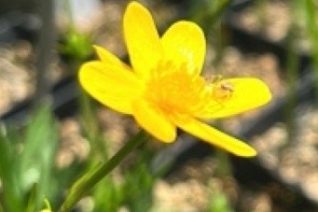
Ranunculus orthorhynchus var. orthorhynchus
Birds foot buttercup is one of the more common varieties in Oregon. Larger (taller) than Ranunculus occidentalis it also has a darker almost maroon gray coloring on the back of each petal. Birds foot buttercup thrives in areas that are often submerged in winter Though it favors wet sites in will easily accommodate dry conditions as well and is happy in upland situations. Short lived perennial (3-5 years). Blooms about three weeks after western buttercup. in April to June. The whole plant goes quickly summer dormant after setting seed in conspicuous spiked capsules. Easy to grow in gardens as this species is used to regular moist soil. To 14″ x 18″wide. Very forgiving native that will happily reseed if given room. Excellent applications in a rain garden. It makes a pleasant cut flower too with the same reflective inner petals. Not bothered by deer or rabbits. Rich to average soils and especially heavy clay soils. Good native pollinator plant. Oregon native plant.

Ratibida columnifera ‘Pulcherrima’
Mexican Hats are iconic flowers of the southwest american prairies. Slender plants that rise up to 2′ feet with adorable flowers, red petals reflexed around a black prominent cone. The red petals are mostly outlined in yellow. Forgiving wildflower for full sun any well drained soil with regular summer water. Remove spent flowers to spur more- this will keep it in continuous bloom. Cute cut flower and the little flowers really do look like sombreros. Winter deciduous. Will often self sow in open disturbed soils.

Ratibida pinnata
The biggest black eyed susan daisy of them all. Towering to 7’+ the sturdy straight stems of this hardy American plains native perennial displays very large yellow flowers with drooping petals reflexed away from a prominent black central cone. The thick stems rise up from a low mound of foliage. Blooms all summer long and often into October. Loved by pollinators of all kinds it also makes a really cool and surprisingly long lasting cut flower. Put this beauty in the back of a border where its sunny yellow flowers can wave to the sky. Light summer water in any well drained soil. Full sun to avoid flopping.
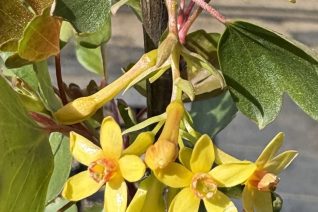
Golden Currant is a tough and beautiful deciduous shrub native to large areas of the arid west. In our area its closest native habitat is in the eastern Columbia River Gorge. A vertical shrub with fantastic glabrous (rubbery texture) tri- lobed leaves that flutter in the wind much like Quaking Aspen. In mid spring a pretty display of bright yellow flowers with a small red corolla in bunches all over the plant. Fast growin to 6′ tall by 4 ‘wide in full sun and any decently draining soil. Established shrubs can get by on natural rainfall alone. Very pretty hedgerow plant or specimen. Loved by birds. In summer bright red edible fruits decorate the stems, mostly eaten by wildlife. In well drained soils this native shrub can handle summer irrigation. Full sun to very light shade, If you want more fruit set plant two or more plants to increase pollination. Very easy to grow and long lived. Avoid planting near 5 needle pines. Fall color ranges from yellow to tints of orange. Blooms on wood from the previous season, prune if needed after flowering. Oregon native plant.

Ribes divaricatum
Coast gooseberry or black gooseberry is an intricately branched native deciduous shrub that is incredibly important to wildlife as well as pollinators. Mounding and spreading with fine and prickly needles housed at each node. The maple shaped leaves have a fine skunk aroma up close. To 4′ x 6′ in the extreme this moderately fast growing plant is best in full sun but can handle quite a bit of shade-especially deciduous shade. This species is never common and its found mainly west of the Cascades The small pendulous flower feature red petals surrounding a white corolla. These morph into prickly sour fruits whose final color ripens to black. Fall color is soft yellow to orange and brief. Light consistent summer water in a average to enriched, well drained soil. The berries are edible but intensely sour and make fine food for a wide range of cool birds. Native to the Portland city limits. Excellent shrub for remediation of wild sites. This pretty shrub makes a great transitional plant for wild areas and has a wild look itself. Blooms on wood from the previous season. Prune if needed AFTER flowering. Oregon native plant

Ribes lobbii
Gummy gooseberry is widespread west of the Cascades but is never common. Also known as Fuchsia Flowering Gooseberry this delightful native shrub decorates itself in mid spring with pendant red and white flowers. The upper petals are red and the downward pointing petals are white. Large growing deciduous shrub with with three thorns at each node. The gummy part of the name refers to the leaves which are not shiny or sticky but matte and a little rubbery. This differentiates Ribes lobbii from the closely related Sierra Currant Ribes roezlii (with conspicuously sticky foliage). Large plant that grows very quickly when young. It will slow down when it hits its max height. Native to disturbed sites and it quickly follows fire it prefers soils that are rich and with light summer water to establish then only what falls from the sky. Loved by hummingbirds and birds in general. The prickly currants supply birds and other critters during autumn. Fall color is showy russet/orange/red. This is one of the showiest native currants. Much less common than Flowering Currant Ribes sanguineum it should be grown more. The long cantilevered stems display the pendant flowers in a wonderful way. Not native east of the Cascade crest. 9’x 5′ in 10 years. Moderately deer resistant. Drought adapted when established. Blooms on wood from the previous season, prune if needed AFTER blooming has ended. This delightful shrub was once more widespread, logging and settlement have shrunken its natural range. Very pretty spring flowering shrub. Native in the Portland city limits. Oregon native plant.

Ribes malvaceum ‘Dancing Tassels’
Really excellent form of Chaparral Currant with 3″ soft pink flowers that appear at any point during winter well into spring. A summer deciduous shrub to 8′ x 5′ in 7 years. Leaves drop completely by September and then re leaf as fall rains progress. Surprisingly hardy for its origin- California’s Channel Islands. Full sun to part shade and well drained average soil. Great on a slope. Loved by overwintering Anna’s hummingbirds. Flowers are surprisingly cold hardy and are undamaged to the upper teens. If those that are open are spoiled by frost more will follow after the thaw. Very very drought tolerant, No supplemental water required when established. Loses most of its leaves in summer drought. Grows fairly quickly and is never a dense shrub- all the better to see the pendant flowers. Dry borders, shrub borders, winter gardens. This shrub loves our climate and is supremely adapted to a winter wet/summer dry regime. Moderate deer resistance. Excellent winter blooming shrub. A beacon to Anna’s Hummingbirds.

Ribes roezlii
Sierra gooseberry or sticky gooseberry is a pretty if prickly native deciduous shrub for rough areas. Charming in bloom , the 1/2″ pendant flowers have sepals that are reflexed and red around a pendant white corolla. After opening they both change to light red and remain showy for several weeks. They line zig zagging stems with three thorns at each node. That means you must site this 7′ tall by 4′ wide arching plant carefully. The flowers are pretty viewed up close and turn into prickly translucent green/red drupes. These are eaten by a huge variety of wildlife and especially smaller birds. Often the shrub will be completely stripped of berries by the time the soft orange fall color appears. Native from the Cascades of Marion county south throughout inland California down to San Diego county CA. Its most often found in dry gravelly areas on slopes in full sun to deep woods where its habit is more restrained and open. Blooms appear in mid spring. Water lightly to establish the first summer then only what falls from the sky in subsequent years. Adaptable to dry shade if it is not completely dark. Moderate deer resistance. Very similar to another native Gooseberry Ribes lobbii which is discrete in its dull non sticky leaves. Wonderful native shrub.Rarely seen in habitat below 1000′. Oregon native plant

Ribes sanguineum ‘Oregon Snowflake’
Excellent improved form of the already popular white flowered Flowering Currant. This form sports foliage that is deeply divided- very pretty- and a more dense and compact habit. Its an incredibly heavy blooming form that has great garden application. To 4′ x 5′ in 7 years with a rounded mounded habit. In late February- April pendant clusters of pure white flowers glow in the early spring sunlight. The buds emerge chartreuse and then become pure sparkling white. This was bred and selected at OSU. And so far has been rare on the market. Full sun to quite a bit of shade with light consistent summer water to establish. Then- it can survive on all that falls from the sky. Takes light irrigation in gardens but never soggy and never soggy during hot weather. Fall color is yellow/orange and brief. Sour fruits are dusky blue in summer. Moderate deer resistance. Derivative of an Oregon native plant. PPAF.

Ribes sanguineum ‘Xera’s Lime Punch’
As luck would have it this lime/chartreuse foliaged variant of our locally native and cherished flowering currant appeared at our nursery. We’ve grown it for years now and it is so much tougher and more reliable than the closely related R. s. ‘Brocklebankii’. Which seems like such a great idea but that most people kill. This is an easier to grow more robust plant. Hot pink flowers contrast in a great way with the lime colored vivid foliage. To 8′ tall and 4′ wide in 7 years. Part shade and regular water to establish the first year then none in subsequent years. Adaptable to many types of soils. Will not burn in full sun but isn’t as happy. Add pep to wild areas. Brighten up shady environs. Blue,very sour fruits appear in early summer. Grows quickly to its ultimate size. Moderate deer resistance. This is a wonderful shrub. (Big pride). Oregon native plant.
Xera Plants Introduction

Ribes sanguineum ssp. sanguineum
Flowering Currant. One of the most conspicuous flowering shrubs over the western half of Oregon. From extreme Southwest BC to northern California. .This v shaped and arching shrub protrudes from highway plantings like a chandelier of pink flowers. Each chain of flowers is a slightly different shade of pink to white on this batch of seedlings. To 9′ x 9′ forming somewhat open shade. Blooms on old wood, prune if needed AFTER flowering has ended in late spring. Fall color ranges from pink to orange and quite often yellow. We had several shrubs of this plant on the property where I grew up. We randomly harvested the branches for cut flowers for almost two generations and none of the plants suffered. They were wild plants and as good as any named variety. Blooms March to April and then maple shaped leaves unfurl and are a quilted nice texture. Full sun to quite a bit of shade at the expense of flowering. Dusty blue fruits cascade in chains as the leaves drop in fall. These are immensely sour fruits. Best on hillsides poking through the rest of the underbrush. Flowers which have a slight skunk funk force easily if brought inside. One of Oregons greatest native flowering shrubs. Moderate deer resistance. Water to establish then only occasionally. Oregon native plant.

Ribes speciosum
Fuchsia flowering gooseberry is a fantastic shrub for dry shade. Heavily armed arching stems produce rows of pendant blood red flowers beginning in December and continuing to early spring. Retains leaves in winter – loses them in heat and drought. Little to no water once established. Best in part shade with good drainage. The millions of little red flowers are irresistible to over wintering Anna’s hummingbirds. Locate away from paths…the thorns on this California native shrub have a bite. To 5′ x 6′ in 7 years. Dramatic in bloom which lasts for months. Tough and beautiful. From an understory chapparel shrub in central California to a common component of that community in the south. Remember that it will go drastically deciduous in mid summer. It looks bad but this is temporary. As with many dry/mediterranean climate adapted shrubs it has a reverse dormancy. Fresh green and blooming during the cool wet season and deciduous and resting to wait out the heat. Prone to growing low and spreading at first then it sends up large vertical whips.
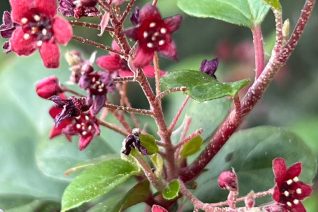
Ribes viburnifolium
Catalina perfume is the common name for this lovely, tough evergreen currant from Southern California. The round evergreen leaves which do remind one of a Viburnum are resinous and spicily fragrant, especially on warm days. To 3′ tall and spreading about 6′ -this low shrub is best adapted to part shade and little to no summer water. It is incredibly drought adapted. In late winter to mid spring panicle of rose red flowers are light and airy- followed by green fruit. This is an ideal groundcover shrub under native Oaks. It also makes an almost formal ground cover in landscapes . Found specifically on Santa Catalina in the Channel Islands off of southern CA. There it grows with other Channel island endemics. Tolerates full sun in our climate but its home is beneath the canopy. Water for the first year to establish then none in subsequent years. Not bothered by deer- unsure of rabbits. Prune it if needed after blooming. Blooms on wood from the previous year. Excellent combined with Vancouveria chrysantha and Camas liechtlinii. for a culture and climate adapted grouping. Grows very fast when happy.

Ribes x gordonianum
One of the most spectacular of the flowering currants. This hybrid between the yellow eastern Ribes odoratum and our locally native pink flowered western Ribes sanguineum splits the good looks with chains of coral orange flowers with a faint yellow center. Salmon up close the color reads as orange from farther away. Blooms March/April for weeks on a large spreading shrub for part shade and rich, well drained soil. Consistent summer moisture- do not let it dry completely nor should it ever be soggy. Extremely cold hardy with orange/yellow fall color. To 8′ x 8′ in 8 years. Blooms on wood from the previous year- prune AFTER flowering if needed.

Romanzoffia californica
Mist Maidens are an integral part of spring in western Oregon. These delicate looking beauties are actually iron tough. Clouds of white flowers sway above rubbery scalloped foliage beginning in early March and continuing to early June. They have the light fragrance of vanilla. Hot weather shuts them down and they quickly retreat to their bulbous roots to wait out summer in dormancy. Once established they require little interevention from humans. Let them romp around in the spring border with such similar perennials as Primula sieboldii and Viola corsica. Just don’t forget that they are there when they magically disappear. To 10″ tall and about as wide. In favored circumstances this Oregon native will happily self sow. Pretty and fresh as spring. Found locally in the coast range in Washington and Yamhill county. Once much more widespread. Its common name is derived from its predilection for growing at the edge of seasonal water falls. Pretty leaves, pretty flowers, easy to please. Oregon native plant.

Romneya coulteri ‘Butterfly’
Improved version of the Matilija Poppy that we love to let colonize our dry hillsides. Enormous 8″ wide ruffled pure white flower petals surround a furry central yellow zone. This cultivar has bigger flowers, more of them and bluer foliage. Unfortunately, it is no less vigorous and will take all the real estate you can give it. Thats easily 10′ x 35′ in 5 years. Best in contained areas. Full sun and average, well drained soil. To 8′ tall in bloom. Transplant very carefully, do not disturb the roots- rather dig a hole and gently set the whole undisturbed rootball in there. Water regularly for the first season to establish then none in subsequent years. Stems will usually freeze to the ground in winter. Removes these in February before new growth starts. Strongly deer resistant. Native to S.California.

Romneya coulteri seedlings
These are seed grown Matilija Poppies. They are very vigorous and will produce 5″ wide pure white flowers with a yellow center from June to September. Soft blue-gray foliage rises on 7′ stems which support the flowers. Full sun and very well drained soil and room to roam. Can travel many tens of feet in unobstructed space. Dies to the ground in winter. Cut back dead stems in spring when new growth emerges. Fried Egg Flower from Southern California. Moderate deer resistance. Wild areas, hillsides, the back 40. Spectacular in bloom.
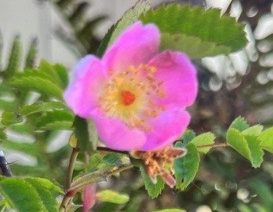
Rosa gymnocarpa var. gymnocarpa
Bald hip rose or woodland rose or miniature rose- three names that describe this dainty inhabitant of woods. A light textured small shrub to 2′-4′ depending on the fertility the soil. Spreads laterally by stolons and it can occupy a large area. Charming nickel sized flowers are pink and lightly fragrant when they appear from April to June. The hips that follow are diminutive and slick without prickles (bald). Slow growing plant that is ideal in shade to dense shade. One of the best native shrubs for shady locations. It will also tolerate full sun but it doesn’t look as happy. A big hit with pollinator and birds who distribute this little roses seeds all throughout western Oregon. Thorns are small and do not hurt. Associated plants in the wild are Polystichum minutum (western sword fern), Osmoronia cerasiformis (Oso plum) and Clinopodium douglasii (Satureja). Woodrose grew on our property near Eugene. It formed the understory layer beneath firs and oaks with Symphoricarpos alba (Snowberry) Not deer resistant but its not first on their list. Light orange fall color. Oregon native plant.

Rosa nutkana ‘Xera Pink’
Silently living its beautiful life in a seasonally flooded ditch near our wholesale nursery we spotted this deep pink flowering variant of our locally native Nootka rose. Intensely fragrant deep pink single flowers appear from May-July. followed by brilliant red hips that ripen in fall. The first and second year canes carry a heavy mahogany tone that is as conspicuous as the deep pink showy flowers. An incredibly tough and adaptable native rose that can endure both seasonally flooded locations and desiccating summer drought. Even the foliage has a sweet fragrance. Carefree shrub that spreads to form colonies and rises to about 4′ tall on average. Laughs at the heaviest, driest clay soils. Red/orange fall color. Not a shrub for shy neighbors, this rose will win. Give it ample room and plan ahead. Oregon native plant.
Xera Plants Introduction

Rubus nutkanus (parviflorus)
Western Thimble berry is a widespread relative of raspberries that grows in many biomes and is especially abundant west of the Cascades. The 5 petal pure white flowers that arrive in spring are among the largest of any Rubus. Thimble berry also does not have thorns. YAY. It forms imposing patches spreading by a creeping rhizome. The large maple shaped leaves can be up to 10 cm wide To 4′ tall and spreading – give it room and plan ahead. The sweet edible red berries appear in mid-late summer. They may be detached from a core on the end of the stem. It leaves a concave hollow berry- shaped like a thimble. Its fairly high in water content which means it does not ship well and its not big as a commercial crop. Nice looking large, opulent shrub for wild areas. Water to establish then none necessary in subsequent years. Thimble berry has a very long lifespan but it is also a seral species populating disturbed sites from fire, logging, roadsides. Full sun to quite a bit of shade with good air circulation- prone to powdery mildew in wet springs. It seldom causes permanent damage to the plant. Fall color is yellow to russet and lingers. Not bothered by deer but birds will predate the fruit and then poop out a whole new colony. Wild areas, margins of forests.
Oregon native plant

Rubus spectabilis ‘Golden Ruby’
This golden leaved form of our native Salmon Berry is an exciting variation for wild areas. The brilliantly colored foliage sparkles with deep pink flowers in spring. In summer it produces salmon colored sweet, edible berries. To 7′ tall and spreading as wide as it would like. Full sun (with irrigation) to quite a bit of high overhead shade. Give this colonizing plant room to spread. It appreciates moist soil but is very tough when established. Deciduous- though it is a short period and the brilliant new leaves begin emerging in late winter. Stream banks, the back area of woodlands, wild areas. Moderate deer resistance. Increases by suckering stolons. Easy native to brighten wild woods. Oregon native plant.

Rudbeckia hirta ‘Autumn Colors’
This short lived, very showy perennial is tough as nails. This strain enchants with huge flowers that are almost always single but come in tones from black to yellow, brown, orange, and red.. They immediately remind me of a blanket made by native Americans. To 28″ tall ( compact ) with enormous flowers up to 5″ across. They come in a profusion from mid summer to early autumn. This strain has a natural life span of 3-5 years – but it does re-sow itself in open and opportune places. Open soil that has been slightly enriched with compost / fertilizer. Full sun and regular water until fall rains take over. Mix with other sunset orange/ brown toned flowers. I pick the searing true red of Salvia ‘Royal Bumble’ as sell as the soft green spikes of Kniphofia pumila both will bloom simultaneously with the Rudbeckia Excellent in summer containers and beloved for its long bloom time. Remove spent flowers for the first few rounds to encourage more bloom. leave the last round to be pollinated and set seed. Excellent pollinator perennial. Regular water for the first season , less the following year. Some deer resistance.

Rudbeckia occidentale
Our native coneflower found in the Cascades. Look! It forgot the petals. Yup thats our boy. Clump forming tall perennial for moist sunny sites. Rich, soil with ample humus. Easy to grow in a perennial border where you can take advantage of the austere look of the flowers, when they come en masse at the end of 30″ stems they are something to behold. Very good cut flower and it goes with a very modern aesthetic. Full sun. Completely deciduous in winter. Oregon Native Plant.

Salvia microphylla ‘Flower Child’
This species has yielded some very good cold and wet tolerant cultivars. This selection from Monterey Bay Nursery in Watsonville, CA has proved to be one of the best performers. Masses of outward facing candy pink flowers swarm the stems of this large, semi-woody Salvia. The flowers begin in May and continue unabated to frost. This is a very good hue of pink, very mixeable with other colors without clashing. To 2′ tall x 2′ wide in a single season. Well drained soil of rich to average fertility. Double dig the soil before planting to incorporate oxygen and improve drainage as well as water permeability. It excels on slopes in full all day sun with just light summer water. Flowers continue through the hottest weather- good trait in our climate where many others take a break in in the mid to upper 90’s. Drought adapted when established. Do not cut back until new growth emerges in spring- then it can be taken back by 2/3rd. New growth will erupt from semi-woody stems around the base and you are up and running. Herbaceous below about 15ºF. Returns from the base if established. Hummers, butterflies, chicks without bras dancing around like nymphs. Its got it all. Moderate deer resistance.

Salvia microphylla ‘La Trinidad Pink’
This species of semi-woody Salvia has produced some of the best for our climate. Shocking pink, relatively large flowers decorate the upward stems of this vigorous and long blooming perennial. To 26″ tall and forming a semi-woody shrub. In essence it is a subshrub which is woody with time but capable of freezing to the ground and returning from the base. The vivid flowers appear from May to frost and are a delight for pollinators, hummingbirds and pink-o-philes. Full, hot sun in a warm position in rich, WELL DRAINED SOIL. Double dig the soil before planting to incorporate oxygen and make it easier for water to reach the roots. Do not prune back in spring until you see new growth. Either from the tips or the base depending on how cold the previous winter. Cut back hard then and it will zoom back to its former stature in no time. Hot sunny places, hell strips, containers. Excellent on hot slopes.
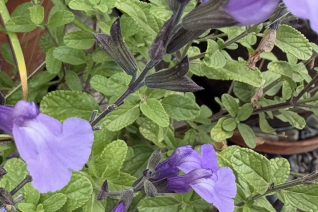
We all agree at Xera that this is a fantastic new color form of cold hardy little leaf sage (Salvia microphylla). The large flowers begin as dark blue in bud and open to a wonderful true light blue. Compact growing to 2′ x 2′ and it blooms continuously for all of summer into early autumn. The flower color is vastly different than ‘Flower Child’ pink and ‘Royal Bumble’ red. It is not only a wonderful border plant its compact habit and continuous flowering make it a wonderful container member as well . This is one of the most visited plants for hummingbirds. Enriched soil that drains in full sun. It will perform well in morning sun only or afternoon sun only. Regular summer water leads to the best blooming. Combines deliciously with chartreuse foliage or paired with lavender flowers. Do not cut back this perennial hard until all chance of frost has passed in spring (after Apri 15th) You may tidy overgrown plants at the end of summer or into fall, but do not cut back hard. Very easy to grow perennial and a wonderful flower color. Semi-deciduous to deciduous in winter. Excellent performance at the Oregon coast.

Salvia muelleri
This purple flowered royal sage has impressed us for years with its hardiness to cold, true purple flowers and tolerance of cold winter wet. A loose spreading perennial that adorns its tips with royal purple flower from June to frost. Never dense it prefers full hot sun and very well drained soils and light but consistent summer water. To 18″ tall by 2′ wide in time. Do not cut back until new growth pushes in spring. It needs a woody framework of branches to protect the overwintering crown. Takes blasting hot conditions. Moderate deer resistance. Very long blooming perennial that doesn’t flinch at heat and drought. The royal purple flowers are held in black calyxes. Excellent on slopes. Some wonderful companions are Epilobium (Zauschneria) septentrionalis ‘Select Mattole’ and Cuphea cyanea ‘hirtella’. Long lived perennial.

Salvia spathacea
Hummingbird Salvia is a Californian Sage. In rich soil it spreads liberally by underground runners to colonize large areas. That is if winter does not knock it back. Large quilted soft green arrow shaped leaves appear in early spring, by late spring 28″ tall chalice’s of rich red/pink (Raspberry) flowers erupt from dramatic and well spaced whorls. Rich to average soil that drains well. Water well in the first season to establish then very light to none in subsequent years. A Salvia of southern and central California it has a distinctive aroma that is loved by some, despised by others. Mulch with dry leaves for the first winter or two. Doesn’t like wet plus subfreezing cold. Good, and restrained in a container. Protect containerized plants from extreme cold (below 20ºF). Nice and very dramatic cut flowers. Blooms March repeatedly until June. Great for hummingbirds, butterflies, and pollinators. Semi-deciduous in winter.
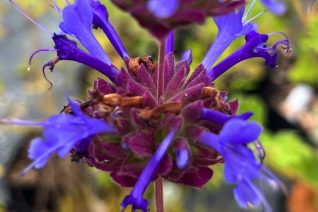
A hybrid between two southern California shrubby Salvias has yielded an amazing plant for our gardens. The parents of this hybrid are S. clevelandii ‘Alpine’ x S. pachyphylla and it continues the amazing foliage fragrance of Salvia clevelandii and the deep blue flowers in purple bracts echo pachyphylla. A shrub/ sub shrub for the very warmest parts of the garden. Against a south or west facing aspect. This Salvias parents come from poor, mineral soils and eventually the pale blue foliage builds to a 30″ x 4′ evergreen shrub. It loses some leaves in harsh winters . In mid to late summer upright stems support whorls that emit striking long deep blue flowers, these are held in a dark purple calyx – the each whorl is dark purple and showy before and after bloom as well. Takes the hottest locations and appreciates it. Strategically placed among large boulder that radiate heat is also useful as is in Hell strips where heat builds. The stems elongate in bloom up to 2′ and are lined with mutiple whorls. Perhaps no animal loves this sage or Salvias in general more than hummingbirds. And the radiant blue tubular flowers are perched just for them. Long blooming aromatic drought adapted sub-shrub. Good drainage, full sun, and regular water to establish, let it dry between watering during summer. Mix with Manzanita, Epilobium – Zauschneria, Grevilleas. Do not cut back until new growth begins in mid spring. Beautiful in bloom. Excellent with a gravel mulch and on south facing slopes. Protect from prolonged temperatures below 15ºF, cover with a cardboard box or a tarpaulin. Naturally drought adapted.

Salvia x ‘Christine Yeo’
Very good Salvia that blooms non-stop medium purple flowers for months in summer well into autumn. Tall growing to 3′ and somewhat wispy. A possible hybrid with the blue flowered Salvia chamaedryoides. Hummingbirds love this free blooming hardy perennial. Freezes to the ground below the mid 20’s. Returns from the base in spring. Rich, WELL DRAINED soil in full sun. Drainage in winter is the key. Add some pumice and gravel to the planting hole and water consistently to this plant good and established. Do not cut back in the spring until you actually see new growth pushing. Then remove all the dead material. Regains stature quickly in spring.

Salvia x jamensis ‘Nachtvlinder’
Exquisite hybrid Salvia that forms a semi-woody subshrub and is clad in velvety purple with reddish toned flowers for months. Its also among the most cold hardy selections that we grow. To 2′ x 3′ forming a bush. The opulent flower color pairs well with almost any hue. Its especially commanding near yellow or chartreuse. Full sun to very light shade in rich soil that drains. Add all purpose fertilizer to the hole and keep it very well watered throughout its first summer. Do NOT cut it back until new growth shows in spring. Then you will know what to remove. The woody structure of the previous years growth actually acts as an insulator during the winter- this is why we recommend not trimming it until all danger of frost has passed. Excellent container subject and irresistible to hummingbirds. Aromatic foliage. Harbors some deer resistance. Remove spent flowers to encourage more. This and many Salvias takes a break from blooming when the temperature is above 95ºF. It will quickly resume blooming when cooler weather arrives. ‘Nachtvlinder’ is Dutch for night butterfly. Exceptionally cold hardy.

Salvia x jamensis ‘Elk Blue Note’
This is one of the best flower colors that we’ve encountered in a Salvia in quite a while. Always on the lookout for blue flowered Salvias this beautiful sage is blue right on point. Upright growing semi-woody Salvia that produces a non-stop supply of sky/ to periwinkle blue flowers. The spires of flowers rise to about 20″ tall forming a rounded sub-shrub as wide. Flowers begin in May. Long blooming perennial for hot, sunny spots. This Salvia would benefit from the added heat of reflected walls and sidewalks. Great near the curb in rich soil with regular water in summer. Flowers take a break in extreme heat but as soon as a cool down they begin again in earnest. Cut back hard in spring AFTER all danger of frost has past (mid-April) and no sooner. Excellent in containers as well. Easy, bloomy, lovely blue. Hummingbird favorite as well as a butterfly magnet. A xera favorite. Moderate deer resistance.
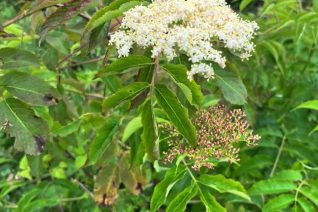
Sambucus mexicana ssp. cerulea
Our locally native blue elderberry makes a good very large shrub or small garden tree. It has beautiful pinnate foliage, large fragrant umbels of white flowers followed by large clumps of edible blue fruit.These appear in May/June quite a bit later than the red druped species S. racemosa. Incredibly fast growing in youth it responds in a robust way to extra water in summer. Adaptable to nearly any soil type. And very drought tolerant as it matures. Fall color is often yellow but also lacking. Birds feast on the berries through winter. Otherwise they hang ornamentally on the bare twigs- also very showy. To 14′-18′ tall and naturally forming a vase shape. Lifespan is typically less than 30 years. Give it room to spread. Edible real fruit set occurs in more well established plants. Widespread throughout the west. Spreads liberally by bird droppings. Oregon native plant.
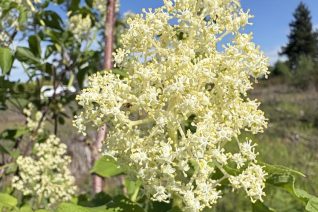
Sambucus racemosum
Red Elderberry is a widespread adaptable large shrub for sun to quite a bit of shade. It can be found in riparian zones around the whole state, more common in Western Oregon it occurs in just about every biome in the state. It will tolerate upland conditions too. Frothy white flowers in early spring morph into clusters of vibrant red berries that are only edible for humans if cooked. Birds distribute this shrub and it can even be found thriving in dry shade under conifers. To 16′ tall in 6 years- very fast growing deciduous shrub with handsome pinnate foliage. Fall color is yellow and brief. The showy berries disappear quickly. Rich to poor soils, give it more irrigation in rough conditions and less when its fat and happy. Water to establish then it has drought adaptation Very easy to grow native shrub for gardens, borders the back native 40. Blooms on wood from the previous season, prune if needed after flowering. Life span 25 years on average. Oregon native plant.

Sanicula crassicaulis
Pacific Snakeroot is a fascinating native perennial that is native west of the Cascades from British Columbia south -to the tip of South America. A summer deciduous perennial whose presence is really from January to July- before slipping into summer/dry dormancy. This unique plant forms handsome palmate leaves that are edged in black when young. As summer approaches the plant elongates up to 30″ tall and begins to bloom. Tight gold/charteuse inflorescence that must attract very specific pollinators. I know for a fact that it draws butteries because I vividly remember them visiting this plant in the country. I’ve always found this easy growing plant pleasant and I have to admit that it is present in just about every biome west of the Cascade Crest. At the coast it is nearly evergreen – no need for summer dormancy. The small spiny seeds that perch at the top of plant are carried away by animals. Adapted to a LOT of soil conditions including compacted xeric clay. Forms increasing rosettes to 18″ across. More than likely you will find seedlings. Found in the Willamette Valley with Dodecatheon, Camassia, Rosa, and in shade with Symphoricarpos and Polystichum. Full sun to full shade. Not eaten by deer. Oregon native plant.

Schizachyrium scoparium ‘The Blues’
A fantastic grass that performs wonderfully well in our climate. A clumping grass with very upright blue foliage. In summer inflorescences rise above the leaves with fine fluffy whitish flowers- provides a dramatic hazy effect. In autumn the 28″ tall grass becomes a whole other color palette. Deep raspberry and purple with tints of red before going over to all all reddish orange. An excellent color trip not the way to dormancy. When dormant it remains a presence and looks nice through winter. Cut down to the ground in late winter/early spring to make way for fresh new foliage. Not evergreen. Average to enriched well drained soil with light summer water. Established plants in reasonably good soil will sale through summer drought with no ill effects. Clumps expand over time to 2′ wide. Full sun. Easy grass. May self sow in open disturbed soil.
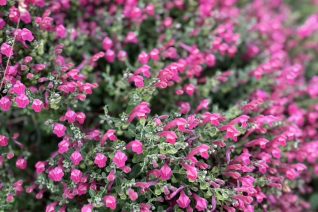
Scutellaria suffrutescens
Texas Cherry Skullcap – its actually native to N. Mexico -is a wildflower with a mission. To bloom – not just a little but in sheets for all of summer with no supplemental irrigation. And I’ll be damned if it doesn’t do that. Forms lows domes to 5″ high by 1′ wide and is smothered in cherry pink flowers from June well into autumn. Rich to average well drained soil and occasional summer irrigation. Cut back in spring after new growth has commenced. Full all day sun, reflected heat and not much else. Long lived and virtually carefree. One of the best surprises in my garden of the past 10 years. Excellent perennial that survives, grows and blooms prolifically with no summer water. Even in the drought and heat of 2021. Extraordinarily adapted to baking hellstrips.

Sedum divergens
Oregon native Sedum that is found at mid and high elevations of the Cascades. It makes its home on recent road cuts and rocky, gravelly cliffs. Small rolly polely green succulent leaves line trailing stems. Very juicy. Forms a thick evergreen mat in full sun to part shade in well drained soil. Excels in enriched soil that also drains. Light to regular summer water to retain luster otherwise completely adapted to summer drought. Rock walls, containers, rock gardens. Easy to grow native that is one of our most attractive stone crops. In late spring 4″ stems rise with clusters of bright yellow/gold star shaped flowers. As with all Sedums they are coveted by pollinators. Takes on red tints in cold weather. Evergreen. Oregon native plant.

Sedum oreganum
Not hard to tell where this stone crop is endemic. It resides mostly in the middle elevations of the western Cascades. Rocky slopes, cliffs, and road cuts is where you find the clusters of small green rosettes that makes large colonies. In summer 4″ stems arrive topped with bright gold/yellow flowers- a pollinators dream. Little spreading plant to just inches high but expanding to several feet wide in well drained, somewhat enriched soil with light summer water. Full sun to quite a bit of shade. Forms a dense mat and may be used as a small scale weed blocking ground cover. Easy to grow plant. Roots into the ground as it spreads- evergreen. Excellent winter container subject, it will happily trail over the edge of pots. The yellow flowers are specific to some of our most endangered pollinators. Very cold hardy. Oregon native plant.

Sedum oregonense ‘McKenzie River’
Creamy stone crop is a common succulent of mid to higher elevations of the Oregon Cascades – it can also be found in the Siskiyous. This is a common plant on rocky slopes, scree its even adaptable to heavier soils. Gray white leaves are crowded into rosettes. In spring stems rise to 6″ tall and produce creamy light yellow colored flowers. Absolutely adored by pollinators this very easy to grow perennial adapts very well to gardens. Its useful in rock gardens, troughs, containers in full sun to very light shade. Light summer water to very little, A classic plant of the Oregon Cascades. Primarily above 2000′. Evergreen. 3″ tall out of bloom and spreading to form large clumps several feet across. Not bothered by deer or rabbits. Lovely Oregon native. The cream/ivory flowers are a welcome respite where all other Oregon sedums are bright yellow. . Oregon native plant.

Sedum spathulifolium ‘Cape Blanco’
An old standard form of our native and widespread Stonecrop. This form is unique for its very pale gray almost white rosettes of leaves. It spreads vigorously in rich to average well drained soil with light summer water. Soil should be light and not compacted. It makes a very good small scale ground cover. Also excellent in rock gardens and even winter containers. Great long lived and easy container subject. To just inches high a single plant can reproduce to several feet wide. In late spring 6″ stems grow upright to display masses of brilliant yellow flowers. Adored by all pollinators. When cold wet weather arrives the entire plant takes on red/raspberry tones. Very pretty. Easy to grow native perennial. Full sun to quite a bit of shade. Oregon native plant.

Sedum spathulifolium ‘Carnea’
Interesting form of Stone crop that has foliage that takes on brilliant red/purple tints in cold weather or with drought stress. Powdery blue foliage is arranged in rosettes at the end of 3″ stems. Starting with the outer most leaves the vivid tints become most apparent in mid-late summer through winter. Red stems support clusters of gold/yellow flowers in early summer. Excellent pollinator plant as are all Sedums. Easy to grow in any soil that drains reasonably well. In regular ground double dig the soil to incorporate oxygen into the soil and avoid compaction. It will spread to multiple feet across in short order. In rock gardens it can be a little rambunctious around delicate plantings. Give it room and plan for it to spread. Great in seasonal containers, troughs, rock walls. Light summer water speeds the growth rate- it also inhibits the bright color. Oregon native plant.

Sedum spathulifolium ‘Rogue River’
Would it surprise you that I found this form of native stonecrop on cliffs above the Rogue River? It fascinated me how tightly to the ground this spreading succulent occurred. Gray green foliage appears to be almost rubbery and it grows in a dense pile. Very nice. To just inches high it eventually makes large colonies in rich, to average well drained soil. Light to little summer water. In late spring 4″ stems support hot yellow sunny flowers for weeks. Loved by pollinators of all types. Evergreen and ever lovely form. Perennial borders, rock gardens, containers. Easy and climate adapted native succulent that loves to be in gardens. Oregon native plant.
Xera Plants Introduction.

Sedum stenopetalum var. douglasii
Pine Sedum is common in the rocky outcrops of foothills and mid-elevation mountains throughout the state. You’ll find it clustered around crevices and on scree at the base of cliffs. Fine stems support clusters of deep green pine needle-like foliage. In summer its crowned by clusters of deep yellow flowers. Not as showy as other native Stone crops but pretty none-the-less. To just 3″ tall and forming clumps to 1′ wide. In the garden give it enriched, fast draining soil with light, consistent summer water- this improves the overall appearance. An interesting native Sedum for containers, rock gardens, borders, dry gardens. Evergreen. Very cold hardy. Oregon Native Plant.

Sidalcea asprella ssp. elegans ‘Josephine’
Beautiful Oregon Native Checker mallow that has handsome deep green glossy scalloped leaves and for all of summer a continuous supply of long stems clad in rows of cup shaped pink flowers. Adapted to heavy soils that dry out completely. But improves greatly under cultivation. Flowering stems stretch horizontally and wind their way through neighboring plants. Cute cut flower. Excellent in borders or no water landscapes alike. To 18″ tall in bloom and spreading to about 3′ wide. Long lived and easy to grow. Native to western Oregon. Our selection of a deep pink and prolific bloomer. One of the naturally longest blooming varieties that can remain in bloom for months. Excellent perennial for drawing butterflies. The long stems of cup shaped luminous pink flowers work well as cut flowers. Light summer water and rich soil prolong its performance. Palmate leaves are glossy and good looking. Oregon native plant.
Xera Plants Introduction

Sidalcea asprella ssp. virgata
Rose checker mallow is one the showiest summer perennials native to the western part of the state. This ‘wild hollyhock’ decorates meadows and swales from slightly south of Portland to the Rogue Valley in SW Oregon. A low rosette of mallow-esque leaves are glossy. The tall straight 16″ spires of densely arranged hot pink flowers wave in the early summer breeze.(Blooms May-July) A great cut flower this obvious mallow relative is among our natives that improves under cultivation. And it is rust resistant. Double dig a wide hole to incorporate oxygen in the soil add a handful of all purpose organic fertilizer into the hole and mix with the existing soil. Water regularly and deeply for the first few months. Allow the ground to dry some between irrigation Loved by butterflies and pollinators and actually one of the host plants for the endangered Willamette Valley ‘Fendler’s Blue’ butterfly. Continuously irrigated plants will have successive flushes of bloom. For native rainfall only plants the show is a little shorter. Long lived, resents disturbance. Excellent with Iris tenax, Penstemon kunthii and all Achilleas. Native to clay soils that dry in summer. Oregon native plant.

Sidalcea campestris
The Willamette Valley is the center of the Sidalcea universe. Willamette Checker Mallow is a fantastic long lived native perennial that thrives in gardens. In May-July and sporadically later stems rise up from low foliage to 14″-36″ and support many soft pink flowers. Loved by pollinators and very easy to grow. This perennial inhabits slopes around the Willamette Valley in very heavy clay soil that dries out to concrete in summer. Adaptable to richer conditions, it also encourages a longer bloom season. Full sun to part shade. Native in Oregon Oak woodlands with Oregon Iris, Shooting Stars (Dodecatheon hendersonii). Pretty meadow flower that combines well with native grasses and the aforementioned perennials. Established plants can get by with very little water. Forms a spreading clump to 2′ wide. This species and several others have a natural range that is defined by the Willamette Valley. Its a special member of the Valley biome. Common associates in the wild are Rosa nutkana var, nutkana as well as Lupinus of various kinds. Good cut flower. Winter deciduous Long lived perennial. Very important for native butterflies. Its a host plant for gray hairstreaks and a nectar source for Fendler’s Blue butterfly. Oregon native plant.

Sidalcea hendersonii
Rare native perennial that can be found in wet marginal areas along the coast from Oregon to S. Alaska. Never common it forms large clumps of verdant green scalloped foliage and towers of deep pink hollyhock-like flowers. The flowers are arranged densely on the stem. Blooms repeatedly from June to frost- remove spent flower spikes to encourage more. To 34″ tall in bloom The best Checkermallow for rich, amended borders with regular summer water. Excellent cutflower and a beacon to pollinators-especially natives. Mostly winter deciduous. Combine with other tall spired perennials of similar culture. Very good with border delphiniums or even Penstemons. Tough long lived plant given the correct site. Climate adapted perennial. Rare. Cut back spent stems in winter. Oregon native plant.
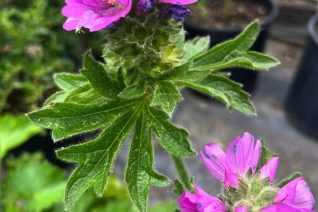
Sidalcea hirtipes
Bluff Checkermallow. One of the very rarest Checkermallows native to Oregon. This bright pink flowering perennial can be found along the northern Oregon coast and up the Columbia to near Portland. The lush, glossy maple shaped leaves surround a turret of bright, light pink flowers. Often seen on bluffs overlooking the ocean this is a perennial that excels on slopes and in clay soils. Easy to grow checker mallow that can be watered to establish then set it free. To 2′ x 3′ forming large patches. The blunt spires of flowers appear anytime from May to October, with the largest show in early summer. Loved by pollinators as well as hummingbirds. Lovely mid border plant, though it does seek slightly drier conditions in late summer. Full sun to very light shade. Amend the soil with a little bit of compost and that is all. Nice cut flower. Occurs natively with Rubus ursinus, Ranunculus occidentalis, Polystichum minutum. Long lived. Oregon native plant.

Silene hookeri
Hooker’s Catchfly is a great Oregon native perennial that is one of the showiest in this genus. Native to dry woods and plains but never common this low spreading perennial produces large pink flowers in late spring to early summer. The nearly 1″ wide frilly flowers are produced on a diminutive plant that spreads. To 4″ tall and forming a mat about 1.5′ wide. Full sun to very light shade (deciduous shade) in average to slightly enriched soils that drain. Adaptable to clay soils on a slope. Water weekly after planting for the first season then none is necessary in subsequent years. Excellent small perennial that is ideal in a trough where you can view the beautiful large flowers up close. Best in rock garden conditions or in a meadow habitat in the ground. Naturally adapted to life between clumping grasses. The slightly cupped leaves are large and encrusted in fine hairs. Native from just south of Portland to northern California. It was once much more widespread in the Willamette Valley. This range has been greatly diminished. Beautiful native perennial. Often left alone by deer. Oregon native plant.

Silene laciniata
This is a showy perennial of pine woods in interior northern California. It comes within 10′ miles of the Oregon border. This gaudy little perennial is seen in full sun to the margins of Ponderosa woods. It forms a rosette of rough moss green basal set of leaves. In late spring to early summer 1′ tall wiry spikes hold shocking vermillion orange/red flowers that have a shredded edge to the petals. It blooms for an extended period and often if the first set of defunct flowers is removed it will set another round. Water to establish the wild flower and then none in subsequent years. Established plants are supremely drought adapted and any superfluous water can lead to rot. This is also a great resident of rock gardens where its smaller dimensions and shocking flower color will be welcome. An obvious draw to hummingbirds and pollinators. Very good in gravel gardens. A slope is an added plus. Somewhat deer resistant. Adapted to coastal gardens as well.

Sisyrinchium ‘Quaint and Queer’
Sweet little blue eyed grass with a penchant for being different. Eschewing the purple and yellow and blue flowers commonly assigned to this genus this little freak puts out simple flowers with petals that alternate soft tan and purple. Its a groovy combination and adds a wild flower flare on long thin stalks to 18″ tall. Forms increasing clumps of grassy blue/green foliage. Deciduous in winter. Full sun and rich to average well drained soil with light but consistent summer water when established. A good sized clump can measure about 10″ across after several years. A charming perennial that we have found is excellently adapted to the open mindedness of the west coast as well as climate. Easy. Gay Iris relatives are few and far between. Treasure them. Moderate deer resistance.

Sisyrinchium bellum ‘Rocky Point’
Remarkable and improved variety of this west coast blue eyed grass. Much larger flowers than the species are deep purple with a distinct yellow eye. Flowers appear continuously from spring into mid-summer. Rich, moist soil with regular irrigation in full sun prolongs the very showy flower display. To just 6″ tall and multiplying quickly to form colonies. This Blue Eyed Grass does NOT set seed and never becomes weedy Full sun. Good butterfly plant. Winter deciduous. The front of borders, rock gardens, hellstrips. Improves with regular irrigation. Oregon native plant.

Sisyrinchium idahoense var. idahoense
Idaho blue eyed grass is a widespread perennial that forms colonies in full sun, in many soil types, including vernally wet sites. To 18″ tall dark purple flowers open in bright light and close with cloudiness or dark. The blue green foliage is distinctively flat and the plant produces a procession of flowers for 2-3 weeks. Deep purple with a yellow eye and about 1/2″ wide. An integral part of a Willamette valley meadow and only adaptable to full all day sun. Spreads by seed and colonies that increase to form a slender clump. Excellent pollinator perennial and is visited by a wide variety of insects. Found in field that have not been invaded by invasives. Typically its found between native clumping grasses such as June Grass (Koeleria macrantha) Roemer’s Fescue (Festuca roemeri).and with other perennials of the meadow. It can be found from riparian to upland sites. Common associated plants are Carex tumulicola, Dodecatheon hendersonii, Ranunculus occidentalis, Dichelostemma congesta, Clarkia amoena, Camassia, ( C. quamash, leichtlinii ). Full sun, no shade. Water to establish the first season then none in subsequent year. Goes summer dormant and will awaken the following February. Oregon native plant

Solidago canadensis var. elongata
Our own west coast form of Golden Rod which can be found in vernally wet locations or even fence rows. Vigorous, strong growing perennial that erupts in plumes of golden flowers from August to October. Spreading via runners it can take up quite a bit of space in lush environs. Best to grow it in un-amended soil with light summer water. Full sun to very light shade. Handsome mid-green leaves line nearly woody stems to 32″ tall. Spreads as far as you let it. Sleeps the first year- LEAPS the second and you have been warned. That having been said its a wonderful romping native perennial for late season pollinators. Its very easy to grow and long blooming. I wouldn’t plant a Willamette Valley meadow without this plant. And my, do you get good bugs. VERY good bugs. Lightly fragrant flowers are great in late season arrangements. Best to pair it with a companion that is just as rambunctious- we select Symphyotrichum subspicatum our native Douglas Aster. Not only do they match each other they make a splendid floral complement and bloom simultaneously. And it will triple the amount of pollinators. Foliage can take on orange/yellow tints in late fall. Cut back in early spring. – but fairly self sufficient. Oregon native plant.

Solidago elongata ‘Bee’s Knees’
This is a wonderful compact and shorter growing golden rod that we found from seed. To just 1′ tall and spreading to form a colony this smaller version fits in tighter places. The large conical flowers are erect at the top of the plant. An excellent version of one of the best pollinator perennials for late summer and early autumn. Average soil with light water to establish. Occasional water after that speeds growth. Mix with other late season native perennials such as Douglas and Halls aster. Winter deciduous and the stems become semi woody and can be left to supply seeds for birds throughout winter. The woody stems can be removed in early spring. This well sized and showy perennial is not only climate adapted its a very long lived perennial. Adaptable to heavy clay soils and drought. Adorable native perennial. To 3′ wide in time. Oregon native plant.
Xera Plants introduction

Solidago lepida ssp salebrosa
Big in every way this Golden Rod of the west rises on sturdy semi-woody stems to display a chalice of fragrant gold flowers. Better put in latin the broad flowers are pyramidal paniculiform arrays, That about says it. Large growing perennial that is found in specific wetland sites around the state (and the west). It spreads laterally by strong rhizomes with stems that rise to 4′ tall. The PYRAMIDAL PANICULIFORM gold flowers emit a sweet pollen fragrance. This and the fact that it is in the daisy family draws a broad amount of pollinators from far and wide. It dies down in winter and the previous years stems can be taken away then. Give it at least 5′ x 5′ to roam. Water to establish then a light consistent water in summer for best flowering. Full hot sun not tolerant of shade at all. A large, regal cut flowers for big displays July-September. This form was found in the Columbia River Gorge near the river. It can also be found around wetlands in arid parts of the state as well as river courses along the west side. The underside of the stems flashes silver with green on top. These incredibly sturdy vertical stems will never topple. Mix with Hall and Douglas Asters for similar space, bloom time and vigor and you’ll quadruple your pollinators. Oregon native plant.

Sphaeralcea ‘Hot Pink’
Globe Mallow. Fun and easy to grow perennial that behaves like a sub-shrub. Semi woody wands of very silvery small maple shaped leaves wave to 3′ tall. Lining these silver stems are bowl shaped hot pink flowers. They begin as early as late May and continue unabated for months. As time goes on this perennial for dry, hot locations with good drainage becomes a showy hot pink mass of blooms. Excellent on hot slopes with light but consistent summer water. Very drought adapted but light water appears to improve the performance. Loved by bees, butterflies and other pollinators. By autumn this 3′ x 3′ shrub should be left intact to over winter. In spring when new growth is breaking from the base it may be cut back hard and recovery to bloom is rapid with the onset of warmer weather. Cold hardier if given very good drainage. As far as I can surmise it will take temperatures down to about 10ºF. A selection or possible hybrid from two southwestern globe mallows.

Sphaeralcea ‘Newleaze Coral’
An American western native wildflower that was selected for its unique flower color in the UK. Well, welcome home my pretty globe mallow. A tall growing semi-woody perennial with soft gray/green foliage. From June to September and longer cupped vivid coral flowers line the 3′ stems. It blooms non-stop for up to two months. Very pretty. Full, hot sun and rich, to average WELL DRAINED soil. A natural for a slope or included in a border where you water just on occasion. Very drought adapted for full hot sun. Do not cut this big wavy perennial back in autumn- leave the top growth as added winter protection. Cut back by 2/3 when you see new growth pushing in spring. Good drainage is key for the combination of wet + arctic air. Dry its hardy way below 0ºF- moist- well, a lot warmer. Excellent long blooming tall plant for seasonal containers as well. Does not like shade. Don’t even try. To 2′ wide.

Spiraea betulifolia var. lucida
This is the true Varnished leaf Spiraea that is native in the Portland area. The large fluffy inflorescences – almost furry and true tiny petals. This too is a wonderful shrub that is tolerant of a host of situations. It is native in the Portland, city limits and knowing where it grows will lead to success with this easy going native. To about 3′ x 3′ and increasing laterally by stolons. This low deciduous shrub is primarily a resident of high douglas fir overstory, but it can alsmost make appearance at the wetter end of oak savanna. The flowers appear from late spring to early summer. They are natural landing pads for butterflies even hummingbirds appear. Best in an open north exposure with regular H20 then the following year less to none. Its naturally one of the most drought adapted of this genus. Give this plant room to spread, interweave its way around Holodiscus and Symphoricarpos, Gaulthria shallon. in rich soil ( to begin its life and establish) Fall color can be yellow to peach and can also not really happen. Wonderful plant. Oregon native plant.

Spiraea splendens (densiflora)
Subalpine Rose Spiraea is native to the higher elevations of the the Cascades. Above 4500′ in sunny, moist glens it makes carpets of deep rose pink umbels from low rounded shrubs. To 30″ tall by 4′ wide in garden conditions, Rich soil with regular irrigation. Moderately fast growing to this dimension. The emerging soft green leaves take on hints of blue as they mature. Bloom at low elevation is May-July but in its highest native haunts bloom can be delayed to late summer. Deciduous shrub with wonderful orange/ red fall color if brief. Easy to grow native garden plant with regular irrigation. Established plants can take deep watering every two weeks. Remember that this as with all Spiraeas have little tolerance for drought and they don’t necessarily wilt going straight to crispy (a look not as fixable as wilting). Mulch heavily for the first few seasons. Avoid blasting, reflected heat and and hot dry situations. Wonderful combined with Rhododendrons and Azaleas for similar cultural conditions. In its native haunt it can be found with Pacific Rhododendron, Helenium, Delphiniums and Veratrum. I’ve never seen it afflicted by disease. Watch for aphids, hose those off if they appear. Beautiful in bloom. Very cold hardy. Oregon native plant.

Spiraea x pyramidata
This is our local form of the Pyramid Spiraea an attractive naturally occurring hybrid between two local species. Spiraea douglasii (dark pink flowered) and Spiraea betulifolia var. lucida (white flowered). Its a larger plant and much more controlled than its parent S. douglasii and it inherits some of the drought adaptation of Birch leaf Spiraea. To 5′ tall and 4′ wide this upright growing shrub produces pyramid shaped inflorescences of the softest pink- intermediate between the two species. This form was found just east of Portland. Full sun and occasional deep soaks in dry summers. Tolerates part shade at the expense of a tidy, upright habit. Blooms on wood from the previous season, prune if needed after flowering. Adaptable to wild areas. Deciduous shrub that turns to tones of yellow and flaming orange in mid autumn. This twiggy shrub would make a great hedgerow plant. Blooms late May to early July. Flowers turn to tan seed heads that persist on the plant. Cold hardy and not difficult to grow. Not bothered by pests or disease. Not fussy about soils adaptable from sand to clay. Oregon native plant.

Stachys coccinea ‘Coral’
For flowers in this genus this is THE plant. Upright growing plant from a clump that rises to 2′ and produces multiple spikes of bright coral colored flowers. They are arranged in symmetrical whorls up the stem. Loved by hummingbirds who constantly seek nectar from the flowers that appear from late spring to late summer. When flower spikes are spent simply cut them away and water and more will arrive. Very easy to grow long blooming perennial for full sun to part shade in rich, well drained soil with light but consistent summer water. Very drought adapted when established. Works well in borders and even seasonal containers. The leaves have a very familiar lemon lime aroma. Dies to a low clump of foliage in winter.

Stachys lavandulifolia
Curious and pretty small perennial that has lovely leaves that have symmetrical black veins. As the plant expands it sends up spikes clad in frosty hairs around violet purple flowers. The don’t exactly go straight up but wind around a little bit. This gives the whole plant an overall haze that is truly fantastic. Appreciate sunny dry environs with sharp drainage but as rich of soil as you can muster. Ideally it finds a home in a dry border or rock garden. Winter deciduous perennial to 18″ x 18″ in a season. Blooms repeatedly all summer. Light summer H20 and drought adapted when very established. Mixes well with Cranesbill (Erodium) and Scutellaria suffrutescens. Pretty little cut flower that acts as a boa in a small arrangements. Very good butterfly and pollinator perennial. Absorbs blasting hot locations. Flowers when spent turn to light brown wands of fuzz- this extends this plants season of interest.

Symphoricarpos albus
Common snowberry is very widespread in our state and is found in a host of biomes This small, deciduous, suckering shrub begins spring with leaves of the freshest green, so fresh they flutter on the late spring early summer breeze. After several weeks of foliage the small white tinted pink flowers are shaped like small bowls and line the stem at every leaf axil. These morph into plush, plump pure white berries that are quite a bit larger than the relatively insignificant flowers. The berries (drupes) are perched in groups on the stems. Their pure white hue is easy to spot for humans and especially birds.They relish the berries while they are toxic for humans. To 32″ tall forming a dome shaped suckering shrub twice as wide. Water to establish the first season then none in subsequent years. Mulch heavily. The berries last well into winter before becoming animal snacks. The gray thin arching stems create a haze on the forest floor that becomes acid green as leaves appear. Spreads by stolons underground to expand its territory. Its adaptable to both upland quite dry situations as well as vernally wet spots in floodplains and fields. In the Willamette Valley its common associates are with Pseudotsuga menziesii (Douglas Fir) Quercus garryana ( Oregon White Oak) and Fraxinus latifolia ( Oregon Ash) as an understory component. Its tolerant of dense shade as long as its deciduous to full hot sun, Very well adapted to the driest summers. In summer the acid green leaves change to a dark blue green and are often afflicted by a strain of powdery mildew- my whole life I’ve known this shrub and I’ve never seen powdery mildew cause any permanent damage- mostly its just a poor aesthetic look for late summer to autumn. Fall color is soft yellow and brief. Branches may be carefully cut in berry and will hold them in arrangements for quite a few days. An excellent forage and cover plant for native fauna. A great native shrub for beginners. This is the taller form of the two species that we grow. Native to the Portland city limits. Moderate deer resistance. One of our best shrubs for seasonally dry shade. Oregon native plant.

Symphoricarpos mollis
Creeping snowberry is widespread in western Oregon and indeed throughout the state. Its a low suckering deciduous shrub that can occupy large areas. To 30″ tall spread is indefinite in rich to average soil with regular water for the first year to establish. Mulch is extremely beneficial and will suppress weeds for the first few years which can arrive in the middle of a patch of this spreading plant. Leaves are fresh green in spring turning blue green with the heat of summer. Small pinkish flowers occur in late spring and morph over the summer into plush white squishy berries. They line the bare stems and are showy until birds make off with them or they remain and rot. The berries are toxic for humans. Fall color is light yellow to very little. Common on undisturbed slopes on the edges of the valley and in the eastern foothills of the Coast Range and western Cascades. Snow berry is often afflicted with powdery mildew in the driest parts of summer. No harm will come to the plant. A wonderful habitat plant. Oregon native plant.

Symphyotrichum chilense
Pacific Aster is a Xera favorite late blooming native perennial. Masses of thick soft periwinkle flowers with a yellow center on an upright growing plant to 30″ tall forming an expanding clump. Blooms which are loved by native pollinators – they instantly appear, you don’t even have to be patient- are a soft color and open on the plant first on top and then down the sides eventually filling in. Its a cloud of periwinkle. Sometime afflicted with harmless powdery mildew. This is more of a problem near winter and afflicted material can be cut away and disposed then. Otherwise leave it standing and dead to thrill bush tits or some creatures like that. Rich soil with deep infrequent irrigation during summer. Once established it can perform reliably on rainfall alone (it will happily accept regular irrigation as well). Excellent mid-border late perennial that is fantastic with the green flowered late blooming Kniphofia pumila, and Golden rod Solidago canadensis elongate. Long lived. It may be divided after several years. This plant is common around the Pacific Rim in temperate to colder regions. Its natural range is enormous- notice the specific epithet refers to its Chilean origin,, it is just as native and prolific on the Oregon coast. Often found at the edge of woods or scrublands in the transition to grassland/ dune lands. Its common associates in habitat are Fragaria chilense (another Pacific Rim resident)- we grow the variety ‘Aulon’, as well as Pacific reed grass ( Calamagrostis nutkaenasis). Long blooming. ( AKA Chilean Aster- but that is confusing as it is native in Oregon as well. Great performance at its native Oregon coast on sand to clay soils. Oregon native plant.

Symphyotrichum chilense ‘Short Sands Purple’
Pacific Aster. Our selection of a widespread beach aster species that circles much of the temperate Pacific Rim. This form tops out at a compact 30″ on an upright plant that forms expanding clumps in rich to average soil ‘Short Sands’ is a purple form from seed of a very dark purple specimen that Greg found. It is by far the darkest purple that we have encountered in this species. The majority are white to very light lavender. Most often its habitat is adjacent or very near the coastal strand. Its adapted to all kinds of soils from sand to clay and it appreciates deep infrequent water during the summer season. Blooms begin in August and open until mid November. This aster is often seen along the sides of HWY 101. In fleeting glimpse you can capture small periwinkle daisies late in the season. A pollinator master piece. All sorts of natives recognize this showy perennial. Full sun to light shade. It seems to be most vertical in full sun and average soil. Over amended soils, too much water, or too much shade will lead to a splaying flop. The flat upturned daisies come in rows of two for a fuller look and are a natural landing pad for butterflies. Winter deciduous, very tolerant of dry conditions when established but does better with deep infrequent summer drinks. Cut back hard in spring- a new batch of leaves will just be arriving. This sophisticated native is at home in pampered borders or wild areas. Associated plants in habitat are Mianthemum dilitatum, Calamagrostis nutkensis, and Vaccinium ovatum. Its habitat is dwindling as Everlasting Pea (Lathyrus latifolius) and Ox Eye Daisy (Dendranthema) have crowded this special plant out Excellent garden plant. Oregon native plant
Xera Plants Introduction

Symphyotrichum hallii
Hall’s Aster might as well be known as Willamette Valley Aster as this charming smaller perennial is found primarily there. To 20″ tall and spreading to form a wider clump this native aster begins blooming in August and continues into Autumn. The small daisy flowers have rays that are primarily white, though light pink and lavender are also seen. The reverse of the petals is always a darker color- primarily very light lavender. Excellent native pollinator plant for late in the season. Full sun to very light shade in rich to average soil. Adaptable to xeric clay soils that dry in summer. In the garden deep infrequent soaks will yield the healthiest and most floriferous plants. Spreads moderately underground by stolons. Not bothered by deer. Nice little cut flower as filler for bolder arrangements. Climate adapted perennial that is a native for a Willamette Valley prairie. Not as vigorous and space consuming as Symphyotrichum subspicatum – Douglas aster. Hall’s aster fits in much smaller spaces. Easy to grow, winter deciduous. Associated plants in the wild are Sidalcea m. ‘Virgata’, Eriophyllum lanatum, Achillea millefolium. Takes intense dry conditions with establishment. Oregon native plant.

Symphyotrichum subspicatum ‘Sauvie Snow’
We selected this form of our locally native Douglas Aster for its snow white flowers. The species in our area ranges from blue/lavender/blue-white. So, this is a nice color break. One of the very best pollinator perennials that we grow. In bloom from July-October it is virtually swarmed by every flying insect you can imagine. A constant buzz of activity. This is a large, rambunctious perennial that is not good with delicate neighbors. Douglas Aster belongs in the wild where it can consort with other similarly over-adapted natives. Virtually any soil in full sun to light shade. In bloom it rises to nearly 30″ and the spread is nearly indefinite This is a rugged perennial for tough sites, even areas submerged during the wet season. Not a bad cut flower. Mix with large ornamental grasses such as Miscanthus sinensis ‘Morning Light’ or Panicum virgatum ‘ Heavy Metal’. Mix with native shrubs- Mahonia aquifolium, Oregon Grape and Holodiscus discolor ‘Ocean Spray’. Drought adapted when established but it appreciates a soak now and again to prolong the bloom period. Oregon native plant.
Xera Plants Introduction

Symphyotrichum subspicatum ‘Sauvie Star’
One of our color selections of the locally native Douglas Aster. This cultivar originates from seed collected on Sauvie Island. This is the predominant wild Aster of the Willamette Valley. A boisterous long blooming perennial at home in wild areas. Rich to average soil with light summer water. Blooms- in this case, periwinkle blue open in early August and continue unabated to October. They are beacons to all pollinators and are constantly in motion as they bloom. To 32″ tall forming wide patches. Runs by underground stolons. Nice cut flower. Wetland remediation, forest verges, denuded road cuts. Those are jobs for you Douglas Aster. Oregon native plant.
Xera Plants Introduction.

Tellima grandiflora
Locally native on our nursery site Fringe Cups or Fairy Bells as they are commonly known are a spreading perennial for moist shady sites. Low mounding maple shaped leaves cover the ground densely and in late spring vertical spikes appear to 18″ tall and sport rows of small green cup shaped flowers which change to white and finish with tints of pink. Closely related to Heuchera and thrives in the same conditions. It will even take full sun in moist conditions. It is a background plant because it often suffers from powdery mildew late in summer which is mostly just ugly and I’ve never seen harm to the plant. The drier the conditions the worse the affliction. Good air circulation helps but its best to just accept that this is how this native perennial rolls. Semi-evergreen in winter. Woodland borders, shady containers. Very easy to grow. Often grows with Claytonia as seen below. Flowers emit a sweet fragrance. Oregon Native Plant.

Thalictrum fendleri var. polycarpa
Tall Thalictrum or Many fruited Rue. A wonderful native perennial that will win you over with its great grace and tenacity. Many divided blue green leaves are composed like shelves along a tall blooming stem. The effect is that of a pastry tray with multiple levels. In early spring a group of these pretty and delicate looking leaves are arranged in a circle. As the spring advances so does the bloom stalk up to 4′ tall in rich soil with regular water. Best with an occasional deep soak in summer, native primarily to wet areas. Its very common companion is Giant Larkspur Delphinium trolliifolium and both species of Camas. The flower that erupts from a many branched scape holds mostly downward pointing stamens with very small modest petals. It perches on the end of the stem like a small chandelier. Winter deciduous. Found primarily in the moist areas west of the Cascades in the inland valleys. Very easy to grow native perennial that improves under cultivation but retains its feral tough habit. Long lived perennial for part shade to high over head shade. Not bothered by deer. Oregon native plant.

Thalictrum occidentale
Smaller growing western meadow rue is a resident of deep moist woods as well as the margins of streams. Many divided leaves are delicate and flutter in the slightest breeze. Each indented leaflet is perched in the arrangement of an arrow. In mid to late spring wiry stems extend above the 1′ tall foliage another 10″ and displays flowers that are comprised of raspberry and brown downward pointed flowers. They make an evenly distributed display that is not so much showy as it is incredibly graceful. Loved by pollinators who swing by for the suspended pollen. Best in enriched soil with consistent irrigation in summer. It spreads to form large colonies and is exceptionally pretty crawling up a low bank or hill. Winter deciduous perennial. This species which is more of an upland species requires a little less water than the similar but taller Thalictrum fendleri but it still requires irrigation in summer, even when well established. Benefits greatly from a top dressing of mulch. Companion plants in habitat are Tellima grandiflora, Mitella, Heuchera and Delphinium . Prefers protection from mid day sun and will burn and/ or die in hot dry situations. ‘Forms expanding colonies. Very good woodland pollinator perennial with a wonderful texture. Moderately deer resistant. Oregon native plant.
f

Tiarella trifoliata
A widespread perennial in the Pacific Northwest. There are two subspecies and this larger leaf form is the more common of the two. A mounding deciduous perennial for moisture retentive soils in light shade to shade. This perennial is often seen along creek banks and seeps where access to water is not very far away. In May-July 18″ spikes of clear starry white flowers crowd a vertical stem. Very pretty and light. An excellent native perennial for woodlands, stream banks. riparian areas. Spreads in rich soil to form extensive colonies foliage tops out at 8″. Excellent combined with native and non-native ferns. Very dark green leaves are handsome throughout the season on a tough and easy to grow plant. Fall color is red and orange before leaves go away. AKA Trifoliate Foam Flower, Northwest Foam Flower. Not bothered by disease or pests that includes snails and slugs. YAY. Oregon native plant

Tolmiea menziesii
Piggy Back plant is what we called this moisture loving woodland plant. Its famous for its ability to sprout a new plant right from the leaf petiole, it forms roots and drops off the plant and roots into the ground. Its also commonly known as a very easy to grow houseplant. Native from Southern Alaska to Northern California. In moist, cool climates like the coast it can grow just about anywhere. The distinctly arrow shaped leaves cover the ground densely on a wide spreading perennial. In mid-spring 2′ spikes erupt with rows of brownish-red flowers. A member of the Saxafrage family and closely related to Heucheras and Tiarellas. this is as superb a garden plant. Evergreen and consistently moist shady sites are where it thrives. Though with some supplemental water it can make its home in some pretty challenging dry shade. Foliage forms spreading mounds to 10″ tall and spreads laterally 2′-3′ when happy. Plants shrink somewhat in winter, and not as verdant but they do cover the ground and out compete weeds. Great container plant. Very nice naturalized among ferns of any kind. Native to the Portland city limits. Oregon native plant.

Tolmiea menziesii ‘Taff’s Gold’
An exceptional variegated form of our native “pigaback” plant that is excellent as a groundcover in dense to light shade. Vigorous and evergreen it will spread to 4′ wide in 2 years but stay only 1′ tall. Very easy to grow, works well under established Rhododendrons. Pretty, but not conspicuous brown flowers. Regular water but will take drought if in the shade. Easy, indispensible native plant. Forms new plants directly from the center of each leaf. Cool trick. Also grown as a houseplant. Good in containers. Oregon native plant.

Trifolium wildenovii
Tomcat clover is one of our showiest native clover species. A tough hardy annual that is found from about Salem to Newport south to California. Its a common component of waste places and dry rocky environs. In poor soil it is a somewhat meager plant with just a little fertility its a completely different animal. To 12″ tall but usually half that this sparse but showy clover beckons pollinators when its pink to red and white delicate looking flowers that erupt into bloom in May-July. Very easy to grow in containers with other native annuals. This shares the fecund trait of other clovers and it will already have shed seed by the time you see it in bloom. Excellent forage for native bees- and purported to supply a tangy taste to Tomcat Clover Honey. Water plants from containers to establish, self sown plants get by on natural rainfall alone. Leave the plant well past bloom to shed the following years crop. Give it open disturbed spaces to self sow. The leaves are very much like a clover but the leaflets are a lot thinner. Also found on dry stream banks and with native clumping grasses. Full all day sun. Oregon native plant.

Trifolium wormskioldii
Springbank Clover. Fascinating perennial clover that was once widespread in wet areas of the Willamette Valley and is now found in restricted sites there but is much more prevalent on the coast and east of the Cascades. A pretty spreading spring wildflower with heads of brilliant magenta/purple flowers. Mainly in spring but also in summer if wet. To 4″ tall it can be up to 2′ wide in favorable conditions. Though mostly restricted to seeps and wet areas now it once made life under native white oaks and there indigenous people would use it as a food source. The creeping green stems root where they touch the ground. Stems were harvested and steamed as a vegetable and they replanted as they harvested the remaining stems ensuring another crop. Not a long lived perennial 3-5 years but it sets copious seed. Wet sites in moisture retentive soil. Mainly riparian in habitat. It can dry considerably in summer and still thrive. But regular water is what it wants. Fun plant to grow that has lost a LOT of its native range. In habitat it is best seen on the wet cliffs adjacent to the beach. Great pollinator plant. Easily overwhelmed by invasive exotics. Oregon native plant.

Trillium albidum
Giant Trillium or Great Western Wake Robin, I think the first name is the most common. This sweet large woodland Trillium inhabits moist woods in the valleys of the western side of the Cascades. Its sporadic in occurrence but when you do stumble upon it in the woods its often very profuse. The stature and individual leaf size are what give this somewhat subtle flowered perennial its name of Giant Trillium. It is very easy to tell aside from western Trillium, T. ovatum. which is a smaller daintier plant with larger white flowers that normally senesce to pink/red before falling apart. Giant Trillium has much smaller individual creamy white flowers and they almost appear as an afterthought in the center of the large leaves which can appear initially with black mottling that then fades. To 2′ tall and increasing to form large patches in vernally moist woods. Giant Trillium goes dormant by mid summer and there is no presence until the following spring. Beware deer love Trilliums. There are two other sub species of Giant Trillium endemic to the Willamette Valley. This is the most widespread species. Rich, moisture retentive soil in part shade to shade. Oregon native plant.

Trillium kurabayashii
One of Oregon’s greatest wildflowers. This native of the Siskiyous and the SW part of the state up into the Willamette Valley. This very rare wildflower also appears occasionally in the Cascades. A wonderful perennial that makes an outstanding garden plant. Ours are divisions from well marked leaves and flowers with a deep maroon/black hue. To 18″ tall in bloom it responds readily to rich, humus filled soil with regular summer water. In very dry conditions it will go happily summer dormant. And it usually does anyway by the end of the hot season. The black and green leaves are dramatic but a great collar to the tall upright dark flowers. Blooms appear in Portland in April/May and last for weeks. Part shade to shade- avoid blasting hot sun- it will grow in sun but go dormant very quickly. Roots very deep into the ground- difficult to move once established so pick its home carefully. Multiplies into a substantial patch with good care. One of our favorite native wildflowers. Limited quantities. Oregon native plant.

Triteleia hyacinthina
Fool’s Onion, though this close relative of Brodiaea is easy to tell apart from Allium as the leaves and stem have no onion odor. A sunny native perennial bulb that forms colonies of white in May-July in meadows, glens, and swales. To 15″ tall in bloom but usually shorter the leaves emerge in mid winter and persist until summer drought. About that time the flowers erupt into clusters of white flowers. Great native bulb for naturalizing, Water if planting from a pot, otherwise it requires only what falls from the sky with a distinct dry period in summer. Associated plants are Ranunculus occidentalis- Western Buttercup, and Brodiaea elegans- Cluster lily, and Plectritis congesta- Sea Blush. Native in clay soils that dry completely in summer. Goes very neatly dormant in summer- nothing is left. Excellent in rock garden conditions. Full sun to very light shade. Moderate deer resistance. Native though out western Oregon. Sweet cutflower Very good for butterflies as well. This plant once occupied large areas of the Willamette Valley, that territory has shrunk considerably. Oregon native plant.

Vaccinium ovatum
Evergreen huckleberry is a fantastic native broadleaf shrub. It is well adapted to shady sites and will accept full sun with regular irrigation. Well established shrubs require less water. Rich, humusy woodland soil is its favorite haunt and it will grow moderately fast to a rounded outline of 8′ tall and 6′ wide. The new growth is a beautiful salmon pink before changing to deep green. In spring and early summer small white urn shaped flowers are pretty and transform into tasty black fruits in autumn. Amazing in muffins, pies.It has an interesting natural distribution along the immediate coast in most of Oregon but veering inland at Douglas County to almost the Cascade foothills. In Puget Sound it seems to be most prominent within sight of salt water. Easy to grow good garden plant. Increase your chance of pollination by planting more than two shrubs. The theory is that berries like to party- and I’ve observed it to be true. Oregon native plant.
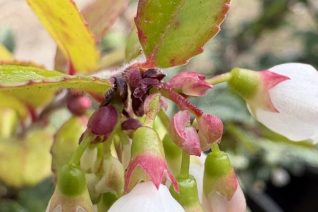
A very handsome version of one of our best native broadleaved evergreen shrubs . I spotted this form with larger leaves that are thicker and convex in the coast range of Douglas County. It gives the shrub a much more substantial appearance . The thick leaves emerge tinted salmon pink before settling to its permanent deep lusterous, dark green. To 6′ tall x 4′ wide in 6 years. Very dense habit is reminiscent of boxwood. This is a very useful and handsome form of Evergreen Huckleberry. This cutting propagated form will have a very uniform texture and habit. In late spring small pink to white urn shaped flower transform into deep black purple tasty fruits. Plant more than one shrub to increase pollination and fruit set. Rich soil high in humic content with regular water in summer. Mulch annually. Allow it to dry between watering. Plant on 3′ centers for a tidy fast hedge. Full sun to quite a bit of shade. Not bothered by deer. Almost formal appearance. Prune after flowering if needed. Oregon native plant.
Xera Plants Introduction
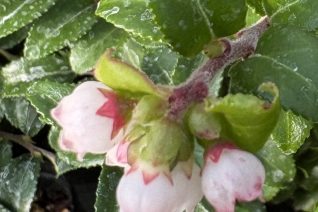
A form of evergreen Huckleberry that is found on the north and central Oregon coast. The leaves are slightly longer and curve a bit and have a fine but noticeable serration. This is a slightly bolder form that is very handsome and somewhat formal in appearance from the species. Forms a shrub with large canes that grow in earnest and then arch.. White flowers are slightly larger than normal and appear in spring form slightly larger than normal black sweet fruit, about the size of a caper. Plant more than one shrub to increase pollination and fruit set. Full sun to full shade in humus rich, highly organic soil . Mulch for the first several years. Irrigate to establish for the first year or two then it should have a large enough rootball to resist summer drought. Otherwise light summer irrigation speeds growth. New growth is salmon orange and turns to shades of yellow before settling to dark green. Very pretty native shrub that demands more irrigation and mulch in full sun. Makes a wonderful informal hedge in time. This form has a pronounced arching shape. Excellent hedge material as this is cutting propagated and will maintain a uniform habit. Wonderful form from the northern Oregon coast. To 8′ x 8′ in 10 years. Prune if needed in Autumn. Oregon native plant.
Xera Plants Introduction
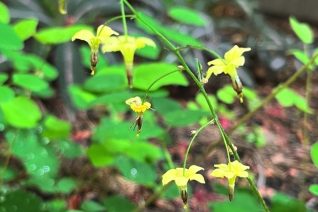
Vancouveria chrysantha
Rare perennial Siskiyou Inside-out-Flower is a much more drought tolerant version of our locally native Vancouveria hexandra (Inside out flower). This yellow flowered species tolerates extreme dry shade and colonizes even compacted dry soils to create a handsome ground cover. The delicate looking interestingly shaped leaves create a soft mound of shapes in cool green and edged slightly in red. In April-June 20″ wiry spikes suspend small downward pointing flowers- they appear to float above the foliage reminding me of a group of fireflies. (Wish we had those). Mostly evergreen if temperatures stay above about 15ºF. Basically this is our version of Epimedium (to which it is related) but with more tolerance for summer drought. To 8″ tall and spreading to several feet wide in richer, moisture retentive soil. Light summer water increases growth. This is an extraordinarily elegant native that should find a happy home in gardens too. Part shade to full shade. Not bothered by pests. Excellent perennial under large shrubs or within tree roots. In the wild it is the understory plant to Arctostaphylos, Rhododendron, Vaccinium, Notholithocarpus densiflorus var. echinoides. Associate perennials were Oxalis oreganus and Mianthemum as well as viola semperivrens- Redwood violet. Easy community to replicate in your garden. Oregon native plant.

Vancouveria hexandra
Inside-Out-Flower is a commonly seen terrestrial component in dry to moderately moist woodlands in our region. The duck foot shaped leaves are conspicuous and pretty and in late spring to mid-summer a continuous supply of dainty downward pointing white flowers. Spreads in gardens very well in enriched soil with regular summer water where it will quickly assume the role of an intertwining ground cover. Winter deciduous- un-like its close and much more drought adapted relative Vancouveria chrysantha (Yellow inside-out-flower, Siskiyou Vancouveria). This perennial is perfect for life among shrubs or mixing with other woodland perennials in part shade to shade. Adapts well to garden culture and thrives on regular summer irrigation. Locally native in the city of Portland. To 10″ tall and spreading. Some deer resistance. Oregon native plant.
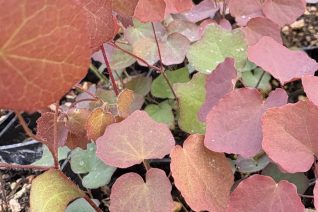
I found this remarkable form of our native Inside Out flower in southern Oregon, I wiggled off a tiny piece and put it in my pocket, the parent plant was unharmed. Its taken years but we are ready to offer this beautiful form of our native Vancouveria hexandra with new foliage that is deep wine colored and then matures to green with a red edge. In early summer this spreading perennial sports upside down white flowers on 4″ to 6″ above the foliage. A spreading ground cover that shows remarkable tolerance to drought once established. Amend the soil with compost and mulch, water consistently for the first year or two. Let the soil dry between watering. Leaves rise 6″ and forms spreading colonies. Winter deciduous, it disappears completely – all the better to showcase the deep burgundy new growth. Fall color is yellow and brief and the plant remains decompose over winter. Not the first plant to be devoured by deer/ rabbits but I would protect for the first few years. Deep burgundy foliage remains showy before morphing to deep green with a red edge. This is a member of the Barberry family (Berberidaceae) and is related to Epimedium and has the same applications. Combine with gold leaved perennials for the most contrast and drama. Hakenochloa macra ‘All Gold’ , ‘Campanula garganica ‘Dicksons Gold’, and Golden baby tears , Soleirolia soleirolii ‘Aurea’ . Very good in containers as well. Spice up a native garden. This perennial makes a great cover for native bulbs – Brodiaea and Fritillaria lanceolata, Calochortus tolmei,- are excellent companions, fading just as the Vancouveria is emerging and bulking up. Enriched soil, regular water to establish, this dweller of the forest floor appreciates an annual mulch. Oregon native plant
Xera Plants Introduction
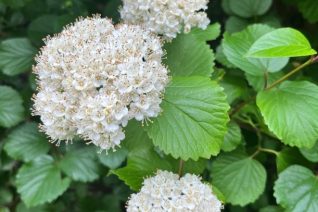
Viburnum ellipticum
Oregon Viburnum or Western Way Faring tree is a moderate to large native deciduous shrub. It stretches a little bit into W. Washington where it is rare but its primary populations are in western Oregon and south into N. California. Its found in moist to dry woods often on the margin where its can get at least half a day sun. It also thrives only much larger and lankier in outline in the shade. It easily tolerates winter inundation but is found on well developed soils in upland situations as well. Its common associates in the wild are Oregon white oak/Quercus garryana, Oregon Ash/Fraxinus latifolius, Cornus stolonifera. Leaves are round, glossy and scalloped and are very handsome on a well proportioned fountain shaped shrub. Shorter in full sun, taller in shade. This plant needs just a modicum of light watering for its first year and once it is thoroughly established you can set it free. In late spring off white cymes of flowers have the fragrance to me of raw potatoes. We had a large specimen of this shrub in our back 40 where I grew up near Eugene. In certain years it can produce quite a fall show with orange/red tinted leaves and translucent blue fruits. Blooms on wood from the previous year. Prune if needed AFTER blooming has ended. June. To 7′ tall in the sun to much taller in shade. Protect young plants from deer. Oregon native plant.

Viola praemorsa ssp. praemorsa
Canary violet or upland Violet has many subspecies in the PNW and west in general. This is our own Willamette Valley form of this intriguing handsome perennial. Large spoon shaped leaves have an underside with conspicuous hairs. The top of the leaf is glossier. In April-May bright yellow flowers appear. The bottom petal has conspicuous black whiskers. In our region this violet is local in the most undisturbed sites but it shows very good persistence in competition with non-native introduced grasses. My experience is that it favors rocky and scree sites that remain somewhat cool- for instance the north side of a steep slope. To 6″ tall and forming expanding plants. Winter deciduous. Arrives early in spring and can go summer dormant with high heat. Excellent planted in fall or winter and left to its own devices. Average to enriched soil yields the best results. This is one of the showiest violets native to the Willamette Valley. Fairly long lived. Little deer resistance. Some associated plants are Olysinium douglasii, Sedum spathulifolium, Dodecatheon hendersonii. Oregon native plant.

Vitis californica x vinifera ‘Roger’s Red’
This wonderful grape vine was originally found along the Russian River by Roger Raiche and is absolutely stunning in autumn. This very large growing deciduous grape will eventually grow to 20′ and develop a sturdy, gnarled trunk. Grows about 3′-6′ per year. This is a wild hybrid between the European Wine grape and our native vitis californica. What that yields is one tough plant that handles our climate like a champion. Best used in wild areas and if you are going to plant it to grow up a tree make sure the vine you start with is small and the tree you put it in is big. In September-November a long display of brilliant claret red foliage- the individual leaves can be 10″ across. Simultaneously it will sport dark purple edible fruit in large clumps. The medium green foliage is leathery and is best in part shade to full sun. Especially brilliant draping evergreen oaks as it was found in the wild. Climbs by tendrils but provide very strong support at least #4 copper wire. Leaves arrive in mid spring. Very drought adapted when established. Water for the first season to establish then set it free. Vitis californica can be found in bot the Rogue and Umpqua river basins in Oregon.

Whipplea modesta
Yerba de Selva or whipple vine, a wonderful small scale evergreen native ground cover. Related to Hydrangeas but this trailer is actually very droughtadapted.e In late spring clouds of small white flowers , Scrambling plant to about 8″ tall and 2′ wide. Full sun to considerable shade. From Portland south this is a common understory component of the herb field. It grew happily in our back 40 where I grew up. There it made pretty scrambling patches between Vancouveria, snow berry and hairy honeysuckle. Often you would see our native columbine ( Aquilegia formosa) as an associate. Its very drought adapted when established but it improves with a few soaks over summer- never perpetually wet and never hot and wet. Otherwise an easy native that should be grown a lot more. For use as a small scale ground cover plant on 10″ centers. It will also gracefully trail over rockeries and walls. Butterflies adore the flowers. Competes well with invasives. Some deer resistance. It may be cut back in early spring to refresh. Once native in the Portland city limits. This is a great native understory for Arctostaphylos, which is frequently seen in the wild. Oregon native plant.

Woodwardia fimbriata
Our native Giant Chain Fern that occupies specific spots in seeps randomly from CA to BC. Large pendant and trailing 3′ long glossy fronds form huge rosettes. Usually occupying permanently wet seeps on shady hillsides in cool places. The entire plant may be up to 5′ across. Evergreen but it benefits greatly from some early spring tidying of spent and aging old leaves. Part shade to shade in rich well drained soil with regular consistent moisture for the best look. Highly deer resistant. We’re honored to grow this, one of our most spectacular native ferns. Oregon native plant.

Wyethia angustifolia
Mules Ears are rare in cultivation. These cheery bold perennials make the transition of our wild flowers from spring into real summer. So named for its long leaves it forms very permanent spreading colonies in clay soils in habitat. The brilliant yellow sun flower blossoms rise up on sturdy stems directly from the ground. Each ebullient large flower is about 4″ across. Blooms appear from late April to early June. This plant usually finishes blooming just as summer drought commences. Its a memorable sight in wild meadows where it blooms simultaneously with native Rosa nutkana and Farewell to spring (Clarkia amoena var. lindleyi) and Giant blue eyed mary (Collinsia grandiflora). Wonderful cut flower and immediate and popular pollinator perennial. This plant was once very common in the Willamette Valley but civilization has immensely shrunk its native range. Good, long lived garden plant that goes summer dormant quickly after blooming has ended. The leaves turn gray and brittle and can easily be removed then. Give it a summer rest w/ little to no summer water once established. Full sun to very light shade. Water to establish its first season then none in subsequent years. Fun to grow and LONG lived. To 14″ in bloom forming a plant several feet across. Moderate deer resistance. Native to the Portland city limits. Very slow to finish in a salable size. Patience. Limited quantities. Oregon native plant

Yucca (nana) hermmaniae
Adorable and rugged little dwarf Yucca from southern Utah. Tight round quills are decorated with filaments on the leaf edges. Not a friendly guy and very slow growing. Forming spheres of spikes to 1′ across and multiplying to produce colonies with pups. Full sun and very well drained soil of average to poor fertility. Requires excellent air circulation- no crowding. Plants that are smooshed with little air circulation protest heavily and it then takes a while for recovery. Open and free in rock garden conditions produces the happiest plants. At home nestled with boulders or as a finer texture element with Agaves. In time it produces adorable and conical shaped hoods of flowers- a gnome wedding. Excellent in containers- open, well drained containers. Light summer water during hot weather seems to speed growth. Locate away from paths. Owwie. Strongly deer and rabbit resistant.

Yucca rostrata
Beaked Yucca does fantastically well in our climate and is one of the Yucca species that will form a dramatic trunk. Blue thin leaves radiate out in a perfectly round orb. Slowly rises to 8′ tall in our climate. Full hot all day sun in a warm position. Very well drained soil with light summer water during the hottest stretches to encourage growth. Occasionally, with age 4′ spikes appear holding large trusses of ivory flowers. Perfectly hardy to cold, way below 0ºF. Avoid cold wet sites- to really do well it needs heat and exposure. Not prone to bacterial leaf blight that affects other Yucca species. Good air circulation. Lives happily in large containers for eons. Focal point in many of the best gardens in our region. High deer resistance. Evergreen.