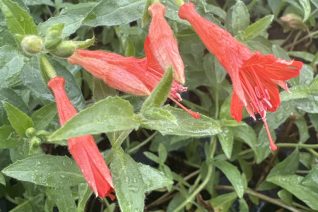
Another selection of Epilobium (Zauschaneria) that our friend Mark Wade made in SW Oregon. This is a lovely low growing form with smaller but profuse vivid lighter orange flowers and this selection supports pink stamens and pollen as well. To less than 6″ tall but spreading to an area of several square feet in a season. ‘Horse Sign’ bears sheets of these tubular flowers for several months beginning in August. Loved by hummingbirds it forms a vivid orange carpet of color. Enriched soil with a bit of all organic fertilizer will send this hardy perennial soaring. Water regularly for the first season, letting the soil dry in between. In subsequent years you can water much less if at all. Full sun to very light shade. Ideal for a slope and along rock walls at eye level. Very showy late season native perennial. Completely deciduous in winter with excellent hardiness to cold. This roaming perennial can inhabit and spill around other perennials, shrubs.  Low and spreading, avoid large perennials nearby that could flop on top. Long lived and easy to grow excellent for late season pollinators and vivid color. Mix with other low growing, sun loving perennials such as Scuttelaria, Orginanum ‘Xera Cascade’ and Erodium ‘Spanish Eyes’. Mulch with compost the first winter, this will help energize it to roar out of the ground in mid spring. Foliage is smaller and green but with a silver cast. Very  good looking native perennial. Oregon native plant

Xera Plants Introduction
My Favorites

Plant type:  |  Sun exposure: ,
Biome: , , ,  |  USDA Hardiness zone: Zn6a -5º to -10ºF
Foliage color: ,  |  Foliage season:


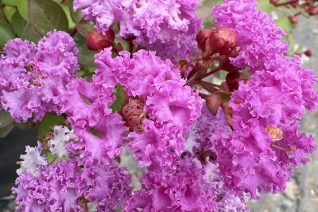
This is a very pretty and unusual Crape Myrtle selection that we made years ago. After more than a decade it has shown no sign of powdery mildew and has profuse frilly rich purple reliable flowers. This is a compact and slow growing shrub to 6′ tall in 10 years and half as wide progressively larger over time. In early July it alights in large trusses of clear purple flowers, in full bloom they obscure the foliage.  Fresh green foliage emerges tinted pewter  and changes to shades of orange and red in fall. Rich soil, in full all day sun in a warm position. Crape myrtles loathe any and all shade. The compact habit and measured growth means that pruning is seldom necessary. Thin trunks and stems exfoliate to a glossy tan and are showy in winter. Water once a week through  bloom. This  shrub creates a wonderful ball of purple for 6-8 weeks beginning in early July.  The long bloom time means that this is a supreme pollinator shrub.  Rich soil with mulch is ideal. Very adaptable to large containers and with regular water and annual applications of all organic fertilizer. Crape myrtles will stall, the leaves will turn red and not bloom if they have insufficient irrigation water once a week. A great small purple crape myrtle we specifically selected for the Willamette Valley.

Xera Plants Introduction

My Favorites

Plant type: ,  |  Sun exposure:
Biome: ,  |  USDA Hardiness zone: Zn6a -5º to -10ºF
Foliage color: , ,  |  Foliage season:


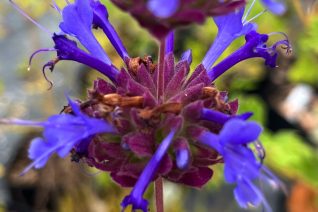
A hybrid between two southern California shrubby Salvias has yielded an amazing plant for our gardens. The parents of this hybrid are S. clevelandii  ‘Alpine’ x S. pachyphylla and it continues the amazing foliage fragrance of Salvia clevelandii and the deep blue flowers in purple bracts echo pachyphylla. A shrub/ sub shrub for the very warmest parts of the garden. Against a south or west facing aspect.  This Salvias parents come from poor, mineral soils and eventually the pale blue foliage builds to  a 30″ x 4′ evergreen shrub. It loses some leaves in harsh winters . In mid to late summer upright stems support whorls that emit striking  long deep blue flowers, these are held in a dark purple calyx – the each whorl is dark purple and showy before and after bloom as well. Takes the hottest locations and appreciates it.  Strategically placed among large boulder that radiate heat is also useful as is in Hell strips where heat builds. The stems elongate in bloom up to 2′ and are lined with mutiple whorls. Perhaps no animal loves this sage or Salvias in general more than hummingbirds. And the radiant blue tubular flowers are perched just for them.  Long blooming aromatic drought adapted sub-shrub.  Good drainage, full sun, and regular water to establish, let it dry between watering during summer.  Mix with Manzanita, Epilobium – Zauschneria, Grevilleas.  Do not cut back until new growth begins in mid spring. Beautiful in bloom. Excellent with a gravel mulch and on south facing slopes.  Protect from prolonged temperatures below 15ºF, cover with a cardboard box or a tarpaulin. Naturally drought adapted.


My Favorites

Plant type: , ,  |  Sun exposure:
Biome: , , , , ,  |  USDA Hardiness zone: Zn8a 15º to 10ºF
Foliage color: ,  |  Foliage season: