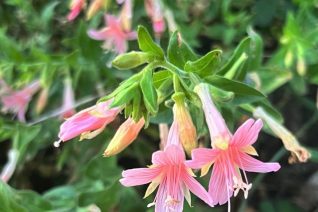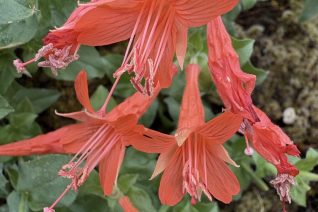
A friend of our nursery selected three Epilobium  formerly Zauschneria in southwest Oregon. This species native throughout California just dips into the southern 1/3 of the southwest part of the state. This form is perhaps the most vivid of the three that Mark Wade chose. Electric salmon/orange flowers with large pink protruding stamens covers this massively blooming perennial. The habit of this form is spreading but lower- intermediate between the low growth of ‘Horse Wall’ and the height and vigor of ‘Illy’. The leaves on this form are more rounded and green and the tubular flowers are electric occurring from early August to October. Hummingbirds adore this plant and it will be visited by birds flying south for the season. To 8″ tall and spreading to 2′-3 wide in rich, well drained soil with regular water to establish. Add a handful of all organic fertilizer when planting , it will establish faster and grow much more vigorously. That said, its a very easy, climate adapted perennial and it can go without summer water when firmly established. These Epilobiums do appreciate a soak every few weeks in the driest part of summer. Totally winter deciduous this herbaceous plant is completely absent in winter. Mix with other climate adapted and vigorous perennials such as Salvia cohuilensis ‘Nuevo Leon’ and Verbena rigida. In habitat it consorts with Clinopodium  and Sidalceas among many others. Excellent performance in containers and will last for years, spreading by the root to emerge from cracks in the pot or or like its natural habitat to root around rocks. Tidy the remnants in spring. Not bothered by deer. Full sun.  Oregon native plant.

Xera Plants Introduction
My Favorites

Plant type:  |  Sun exposure:
Biome: , , , ,  |  USDA Hardiness zone: Zn6a -5º to -10ºF
Foliage color: ,  |  Foliage season:


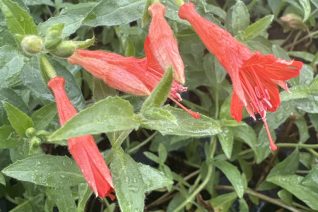
Another selection of Epilobium (Zauschaneria) that our friend Mark Wade made in SW Oregon. This is a lovely low growing form with smaller but profuse vivid lighter orange flowers and this selection supports pink stamens and pollen as well. To less than 6″ tall but spreading to an area of several square feet in a season. ‘Horse Sign’ bears sheets of these tubular flowers for several months beginning in August. Loved by hummingbirds it forms a vivid orange carpet of color. Enriched soil with a bit of all organic fertilizer will send this hardy perennial soaring. Water regularly for the first season, letting the soil dry in between. In subsequent years you can water much less if at all. Full sun to very light shade. Ideal for a slope and along rock walls at eye level. Very showy late season native perennial. Completely deciduous in winter with excellent hardiness to cold. This roaming perennial can inhabit and spill around other perennials, shrubs.  Low and spreading, avoid large perennials nearby that could flop on top. Long lived and easy to grow excellent for late season pollinators and vivid color. Mix with other low growing, sun loving perennials such as Scuttelaria, Orginanum ‘Xera Cascade’ and Erodium ‘Spanish Eyes’. Mulch with compost the first winter, this will help energize it to roar out of the ground in mid spring. Foliage is smaller and green but with a silver cast. Very  good looking native perennial. Oregon native plant

Xera Plants Introduction

My Favorites

Plant type:  |  Sun exposure: ,
Biome: , , ,  |  USDA Hardiness zone: Zn6a -5º to -10ºF
Foliage color: ,  |  Foliage season:


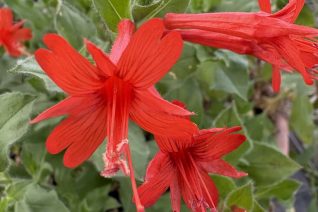
A friend of the nursery Mark Wade selected several forms of Caifornia Fuchsia that are native to southwestern Oregon. This form is low and spreading to 1′ tall and up to 3′ wide. It has large and exceptionally vivid orange flowers from July to October. The flowesr are perched as horizontal tubes that beckon hummingbirds. This form was found along the Illinois River in Josphine, County hence the name ‘Illy’.  It has distinctively green foliage which is a great contrasting backdrop to the vivid flowers.  Rich soil  that drains in full sun with regular summer water for the first summer. Completely deciduous in winter,  Common associates in the wild are Delphinium nudicaule, and Iris bracteata as well as Sidalcea asprella ‘Josephine’. Very easy to grow  native perennial for hot sunny spots- the front of low borders, large rock gardens. Very long blooming selection that has enhanced cold hardiness.  Avoid crowding from taller plants. Creeps underground  by stolons up to 6″ away from the initial clump annually. Very drought adapted when established. Thank you very much Mark.  Oregon native plant.

Xera Plants Introduction
My Favorites

Plant type: ,  |  Sun exposure:
Biome: , , ,  |  USDA Hardiness zone: Zn6a -5º to -10ºF
Foliage color:  |  Foliage season:


Epilobium densiflorum

Spike primrose is a quiet but important long season hardy annual. It rises up to 2′ tall when happy. A dense thick spike of buds rises and the small pink flowers decorate the spike in a circle. Loved by pollinators and especially popular with butterflies. This drought adapted annual blooms from July to October. Mix with other hardy native annuals. Especially nice with Madia elegans as their bloom period are the same. Full sun in virtually any soil. Water in potted plants well and you will likely see seedlings in open disturbed sites in the spring. The seedlings of this Epilobium mimic several more weedy types (they are native but kind of rambunctious). This plant is never showy but its a primary nectar source for late in the summer. Very easy, climate adapted native hardy annual. Native in the Portland city limits. Found primarily in stable meadows on both sides of the Cascades.  Oregon native plant.

My Favorites

Plant type:  |  Sun exposure:
Biome: , , , , ,  |  USDA Hardiness zone: Zn5a -15º to -20ºFZn6b 0º to -5ºF
Foliage color:  |  Foliage season:


Epilobium (Zauschneria) ‘Carmen’s Gray’

California Fuchsia that is an excellent combination of hot orange tubular flowers set agains dusty gray foliage. To 18″ tall in bloom this Epilobium is a spreader especially in light to rich soil. Adapted to life on slopes and often between boulders on cliffs. There its roots penetrate the cool, wet cracks and that provides sustenance. Give this perennial at least 2′ x 3′ feet to roam. Wonderful performance in hell strips.  Add a little compost and organic fertilizer and you’ll be off to the races. Most (Zauschnerias) require irrigation about once a month and no more than once a week to look and bloom their best. Though it is supremely drought adapted this occasional irrigation substantially improves looks. Loved by hummingbirds and bush tits too who play with the flowers and rip them apart- their goal I have no idea. Dies to the ground in winter- the only presence then is spent stems. Cut these away in early spring after a threat of a hard freeze has passed  Companion plants in the wild are Diplaucus, Delphinium cardinalis, Sedum spathulifolium. California Fuchsias range into southern Oregon and technically they are native to our state. This is an excellent perennial with great contrast between the masses of hot flowers and gray foliage. Not bothered by deer. Loved by hummingbirds Oregon native plant.

My Favorites

Plant type:  |  Sun exposure:
Biome: , , , ,  |  USDA Hardiness zone: Zn7b 10º to 5ºF
Foliage color:  |  Foliage season:


Epilobium (Zauschneria) cana ‘ Peach Surprise’

A beautiful color form of California Fuchsia. This is is a very long blooming, low, spreading perennial with downy gray green foliage and a constant procession of tubular peach/pink flowers. Loved by low flying hummer’s this plant is ideal for hot, locations in soil that never becomes boggy. To 6″ tall x 2′ wide and forming substantial patches in full sun. Excellent performance in hell strips. Most Epilobiums (Zauschneria) in our climate are drought tolerant but they perform better and are showier in bloom with light, occasional summer water.  Water during the driest times of the year about once every two weeks. Blooms begin in late July and are resplendent well into autumn.  Great long term performance in large containers, planters. Winter deciduous. Remove frost damaged tops when frost kills them. Best to match the vigor of this perennial with vigorous neighbors. It can swamp shy plants. Excellent in rock walls, at the top of walls.  Combine with Sedum palmeri, Helichrysum thianshanicum, Chocolate cosmos for a community of perennials with identical requirements. Winter deciduous. Spreads laterally by underground stolons. Give Woody some room.

My Favorites

Plant type:  |  Sun exposure:
Biome: , , ,  |  USDA Hardiness zone: Zn7a 5º to 0ºF
Foliage color:  |  Foliage season:


Epilobium (Zauschneria ) 'Solidarity Pink'

Epilobium (Zauschneria ) ‘Solidarity Pink’

If shocking vermillion, red, and orange are a bit too vibrant for you enter this softly hued selection. Soft pink tubular flowers appear constantly from early August to October. Low spreading perennial to 8″ tall by 2′ wide in a short time. The very light green foliage is clad in soft hairs giving the whole plant a soft mien. Full sun and rich to average well drained soil is ideal. Slopes, rock gardens, walls, hellstrips all are appropriate for this low water plant. Water diligently to establish but never boggy. In subsequent years only light water on occasion is required. Spreads laterally underground by stolons. Long lived perennial if sited and somewhat cared for. Completely winter deciduous- cut away the previous years dead growth in February. Somewhat deer resistant. Mix with other late blooming perennial. Wonderful combined with Cuphea hirtella and the soft yellow flowers of Erodium chrysanthemum.  West coast native plant that calls to hummingbirds far and wide. Takes blasting hot conditions in stride.

My Favorites

Plant type:  |  Sun exposure:
Biome: , , , ,  |  USDA Hardiness zone: Zn7a 5º to 0ºF
Foliage color:  |  Foliage season:


Epilobium (Zauschneria) latifolia ‘Calistoga’

California Fuchsias are known for their striking hot orange flowers. This variety takes it even  further with profuse flowers that range to vermillion red. To 1′ tall and 3′ wide in rich, well drained soil with little summer moisture. Full sun. This spreading gray leaved perennial begins blooming in August and extends to October. Excellent perennial for dry hillsides, large rock gardens. Combines well with Arctostaphylos and other low water plants. Loved by hummingbirds. Completely deciduous in winter. Give it room to spread. The vermillion orange flowers are larger than other cultivars and its impressive.

My Favorites

Plant type:  |  Sun exposure:
Biome: , , ,  |  USDA Hardiness zone: Zn7b 10º to 5ºF
Foliage color:  |  Foliage season:


Epilobium (Zauschneria) 'Silver Select'

Epilobium (Zauschneria) ‘Silver Select’

No other California Fuchsia has foliage that even approaches being as ashy white as this cultivar. Its as if the foliage is covered in dense white powder. The 1″ long hot orange/red flowers absolutely shine against this ghostly backdrop. Vigorous perennial for well drained sites and just light summer water. Full sun. To 20″ tall in bloom which starts in early August and continues into October. Hummingbirds dive down for this vivid sweet treat. Expanding to a clump 2′ wide in just a few years. Dies completely away in winter…only the stoloniferous roots remain to regenerate this sexy perennial in spring. Moderate deer resistance. The flowers are individually the largest of any cultivar that we grow.

My Favorites

Plant type:  |  Sun exposure:
Biome: , , , ,  |  USDA Hardiness zone: Zn7a 5º to 0ºF
Foliage color:  |  Foliage season:


Epilobium (Zauschneria) ‘Bowman’

Possibly our second most popular California Fuchsia cultivar as it is more upright but also a free and early bloomer. To 20″ tall the fine green leaves that line the stems make the brilliant orange tubular flowers stand out. Blooms early August to October and spreading underground by stolons to form expanding colonies. To several feet wide- give it room. Rather than running over neighboring plants ‘Bowman’ flows around other plants never over topping or even crowding the. Ideal in full sun, well drained soil- or on a slope which will further assist in drainage. Brilliant flowers are a beacon to Hummingbirds. Completely drought adapted and requires little if any summer water. Long blooming western native perennial. Water regularly to establish the first year.

My Favorites

Plant type:  |  Sun exposure:
Biome: , , , ,  |  USDA Hardiness zone: Zn7b 10º to 5ºF
Foliage color:  |  Foliage season: