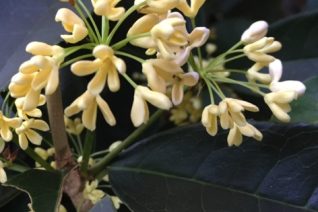
A local form of Fragrant Tea Olive that was discovered as a seedling in Phil Thornburgs wonderful SE Portland garden. He has a large estabished collection of the genus Osmanthus and this seedling has turned out to have several exemplary attributes- So we named it for the gardener. A moderately fast growing evergreen small tree to 16′ in 10 years. Large glossy foliage emerges tinted a very striking russet red before settling to deep green. This new growth follows the flowers which in our climate appear from late fall to early spring – on wood that is more than one year old. Parchment colored tiny flowers ring the stems and emit one of the most penetrating  perfumes in the floral kingdom- sweet apricot and freesia  These flowers are dried and used to flavor tea in China. The trunk/stems are a soft taupe color that contrasts nicely with the dark green foliage. We have observed excellent cold hardiness but  it should still be protected from subfreezing east wind during arctic events. The west side of a building is ideal- and you can appreciate the sweet perfume in winter just by opening a window.  Somewhat formal looking small tree that has a conical habit in youth and then a spreading crown with age. Water to establish, then light water during summer drought. Full sun to light shade. Gains hardiness with age/ establishment. Protect young plants from temperatures below 15F- cover with a cardboard box. Excellent tree for courtyards, the slim areas between modern architecture. Wonderful tried and tested local selection of an infamous tree native to large parts of Asia. Durable, almost formal, verdant look year round.

Xera Plants Introduction

My Favorites

Plant type: , ,  |  Sun exposure: ,
Biome: ,  |  USDA Hardiness zone: Zn7b 10º to 5ºF
Foliage color: ,  |  Foliage season:


Osmanthus decorum ‘Baki Kasapligil’

Osmanthus are incredibly handsome and useful shrubs/trees and turkish Osmanthus fits that trend  Renowned for fragrance this tough species excels at its tidy and uniform look year round. Long pointed deep green leaves are exceedingly handsome and immediately one thinks of this 8′ x 8′ shrub as an ideal  hedge subject and it is. In mid spring small tubular flowers crowd the leaf axils and emit a vanilla aroma that is detectable many meters away. Moderately fast growing evergreen for full sun to quite a bit of shade it is adapted to most well drained soils, including heavy clay. Exceptionally tolerant of drought when established  and very long lived. In time, sans pruning, it will achieve small tree status. Cold hardy to 0ºF and not terribly sensitive to subfreezing wind. Not often bothered by deer- protect young plants with age and familiarity they will leave it alone.  Very good replacement hedge for voracious and invasive cherry laurel or disease riddled Photinia.  Somewhat formal appearance.  Lovely no water/low water shrub when established.  Prune after flowering- blooms on old wood This is one of the parents of Osmanthus x burkwoodii. .This form was selected from the wild in  Turkey/Anatolia.

My Favorites

Plant type: ,  |  Sun exposure: , ,
Biome: , , , ,  |  USDA Hardiness zone: Zn7a 5º to 0ºF
Foliage color:  |  Foliage season:


Osmanthus armatus ‘Lemon Line’ ™

A wonderful sister to our  variegated selection of Osmanthus armatus ‘Zipline’. This all gold form emerges tinted in red before the leaves turn to an illuminating lemon, lacquer yellow.  The symmetrically spined leaves add to the display. Full sun to part shade. Variegation is brightest in full sun. Moderately fast growing and glowing evergreen shrub for average to enriched soils. Ligjht consistent summer water to establish, then occaisionally depending on aridity. To 4′ x 4′ in 6 years and then progressive larger. Shares the same toughness as the species enduring temperatures slightly below 0ºF. Tiny white flowers are adorable in fall but add little. Not fragrant that I can detect, but the glory of this shrub is in how vivid the foliage shines. Not perfectly drought tolerant, check it before heat waves. Other than that its handsome year round and gets better with age. Tolerates some subfreezing wind. Not the first shrub/tree on a deers list but you never know. Mine is home to the deep blue flowered Clematis ‘Rhapsody’ for a brilliant contrast.

Xera Plants Introduction

My Favorites

Plant type: , ,  |  Sun exposure: ,
Biome: , , ,  |  USDA Hardiness zone: Zn6b 0º to -5ºF
Foliage color:  |  Foliage season:


Osmanthus armatus ‘Zipline’

Sometimes the garden goddess smiles on us. I found this sport (a variegated stem) on my Osmanthus armatus ‘Jim Porter’ and I separated and rooted it. It has become a fantastic extremely showy shrub. This is welcome because Osmanthus armatus is not a particularly conspicuous species. It has serrated deep green leaves and small white flowers in autumn that emit a faint but sweet fragrance. Variegation improves the species markedly. The variegation is very stable, I have yet to see any reversions. Each leaf is symmetrically serrated and the variegation is vivid and adds an incredible amount of depth. Large growing shrub to 9′ x6′ in 10 years. Excellent cold hardiness on a brilliant evergreen. Full sun gives the best variegation and I have yet to see it burn in the hottest conditions. Excellent specimen, hedge, or screen. Cut foliage lasts for about 1 week in a vase. Light consistent summer water to establish then very tolerant of dry summer conditions  Cold hardy slightly below 0ºF and durable and long lived. In time it can make small tree status which makes a very striking tree. A wonderful shrub and a happy discovery, See video below.

Xera Plants Introduction

My Favorites

Plant type:  |  Sun exposure: ,
Biome: , ,  |  USDA Hardiness zone: Zn6b 0º to -5ºF
Foliage color:  |  Foliage season:


Osmanthus heterophyllus ‘Kaori Hime’

What a sweet little version of Holly Tea Olive. Leaves are tiny compared to the species and the whole plant is a diminuitive version of the that plant. To just 4′ x 4′ in 10 years it eventually gets progressively larger. An extremely floriferous form that condenses hundreds of small white fragrant flowers along the stems in October to December. Slow to finish in a container because of its size- be patient.  Grows about 4″ per year. Foundations, rock gardens, hedges, specimen. Great cold hardiness for a broad leaved evergreen. Drought adapted when established otherwise it tolerates regular irrigation which will eventually speed growth. Cute. Really, freaking cute ancient cultivar from Japan. Rare plant that is slow to increase. Limited quantities.

My Favorites

Plant type: ,  |  Sun exposure: ,
Biome: , , ,  |  USDA Hardiness zone: Zn6b 0º to -5ºF
Foliage color:  |  Foliage season:


Osmanthus heterophyllus ‘Akebono’

An exceptional Tea Olive that we love. New growth emerges pink before changing to lacquer white and finally deep green. This period of transition lasts for months and is far showier than the small white flowers that cluster at the leaf axils in autumn. They do, however, emit a sweet perfume that is detectable for many yards. Great cold hardiness for a broad leaved evergreen enduring temps below 0ºF with no harm. Tolerates subfreezing wind and would be a fantastic and showy hedge to block the east wind. To 7′ tall in 7′ years eventually reaching small tree size. Full sun to part shade in average to enriched soil where there is never standing water in summer. Tolerates clay soils on slopes and it is best with about 3 deep soaks per summer once well established. Mulch when planting. Avoid reflected heat. Moderately deer resistant. Blooms on old wood. Prune if needed AFTER blooming has ended. Naturally dense habit. As the shrub matures the leaves which are  mildly prickly in youth change to smooth edged entire leaves. Pretty, tough, dynamic shrub. Japan.

My Favorites

Plant type: ,  |  Sun exposure: , ,
Biome: , , ,  |  USDA Hardiness zone: Zn6a -5º to -10ºF
Foliage color: ,  |  Foliage season:


Osmanthus heterophyllus ‘Variegatus’

Excellent cold hardy, drought tolerant shrub that reaches tree like proportions with great age. The pretty variegation presents as prickly leaves outlined in white. With age/maturity the leaves lose their prickles and become smooth and entire. The variegation on this plant is incredibly stable. I have yet to see a reversion of any consequence. Ancient specimens that are now 20′ trees can be found in old, old gardens. Its obviously been grown in this climate for eons. Very, very cold hardy evergreen that is not only hardy below 0ºF it makes a great hedge even near the Gorge where it endures subfreezing wind with no ill effects. Tolerates regular irrigation which increases the rate of growth- on average about 2′-3′ per year can be expected. 8′ x 6′ in 7 years is typical. Full sun to shade. Avoid permanently boggy soils- otherwise very adaptable- including heavy dry summertime clay. In October-December tiny fragrant white flowers crowd the stems. Moderate deer resistance. Long lived.

My Favorites

Plant type: ,  |  Sun exposure: , ,
Biome: , , , ,  |  USDA Hardiness zone: Zn6b 0º to -5ºF
Foliage color:  |  Foliage season:


Osmanthus heterophyllus ‘Sasaba’

We adore this wickedly armed evergreen shrub. Its a piece of pure architecture. The sharply pointed leaves jut out like blades and are deep glossy green year round. Excellent, interesting evergreen for screen or specimen. Totally cold hardy- excellent performance in blasting subfreezing winds from the Gorge. Rounded, upright shrub to 9′ tall and 6′ wide in 8 years. In autumn the stems of older wood are crowded with tiny white flowers that emit a sweet perfume. Bloom Sept.-Nov. and sometimes later. The fragrance carries quite a distance on mild days. Light water to establish then completely drought tolerant in average, well drained soil. Also accepts the regular irrigation of borders. Good bet where deer are a menace. Full sun to quite a bit of shade. Great barrier hedge.

My Favorites

Plant type: ,  |  Sun exposure: , ,
Biome: , , ,  |  USDA Hardiness zone: Zn6a -5º to -10ºF
Foliage color:  |  Foliage season:


Osmanthus heterophyllus ‘Goshiki’

Wonderful, useful, well scaled variegated hardy Tea Olive that is also incredibly hardy to cold. To 4′ x 4′ in 8 years this slow growing dense shrub has new leaves that emerge tinted pink, mostly cream and then settles to green leaves with splashes of cream. Excellent appearance year round. Great shrub where subfreezing winds are brutal. In October to November the tiny white flowers cluster around the leaf stems and crowd the twigs- they emit a sweet perfume detectable quite far away on mild days. Good deer resistance when established. Average to enriched, well drained soil. Light summer water. Full sun to quite a bit of shade. Very drought tolerant when established. Pretty.

My Favorites

Plant type:  |  Sun exposure: ,
Biome: , , ,  |  USDA Hardiness zone: Zn6a -5º to -10ºF
Foliage color: , ,  |  Foliage season:


Osmanthus fragrans

Long ago I dismissed this tall sweetly scented Tea Olive as hopelessly tender in our climate. Then in a garden in Lake Oswego under towering firs I ran head on into an 18′ tall perfectly happy specimen. Looks like it had never suffered damage. It was just a really nice broadleaved evergreen tree. Copious amounts of small off white flowers crowd the stems beginning in autumn in our climate and then sporadically until spring. The POWERFUL fragrance they emit is that of apricot/freesia/rose and it travels- detectable 20′ away when in full bloom. To 15′-20′ tall apparently. Requires protection as a young plant and it really should not be in an exposed site. Instead locate near a house wall- where you can open the windows and let the perfume flow- and gain added protection. Gains much, much, greater hardiness with age. Summer heat seems to play a role- the more heat in summer the hardier in winter. Full sun to high overhead shade. Grows 2′-3’/yr. when young- aided by consistent summer water. Otherwise established trees need little. Not a plant for cold gardens.

My Favorites

Plant type: ,  |  Sun exposure: ,
Biome: ,  |  USDA Hardiness zone: Zn7b 10º to 5ºF
Foliage color:  |  Foliage season: