

When you have a small garden you want to get as much bang for your buck as possible. Enter this great cultivar of English Lavender that blooms not just once but over and over again until frost. Medium lavender blue flowers cluster at the top of straight wiry stems to 10″ long. A naturally compact plant to about 2′ x 2′ ultimately. Silver evergreen aromatic foliage. Rich, to average well drained soil in full sun with light summer water. Somewhat drought adapted. Looks better , re-blooms better with light water. Saches, Lavender wands, potpourri- everblooming fragrant hedge. Very good Pastor. Very good.
Plant Type: Hedge or Screen

Screens and hedges are two different things but many of the same plants are applicable. A screen can be blocking one particular view or angle. At its best it is informal and grows quickly to its intended height. A hedge is inherently more formal. Often clipped or sheared it professes a uniformity that imbues structure and form into gardens. Hedges can delineate space in a natural way and they don’t have to be formal. Shrubs with a similar habit in a row can be just as pleasing.

It pays dividends to treat these plants well from the beginning. Dig a large hole and develop a moat around each plant for irrigation. And absolutely mulch them. Treating a hedge well and uniformly affords you the best form and color and saves you the headache of having to replace a fallen soldier. We list screens and hedge plants varying in size. That gives the gardener as many applications as possible. One tip: When buying a row of hedge plants plant 1 or 2 more than you need in other parts of the garden, that way if one of them dies you’ll have a replacement of just the same size and you’ll save considerably too.
Climate adapted plants for gardeners in the PNW

Leptospermum lanigerum
Wooly tea tree is a cold hardy member of the myrtle family from Tasmania/Australia. The pewter gray small evergreen foliage creates a cloud like outline on billowing shrub. In June 1″ pure white single flowers spangle the boughs like snow. Woody seed capsules follow and persist. To 12′ tall and 4′ wide in 7 years. May be limbed into a small tree. Full sun and virtually any soil. Light summer water though very drought adapted. Excellent background shrub or screen or large informal hedge. Takes well to pruning which will not mangle the tiny foliage and becomes very dense as a result. Good bet where deer are a problem. Cold hardy to about 5ºF. Grows very fast with regular irrigation which is recommended for the first summer to establish. Does not tolerate shade of any kind. When using as a hedge plant about 2′ apart for a fast screen. Prune after flowering and again in autumn. Tasmania.

Leptospermum rupestre ‘Squiggly’
One of the naturally cold hardiest species of tea tree. This form of Alpine tea tree from Tasmania has a distinctly upright habit. Cinnamon red squiggly stems support tiny pewter colored evergreen foliage. In early summer pink buds spangle the stems opening to pure white single flowers. So prolific is the bloom that the plant appears covered in snow. Vigorous growth to 5′ tall and 3′ wide in 6 years. Full sun and virtually any soil. Summer water is tolerated but far from necessary. Takes pruning incredibly well, including shearing and the leaves are so small that they remain unmangled. It quickly forms a dense hedge that is tough, incredibly dense and drought and cold hardy. Strongly deer resistant. Excellent shrub or hedge for rural areas. It tolerates a wide variety of soils and aspects. Leaves are aromatic when bruised. You achieve a much shapelier plant with even a minimal amount of tip pruning. otherwise it has a very wild habit. It has been undamaged by cold to 0ºF. Drought adapted. Tasmania. Click on the green link below for a video of ‘Squiggly’ in full bloom. Excellent shrub with a number of uses.
Xera Plants Introduction.

Lonicera ‘Lemon Beauty’
Dramatic yellow foliage with an interior of deep green on the small evenly spaced evergreen leaves of this low spreading shrub. To 3′ x 4′ and forming something of a mound. Spreads low at first- gains height with age. Rich soil with light summer water in full sun to part shade. Very drought tolerant when established. Lights up borders, is easily clipped- without mangling the small foliage. Flowers are tiny and cream colored often followed by translucent purple berries. Sometimes reverts to all green – just cut those reversions cleanly out. Very easy to grow plant for foundation plantings, tough sites, hedges. There is some confusion over the exact species…if you look it up half say L. nitida and half say L. pileata. I’m going to have to go with L. ??. Shrubby honeysuckle.

Lonicera nitida ‘Baggesens Gold’
Useful fine textured golden evergreen shrub that brightens the landscape. This form of box leaf honeysuckle is popular as a sheared hedge but we think it makes a better focal point. The leaves can burn in the hottest locations and conversely turn a bit more green in the shade. Takes any amount of pruning. We have yet to notice flowers or berries on this cultivar. To 4′ x 4′ very quickly. Very drought tolerant when established. Cold hardy to 0ºF when established. May be pruned into any conceivable shape. The tiny leaves escape damage by shearing and the whole plant becomes immensely dense. Prune virtually any time of the year. Supposedly tiny yellow flowers are not very conspicuous but can transform into translucent purple berries if pollinated. Rare to see. Grows quickly.

Lonicera nitida ‘Twiggy’
British selection that is a golden dwarf form of L.n. ‘Baggesen’s Gold’. Low compact dense growing ever-gold shrub that is well scaled for small gardens. To 1′ tall and in a long time 1/1/2′ wide. Full sun to part shade in rich to average well drained soil. Leaf color is most vivid in full sun and hardiness to cold improves there too. We have never seen flowers on this cultivar of box leaf honeysuckle. Easy to grow. In very cold winters the foliage takes on maroon tints. Low hedges, massed as a ground cover.


A fantastic selection of a species that has many fine attributes. ‘Soft Caress’ is one popular iteration and we grow a blue leaved variety with much larger foliage. This form has the finely dissected leaves of ‘Soft Caress but about one scale larger. The new growth emerges maroon and indeed it keeps that tint for most of the year. In December-February spikes of gold/yellow flower light the dark of winter. While some selections in this species can be tender to extreme cold and primarily subfreezing wind- this is a hardy variety with few problems with cold. To 5′ tall and 3’ wide forming a pillar of gorgeous fine, pinnate leaves. In time it can take very dry shade positions as well as sun with a bit more water. Full sun to deep shade. Not palatable to deer but loved by rabbits. Protect when young. Very tough but elegant evergreen. Mix with winter blooming and dry shade accommodating Sarcoccoca for similar culture. Regular water to establish.
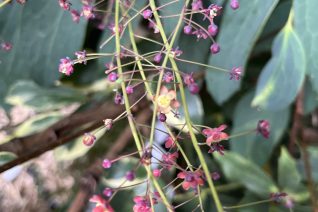
Mahonia gracilipes
Elegant, sturdy mahonia that has wands of small red and yellow flowers in late summer. To 5′ tall give it full sun to part shade. Avoid the reflected heat of walls. The somewhat concave pinnate leaves are frosted on the underside with very light gray blue. The wind, however must really howl to reveal this secret. Stiff and upright, it flails toward the sun in shade. It is at its best in very high overhead shade or morning sun with afternoon shade (an eastern aspect). Occasional deep soaks in summer ensures the display of fall flowers. The tiny flowers are replaced by oblong small fruits that begin pink and arrive at purple/black upon ripening. Most of these fruits will b consumed by birds. The subtle flowers are a beacon to both hummingbird and Bush tits. Good shrub where heavy snow/ice occur. Cold hardy to slightly below 0ºF. Grows fairly slowly. Mix in shrub borders or low water high shade. Pretty shrub native to China. Not bothered by deer or rabbits. Raised from seed. Limited quantities. Red flowered Mahonia.

Morella (Myrica) californica
Pacific Wax Myrtle is native along the direct coast from Santa Barbara California to near Tofino, on Vancouver Island, BC. It forms a large evergreen shrub to eventually a small tree in time and has thin, pretty dark green foliage. Aromatic if bruised the leaves are deep green and lustrous year round. Tiny brown flowers change to waxy gray berries that line the stems but are not terribly conspicuous. Fast growing to 12′ tall and 8′ wide in 7 years. Adaptable to a variety of soils, including winter inundation. Soil that is too rich can lead to prodigious growth and an unsteady plant until it bulks up. Judicious pruning can keep it much smaller. Prune at any time of the year. An excellent, drought tolerant, cold tolerant shrub for a hedge, screen or small garden tree. Our material is from locally cold hardy stock. Easy. Tolerates salt spray- including first line strand conditions. Recently changed from Myrica to Morella. In time it can become a handsome rounded evergreen tree with contrasting pretty white bark. Oregon native plant.

Olearia x haastii
Our most favorite New Zealand Daisy Bush this Olearia hybrid forms a large ever-gray rounded shrub. The small waxy thick leaves have a top of olive green and an underside of nearly white. Clusters of white daisy flowers in summer have a distinct vanilla fragrance that carries for some distance. And following those are fluffy tan seed heads. A tough and cold hardy Olearia – we’ve never seen it damaged by cold in PDX. To 6’x 7′ in 5 years for full sun and poor to average well drained soil. Completely summer drought tolerant- once established no water is required. Handsome shrub for wild areas, an informal hedge, coastal spray. In time the trunk becomes shreddy and gnarled. Prune after flowering if needed. Moderate deer resistance. Handsome plant.
- « Previous Page
- 1
- …
- 4
- 5
- 6
- 7
- 8
- 9
- Next Page »