Telopea x ‘Braidwood Seedlings’

Waratah of Australia, this extraordinary shrub produces some of the most alluring flowers in the flower kingdom. A tall growing evergreen shrub with handsome leaves. In spring and often again in late summer crown shaped flowers emerge purple and open to circular red flowers at the branch tips. These are seedlings of Telopea x ‘Braidwood Brilliant’ which is a hybrid selected for excellent cold hardiness for the cut flower trade. Protea- which means you should avoid fertilizer and too much compost. Rich to average soils- pure loam is ideal in a protected location in full sun to part shade. Avoid reflected heat. Light summer water. Not the easiest shrub to establish but the care and patience are worth it in the end. Cold hardy to approximately 5ºF. Protect from subfreezing wind. Amazing cut flower that lasts for weeks in a vase- if you can spare a stem. Excellent performance at the Oregon Coast.  To 12′ x 8′.

Xera Plants Introduction.

My Favorites

Plant type:  |  Sun exposure: ,
Biome: ,  |  USDA Hardiness zone: Zn7b 10º to 5ºF
Foliage color:  |  Foliage season:


Ternstroemia gymnanthera

Obscure but exceedingly handsome and reliable shrub for hedges, specimens, eventually a small tree. Rounded leaves are good looking year round and especially when they first emerge brilliant salmon red before settling to dark green. This is the most showy display on this plant and it lasts for weeks. In mid-late summer small pendant white/cream flowers are nestled among the leaves, you really have to look to see them. Clean evergreen whose foliage is never marred by fungus or cold. Full sun to high overhead shade. To 8′-10′ tall and about half as wide. With great age and no pruning it can achieve small tree status and it forms attractive cloud like crowns of foliage. As a hedge  it excels. Plant 2 gallon plants on 3′ centers and mulch. Irrigate about once a week until you see good new growth. Established plants are very tolerant of dry conditions. Theaceae- Camellia family. Excellent cold hardiness to 0ºF, tolerates some subfreezing wind. Excellent companion plant for Rhododendrons, Pieris, Illicium. Full sun to quite a bit of shade. Native to Japan.  Good looking tough plant. Light deer resistance.

My Favorites

Plant type: ,  |  Sun exposure: , ,
Biome: , ,  |  USDA Hardiness zone: Zn7a 5º to 0ºF
Foliage color: ,  |  Foliage season:


Tetrapanax papyifera ‘Steroidal Giant’

Big form of the already big Japanese Rice Paper plant. Enormous 3′ wide leaves look jurassic and erupt in spring from seemingly spindly bare stalks. Fast growing deciduous shrub/tree that also suckers to form wide colonies. To 18′ tall in 5 years with multiple trunks in deep rich soil with regular irrigation. Full sun to part shade. Be aware that this plant travels. It moves stealthily underground and can be many feet away from the parent plant before you notice it. The more root disturbance the more errant suckering. Give it room and respect. Light summer water. Almost blooms each autumn before running out of heat and daylength. Bare sticks in winter. It may also be contained the same as bamboo. It is, however, easy to pull the suckers by hand. Wait until they grow several leaves and then grab it by the stem and wiggle, slowly at first then in wide arcs and pull. It will pull right up. Also, there is a conspicuous indumentum (brown fur) all over the plant and especially the leaves, these tiny hairs when rubbed off or disturbed can cause skin irritation in some people. Wear gloves and a rain coat while pruning.

My Favorites

Plant type:  |  Sun exposure: ,
Biome: , , ,  |  USDA Hardiness zone: Zn7a 5º to 0ºF
Foliage color:  |  Foliage season:


Teucridium parviflorum

A stylish shrub/subshrub that is native to the drier parts of New Zealand, and offers great fine texture. The stems which are the only thing that differentiates this from the genus Coprosma- they are square. are golden orange woody stems that  rise up to about 4′ tall by 3′ wide.  Tiny round green leaves decorate these stems and in late spring and early summer small white flowers appear in the leaf axils. This plant can quickly return from the roots if chopped back severely or frozen to the ground. Established plants can regain their stature in several months. Average to enriched soil that is never boggy in summer. The fine foliage  common adaptation in New Zealand, most likely the fine texture of the shrub was to foil grazing giant moa birds and other predators. Very good in containers ( it will be less hardy in a container as with  everything) and it can be crowded heavily and still thrive. In the ground give it enriched soil and regular summer water for its first season. Let it grow as much as possible and develop a resilient root system- in the case of an arctic event it will be well prepared to regrow.. Mulch in fall for the first year. The luminous stems and see through appearance make it combine well with bolder textured plants. Regiar water in summer speeds growth and establishment the first year, in subsequent years it only requires irrigation once every two weeks. Freezes the ground at about 20ºF, returns quickly in spring when the soil warms. Not bothered by deer, not sure about rabbits. Excellent architectural plant. We took a break from growing this plant for years, we’re happy that its back.

My Favorites

Plant type: ,  |  Sun exposure: ,
Biome: , , ,  |  USDA Hardiness zone: Zn8a 15º to 10ºF
Foliage color:  |  Foliage season:


Teucrium fruticans

Silver Germander is a wiry shrub with gray foliage and even lighter gray/white stems. All summer it bears pale blue small flowers with a prominent central lip. Traditionally used in topiary or as a trimmed hedge, it takes amazingly well to heavy shearing. It responds by becoming incredibly dense. Its malleability  leads people to also trim it into any whimsical shape they can dream of. Full sun, average, well drained soil. Little to light summer water when established. Requires full sun and a hot position with protection from subfreezing wind. Classic mediterranean shrub. Grows as well at the cool coast as it does in the hot inland areas. To 4′ x 4′ if left unpruned.

My Favorites

Plant type: ,  |  Sun exposure:
Biome: , ,  |  USDA Hardiness zone: Zn8a 15º to 10ºF
Foliage color:  |  Foliage season:


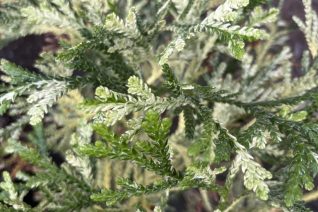
A fantastic, tough and exotic looking evergreen (conifer)  that is striking and easy to grow. To 4′ in 10 years, a slow growing shrub that is often as wide as it is tall. The scale leaves are deep glossy green liberally splashed with cream. The large leaflets protrude from a single trunk and is layered like a gigantic moss. The foliage is glossy on the surface and dull beneath. Wonderful specimen or even small hedge. Scaled very well for large rock gardens. This is a very rare form of this enchanting species native to Asia. Full sun and water to establish, let it dry between irrigating, then in a year or two it can survive on natural rainfall alone. Very cold hardy and takes the subfreezing wind from the east with no damage. Excellent in the Columbia River Gorge. Not bothered by deer,and likely not bothered by rabbits, but we are not 100% sure, but its worth a try. Good appearance year round.

My Favorites

Plant type: ,  |  Sun exposure: ,
Biome: , , , ,  |  USDA Hardiness zone: Zn6a -5º to -10ºF
Foliage color: , ,  |  Foliage season:


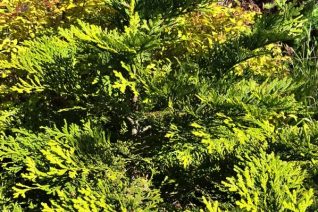
Elk Horn Cedar is originally from Japan but is grown around the globe This layered and refreshing glossy green conifer grows very slowly and looks fantastic year round. Slow growing to 3′ x 3′ in 10 years. Excellent in mixed borders or shrub borders. Water well to establish the first summer then occasional deep soaks in summer. Unlike any other confier the name elk horn refers to the flat leaflets that look to me like a form of giant moss. Works well in winter containers. The flattened scales are glossy on the surface and dull beneath. This is the darker green of two varieties in the nursery trade. It would make a challenging bonsai. Full sun to light shade in rich to average soil .  Not often deer food, very worth trying. Cold hardy below 0ºF for short periods. Excellent performance in the Columbia Gorge.

My Favorites

Plant type:  |  Sun exposure: ,
Biome: , , ,  |  USDA Hardiness zone: Zn6a -5º to -10ºF
Foliage color:  |  Foliage season:


Vaccinium ovatum

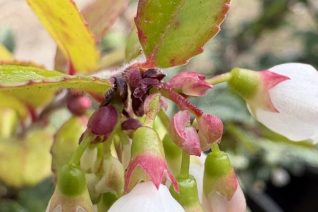
Evergreen huckleberry is a fantastic native broadleaf shrub. It is well adapted to shady sites and will accept full sun with regular irrigation. Well established shrubs require less water. Rich, humusy woodland soil is its favorite haunt and it will grow moderately fast to a rounded outline of 8′ tall and 6′ wide. The new growth is a beautiful salmon pink before changing to deep green. In spring and early summer small white urn shaped flowers are pretty and transform into tasty black fruits in autumn. Amazing in muffins, pies.It has an interesting natural distribution along the immediate coast in most of Oregon but veering inland at Douglas County to almost the Cascade foothills. In Puget Sound it seems to be most prominent within sight of salt water.  Easy to grow good garden plant. Increase your chance of pollination by planting more than two shrubs. The theory is that berries like to party- and I’ve observed it to be true.  Oregon native plant.

My Favorites

Plant type: ,  |  Sun exposure:
Biome: , , ,  |  USDA Hardiness zone: Zn7a 5º to 0ºF
Foliage color:  |  Foliage season:


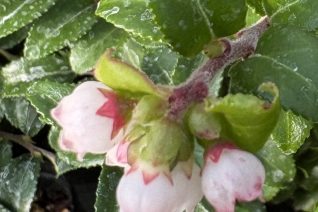
A very handsome version of one of our best native broadleaved evergreen shrubs . I spotted this form with larger leaves that are thicker and convex in the coast range of Douglas County.   It gives the shrub a  much more substantial appearance . The thick leaves emerge tinted salmon pink before settling to its permanent deep lusterous, dark green. To 6′ tall x 4′ wide in 6 years. Very dense habit is reminiscent of boxwood. This is a very useful and handsome form of Evergreen Huckleberry. This cutting propagated form will have a very uniform texture  and habit. In late spring small pink to white urn shaped flower transform into deep black purple tasty fruits. Plant more than one shrub to increase pollination and fruit set. Rich soil high in humic content with regular water in summer.  Mulch annually. Allow it to dry between watering. Plant on 3′ centers for a tidy fast hedge. Full sun to quite a bit of shade. Not bothered by deer. Almost formal appearance. Prune after flowering if needed.  Oregon native plant.

Xera Plants Introduction

My Favorites

Plant type: , ,  |  Sun exposure: , ,
Biome: , , ,  |  USDA Hardiness zone: Zn7a 5º to 0ºF
Foliage color:  |  Foliage season:


A form of evergreen Huckleberry that is found on the north and central Oregon coast. The leaves are slightly longer and curve a bit and have a fine but noticeable serration. This is a slightly bolder form that is very handsome and somewhat formal in appearance from the species. Forms a shrub with large canes that grow in earnest and then arch.. White flowers are slightly larger than  normal and appear in spring form slightly larger than normal black sweet fruit, about the size of a caper. Plant more than one shrub to increase pollination and fruit set. Full sun to full shade in humus rich, highly organic soil . Mulch for the first several years. Irrigate to establish for the first year or two then it should have a large enough rootball to resist summer drought.  Otherwise light summer irrigation speeds growth.  New growth is salmon orange and turns to shades of yellow before settling to dark green. Very pretty native shrub that demands more irrigation and mulch in full sun.  Makes a wonderful informal hedge in time. This form has a pronounced arching shape.  Excellent hedge material as this is cutting propagated and will maintain a uniform habit.  Wonderful form from the northern Oregon coast. To 8′ x 8′ in 10 years.  Prune if needed in Autumn.    Oregon native plant.

Xera Plants Introduction

My Favorites

Plant type: ,  |  Sun exposure: , ,
Biome: , , , , ,  |  USDA Hardiness zone: Zn7a 5º to 0ºF
Foliage color: , , ,  |  Foliage season: