

A great introduction from the Sequim, WA nursery Desert Northwest. Incredibly showy in bloom this easy to grow shrub produces 4″ long 1″ thick soft yellow colored sweetly scented brushes in late spring and early summer. Moderately fast growing shrub to 7′ tall and 3′ wide in 6 years. The pretty, fine foliage is handsome ochre green and contrasts beautifully with the light taupe colored bark.This is an exceptional shrub out of bloom as well and has a very upright, tidy habit for this genus. From a distance a mature shrub appears like a Podocarpus. Full sun and average to rich soil with light but consistent summer water. Drought adapted. Considering the size of the brushes this is an exceptionally hardy Callistemon taking 5ºF when established. If there is any confusion about which species this appears to be- the foliage is unlike C. pityoides but the large brushes are dense and fragrant just like that species. A hybrid is likely. This very upright shrub would make a fantastic informal hedge/screen with minimal pruning. Great shrub. Pollinated at night by moths who will literally glue themselves to the brushes for hours. Fascinating shrub.
Genus: Callistemon (Melaleuca)
Bottlebrush- Cold hardy varieties
Callistemon/ Melaleuca-
Callistemons bottlebrush are so closely related to paperbarks Melaleuca that they are now combined in that Genus. We list both to make them easy to find. Their common name is a description of the flower which is composed of very long stamens. These flowers hold a trove of nectar for animals at the base.
Bottlebrushes are in the Myrtaceae , directly related to Eucalyptus and native only to Australia. Over the years quite a few have been grown in our climate. We grow our favorites that have shown long term survival 15+ years. They also range a lot in hardiness. The hardiest species are pityoides – Alpine bottlebrush, with yellow flowers and viridiflorus- Mountain Bottlebrush with acid green flowers are both solidly zone 7b.

All day brilliant sun
Callistemons are sun loving plants and all uniformly abhor shade. Place them in at least 6 hours of sun per day. Callistemons in the shade will not bloom, grow rangily , and are much less hardy to cold. For full cold hardiness place in warm sunny open space and do not amend the soil. Water weekly for the first season then they are are much less thirsty. They are best with at least two deep soaks a month during the dry period. They all require full sun to bloom sufficiently.

Easy to grow, pruning, re-bloom
Bottlebrushes like closely related Tea Trees Leptospermums do not move once established. They have very woody roots that if severed do not regrow and the whole plant fails. Its best to start with a new plant. They bloom on wood from the past year but as they age they develop the ability to bloom on new growth as well. Callistemon pityoides often re-blooms in the autumn, but not every year. Mountain bottlebrush Callistemon viridiflorus has never been seen to re-bloom with just one season in late spring.
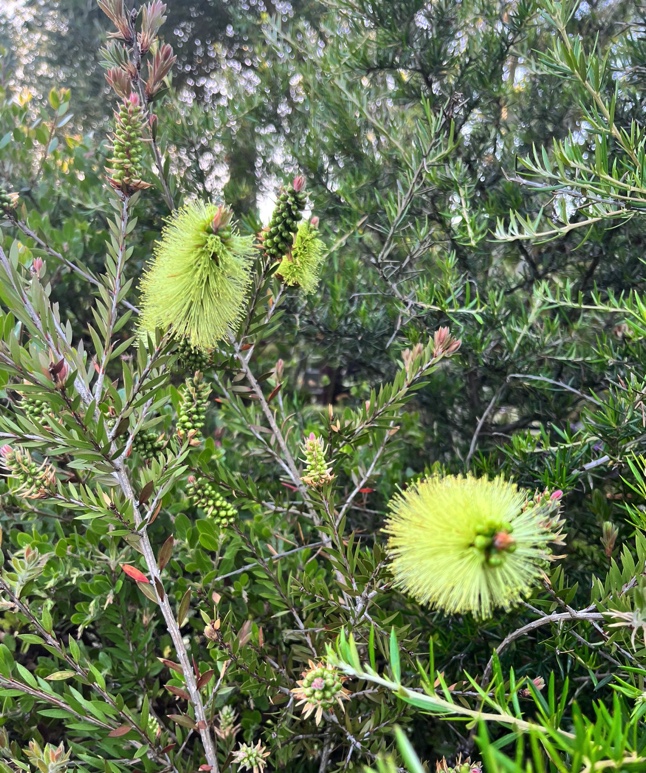
If an arctic episode occurs (temps below 20F for at least 3 days) you can protect young plants with a cardboard box secured for wind. In temperatures below 10F some species will freeze to the ground. This happens about 1/10 years in the Willamette Valley. Signs of a frozen plant, the bark will split from the trunk in strips and leave will dry and curl. Cut this plant to the ground – to 6″ in March. Water consistently during the recovery year and it will regain stature by the end of summer.
Callistemons are in the aromatic Myrtaceae and bruised foliage emits a sweet mentholatum aroma, this makes them less palatable to animals.
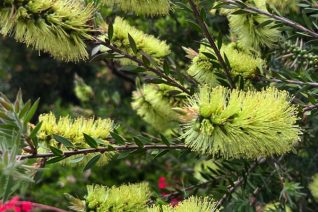
Callistemon (Melaleuca) viridiflorus
Mountain bottlebrush or Green bottlebrush is one of our very favorite shrubs that combines unusual foliage, beautiful bark, and a great flower color. Upright growing with small diamond shaped forest green leaves that line the wand-like stems. In cold weather this unusual shrub takes on maroon and purple tones, a great foil to the very light tan stems and trunk. To 8′ x 6′ in 6 years. In May 4” long by 1” wide chartreuse/yellow bottlebrushes protrude from the tips of the branches shoot out at every angle. In Tasmania where it is native it follows cold air drainages, proving that it requires at least some cold for good flower set. This clone is from a specimen that survived 0ºF in 1989. FULL sun and any soil with occasional summer water. My own receives no irrigation and performs beautifully. Hardier to cold in full sun. Unusual shrub that seems to bridge the aesthetic gap between broad-leaved evergreen and conifer. (Syn. Melaleuca virens)

Callistemon (Melaleuca) pityoides ‘Excellent’
This form of alpine bottlebrush has flowers that truly are excellent. Fine grass green needle like foliage on a spreading shrub to 5’ tall and 6’ wide. In early summer to early autumn 3” yellow bottlebrush flowers decorate the stems. Sometimes they are as long as 6″ and wind around like a serpent. Woody seed capsules that follow persist on the branches. Blooms on wood from the previous year and then sporadically on new growth. May be damaged below 10ºF but has recovered fully from much lower and has actually bloomed fantastically the following spring. Full sun and adaptable to many kinds of soil including heavy clay. Occasional summer water encourages growth. Wonky twisting habit is fascinating. Like nothing you’ve ever seen. Very informal and wild.
Xera Plants Introduction.
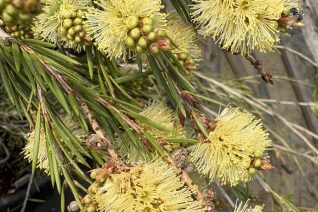
Callistemon (Melaleuca) pityoides ‘Corvallis’
I found this Callistemon in a garden in Corvallis, OR over 20 years ago. For the previous 30 years it had thrived through the coldest (0ºF or -18ºc) winters. Upright growing fine textured evergreen shrub to 6′ tall and 3′ wide in 7 years. 2″ pale yellow fluffy brushes appear in late spring/summer and again in early autumn. Full sun, average soil – especially good in clay soils and regular summer water- though it can live on no supplemental water in summer irrigation improves fall bloom. Completely deer resistant. Perfectly hardy in all of Western Oregon. Long lived shrub that tolerates heavy snow and ice. Easy shrub. Moderately fast growing. Excellent performance on the Oregon coast. Prune if needed after bloom has ended. Excellent companion shrubs are Ceanothus x ‘Topaz’ and Myrtus communis ‘Andy’s Hardy’ which bloom simultaneously,
Xera Plants Introduction.