
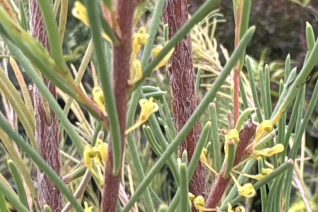

We love cold hardy plants in the Protea family, not only do they have exotic flowers, they can sport foliage that is just as interesting , Hakea nodosa is another shrubby Hakea that is known as yellow Hakea. Multiple fine stems emerge from the ground and are staunchly vertical. They have few side branches and each stem is clad in slightly swollen blue phyllodes, these are not prickly and are about 1 cm long. In spring, very small yellow flowers crowd the leaf axils on older wood.- not conspicuous but hummingbirds find them. An upright small shrub to about 6′ tall and 2′ wide. Pollinated flowers produce large seed pods that can cause the stems to nod, not sure if this is what the specific name refers to. Moderately fast growing in native, un-amended soil that drains, including clay soils that dry in summer. Water to establish then extremely tolerant of drought. A wonderful textural evergreen that we love at Xera. An excellent companion to Grevilleas, Ceanothus, Halimium, Arctostaphylos.. Fulll sun to very very light shade. This form has been cold hardy below 10ºF in western Oregon with a probable lowest temperature around 5ºF. Native to areas of South Australia into Tasmania. Ours are grown from high elevation, cold hardy seed from Tasmania. Lovely soft, rare shrub . Pronounced HAY- kee -uh. But with an Australian accent. Well adapted to the Oregon coast and can be cultivated on sand. Deer resistant, but protect newly installed plants from rabbits. Very easy to grow, a natural with ornamental grasses and large hardy succulents, Cactus, Agaves. Not prickly but rather soft.
Genus: Hakea

Hakea microcarpa
Alpine needlebush is an unusual tree/shrub from cold high elevation areas of Australia into Tasmania with spiky modified phyllodes as leaves. The spiky leaves are blue green and it forms an airy conifer like large plant very quickly. In spring flossy white flowers crowd the blue green leaf axils and are showy for several weeks. Full sun and average to poor well drained soil. Little summer water once established. Fast growing in youth to its ultimate size. Cold hardy for us to 5ºF but avoid exposure to subfreezing winds. Proteaceous- do not fertilize or even add compost. Un amended native soils are ideal. Very attractive to birds who will use the leaves as perches. Humming birds love this plant in bloom as well. To 9′ tall and 6′ wide in 6 years. Great on slopes. Casts no shade- great textural element year round. High deer resistance. Very unusual plant- out of the ordinary and cool. Pronounced HAY-kee-uh.

Hakea epiglottis
Beaked Hakea. Out of this world wiry shrub from Tasmania that forms nearly a tree with modified stems that serve as leaves. Fast growing see through plant that casts no shade for full sun and average to poor well drained soil. Proteaceous- avoid fertilizers and compost. Completely drought adapted needing no supplemental water once established. Water regularly until new growth commences . Forms a large piece of architecture. In early spring tiny sulphur yellow flowers crowd the leaf axils and emit a sweet clove fragrance. Very easy to grow. Cold hardy to 5ºF but avoid blasting subfreezing winds from the gorge. Completely deer resistant. Very inviting to small birds who will swarm the shrub to find protection in its wiry center- Bush tits adore this shrub To 8′ x 6′ in 5 years. Specimen, unusual hedgerow. Excellent cut material for groovy bouquets. Very fun to grow. Pronounced HAY-kee-uh.