
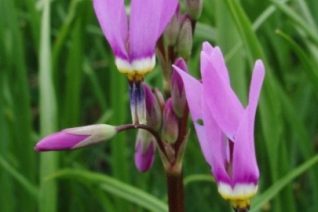
This is the second and less common shooting star native in the Willamette Valley locally into the Gorge, its more common to the north. AKA Alaska shooting star it has several important differences. The flower structure and petal color are very similar to Dodecatheon hendersonii foothill shooting star but they are closer to pink than purple and the color gets darker at the base of the petal. The face of the flower is white and yellow with a bright orange filament around the center. And the leaves are large and distinctively long. As for culture this species is endemic to rich soils that retain moisture in the moist parts of meadows in full sun to very light shade Near Eugene where i grew up this was the wet loving shooting star that you could find along moist stream banks. The more common D. hendersonii is almost exclusively an upland perennial. Loved by early pollinators when the striking flowers appear April-June. To 18″ tall in bloom. The whole plant retreats into dormancy with hot weather- it disappears. This more moisture tolerant species is easier to cultivate with more traditional perennials. In habitat its close friends are Camassia quamash maxima and Camassia l. suksdorfii, Plagiobothyrs figuratus , Mitella oregana and Delphinium trollifolium. Excellent perennial for a rain garden. Nice cut flower too. Oregon native plant.
Genus: Dodecatheon

Dodecatheon hendersonii
Henderson’s shooting star or more appropriately foothill shooting star. Thats where you see them in meadows and glens usually underneath or near Oregon white oaks. Common composition of the flora seen with this plant are giant baby blue eyes Nemophila m. ‘atomaria’., Ranunculus occidentalis – western buttercup as well as Lithophragma- Prairie Stars. Rubbery near round leaves emerge in mid winter and persist as rosettes for months until real heat pushes them into sleep. The charming flowers rise up to 14″ on tall straight stems. The nodding flowers gives away its familial association with Cyclamen and Primrose and reflexed magenta purple petals shoot straight up. The interior of the flower is a spike decorated like a single cake with a red brick a brack design if you look closely. Great cut flower and where ever you throw the spent flowers they will still ripen and set seed and quickly a new patch will be created. Full sun to part shade in clay soils that dry in summer. No water once established. They quickly go dormant and disappear to escape summer heat and dry. Relatively easy native wildflower to grow. Deer resistant. Native from northern California north to SW British Columbia. Found throughout the western half of the state. This wildflower made extensive colonies around my childhood home near Eugene. It always bloomed around my birthday and over the years I built up huge colonies. It was so charming with Erythronium oreganum- Oregon fawn lily- they grew side by side. In our ‘backyard’ there were huge colonies of native Dodecatheon. I would pick bouquets of them from the backyard and when the flowers were spent I would chuck them off the front deck into the woods. Over time I realized they were still setting viable seed as we had a huge population in the front in a few years, . Blooms late March to early May. Oregon native plant.