

Tree heathers fascinate us and this widespread species of southern to northwestern Europe makes a fantastic, drought adapted garden plant. Fine needle like green foliage lines strongly vertical growth. In mid summer the tips of the stems produce many urn shaped pale pink blossoms that are showy for up to 6 weeks. Following the bloom period these remain on the shrub and turn a russet color adding to its charm. To 3′ x 3′ in 4 years. Full sun and well drained average soil with light summer water to establish. Once you have it going it requires no supplemental water. Great for dry areas, gravel borders, hellstrips. Excellent fine textured shrub that develops a shredded gnarled brown trunk with time. Moderate deer resistance. Gains drought adaptation with age. As with most ericaceous plants it must build up a large root system over time and then it is drought adapted and will sail through the driest summers without fainting.
Family: Ericaceae

Gaultheria shallon
Salal. An iconic native shrub that occupies the understory of the forests from the coast to the Cascades- in the Willamette Valley its restricted to the shadiest, mesic environs. A mounding evergreen that forms large colonies in time. Ranges in height from 2′ to 6′ depending upon its situation. Spread is indefinite when happy. In spring chains of white urn shaped flowers transform into edible berries. Very handsome foliage is used as long lasting cut material and is sometimes marketed as ‘lemon leaf’. Can be tricky to establish. Shade to part shade is best in rich, humus rich soil with regular water. To establish water, water, water. And apply a liberal deep mulch. Avoid hot sun and compacted dry soils. Once it gets going, its yours forever. Occurs naturally in mesic/shady environs around Portland. Mulch annually to accumulate a layer of organic material that this spreading shrub craves. Oregon native plant.

Pieris japonica ‘Cavatine’
This is a very pretty and very useful plant that is tough as nails when established. To just 3′ tall by as wide in 10 years. In late winter the whole shrub is a garland of white urn shaped flowers on fine filaments. Bloom begins in February and remains effective for months. Medium green evergreen foliage with great year round appearance. Fits in small places in full sun to quite a bit of shade. Regular water to establish then light water to eventually none on well established shrubs. Rich soil with high organice/wood content that is acidic. Very easy to grow in our climate and one of the best Pieris. Flowers buds are set the previous summer and are attractive for months until they open. New growth is tinted red. Very cold hardy enduring subfreezing wind and temperatures below 0ºF. Not bothered by deer- for the most part. Wonderful small hedge or specimen. Long lived.

Pieris japonica ‘Little Heath’
One of the best variegated Pieris on the market. This plant was brought to the U.S. by Gossler Farms in Springfield, Oregon and has gained great popularity. In our experience the ‘little’ refers not to the overall size of the plant- which is eventually large 5′ x 5′- but to the smaller size of the leaves. And each leaf is outlined in white with a darker green center. In full sun this shrub sets tons of chains of pink buds which open to white flowers in Feb/March. The overall fine texture combined with the white variegation gives this plant a very graceful mein. New growth emerges salmon and ages to light yellow before its final destination of green and white. Occasionally shows all green reversions. Simply cut these away. Full sun to quite a bit of shade in rich to average well drained soil. Grows more quickly with regular summer irrigation but established plants sail through summer with a minimum. Very hardy to cold- and tolerates subfreezing wind well.

Vaccinium ovatum
Evergreen huckleberry is a fantastic native broadleaf shrub. It is well adapted to shady sites and will accept full sun with regular irrigation. Well established shrubs require less water. Rich, humusy woodland soil is its favorite haunt and it will grow moderately fast to a rounded outline of 8′ tall and 6′ wide. The new growth is a beautiful salmon pink before changing to deep green. In spring and early summer small white urn shaped flowers are pretty and transform into tasty black fruits in autumn. Amazing in muffins, pies.It has an interesting natural distribution along the immediate coast in most of Oregon but veering inland at Douglas County to almost the Cascade foothills. In Puget Sound it seems to be most prominent within sight of salt water. Easy to grow good garden plant. Increase your chance of pollination by planting more than two shrubs. The theory is that berries like to party- and I’ve observed it to be true. Oregon native plant.
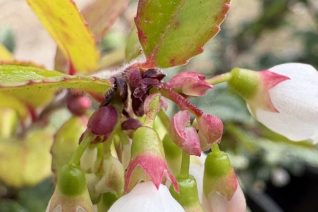

A very handsome version of one of our best native broadleaved evergreen shrubs . I spotted this form with larger leaves that are thicker and convex in the coast range of Douglas County. It gives the shrub a much more substantial appearance . The thick leaves emerge tinted salmon pink before settling to its permanent deep lusterous, dark green. To 6′ tall x 4′ wide in 6 years. Very dense habit is reminiscent of boxwood. This is a very useful and handsome form of Evergreen Huckleberry. This cutting propagated form will have a very uniform texture and habit. In late spring small pink to white urn shaped flower transform into deep black purple tasty fruits. Plant more than one shrub to increase pollination and fruit set. Rich soil high in humic content with regular water in summer. Mulch annually. Allow it to dry between watering. Plant on 3′ centers for a tidy fast hedge. Full sun to quite a bit of shade. Not bothered by deer. Almost formal appearance. Prune after flowering if needed. Oregon native plant.
Xera Plants Introduction
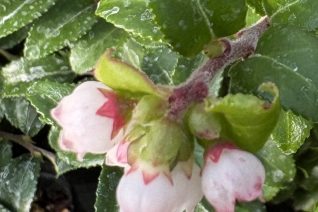
A form of evergreen Huckleberry that is found on the north and central Oregon coast. The leaves are slightly longer and curve a bit and have a fine but noticeable serration. This is a slightly bolder form that is very handsome and somewhat formal in appearance from the species. Forms a shrub with large canes that grow in earnest and then arch.. White flowers are slightly larger than normal and appear in spring form slightly larger than normal black sweet fruit, about the size of a caper. Plant more than one shrub to increase pollination and fruit set. Full sun to full shade in humus rich, highly organic soil . Mulch for the first several years. Irrigate to establish for the first year or two then it should have a large enough rootball to resist summer drought. Otherwise light summer irrigation speeds growth. New growth is salmon orange and turns to shades of yellow before settling to dark green. Very pretty native shrub that demands more irrigation and mulch in full sun. Makes a wonderful informal hedge in time. This form has a pronounced arching shape. Excellent hedge material as this is cutting propagated and will maintain a uniform habit. Wonderful form from the northern Oregon coast. To 8′ x 8′ in 10 years. Prune if needed in Autumn. Oregon native plant.
Xera Plants Introduction
- « Previous Page
- 1
- …
- 4
- 5
- 6