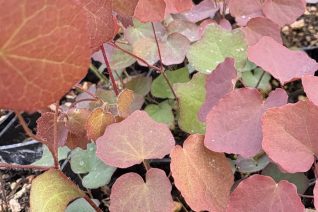
I found this remarkable form of our native Inside Out flower in southern Oregon,  I wiggled off a tiny piece and put it in my pocket, the parent plant was unharmed.  Its taken years but we are ready to offer this beautiful form of our native Vancouveria hexandra with new foliage that is deep wine colored and then matures to green with a red edge. In early summer this spreading perennial sports upside down white flowers on 4″ to 6″ above the foliage. A spreading ground cover that shows remarkable tolerance to drought once established.  Amend the soil  with compost and mulch, water consistently for the first year or two. Let the soil dry between watering. Leaves rise 6″ and forms spreading colonies.  Winter deciduous, it disappears completely – all the better to showcase the deep burgundy new growth. Fall color is yellow and brief and the plant remains decompose over winter.  Not the first plant to be devoured by deer/ rabbits but I would protect for the first few years.  Deep burgundy foliage remains showy before morphing to deep green  with a red edge. This is a member of the Barberry family (Berberidaceae) and is related to Epimedium and has the same applications. Combine with gold leaved perennials for the most contrast and drama. Hakenochloa macra ‘All Gold’ , ‘Campanula garganica ‘Dicksons Gold’, and Golden baby tears , Soleirolia soleirolii ‘Aurea’ . Very good in containers as well. Spice up a native garden. This perennial makes a great cover for native bulbs –  Brodiaea  and Fritillaria lanceolata, Calochortus tolmei,- are excellent companions, fading just as the Vancouveria  is emerging and bulking up. Enriched soil, regular water to establish, this dweller of the forest floor appreciates an annual mulch.  Oregon native plant 

Xera Plants Introduction
My Favorites

Plant type: ,  |  Sun exposure: ,
Biome: , , , ,  |  USDA Hardiness zone: Zn6a -5º to -10ºF
Foliage color: ,  |  Foliage season:


Viburnum ellipticum

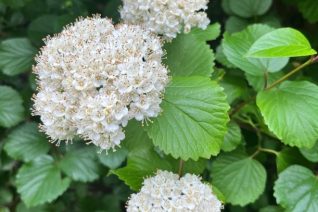
Oregon Viburnum or Western Way Faring tree is a moderate to large native deciduous shrub. It stretches a little bit into W. Washington where it is rare but its primary populations are in western Oregon and south into N. California. Its found in moist to dry woods often on the margin where its can get at least half a day sun. It also thrives only much larger and lankier in outline in the shade. It easily tolerates winter inundation but is found on well developed soils in upland situations as well. Its common associates in the wild are Oregon white oak/Quercus garryana, Oregon Ash/Fraxinus latifolius, Cornus stolonifera. Leaves are round, glossy and scalloped and are very handsome on a well proportioned fountain shaped shrub. Shorter in full sun, taller in shade. This plant needs just a modicum of light watering for its first year and once it is thoroughly established you can set it free. In late spring off white cymes of flowers have the fragrance to me of raw potatoes. We had a large specimen of this shrub in our back 40 where I grew up near Eugene. In certain years it can produce quite a fall show with orange/red tinted leaves and translucent blue fruits. Blooms on wood from the previous year. Prune if needed AFTER blooming has ended. June. To 7′ tall in the sun to much taller in shade. Protect young plants from deer. Oregon native plant.

My Favorites

Plant type:  |  Sun exposure: , ,
Biome: , , , , ,  |  USDA Hardiness zone: Zn5b -10º to -15ºF
Foliage color:  |  Foliage season:


Viola praemorsa ssp. praemorsa

Canary violet or upland Violet has many subspecies in the PNW and west in general. This is our own Willamette Valley form of this intriguing handsome perennial. Large spoon shaped leaves have an underside with conspicuous hairs. The top of the leaf is glossier. In April-May bright yellow flowers appear. The bottom petal has conspicuous black whiskers. In our region this violet is local in the most undisturbed sites but it shows very good persistence in competition with non-native introduced grasses. My experience is that it favors rocky and scree sites that remain somewhat cool- for instance the north side of a steep slope. To 6″ tall and forming expanding plants. Winter deciduous. Arrives early in spring and can go summer dormant with high heat. Excellent planted in fall or winter and left to its own devices. Average to enriched soil yields the best results. This is one of the showiest violets native to the Willamette Valley. Fairly long lived. Little deer resistance. Some associated plants are Olysinium douglasii, Sedum spathulifolium, Dodecatheon hendersonii. Oregon native plant.

My Favorites

Plant type:  |  Sun exposure: ,
Biome: , , ,  |  USDA Hardiness zone: Zn5a -15º to -20ºF
Foliage color:  |  Foliage season:


Vitis californica x vinifera ‘Roger’s Red’

This wonderful grape vine was originally found along the Russian River by Roger Raiche and is absolutely stunning in autumn. This very large growing deciduous grape will eventually grow to 20′ and develop a sturdy, gnarled trunk. Grows about 3′-6′ per year. This is a wild hybrid between the European Wine grape and our native  vitis californica. What that yields is one tough plant that handles our climate like a champion. Best used in wild areas and if you are going to plant it to grow up a tree make sure the vine you start with is small and the tree you put it in is big. In September-November a long display of brilliant claret red foliage- the individual leaves can be 10″ across. Simultaneously it will sport dark purple edible fruit in large clumps. The medium green foliage is leathery and is best in part shade to full sun. Especially brilliant draping evergreen oaks as it was found in the wild. Climbs by tendrils but provide very strong support at least #4 copper wire.  Leaves arrive in mid spring. Very drought adapted when established. Water for the first season to establish then set it free. Vitis californica can be found in bot the Rogue and Umpqua river basins in Oregon.

My Favorites

Plant type: ,  |  Sun exposure: ,
Biome: , , ,  |  USDA Hardiness zone: Zn6b 0º to -5ºF
Foliage color: ,  |  Foliage season:


Whipplea modesta

Yerba de Selva or whipple vine, a wonderful small scale evergreen native ground cover. Related to Hydrangeas but this trailer is actually very droughtadapted.e In late spring clouds of small white flowers , Scrambling plant to about 8″ tall and 2′ wide. Full sun to considerable shade. From Portland south this is a common understory component of the herb field. It grew happily in our back 40 where I grew up. There it made pretty scrambling patches between Vancouveria, snow berry and hairy honeysuckle. Often you would see our native columbine ( Aquilegia formosa) as an associate. Its very drought adapted when established but it improves with a few soaks over summer- never perpetually wet and never hot and wet. Otherwise an easy native that should be grown a lot more. For use as a small scale ground cover plant on 10″ centers. It will also gracefully trail over rockeries and walls. Butterflies adore the flowers. Competes well with invasives. Some deer resistance. It may be cut back in early spring to refresh. Once native in the Portland city limits. This is a great native understory for Arctostaphylos, which is frequently seen in the wild.    Oregon native plant.

My Favorites

Plant type: ,  |  Sun exposure: , ,
Biome: , , , , ,  |  USDA Hardiness zone: Zn5b -10º to -15ºF
Foliage color:  |  Foliage season:


Woodwardia fimbriata

Our native Giant Chain Fern that occupies specific spots in seeps randomly from CA to BC. Large pendant and trailing 3′ long glossy fronds form huge rosettes. Usually occupying permanently wet seeps on shady hillsides in cool places. The entire plant may be up to 5′ across. Evergreen but it benefits greatly from some early spring tidying of spent and aging old leaves. Part shade to shade in rich well drained soil with regular consistent moisture for the best look. Highly deer resistant. We’re honored to grow this, one of our most spectacular native ferns. Oregon native plant.

My Favorites

Plant type: ,  |  Sun exposure: ,
Biome: , , ,  |  USDA Hardiness zone: Zn6a -5º to -10ºF
Foliage color:  |  Foliage season:


Wyethia angustifolia

Mules Ears are rare in cultivation. These cheery bold perennials make the transition of our wild flowers from spring into real summer. So named for its long leaves it forms very permanent spreading colonies in clay soils in habitat. The brilliant yellow sun flower blossoms rise up on sturdy stems directly from the ground. Each ebullient large flower is about 4″ across. Blooms appear from late April to early June. This plant usually finishes blooming just as summer drought commences. Its a memorable sight in wild meadows where it blooms simultaneously with native Rosa nutkana and Farewell to spring (Clarkia amoena var. lindleyi) and Giant blue eyed mary (Collinsia grandiflora). Wonderful cut flower and immediate and popular pollinator perennial. This plant was once very common in the Willamette Valley but civilization has immensely shrunk its native range. Good, long lived garden plant that goes summer dormant quickly after blooming has ended. The leaves turn gray and brittle and can easily be removed then. Give it a summer rest w/ little to no summer water once established. Full sun to very light shade. Water to establish its first season then none in subsequent years. Fun to grow and LONG lived. To 14″ in bloom forming a plant several feet across. Moderate deer resistance. Native to the Portland city limits. Very slow to finish in a salable size. Patience. Limited quantities. Oregon native plant

My Favorites

Plant type:  |  Sun exposure: ,
Biome: , , , ,  |  USDA Hardiness zone: Zn5b -10º to -15ºF
Foliage color:  |  Foliage season:


Yucca (nana) hermmaniae

Adorable and rugged little dwarf Yucca from southern Utah. Tight round quills are decorated with filaments on the leaf edges. Not a friendly guy and very slow growing. Forming spheres of spikes to 1′ across and multiplying to produce colonies with pups. Full sun and very well drained soil of  average to poor fertility. Requires excellent air circulation- no crowding. Plants that are smooshed with little air circulation protest heavily and it then takes a while for recovery. Open and free in rock garden conditions produces the happiest plants. At home nestled with boulders or as a finer texture element with Agaves. In time it produces adorable and conical shaped hoods of flowers- a gnome wedding. Excellent in containers- open, well drained containers. Light summer water during hot weather seems to speed growth. Locate away from paths. Owwie. Strongly deer and rabbit resistant.

My Favorites

Plant type:  |  Sun exposure:
Biome: , ,  |  USDA Hardiness zone: Zn5b -10º to -15ºF
Foliage color:  |  Foliage season:


Yucca rostrata

Beaked Yucca does fantastically well in our climate and is one of the Yucca species that will form a dramatic trunk. Blue thin leaves radiate out in a perfectly round orb. Slowly rises to 8′ tall in our climate. Full hot all day sun in a warm position. Very well drained soil with light summer water during the hottest stretches to encourage growth. Occasionally, with age 4′ spikes appear holding large trusses of ivory flowers. Perfectly hardy to cold, way below 0ºF. Avoid cold wet sites- to really do well it needs heat and exposure. Not prone to bacterial leaf blight that affects other Yucca species. Good air circulation. Lives happily in large containers for eons. Focal point in many of the best gardens in our region. High deer resistance. Evergreen.

My Favorites

Plant type: ,  |  Sun exposure:
Biome: , , ,  |  USDA Hardiness zone: Zn5a -15º to -20ºF
Foliage color:  |  Foliage season: