

A customer of ours from the N. Oregon Coast (Gearhart) brought us divisions of the large, green-flowered Kangaroo Paw species. It had thrived in her garden there for 20 years and formed a huge patch. She had divisions aplenty. We’ve since found that it isn’t quite hardy inland but it’s still a durable, cool, long-blooming plant. Easy container plant that you can protect if the temperature threatens to drop below 20ºF. In summer they send up 4′ spikes with their green, curiously fuzzy paw-shaped flowers. They remain in bloom for weeks. Full sun and fertile well-drained soil with regular water. Easy to divide. Multiples quickly.
Foliage Color: Dark Green

Anthyllis vulneraria var. coccinea
Kidney Vetch is a playful, short-lived perennial with shocking red flowers that come in clusters much like clover. Low, spreading plant that hugs the ground, all the better to see the piercing red flowers on this form. Seeds prolifically, and the seedlings are both easy to identify as well as move or dispatch. To 3″ tall by 18″ wide, when very happy. Loved by pollinators. Forms a vivid patch of color in the most unlikely places. Seeds germinate in autumn and bloom commences in spring. Excellent little nitrogen-fixing temporary plant for new gardens. Enriches soil in a wonderful way. Light to little summer water. Mediterranean.

Aralia californica
Elk Clover. Our native large herbaceous Aralia that forms large, tropical-looking clumps along moist places in the central southern part of the state. To 8′ tall and as wide when established in rich soil with an adequate summer moisture supply. A native plant that takes very well to cultivation. In summer 2′ long spikes reveal white orbs. Showy and a little exotic for a native as well. This is a great large scale plant for tropical effects- mix with Hardy Banana (Musa basjoo) and you have got yourself a big bold look. Black berries follow the flowers and are somewhat showy as well. Completely winter deciduous. Native to the southwest part of the state with a disjunct population in the Cascade foothills of Lane county. Oregon native plant.

Arbutus andrachne
The true strawberry tree of the Mediterranean this close relative of our Pacific Madrone is a small rounded multi-trunked tree. Evergreen long glossy foliage creates dark shade. In the spring whitish/green urn shaped flowers transform into small, edible, red berries. These are loved by birds and people too, the dried fruit is reportedly extremely heavy in antioxidants. The bark exfoliates beautifully just like our own and it peels in summer to reveal a green glossy trunk that slowly changes to rusty brown and continues to be glossy. Seed of these trees was collected outside of Jerusalem. This small tree of of the Mediterranean region circles that whole sea and even results in hybrids with Arbutus unedo. Moderately fast growing tree to 30′ in great age. Beautiful tree that is extraordinarily drought adapted. Ideal for hot sunny slopes and perfect accompaniment to Manzanitas and our own Madrone. Avoid subfreezing wind and err on the side of protected location, a west or south aspect is ideal. Water to establish the first season then none in subsequent years. Beautiful evergreen, lovely fruit, and bark. Gains cold hardiness with age. AKA Greek Strawberry tree.
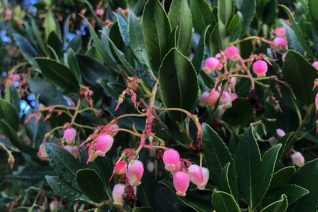
Arbutus unedo ‘Oktoberfest’
This is an exceptional form of Strawberry tree with an upright tree like habit with a dense crown and pink rather than white flowers. To 12′ tall after 8 years. The long deep green foliage is lusterous and glossy. In autumn clusters of pink urn shaped flowers appear. They form yellow, then orange, then red fruits that are showy from August to January. These can be a little messy during fruit drop- many are eaten by large birds. Loved by Anna’s hummingbirds as well as other species that are going south. Moderately fast growing. In areas exposed to gorge wind locate on a west or south facing aspect. Very easy to grow and will accept both annual summer drought as well as light consistent irrigation. Average to enriched soil, water for the first year then monitor it in subsequent years- chances are you won’t see it wilt. Wonderful hedge or hedgerow subject with a long lifespan. Full sun to very light shade. Combine with fall blooming sasanqua Camellias for a flowery fall show. Excellent performance at the Oregon coast.

Arctostaphylos ‘Greensphere’

Very cool and tough Manzanita that is a true dwarf and therefore it is slow to get to market. We anticipate having more of this dense growing, cold hardy, disease-resistant shrub. To 30″ x 30″ with great age forming a perfectly round sphere. New growth is bright red settling to blue green. Leaves are held densely on the stems. Full sun and good air circulation in average, well-drained soil. Excellent cold hardiness to near 0ºF. A natural for hellstrips or anywhere space is a premium. Pink flowers in late winter are showy and profuse. Mahogany glossy bark- in time. Very limited quantities. Probably available in autumn. Very slow growing. Limited availability- Order via email.

Arctostaphylos ‘Monica’

She’s a big girl, but so pretty and adaptable and easy to grow we love her. Soaring to 9′ tall and almost as wide the pretty, large, deep forest green foliage is particularly disease resistant. In late winter to early spring profuse clusters of pink flowers transform into russet berries (bird food). Fast growing shrub with amazing glossy mahogany stems and trunks. Full sun, well drained to average soil with no summer water. One of the most garden tolerant of the gigantic cultivars. Cold hardy to at least 5ºF. Spectacular turned into a small tree.

Arctostaphylos edmundsii ‘Big Sur’

This handsome low growing and compact Manzanita has great performance in our climate. Glossy mid-green foliage clothes a dense growing plant to 2′ x 4′. Admirable low ground cover as a massed subject but individual plants have glossy mahogany trunks that develop character with age. Masses of small light pink urn shaped flowers appear in late winter to early spring. Healthy looking at all times and not prone to black spot. Takes reflected heat well and even tolerates a light amount of shade. No water necessary once established, but it will take light water on slopes. Great small scale for small gardens. In time you can lift the plant up by pruning to reveal the small trunks. Long lived. One of the finest smaller varieties. Avoid the coldest gardens. Central CA coast.

Arctostaphylos edmundsii ‘Witches Broom’

A very compact and slow growing form of this species.. Round glossy leaves add to the the overall dome shape. In winter into spring a continual procession of whitish-pink flowers. They come in groups and decorate this small shrub evenly. To about 1′ tall by 3′ wide not very quickly. Dense and smothers weeds effectively. Grows about 3″ per year, faster in more fertile soil. Great in year round containers where its restrained growth and ability to adhere to contours makes it perfect for life on the edge. Not quite as vigorous as kinnnick kinnick and actually a better specimen than ground cover. Great in rock gardens. Little summer water when established. Nice resistance to black spot. Appreciates a warm location. Moderately deer resistant. We have yet to see it produce berries. Or they were snagged by birds before we could notice. Demure little shrub. Looks glossy and fresh year round.

Arctostaphylos hookeri ‘Wayside’

At the North Willamette Experimental Station in Wilsonville where OSU conducted a trial of scores of Arctostaphylos species and cultivars this special ground cover Manzanita has been consistently one of the best performers. Deep green pointed leaves are held perpendicular to the sun on cinnamon red stems. In time it forms glossy red bark that is very showy. Low and dense growing to 2′ tall and 6′ wide. Excellent bank cover or ground cover in any soil that is not amended or boggy. Profuse white flowers in spring. First rate weed suppressing plant for hellstrips, rock gardens, dry borders. Excellent appearance year round. No summer water. Take advantage of its low dense growth to cover and suppress weeds. Wonderful plant for baking hot locations. Very easy to grow.
- « Previous Page
- 1
- 2
- 3
- 4
- …
- 37
- Next Page »